

ASTM F567-23
(Practice)Standard Practice for Installation of Chain-Link Fence
General Information
- Abstract
ABSTRACT
This practice establishes the standard installation procedures for chain-link fences. It includes site preparation, post location, post setting, and terminal post bracing measures. Also included here are the detailed requirements for the top rail and tension wire, tie wires and clips, chain-link fabric, barbed wires, and gates.
SCOPE
1.1 This practice covers the installation procedure for chain-link fence.
1.2 This practice is intended primarily to guide those responsible for or concerned with the installation of chain-link fence.
1.3 This practice does not intend to preclude any practice that has proven equal to or given better performance under varying conditions, that is, location, weather, intended use, materials, etc.
1.4 The values stated in inch-pound units are to be regarded as standard. The values given in parentheses are mathematical conversions to SI units that are provided for information only and are not considered standard.
1.5 This standard does not purport to address all of the safety concerns, if any, associated with its use. It is the responsibility of the user of this standard to establish appropriate safety, health, and environmental practices and determine the applicability of regulatory limitations prior to use. For specific precautionary statements, see Section 13.
1.6 This international standard was developed in accordance with internationally recognized principles on standardization established in the Decision on Principles for the Development of International Standards, Guides and Recommendations issued by the World Trade Organization Technical Barriers to Trade (TBT) Committee.
- Status
- Published
- Publication Date
- 31-May-2023
- Technical Committee
- F14 - Fences
- Drafting Committee
- F14.40 - Chain Link Fence and Wire Accessories

Overview
ASTM F567-23: Standard Practice for Installation of Chain-Link Fence provides comprehensive procedures and guidelines for the installation of chain-link fencing. Developed by ASTM International, this standard is widely regarded in the fencing and construction industries due to its clear, methodical approach to both residential and commercial applications. The practice covers crucial aspects of fence installation, including site preparation, post location and setting, bracing, installation of chain-link fabric, tie wires and clips, top rail and tension wire attachment, as well as guidance for barbed wire and gates. This document supports professionals aiming to achieve durable, safe, and effective chain-link fence installations.
Key Topics
- Site Preparation: Proper demarcation of the fence line, identification of underground utilities, and clearing or grading the site to ensure unobstructed installation.
- Post Location and Setting: Guidelines for post spacing, setting methods based on ground or rock conditions, depth, and backfill requirements to ensure structural integrity. Includes specifications for residential, industrial, and commercial applications.
- Bracing and Rails: Directions for when and where braces and middle rails are required, securing braces and rails, and recommendations based on fence height.
- Chain-Link Fabric Installation: Best practices for fabric placement, joining rolls, securing at posts and rails, tensioning, and height clearances above grade for a secure, neat finish.
- Tie Wires and Clips: Types of fasteners and detailed installation techniques to ensure safety and reliability, especially important in pedestrian areas and public facilities.
- Barbed Wire and Gates: Procedures for installing and tensioning barbed wire, proper gate alignment, clearance, and obstruction consideration for smooth operation.
- Safety and Appearance: Recommendations for safe installation practices in compliance with applicable regulations and leaving the site clean post-installation.
Applications
The ASTM F567-23 standard is essential for professionals tasked with installing chain-link fencing across various industries. Its guidance applies to:
- Residential Fencing: Ensuring property security, safe play areas, and boundary definition.
- Commercial and Industrial Sites: Securing perimeters, managing access control, and minimizing risks in high-traffic or restricted areas.
- Recreational Facilities: Enclosing parks, sports fields, and playgrounds with emphasis on pedestrian safety and durability.
- Public Infrastructure: Roads, utilities, and government properties requiring uniform, code-compliant fencing solutions.
- Temporary or Permanent Installations: Suitable for both short-term and long-standing fence projects, adaptable to a range of site conditions and environments.
Related Standards
ASTM F567-23 references several complementary standards to ensure a holistic approach to chain-link fence installation:
- ASTM F626: Specification for Fence Fittings - defines quality and compatibility of fence hardware.
- ASTM F654: Specification for Residential Chain Link Fence Gates - sets requirements for gate materials and dimensions in residential settings.
- ASTM F900: Specification for Industrial and Commercial Steel Swing Gates - covers robust gate solutions for non-residential applications.
- ASTM F1184: Specification for Industrial and Commercial Horizontal Slide Gates - details sliding gate design and installation for high-security needs.
Adhering to ASTM F567-23 improves consistency, longevity, and safety of chain-link fencing projects. Utilize this standard to achieve results that meet industry best practices and comply with internationally recognized construction principles.
Relations
- Effective Date
- 01-Apr-2014
- Effective Date
- 01-Mar-2013
- Effective Date
- 01-Jul-2012
- Effective Date
- 01-Dec-2011
- Refers
ASTM F1184-05(2010) - Standard Specification for Industrial and Commercial Horizontal Slide Gates - Effective Date
- 01-Jul-2010
- Effective Date
- 01-Jun-2008
- Effective Date
- 01-Jul-2007
- Effective Date
- 01-Jul-2005
- Effective Date
- 01-Jul-2005
- Effective Date
- 10-Jan-2003
- Effective Date
- 10-Jan-2003
- Effective Date
- 10-Jan-2003
- Effective Date
- 10-Jan-2003
- Effective Date
- 01-Jan-2000
- Refers
ASTM F1184-94(2000) - Standard Specification for Industrial and Commercial Horizontal Slide Gates - Effective Date
- 01-Jan-2000
Get Certified
Connect with accredited certification bodies for this standard

DIBt (Deutsches Institut für Bautechnik)
German Institute for Building Technology.
DIN CERTCO
DIN Group product certification.

Aboma Certification B.V.
Specialized in construction, metal, and transport sectors.
Sponsored listings
Frequently Asked Questions
ASTM F567-23 is a standard published by ASTM International. Its full title is "Standard Practice for Installation of Chain-Link Fence". This standard covers: ABSTRACT This practice establishes the standard installation procedures for chain-link fences. It includes site preparation, post location, post setting, and terminal post bracing measures. Also included here are the detailed requirements for the top rail and tension wire, tie wires and clips, chain-link fabric, barbed wires, and gates. SCOPE 1.1 This practice covers the installation procedure for chain-link fence. 1.2 This practice is intended primarily to guide those responsible for or concerned with the installation of chain-link fence. 1.3 This practice does not intend to preclude any practice that has proven equal to or given better performance under varying conditions, that is, location, weather, intended use, materials, etc. 1.4 The values stated in inch-pound units are to be regarded as standard. The values given in parentheses are mathematical conversions to SI units that are provided for information only and are not considered standard. 1.5 This standard does not purport to address all of the safety concerns, if any, associated with its use. It is the responsibility of the user of this standard to establish appropriate safety, health, and environmental practices and determine the applicability of regulatory limitations prior to use. For specific precautionary statements, see Section 13. 1.6 This international standard was developed in accordance with internationally recognized principles on standardization established in the Decision on Principles for the Development of International Standards, Guides and Recommendations issued by the World Trade Organization Technical Barriers to Trade (TBT) Committee.
ABSTRACT This practice establishes the standard installation procedures for chain-link fences. It includes site preparation, post location, post setting, and terminal post bracing measures. Also included here are the detailed requirements for the top rail and tension wire, tie wires and clips, chain-link fabric, barbed wires, and gates. SCOPE 1.1 This practice covers the installation procedure for chain-link fence. 1.2 This practice is intended primarily to guide those responsible for or concerned with the installation of chain-link fence. 1.3 This practice does not intend to preclude any practice that has proven equal to or given better performance under varying conditions, that is, location, weather, intended use, materials, etc. 1.4 The values stated in inch-pound units are to be regarded as standard. The values given in parentheses are mathematical conversions to SI units that are provided for information only and are not considered standard. 1.5 This standard does not purport to address all of the safety concerns, if any, associated with its use. It is the responsibility of the user of this standard to establish appropriate safety, health, and environmental practices and determine the applicability of regulatory limitations prior to use. For specific precautionary statements, see Section 13. 1.6 This international standard was developed in accordance with internationally recognized principles on standardization established in the Decision on Principles for the Development of International Standards, Guides and Recommendations issued by the World Trade Organization Technical Barriers to Trade (TBT) Committee.
ASTM F567-23 is classified under the following ICS (International Classification for Standards) categories: 91.090 - External structures. The ICS classification helps identify the subject area and facilitates finding related standards.
ASTM F567-23 has the following relationships with other standards: It is inter standard links to ASTM F626-14, ASTM F626-08(2013), ASTM F654-07(2012), ASTM F900-11, ASTM F1184-05(2010), ASTM F626-08, ASTM F654-07, ASTM F900-05, ASTM F1184-05, ASTM F654-03, ASTM F1184-03, ASTM F626-96a(2003), ASTM F900-03, ASTM F900-94(2000), ASTM F1184-94(2000). Understanding these relationships helps ensure you are using the most current and applicable version of the standard.
ASTM F567-23 is available in PDF format for immediate download after purchase. The document can be added to your cart and obtained through the secure checkout process. Digital delivery ensures instant access to the complete standard document.
Standards Content (Sample)
This international standard was developed in accordance with internationally recognized principles on standardization established in the Decision on Principles for the
Development of International Standards, Guides and Recommendations issued by the World Trade Organization Technical Barriers to Trade (TBT) Committee.
Designation: F567 − 23
Standard Practice for
Installation of Chain-Link Fence
This standard is issued under the fixed designation F567; the number immediately following the designation indicates the year of original
adoption or, in the case of revision, the year of last revision. A number in parentheses indicates the year of last reapproval. A superscript
epsilon (´) indicates an editorial change since the last revision or reapproval.
1. Scope F1184 Specification for Industrial and Commercial Horizon-
tal Slide Gates
1.1 This practice covers the installation procedure for chain-
link fence.
3. Site Preparation
1.2 This practice is intended primarily to guide those
3.1 The purchaser shall indicate the location of fence lines,
responsible for or concerned with the installation of chain-link
gates, and terminal posts with suitable stakes. Stake intervals
fence.
shall not exceed 500 ft (152.5 m) or line of sight.
1.3 This practice does not intend to preclude any practice
3.2 All underground utility locations, USC&G benchmarks,
that has proven equal to or given better performance under
property monuments, and other underground structures shall be
varying conditions, that is, location, weather, intended use,
indicated by the purchaser.
materials, etc.
3.3 Before installing chain-link fence, all necessary site
1.4 The values stated in inch-pound units are to be regarded
clearing and grading shall be performed by the purchaser.
as standard. The values given in parentheses are mathematical
Adequate clearance on both sides of the fence line is required.
conversions to SI units that are provided for information only
and are not considered standard.
4. Post Location
1.5 This standard does not purport to address all of the
4.1 Space line posts equidistant at intervals not exceeding
safety concerns, if any, associated with its use. It is the
10 ft (3.05 m). Measure the interval parallel to the grade of the
responsibility of the user of this standard to establish appro-
proposed fence and in the line of fence from center to center of
priate safety, health, and environmental practices and deter-
the post.
mine the applicability of regulatory limitations prior to use.
4.2 Set terminal posts (end, corner, and gate) at the begin-
For specific precautionary statements, see Section 13.
ning and end of each continuous length of fence and at abrupt
1.6 This international standard was developed in accor-
changes in vertical and horizontal alignments.
dance with internationally recognized principles on standard-
ization established in the Decision on Principles for the
5. Post Setting
Development of International Standards, Guides and Recom-
mendations issued by the World Trade Organization Technical 5.1 Set posts in concrete in holes of diameter and depth as
Barriers to Trade (TBT) Committee. follows. Intended use and local conditions shall determine post
footing dimensions; that is, under normal conditions the
2. Referenced Documents
diameter shall be four times the largest cross section of the post
up to a 4 in. (101.5 mm) outside diameter and three times for
2.1 ASTM Standards:
larger outside diameters. The depth shall be a minimum of
F626 Specification for Fence Fittings
24 in. (609.6 mm) plus an additional 3 in. (76.2 mm) for each
F654 Specification for Residential Chain Link Fence Gates
1 ft (305 mm) increase in the fence height over 4 ft (1.22 m) to
F900 Specification for Industrial and Commercial Steel
a maximum total of 60 in. (1525 mm) for a fence height up to
Swing Gates
20 ft (6.10 m).
5.2 Dig or drill holes in the line of the fence in accordance
This practice is under the jurisdiction of ASTM Committee F14 on Fences and
with 5.1. Forms are not necessary.
is the direct responsibility of Subcommittee F14.40 on Chain Link Fence and Wire
Accessories.
5.3 Set posts in a vertical position, plumb and in line.
Current edition approved June 1, 2023. Published June 2023. Originally
Backfill concrete (2500 psi) (17.2 MPa) into the excavation
approved in 1978. Last previous edition approved in 2019 as F567 – 14a (2019).
DOI: 10.1520/F0567-23.
and extend 2 in. (50 mm) above grade. An alternative method
For referenced ASTM standards, visit the ASTM website, www.astm.org, or
is to stop footing 6 in. (152.4 mm) below grade to allow for
contact ASTM Customer Service at service@astm.org. For Annual Book of ASTM
cover with sod, black top, or other materials if the footings are
Standards volume information, refer to the standard’s Document Summary page on
the ASTM website. not in an area subject to cathodic protection. In either case,
Copyright © ASTM International, 100 Barr Harbor Drive, PO Box C700, West Conshohocken, PA 19428-2959. United States
F567 − 23
crown the concrete at its top to shed water and slope a when specified. Braces are required on all terminals regardless
minimum of 2 in. (50.8 mm) away from the post. When setting of height, on fences installed without a top rail.
a post in concrete the post end may be suspended above the
6.2 Securely fasten diagonal braces to the terminal post and
bottom of the hole by using mechanical means of support,
the adjacent line post or its footing or a footing of equal size.
gravel or concrete with slump sufficient to support the post.
There shall be no more than a 50° angle between the brace and
5.4 The use of mechanical devices for the setting of fence the ground. Securely fasten horizontal braces with truss rods to
posts is acceptable under this practice, provided the mechanical the adjacent line post and terminal posts.
strength in the ground is equal or superior to the strength
6.3 When the top rail is used, attach the brace at the halfway
developed by the concrete footing as recommended.
point of the terminal post above grade and, when the top rail is
5.5 When solid rock or concrete is encountered, without an omitted, at the two-thirds point above grade.
overburden of soil, set posts in the solid rock or concrete. The
7. Top Rail and Tension Wire
depth of the hole shall be three times the largest cross section
of the posts. The diameter of the hole shall be ⁄2 in. (13 mm)
7.1 Support the top rail at each post so that a continuous
greater than the largest cross section of the post.
brace from end to end of each stretch of fence is formed.
Securely fasten the top rail to the terminal posts and join with
5.6 The use of sleeves in order to leave voids in new
sleeves or coupling to allow for expansion and contraction.
concrete construction is recommended.
7.2 When the top rail is omitted, stretch a tension wire from
5.7 Half-fill the void with nonshrinkable hydraulic cement
end to end of each stretch of fence at a height that will enable
and force post to the bottom of the hole and plumb. Thoroughly
it to be fastened to the fabric within the top 1 ft (305 mm) of
work additional grout into the hole so as to leave no voids.
the chain-link fabric. If specified, fasten the bottom tension
Crown the grout to shed water.
wire within the bottom 6 in. (150 mm) of fabric. Securely
5.8 Drive posts are to be driven by mechanical means to a
fasten the tension wire to the terminal posts. The tension wire
minimum depth of 36 in. (914.4 mm) or 6 in. (152.4 mm)
shall be taut and free of sag.
greater than that called for in 5.1, for the height of fence.
8. Tie Wires and Clips
5.9 Where soil conditions are unstable or rock is
encountered, the drive post embedment must be altered to
8.1 Standard straight, preformed hook or pigtail round wire
maintain stability. The depth should be in keeping with
ties, preformed power-fastened wire ties, interlocking flat
standard fence construction practices for the local area or refer
aluminum band ties, and powder-driven fasteners for attaching
to 5.5.
chain link fabric to round tubular or rectangular roll-formed
rails and intermediate posts shall be as specified in Specifica-
5.10 The post tops must be protected to prevent distortion of
tion F626.
the exposed end. The use of a drive cap is recommended.
8.2 Irrespective of the type of fastener utilized, it is critical
5.11 Residential Swing Gate Posts:
to the integrity of the fence system to assure that they are
5.11.1 See Table 1.
installed properly.
5.12 Industrial and Commercial Swing Gate Posts:
8.2.1 Consumer Safety—For fence applications where pe-
5.12.1 See Table 2.
destrians may be in contact with the fence, such as play areas,
5.13 Cantilever Slide Gate Posts (Specification F1184, Type
sports fields, play courts, and swimming pools, wire ties shall
II)—Refer to Specification F1184, Type II Cantilever Slide
be trimmed and bent in such a manner as to avoid injury to
Gates, for post setting requirements.
pedestrians in contact with the fence.
5.14 Overhead Slide Gate Posts (Specifi
...
This document is not an ASTM standard and is intended only to provide the user of an ASTM standard an indication of what changes have been made to the previous version. Because
it may not be technically possible to adequately depict all changes accurately, ASTM recommends that users consult prior editions as appropriate. In all cases only the current version
of the standard as published by ASTM is to be considered the official document.
Designation: F567 − 14a (Reapproved 2019) F567 − 23
Standard Practice for
Installation of Chain-Link Fence
This standard is issued under the fixed designation F567; the number immediately following the designation indicates the year of original
adoption or, in the case of revision, the year of last revision. A number in parentheses indicates the year of last reapproval. A superscript
epsilon (´) indicates an editorial change since the last revision or reapproval.
1. Scope
1.1 This practice covers the installation procedure for chain-link fence.
1.2 This practice is intended primarily to guide those responsible for or concerned with the installation of chain-link fence.
1.3 This practice does not intend to preclude any practice that has proven equal to or given better performance under varying
conditions, that is, location, weather, intended use, materials, etc.
1.4 The values stated in inch-pound units are to be regarded as standard. The values given in parentheses are mathematical
conversions to SI units that are provided for information only and are not considered standard.
1.5 This standard does not purport to address all of the safety concerns, if any, associated with its use. It is the responsibility
of the user of this standard to establish appropriate safety, health, and environmental practices and determine the applicability of
regulatory limitations prior to use. For specific precautionary statements, see Section 13.
1.6 This international standard was developed in accordance with internationally recognized principles on standardization
established in the Decision on Principles for the Development of International Standards, Guides and Recommendations issued
by the World Trade Organization Technical Barriers to Trade (TBT) Committee.
2. Referenced Documents
2.1 ASTM Standards:
F626 Specification for Fence Fittings
F654 Specification for Residential Chain Link Fence Gates
F900 Specification for Industrial and Commercial Steel Swing Gates
F1184 Specification for Industrial and Commercial Horizontal Slide Gates
3. Site Preparation
3.1 The purchaser shall indicate the location of fence lines, gates, and terminal posts with suitable stakes. Stake intervals shall not
exceed 500 ft (152.5 m) or line of sight.
3.2 All underground utility locations, USC&G benchmarks, property monuments, and other underground structures shall be
indicated by the purchaser.
This practice is under the jurisdiction of ASTM Committee F14 on Fences and is the direct responsibility of Subcommittee F14.40 on Chain Link Fence and Wire
Accessories.
Current edition approved May 1, 2019June 1, 2023. Published June 2019June 2023. Originally approved in 1978. Last previous edition approved in 20142019 as
F567 – 14a.F567 – 14a (2019). DOI: 10.1520/F0567-14AR19.10.1520/F0567-23.
For referenced ASTM standards, visit the ASTM website, www.astm.org, or contact ASTM Customer Service at service@astm.org. For Annual Book of ASTM Standards
volume information, refer to the standard’s Document Summary page on the ASTM website.
Copyright © ASTM International, 100 Barr Harbor Drive, PO Box C700, West Conshohocken, PA 19428-2959. United States
F567 − 23
3.3 Before installing chain-link fence, all necessary site clearing and grading shall be performed by the purchaser. Adequate
clearance on both sides of the fence line is required.
4. Post Location
4.1 Space line posts equidistant at intervals not exceeding 10 ft (3.05 m). Measure the interval parallel to the grade of the proposed
fence and in the line of fence from center to center of the post.
4.2 Set terminal posts (end, corner, and gate) at the beginning and end of each continuous length of fence and at abrupt changes
in vertical and horizontal alignments.
5. Post Setting
5.1 Set posts in concrete in holes of diameter and depth as follows. Intended use and local conditions shall determine post footing
dimensions; that is, under normal conditions the diameter shall be four times the largest cross section of the post up to a 4 in. (101.5
mm) outside diameter and three times for larger outside diameters. The depth shall be a minimum of 24 in. (609.6 mm) plus an
additional 3 in. (76.2 mm) for each 1 ft (305 mm) increase in the fence height over 4 ft (1.22 m) to a maximum total of 60 in.
(1525 mm) for a fence height up to 20 ft.20 ft (6.10 m).
5.2 Dig or drill holes in the line of the fence in accordance with 5.1. Forms are not necessary.
5.3 Set posts in a vertical position, plumb and in line. Backfill concrete (2500 psi) (17.2 MPa) into the excavation and extend 2
in. (50 mm) above grade. An alternative method is to stop footing 6 in. (152.4 mm) below grade to allow for cover with sod, black
top, or other materials if the footings are not in an area subject to cathodic protection. In either case, crown the concrete at its top
to shed water and slope a minimum of 2 in. (50.8 mm) away from the post. When setting a post in concrete the post end may be
suspended above the bottom of the hole by using mechanical means of support, gravel or concrete with slump sufficient to support
the post.
5.4 The use of mechanical devices for the setting of fence posts is acceptable under this practice, provided the mechanical strength
in the ground is equal or superior to the strength developed by the concrete footing as recommended.
5.5 When solid rock or concrete is encountered, without an overburden of soil, set posts in the solid rock or concrete. The depth
of the hole shall be three times the largest cross section of the posts. The diameter of the hole shall be ⁄2 in. (13 mm) greater than
the largest cross section of the post.
5.6 The use of sleeves in order to leave voids in new concrete construction is recommended.
5.7 Half-fill the void with nonshrinkable hydraulic cement and force post to the bottom of the hole and plumb. Thoroughly work
additional grout into the hole so as to leave no voids. Crown the grout to shed water.
5.8 Drive posts are to be driven by mechanical means to a minimum depth of 36 in. (914.4 mm) or 6 in. (152.4 mm) greater than
that called for in 5.1, for the height of fence.
5.9 Where soil conditions are unstable or rock is encountered, the drive post embedment must be altered to maintain stability. The
depth should be in keeping with standard fence construction practices for the local area or refer to 5.5.
5.10 The post tops must be protected to prevent distortion of the exposed end. The use of a drive cap is recommended.
5.11 Residential Swing Gate Posts:
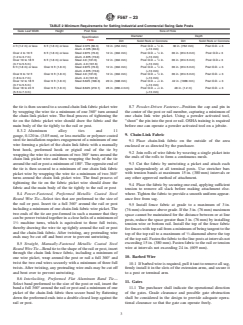
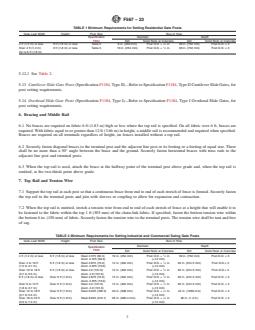
5.11.1 See Table 1.
5.12 Industrial and Commercial Swing Gate Posts:
F567 − 23
TABLE 1 Minimum Requirements for Setting Residential Gate Posts
Gate Leaf Width Height Post Size Size of Hole
Specification Diameter Depth
F654 Dirt Solid Rock or Concrete Dirt Solid Rock or Concrete
4 ft (1.2 m) or less 6 ft (1.8 m) or less Table 2 8 in. (203 mm) Post O.D. + ⁄2 in. 30 in. (762 mm) Post O.D. × 3
Over 4 ft (1.2 m) 6 ft (1.8 m) or less Table 3 10 in. (254 mm) Post O.D. + ⁄2 in. 30 in. (762 mm) Post O.D. × 3
Up to 6 ft (1.8 m)
5.12.1 See Table 2.
5.13 Cantilever Slide Gate Posts (Specification F1184, Type II)—Refer to Specification F1184, Type II Cantilever Slide Gates, for
post setting requirements.
5.14 Overhead Slide Gate Posts (Specification F1184, Type I)—Refer to Specification F1184, Type I Overhead Slide Gates, for
post setting requirements.
6. Bracing and Middle Rail
6.1 No braces are required on fabric 6 ft (1.83 m) high or less where the top rail is specified. On all fabric over 6 ft, braces are
required. With fabric equal to or greater than 12 ft (3.66 m) in height, a middle rail is recommended and required when specified.
Braces are required on all terminals regardless of height, on fences installed without a top rail.
6.2 Securely fasten diagonal braces to the terminal post and the adjacent line post or its footing or a footing of equal size. There
shall be no more than a 50° angle between the brace and the ground. Securely fasten horizontal braces with truss rods to the
adjacent line post and terminal posts.
6.3 When the top rail is used, attach the brace at the halfway point of the terminal post above grade and, when the top rail is
omitted, at the two-thirds point above grade.
7. Top Rail and Tension Wire
7.1 Support the top rail at each post so that a continuous brace from end to end of each stretch of fence is formed. Securely fasten
the top rail to the terminal posts and join with sleeves or coupling to allow for expansion and contraction.
7.2 When the top rail is omitted, stretch a tension wire from end to end of each stretch of fence at a height that will enable it to
be fastened to the fabric within the top 1 ft (305 mm) of the chain-link fabric.
...