

ASTM D8132/D8132M-23
(Test Method)Standard Test Method for Determination of Prepreg Impregnation by Permeability Measurement
General Information
- Abstract
SIGNIFICANCE AND USE
5.1 It is well known that the prepreg impregnation level affects handling characteristics, tack and drape, and final part quality. Resin impregnation level is the dominant factor in the ability of removing air and volatiles from the layup during processing. Partially impregnated prepreg materials can in some applications provide higher quality, lower void content composite parts, and are becoming increasingly more common due to the desire to cure out-of-autoclave, using vacuum bag-only processes. This test can identify small changes in the material impregnation level which can assist in definition of production processes or shipping and handling procedures. The value of permeability can be used for specifying ranges as acceptance requirements for prepreg materials, thus enabling the prepreg manufacturer and user greater confidence in the ability to produce repeatable and high quality parts. This test directly determines the actual air flow propensity of the material tested without any applied compaction pressure during testing.
5.2 Factors that influence the permeability of the tested prepreg material shall be reported including: prepreg material, orientation, location on roll, width, length, thickness, and actual atmospheric pressure.
SCOPE
1.1 This test method determines the in-plane permeability of composite prepreg (pre-impregnated) materials as a measure of level of impregnation. Permissible prepreg materials include those reinforced with carbon, glass, aramid, thermoplastic and other fibers impregnated with a thermoset or thermoplastic matrix resin, creating a single ply sheet material. The reinforcements may be unidirectional or woven fabrics.
1.2 The values stated in either SI units or inch-pound units are to be regarded separately as standard. The values stated in each system are not necessarily exact equivalents; therefore, to ensure conformance with the standard, each system shall be used independently of the other, and values from the two systems shall not be combined.
1.2.1 Within the text, the inch-pound units are shown in brackets.
1.3 This standard does not purport to address all of the safety concerns, if any, associated with its use. It is the responsibility of the user of this standard to establish appropriate safety, health, and environmental practices and determine the applicability of regulatory limitations prior to use.
1.4 This international standard was developed in accordance with internationally recognized principles on standardization established in the Decision on Principles for the Development of International Standards, Guides and Recommendations issued by the World Trade Organization Technical Barriers to Trade (TBT) Committee.
- Status
- Published
- Publication Date
- 31-Aug-2023
- Technical Committee
- D30 - Composite Materials
- Drafting Committee
- D30.03 - Constituent/Precursor Properties
Buy Documents
ASTM D8132/D8132M-23 - Standard Test Method for Determination of Prepreg Impregnation by Permeability Measurement
REDLINE ASTM D8132/D8132M-23 - Standard Test Method for Determination of Prepreg Impregnation by Permeability Measurement
Overview
ASTM D8132/D8132M-23 is the Standard Test Method for Determination of Prepreg Impregnation by Permeability Measurement, published by ASTM International. This method provides a standardized process for measuring the in-plane permeability of composite prepreg (pre-impregnated) materials, which include fiber reinforcements such as carbon, glass, aramid, thermoplastic, and others impregnated with thermoset or thermoplastic matrix resins. The resulting data quantifies the level of impregnation of a prepreg, which is a critical property influencing the quality, performance, and processing of composite components.
Proper prepreg impregnation is essential for handling, tack, and drape, and directly impacts the final part quality, particularly in advanced manufacturing techniques such as out-of-autoclave and vacuum bag-only processes.
Key Topics
- Prepreg Impregnation Level: The method allows manufacturers and users to quantify how thoroughly the resin has impregnated the fiber reinforcement, which affects removal of air and volatiles during processing.
- Permeability Measurement: The test measures the air flow propensity in the plane of the fiber, helping identify subtle variations in material impregnation.
- Material Scope: Covers unidirectional or woven fibers, including carbon fiber, glass fiber, aramid, and other reinforcements pre-impregnated with appropriate resins.
- Testing Procedure: No compaction pressure is applied during testing; instead, permeability is determined by the change in pressure across the sample using specialized equipment.
- Factors Influencing Permeability: The standard requires reporting details such as material type, orientation, sampling location, width, length, thickness, and testing conditions (e.g., atmospheric pressure, humidity, temperature).
- Significance for Quality Control: Enables definition of acceptance requirements for prepreg materials, supporting the production of repeatable and high-quality composite parts.
Applications
- Production Process Specification: By measuring permeability, manufacturers can set and verify impregnation criteria for prepregs, enhancing process reliability.
- Materials Acceptance and Delivery: Permeability values can be used as acceptance criteria between prepreg suppliers and end users, ensuring consistent material quality.
- Optimizing Out-of-Autoclave Processing: As demand for out-of-autoclave/vacuum bag-only cured composites grows, this standard helps engineers select prepregs with appropriate impregnation levels to minimize voids and improve part integrity.
- Material Development: Research and development teams use these test results to develop new prepreg formulations with improved permeability and performance characteristics.
- Quality Documentation: Provides standardized reporting for quality assurance, certification, and traceability in aerospace, automotive, sports equipment, and wind energy sectors.
Related Standards
- ASTM D3878: Terminology for Composite Materials
- ASTM D883: Terminology Relating to Plastics
- ASTM E122: Practice for Calculating Sample Size to Estimate with Specified Precision
- ASTM E177: Practice for Use of the Terms Precision and Bias in ASTM Test Methods
- ASTM E456: Terminology Relating to Quality and Statistics
- ASTM E691: Practice for Conducting an Interlaboratory Study
These related ASTM standards provide essential terminology, statistical methods, and best practices for carrying out and interpreting results from permeability and other composite material tests.
By adopting ASTM D8132/D8132M-23, organizations can implement standardized, reliable assessment of prepreg impregnation levels, ultimately enabling better process control, improved product quality, and greater confidence in composite manufacturing operations. Keywords: prepreg, permeability, impregnation, composite materials, quality control, ASTM D8132.
Relations
- Effective Date
- 01-Sep-2023
- Effective Date
- 01-Feb-2024
- Effective Date
- 01-Nov-2023
- Effective Date
- 01-Nov-2022
- Effective Date
- 01-Apr-2022
- Effective Date
- 01-Apr-2022
- Effective Date
- 01-Sep-2023
Buy Documents
ASTM D8132/D8132M-23 - Standard Test Method for Determination of Prepreg Impregnation by Permeability Measurement
REDLINE ASTM D8132/D8132M-23 - Standard Test Method for Determination of Prepreg Impregnation by Permeability Measurement
Get Certified
Connect with accredited certification bodies for this standard

DIN CERTCO
DIN Group product certification.

Smithers Quality Assessments
US management systems and product certification.
Sponsored listings
Frequently Asked Questions
ASTM D8132/D8132M-23 is a standard published by ASTM International. Its full title is "Standard Test Method for Determination of Prepreg Impregnation by Permeability Measurement". This standard covers: SIGNIFICANCE AND USE 5.1 It is well known that the prepreg impregnation level affects handling characteristics, tack and drape, and final part quality. Resin impregnation level is the dominant factor in the ability of removing air and volatiles from the layup during processing. Partially impregnated prepreg materials can in some applications provide higher quality, lower void content composite parts, and are becoming increasingly more common due to the desire to cure out-of-autoclave, using vacuum bag-only processes. This test can identify small changes in the material impregnation level which can assist in definition of production processes or shipping and handling procedures. The value of permeability can be used for specifying ranges as acceptance requirements for prepreg materials, thus enabling the prepreg manufacturer and user greater confidence in the ability to produce repeatable and high quality parts. This test directly determines the actual air flow propensity of the material tested without any applied compaction pressure during testing. 5.2 Factors that influence the permeability of the tested prepreg material shall be reported including: prepreg material, orientation, location on roll, width, length, thickness, and actual atmospheric pressure. SCOPE 1.1 This test method determines the in-plane permeability of composite prepreg (pre-impregnated) materials as a measure of level of impregnation. Permissible prepreg materials include those reinforced with carbon, glass, aramid, thermoplastic and other fibers impregnated with a thermoset or thermoplastic matrix resin, creating a single ply sheet material. The reinforcements may be unidirectional or woven fabrics. 1.2 The values stated in either SI units or inch-pound units are to be regarded separately as standard. The values stated in each system are not necessarily exact equivalents; therefore, to ensure conformance with the standard, each system shall be used independently of the other, and values from the two systems shall not be combined. 1.2.1 Within the text, the inch-pound units are shown in brackets. 1.3 This standard does not purport to address all of the safety concerns, if any, associated with its use. It is the responsibility of the user of this standard to establish appropriate safety, health, and environmental practices and determine the applicability of regulatory limitations prior to use. 1.4 This international standard was developed in accordance with internationally recognized principles on standardization established in the Decision on Principles for the Development of International Standards, Guides and Recommendations issued by the World Trade Organization Technical Barriers to Trade (TBT) Committee.
SIGNIFICANCE AND USE 5.1 It is well known that the prepreg impregnation level affects handling characteristics, tack and drape, and final part quality. Resin impregnation level is the dominant factor in the ability of removing air and volatiles from the layup during processing. Partially impregnated prepreg materials can in some applications provide higher quality, lower void content composite parts, and are becoming increasingly more common due to the desire to cure out-of-autoclave, using vacuum bag-only processes. This test can identify small changes in the material impregnation level which can assist in definition of production processes or shipping and handling procedures. The value of permeability can be used for specifying ranges as acceptance requirements for prepreg materials, thus enabling the prepreg manufacturer and user greater confidence in the ability to produce repeatable and high quality parts. This test directly determines the actual air flow propensity of the material tested without any applied compaction pressure during testing. 5.2 Factors that influence the permeability of the tested prepreg material shall be reported including: prepreg material, orientation, location on roll, width, length, thickness, and actual atmospheric pressure. SCOPE 1.1 This test method determines the in-plane permeability of composite prepreg (pre-impregnated) materials as a measure of level of impregnation. Permissible prepreg materials include those reinforced with carbon, glass, aramid, thermoplastic and other fibers impregnated with a thermoset or thermoplastic matrix resin, creating a single ply sheet material. The reinforcements may be unidirectional or woven fabrics. 1.2 The values stated in either SI units or inch-pound units are to be regarded separately as standard. The values stated in each system are not necessarily exact equivalents; therefore, to ensure conformance with the standard, each system shall be used independently of the other, and values from the two systems shall not be combined. 1.2.1 Within the text, the inch-pound units are shown in brackets. 1.3 This standard does not purport to address all of the safety concerns, if any, associated with its use. It is the responsibility of the user of this standard to establish appropriate safety, health, and environmental practices and determine the applicability of regulatory limitations prior to use. 1.4 This international standard was developed in accordance with internationally recognized principles on standardization established in the Decision on Principles for the Development of International Standards, Guides and Recommendations issued by the World Trade Organization Technical Barriers to Trade (TBT) Committee.
ASTM D8132/D8132M-23 is classified under the following ICS (International Classification for Standards) categories: 83.120 - Reinforced plastics. The ICS classification helps identify the subject area and facilitates finding related standards.
ASTM D8132/D8132M-23 has the following relationships with other standards: It is inter standard links to ASTM D8132/D8132M-17, ASTM D883-24, ASTM D883-23, ASTM D883-22, ASTM E456-13a(2022)e1, ASTM E456-13a(2022), ASTM D4762-23. Understanding these relationships helps ensure you are using the most current and applicable version of the standard.
ASTM D8132/D8132M-23 is available in PDF format for immediate download after purchase. The document can be added to your cart and obtained through the secure checkout process. Digital delivery ensures instant access to the complete standard document.
Standards Content (Sample)
This international standard was developed in accordance with internationally recognized principles on standardization established in the Decision on Principles for the
Development of International Standards, Guides and Recommendations issued by the World Trade Organization Technical Barriers to Trade (TBT) Committee.
Designation: D8132/D8132M − 23
Standard Test Method for
Determination of Prepreg Impregnation by Permeability
Measurement
This standard is issued under the fixed designation D8132/D8132M; the number immediately following the designation indicates the
year of original adoption or, in the case of revision, the year of last revision. A number in parentheses indicates the year of last
reapproval. A superscript epsilon (´) indicates an editorial change since the last revision or reapproval.
1. Scope E177 Practice for Use of the Terms Precision and Bias in
ASTM Test Methods
1.1 This test method determines the in-plane permeability of
E456 Terminology Relating to Quality and Statistics
composite prepreg (pre-impregnated) materials as a measure of
E691 Practice for Conducting an Interlaboratory Study to
level of impregnation. Permissible prepreg materials include
Determine the Precision of a Test Method
those reinforced with carbon, glass, aramid, thermoplastic and
other fibers impregnated with a thermoset or thermoplastic
3. Terminology
matrix resin, creating a single ply sheet material. The reinforce-
3.1 Definitions—Terminology D3878 defines terms relating
ments may be unidirectional or woven fabrics.
to high-modulus fibers and their composites. Terminology
1.2 The values stated in either SI units or inch-pound units
D883 defines terms relating to plastics. Terminology E456 and
are to be regarded separately as standard. The values stated in
Practice E177 define terms relating to statistics. In the event of
each system are not necessarily exact equivalents; therefore, to
a conflict between terms, Terminology D3878 shall have
ensure conformance with the standard, each system shall be
precedence over the other terminologies.
used independently of the other, and values from the two
3.2 Definitions of Terms Specific to This Standard:
systems shall not be combined.
3.2.1 as cast—pertaining to the transparent and smooth
1.2.1 Within the text, the inch-pound units are shown in
surface of an acrylic block.
brackets.
3.2.2 acrylic block assembly—the acrylic blocks nested
1.3 This standard does not purport to address all of the
together or clamped together but that are otherwise oriented or
safety concerns, if any, associated with its use. It is the
joined together only for a temporary process.
responsibility of the user of this standard to establish appro-
3.2.3 cut side—machined surface of an acrylic block.
priate safety, health, and environmental practices and deter-
mine the applicability of regulatory limitations prior to use.
3.2.4 permeability—material property that determines flow
1.4 This international standard was developed in accor-
through a porous medium. Within this standard, used to
dance with internationally recognized principles on standard-
determine the air transport of prepreg materials in the in-plane
ization established in the Decision on Principles for the
directions.
Development of International Standards, Guides and Recom-
3.2.5 permeability test apparatus—the vacuum test chamber
mendations issued by the World Trade Organization Technical
with known volume where the permeability test specimen is
Barriers to Trade (TBT) Committee.
mounted and tested to determine permeability.
3.2.6 permeability test specimen—specimen prepared for
2. Referenced Documents
the permeability test.
2.1 ASTM Standards:
3.3 Symbols
D883 Terminology Relating to Plastics
A = cross-sectional area of the prepreg test specimen
D3878 Terminology for Composite Materials
CV = coefficient of variation of a sample population for a
E122 Practice for Calculating Sample Size to Estimate, With
given property (in percent)
Specified Precision, the Average for a Characteristic of a
FAW = fiber areal weight
Lot or Process
H = prepreg thickness
ID = inner diameter
K = permeability
This test method is under the jurisdiction of ASTM Committee D30 on
Composite Materials and is the direct responsibility of Subcommittee D30.03 on
K = normalized permeability (independent of prepreg
n
Constituent/Precursor Properties.
thickness)
Current edition approved Sept. 1, 2023. Published October 2023. Originally
L = length of prepreg sample
approved in 2017. Last previous edition approved in 2017 as D8132/D8132M – 17.
DOI: 10.1520/D8132_D8132M-23. OD = outer diameter
Copyright © ASTM International, 100 Barr Harbor Drive, PO Box C700, West Conshohocken, PA 19428-2959. United States
D8132/D8132M − 23
P = absolute pressure in vacuum chamber (P as a function of orientation, location on roll, width, length, thickness, and
time) actual atmospheric pressure.
P = actual atmospheric pressure
atm
P = initial absolute pressure in vacuum chamber (P at
6. Interferences
i iabs
time 0)
6.1 Material and Specimen Preparation—Poor material fab-
RH = relative humidity
rication practices, lack of control of fiber alignment, and
S = standard deviation of a sample population for a given
n-1
damage induced by improper specimen cutting are known
property
causes of high data scatter in composites in general. Specific
x = test result for an individual specimen from the sample
factors that affect the prepreg test specimen permeability
population for a given property
results include compression and bending of prepreg, handling,
x¯ = mean or average (estimate of mean) of a sample
sharpness of cutting blades, and control of fiber alignment and
population for a given property
orientation when cutting. Measuring prepreg thickness is very
difficult and subjective due to the viscoelastic material and
4. Summary of Test Method
non-uniform surface and can cause significant permeability
4.1 This test method consists of imparting a pressure differ-
calculation error. When comparing values at different
ential across a single ply of prepreg to determine the perme-
laboratories, a normalized permeability value that does not take
ability of the material by exposing one side to the atmosphere
into account prepreg thickness may be more applicable.
and the other to known volume of reduced pressure. The initial
reduced pressure, created by a vacuum pump, increases after
6.2 Permeability Test Specimen Preparation—To maintain a
the pump is shut off as a function of air flow through the
high quality seal to the prepreg material it is important to have
prepreg. To create the test specimen, a single ply of prepreg is
clean bonding surfaces on the acrylic blocks. Also the
sandwiched and bonded between acrylic blocks. This test
viscosity, gel, and cure time of adhesive, time to apply
specimen is then attached to the surface of the known volume
adhesive and mount specimen, and adhesive quantity can affect
with vacuum tape. This assembly provides a leak-free seal and
the seal or cause undesired impregnation of areas of the
no applied compaction pressure on the prepreg surface during
prepreg. The adhesive must fill in the bond line between the
testing.
two acrylic block adherends or there can be a gap that is
4.2 This standard defines a test method to determine the air difficult to seal from the environment. Control of the orienta-
transport capacity of a prepreg composite material in the plane tion of the prepreg between the acrylic blocks is necessary for
of the fiber; in unidirectional materials, this means either repeatable results. Once the prepreg is mounted and adhered
parallel to or orthogonal to the fiber direction and in woven between the acrylic blocks, the test specimen should be
fabric materials, in the warp or fill direction.
allowed to cure without pressure on the prepreg. Ends of the
mounted prepreg should never be touched except for cutting
4.3 A successful test is dependent on proper handling and
immediately before testing.
mounting of the prepreg material sample. A leak-free seal is
required between the prepreg and acrylic block adherends and
6.3 Mounting Blocks and Adhesive—The mounting blocks
the surface of the test apparatus.
that are specified are based on cast clear acrylic which enables
inspection of the bond line. Other clear polymer blocks may be
5. Significance and Use
used but adhesion would need to be evaluated with the
5.1 It is well known that the prepreg impregnation level mounting adhesive.
affects handling characteristics, tack and drape, and final part
6.4 Mounting Permeability Test Specimen to Apparatus—
quality. Resin impregnation level is the dominant factor in the
The completed test specimens must be mounted with the
ability of removing air and volatiles from the layup during
prepreg centered so as not to touch the sides of the apparatus.
processing. Partially impregnated prepreg materials can in
An air-tight seal must be maintained throughout the testing.
some applications provide higher quality, lower void content
composite parts, and are becoming increasingly more common
6.5 Barometric Pressure—The barometric pressure that is
due to the desire to cure out-of-autoclave, using vacuum
used for the calculation of permeability must be the actual
bag-only processes. This test can identify small changes in the
barometric pressure in the ambient testing environment and not
material impregnation level which can assist in definition of
a corrected barometric pressure. All pressure units used for
production processes or shipping and handling procedures. The
calculations must be in absolute values.
value of permeability can be used for specifying ranges as
6.6 Geometry—Specific geometric factors that affect perme-
acceptance requirements for prepreg materials, thus enabling
ability results include prepreg thickness, width, length, and
the prepreg manufacturer and user greater confidence in the
orientation.
ability to produce repeatable and high quality parts. This test
directly determines the actual air flow propensity of the
6.7 Environment—Results can be affected by large varia-
material tested without any applied compaction pressure during
tions in environmental conditions under which the tests are
testing.
conducted. Sample preparation and testing in relative humidity
(RH) over 70% and temperatures above 24 °C [75 °F] or below
5.2 Factors that influence the permeability of the tested
prepreg material shall be reported including: prepreg material, 15 °C [60 °F] are not recommended.
D8132/D8132M − 23
7. Apparatus opposite side. All threads should be sealed with anaerobic pipe
thread sealant to ensure an air tight seal. The digital vacuum
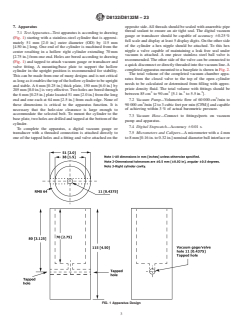
7.1 Test Apparatus—Test apparatus is according to drawing
gauge or transducer should be capable of accuracy 60.25 %
(Fig. 1) starting with a stainless-steel cylinder that is approxi-
full scale and display at least 5 display digits. On the other side
mately 51 mm [2.0 in.] outer diameter (OD) by 115 mm
of the cylinder a hex nipple should be attached. To this hex
[4.50 in.] long. One end of the cylinder is machined from the
nipple a valve capable of maintaining a leak free seal under
center resulting in a hollow right cylinder extending 70 mm
vacuum is attached. A one piece stainless steel ball valve is
[2.75 in.] from one end. Holes are bored according to drawing
recommended. The other side of the valve can be connected to
(Fig. 1) and tapped to attach vacuum gauge or transducer and
a quick disconnect or directly threaded into the vacuum line. A
valve fitting. A mounting/base plate to support the hollow
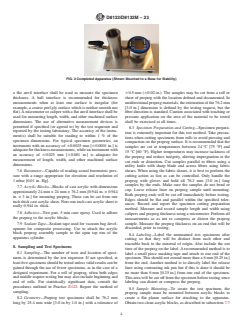
completed apparatus mounted to a baseplate is shown in Fig. 2.
cylinder in the upright position is recommended for stability.
The total volume of the completed vacuum chamber appa-
This can be made from one of many designs and is not critical
ratus from the closed valve to the top of the open cylinder
as long as it enables the top of the hollow cylinder to be upright
needs to be calculated or determined from filling with appro-
and stable. A 6 mm [0.25 in.] thick plate, 150 mm [6.0 in.] by
priate density fluid. The total volume with fittings should be
205 mm [8.0 in.] is very effective. Two holes are bored through
3 3 3 3
between 85 cm to 90 cm [5.1 in. to 5.5 in. ].
the 6 mm [0.25 in.] plate located 51 mm [2.0 in.] from the long
end and one each at 64 mm [2.5 in.] from each edge. None of 7.2 Vacuum Pump—Volumetric flow of 60 000 cm /min to
these dimensions is critical to the apparatus function. It is 90 000 cm /min [2 to 3 cubic feet per min (CFM)] and capable
necessary that the hole-size clearance is large enough to of achieving within 3 % of actual barometric pressure.
accommodate the selected bolt. To mount the cylinder to the
7.3 Vacuum Hose—Connect to fittings/ports on vacuum
base plate, two holes are drilled and tapped at the bottom of the
pump and apparatus.
cylinder.
7.4 Digital Stopwatch—Accuracy 60.01 s.
To complete the apparatus, a digital vacuum gauge or
transducer with a threaded connection is attached directly to 7.5 Micrometers and Calipers—A micrometer with a 4 mm
one of the tapped holes and a fitting and valve attached on the to 8 mm [0.16 in. to 0.32 in.] nominal diameter ball interface or
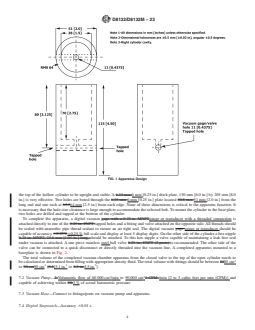
FIG. 1 Apparatus Design
D8132/D8132M − 23
FIG. 2 Completed Apparatus (Shown Mounted to a Base for Stability)
a flat anvil interface shall be used to measure the specimen 60.5 mm (60.02 in.). The samples may be cut from a roll or
thickness. A ball interface is recommended for thickness sheet of prepreg with the location defined and documented. In
measurements when at least one surface is irregular (for unidirectional prepreg materials, the orientation of the 76.2 mm
example, a course peel ply surface which is neither smooth nor [3.0 in.] dimension is defined by the testing request, but the
flat). A micrometer or caliper with a flat anvil interface shall be fiber direction is standard. Caution associated with touching or
used for measuring length, width, and other machined surface pressure application on the area of the material to be tested
dimensions. The use of alternative measurement devices is shall be exercised at all times.
permitted if specified (or agreed to) by the test requestor and
8.3 Specimen Preparation and Cutting—Specimen prepara-
reported by the testing laboratory. The accuracy of the instru-
tion is extremely important for this test method. Take precau-
ment(s) shall be suitable for reading to within 1 % of the
tions when cutting specimens from rolls to avoid pressing and
specimen dimensions. For typical specimen geometries, an
compaction on the prepreg surface. It is recommended that the
instrument with an accuracy of 60.0025 mm [60.0001 in.] is
samples are cut at temperatures between 24 °C [75 °F] and
adequate for thickness measurements, while an instrument with
15 °C [60 °F]. Higher temperatures may increase tackiness of
an accuracy of 60.025 mm [60.001 in.] is adequate for
the prepreg and reduce integrity, altering impregnation at the
measurement of length, width, and other machined surface
cut ends or distortion. Cut samples parallel to fibers using a
dimensions.
utility knife with sharp blade and across fibers using fabric
shears. When using the fabric shears, it is best to perform the
7.6 Barometer—Capable of reading actual barometric pres-
sure with a range appropriate for elevation and resolution of cutting action as fast as can be controlled. Only handle the
prepreg with gloves and hold all 76.2 mm [3.0 in.] long
1 mbar [0.01 in. Hg].
samples by the ends. Make sure the samples do not bend or
7.7 Acrylic Blocks—Blocks of cast acrylic with dimensions
cup. Leave release liner on prepreg sample until mounting.
approximately 24 mm × 24 mm × 76.2 mm [0.944 in. × 0.944
Both prepreg ends will be cut off immediately before testing.
in. × 3 in.] for mounting prepreg. These can be cut from one
Edges should be flat and parallel within the specified toler-
inch thick cast acrylic sheet. Note one inch cast acrylic sheet is
ances. Record and report the specimen cutting preparation
really 0.944 in. thick.
method. Measure and record sample length and width using
7.8 Adhesive—Two part, 5 min cure epoxy. Used to adhere
calipers and prepreg thickness using a micrometer. Perform all
the prepreg to the acrylic blocks.
measurements so as not to compress or distort the prepreg
7.9 Sealant Tape—Sealant tape used for vacuum bag devel- sample. Measure the prepreg thickness on an end that will be
discarded, prior to testing.
opment for composite processing. Use to attach the acrylic
block prepreg assembly sample to the open top rim of the
8.4 Labeling—Label the unmounted test specimens after
apparatus cylinder.
cutting so that they will be distinct from each other and
traceable back to the material of origin. Also include the out
8. Sampling and Test Specimens
time of the prepreg on the label. A recommended method is to
8.1 Sampling—The number of tests and location of speci-
label a small piece masking tape and attach to one end of the
mens is determined by the test requestor. If not specified, at specimen. This should not extend more than a 6 mm [0.25 in.]
least five specimens should be tested unless valid results can be
from the end. Another method is to directly label the release
gained through the use of fewer specimens, as in the case of a liner using contrasting ink pen but if this is done it should be
designed experiment. For a roll of prepreg, often both edges
no more than 6 mm [0.25 in.] from one end of the specimen.
and middle require testing but may also include beginning and This area will be cut off from the specimen before testing since
end of rolls. For statistically significant data, consult the
labeling can distort or compress the prepreg.
procedures outlined in Practice E122. Report the method of
8.5 Sample Mount
...
This document is not an ASTM standard and is intended only to provide the user of an ASTM standard an indication of what changes have been made to the previous version. Because
it may not be technically possible to adequately depict all changes accurately, ASTM recommends that users consult prior editions as appropriate. In all cases only the current version
of the standard as published by ASTM is to be considered the official document.
Designation: D8132/D8132M − 17 D8132/D8132M − 23
Standard Test Method for
Determination of Prepreg Impregnation by Permeability
Measurement
This standard is issued under the fixed designation D8132/D8132M; the number immediately following the designation indicates the
year of original adoption or, in the case of revision, the year of last revision. A number in parentheses indicates the year of last
reapproval. A superscript epsilon (´) indicates an editorial change since the last revision or reapproval.
1. Scope
1.1 This test method determines the in-plane permeability of composite prepreg (pre-impregnated) materials as a measure of level
of impregnation. Permissible prepreg materials include those reinforced with carbon, glass, aramid, thermoplastic and other fibers
impregnated with a thermoset or thermoplastic matrix resin, creating a single ply sheet material. The reinforcements may be
unidirectional or woven fabrics.
1.2 The values stated in either SI units or inch-pound units are to be regarded separately as standard. The values stated in each
system are not necessarily exact equivalents; therefore, to ensure conformance with the standard, each system shall be used
independently of the other, and values from the two systems shall not be combined.
1.2.1 Within the text, the inch-pound units are shown in brackets.
1.3 This standard does not purport to address all of the safety concerns, if any, associated with its use. It is the responsibility
of the user of this standard to establish appropriate safety, health, and environmental practices and determine the applicability of
regulatory limitations prior to use.
1.4 This international standard was developed in accordance with internationally recognized principles on standardization
established in the Decision on Principles for the Development of International Standards, Guides and Recommendations issued
by the World Trade Organization Technical Barriers to Trade (TBT) Committee.
2. Referenced Documents
2.1 ASTM Standards:
D883 Terminology Relating to Plastics
D3878 Terminology for Composite Materials
E122 Practice for Calculating Sample Size to Estimate, With Specified Precision, the Average for a Characteristic of a Lot or
Process
E177 Practice for Use of the Terms Precision and Bias in ASTM Test Methods
E456 Terminology Relating to Quality and Statistics
E691 Practice for Conducting an Interlaboratory Study to Determine the Precision of a Test Method
3. Terminology
3.1 Definitions—Terminology D3878 defines terms relating to high-modulus fibers and their composites. Terminology D883
This test method is under the jurisdiction of ASTM Committee D30 on Composite Materials and is the direct responsibility of Subcommittee D30.03 on
Constituent/Precursor Properties.
Current edition approved Aug. 1, 2017Sept. 1, 2023. Published September 2017October 2023. Originally approved in 2017. Last previous edition approved in 2017 as
D8132/D8132M – 17. DOI: 10.1520/D8132_D8132M-1710.1520/D8132_D8132M-23.
Copyright © ASTM International, 100 Barr Harbor Drive, PO Box C700, West Conshohocken, PA 19428-2959. United States
D8132/D8132M − 23
defines terms relating to plastics. Terminology E456 and Practice E177 define terms relating to statistics. In the event of a conflict
between terms, Terminology D3878 shall have precedence over the other terminologies.
3.2 Definitions of Terms Specific to This Standard:
3.2.1 as cast—pertaining to the transparent and smooth surface of an acrylic block.
3.2.2 acrylic block assembly—the acrylic blocks nested together or clamped together but that are otherwise oriented or joined
together only for a temporary process.
3.2.3 cut side—machined surface of an acrylic block.
3.2.4 permeability—Materialmaterial property that determines flow through a porous medium. Used Within this standard, used to
determine the air transport of prepreg materials in the in-plane directions.
3.2.5 permeability test apparatus—the vacuum test chamber with known volume where the permeability test specimen is mounted
and tested to determine permeability.
3.2.6 permeability test specimen—the vacuum test chamber with known volume where the permeability test specimen is mounted
and tested to determine permeability.specimen prepared for the permeability test.
3.3 Symbols
A = cross-sectional area of the prepreg test specimen
CV = coefficient of variation statistic of a sample population for a given property (in percent)
FAW = fiber areal weight
H = prepreg thickness
ID = inner diameter
K = permeability
K = normalized permeability (independent of prepreg thickness)
n
L = length of prepreg sample
OD = outer diameter
P = absolute pressure in vacuum chamber (P as a function of time)
P = actual atmospheric pressure
atm
P = initial absolute pressure in vacuum chamber (P at time 0)
i iabs
RH = relative humidity
S = standard deviation statistic of a sample population for a given property
n-1
x = test result for an individual specimen from the sample population for a given property
x¯ = mean or average (estimate of mean) of a sample population for a given property
4. Summary of Test Method
4.1 This test method consists of imparting a pressure differential across a single ply of prepreg to determine the permeability of
the material by exposing one side to the atmosphere and the other to known volume of reduced pressure. The initial reduced
pressure, created by a vacuum pump, increases after the pump is shut off as a function of air flow through the prepreg. To create
the test specimen, a single ply of prepreg is sandwiched and bonded between acrylic blocks. This test specimen is then attached
to the surface of the known volume with vacuum tape. This assembly provides a leak-free seal and no applied compaction pressure
on the prepreg surface during testing.
4.2 This standard defines a test method to determine the air transport capacity of a prepreg composite material in the plane of the
fiber; in unidirectional materials, this means either parallel to or orthogonal to the fiber direction and in woven fabric materials,
in the warp or fill direction.
4.3 A successful test is dependent on proper handling and mounting of the prepreg material sample. A leak-free seal is required
between the prepreg and acrylic block adherends and to the surface of the test apparatus.
D8132/D8132M − 23
5. Significance and Use
5.1 It is well known that the prepreg impregnation level affects handling characteristics, tack and drape, and final part quality.
Resin impregnation level is the dominant factor in the ability of removing air and volatiles from the layup during processing.
Partially impregnated prepreg materials can in some applications provide higher quality, lower void content composite parts, and
are becoming increasingly more common due to the desire to cure out-of-autoclave, using vacuum bag-only processes. This test
can identify small changes in the material impregnation level which can assist in definition of production processes or shipping
and handling procedures. The value of permeability can be used for specifying ranges as acceptance requirements for prepreg
materials, thus enabling the prepreg manufacturer and user greater confidence in the ability to produce repeatable, repeatable and
high quality parts. This test directly determines the actual air flow propensity of the material tested without any applied compaction
pressure during testing.
5.2 Factors that influence the permeability of the tested prepreg material shall be reported including: prepreg material, orientation,
location on roll, width, length, thickness, and actual atmospheric pressure.
6. Interferences
6.1 Material and Specimen Preparation—Poor material fabrication practices, lack of control of fiber alignment, and damage
induced by improper specimen cutting are known causes of high data scatter in composites in general. Specific factors that affect
the prepreg test specimen permeability results include compression and bending of prepreg, handling, sharpness of cutting blades,
and control of fiber alignment and orientation when cutting. Measuring prepreg thickness is very difficult and subjective due to
the viscoelastic material and non-uniform surface and can cause significant permeability calculation error. When comparing values
at different laboratories, a normalized permeability value that does not take into account prepreg thickness may be more applicable.
6.2 Permeability Test Specimen Preparation—To maintain a high quality seal to the prepreg material it is important to have clean
bonding surfaces on the acrylic blocks. Also the viscosity, gel, and cure time of adhesive, time to apply adhesive and mount
specimen, and adhesive quantity can affect the seal or cause undesired impregnation of areas of the prepreg. The adhesive must
fill in the bond line between the two acrylic block adherends or there can be a gap that is difficult to seal from the environment.
Control of the orientation of the prepreg between the acrylic blocks is necessary for repeatable results. Once the prepreg is mounted
and adhered between the acrylic blocks, the test specimen should be allowed to cure without pressure on the prepreg. Ends of the
mounted prepreg should never be touched except for cutting immediately before testing.
6.3 Mounting Blocks and Adhesive—The mounting blocks that are specified are based on cast clear acrylic which enables
inspection of the bond line. Other clear polymer blocks may be used but adhesion would need to be evaluated with the mounting
adhesiveadhesive.
6.4 Mounting Permeability Test Specimen to Apparatus—The completed test specimens must be mounted with the prepreg
centered so as not to touch the sides of the apparatus. An air-tight seal must be maintained throughout the testing.
6.5 Barometric Pressure—The barometric pressure that is used for the calculation of permeability must be the actual barometric
pressure in the ambient testing environment and not a corrected barometric pressure. All pressure units used for calculations must
be in absolute values.
6.6 Geometry—Specific geometric factors that affect permeability results include prepreg thickness, width, length, and orientation.
6.7 Environment—Results can be affected by large variations in environmental conditions under which the tests are conducted.
Sample preparation and testing in relative humidity (RH) over 70% and temperatures above 23.9 °C24 °C [75 °F] or below 15.6
°C 15 °C [60 °F] are not recommended.
7. Apparatus
7.1 Test Apparatus—Test apparatus is according to drawing (Fig. 1) starting with a stainless-steel cylinder that is approximately
51 mm [2.0 in.] outer diameter (OD) by 115 mm [4.50 in.] long. One end of the cylinder is machined from the center resulting
in a hollow right cylinder extending 69.85 mm 70 mm [2.75 in.] from one end. Holes are bored according to drawing (Fig. 1) and
tapped to attach vacuum gage gauge or transducer and valve fitting. A mounting/base plate to support the hollow cylinder in the
upright position is recommended for stability. This can be made from one of many designs and is not critical as long as it enables
D8132/D8132M − 23
FIG. 1 Apparatus Design
the top of the hollow cylinder to be upright and stable. A 6.35 mm 6 mm [0.25 in.] thick plate, 150 mm [6.0 in.] by 205 mm [8.0
in.] is very effective. Two holes are bored through the 6.35 mm 6 mm [0.25 in.] plate located 50.8 mm 51 mm [2.0 in.] from the
long end and one each at 63.564 mm [2.5 in.] from each edge. None of these dimensions is critical to the apparatus function. It
is necessary that the hole-size clearance is large enough to accommodate the selected bolt. To mount the cylinder to the base plate,
two holes are drilled and tapped at the bottom of the cylinder.
To complete the apparatus, a digital vacuum gage with a 0.25 in. MNPTgauge or transducer with a threaded connection is
attached directly to one of the 0.25 in. FNPT tapped holes and a fitting and valve attached on the opposite side. All threads should
be sealed with anaerobic pipe thread sealant to ensure an air tight seal. The digital vacuum gage gauge or transducer should be
capable of accuracy 60.25%60.25 % full scale and display at least 5 display digits. On the other side of the cylinder a hex nipple
0.25 in. MNPT, 25.6 mm [1.01 in.] long, should be attached. To this hex nipple a valve capable of maintaining a leak free seal
under vacuum is attached. A one piece stainless steel ball valve 0.25 in., FNPT (2 ports) is recommended. The other side of the
valve can be connected to a quick disconnect or directly threaded into the vacuum line. A completed apparatus mounted to a
baseplate is shown in Fig. 2.
The total volume of the completed vacuum chamber apparatus from the closed valve to the top of the open cylinder needs to
be calculated or determined from filling with appropriate density fluid. The total volume with fittings should be between 8585 cm
3 3 3
to 90 cm90 cm [5.1[5.1 in. to 5.5 in.5.5 in. ].
3 3
7.2 Vacuum Pump—2 Volumetric flow of 60 000 cm /min to 90 000 cm 3 CFM /min [2 to 3 cubic feet per min (CFM)] and
capable of achieving within 3%3 % of actual barometric pressure.
7.3 Vacuum Hose—Connect to fittings/ports on vacuum pump and apparatus.
7.4 Digital Stopwatch—Accuracy 60.01 s.
D8132/D8132M − 23
FIG. 2 Completed Apparatus (Shown Mounted to a Base for Stability)
7.5 Micrometers and Calipers—A micrometer with a 4 to 7 mm [0.16 to 0.28 in.] 4 mm to 8 mm [0.16 in. to 0.32 in.] nominal
diameter ball interface or a flat anvil interface shall be used to measure the specimen thickness. A ball interface is recommended
for thickness measurements when at least one surface is irregular (e.g. (for example, a course peel ply surface which is neither
smooth nor flat). A micrometer or caliper with a flat anvil interface shall be used for measuring length, width, and other machined
surface dimensions. The use of alternative measurement devices is permitted if specified (or agreed to) by the test requestor and
reported by the testing laboratory. The accuracy of the instrument(s) shall be suitable for reading to within 1 % of the specimen
dimensions. For typical specimen geometries, an instrument with an accuracy of 60.0025 mm [60.0001 in.] is adequate for
thickness measurements, while an instrument with an accuracy of 60.025 mm [60.001 in.] is adequate for measurement of length,
width, and other machined surface dimensions.
7.6 Barometer—Capable of reading actual barometric pressure with a range appropriate for elevation and resolution of 0.01 in.
Hg [1 mbar].1 mbar [0.01 in. Hg].
7.7 Acrylic Blocks—Blocks of cast acrylic with dimensions approximately 24 mm × 24 mm × 76.2 mm [0.944 in. × 0.944 in. ×
3 in.] for mounting prepreg. These can be cut from one inch thick cast acrylic sheet. Note one inch cast acrylic sheet is really 0.944
in. thick.
7.8 Adhesive—Two part, 5 min cure epoxy. Used to adhere the prepreg to the acrylic blocks.
7.9 Sealant Tape—Sealant tape used for vacuum bag development for composite processing. Use to attach the acrylic block
prepreg assembly sample to the open top rim of the apparatus cylinder.
8. Sampling and Test Specimens
8.1 Sampling—The number of tests and location of specimens is determined by the test requestor. If not specified, at least five
specimens should be tested unless valid results can be gained through the use of fewer specimens, as in the case of a designed
experiment. For a roll of prepreg, often both edges and middle require testing but may also include beginning and end of rolls.
For statistically significant data, consult the procedures outlined in Practice E122. Report the method of sampling.
8.2 Geometry—Prepreg test specimens shall be 76.2 mm long by 25.4 mm wide [3.0 in by 1.0 in.]. in.] with a tolerance of
60.5 mm (60.02 in.). The samples may be cut from a roll or sheet of prepreg with the location defined and documented. In
unidirectional prepreg materials, the orientation of the 76.2 mm [3.0 in.] dimension is defined by the testing request, but the fiber
direction is standard. Caution associated with touching or pressure application on the area of the material to be tested shall be
exercised at all times.
8.3 Specimen Preparation and Cutting—Specimen preparation is extremely important for this test method. Take precautions when
cutting specimens from rolls to avoid pressing and compaction on the prepreg surface. It is recommended that the samples are cut
at temperatures between 23.9 °C 24 °C [75 °F] and 15.6 °C 15 °C [60 °F]. Higher temperatures may increase tackiness of the
prepreg and reduce integrity, altering impregnation at the cut ends or distortion. Cut samples parallel to fibers using a utility knife
with sharp blade and across fibers using fabric shears. When using the fabric shears, it is best to perform the cutting action as fast
as can be controlled. Only handle the prepreg with gloves and hold all 76.2 mm [3.0 in.] long samples by the ends. Make sure the
samples don’t do not bend or cup. Leave release liner on prepreg sample until mounting. Both prepreg ends will be cut off
D8132/D8132M − 23
immediately before testing. Edges should be flat and parallel within the specified tolerances. Record and report the specimen
cutting preparation method. Measure and record sample length and width using calipers and prepreg thickness using a micrometer.
Perform all measurements so as not to compress or distort the prepreg sample. Measure the prepreg thickness on an end that will
be discarded, prior to testing.
8.4 Labeling—Label the unmounted test specimens after cutting so that they will be distinct from each other and traceable back
to the material of origin. Also include the out time of the prepreg on the label. A recommended method is to label a small piece
masking tape and attach to one end of the specimen. This should not extend more than a 6.35 mm 6 mm [0.25 in.] from the end.
Another method is to directly label the release liner using contrasting ink pen but if this is done it should be no more than 6.35
mm 6 mm [0.25 in.] from one end of the specimen. This area wil
...