


ASTM D4355/D4355M-14(2018)
(Test Method)Standard Test Method for Deterioration of Geotextiles by Exposure to Light, Moisture and Heat in a Xenon Arc-Type Apparatus
Standard Test Method for Deterioration of Geotextiles by Exposure to Light, Moisture and Heat in a Xenon Arc-Type Apparatus
SIGNIFICANCE AND USE
5.1 This method is intended to induce property changes associated with end-use conditions, including the effects of solar radiation, moisture, and heat. The exposure used is not intended to simulate the deterioration caused by localized weather phenomena such as atmospheric pollution, biological attack, and salt water exposure.
5.2 The relation between time to failure in an exposure conducted in accordance with this test method and service life in a specific outdoor environment requires determination of an acceleration factor, as defined in Terminology G113. The acceleration factor is material dependent and is only valid if it is based on data from a sufficient number of separate exterior and laboratory-accelerated exposures so that the results used to relate times to failure in each exposure can be analyzed using statistical methods.
Note 1: An example of a statistical analysis using multiple laboratory and exterior exposures to calculate an acceleration factor is described by J. A. Simms.4 See Practice G151 for more information and additional cautions about the use of acceleration factors.
5.2.1 The deterioration curve obtained from the results of this test method enables the user to determine the tendency of a geotextile to deteriorate when exposed to xenon arc radiation, water, and heat.
5.3 Variation in results may be expected when operating conditions are varied within the accepted limits of this test method. Its intended use is as a qualitative assessment of the presence of ultraviolet inhibitors, and comparison of that influence between products. However, no inference to the time of stability should be implied by the test results to the relation between time duration and outdoor exposure.
Note 2: Information on sources of variability and on strategies for addressing variability in the design, execution, and data analysis of laboratory-accelerated exposure tests is found in Guide G141.
5.3.1 If it becomes necessary for the purchaser and seller...
SCOPE
1.1 This test method covers the determination of the deterioration in tensile strength of geotextiles by exposure to xenon arc radiation, moisture, and heat.
1.2 The light and water exposure apparatus employs a xenon arc light source.
1.3 The values stated in either SI units or inch-pound units are to be regarded separately as standard. The values stated in each system may not be exact equivalents; therefore, each system shall be used independently of the other. Combining values from the two systems may result in nonconformance with the standard.
1.4 This standard does not purport to address all of the safety concerns, if any, associated with its use. It is the responsibility of the user of this standard to establish appropriate safety, health, and environmental practices and determine the applicability of regulatory limitations prior to use.
1.5 This international standard was developed in accordance with internationally recognized principles on standardization established in the Decision on Principles for the Development of International Standards, Guides and Recommendations issued by the World Trade Organization Technical Barriers to Trade (TBT) Committee.
General Information
Buy Standard
Standards Content (Sample)
NOTICE: This standard has either been superseded and replaced by a new version or withdrawn.
Contact ASTM International (www.astm.org) for the latest information
Designation: D4355/D4355M − 14 (Reapproved 2018)
Standard Test Method for
Deterioration of Geotextiles by Exposure to Light, Moisture
and Heat in a Xenon Arc-Type Apparatus
This standard is issued under the fixed designation D4355/D4355M; the number immediately following the designation indicates the
year of original adoption or, in the case of revision, the year of last revision. A number in parentheses indicates the year of last
reapproval. A superscript epsilon (´) indicates an editorial change since the last revision or reapproval.
This standard has been approved for use by agencies of the U.S. Department of Defense.
1. Scope D5035Test Method for Breaking Force and Elongation of
Textile Fabrics (Strip Method)
1.1 This test method covers the determination of the dete-
E691Practice for Conducting an Interlaboratory Study to
riorationintensilestrengthofgeotextilesbyexposuretoxenon
Determine the Precision of a Test Method
arc radiation, moisture, and heat.
G113Terminology Relating to Natural andArtificial Weath-
1.2 The light and water exposure apparatus employs a
ering Tests of Nonmetallic Materials
xenon arc light source.
G141Guide for Addressing Variability in Exposure Testing
of Nonmetallic Materials
1.3 The values stated in either SI units or inch-pound units
are to be regarded separately as standard. The values stated in G151PracticeforExposingNonmetallicMaterialsinAccel-
erated Test Devices that Use Laboratory Light Sources
each system may not be exact equivalents; therefore, each
system shall be used independently of the other. Combining G155Practice for Operating XenonArc LightApparatus for
Exposure of Non-Metallic Materials
values from the two systems may result in nonconformance
with the standard.
3. Terminology
1.4 This standard does not purport to address all of the
safety concerns, if any, associated with its use. It is the
3.1 Definitions of Terms Specific to This Standard:
responsibility of the user of this standard to establish appro-
3.1.1 geotextile—any permeable textile material used with
priate safety, health, and environmental practices and deter-
foundation, soil, rock, earth, or any other geotechnical
mine the applicability of regulatory limitations prior to use.
engineering-related material that is an integral part of a
1.5 This international standard was developed in accor-
manmade product, structure, or system.
dance with internationally recognized principles on standard-
3.2 Definitions:
ization established in the Decision on Principles for the
3.2.1 For definitions of other textile terms used in this test
Development of International Standards, Guides and Recom-
method, refer to Terminology D123; for geotextile terms, refer
mendations issued by the World Trade Organization Technical
to Terminology D4439.
Barriers to Trade (TBT) Committee.
3.2.2 The definitions given in Terminology G113 are appli-
cable to this standard.
2. Referenced Documents
2.1 ASTM Standards:
4. Summary of Test Method
D123Terminology Relating to Textiles
4.1 Fivespecimensofageotextileforthemachinedirection
D1898Practice for Sampling of Plastics (Withdrawn 1998)
and for the cross-machine direction are exposed in a xenon arc
D4439Terminology for Geosynthetics
device for each of the following times: 0 (control specimens),
150, 300, and 500 h. The exposure consists of 120-min cycles
This test method is under the jurisdiction of ASTM Committee D35 on
asfollows:90minoflightonlyat65 63°Cuninsulatedblack
Geosynthetics and is the direct responsibility of Subcommittee D35.02 on Endur-
panel temperature and 50 610% relative humidity, followed
ance Properties.
by 30 min of light plus water spray. (See Note 8.)
Current edition approved June 1, 2018. Published June 2018. Originally
approved in 1984. Last previous edition approved in 2014 as D4355/D4355M–14.
4.2 Aftereachexposureperiod,thespecimensaresubjected
DOI: 10.1520/D4355_D4355M-14R18.
toacutorravelstriptensiletest.Theaveragebreakingstrength
For referenced ASTM standards, visit the ASTM website, www.astm.org, or
contact ASTM Customer Service at service@astm.org. For Annual Book of ASTM
in each direction is compared with the average breaking
Standards volume information, refer to the standard’s Document Summary page on
strengthineachdirectionofthecontrolspecimens.Thepercent
the ASTM website.
strength retained is plotted versus exposure period to produce
The last approved version of this historical standard is referenced on
www.astm.org. a degradation curve for the specimens from each direction.
Copyright © ASTM International, 100 Barr Harbor Drive, PO Box C700, West Conshohocken, PA 19428-2959. United States
D4355/D4355M − 14 (2018)
NOTE 3—Previous versions of this standard referenced Practice G26,
5. Significance and Use
whichdescribesspecificequipmentdesignsofxenonarcdevices.Practice
5.1 This method is intended to induce property changes
G26 has been replaced by Practice G151, which gives performance
associated with end-use conditions, including the effects of
criteria for all devices that use laboratory light sources, plus Practice
G155, which gives requirements for exposure of nonmetallic materials in
solar radiation, moisture, and heat. The exposure used is not
xenon arc devices.
intended to simulate the deterioration caused by localized
weather phenomena such as atmospheric pollution, biological 6.1.1 The apparatus must be capable of exposing the speci-
attack, and salt water exposure.
mens to cycles of light only, followed by light and moisture as
water spray.
5.2 The relation between time to failure in an exposure
conducted in accordance with this test method and service life
6.2 Strength Testing Apparatus, conforming to that de-
in a specific outdoor environment requires determination of an
scribed for a 2-in. cut or ravel strip test, as described in Test
acceleration factor, as defined in Terminology G113. The
Method D5035.
acceleration factor is material dependent and is only valid if it
is based on data from a sufficient number of separate exterior
7. Sampling
andlaboratory-acceleratedexposuressothattheresultsusedto
7.1 LotSample—Asalotsampleforacceptancetesting,take
relate times to failure in each exposure can be analyzed using
at random the number of rolls of fabric directed in an
statistical methods.
applicable material specification or other agreement between
NOTE 1—An example of a statistical analysis using multiple laboratory
thepurchaserandthesupplier.Considerrollsoffabrictobethe
and exterior exposures to calculate an acceleration factor is described by
primary sampling units. If the specification requires sampling
J. A. Simms. See Practice G151 for more information and additional
during manufacture, select the rolls for the lot sample at
cautions about the use of acceleration factors.
uniformly spaced time intervals throughout the production
5.2.1 The deterioration curve obtained from the results of
period.
this test method enables the user to determine the tendency of
ageotextiletodeterioratewhenexposedtoxenonarcradiation, NOTE 4—An adequate specification, or other agreement between the
purchaser and the supplier, requires taking into account the variability
water, and heat.
between rolls of fabric and between specimens from a swatch from a roll
5.3 Variation in results may be expected when operating
of fabric, so as to provide a sampling plan with a meaningful producer’s
conditions are varied within the accepted limits of this test risk, consumer’s risk, acceptable quality level, and limiting quality level.
method. Its intended use is as a qualitative assessment of the
7.2 Laboratory Sample—Take for the laboratory sample a
presence of ultraviolet inhibitors, and comparison of that
sample extending the full width of the fabric of sufficient
influence between products. However, no inference to the time
length along the selvage from each sample roll such that the
of stability should be implied by the test results to the relation
requirementsof8.1aremet.Thesampleshallexcludematerial
between time duration and outdoor exposure.
from the outer wrap of the roll or the inner wrap around the
core,unlessthesampleistakenattheproductionsite,atwhich
NOTE 2—Information on sources of variability and on strategies for
addressing variability in the design, execution, and data analysis of
point inner and outer wrap material may be used.
laboratory-accelerated exposure tests is found in Guide G141.
5.3.1 If it becomes necessary for the purchaser and seller to
8. Specimen Preparation
use this test method for acceptance testing, the statistical bias,
8.1 Take two 1-m portions from the laboratory sample.
if any, between the purchaser’s and seller’s laboratories should
Eachshallbenoclosertotheselvagethanone-tenththesample
be determined. Such comparison is based on specimens ran-
width. One is to be used for machine direction specimens, the
domly drawn from the sample of geotextile being evaluated.
other for cross-machine direction specimens.
5.3.2 In such cases, at a minimum, the two parties should
take a group of test specimens which are as homogeneous as
NOTE 5—Since the thickness of a specimen may markedly affect test
results, thickness of the replicate specimens shall be within 610% of the
possible, and which are from a lot of material of the type in
nominal dimensions. This is especially important when mechanical
question.Thetestspecimensshouldthenberandomlyassigned
properties are being investigated.
in equal numbers to each laboratory for testing. The average
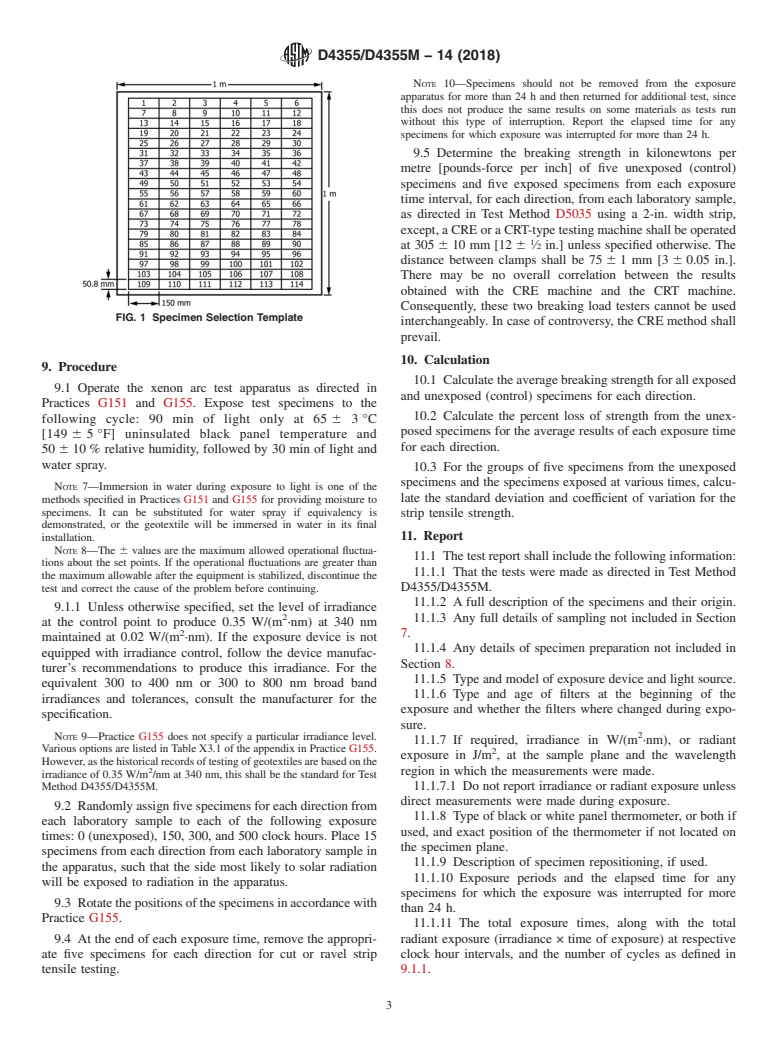
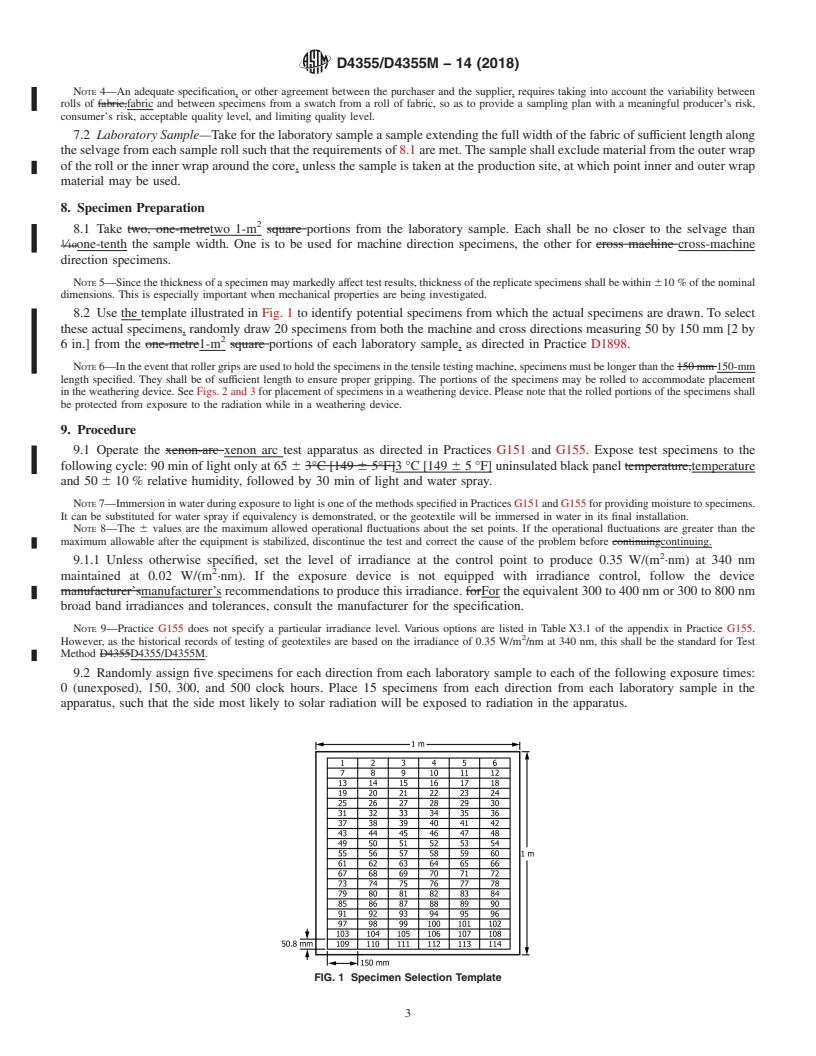
8.2 UsethetemplateillustratedinFig.1toidentifypotential
results from the two laboratories should be compared using
specimens from which the actual specimens are drawn. To
Student’s t-test for unpaired data and an acceptable probability
select these actual specimens, randomly draw 20 specimens
level chosen by the two parties before the testing started. If a
from both the machine
...
This document is not an ASTM standard and is intended only to provide the user of an ASTM standard an indication of what changes have been made to the previous version. Because
it may not be technically possible to adequately depict all changes accurately, ASTM recommends that users consult prior editions as appropriate. In all cases only the current version
of the standard as published by ASTM is to be considered the official document.
Designation: D4355/D4355M − 14 D4355/D4355M − 14 (Reapproved 2018)
Standard Test Method for
Deterioration of Geotextiles by Exposure to Light, Moisture
and Heat in a Xenon Arc Type Arc-Type Apparatus
This standard is issued under the fixed designation D4355/D4355M; the number immediately following the designation indicates the
year of original adoption or, in the case of revision, the year of last revision. A number in parentheses indicates the year of last
reapproval. A superscript epsilon (´) indicates an editorial change since the last revision or reapproval.
This standard has been approved for use by agencies of the U.S. Department of Defense.
1. Scope
1.1 This test method covers the determination of the deterioration in tensile strength of geotextiles by exposure to xenon arc
radiation, moisture, and heat.
1.2 The light and water exposure apparatus employs a xenon-arc xenon arc light source.
1.3 The values stated in either SI units or inch-pound units are to be regarded separately as standard. The values stated in each
system may not be exact equivalents; therefore, each system shall be used independently of the other. Combining values from the
two systems may result in non-conformancenonconformance with the standard.
1.4 This standard does not purport to address all of the safety concerns, if any, associated with its use. It is the responsibility
of the user of this standard to establish appropriate safety safety, health, and healthenvironmental practices and determine the
applicability of regulatory limitations prior to use.
1.5 This international standard was developed in accordance with internationally recognized principles on standardization
established in the Decision on Principles for the Development of International Standards, Guides and Recommendations issued
by the World Trade Organization Technical Barriers to Trade (TBT) Committee.
2. Referenced Documents
2.1 ASTM Standards:
D123 Terminology Relating to Textiles
D1898 Practice for Sampling of Plastics (Withdrawn 1998)
D4439 Terminology for Geosynthetics
D5035 Test Method for Breaking Force and Elongation of Textile Fabrics (Strip Method)
E691 Practice for Conducting an Interlaboratory Study to Determine the Precision of a Test Method
G113 Terminology Relating to Natural and Artificial Weathering Tests of Nonmetallic Materials
G141 Guide for Addressing Variability in Exposure Testing of Nonmetallic Materials
G151 Practice for Exposing Nonmetallic Materials in Accelerated Test Devices that Use Laboratory Light Sources
G155 Practice for Operating Xenon Arc Light Apparatus for Exposure of Non-Metallic Materials
3. Terminology
3.1 Definitions of Terms Specific to This Standard:
3.1.1 geotextile—any permeable textile material used with foundation, soil, rock, earth, or any other geotechnical engineering
related engineering-related material that is an integral part of a man-mademanmade product, structure, or system.
3.2 Definitions:
3.2.1 For definitions of other textile terms used in this test method, refer to Terminology D123,; for geotextile terms, refer to
Terminology D4439.
3.2.2 The definitions given in Terminology G113 are applicable to this standard.
This test method is under the jurisdiction of ASTM Committee D35 on Geosynthetics and is the direct responsibility of Subcommittee D35.02 on Endurance Properties.
Current edition approved July 15, 2014June 1, 2018. Published September 2014June 2018. Originally approved in 1984. Last previous edition approved in 20072014 as
D4355 – 07.D4355/D4355M – 14. DOI: 10.1520/D4355_D4355M-14.10.1520/D4355_D4355M-14R18.
For referenced ASTM standards, visit the ASTM website, www.astm.org, or contact ASTM Customer Service at service@astm.org. For Annual Book of ASTM Standards
volume information, refer to the standard’s Document Summary page on the ASTM website.
The last approved version of this historical standard is referenced on www.astm.org.
Copyright © ASTM International, 100 Barr Harbor Drive, PO Box C700, West Conshohocken, PA 19428-2959. United States
D4355/D4355M − 14 (2018)
4. Summary of Test Method
4.1 Five specimens of a geotextile for the machine direction and for the cross machine cross-machine direction are exposed in
a xenon arc device for each of the following times: 0 (control specimens), for 150, 300, and 500 h. The exposure consists of
120-min cycles as follows: 90 min of light only at 65 6 3°C3 °C uninsulated black panel temperature and 50 6 10 % relative
humidity, followed by 30 min of light plus water spray. (See Note 8.)
4.2 After each exposure period, the specimens are subjected to a cut or ravel strip tensile test. The average breaking strength
in each direction is compared with the average breaking strength in each direction of the control specimens. The percent strength
retained is plotted versus exposure period to produce a degradation curve for the specimens from each direction.
5. Significance and Use
5.1 This method is intended to induce property changes associated with end use end-use conditions, including the effects of solar
radiation, moisture, and heat. The exposure used is not intended to simulate the deterioration caused by localized weather
phenomena such as atmospheric pollution, biological attack, and salt water exposure.
5.2 The relation between time to failure in an exposure conducted in accordance with this test method,method and service life
in a specific outdoor environment requires determination of an acceleration factor, as defined in Terminology G113. The
acceleration factor is material-dependent material dependent and is only valid if it is based on data from a sufficient number of
separate exterior and laboratory-accelerated exposures so that the results used to relate times to failure in each exposure can be
analyzed using statistical methods.
NOTE 1—An example of a statistical analysis using multiple laboratory and exterior exposures to calculate an acceleration factor is described by J. A.
Simms. See Practice G151 for more information and additional cautions about the use of acceleration factors.
5.2.1 The deterioration curve obtained from the results of this test method enables the user to determine the tendency of a
geotextile to deteriorate when exposed to xenon arc radiation, water, and heat.
5.3 Variation in results may be expected when operating conditions are varied within the accepted limits of this test method.
Its intended use is as a qualitative assessment of the presence of ultraviolet inhibitors, and comparison of that influence between
products. However, no inference to the time of stability should be implied by the test results to the relation between time duration
and outdoor exposure.
NOTE 2—Information on sources of variability and on strategies for addressing variability in the design, execution, and data analysis of laboratory
accelerated laboratory-accelerated exposure tests is found in Guide G141.
5.3.1 If it becomes necessary for the purchaser and seller to use this test method for acceptance testing, the statistical bias, if
any, between the purchaser’s and seller’s laboratories should be determined. Such comparison is based on specimens randomly
drawn from the sample of geotextile being evaluated.
5.3.2 In such cases, asat a minimum, the two parties should take a group of test specimens which are as homogeneous as
possible, and which are from a lot of material of the type in question. The test specimens should then be randomly assigned in equal
numbers to each laboratory for testing. The average results from the two laboratories should be compared using Student’s t-test
for unpaired data and an acceptable probability level chosen by the two parties before the testing started. If a bias is found, either
its cause must be found and corrected, or the purchaser and the supplier must agree to interpret future test results in the light of
the known bias.
6. Apparatus
6.1 Xenon-Arc Xenon Arc Apparatus, with daylight filters conforming to Practices G151 and G155.
NOTE 3—Previous versions of this standard referenced in Practice G26, which describes specific equipment designs of xenon arc devices. Practice G26
has been replaced by Practice G151, which gives performance criteria for all devices that use laboratory light sources, plus Practice G155, which gives
requirements for exposure of nonmetallic materials in xenon arc devices.
6.1.1 The apparatus must be capable of exposing the specimens to cycles of light only, followed by light and moisture as water
spray.
6.2 Strength Testing Apparatus, conforming to that described for a 2-in. cut or ravel strip test, as described in Test Method
D5035.
7. Sampling
7.1 Lot Sample—As a lot sample for acceptance testing, take at random the number of rolls of fabric directed in an applicable
material specification or other agreement between the purchaser and the supplier. Consider rolls of fabric to be the primary
sampling units. If the specification requires sampling during manufacture, select the rolls for the lot sample at uniformly spaced
time intervals throughout the production period.
Simms, J. A., The Journal of Coatings Technology, Vol 50, 1987, pp. 45-53.45–53.
D4355/D4355M − 14 (2018)
NOTE 4—An adequate specification, or other agreement between the purchaser and the supplier, requires taking into account the variability between
rolls of fabric,fabric and between specimens from a swatch from a roll of fabric, so as to provide a sampling plan with a meaningful producer’s risk,
consumer’s risk, acceptable quality level, and limiting quality level.
7.2 Laboratory Sample—Take for the laboratory sample a sample extending the full width of the fabric of sufficient length along
the selvage from each sample roll such that the requirements of 8.1 are met. The sample shall exclude material from the outer wrap
of the roll or the inner wrap around the core, unless the sample is taken at the production site, at which point inner and outer wrap
material may be used.
8. Specimen Preparation
8.1 Take two, one-metretwo 1-m square portions from the laboratory sample. Each shall be no closer to the selvage than
⁄10one-tenth the sample width. One is to be
...
Questions, Comments and Discussion
Ask us and Technical Secretary will try to provide an answer. You can facilitate discussion about the standard in here.