

ASTM D3700-21
(Practice)Standard Practice for Obtaining LPG Samples Using a Floating Piston Cylinder
General Information
- Abstract
SIGNIFICANCE AND USE
5.1 This practice allows the collection of a representative sample of LPG that may contain trace volatile dissolved components such as methane, ethane, and nitrogen. Sampling by Practice D1265 can result in a small, but predictable, loss of these lighter components. Practice D1265 is suitable for collecting samples for routine specification testing, as the small loss of light components is not significant under Specification D1835 specification requirements. Practice D3700 is recommended whenever highly accurate determination of light components is required. For example, compositions determined on samples collected according to Practice D3700 may be used to establish the product value of NGL mixtures (see Appendix X1).
SCOPE
1.1 This practice covers the equipment and procedures for obtaining a representative sample of liquefied petroleum gas (LPG), such as specified in ASTM Specification D1835, GPA 2140, and comparable international standards. It may also be used for other natural gas liquid (NGL) products that are normally single phase (for example, NGL mix, field butane, and so forth), defined in other industry specifications or contractual agreements, and for volatile (higher vapor pressure) crude oils.
Note 1: Some floating piston cylinders have such tight piston seals that the vapor pressure of some high vapor pressure crude oils may not be sufficient to allow sampling without a handle to move the piston. An alternative sampling practice for UN Class 3 liquids (under 300 kPa at 52 °C) is Practice D8009, which utilizes a Manual Piston Cylinder (MPC) sampler.
1.2 This practice is not intended for non-specification products that contain significant quantities of undissolved gases (N2, CO2), free water or other separated phases, such as raw or unprocessed gas/liquids mixtures and related materials. The same equipment can be used for these purposes, but additional precautions are generally needed to obtain representative samples of multi-phase products (see Appendix X1).
1.3 This practice includes recommendations for the location of a sample point in a line or vessel. It is the responsibility of the user to ensure that the sampling point is located so as to obtain a representative sample.
1.4 The values stated in SI units are to be regarded as standard.
1.4.1 Exception—The values given in parentheses are for information only.
1.5 This standard does not purport to address all of the safety concerns, if any, associated with its use. It is the responsibility of the user of this standard to establish appropriate safety, health, and environmental practices, and determine the applicability of regulatory limitations prior to use.
1.6 This international standard was developed in accordance with internationally recognized principles on standardization established in the Decision on Principles for the Development of International Standards, Guides and Recommendations issued by the World Trade Organization Technical Barriers to Trade (TBT) Committee.
- Status
- Published
- Publication Date
- 30-Nov-2021
- Technical Committee
- D02 - Petroleum Products, Liquid Fuels, and Lubricants
- Drafting Committee
- D02.H0 - Liquefied Petroleum Gas
Overview
ASTM D3700-21 is the standard practice developed by ASTM International for obtaining representative samples of liquefied petroleum gas (LPG) using a floating piston cylinder (FPC). This method is designed to prevent loss of volatile light components, such as methane, ethane, and nitrogen, which may otherwise occur during sampling by alternative practices like ASTM D1265. The standard outlines the necessary equipment, procedures, and safety considerations to ensure sample integrity for accurate testing and analysis. It is widely referenced for sampling LPG, natural gas liquids (NGL), and high vapor pressure liquids in compliance with industry specifications and international standards.
Key Topics
- Floating Piston Cylinder (FPC) Use: The FPC is a specialized high-pressure sample container with a free-floating internal piston, which separates the LPG sample from a pressurizing inert gas, preventing vaporization and preserving the true composition of the sample.
- Representative Sampling: Detailed procedures and equipment recommendations help users obtain and maintain samples that truly represent the source material, especially for determining light hydrocarbon composition with high accuracy.
- Sample Integrity Risks: The standard identifies sources of interference that can compromise samples, including poor sampling location, contamination from lubricants and cylinder surfaces, leaks, improper cleaning, and incorrect handling.
- Safety and Compliance: Users are reminded to adhere to jurisdictional safety requirements, use appropriate pressure vessel certifications, and follow health, safety, and environmental protections.
- Practical Limitations: ASTM D3700-21 is intended for single-phase specification products; its direct use for raw, multi-phase, or contaminated mixtures requires additional precautions. Practice D8009 is referenced for UN Class 3 liquids below 300 kPa at 52°C.
- Purging and Mixing: Emphasizes thorough purging of sampling lines and equipment to avoid contamination, as well as sample mixing to prevent stratification in collected samples.
Applications
- LPG Quality Measurement: Essential for accurately determining composition-including trace light components-in custody transfer, regulatory compliance, and quality assurance of LPG and NGL products.
- Valuation of NGL Mixtures: Enables precise composition analysis, crucial for commercial transactions where product value depends on individual hydrocarbon content.
- Specification Testing: Especially important when product certification or regulatory reporting demands the highest accuracy for volatile component determination, such as in ethane- and propane-rich LPGs.
- Laboratory and On-site Sampling: Used by laboratories, refineries, petrochemical plants, and midstream operators to ensure reliable sample transport and analysis.
- Specialty Sampling Scenarios: Useful in situations where loss of volatile components could bias analytical results, or where regulatory bodies stipulate stringent vapor phase composition limits.
Related Standards
- ASTM D1835: Specification for Liquefied Petroleum (LP) Gases. Defines product requirements referenced by D3700.
- ASTM D1265: Manual sampling of LP gases; suitable for routine specifications but not for highly accurate light component analysis.
- ASTM D8009: Practice for manual piston cylinder sampling of volatile crude oils and liquid petroleum products.
- ASTM D4175: Terminology relating to petroleum products, liquid fuels, and lubricants.
- GPA 2140: Liquefied Petroleum Gas Specifications and Test Methods.
- GPA 2174: Guidance on obtaining liquid hydrocarbon samples for analysis, including NGLs.
Keywords: ASTM D3700, LPG sampling, floating piston cylinder, natural gas liquids, NGL sampling, volatile hydrocarbons, sample integrity, LPG quality, petrochemical standards, gas sampling cylinder.
Relations
- Refers
ASTM D4175-23a - Standard Terminology Relating to Petroleum Products, Liquid Fuels, and Lubricants - Effective Date
- 15-Dec-2023
- Effective Date
- 01-Dec-2023
- Refers
ASTM D4175-23e1 - Standard Terminology Relating to Petroleum Products, Liquid Fuels, and Lubricants - Effective Date
- 01-Jul-2023
- Effective Date
- 01-May-2013
- Effective Date
- 01-Dec-2012
- Effective Date
- 01-May-2011
- Effective Date
- 01-Apr-2005
- Refers
ASTM D1265-04a - Standard Practice for Sampling Liquefied Petroleum (LP) Gases (Manual Method) - Effective Date
- 01-Nov-2004
- Effective Date
- 01-May-2004
- Effective Date
- 01-Nov-2003
- Effective Date
- 10-May-2003
- Effective Date
- 10-Nov-1997
- Effective Date
- 10-Nov-1997
Get Certified
Connect with accredited certification bodies for this standard

Element Materials Technology
Materials testing and product certification.

ABS Group Brazil
ABS Group certification services in Brazil.

ABS Quality Evaluations Inc.
American Bureau of Shipping quality certification.
Sponsored listings
Frequently Asked Questions
ASTM D3700-21 is a standard published by ASTM International. Its full title is "Standard Practice for Obtaining LPG Samples Using a Floating Piston Cylinder". This standard covers: SIGNIFICANCE AND USE 5.1 This practice allows the collection of a representative sample of LPG that may contain trace volatile dissolved components such as methane, ethane, and nitrogen. Sampling by Practice D1265 can result in a small, but predictable, loss of these lighter components. Practice D1265 is suitable for collecting samples for routine specification testing, as the small loss of light components is not significant under Specification D1835 specification requirements. Practice D3700 is recommended whenever highly accurate determination of light components is required. For example, compositions determined on samples collected according to Practice D3700 may be used to establish the product value of NGL mixtures (see Appendix X1). SCOPE 1.1 This practice covers the equipment and procedures for obtaining a representative sample of liquefied petroleum gas (LPG), such as specified in ASTM Specification D1835, GPA 2140, and comparable international standards. It may also be used for other natural gas liquid (NGL) products that are normally single phase (for example, NGL mix, field butane, and so forth), defined in other industry specifications or contractual agreements, and for volatile (higher vapor pressure) crude oils. Note 1: Some floating piston cylinders have such tight piston seals that the vapor pressure of some high vapor pressure crude oils may not be sufficient to allow sampling without a handle to move the piston. An alternative sampling practice for UN Class 3 liquids (under 300 kPa at 52 °C) is Practice D8009, which utilizes a Manual Piston Cylinder (MPC) sampler. 1.2 This practice is not intended for non-specification products that contain significant quantities of undissolved gases (N2, CO2), free water or other separated phases, such as raw or unprocessed gas/liquids mixtures and related materials. The same equipment can be used for these purposes, but additional precautions are generally needed to obtain representative samples of multi-phase products (see Appendix X1). 1.3 This practice includes recommendations for the location of a sample point in a line or vessel. It is the responsibility of the user to ensure that the sampling point is located so as to obtain a representative sample. 1.4 The values stated in SI units are to be regarded as standard. 1.4.1 Exception—The values given in parentheses are for information only. 1.5 This standard does not purport to address all of the safety concerns, if any, associated with its use. It is the responsibility of the user of this standard to establish appropriate safety, health, and environmental practices, and determine the applicability of regulatory limitations prior to use. 1.6 This international standard was developed in accordance with internationally recognized principles on standardization established in the Decision on Principles for the Development of International Standards, Guides and Recommendations issued by the World Trade Organization Technical Barriers to Trade (TBT) Committee.
SIGNIFICANCE AND USE 5.1 This practice allows the collection of a representative sample of LPG that may contain trace volatile dissolved components such as methane, ethane, and nitrogen. Sampling by Practice D1265 can result in a small, but predictable, loss of these lighter components. Practice D1265 is suitable for collecting samples for routine specification testing, as the small loss of light components is not significant under Specification D1835 specification requirements. Practice D3700 is recommended whenever highly accurate determination of light components is required. For example, compositions determined on samples collected according to Practice D3700 may be used to establish the product value of NGL mixtures (see Appendix X1). SCOPE 1.1 This practice covers the equipment and procedures for obtaining a representative sample of liquefied petroleum gas (LPG), such as specified in ASTM Specification D1835, GPA 2140, and comparable international standards. It may also be used for other natural gas liquid (NGL) products that are normally single phase (for example, NGL mix, field butane, and so forth), defined in other industry specifications or contractual agreements, and for volatile (higher vapor pressure) crude oils. Note 1: Some floating piston cylinders have such tight piston seals that the vapor pressure of some high vapor pressure crude oils may not be sufficient to allow sampling without a handle to move the piston. An alternative sampling practice for UN Class 3 liquids (under 300 kPa at 52 °C) is Practice D8009, which utilizes a Manual Piston Cylinder (MPC) sampler. 1.2 This practice is not intended for non-specification products that contain significant quantities of undissolved gases (N2, CO2), free water or other separated phases, such as raw or unprocessed gas/liquids mixtures and related materials. The same equipment can be used for these purposes, but additional precautions are generally needed to obtain representative samples of multi-phase products (see Appendix X1). 1.3 This practice includes recommendations for the location of a sample point in a line or vessel. It is the responsibility of the user to ensure that the sampling point is located so as to obtain a representative sample. 1.4 The values stated in SI units are to be regarded as standard. 1.4.1 Exception—The values given in parentheses are for information only. 1.5 This standard does not purport to address all of the safety concerns, if any, associated with its use. It is the responsibility of the user of this standard to establish appropriate safety, health, and environmental practices, and determine the applicability of regulatory limitations prior to use. 1.6 This international standard was developed in accordance with internationally recognized principles on standardization established in the Decision on Principles for the Development of International Standards, Guides and Recommendations issued by the World Trade Organization Technical Barriers to Trade (TBT) Committee.
ASTM D3700-21 is classified under the following ICS (International Classification for Standards) categories: 75.120 - Hydraulic fluids. The ICS classification helps identify the subject area and facilitates finding related standards.
ASTM D3700-21 has the following relationships with other standards: It is inter standard links to ASTM D4175-23a, ASTM D1265-23a, ASTM D4175-23e1, ASTM D1835-13, ASTM D1835-12, ASTM D1835-11, ASTM D1835-05, ASTM D1265-04a, ASTM D1265-04, ASTM D1835-03a, ASTM D1835-03, ASTM D1265-97, ASTM D1835-97. Understanding these relationships helps ensure you are using the most current and applicable version of the standard.
ASTM D3700-21 is available in PDF format for immediate download after purchase. The document can be added to your cart and obtained through the secure checkout process. Digital delivery ensures instant access to the complete standard document.
Standards Content (Sample)
This international standard was developed in accordance with internationally recognized principles on standardization established in the Decision on Principles for the
Development of International Standards, Guides and Recommendations issued by the World Trade Organization Technical Barriers to Trade (TBT) Committee.
Designation: D3700 − 21
Standard Practice for
Obtaining LPG Samples Using a Floating Piston Cylinder
This standard is issued under the fixed designation D3700; the number immediately following the designation indicates the year of
original adoption or, in the case of revision, the year of last revision. A number in parentheses indicates the year of last reapproval. A
superscript epsilon (´) indicates an editorial change since the last revision or reapproval.
1. Scope* 1.6 This international standard was developed in accor-
dance with internationally recognized principles on standard-
1.1 This practice covers the equipment and procedures for
ization established in the Decision on Principles for the
obtaining a representative sample of liquefied petroleum gas
Development of International Standards, Guides and Recom-
(LPG), such as specified in ASTM Specification D1835,GPA
mendations issued by the World Trade Organization Technical
2140, and comparable international standards. It may also be
Barriers to Trade (TBT) Committee.
used for other natural gas liquid (NGL) products that are
normally single phase (for example, NGL mix, field butane,
2. Referenced Documents
and so forth), defined in other industry specifications or
2.1 ASTM Standards:
contractual agreements, and for volatile (higher vapor pres-
D1265 Practice for Sampling Liquefied Petroleum (LP)
sure) crude oils.
Gases, Manual Method
NOTE 1—Some floating piston cylinders have such tight piston seals
D1835 Specification for Liquefied Petroleum (LP) Gases
that the vapor pressure of some high vapor pressure crude oils may not be
D4175 Terminology Relating to Petroleum Products, Liquid
sufficient to allow sampling without a handle to move the piston. An
alternative sampling practice for UN Class 3 liquids (under 300 kPa at
Fuels, and Lubricants
52 °C) is Practice D8009, which utilizes a Manual Piston Cylinder (MPC)
D8009 Practice for Manual Piston Cylinder Sampling for
sampler.
Volatile Crude Oils, Condensates, and Liquid Petroleum
1.2 This practice is not intended for non-specification prod-
Products
ucts that contain significant quantities of undissolved gases
2.2 GPA Midstream Association Standards:
(N ,CO ), free water or other separated phases, such as raw or
GPA 2140 Liquefied Petroleum Gas Specifications and Test
2 2
unprocessed gas/liquids mixtures and related materials. The
Methods
same equipment can be used for these purposes, but additional
GPA 2174 Obtaining Liquid Hydrocarbon Samples for
precautions are generally needed to obtain representative
Analysis by Gas Chromatography
samples of multi-phase products (see Appendix X1).
3. Terminology
1.3 This practice includes recommendations for the location
3.1 Definitions:
of a sample point in a line or vessel. It is the responsibility of
3.1.1 For definitions of terms used in this practice, refer to
the user to ensure that the sampling point is located so as to
Terminology D4175.
obtain a representative sample.
3.1.2 floating piston cylinder (FPC), n—a high pressure
1.4 The values stated in SI units are to be regarded as
sample container, with a free floating internal piston that
standard.
effectively divides the container into two separate compart-
1.4.1 Exception—The values given in parentheses are for
ments.
information only.
3.1.2.1 Discussion—A floating piston cylinder is used to
collect a sample of liquid under pressure without the formation
1.5 This standard does not purport to address all of the
of a gaseous phase which can result in changes in the
safety concerns, if any, associated with its use. It is the
responsibility of the user of this standard to establish appro- composition of the liquid sample.
priate safety, health, and environmental practices, and deter-
3.1.3 maximum fill volume (reduced fill volume), n—the
mine the applicability of regulatory limitations prior to use.
volumeofacontainerthatmaybesafelyoccupiedbytheliquid
sample, usually expressed as a percentage of the total capacity.
1 2
This practice is under the jurisdiction of ASTM Committee D02 on Petroleum For referenced ASTM standards, visit the ASTM website, www.astm.org, or
Products, Liquid Fuels, and Lubricants and is the direct responsibility of Subcom- contact ASTM Customer Service at service@astm.org. For Annual Book of ASTM
mittee D02.H0 on Liquefied Petroleum Gas. Standards volume information, refer to the standard’s Document Summary page on
Current edition approved Dec. 1, 2021. Published December 2021. Originally the ASTM website.
approved in 1978. Last previous edition approved in 2016 as D3700 – 16. DOI: Available from GPA Midstream Association, 6526 E. 60th St., Tulsa, OK
10.1520/D3700-21. 74145, www.gpaglobal.org
*A Summary of Changes section appears at the end of this standard
Copyright © ASTM International, 100 Barr Harbor Drive, PO Box C700, West Conshohocken, PA 19428-2959. United States
D3700 − 21
3.1.3.1 Discussion—Some regulatory agencies use the ex- 6.7 Sampling from stratified tanks, dead zones in flowing
pressions “maximum fill density” and “reduced fill density.” systems, or inappropriate time periods in composite sampling
systems can result in non-representative samples.
4. Summary of Practice
6.8 Any material that can create carryover contamination
from one sample to the next has to be removed from the
4.1 Aliquid petroleum gas (LPG) sample is transferred as a
cylinder and the cylinder shall be thoroughly cleaned. In
liquid under pressure from a sample point to a floating piston
additiontocleaningtheinteriormetalsurfacesandcleaningthe
cylinder. The floating piston cylinder (FPC) is designed to
softparts(O-rings,forexample),considerationshouldbegiven
collect liquid samples with no vaporization by displacing a
to replacing the soft parts if they might have absorbed any
pistonagainstapressurizingfluid(preferablyaninertgas).The
contamination. Examples of contaminants include glycol,
piston serves as a physical barrier between the sample and the
amine, lubricants, sulfur species, solvents, methanol, etc.
pressurizing fluid, at the sampling pressure.The position of the
piston at the end of sampling indicates the percent fill of the
7. Apparatus
sample cylinder.
7.1 Floating Piston Cylinder (FPC):
4.2 It is the responsibility of the user of this practice to
7.1.1 Construction, typically fabricated from corrosion re-
locate the sample point at a suitable location and orientation
sistant 316 stainless steel, in accordance with the pressure
where the product being sampled is a representative, single
vessel certification requirements in the jurisdictions in which it
phase, homogeneous liquid.
is to be used, and through which it will be transported.
Protective internal coatings or surface treatments are accept-
5. Significance and Use
able provided that they do not adversely affect the free
movement of the piston, or effectiveness of the seals (see Fig.
5.1 This practice allows the collection of a representative
1).
sample of LPG that may contain trace volatile dissolved
7.1.1.1 Users should consult with the manufacturer of these
components such as methane, ethane, and nitrogen. Sampling
sample cylinders and sample collection systems any time
by Practice D1265 can result in a small, but predictable, loss of
ambient or product temperatures, or both, exceed the range of
these lighter components. Practice D1265 is suitable for
–29 °C (–20 °F) to 60 °C (140 °F). Extreme temperature ef-
collectingsamplesforroutinespecificationtesting,asthesmall
fects upon metal, O-rings, valve seats, seals, gauges, relief
loss of light components is not significant under Specification
devices, sample pump components and other devices and
D1835 specification requirements. Practice D3700 is recom-
components in the system should be assessed in a hazards
mended whenever highly accurate determination of light com-
analysis before any sampling takes place.
ponents is required. For example, compositions determined on
samples collected according to Practice D3700 may be used to
NOTE 2—At present, there is no international approval process for
establish the product value of NGL mixtures (see Appendix
pressure cylinders. Cylinders require appropriate approval in each juris-
X1). diction in which they are used or transported.
7.1.2 Volume of Sample—The minimum volume required is
6. Interferences
determined by the combined volumes required by each of the
tests to be performed, typically 400 mL (that is, 80 % of a
6.1 An interference in a sampling procedure is anything
500 mL sample cylinder at 15 °C).
which compromises the integrity of the sample.
7.1.2.1 For safe handling of these cylinders under extremes
6.2 Incorrect choice of a sample point location can result in
of product or ambient temperatures, or both, the user shall
a non-representative sample due to solid or liquid
consider the effects of thermal expansion on the volume of
contaminants, two phases, storage tank stratification, and so
product in the cylinder. For example, if a product is sampled at
forth.
–40 °C(–40 °F),theusershallplanforthecylinderandsample
to warm considerably during transport and before analysis is
6.3 Reactivity of steel surfaces can remove or chemically
performed in the laboratory. During summer months, the
alter trace reactive components such as H S, COS, and
temperature of the cylinder and product could reasonably be
mercaptan.
expected to rise to as high as 46 °C (115 °F) in hot environ-
6.4 A lubricant used on the floating piston or other internal
ments. A cylinder initially filled cold to 80 % of its capacity
wettedpartsthatissolubleinLPGcancontaminatethesample.
will, upon warming, be over-pressured and the relief device(s)
will activate under these conditions. Hydrocarbon releases of
6.5 Pre-charge (inert) gas can leak into the sample due to
this type are unexpected and dangerous. In such an extreme,
worn or damaged piston seals or poor surface finish (see 8.1).
but not uncommon case, the cylinder should not be filled more
6.5.1 Consult the manufacturer’s guidelines for suitable
than approximately 60 % of its capacity during the initial fill.
procedures to verify a leak-free cylinder, such as pressure
Users should review ASTM/API/GPA Midstream volume cor-
testing each side of the cylinder. It is also possible to analyze
rection factor calculations, or data from similar samples, or
the sample for inert gas, or the inert gas for hydrocarbon, to
both, to determine the maximum fill for the product and
detect leakage in either direction.
conditions being sampled, but should always leave at least
6.6 Failure to flush sample lines and dead volumes can 10 % vapor space after allowing for the worst likely case of
result in contaminants in samples. thermal expansion.
D3700 − 21
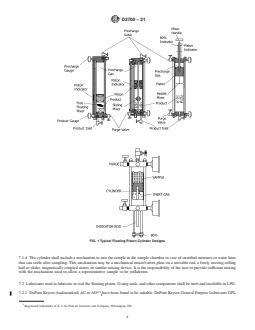
FIG. 1 Typical Floating Piston Cylinder Designs
NOTE 3—The appropriate tables for conversion of LPG volume or
7.1.3.1 Floating piston cylinders that are not equipped with
densityasafunctionoftemperatureare:MNLTP27,ManualonPetroleum
a piston position indicator shall not be used without a proce-
Measurement Standards, Chapter 11–Physical Properties Data, Section 2,
dure to allow the operator to verify fill volume immediately
Part 4–Temperature Correction for the Volume of NGL and LPG Tables
after sampling and prior to transport. Consult the authority
23E, 24E, 53E, 59E, and 60E; or GPA Midstream Technical Publication
TP-27.
having jurisdiction for acceptable procedures.
7.1.4 The cylinder shall include a mechanism to mix the
7.1.3 Piston Position Indicator—TheFPCshallbeequipped
with a piston position indicator such as a magnetic follower, sample in the sample chamber in case of stratified mixtures or
water haze that can settle after sampling. This mechanism may
piston rod, or equivalent which indicates the sample volume to
comply with the maximum percent fill (maximum fill volume) be a mechanical mixer/vortex plate on a movable rod, a freely
allowed for storage and transportation. An outage chamber moving rolling ball or slider, magnetically coupled stirrer, or
with indicating level device may also be used. similar mixing device. It is the responsibility of the user to
D3700 − 21
FIG. 2 Typical Sampling System with Valving
provide sufficient mixing with the mechanism used to allow a (hydraulically locked) from either overfilling or liquid thermal
representative sample to be withdrawn. expansion from excessive temperature increase.
7.3.1 A rupture disk or a self-resetting pressure relief valve
7.2 Lubricants used to lubricate or seal the floating piston,
shall be fitted to the cylinder to prevent overpressure from
O-ring seals, and other components shall be inert and insoluble
hydraulic filling due to temperature increase. A self-resetting
in LPG.
4,5
pressure relief valve (“poppet valve”) is preferred.
7.2.1 DuPont Krytox (trademarked)AC orAD have been
4,5
7.3.1.1 DuPont KEL-F has been found to be suitable.
found to be suitable. DuPont Krytox General Purpose Lubri-
4,5
7.3.1.2 Polytetrafluoroethylene (PTFE) or other materials
cants GPL107 (viscous oil) and GPL201 (light grease) have
been found to be suitable in floating piston cylinders, and are that are prone to creep under pressure, and metal-to-metal
valve seals are not recommended.
less costly than the aerospace grades [AC and AD] of PTFE
lubricants. These lubricants are insoluble in aliphatic/aromatic
7.3.2 Users may not alter valves or safety relief devices that
hydrocarbons, water, caustic, amines, and glycols. are required as part of a cylinder permit or exemption.
7.2.2 Some common grades of silicone based ‘O’ ring
7.3.2.1 The USA has an exemption system and Canada has
lubricants have been successfully used for LPG due to the low
a permitting procedure for non-ASME or DOT cylinders.
solvency of light paraffinic hydrocarbons such as propane and
7.4 Sampling System—It is not possible to provide a single
butanes. However, these lubricants are quickly removed by
procedure that will be applicable for all sampling situations.
aromatic hydrocarbons and crude oils, and are not recom-
Different procedures and sampling equipment may be required
mended for this service.
for sampling pipes, storage tanks, rail cars, trucks, and smaller
NOTE 4—The use of lubricants that are soluble in hydrocarbon samples
storage vessels in order to obtain a representative sample (see
will result in contamination of the sample and loss of sealing integrity of
the floating piston. 4.2).
7.4.1 Sample equipment and procedures shall be designed
7.3 A safety relief device is required to prevent over-
and used to obtain representative samples of a product, and to
pressure in the event that a cylinder becomes fully liquid filled
maintain sample integrity for the tests being performed. A
typical sampling system for LPG flowing in a pipe is shown in
Fig. 2.
Registered trademarks of E. I. du Pont de Nemours and Company,Wilmington,
DE.
NOTE 5—While not required by this practice, the use of a sample probe
The sole source of supply of the apparatus known to the committee at this time
in a flowing line is recommended. The sample probe should be located on
isE.I.duPontdeNemoursandCompany,http://www.dupont.com.Ifyouareaware
the top or side of a line, extending into the center third of the flowing
of alternative suppliers, please provide this information to ASTM International
Headquarters.Your comments will receive careful consideration at a meeting of the stream. Sample points should not be installed on the bottom of a line,
responsible technical committee, which you may attend. unless provisions are made to flush any accumulated debris from the
D3700 − 21
FIG. 3 Typical Sample Probe Installation on Orifice Fitting
sample point immediately prior to sampling.The sample probe should not
7.4.5 Sample loops should preferably be installed around
be horizontal; rather it should have enough elevation to be sure any heavy
pumps, valves, or other sources of pressure drop to minimize
contaminants that might be encountered, including water, will tend to
atmospheric emissions from purging of sample lines.
drain out of it. The probe should be placed in a horizontal piece of pipe
and within 45 degrees of vertical for ordinary sampling. 7.4.5.1 Do not install sample loops around a meter, as
To determine sediment and water in a condensate sample, the probe tip
bypassing the meter can create a bias in measurement and error
should be placed after a static mixing system to ensure it samples the
in indicated volume.
mixed stream and collects a representative sample of the full stream. In
7.4.6 Sampling pumps or other means of controlling pres-
general, it is recommended that these sample systems are in a vertical run
sures higher than the vapor pressure of the sample may be
of pipe following a static mixer, with downward flow through the mixer
and then the sample point. In this case, with a vertical piping run, a
acceptable, and may be used to flush the lines or the cylinder
horizontal probe is recommended.
dead volume, or both, if any, prior to sample collection. The
NOTE 6—Reactive materials should be tested as soon as possible after
cylinder may be partially filled and then emptied prior to
they are collected. When accurate determinations are absolutely critical,
collection of the sample as an alternative to venting hydrocar-
consideration should be given to use of portable or online analytical
equipment to test the product directly at the source, rather than potentially bon to flush lines.
compromising the integrity of the sample during transportation and
7.5 Composite Sampler:
handling.
7.5.1 A composite sampler (also called a proportional sam-
7.4.2 Transfer lines, valves, pressure gauges and so forth in
pler) is a device that is used to obtain a representative sample
the transfer system shall be corrosion resistant (typically
from a flowing product stream by accumulating small portions
stainless steel) and designed consistent with maximum antici-
of product over a period of time.The sampling system consists
pated pressure. Experience has shown that the transfer lines
of a sample probe, a means of collecting repetitive small
should have a minimum internal diameter of 3 mm nominal
portions, and a floating piston cylinder to accumulate the total
( ⁄8 in.) and be as short as practical to minimize line blockage
sample. Figs. 5 and 6 show typical sample systems using a
or sample vaporization, or both. The use of filters, dryers,
probe-mounted sample pump (Fig. 5), or a flow-through
needle valves and so forth are not recommended, unless
sample injection valve (Fig. 6).
provisions are made to prevent excessive flow restriction and
7.5.2 Thorough purging of sample lines, pumps, and con-
pressure drop.A“T” junction with a purge valve at the sample
nections to the sample cylinder is necessary to avoid contami-
connection point is recommended to allow purging of the dead
nation of the sample. A suitable purging arrangement at the
volume at the sampler connection. Flexible hose or tubing with
point of sampling shall be provided. This purging arrangement
adequate pressure rating may be used.
maytaketheformofa“T”connectionandpurgingvalve,oran
NOTE 7—While not required by this practice, the use of non-reactive
operating procedure that allows slight loosening of the connec-
and non-absorptive materials is recommended, especially when sampling
tion to vent the dead volume at the sample connection (if
to determine trace levels of reactive or polar materials such as H S and
allowed by the local jurisdiction). Composite sampler systems
water.
shall be designed to minimize dead end lines that could result
7.4.3 Other piping arrangements may be acceptable, but
in the sample not being representative of the LPG source.
may require different flushing procedures prior to sample
7.5.3 Take precautions to avoid vaporization in sample loop
collection. Typical sample loops are shown in Figs. 3 and 4.
lineswhenoperatingneartheequilibriumvaporpressureofthe
7.4.4 Sample loops that are closed side stream samplers
LPG. To control the pressure or temperature of sample
designed to minimize volatile light end losses during sampling
containers, it may be necessary either to cool or insulate the
may be used. The sample loop system shall be connected to
sample line and sample container, or both.
on-line analyzers or composite samplers in a manner that
ensures sample integrity is maintained for the tests being 7.5.4 Ensure that the pressure at the sample point is above
performed. the vapor pressure of the sample to avoid vaporization in the
D3700 − 21
FIG. 4 Typical Sample Probe Installation for a Pump-Assisted Sample Loop System
FIG. 5 Typical Sampler Using an Injection Pump for Composite Sampling
pipe or sampling lines when using a device such as an orifice rate to prevent overfilling of the sample container, considering
plate or valve to create a pressure differential for sampling. the sample size, maximum anticipated flow rates and time
7.5.5 The floating piston cylinder shall be connected to the periods.Incorrectoperationcanresultinaliquidfilledcylinder
purged sample line of the composite sampler. Apply inert gas that does not have a representative sample, since sampling
pressure (pre-charge gas) to the cylinder to force the piston to might have stopped prior to the end of the sampling period, or
the sample point end of the FPC. Maintain the inert gas preferential release of light ends occurred (depending upon
pressure at a pressure that exceeds the equilibrium vapor venting configuration).
pressure of the fluid sampled under the expected temperature 7.5.7 Adjust the total volume taken over the sampling
conditionsbyabout350 kPato1400kPa(50 psito200psi).At periodinproportiontotheflowrateoftheproductbyadjusting
pressure differences less than about 350 kPa (50 psi), there is each incremental sample volume taken by the sampling valve,
an increasing chance of non-representative samples. Transient or adjusting the frequency of incremental samples, or both.
pressure fluctuation below the vapor pressure can result in 7.5.8 The floating piston cylinder used in the above system
non-representative samples. may be removed from the composite sampling device after the
7.5.6 Adjust the automatic sample injection valve to obtain desired sample has been collected.
incremental samples at a rate such that the floating piston 7.5.9 Do not take outage or reduce pressure on the cylinder.
cylinder will have adequate capacity to hold the combined Check valves for leaks, cap valves with the correct fittings, and
sample aliquots during its period of sampling. Set the sampling use pipe tape on pipe threads to protect threads. Prepare the
D3700 − 21
FIG. 6 Typical Automatic Proportional Sampler for Composite Sampling
sample information tag and box for transport according to the 7.5.12 Sample Filters—The sample filter is an optional
Department of Transportation or other applicable requirements device used to protect the sampling valve from scoring due to
of the authority having jurisdiction. the presence of foreign contaminants such as metal shavings,
7.5.10 If it is not possible to disconnect the primary floating dirt, and so forth. If a filter is used, the filter should be of a
piston cylinder from the automatic system, mix the sample in small total volume, of an inline-type design, and contain a
the primary cylinder to homogenize it and transfer sample to a replaceable/disposable element. (Warning—Be aware that
secondary floating piston cylinder. Proceed as in 9.2.1, treating usingfiltersorstrainerscanentrapwaterandothercomponents
the primary cylinder as a flowing sou
...
This document is not an ASTM standard and is intended only to provide the user of an ASTM standard an indication of what changes have been made to the previous version. Because
it may not be technically possible to adequately depict all changes accurately, ASTM recommends that users consult prior editions as appropriate. In all cases only the current version
of the standard as published by ASTM is to be considered the official document.
Designation: D3700 − 16 D3700 − 21
Standard Practice for
Obtaining LPG Samples Using a Floating Piston Cylinder
This standard is issued under the fixed designation D3700; the number immediately following the designation indicates the year of
original adoption or, in the case of revision, the year of last revision. A number in parentheses indicates the year of last reapproval. A
superscript epsilon (´) indicates an editorial change since the last revision or reapproval.
1. Scope*
1.1 This practice covers the equipment and procedures for obtaining a representative sample of liquefied petroleum gas (LPG),
such as specified in ASTM Specification D1835, GPA 2140, and comparable international standards. It may also be used for other
natural gas liquid (NGL) products that are normally single phase (for example, NGL mix, field butane, and so forth), defined in
other industry specifications or contractual agreements, and for volatile (higher vapor pressure) crude oils.
NOTE 1—Some floating piston cylinders have such tight piston seals that the vapor pressure of some high vapor pressure crude oils may not be sufficient
to allow sampling without a handle to move the piston. An alternative sampling practice for UN Class 3 liquids (under 300 kPa at 52 °C) is Practice
D8009, which utilizes a Manual Piston Cylinder (MPC) sampler.
1.2 This practice is not intended for non-specification products that contain significant quantities of undissolved gases (N , CO ),
2 2
free water or other separated phases, such as raw or unprocessed gas/liquids mixtures and related materials. The same equipment
can be used for these purposes, but additional precautions are generally needed to obtain representative samples of multi-phase
products (see Appendix X1).
1.3 This practice includes recommendations for the location of a sample point in a line or vessel. It is the responsibility of the user
to ensure that the sampling point is located so as to obtain a representative sample.
1.4 The values stated in SI units are to be regarded as standard.
1.4.1 Exception—The values given in parentheses are for information only.
1.5 This standard does not purport to address all of the safety concerns, if any, associated with its use. It is the responsibility
of the user of this standard to establish appropriate safety safety, health, and healthenvironmental practices, and determine the
applicability of regulatory limitations prior to use.
1.6 This international standard was developed in accordance with internationally recognized principles on standardization
established in the Decision on Principles for the Development of International Standards, Guides and Recommendations issued
by the World Trade Organization Technical Barriers to Trade (TBT) Committee.
2. Referenced Documents
2.1 ASTM Standards:
D1265 Practice for Sampling Liquefied Petroleum (LP) Gases, Manual Method
This practice is under the jurisdiction of ASTM Committee D02 on Petroleum Products, Liquid Fuels, and Lubricants and is the direct responsibility of Subcommittee
D02.H0 on Liquefied Petroleum Gas.
Current edition approved Oct. 1, 2016Dec. 1, 2021. Published October 2016December 2021. Originally approved in 1978. Last previous edition approved in 20142016
as D3700 – 14.16. DOI: 10.1520/D3700-16.10.1520/D3700-21.
For referenced ASTM standards, visit the ASTM website, www.astm.org, or contact ASTM Customer Service at service@astm.org. For Annual Book of ASTM Standards
volume information, refer to the standard’s Document Summary page on the ASTM website.
*A Summary of Changes section appears at the end of this standard
Copyright © ASTM International, 100 Barr Harbor Drive, PO Box C700, West Conshohocken, PA 19428-2959. United States
D3700 − 21
D1835 Specification for Liquefied Petroleum (LP) Gases
D4175 Terminology Relating to Petroleum Products, Liquid Fuels, and Lubricants
D8009 Practice for Manual Piston Cylinder Sampling for Volatile Crude Oils, Condensates, and Liquid Petroleum Products
2.2 GPA Midstream Association Standards:
GPA 2140 Liquefied Petroleum Gas Specifications and Test Methods
GPA 2174 Obtaining Liquid Hydrocarbon Samples for Analysis by Gas Chromatography
3. Terminology
3.1 Definitions:
3.1.1 For definitions of terms used in this practice, refer to Terminology D4175.
3.1.2 floating piston cylinder (FPC), n—a high pressure sample container, with a free floating internal piston that effectively
divides the container into two separate compartments.
3.1.2.1 Discussion—
A floating piston cylinder is used to collect a sample of liquid under pressure without the formation of a gaseous phase which can
result in changes in the composition of the liquid sample.
3.1.3 maximum fill volume (reduced fill volume), n—the volume of a container that may be safely occupied by the liquid sample,
usually expressed as a percentage of the total capacity.
3.1.3.1 Discussion—
Some regulatory agencies use the expressions “maximum fill density” and “reduced fill density.”
4. Summary of Practice
4.1 A liquid petroleum gas (LPG) sample is transferred as a liquid under pressure from a sample point to a floating piston cylinder.
The floating piston cylinder (FPC) is designed to collect liquid samples with no vaporization by displacing a piston against a
pressurizing fluid (preferably an inert gas). The piston serves as a physical barrier between the sample and the pressurizing fluid,
at the sampling pressure. The position of the piston at the end of sampling indicates the percent fill of the sample cylinder.
4.2 It is the responsibility of the user of this practice to locate the sample point at a suitable location and orientation where the
product being sampled is a representative, single phase, homogeneous liquid.
5. Significance and Use
5.1 This practice allows the collection of a representative sample of LPG that may contain trace volatile dissolved components
such as methane, ethane, and nitrogen. Sampling by Practice D1265 can result in a small, but predictable, loss of these lighter
components. Practice D1265 is suitable for collecting samples for routine specification testing, as the small loss of light
components is not significant under Specification D1835 specification requirements. Practice D3700 is recommended whenever
highly accurate determination of light components is required. For example, compositions determined on samples collected
according to Practice D3700 may be used to establish the product value of NGL mixtures (see Appendix X1).
6. Interferences
6.1 An interference in a sampling procedure is anything which compromises the integrity of the sample.
6.2 Incorrect choice of a sample point location can result in a non-representative sample due to solid or liquid contaminants, two
phases, storage tank stratification, and so forth.
6.3 Reactivity of steel surfaces can remove or chemically alter trace reactive components such as H S, COS, and mercaptan.
6.4 A lubricant used on the floating piston or other internal wetted parts that is soluble in LPG can contaminate the sample.
6.5 Pre-charge (inert) gas can leak into the sample due to worn or damaged piston seals or poor surface finish (see 8.1).
Available from GPA Midstream Association, 6526 E. 60th St., Tulsa, OK 74145, www.gpaglobal.org
D3700 − 21
6.5.1 Consult the manufacturer’s guidelines for suitable procedures to verify a leak-free cylinder, such as pressure testing each side
of the cylinder. It is also possible to analyze the sample for inert gas, or the inert gas for hydrocarbon, to detect leakage in either
direction.
6.6 Failure to flush sample lines and dead volumes can result in contaminants in samples.
6.7 Sampling from stratified tanks, dead zones in flowing systems, or inappropriate time periods in composite sampling systems
can result in non-representative samples.
6.8 Any material that can create carryover contamination from one sample to the next has to be removed from the cylinder and
the cylinder shall be thoroughly cleaned. In addition to cleaning the interior metal surfaces and cleaning the soft parts (O-rings,
for example), consideration should be given to replacing the soft parts if they might have absorbed any contamination. Examples
of contaminants include glycol, amine, lubricants, sulfur species, solvents, methanol, etc.
7. Apparatus
7.1 Floating Piston Cylinder (FPC):
7.1.1 Construction, typically fabricated from corrosion resistant 316 stainless steel, in accordance with the pressure vessel
certification requirements in the jurisdictions in which it is to be used, and through which it will be transported. Protective internal
coatings or surface treatments are acceptable provided that they do not adversely affect the free movement of the piston, or
effectiveness of the seals (see Fig. 1).
7.1.1.1 Users should consult with the manufacturer of these sample cylinders and sample collection systems any time ambient or
product temperatures, or both, exceed the range of –29 °C (–20 °F) to 60 °C (140 °F). Extreme temperature effects upon metal,
O-rings, valve seats, seals, gauges, relief devices, sample pump components and other devices and components in the system
should be assessed in a hazards analysis before any sampling takes place.
NOTE 2—At present, there is no international approval process for pressure cylinders. Cylinders require appropriate approval in each jurisdiction in which
they are used or transported.
7.1.2 Volume of Sample—The minimum volume required is determined by the combined volumes required by each of the tests
to be performed, typically 400 mL (that is, 80 % of a 500 mL sample cylinder at 15 °C).
7.1.2.1 For safe handling of these cylinders under extremes of product or ambient temperatures, or both, the user shall consider
the effects of thermal expansion on the volume of product in the cylinder. For example, if a product is sampled at –40 °C (–40 °F),
the user shall plan for the cylinder and sample to warm considerably during transport and before analysis is performed in the
laboratory. During summer months, the temperature of the cylinder and product could reasonably be expected to rise to as high
as 46 °C (115 °F) in hot environments. A cylinder initially filled cold to 80 % of its capacity will, upon warming, be over-pressured
and the relief device(s) will activate under these conditions. Hydrocarbon releases of this type are unexpected and dangerous. In
such an extreme, but not uncommon case, the cylinder should not be filled more than approximately 60 % of its capacity during
the initial fill. Users should review ASTM/API/GPA Midstream volume correction factor calculations, or data from similar
samples, or both, to determine the maximum fill for the product and conditions being sampled, but should always leave at least
10 % vapor space after allowing for the worst likely case of thermal expansion.
NOTE 3—The appropriate tables for conversion of LPG volume or density as a function of temperature are: MNLTP27, Manual on Petroleum
Measurement Standards, Chapter 11–Physical Properties Data, Section 2, Part 4–Temperature Correction for the Volume of NGL and LPG Tables 23E,
2 3
24E, 53E, 59E, and 60E; or GPA Midstream Technical Publication TP-27.
7.1.3 Piston Position Indicator—The FPC shall be equipped with a piston position indicator such as a magnetic follower, piston
rod, or equivalent which indicates the sample volume to comply with the maximum percent fill (maximum fill volume) allowed
for storage and transportation. An outage chamber with indicating level device may also be used.
7.1.3.1 Floating piston cylinders that are not equipped with a piston position indicator shall not be used without a procedure to
allow the operator to verify fill volume immediately after sampling and prior to transport. Consult the authority having jurisdiction
for acceptable procedures.
D3700 − 21
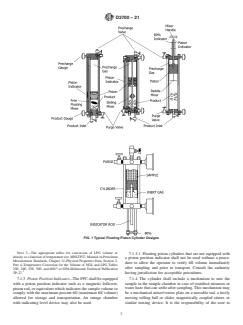
FIG. 1 Typical Floating Piston Cylinder Designs
7.1.4 The cylinder shall include a mechanism to mix the sample in the sample chamber in case of stratified mixtures or water haze
that can settle after sampling. This mechanism may be a mechanical mixer/vortex plate on a movable rod, a freely moving rolling
ball or slider, magnetically coupled stirrer, or similar mixing device. It is the responsibility of the user to provide sufficient mixing
with the mechanism used to allow a representative sample to be withdrawn.
7.2 Lubricants used to lubricate or seal the floating piston, O-ring seals, and other components shall be inert and insoluble in LPG.
4,5
7.2.1 DuPont Krytox (trademarked) AC or AD have been found to be suitable. DuPont Krytox General Purpose Lubricants GPL
Registered trademarks of E. I. du Pont de Nemours and Company, Wilmington, DE.
D3700 − 21
4,5
107 (viscous oil) and GPL 201 (light grease) have been found to be suitable in floating piston cylinders, and are less costly than
the aerospace grades [AC and AD] of PTFE lubricants. These lubricants are insoluble in aliphatic/aromatic hydrocarbons, water,
caustic, amines, and glycols.
7.2.2 Some common grades of silicone based ‘O’ ring lubricants have been successfully used for LPG due to the low solvency
of light paraffinic hydrocarbons such as propane and butanes. However, these lubricants are quickly removed by aromatic
hydrocarbons and crude oils, and are not recommended for this service.
NOTE 4—The use of lubricants that are soluble in hydrocarbon samples will result in contamination of the sample and loss of sealing integrity of the
floating piston.
7.3 A safety relief device is required to prevent over-pressure in the event that a cylinder becomes fully liquid filled (hydraulically
locked) from either overfilling or liquid thermal expansion from excessive temperature increase.
7.3.1 A rupture disk or a self-resetting pressure relief valve shall be fitted to the cylinder to prevent overpressure from hydraulic
filling due to temperature increase. A self-resetting pressure relief valve (“poppet valve”) is preferred.
4,5
7.3.1.1 DuPont KEL-F has been found to be suitable.
7.3.1.2 Polytetrafluoroethylene (PTFE) or other materials that are prone to creep under pressure, and metal-to-metal valve seals
are not recommended.
7.3.2 Users may not alter valves or safety relief devices that are required as part of a cylinder permit or exemption.
7.3.2.1 The USA has an exemption system and Canada has a permitting procedure for non-ASME or DOT cylinders.
7.4 Sampling System—It is not possible to provide a single procedure that will be applicable for all sampling situations. Different
procedures and sampling equipment may be required for sampling pipes, storage tanks, rail cars, trucks, and smaller storage vessels
in order to obtain a representative sample (see 4.2).
7.4.1 Sample equipment and procedures shall be designed and used to obtain representative samples of a product, and to maintain
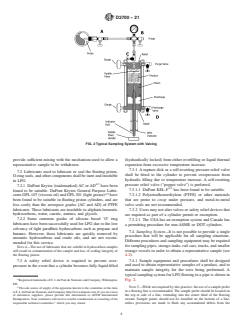
sample integrity for the tests being performed. A typical sampling system for LPG flowing in a pipe is shown in Fig. 2.
NOTE 5—While not required by this practice, the use of a sample probe in a flowing line is recommended. The sample probe should be located on the
top or side of a line, extending into the center third of the flowing stream. Sample points should not be installed on the bottom of a line, unless provisions
are made to flush any accumulated debris from the sample point immediately prior to sampling. The sample probe should not be horizontal; rather it
should have enough elevation to be sure any heavy contaminants that might be encountered, including water, will tend to drain out of it. The probe should
be placed in a horizontal piece of pipe and within 45 degrees of vertical for ordinary sampling.
To determine sediment and water in a condensate sample, the probe tip should be placed after a static mixing system to ensure it samples the mixed
stream and collects a representative sample of the full stream. In general, it is recommended that these sample systems are in a vertical run of pipe
following a static mixer, with downward flow through the mixer and then the sample point. In this case, with a vertical piping run, a horizontal probe
is recommended.
NOTE 6—Reactive materials should be tested as soon as possible after they are collected. When accurate determinations are absolutely critical,
consideration should be given to use of portable or online analytical equipment to test the product directly at the source, rather than potentially
compromising the integrity of the sample during transportation and handling.
7.4.2 Transfer lines, valves, pressure gauges and so forth in the transfer system shall be corrosion resistant (typically stainless
steel) and designed consistent with maximum anticipated pressure. Experience has shown that the transfer lines should have a
minimum internal diameter of 3 mm nominal ( ⁄8 in.) and be as short as practical to minimize line blockage or sample vaporization,
or both. The use of filters, dryers, needle valves and so forth are not recommended, unless provisions are made to prevent excessive
flow restriction and pressure drop. A “T” junction with a purge valve at the sample connection point is recommended to allow
purging of the dead volume at the sampler connection. Flexible hose or tubing with adequate pressure rating may be used.
NOTE 7—While not required by this practice, the use of non-reactive and non-absorptive materials is recommended, especially when sampling to
determine trace levels of reactive or polar materials such as H S and water.
The sole source of supply of the apparatus known to the committee at this time is E. I. du Pont de Nemours and Company, http://www.dupont.com. If you are aware
of alternative suppliers, please provide this information to ASTM International Headquarters. Your comments will receive careful consideration at a meeting of the responsible
technical committee, which you may attend.
D3700 − 21
FIG. 2 Typical Sampling System with Valving
7.4.3 Other piping arrangements may be acceptable, but may require different flushing procedures prior to sample collection.
Typical sample loops are shown in Figs. 3 and 4.
7.4.4 Sample loops that are closed side stream samplers designed to minimize volatile light end losses during sampling may be
used. The sample loop system shall be connected to on-line analyzers or composite samplers in a manner that ensures sample
integrity is maintained for the tests being performed.
7.4.5 Sample loops should preferably be installed around pumps, valves, or other sources of pressure drop to minimize
atmospheric emissions from purging of sample lines.
7.4.5.1 Do not install sample loops around a meter, as bypassing the meter can create a bias in measurement and error in indicated
volume.
7.4.6 Sampling pumps or other means of controlling pressures higher than the vapor pressure of the sample may be acceptable,
and may be used to flush the lines or the cylinder dead volume, or both, if any, prior to sample collection. The cylinder may be
partially filled and then emptied prior to collection of the sample as an alternative to venting hydrocarbon to flush lines.
7.5 Composite Sampler:
7.5.1 A composite sampler (also called a proportional sampler) is a device that is used to obtain a representative sample from a
flowing product stream by accumulating small portions of product over a period of time. The sampling system consists of a sample
probe, a means of collecting repetitive small portions, and a floating piston cylinder to accumulate the total sample. Figs. 5 and
6 show typical sample systems using a probe-mounted sample pump (Fig. 5), or a flow-through sample injection valve (Fig. 6).
7.5.2 Thorough purging of sample lines, pumps, and connections to the sample cylinder is necessary to avoid contamination of
the sample. A suitable purging arrangement at the point of sampling shall be provided. This purging arrangement may take the form
of a “T” connection and purging valve, or an operating procedure that allows slight loosening of the connection to vent the dead
volume at the sample connection (if allowed by the local jurisdiction). Composite sampler systems shall be designed to minimize
dead end lines that could result in the sample not being representative of the LPG source.
D3700 − 21
FIG. 3 Typical Sample Probe Installation on Orifice Fitting
FIG. 4 Typical Sample Probe Installation for a Pump-Assisted Sample Loop System
7.5.3 Take precautions to avoid vaporization in sample loop lines when operating near the equilibrium vapor pressure of the LPG.
To control the pressure or temperature of sample containers, it may be necessary either to cool or insulate the sample line and
sample container, or both.
7.5.4 Ensure that the pressure at the sample point is above the vapor pressure of the sample to avoid vaporization in the pipe or
sampling lines when using a device such as an orifice plate or valve to create a pressure differential for sampling.
7.5.5 The floating piston cylinder shall be connected to the purged sample line of the composite sampler. Apply inert gas pressure
(pre-charge gas) to the cylinder to force the piston to the sample point end of the FPC. Maintain the inert gas pressure at a pressure
that exceeds the equilibrium vapor pressure of the fluid sampled under the expected temperature conditions by about 350350 kPa
to 1400 kPa (50(50 psi to 200 psi). At pressure differences less than about 350 kPa (50 psi), there is an increasing chance of
non-representative samples. Transient pressure fluctuation below the vapor pressure can result in non-representative samples.
7.5.6 Adjust the automatic sample injection valve to obtain incremental samples at a rate such that the floating piston cylinder will
have adequate capacity to hold the combined sample aliquots during its period of sampling. Set the sampling rate to prevent
overfilling of the sample container, considering the sample size, maximum anticipated flow rates and time periods. Incorrect
operation can result in a liquid filled cylinder that does not have a representative sample, since sampling might have stopped prior
to the end of the sampling period, or preferential release of light ends occurred (depending upon venting configuration).
7.5.7 Adjust the total volume taken over the sampling period in proportion to the flow rate of the product by adjusting each
incremental sample volume taken by the sampling valve, or adjusting the frequency of incremental samples, or both.
7.5.8 The floating piston cylinder used in the above system may be removed from the composite sampling device after the desired
sample has been collected.
7.5.9 Do not take outage or reduce pressure on the cylinder. Check valves for leaks, cap valves with the correct fittings, and use
D3700 − 21
FIG. 5 Typical Sampler Using an Injection Pump for Composite Sampling
FIG. 6 Typical Automatic Proportional Sampler for Composite Sampling
pipe tape on pipe threads to protect threads. Prepare the sample information tag and box for transport according to the Department
of Transportation or other applicable requirements of the authority having jurisdiction.
D3700 − 21
7.5.10 If it is not possible to disconnect the primary floating piston cylinder from the automatic system, mix the sample in the
primary cylinder to homogenize it and transfer sample to a secondary floating piston cylinder. Proceed as in 9.2.1, treating the
primary cylinder as a flowing source. In this particular transfer situation, as sample is withdrawn, the master sample container will
partially depressurize. Maintain the pre-charge (inert gas) pressure above the product vapor pressure at the existing master sampler
temperature to prevent flashing. (Warning—The cylinder shall not be filled beyond 80 % of its capacity with sample. In the event
of an inadvertent over fill, samp
...