

ASTM D8029-23
(Specification)Standard Specification for Biodegradable, Low Aquatic Toxicity Hydraulic Fluids
General Information
- Abstract
ABSTRACT
This specification covers performance requirements for biodegradable hydraulic fluids with low aquatic toxicity used in industrial/mobile hydraulic applications. There are some cases where biodegradable fluids have been found to perform differently than traditional mineral oils, which makes separate performance requirements desirable.
SCOPE
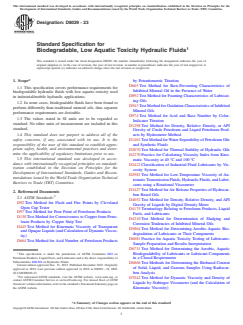
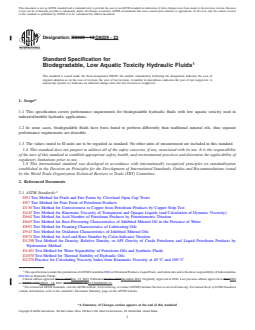
1.1 This specification covers performance requirements for biodegradable hydraulic fluids with low aquatic toxicity used in industrial/mobile hydraulic applications.
1.2 In some cases, biodegradable fluids have been found to perform differently than traditional mineral oils, thus separate performance requirements are desirable.
1.3 The values stated in SI units are to be regarded as standard. No other units of measurement are included in this standard.
1.4 This standard does not purport to address all of the safety concerns, if any, associated with its use. It is the responsibility of the user of this standard to establish appropriate safety, health, and environmental practices and determine the applicability of regulatory limitations prior to use.
1.5 This international standard was developed in accordance with internationally recognized principles on standardization established in the Decision on Principles for the Development of International Standards, Guides and Recommendations issued by the World Trade Organization Technical Barriers to Trade (TBT) Committee.
- Status
- Published
- Publication Date
- 14-Dec-2023
- Technical Committee
- D02 - Petroleum Products, Liquid Fuels, and Lubricants
- Drafting Committee
- D02.N0 - Hydraulic Fluids
Buy Documents
ASTM D8029-23 - Standard Specification for Biodegradable, Low Aquatic Toxicity Hydraulic Fluids
REDLINE ASTM D8029-23 - Standard Specification for Biodegradable, Low Aquatic Toxicity Hydraulic Fluids
Overview
ASTM D8029-23, Standard Specification for Biodegradable, Low Aquatic Toxicity Hydraulic Fluids, sets forth performance requirements for hydraulic fluids designed to minimize environmental impact. Specifically, this specification addresses biodegradable hydraulic fluids with low aquatic toxicity suitable for use in industrial and mobile hydraulic systems. As the performance of biodegradable fluids often differs from that of traditional mineral-based oils, the standard outlines separate criteria to ensure safety, efficiency, and reduced ecological risks. Using clearly defined SI units, the specification supports international alignment and best practices in the lubricants and fluids industry.
Key Topics
- Biodegradability: The fluids must achieve a specified level of biodegradation, confirming they break down in the environment more rapidly than conventional hydraulic fluids.
- Low Aquatic Toxicity: The standard requires fluids to demonstrate minimal harm to aquatic life, as verified by standardized toxicity tests.
- Performance Requirements:
- Physical properties such as viscosity, flash point, pour point, and rust prevention must meet strict thresholds.
- Elastomer compatibility and foam resistance are essential to ensure safe and effective operation in various equipment.
- Detailed requirements for oxidation stability, water separability, and wear inhibition are included to maximize fluid longevity and protect machinery.
- Regulatory Compliance: The specification helps users align with global regulatory requirements for environmental safety, as evidenced by cross-references to relevant EPA and OECD test methods.
- Testing and Certification: Good Laboratory Practices (GLP) and ISO 17025 requirements are recommended for all testing, ensuring reliable and internationally accepted results.
Applications
ASTM D8029-23 provides significant value across industries where hydraulic systems are commonplace and where environmental protection is a priority. Key applications include:
- Industrial and Mobile Equipment: Construction, mining, agriculture, forestry, and municipal machinery often operate near sensitive water bodies and ecologically vulnerable sites. Using biodegradable, low toxicity hydraulic fluids reduces potential impacts from leaks and spills.
- Marine and Offshore: Vessels, ports, and offshore platforms can benefit from these fluids, as unintentional releases pose a pronounced risk to aquatic ecosystems.
- Environmentally Sensitive Projects: Any project governed by strict environmental standards or international sustainability guidelines will find compliance with ASTM D8029-23 advantageous for meeting permit and regulatory expectations.
- OEM Specifications: Equipment manufacturers adopting sustainable practices may specify compliant fluids to enhance the environmental profile of their products.
Related Standards
For a comprehensive approach to hydraulic fluid selection and environmental stewardship, ASTM D8029-23 references several related standards, including but not limited to:
- ASTM D5864: Test Method for Determining Aerobic Aquatic Biodegradation of Lubricants or Their Components
- ASTM D6731: Test Method for Aerobic, Aquatic Biodegradability of Lubricants in a Closed Respirometer
- ASTM D665: Rust-Preventing Characteristics of Inhibited Mineral Oil in the Presence of Water
- ASTM D445: Kinematic Viscosity of Transparent and Opaque Liquids
- ASTM D892: Foaming Characteristics of Lubricating Oils
- ASTM D7752: Practice for Evaluating Compatibility of Hydraulic Fluid Mixtures
- ISO 6072: Compatibility between Hydraulic Fluids and Standard Elastomers
- OECD 301: Ready Biodegradability
- EPA OPPTS 850 series: Aquatic Toxicity Tests
Practical Value
Adopting ASTM D8029-23 supports organizations in reducing environmental liabilities, complying with international environmental regulations, and embracing sustainable fluid management. It offers a scientifically rigorous method for specifying, testing, and verifying that hydraulic fluids contribute to lower ecological risks, cleaner operations, and safer workplaces. Environmental managers, equipment designers, and maintenance professionals all benefit from the clear, harmonized guidance provided by this important ASTM standard.
Relations
- Replaces
ASTM D8029-18 - Standard Specification for Biodegradable, Low Aquatic Toxicity Hydraulic Fluids - Effective Date
- 15-Dec-2023
- Effective Date
- 01-Apr-2024
- Effective Date
- 01-Mar-2024
- Effective Date
- 01-Feb-2024
- Refers
ASTM D4175-23a - Standard Terminology Relating to Petroleum Products, Liquid Fuels, and Lubricants - Effective Date
- 15-Dec-2023
- Effective Date
- 01-Dec-2023
- Effective Date
- 01-Nov-2023
- Refers
ASTM D4175-23e1 - Standard Terminology Relating to Petroleum Products, Liquid Fuels, and Lubricants - Effective Date
- 01-Jul-2023
- Effective Date
- 01-Jul-2023
- Effective Date
- 01-Nov-2022
- Effective Date
- 15-Mar-2022
- Effective Date
- 01-Dec-2019
- Effective Date
- 15-Jul-2017
Buy Documents
ASTM D8029-23 - Standard Specification for Biodegradable, Low Aquatic Toxicity Hydraulic Fluids
REDLINE ASTM D8029-23 - Standard Specification for Biodegradable, Low Aquatic Toxicity Hydraulic Fluids
Get Certified
Connect with accredited certification bodies for this standard

Element Materials Technology
Materials testing and product certification.

ABS Group Brazil
ABS Group certification services in Brazil.

ABS Quality Evaluations Inc.
American Bureau of Shipping quality certification.
Sponsored listings
Frequently Asked Questions
ASTM D8029-23 is a technical specification published by ASTM International. Its full title is "Standard Specification for Biodegradable, Low Aquatic Toxicity Hydraulic Fluids". This standard covers: ABSTRACT This specification covers performance requirements for biodegradable hydraulic fluids with low aquatic toxicity used in industrial/mobile hydraulic applications. There are some cases where biodegradable fluids have been found to perform differently than traditional mineral oils, which makes separate performance requirements desirable. SCOPE 1.1 This specification covers performance requirements for biodegradable hydraulic fluids with low aquatic toxicity used in industrial/mobile hydraulic applications. 1.2 In some cases, biodegradable fluids have been found to perform differently than traditional mineral oils, thus separate performance requirements are desirable. 1.3 The values stated in SI units are to be regarded as standard. No other units of measurement are included in this standard. 1.4 This standard does not purport to address all of the safety concerns, if any, associated with its use. It is the responsibility of the user of this standard to establish appropriate safety, health, and environmental practices and determine the applicability of regulatory limitations prior to use. 1.5 This international standard was developed in accordance with internationally recognized principles on standardization established in the Decision on Principles for the Development of International Standards, Guides and Recommendations issued by the World Trade Organization Technical Barriers to Trade (TBT) Committee.
ABSTRACT This specification covers performance requirements for biodegradable hydraulic fluids with low aquatic toxicity used in industrial/mobile hydraulic applications. There are some cases where biodegradable fluids have been found to perform differently than traditional mineral oils, which makes separate performance requirements desirable. SCOPE 1.1 This specification covers performance requirements for biodegradable hydraulic fluids with low aquatic toxicity used in industrial/mobile hydraulic applications. 1.2 In some cases, biodegradable fluids have been found to perform differently than traditional mineral oils, thus separate performance requirements are desirable. 1.3 The values stated in SI units are to be regarded as standard. No other units of measurement are included in this standard. 1.4 This standard does not purport to address all of the safety concerns, if any, associated with its use. It is the responsibility of the user of this standard to establish appropriate safety, health, and environmental practices and determine the applicability of regulatory limitations prior to use. 1.5 This international standard was developed in accordance with internationally recognized principles on standardization established in the Decision on Principles for the Development of International Standards, Guides and Recommendations issued by the World Trade Organization Technical Barriers to Trade (TBT) Committee.
ASTM D8029-23 is classified under the following ICS (International Classification for Standards) categories: 75.120 - Hydraulic fluids. The ICS classification helps identify the subject area and facilitates finding related standards.
ASTM D8029-23 has the following relationships with other standards: It is inter standard links to ASTM D8029-18, ASTM D445-24, ASTM D2070-24, ASTM D6866-24, ASTM D4175-23a, ASTM D665-23, ASTM D445-23, ASTM D4175-23e1, ASTM D2070-23, ASTM D974-22, ASTM D6866-22, ASTM D665-19, ASTM D1298-12b(2017)e1. Understanding these relationships helps ensure you are using the most current and applicable version of the standard.
ASTM D8029-23 is available in PDF format for immediate download after purchase. The document can be added to your cart and obtained through the secure checkout process. Digital delivery ensures instant access to the complete standard document.
Standards Content (Sample)
This international standard was developed in accordance with internationally recognized principles on standardization established in the Decision on Principles for the
Development of International Standards, Guides and Recommendations issued by the World Trade Organization Technical Barriers to Trade (TBT) Committee.
Designation: D8029 − 23
Standard Specification for
Biodegradable, Low Aquatic Toxicity Hydraulic Fluids
This standard is issued under the fixed designation D8029; the number immediately following the designation indicates the year of
original adoption or, in the case of revision, the year of last revision. A number in parentheses indicates the year of last reapproval. A
superscript epsilon (´) indicates an editorial change since the last revision or reapproval.
1. Scope* by Potentiometric Titration
D665 Test Method for Rust-Preventing Characteristics of
1.1 This specification covers performance requirements for
Inhibited Mineral Oil in the Presence of Water
biodegradable hydraulic fluids with low aquatic toxicity used
D892 Test Method for Foaming Characteristics of Lubricat-
in industrial/mobile hydraulic applications.
ing Oils
1.2 In some cases, biodegradable fluids have been found to
D943 Test Method for Oxidation Characteristics of Inhibited
perform differently than traditional mineral oils, thus separate
Mineral Oils
performance requirements are desirable.
D974 Test Method for Acid and Base Number by Color-
1.3 The values stated in SI units are to be regarded as
Indicator Titration
standard. No other units of measurement are included in this
D1298 Test Method for Density, Relative Density, or API
standard.
Gravity of Crude Petroleum and Liquid Petroleum Prod-
1.4 This standard does not purport to address all of the
ucts by Hydrometer Method
safety concerns, if any, associated with its use. It is the
D1401 Test Method for Water Separability of Petroleum Oils
responsibility of the user of this standard to establish appro-
and Synthetic Fluids
priate safety, health, and environmental practices and deter-
D2070 Test Method for Thermal Stability of Hydraulic Oils
mine the applicability of regulatory limitations prior to use.
D2270 Practice for Calculating Viscosity Index from Kine-
1.5 This international standard was developed in accor-
matic Viscosity at 40 °C and 100 °C
dance with internationally recognized principles on standard-
D2422 Classification of Industrial Fluid Lubricants by Vis-
ization established in the Decision on Principles for the
cosity System
Development of International Standards, Guides and Recom-
D2983 Test Method for Low-Temperature Viscosity of Au-
mendations issued by the World Trade Organization Technical
tomatic Transmission Fluids, Hydraulic Fluids, and Lubri-
Barriers to Trade (TBT) Committee.
cants using a Rotational Viscometer
D3427 Test Method for Air Release Properties of Hydrocar-
2. Referenced Documents
bon Based Oils
2.1 ASTM Standards:
D4052 Test Method for Density, Relative Density, and API
D92 Test Method for Flash and Fire Points by Cleveland
Gravity of Liquids by Digital Density Meter
Open Cup Tester
D4175 Terminology Relating to Petroleum Products, Liquid
D97 Test Method for Pour Point of Petroleum Products
Fuels, and Lubricants
D130 Test Method for Corrosiveness to Copper from Petro-
D4310 Test Method for Determination of Sludging and
leum Products by Copper Strip Test
Corrosion Tendencies of Inhibited Mineral Oils
D445 Test Method for Kinematic Viscosity of Transparent
D5864 Test Method for Determining Aerobic Aquatic Bio-
and Opaque Liquids (and Calculation of Dynamic Viscos-
degradation of Lubricants or Their Components
ity)
D6081 Practice for Aquatic Toxicity Testing of Lubricants:
D664 Test Method for Acid Number of Petroleum Products
Sample Preparation and Results Interpretation
D6731 Test Method for Determining the Aerobic, Aquatic
Biodegradability of Lubricants or Lubricant Components
This specification is under the jurisdiction of ASTM Committee D02 on
Petroleum Products, Liquid Fuels, and Lubricants and is the direct responsibility of
in a Closed Respirometer
Subcommittee D02.N0 on Hydraulic Fluids.
D6866 Test Methods for Determining the Biobased Content
Current edition approved Dec. 15, 2023. Published December 2023. Originally
of Solid, Liquid, and Gaseous Samples Using Radiocar-
approved in 2016. Last previous edition approved in 2018 as D8029 – 18. DOI:
10.1520/D8029-23.
bon Analysis
For referenced ASTM standards, visit the ASTM website, www.astm.org, or
D7042 Test Method for Dynamic Viscosity and Density of
contact ASTM Customer Service at service@astm.org. For Annual Book of ASTM
Liquids by Stabinger Viscometer (and the Calculation of
Standards volume information, refer to the standard’s Document Summary page on
the ASTM website. Kinematic Viscosity)
*A Summary of Changes section appears at the end of this standard
Copyright © ASTM International, 100 Barr Harbor Drive, PO Box C700, West Conshohocken, PA 19428-2959. United States
D8029 − 23
D7043 Test Method for Indicating Wear Characteristics of medium—Method by analysis of inorganic carbon in
Non-Petroleum and Petroleum Hydraulic Fluids in a sealed vessels (CO headspace test)
Constant Volume Vane Pump ISO 17025 General requirements for the competence of
D7373 Test Method for Predicting Biodegradability of Lu- testing and calibration laboratories
bricants Using a Bio-kinetic Model (Withdrawn 2021)
D7752 Practice for Evaluating Compatibility of Mixtures of 3. Terminology
Hydraulic Fluids
3.1 Definitions:
2.2 EPA Standards:
3.1.1 For definitions of terms used in this specification, refer
OPPTS 835.3110 Ready Biodegradability
to Terminology D4175.
OPPTS 850.1010 Aquatic Invertebrate Acute Toxicity Test,
3.1.2 acute ecotoxicity, n—the propensity of a test material
Freshwater Daphnids
to produce adverse behavioral, biochemical, or physiological
OPPTS 850.1075 Fish Acute Toxicity Test, Freshwater and
effects in non-human organisms or populations in a short
Marine
period, usually not constituting a substantial portion of their
OPPTS 850.5400 Algal Toxicity, Tiers I and II
life span.
2.3 OECD Standards:
3.1.3 acute ecotoxicity test, n—a comparative ecotoxicity
OECD Test No. 107 Partition Coefficient (N-Octanol/
test in which a representative subpopulation of organisms is
Water), Shake Flask Method
exposed to different treat rates of a test material and is observed
OECD Test No. 117 Partition Coefficient (N-Octanol/Water),
for a short period, usually not constituting a substantial portion
High Performance Liquid Chromatography Method
of their life span.
OECD Test No. 123 Partition Coefficient (1-Octanol/Water):
3.1.4 bioaccumulation, n—the net accumulation of a sub-
Slow-Stirring Method
stance by an organism as a result of uptake from all environ-
OECD Test No. 201 Freshwater Alga and Cyanobacteria,
mental sources.
Growth Inhibition Test
OECD Test No. 202 Daphnia sp. Acute Immobilisation Test
3.1.5 biodegradation, n—the process of chemical break-
OECD Test No. 203 Fish, Acute Toxicity Test
down or transformation of a material caused by organisms or
OECD Test No. 301 Ready Biodegradability
their enzymes.
OECD Test No. 305 Bioaccumulation in Fish: Aqueous and
3.1.5.1 Discussion—Biodegradation is only one mechanism
Dietary Exposure
by which materials are transformed in the environment.
2.4 CEC Standards:
3.1.6 hydraulic fluid, n—a liquid used in hydraulic systems
CEC Test Method L-45-99 Viscosity Shear Stability of
for lubrication and transmission of power.
Transmission Lubricants
2.5 ISO Standards:
4. Biodegradable Hydraulic Fluid Performance
ISO 6072 Rubber—Compatibility between hydraulic fluids
Requirements
and standard elastomeric materials
ISO 9408 Water quality—Evaluation of ultimate aerobic 4.1 Table 1 summarizes the environmental behavior require-
biodegradability of organic compounds in aqueous me- ments.
dium by determination of oxygen demand in a closed
4.2 Table 2 summarizes the physical property and perfor-
respirometer
mance requirements.
ISO 9439 Water quality—Evaluation of ultimate aerobic
4.3 This specfication assumes that all biodegradable hydrau-
biodegradability of organic compounds in aqueous
lic fluids shall have a minimum impact on human health, which
medium—Carbon dioxide evolution test
is documented in the safety data sheet offering a labeling-free
ISO 14593 Water quality—Evaluation of ultimate aerobic
product in accordance with globally harmonized system (GHS)
biodegradability of organic compounds in aqueous
regulation.
The last approved version of this historical standard is referenced on
5. Compatibility of Mixtures of Hydraulic Fluids
www.astm.org.
U.S. EPA Prevention, Pesticides, and Toxic Substances (7101); available from
5.1 As a general guideline, different fluids should not be
United States Environmental Protection Agency (EPA), William Jefferson Clinton
mixed.
Bldg., 1200 Pennsylvania Ave., NW, Washington, DC 20460, http://www.epa.gov.
Available from Organisation for Economic Cooperation and Development
5.2 Compatibility should be evaluated according to Practice
(OECD), 2 rue André Pascal, 75775 Paris Cedex 16, France, http://www.oecd.org.
D7752.
Available from Coordinating European Council (CEC), Services provided by
Kellen Europe, Avenue Jules Bordet 142 - 1140, Brussels, Belgium, http://
www.cectests.org. 6. Keywords
Available from International Organization for Standardization (ISO), ISO
6.1 aquatic toxicity; bioaccumulation; biodegradable; envi-
Central Secretariat, BIBC II, Chemin de Blandonnet 8, CP 401, 1214 Vernier,
Geneva, Swit
...
This document is not an ASTM standard and is intended only to provide the user of an ASTM standard an indication of what changes have been made to the previous version. Because
it may not be technically possible to adequately depict all changes accurately, ASTM recommends that users consult prior editions as appropriate. In all cases only the current version
of the standard as published by ASTM is to be considered the official document.
Designation: D8029 − 18 D8029 − 23
Standard Specification for
Biodegradable, Low Aquatic Toxicity Hydraulic Fluids
This standard is issued under the fixed designation D8029; the number immediately following the designation indicates the year of
original adoption or, in the case of revision, the year of last revision. A number in parentheses indicates the year of last reapproval. A
superscript epsilon (´) indicates an editorial change since the last revision or reapproval.
1. Scope*
1.1 This specification covers performance requirements for biodegradable hydraulic fluids with low aquatic toxicity used in
industrial/mobile hydraulic applications.
1.2 In some cases, biodegradable fluids have been found to perform differently than traditional mineral oils, thus separate
performance requirements are desirable.
1.3 The values stated in SI units are to be regarded as standard. No other units of measurement are included in this standard.
1.4 This standard does not purport to address all of the safety concerns, if any, associated with its use. It is the responsibility
of the user of this standard to establish appropriate safety, health, and environmental practices and determine the applicability of
regulatory limitations prior to use.
1.5 This international standard was developed in accordance with internationally recognized principles on standardization
established in the Decision on Principles for the Development of International Standards, Guides and Recommendations issued
by the World Trade Organization Technical Barriers to Trade (TBT) Committee.
2. Referenced Documents
2.1 ASTM Standards:
D92 Test Method for Flash and Fire Points by Cleveland Open Cup Tester
D97 Test Method for Pour Point of Petroleum Products
D130 Test Method for Corrosiveness to Copper from Petroleum Products by Copper Strip Test
D445 Test Method for Kinematic Viscosity of Transparent and Opaque Liquids (and Calculation of Dynamic Viscosity)
D664 Test Method for Acid Number of Petroleum Products by Potentiometric Titration
D665 Test Method for Rust-Preventing Characteristics of Inhibited Mineral Oil in the Presence of Water
D892 Test Method for Foaming Characteristics of Lubricating Oils
D943 Test Method for Oxidation Characteristics of Inhibited Mineral Oils
D974 Test Method for Acid and Base Number by Color-Indicator Titration
D1298 Test Method for Density, Relative Density, or API Gravity of Crude Petroleum and Liquid Petroleum Products by
Hydrometer Method
D1401 Test Method for Water Separability of Petroleum Oils and Synthetic Fluids
D2070 Test Method for Thermal Stability of Hydraulic Oils
D2270 Practice for Calculating Viscosity Index from Kinematic Viscosity at 40 °C and 100 °C
This specification is under the jurisdiction of ASTM Committee D02 on Petroleum Products, Liquid Fuels, and Lubricants and is the direct responsibility of Subcommittee
D02.N0 on Hydraulic Fluids.
Current edition approved Oct. 1, 2018Dec. 15, 2023. Published October 2018December 2023. Originally approved in 2016. Last previous edition approved in 20172018
as D8029 – 17a.D8029 – 18. DOI: 10.1520/D8029-18.10.1520/D8029-23.
For referenced ASTM standards, visit the ASTM website, www.astm.org, or contact ASTM Customer Service at service@astm.org. For Annual Book of ASTM Standards
volume information, refer to the standard’s Document Summary page on the ASTM website.
*A Summary of Changes section appears at the end of this standard
Copyright © ASTM International, 100 Barr Harbor Drive, PO Box C700, West Conshohocken, PA 19428-2959. United States
D8029 − 23
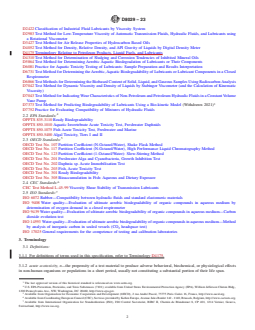
D2422 Classification of Industrial Fluid Lubricants by Viscosity System
D2983 Test Method for Low-Temperature Viscosity of Automatic Transmission Fluids, Hydraulic Fluids, and Lubricants using
a Rotational Viscometer
D3427 Test Method for Air Release Properties of Hydrocarbon Based Oils
D4052 Test Method for Density, Relative Density, and API Gravity of Liquids by Digital Density Meter
D4175 Terminology Relating to Petroleum Products, Liquid Fuels, and Lubricants
D4310 Test Method for Determination of Sludging and Corrosion Tendencies of Inhibited Mineral Oils
D5864 Test Method for Determining Aerobic Aquatic Biodegradation of Lubricants or Their Components
D6081 Practice for Aquatic Toxicity Testing of Lubricants: Sample Preparation and Results Interpretation
D6731 Test Method for Determining the Aerobic, Aquatic Biodegradability of Lubricants or Lubricant Components in a Closed
Respirometer
D6866 Test Methods for Determining the Biobased Content of Solid, Liquid, and Gaseous Samples Using Radiocarbon Analysis
D7042 Test Method for Dynamic Viscosity and Density of Liquids by Stabinger Viscometer (and the Calculation of Kinematic
Viscosity)
D7043 Test Method for Indicating Wear Characteristics of Non-Petroleum and Petroleum Hydraulic Fluids in a Constant Volume
Vane Pump
D7373 Test Method for Predicting Biodegradability of Lubricants Using a Bio-kinetic Model (Withdrawn 2021)
D7752 Practice for Evaluating Compatibility of Mixtures of Hydraulic Fluids
2.2 EPA Standards:
OPPTS 835.3110 Ready Biodegradability
OPPTS 850.1010 Aquatic Invertebrate Acute Toxicity Test, Freshwater Daphnids
OPPTS 850.1075 Fish Acute Toxicity Test, Freshwater and Marine
OPPTS 850.5400 Algal Toxicity, Tiers I and II
2.3 OECD Standards:
OECD Test No. 107 Partition Coefficient (N-Octanol/Water), Shake Flask Method
OECD Test No. 117 Partition Coefficient (N-Octanol/Water), High Performance Liquid Chromatography Method
OECD Test No. 123 Partition Coefficient (1-Octanol/Water): Slow-Stirring Method
OECD Test No. 201 Freshwater Alga and Cyanobacteria, Growth Inhibition Test
OECD Test No. 202 Daphnia sp. Acute Immobilisation Test
OECD Test No. 203 Fish, Acute Toxicity Test
OECD Test No. 301 Ready Biodegradability
OECD Test No. 305 Bioaccumulation in Fish: Aqueous and Dietary Exposure
2.4 CEC Standards:
CEC Test Method L-45-99 Viscosity Shear Stability of Transmission Lubricants
2.5 ISO Standards:
ISO 6072 Rubber—Compatibility between hydraulic fluids and standard elastomeric materials
ISO 9408 Water quality—Evaluation of ultimate aerobic biodegradability of organic compounds in aqueous medium by
determination of oxygen demand in a closed respirometer
ISO 9439 Water quality—Evaluation of ultimate aerobic biodegradability of organic compounds in aqueous medium—Carbon
dioxide evolution test
ISO 14593 Water quality—Evaluation of ultimate aerobic biodegradability of organic compounds in aqueous medium—Method
by analysis of inorganic carbon in sealed vessels (CO headspace test)
ISO 17025 General requirements for the competence of testing and calibration laboratories
3. Terminology
3.1 Definitions:
3.1.1 For definitions of terms used in this specification, refer to Terminology D4175.
3.1.2 acute ecotoxicity, n—the propensity of a test material to produce adverse behavioral, biochemical, or physiological effects
in non-human organisms or populations in a short period, usually not constituting a substantial portion of their life span.
The last approved version of this historical standard is referenced on www.astm.org.
U.S. EPA Prevention, Pesticides, and Toxic Substances (7101); available from United States Environmental Protection Agency (EPA), William Jefferson Clinton Bldg.,
1200 Pennsylvania Ave., NW, Washington, DC 20460, http://www.epa.gov.
Available from Organisation for Economic Cooperation and Development (OECD), 2 rue André Pascal, 75775 Paris Cedex 16, France, http://www.oecd.org.
Available from Coordinating European Council (CEC), Services provided by Kellen Europe, Avenue Jules Bordet 142 - 1140, Brussels, Belgium, http://www.cectests.org.
Available from International Organization for Standardization (ISO), ISO Central Secretariat, BIBC II, Chemin de Blandonnet 8, CP 401, 1214 Vernier, Geneva,
Switzerland, http://www.iso.org.
D8029 − 23
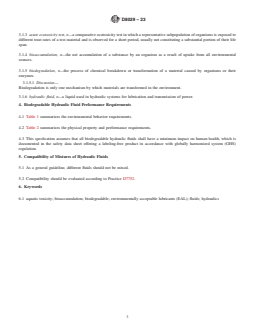
3.1.3 acute ecotoxicity test, n—a comparative ecotoxicity test in which a representative subpopulation of organisms is exposed to
different treat rates of a test material and is observed for a short period, usually not constituting a substantial portion of their life
span.
3.1.4 bioaccumulation, n—the net accumulation of a substance by an organism as a result of uptake from all environmental
sources.
3.1.5 biodegradation, n—the process of chemical breakdown or transformation of a material caused by organisms or their
enzymes.
3.1.5.1 Discussion—
Biodegradation is only one mechanism by which materials are transformed in the environment.
3.1.6 hydraulic fluid, n—a liquid used in hydraulic systems for lubrication and transmission of power.
4. Biodegradable Hydraulic Fluid Performance Requirements
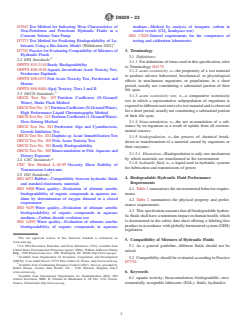
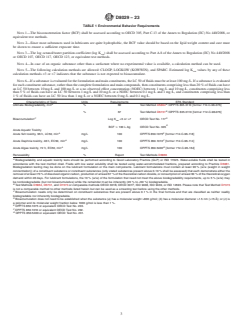
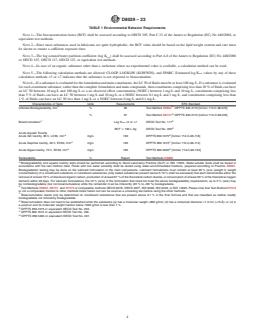
4.1 Table 1 summarizes the environmental behavior requirements.
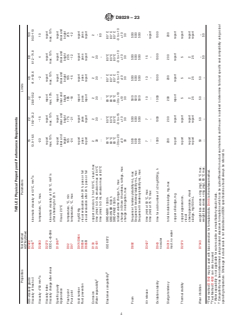
4.2 Table 2 summarizes the physical property and performance requirements.
4.3 This specfication assumes that all biodegradable hydraulic fluids shall have a minimum impact on human health, which is
documented in the safety data sheet offering a labeling-free product in accordance with globally harmonized system (GHS)
regulation.
5. Compatibility of Mixtures of Hydraulic Fluids
5.1 As a general guideline, different fluids should not be mixed.
5.2 Compatibility should be evaluated according to Practice D7752.
6. Keywords
6.1 aquatic toxicity; bioaccumulation; biodegradable; environmentally accept
...