

ASTM C1239-13(2018)
(Practice)Standard Practice for Reporting Uniaxial Strength Data and Estimating Weibull Distribution Parameters for Advanced Ceramics
General Information
- Abstract
SIGNIFICANCE AND USE
5.1 Advanced ceramics usually display a linear stress-strain behavior to failure. Lack of ductility combined with flaws that have various sizes and orientations leads to scatter in failure strength. Strength is not a deterministic property, but instead reflects an intrinsic fracture toughness and a distribution (size and orientation) of flaws present in the material. This practice is applicable to brittle monolithic ceramics that fail as a result of catastrophic propagation of flaws present in the material. This practice is also applicable to composite ceramics that do not exhibit any appreciable bilinear or nonlinear deformation behavior. In addition, the composite must contain a sufficient quantity of uniformly distributed reinforcements such that the material is effectively homogeneous. Whisker-toughened ceramic composites may be representative of this type of material.
5.2 Two- and three-parameter formulations exist for the Weibull distribution. This practice is restricted to the two-parameter formulation. An objective of this practice is to obtain point estimates of the unknown parameters by using well-defined functions that incorporate the failure data. These functions are referred to as “estimators.” It is desirable that an estimator be consistent and efficient. In addition, the estimator should produce unique, unbiased estimates of the distribution parameters (6). Different types of estimators exist, including moment estimators, least-squares estimators, and maximum likelihood estimators. This practice details the use of maximum likelihood estimators due to the efficiency and the ease of application when censored failure populations are encountered.
5.3 Tensile and flexural test specimens are the most commonly used test configurations for advanced ceramics. The observed strength values are dependent on test specimen size and geometry. Parameter estimates can be computed for a given test specimen geometry ( m^, ^σθ), but it is suggested that the paramet...
SCOPE
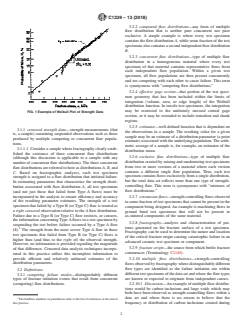
1.1 This practice covers the evaluation and reporting of uniaxial strength data and the estimation of Weibull probability distribution parameters for advanced ceramics that fail in a brittle fashion (see Fig. 1). The estimated Weibull distribution parameters are used for statistical comparison of the relative quality of two or more test data sets and for the prediction of the probability of failure (or, alternatively, the fracture strength) for a structure of interest. In addition, this practice encourages the integration of mechanical property data and fractographic analysis.
1.6 The values stated in SI units are to be regarded as the standard per IEEE/ASTM SI 10.
1.7 This international standard was developed in accordance with internationally recognized principles on standardization established in the Decision on Principles for the Development of International Standards, Guides and Recommendations issued by the World Trade Organization Technical Barriers to Trade (TBT) Committee.
- Status
- Published
- Publication Date
- 30-Jun-2018
- Technical Committee
- C28 - Advanced Ceramics
- Drafting Committee
- C28.01 - Mechanical Properties and Performance
Overview
ASTM C1239-13(2018), titled Standard Practice for Reporting Uniaxial Strength Data and Estimating Weibull Distribution Parameters for Advanced Ceramics, provides established methods for the collection, analysis, and reporting of uniaxial strength data for advanced ceramics. Issued by ASTM International, this standard outlines a uniform practice for determining and presenting mechanical property data, specifically focusing on the estimation of Weibull distribution parameters-a key statistical method in characterizing the brittle fracture behavior of advanced ceramics.
The standard is applicable to both monolithic ceramics and composite ceramics that exhibit brittle failure without significant nonlinear or plastic deformation. By standardizing data reporting and analysis, ASTM C1239-13 (2018) supports meaningful statistical comparison, quality control, and reliability predictions for ceramic components used in critical applications.
Key Topics
- Uniaxial Strength Testing: Details on conducting and reporting results from tensile and flexural tests on advanced ceramics, ensuring comparability across laboratories and industries.
- Weibull Distribution Parameters: Focus on the two-parameter Weibull distribution for characterizing strength variability due to the inherent flaw population in ceramics.
- Maximum Likelihood Estimation: Outlines maximum likelihood approaches for parameter estimation, enabling efficient calculations even with censored data due to multiple flaw populations.
- Fractography Integration: Recommends coupling mechanical test data with fractographic analysis to identify flaw types and distribution, improving the reliability of failure origin assignments.
- Bias Correction and Confidence Bounds: Provides approaches to correct statistical bias and calculate confidence intervals around Weibull parameter estimates, increasing the reliability and utility of reported data.
- Data Presentation: Guidance on graphical and tabular representation of strength data, Weibull plots, and standardized reporting practices to ensure clarity and utility of test results.
Applications
ASTM C1239-13(2018) is widely used by materials scientists, engineers, and quality assurance professionals in industries where advanced ceramics are implemented, including:
- Aerospace and Defense: Ensuring the reliability of brittle ceramic components subject to high uniaxial stress, such as turbine blades, armor, and thermal shields.
- Medical Devices: Characterizing and qualifying bioceramics for implants and prosthetics, where consistent mechanical integrity is essential.
- Electronics and Semiconductors: Supporting reliability data for ceramic substrates and insulators.
- Automotive: Assessing mechanical properties and expected failure probabilities of engine components, sensors, and seals made from advanced ceramics.
- Research and Development: Standardizing reporting for academic and industrial research, enabling comparison across studies and facilitating new material development.
- Quality Control and Assurance: Implementing systematic, statistically valid approaches to material acceptance criteria and failure prediction.
Using ASTM C1239-13(2018) enables organizations to adhere to internationally recognized standards, increasing confidence for customers and meeting regulatory requirements for safety-critical ceramic components.
Related Standards
When applying ASTM C1239-13(2018), the following standards are frequently referenced to supplement testing and analysis:
- ASTM C1145 – Terminology of Advanced Ceramics
- ASTM C1322 – Practice for Fractography and Characterization of Fracture Origins in Advanced Ceramics
- ASTM E6 – Terminology Relating to Methods of Mechanical Testing
- ASTM E178 – Practice for Dealing With Outlying Observations
- ASTM E456 – Terminology Relating to Quality and Statistics
- IEEE/ASTM SI 10 – American National Standard for Use of the International System of Units (SI): The Modern Metric System
By employing ASTM C1239-13(2018) alongside these related standards, professionals can ensure comprehensive, reliable, and globally recognized assessments of advanced ceramic strength and failure probabilities, optimizing material performance for high-reliability applications.
Keywords: advanced ceramics, Weibull distribution, uniaxial strength, mechanical testing, fractography, ASTM C1239-13, statistical reliability, brittle materials, quality assurance, failure analysis.
Relations
- Effective Date
- 01-Jul-2018
- Effective Date
- 01-Apr-2022
- Effective Date
- 01-Jul-2019
- Effective Date
- 01-Oct-2017
- Effective Date
- 01-Oct-2017
- Effective Date
- 01-Jun-2016
- Effective Date
- 01-Jul-2015
- Effective Date
- 15-Nov-2013
- Effective Date
- 15-Nov-2013
- Effective Date
- 15-Nov-2013
- Effective Date
- 15-Nov-2013
- Effective Date
- 15-Aug-2013
- Effective Date
- 01-Feb-2013
- Effective Date
- 01-Feb-2013
- Effective Date
- 01-May-2012
Frequently Asked Questions
ASTM C1239-13(2018) is a standard published by ASTM International. Its full title is "Standard Practice for Reporting Uniaxial Strength Data and Estimating Weibull Distribution Parameters for Advanced Ceramics". This standard covers: SIGNIFICANCE AND USE 5.1 Advanced ceramics usually display a linear stress-strain behavior to failure. Lack of ductility combined with flaws that have various sizes and orientations leads to scatter in failure strength. Strength is not a deterministic property, but instead reflects an intrinsic fracture toughness and a distribution (size and orientation) of flaws present in the material. This practice is applicable to brittle monolithic ceramics that fail as a result of catastrophic propagation of flaws present in the material. This practice is also applicable to composite ceramics that do not exhibit any appreciable bilinear or nonlinear deformation behavior. In addition, the composite must contain a sufficient quantity of uniformly distributed reinforcements such that the material is effectively homogeneous. Whisker-toughened ceramic composites may be representative of this type of material. 5.2 Two- and three-parameter formulations exist for the Weibull distribution. This practice is restricted to the two-parameter formulation. An objective of this practice is to obtain point estimates of the unknown parameters by using well-defined functions that incorporate the failure data. These functions are referred to as “estimators.” It is desirable that an estimator be consistent and efficient. In addition, the estimator should produce unique, unbiased estimates of the distribution parameters (6). Different types of estimators exist, including moment estimators, least-squares estimators, and maximum likelihood estimators. This practice details the use of maximum likelihood estimators due to the efficiency and the ease of application when censored failure populations are encountered. 5.3 Tensile and flexural test specimens are the most commonly used test configurations for advanced ceramics. The observed strength values are dependent on test specimen size and geometry. Parameter estimates can be computed for a given test specimen geometry ( m^, ^σθ), but it is suggested that the paramet... SCOPE 1.1 This practice covers the evaluation and reporting of uniaxial strength data and the estimation of Weibull probability distribution parameters for advanced ceramics that fail in a brittle fashion (see Fig. 1). The estimated Weibull distribution parameters are used for statistical comparison of the relative quality of two or more test data sets and for the prediction of the probability of failure (or, alternatively, the fracture strength) for a structure of interest. In addition, this practice encourages the integration of mechanical property data and fractographic analysis. 1.6 The values stated in SI units are to be regarded as the standard per IEEE/ASTM SI 10. 1.7 This international standard was developed in accordance with internationally recognized principles on standardization established in the Decision on Principles for the Development of International Standards, Guides and Recommendations issued by the World Trade Organization Technical Barriers to Trade (TBT) Committee.
SIGNIFICANCE AND USE 5.1 Advanced ceramics usually display a linear stress-strain behavior to failure. Lack of ductility combined with flaws that have various sizes and orientations leads to scatter in failure strength. Strength is not a deterministic property, but instead reflects an intrinsic fracture toughness and a distribution (size and orientation) of flaws present in the material. This practice is applicable to brittle monolithic ceramics that fail as a result of catastrophic propagation of flaws present in the material. This practice is also applicable to composite ceramics that do not exhibit any appreciable bilinear or nonlinear deformation behavior. In addition, the composite must contain a sufficient quantity of uniformly distributed reinforcements such that the material is effectively homogeneous. Whisker-toughened ceramic composites may be representative of this type of material. 5.2 Two- and three-parameter formulations exist for the Weibull distribution. This practice is restricted to the two-parameter formulation. An objective of this practice is to obtain point estimates of the unknown parameters by using well-defined functions that incorporate the failure data. These functions are referred to as “estimators.” It is desirable that an estimator be consistent and efficient. In addition, the estimator should produce unique, unbiased estimates of the distribution parameters (6). Different types of estimators exist, including moment estimators, least-squares estimators, and maximum likelihood estimators. This practice details the use of maximum likelihood estimators due to the efficiency and the ease of application when censored failure populations are encountered. 5.3 Tensile and flexural test specimens are the most commonly used test configurations for advanced ceramics. The observed strength values are dependent on test specimen size and geometry. Parameter estimates can be computed for a given test specimen geometry ( m^, ^σθ), but it is suggested that the paramet... SCOPE 1.1 This practice covers the evaluation and reporting of uniaxial strength data and the estimation of Weibull probability distribution parameters for advanced ceramics that fail in a brittle fashion (see Fig. 1). The estimated Weibull distribution parameters are used for statistical comparison of the relative quality of two or more test data sets and for the prediction of the probability of failure (or, alternatively, the fracture strength) for a structure of interest. In addition, this practice encourages the integration of mechanical property data and fractographic analysis. 1.6 The values stated in SI units are to be regarded as the standard per IEEE/ASTM SI 10. 1.7 This international standard was developed in accordance with internationally recognized principles on standardization established in the Decision on Principles for the Development of International Standards, Guides and Recommendations issued by the World Trade Organization Technical Barriers to Trade (TBT) Committee.
ASTM C1239-13(2018) is classified under the following ICS (International Classification for Standards) categories: 81.060.99 - Other standards related to ceramics. The ICS classification helps identify the subject area and facilitates finding related standards.
ASTM C1239-13(2018) has the following relationships with other standards: It is inter standard links to ASTM C1239-13, ASTM E456-13a(2022)e1, ASTM C1145-19, ASTM E456-13A(2017)e1, ASTM E456-13A(2017)e3, ASTM E178-16, ASTM C1322-15, ASTM E456-13ae1, ASTM E456-13ae3, ASTM E456-13ae2, ASTM E456-13a, ASTM E456-13, ASTM C1145-06(2013)e1, ASTM C1145-06(2013), ASTM E456-12e1. Understanding these relationships helps ensure you are using the most current and applicable version of the standard.
ASTM C1239-13(2018) is available in PDF format for immediate download after purchase. The document can be added to your cart and obtained through the secure checkout process. Digital delivery ensures instant access to the complete standard document.
Standards Content (Sample)
This international standard was developed in accordance with internationally recognized principles on standardization established in the Decision on Principles for the
Development of International Standards, Guides and Recommendations issued by the World Trade Organization Technical Barriers to Trade (TBT) Committee.
Designation: C1239 − 13 (Reapproved 2018)
Standard Practice for
Reporting Uniaxial Strength Data and Estimating Weibull
Distribution Parameters for Advanced Ceramics
This standard is issued under the fixed designation C1239; the number immediately following the designation indicates the year of
original adoption or, in the case of revision, the year of last revision.Anumber in parentheses indicates the year of last reapproval.A
superscript epsilon (´) indicates an editorial change since the last revision or reapproval.
1. Scope
Section
Scope 1
1.1 This practice covers the evaluation and reporting of
Referenced Documents 2
uniaxialstrengthdataandtheestimationofWeibullprobability Terminology 3
Summary of Practice 4
distribution parameters for advanced ceramics that fail in a
Significance and Use 5
brittle fashion (see Fig. 1). The estimated Weibull distribution
Interferences 6
parameters are used for statistical comparison of the relative Outlying Observations 7
Maximum Likelihood Parameter Estimators 8
quality of two or more test data sets and for the prediction of
for Competing Flaw Distributions
the probability of failure (or, alternatively, the fracture
Unbiasing Factors and Confidence Bounds 9
Fractography 10
strength) for a structure of interest. In addition, this practice
Examples 11
encourages the integration of mechanical property data and
Keywords 12
fractographic analysis.
ComputerAlgorithm MAXL Appendix X1
Test Specimens with Unidentified Fracture Appendix X2
1.2 Thefailurestrengthofadvancedceramicsistreatedasa
Origins
continuousrandomvariabledeterminedbytheflawpopulation.
1.6 The values stated in SI units are to be regarded as the
Typically, a number of test specimens with well-defined
standard per IEEE/ASTMSI10.
geometry are failed under isothermal, well-defined displace-
1.7 This international standard was developed in accor-
ment and/or force-application conditions. The force at which
dance with internationally recognized principles on standard-
eachtestspecimenfailsisrecorded.Theresultingfailurestress
ization established in the Decision on Principles for the
data are used to obtain Weibull parameter estimates associated
Development of International Standards, Guides and Recom-
with the underlying flaw population distribution.
mendations issued by the World Trade Organization Technical
1.3 This practice is restricted to the assumption that the
Barriers to Trade (TBT) Committee.
distribution underlying the failure strengths is the two-
parameter Weibull distribution with size scaling. Furthermore, 2. Referenced Documents
this practice is restricted to test specimens (tensile, flexural,
2.1 ASTM Standards:
pressurized ring, etc.) that are primarily subjected to uniaxial
C1145Terminology of Advanced Ceramics
stressstates.Thepracticealsoassumesthattheflawpopulation
C1322Practice for Fractography and Characterization of
is stable with time and that no slow crack growth is occurring.
Fracture Origins in Advanced Ceramics
1.4 The practice outlines methods to correct for bias errors
E6Terminology Relating to Methods of Mechanical Testing
in the estimated Weibull parameters and to calculate confi- E178Practice for Dealing With Outlying Observations
dence bounds on those estimates from data sets where all
E456Terminology Relating to Quality and Statistics
failuresoriginatefromasingleflawpopulation(thatis,asingle IEEE/ASTMSI10American National Standard for Use of
failure mode). In samples where failures originate from mul-
theInternationalSystemofUnits(SI):TheModernMetric
tiple independent flaw populations (for example, competing System
failure modes), the methods outlined in Section 9 for bias
3. Terminology
correction and confidence bounds are not applicable.
3.1 Proper use of the following terms and equations will
1.5 This practice includes the following:
alleviate misunderstanding in the presentation of data and in
the calculation of strength distribution parameters.
This practice is under the jurisdiction ofASTM Committee C28 on Advanced
Ceramics and is the direct responsibility of Subcommittee C28.01 on Mechanical
Properties and Performance. For referenced ASTM standards, visit the ASTM website, www.astm.org, or
CurrenteditionapprovedJuly1,2018.PublishedJuly2018.Originallyapproved contact ASTM Customer Service at service@astm.org. For Annual Book of ASTM
in 1993. Last previous edition approved in 2013 as C1239–13. DOI: 10.1520/ Standards volume information, refer to the standard’s Document Summary page on
C1239-13R18. the ASTM website.
Copyright ©ASTM International, 100 Barr Harbor Drive, PO Box C700, West Conshohocken, PA19428-2959. United States
C1239 − 13 (2018)
3.2.2 compound flaw distributions—any form of multiple
flaw distribution that is neither pure concurrent nor pure
exclusive. A simple example is where every test specimen
contains the flaw distribution A, while some fraction of the test
specimensalsocontainsasecondindependentflawdistribution
B.
3.2.3 concurrent flaw distributions—type of multiple flaw
distribution in a homogeneous material where every test
specimen of that material contains representative flaws from
each independent flaw population. Within a given test
specimen, all flaw populations are then present concurrently
and are competing with each other to cause failure. This term
is synonymous with “competing flaw distributions.”
3.2.4 effective gage section—that portion of the test speci-
men geometry that has been included within the limits of
integration (volume, area, or edge length) of the Weibull
distribution function. In tensile test specimens, the integration
may be restricted to the uniformly stressed central gage
FIG. 1 Example of Weibull Plot of Strength Data
section, or it may be extended to include transition and shank
regions.
3.2.5 estimator—well-defined function that is dependent on
3.1.1 censored strength data—strength measurements (that
the observations in a sample. The resulting value for a given
is, a sample) containing suspended observations such as those
sample may be an estimate of a distribution parameter (a point
produced by multiple competing or concurrent flaw popula-
estimate) associated with the underlying population.The arith-
tions.
metic average of a sample is, for example, an estimator of the
3.1.1.1 Considerasamplewherefractographyclearlyestab-
distribution mean.
lished the existence of three concurrent flaw distributions
3.2.6 exclusive flaw distributions—type of multiple flaw
(although this discussion is applicable to a sample with any
distribution created by mixing and randomizing test specimens
number of concurrent flaw distributions). The three concurrent
from two or more versions of a material where each version
flaw distributions are referred to here as distributions A, B, and
contains a different single flaw population. Thus, each test
C. Based on fractographic analyses, each test specimen
specimencontainsflawsexclusivelyfromasingledistribution,
strength is assigned to a flaw distribution that initiated failure.
but the total data set reflects more than one type of strength-
In estimating parameters that characterize the strength distri-
controlling flaw. This term is synonymous with “mixtures of
bution associated with flaw distribution A, all test specimens
flaw distributions.”
(and not just those that failed from Type A flaws) must be
incorporated in the analysis to ensure efficiency and accuracy
3.2.7 extraneous flaws—strength-controllingflawsobserved
of the resulting parameter estimates. The strength of a test
in some fraction of test specimens that cannot be present in the
specimen that failed by aType B (orType C) flaw is treated as
component being designed.An example is machining flaws in
a right censored observation relative to the A flaw distribution.
ground bend test specimens that will not be present in
Failure due to a Type B (or Type C) flaw restricts, or censors,
as-sintered components of the same material.
the information concerningTypeAflaws in a test specimen by
3.2.8 fractography—analysis and characterization of pat-
suspending the test before failure occurred by a Type A flaw
terns generated on the fracture surface of a test specimen.
(1). The strength from the most severe Type A flaw in those
Fractography can be used to determine the nature and location
test specimens that failed from Type B (or Type C) flaws is
of the critical fracture origin causing catastrophic failure in an
higher than (and thus to the right of) the observed strength.
advanced ceramic test specimen or component.
However, no information is provided regarding the magnitude
3.2.9 fracture origin—thesourcefromwhichbrittlefracture
of that difference. Censored data analysis techniques incorpo-
commences (Terminology C1145).
rated in this practice utilize this incomplete information to
provide efficient and relatively unbiased estimates of the
3.2.10 multiple flaw distributions—strength-controlling
distribution parameters.
flawsobservedbyfractographywheredistinguishablydifferent
flaw types are identified as the failure initiation site within
3.2 Definitions:
differenttestspecimensofthedatasetandwheretheflawtypes
3.2.1 competing failure modes—distinguishably different
are known or expected to originate from independent causes.
types of fracture initiation events that result from concurrent
3.2.10.1 Discussion—An example of multiple flaw distribu-
(competing) flaw distributions.
tions would be carbon inclusions and large voids which may
both have been observed as strength-controlling flaws within a
data set and where there is no reason to believe that the
Theboldfacenumbersinparenthesesrefertothelistofreferencesattheendof
this practice. frequency or distribution of carbon inclusions created during
C1239 − 13 (2018)
fabrication was in any way dependent on the frequency or ing uniaxial tensile strength of an advanced ceramic is char-
distribution of voids (or vice-versa). acterized by Eq 4-7, then the probability that this advanced
ceramic will fail under an applied uniaxial tensile stress σ is
3.2.11 population—totality of potential observations about
given by the cumulative distribution function as follows:
which inferences are made.
σ
3.2.12 population mean—average of all potential measure-
m
P 5 1 2 exp 2 σ.0 (8)
F S D G
f
σ
θ
mentsinagivenpopulationweightedbytheirrelativefrequen-
cies in the population. P 5 0 σ#0 (9)
f
3.2.13 probability density function—function f(x) is a prob-
where:
ability density function for the continuous random variable X
P = probability of failure, and
f
if:
σ = Weibull characteristic strength.
θ
f x $0 (1)
~ !
Note that theWeibull characteristic strength is dependent on
theuniaxialtestspecimen(tensile,flexural,orpressurizedring)
and
and will change with test specimen size and geometry. In
`
f x dx 51 (2)
* ~ !
addition, the Weibull characteristic strength has units of stress
2`
and should be reported using units of megapascals or gigapas-
The probability that the random variable X assumes a
cals.
value between a and b is given by the following equation:
3.2.20 An alternative expression for the probability of
b
failure is given by the following equation:
Pr~a,X,b! 5 f~x! dx (3)
*
a
σ
m
3.2.14 sample—collection of measurements or observations
P 5 1 2 exp 2* dV σ.0 (10)
F S D G
f
v σ
taken from a specified population.
P 5 0 σ#0 (11)
f
3.2.15 skewness—term relating to the asymmetry of a prob-
The integration in the exponential is performed over all
ability density function. The distribution of failure strength for
advanced ceramics is not symmetric with respect to the tensile regions of the test specimen volume if the strength-
controlling flaws are randomly distributed through the volume
maximum value of the distribution function, but has one tail
longer than the other. of the material, or over all tensile regions of the test specimen
area if flaws are restricted to the test specimen surface. The
3.2.16 statistical bias—inherent to most estimates, this is a
integration is sometimes carried out over an effective gage
typeofconsistentnumericaloffsetinanestimaterelativetothe
section instead of over the total volume or area. In Eq 10, σ is
trueunderlyingvalue.Themagnitudeofthebiaserrortypically
the Weibull material scale parameter. The parameter is a
decreases as the sample size increases.
material property if the two-parameter Weibull distribution
3.2.17 unbiased estimator—estimator that has been cor-
properly describes the strength behavior of the material. In
rected for statistical bias error.
addition,theWeibullmaterialscaleparametercanbedescribed
3.2.18 Weibull distribution—continuous random variable X
as the Weibull characteristic strength of a test specimen with
has a two-parameter Weibull distribution if the probability unit volume or area forced in uniform uniaxial tension. The
density function is given by the following equations: Weibull material scale parameter has units of
1/m
m21 m stress·(volume) and should be reported using units of
m x x
3/m 3/m
f x 5 exp 2 x.0 (4)
~ ! S DS D F S D G MPa·(m) or GPa·(m) if the strength-controlling flaws are
β β β
distributed through the volume of the material. If the strength-
f~x! 5 0 x#0 (5)
controlling flaws are restricted to the surface of the test
specimens in a sample, then the Weibull material scale param-
and the cumulative distribution function is given by the
2/m
eter should be reported using units of MPa·(m) or
following equations:
2/m
GPa·(m) . For a given test specimen geometry, Eq 8 and Eq
m
x
F x 5 1 2 exp 2 x.0 (6) 10 can be equated, which yields an expression relating σ and
~ ! F S D G
β
σ . Further discussion related to this issue can be found in 8.6.
θ
or
3.3 Fordefinitionsofotherstatisticalterms,termsrelatedto
mechanical testing, and terms related to advanced ceramics
F x 5 0 x#0 (7)
~ !
used in this practice, refer to Terminologies E456, C1145, and
where:
E6 or to appropriate textbooks on statistics (2-5).
m = Weibull modulus (or the shape parameter) (>0), and
3.4 Symbols:
β = scale parameter (>0).
A = test specimen area (or area of effective gage section,
3.2.19 The random variable representing uniaxial tensile
if used).
strength of an advanced ceramic will assume only positive
b = gage section dimension, base of bend test specimen.
values, and the distribution is asymmetrical about the mean.
d = gage section dimension, depth of bend test specimen.
Thesecharacteristicsruleouttheuseofthenormaldistribution
F(x) = cumulative distribution function.
(as well as others) and point to the use of the Weibull and
f(x) = probability density function.
similar skewed distributions. If the random variable represent-
C1239 − 13 (2018)
material is effectively homogeneous. Whisker-toughened ce-
L = length of the inner span for a bend test specimen.
i
ramic composites may be representative of this type of
L = length of the outer span for a bend test specimen.
o
material.
+ = likelihood function.
m = Weibull modulus.
5.2 Two- and three-parameter formulations exist for the
mˆ = estimate of the Weibull modulus.
Weibull distribution. This practice is restricted to the two-
mˆ = unbiased estimate of the Weibull modulus.
U
parameterformulation.Anobjectiveofthispracticeistoobtain
N = number of test specimens in a sample.
point estimates of the unknown parameters by using well-
P = probability of failure.
f
defined functions that incorporate the failure data. These
r = number of test specimens that failed from the flaw
functions are referred to as “estimators.” It is desirable that an
populationforwhichtheWeibullestimatorsarebeing
estimator be consistent and efficient. In addition, the estimator
calculated.
should produce unique, unbiased estimates of the distribution
t = intermediate quantity defined by Eq 27, used in
parameters (6). Different types of estimators exist, including
calculation of confidence bounds.
moment estimators, least-squares estimators, and maximum
V = test specimen volume (or volume of effective gage
likelihoodestimators.Thispracticedetailstheuseofmaximum
section, if used).
likelihood estimators due to the efficiency and the ease of
X = random variable.
applicationwhencensoredfailurepopulationsareencountered.
x = realization of a random variable X.
β = Weibull scale parameter.
5.3 Tensile and flexural test specimens are the most com-
ε = stoppingtoleranceinthecomputeralgorithmMAXL.
monly used test configurations for advanced ceramics. The
µˆ = estimate of mean strength.
observed strength values are dependent on test specimen size
σ = uniaxial tensile stress.
and geometry. Parameter estimates can be computed for a
σ = maximum stress in the ith test specimen at failure.
i
given test specimen geometry (mˆ, σˆ ), but it is suggested that
θ
σ = maximum stress in the jth test specimen at failure.
j
the parameter estimates be transformed and reported as
σ = Weibull material scale parameter (strength relative to
O
material-specific parameters (mˆ, σˆ ). In addition, different flaw
unit size) defined in Eq 10.
distributions (for example, failures due to inclusions or ma-
σ = Weibull characteristic strength (associated with a test
θ
chining damage) may be observed, and each will have its own
specimen) defined in Eq 8.
strength distribution parameters. The procedure for transform-
σˆ = estimate of the Weibull material scale parameter.
O
ing parameter estimates for typical test specimen geometries
σˆ = estimate of the Weibull characteristic strength.
θ
and flaw distributions is outlined in 8.6.
4. Summary of Practice
5.4 Many factors affect the estimates of the distribution
4.1 This practice enables the experimentalist to estimate parameters. The total number of test specimens plays a
Weibull distribution parameters from failure data. Begin by significant role. Initially, the uncertainty associated with pa-
performing a fractographic examination of each failed test rameter estimates decreases significantly as the number of test
specimen (optional, but highly recommended) in order to specimens increases. However, a point of diminishing returns
characterize fracture origins. Usually discrete fracture origins isreachedwhenthecostofperformingadditionalstrengthtests
can be grouped by flaw distributions. Screen the data associ- may not be justified. This suggests that a practical number of
atedwitheachflawdistributionforoutliers.Computeestimates strength tests should be performed to obtain a desired level of
of the biased Weibull modulus and Weibull characteristic confidence associated with a parameter estimate. The number
strength. If necessary, compute the estimate of the mean of test specimens needed depends on the precision required in
strength.Ifallfailuresoriginatefromasingleflawdistribution, the resulting parameter estimate. Details relating to the com-
compute an unbiased estimate of the Weibull modulus and putation of confidence bounds (directly related to the precision
compute confidence bounds for both the estimated Weibull of the estimate) are presented in 9.3 and 9.4.
modulus and the estimated Weibull characteristic strength.
6. Interferences
Prepareagraphicalrepresentationofthefailuredataalongwith
6.1 CAUTION—Many ceramics are susceptible to slow
a test report.
crack growth (SCG—either environmentally assisted or ther-
5. Significance and Use
mally activated) in which flaw sizes/shapes/locations change
with time and result in changes in the strength distributions.
5.1 Advanced ceramics usually display a linear stress-strain
The analysis methods used in this practice assume that flaws
behavior to failure. Lack of ductility combined with flaws that
and strength are stationary (non-variant with time) with iden-
have various sizes and orientations leads to scatter in failure
tical statistics of ensemble and sample. Therefore, if SCG
strength. Strength is not a deterministic property, but instead
occurs during testing (for example, high temperature or high
reflects an intrinsic fracture toughness and a distribution (size
humidity) or SCG is determined from fractography, a time-
and orientation) of flaws present in the material. This practice
variableprocessexists,thebaselineassumptionsofthepractice
is applicable to brittle monolithic ceramics that fail as a result
are not met, and the analysis and calculation methods in this
of catastrophic propagation of flaws present in the material.
practice will not give valid, reliable estimates of the Weibull
This practice is also applicable to composite ceramics that do
parameters.
not exhibit any appreciable bilinear or nonlinear deformation
behavior. In addition, the composite must contain a sufficient 6.2 Note that oxide ceramics, glasses, glass ceramics, and
quantity of uniformly distributed reinforcements such that the ceramics containing boundary phase glass are particularly
C1239 − 13 (2018)
susceptible to slow crack growth. Time-dependent effects that parameter estimates. The censoring techniques presented
are caused by environmental factors (for example, water as herein require positive confirmation of multiple flaw
humidity in air) may be minimized through the use of inert distributions, which necessitates fractographic examination to
testing atmosphere such as dry nitrogen gas or vacuum. characterize the fracture origin in each test specimen. Multiple
flaw distributions may be further evidenced by deviation from
6.3 Thermally activated slow crack growth may occur at
the linearity of the data from a single Weibull distribution (for
elevated temperatures even in inert atmospheres. Thermally
example, Fig. 2). However, since there are many exceptions,
activated SCG can be reduced or eliminated by testing at
observations of approximately linear behavior should not be
accelerated testing rates. (See the appropriate ceramic me-
considered sufficient reason to conclude that only a single flaw
chanicaltestingstandard—tensile,flexure,compression,cyclic
distribution is active.
loading, creep, etc.)
8.2.1 For data sets with multiple active flaw distributions
6.4 Many ceramics such as boron carbide, silicon carbide,
where one flaw distribution (identified by fractographic analy-
aluminumnitride,andmanysiliconnitrideshavenosensitivity
sis) occurs in a small number of test specimens, it is sufficient
to slow crack growth at room or moderately elevated tempera-
toreporttheexistenceofthisflawdistribution(andthenumber
tures.
of occurrences), but it is not necessary to estimate Weibull
parameters. Estimates of the Weibull parameters for this flaw
7. Outlying Observations
distribution would be potentially biased with wide confidence
7.1 Before computing the parameter estimates, the data
bounds (neither of which could be quantified through use of
should be screened for outlying observations (outliers). An
this practice). However, special note should be made in the
outlying observation is one that deviates significantly from
report if the occurrences of this flaw distribution take place in
other observations in the sample. It should be understood that
the upper or lower tail of the sample strength distribution.
an apparent outlying observation may be an extreme manifes-
8.3 Theapplicationofthecensoringtechniquespresentedin
tationofthevariabilityofthestrengthofanadvancedceramic.
this standard can be complicated by the presence of test
If this is the case, the data point should be retained and treated
specimens that fail from extraneous flaws, fractures that
as any other observation in the failure sample. However, the
originate outside the effective gage section, and unidentified
outlying observation may be the result of a gross deviation
fracture origins. If these complications arise, the strength data
from prescribed experimental procedure or an error in calcu-
from these specimens should generally not be discarded.
lating or recording the numerical value of the data point in
Strength data from specimens with fracture origins outside the
question.Whentheexperimentalistisclearlyawarethatagross
effective gage section in tension specimens, and outside the
deviation from the prescribed experimental procedure has
inner span region of four-point flexural specimens, should be
occurred,theoutlyingobservationmaybediscarded,unlessthe
examined to ascertain whether fracture was caused by an
observation can be corrected in a rational manner. The proce-
extraneous flaw or fixture misalignment. Specimens with
dures for dealing with outlying observations are detailed in
fractures that originate from extraneous flaws should be
Practice E178.
censored, and the maximum likelihood methods presented in
8. Maximum Likelihood Parameter Estimators for
this standard are applicable.
Competing Flaw Distributions
8.1 This practice outlines the application of parameter
estimation methods based on the maximum likelihood tech-
nique. This technique has certain advantages, especially when
parameters must be determined from censored failure popula-
tions. When a sample of test specimens yields two or more
distinct flaw distributions, the sample is said to contain
censored data, and the associated methods for censored data
must be employed. Fractography (see Section 10) should be
used to determine whether multiple flaw distributions are
present. The methods described in this practice include cen-
soring techniques that apply to multiple concurrent flaw
distributions. However, the techniques for parameter estima-
tionpresentedinthispracticearenotdirectlyapplicabletodata
sets that contain exclusive or compound multiple flaw distri-
butions (7). The parameter estimates obtained using the maxi-
mum likelihood technique are unique (for a two-parameter
Weibull distribution), and as the size of the sample increases,
the estimates statistically approach the true values of the
population.
8.2 This practice allows failure to be controlled by multiple
NOTE 1—The boxes refer to surface flaws; the circles refer to volume
flaw distributions.Advanced ceramics typically contain two or
flaws.
more active flaw distributions each with an independent set of FIG. 2 Example – Failure Data in 11.2
C1239 − 13 (2018)
8.3.1 Test specimens with unidentified fracture origins Weibull modulus. Expressions that relate σˆ to the Weibull
θ
sometimes occur. It is imperative that the number of unidenti- material scale parameter σˆ for typical test specimen geom-
fied fracture origins, and how they were classified, be stated in etries are given in 8.6. Finally, the likelihood function for the
the test report. This practice recognizes four options the two-parameter Weibull distribution for a single-flaw popula-
experimentalist can pursue when unidentified fracture origins tion is defined by the following equation:
are encountered during fractographic examinations. The situa-
N
mˆ σ σ
i i
mˆ21 mˆ
+ 5 II ! exp 2 ! (13)
tion may arise where more than one option will be used within S DS F S G
σˆ σˆ σˆ
i51 θ θ θ
a single data set. Test specimens with unidentified fracture
where r was taken equal to N in Eq 12.
origins can be:
8.3.1.1 Option a—Assigned a previously identified flaw
8.5 Thesystemofequationsobtainedbymaximizingthelog
distribution using inferences based on all available fracto-
likelihood function for a censored sample is given by the
graphic information,
following equations (9):
8.3.1.2 Option b—Assigned the same flaw distribution as
N
mˆ
that of the test specimen closest in strength,
~σ ! 1n~σ !
r
( i i
1 1
i51
8.3.1.3 Option c—Assigned a new and as yet unspecified
2 1n~σ ! 2 50 (14)
N ( i
r mˆ
i51
mˆ
flaw distribution, and
~σ !
( i
i51
8.3.1.4 Option d—Be removed from the sample.
and
NOTE 1—The user is cautioned that the use of any of the options
N 1/mˆ
outlined in 8.3.1 for the classification of test specimens with unidentified
mˆ
σˆ 5 σ (15)
fracture origins may create a consistent bias error in the parameter FS ~ ! D G
θ i
(
r
i51
estimates. In addition, the magnitude of the bias cannot be determined by
the methods presented in 9.2.
where:
8.3.2 A discussion of the appropriateness of each option in
r = number of failed test specimens from a particular group
8.3.1 is given in Appendix X2. If the strength data and the
of a censored sample.
resulting parameter estimates are used for component design,
When a sample does not require censoring, r is replaced by
the engineer must consult with the fractographer before and
N in Eq 14 and 15. Eq 14 is solved first for mˆ. Subsequently,
after performing the fractographic examination. Considerable
σˆ is computed from Eq 15. Obtaining a closed-form solution
θ
judgement may be needed to identify the correct option.
of Eq 14 for mˆ is not possible. This expression must be solved
Whenever partial fractographic information is available,
numerically. When there are multiple active flaw populations,
8.3.1.1isstronglyrecommended,especiallyifthedataareused
Eq 14 and 15 must be solved for each flaw population. A
forcomponentdesign.Conversely,8.3.1.4isnotrecommended
computeralgorithm(entitledMAXL)thatcalculatestherootof
by this practice unless there is overwhelming justification.
Eq 14 is presented as a convenience in Appendix X1.
8.4 The likelihood function for the two-parameter Weibull
8.6 The numerical procedure in accordance with 8.5 yields
distribution of a censored sample is defined by the following
parameter estimates of the Weibull modulus (mˆ) and the
equation (8):
characteristic strength (σˆ ). Since the characteristic strength
θ
r N
mˆ σ σ σ
also reflects test specimen geometry and stress gradients, this
i i j
mˆ21 mˆ mˆ
+ II ! exp 2 ! II exp 2 !
S DS F S G F S G
H J
σˆ σˆ σˆ σˆ
practice suggests reporting the estimated Weibull material
i51 θ θ θ j5r11 θ
scale parameter σˆ .
(12)
8.6.1 The following equation defines the relationship be-
This expression is applied to a sample where two or more
tween the parameters for tensile test specimens:
active concurrent flaw distributions have been identified from
1/ mˆ v
~ !
~σˆ ! 5 ~V! ~σˆ ! (16)
0 V θ V
fractographic inspection. For the purpose of the discussion
here, the different distributions will be identified as flawTypes
where V is the volume of the uniform gage section of the
A, B, C, etc. When Eq 12 is used to estimate the parameters
tensile test specimen, and the fracture origins are spatially
associated with the A flaw distribution, then r is the number of
distributed strictly within this volume. The gage section of a
test specimens where Type A flaws were found at the fracture
tensile test specimen is defined herein as the central region of
origin, and i is the associated index in the first summation.The
the test specimen with the smallest constant cross-sectional
secondsummationiscarriedoutforallothertestspecimensnot
area. However, the experimentalist may include transition
failing fromTypeAflaws (that is,Type B flaws,Type C flaws,
regions and the shank regions of the test specimen if the
etc.).Therefore,thesumiscarriedoutfrom(j= r+1)to N(the
volume (or area) integration defined by Eq 10 is analyzed
total number of test specimens) where j is the index in the
properly. This procedure is discussed in 8.6.3. If the transition
second summation. Accordingly, σ and σ are the maximum
i j
region or the shank region, or both, are included in the
stress in the ith and jth test specimen at failure. The parameter
integration, Eq 16 is not applicable. For tensile test specimens
estimates (the Weibull modulus mˆ and the characteristic
in which fracture origins are spatially distributed strictly at the
strength σˆ ) are determined by taking the partial derivatives of
θ
surface of the test specimens tested, the following equation
the logarithm of the likelihood function with respect to mˆ and
applies:
σˆ and equating the resulting expressions to zero. Note that σˆ
θ θ
1/ mˆ A
~ !
σˆ 5 A σˆ (17)
~ ! ~ ! ~ !
is a function of test specimen geometry and the estimate of the 0 A θ A
C1239 − 13 (2018)
where A = surface area of the uniform gage section. The effective volume can be interpreted as the size of an
8.6.2 For flexural test specimen geometries, the relation- equivalent uniaxial tensile test specimen that has the same risk
shipsbecomemorecomplex (10).Thefollowingrelationshipis of rupture as the test specimen or component. As the term
basedonthegeometryofaflexuraltestspecimenfoundinFig. implies, the product represents the volume of material subject
3. For fracture origins spatially distributed strictly within both to a uniform uniaxial tensile stress (11). Setting Eq 21 and Eq
the volume of a flexural test specimen and the outer span, the 22 equal to one another yields the following expression:
following equation applies:
1/~mˆ !V
~σˆ ! 5 ~kV! ~σˆ ! (23)
0 θ
V V
1/ mˆ V
~ !
L
i
V mˆ 11
~ ! 8.6.5 Thus, for an arbitrary test specimen, the experimen-
FS D G
v
L
o
U U
talist evaluates the integral identified in Eq 10 for the effective
~σˆ ! 5 ~σˆ ! (18)
0 θ 2
V V
2@~mˆ ! 11#
v
volume(kV),andutilizesEq23toobtaintheestimatedWeibull
where: material scale parameter σˆ . A similar procedure can be
adopted when fracture origins are spatially distributed at the
L = length of the inner span,
i
surface of the test specimen.
L = length of the outer span,
o
V = volume of the gage section defined by the following
8.7 An objective of this practice is the consistent represen-
expression:
tation of strength data. To this end, the following procedure is
V 5bdL (19)
the recommended graphical representation of strength data.
o
Begin by ranking the strength data obtained from laboratory
and:
testing in ascending order, and assign to each a ranked
b, d = dimensions identified in Fig. 2.
probabilityoffailure, P,accordingtotheestimatorasfollows:
f
For fracture origins spatially distributed strictly at the
i 2 0.5
surface of a flexural test specimen and within the outer span,
P ~σ ! 5 (24)
f i
N
the following equation applies:
1/~mˆ ! A where:
L
i
~mˆ ! 11
S D
A
N = number of test specimens, and
d L
o
F S DG
σˆ 5 σˆ L 1b
~ ! ~ ! S D
0 θ o
A A i = ith datum.
mˆ 11 mˆ 11
~ ! ~ !
A A
(20)
Compute the natural logarithm of the ith failure stress, and
the natural logarithm of the natural logarithm of [1/(1 − P)]
f
8.6.3 Test specimens other than tensile and flexure test
(that is, the double logarithm of the quantity in brackets),
specimensmaybeutilized.Relationshipsbetweentheestimate
where P is associated with the ith failure stress.
f
of the Weibull characteristic strength and the Weibull material
scale parameter for any test specimen configuration can be
8.8 Create a graph representing the data as shown in Fig. 2.
derivedbyequatingtheexpressionsdefinedbyEq8andEq10
Plotln ln 1/ 12P astheordinate,andln(σ)astheabscissa.
$ @ ~ !#%
f
with the modifications that follow. Begin by replacing σ (an
A typical ordinate scale assumes values from +2 to −6. This
applied uniaxial tensile stress) in Eq 8 with σ , which is
max approximately corresponds to a range in probability of failure
defined as the maximum tensile stress within the test specimen
from 0.25 to 99.9%. The ordinate axis must be labeled as
of interest. Thus:
probability of failure P, as depicted in Fig. 2. Similarly, the
f
m
abscissamustbelabeledasfailurestress(flexural,tensile,etc.),
σ
max
P 5 1 2 exp 2 (21)
F S D G
f preferably using units of megapascals or gigapascals.
σ
θ
8.9 Included on the plot should be a line (two or more lines
8.6.4 Also perform the integration given in Eq 10 such that
forconcurrentflawdistributions)whosepositionisfixedbythe
m
σ
max
P 5 1 2 exp 2kV (22) estimates of the Weibull parameters. The line is defined by the
F S D G
f
σ
following mathematical equation:
where k is a dimensionless constant that accounts for test
σ
P 5 1 2 exp 2 mˆ (25)
specimen geometry and stress gradients. Note that in general, F S D G
f
σˆ
θ
k is a function of the estimated Weibull modulus mˆ, and is
always less than or equal to unity. The product (kV) is often The slope of the line, which is the estimate of the Weibull
referred to as the effective volume (with the designation V ). modulus mˆ, should be identified as shown in Fig. 2. The
E
estimate of the characteristic strength σ should also be
θ
identified. This corresponds to a P of 63.2%, or a value of
f
zeroforln|ln@1/1~12P !#.Atestreport(thatis,adatasheet)that
f
details the type of material characterized, the test procedure
(preferablydesignatinganappropriatestandard),thenumberof
failed test specimens, the flaw type, the maximum likelihood
estimates of the Weibull parameters, the unbiasing factor, and
the information that allows the construction of 90% confi-
dence bounds is depicted in Fig. 4. This data sheet should
FIG. 3 Flexural Test Specimen Geometry accompany the graph to provide a complete representation of
C1239 − 13 (2018)
FIG. 4 Sample Test Report
C1239 − 13 (2018)
the failure data. Insert a column on the graph (in any conve- associated with the maximum likelihood estimators presented
nient location), or alternatively provide a separate table that in this practice can be reduced by increasing the sample size.
identifies the individual strength values in ascending order as
9.2 An unbiased estimator produces nearly zero statistical
shown in Fig. 5 (12). This will permit other users to perform
bias between the value of the true parameter and the point
alternative analyses (for example, future implementations of
estimate.The amount of deviation can be quantified either as a
bias correction or confidence bounds, or both, on multiple flaw
percent difference or with unbiasing factors. In keeping with
populations). In addition, the experimentalist should include a
the accepted practice in the open literature, this practice
separate sketch of the test specimen geometry that includes all
quantifies statistical bias through the use of unbiasing factors,
pertinentdimensions.Anestimateofmeanstrengthcanalsobe
denoted here as UF. Depending on the number of test speci-
depicted in the graph. The estimate of mean strength |gm is
mens in a given sample, the point estimate of the Weibull
calculated by using the arithmetic mean as the estimator in the
modulus mˆ mayexhibitsignificantstatisticalbias.Anunbiased
following equation:
estimateoftheWeibullmodulus(denotedasmˆ )isobtainedby
U
N
multiplying the biased estimate with appropriate unbiasing
µˆ 5 σ (26)
S DS D
( i factor. Unbiasing factors for mˆ are listed in Table 1. The
N
i51
example in 11.3 demonstrates the use of Table 1 in correcting
Note that this estimate of the mean strength is not appropri-
a biased estimate of the Weibull modulus.As a final note, this
ate for samples with multiple failure populations.
procedure is not appropriate for censored samples. The theo-
retical approach was developed for uncensored samples where
9. Unbiasing Factors and Confidence Bounds
r = N.
9.1 Paragraphs 9.2 – 9.4 outline methods to correct for
9.3 Confidence bounds quantify the uncertainty associated
statistical bias errors in the estimated Weibull parameters and
withapointestimateofapopulationparameter.Thesizeofthe
outline methods to calculate confidence bounds. The proce-
confidence bounds for maximum likelihood estimates of both
dures described herein to correct for statistical bias errors and
Weibull parameters will diminish with increasing sample size.
to compute confidence bounds are appropriate only for data
The values used to construct confidence bounds are based on
sets where all failures originate from a single flaw population
percentile distributions obtained by Monte Carlo simulation.
(that is, an uncensored sample). Procedures for bias correction
For example, the 90% confidence bound on the Weibull
and confidence bounds in the presence of multiple active flaw
modulus is obtained from the 5 and 95 percentile distributions
populations are not well developed at this time. Note that the
of the ratio of mˆ to the true population value m. For the point
statistical bias associated with the estimator σˆ is minimal
θ
estimate of the Weibull modulus, the normalized values (mˆ/m)
(<0.3% for 20 test specimens, as opposed to .7% bias for mˆ
necessarytoconstructthe90%confidenceboundsarelistedin
with the same number of test specimens). Therefore, this
Table 2. The example in 11.3 demonstrates the use of Table 2
practice allows the assumption that σˆ is an unbiased estimator
θ
in constructing the upper and lower bounds in mˆ. Note that the
ofthetruepopulationparameter.Theparameterestimateofthe
statisticalbiasedestimateoftheWeibullmodulusmustbeused
Weibull modulus (mˆ) generally exhibits statistical bias. The
here. Again, this procedure is not appropriate for censored
amount of statistical bias depends on the number of test
statistics.
specimens in the sample. An unbiased estimate of m shall be
obtained by multiplying mˆ by unbiasing factors (13). This TABLE 1 Unbiasing Factors for the Maximum Likelihood
Estimate of the Weibull Modulus
procedureisdiscussedinthefollowingsections.Statisticalbias
Number of Test Unbiasing Factor, Number of Test Unbiasing Factor,
Specimens, N UF Specimens, N UF
5 0.700 42 0.968
6 0.752 44 0.970
7 0.792 46 0.971
8 0.820 48 0.972
9 0.842 50 0.973
10 0.859 52 0.974
11 0.872 54 0.975
12 0.883 56 0.976
13 0.893 58 0.977
14 0.901 60 0.978
15 0.908 62 0.979
16 0.914 64 0.980
18 0.923 66 0.980
20 0.931 68 0.981
22 0.938 70 0.981
24 0.943 72 0.982
26 0.947 74 0.982
28 0.951 76 0.983
30 0.955 78 0.983
32 0.958 80 0.984
34 0.960 85 0.985
36 0.962 90 0.986
38 0.964 100 0.987
40 0.966 120 0.990
FIG. 5 Example – Failure Data with Fractography Information (12)
C1239 − 13 (2018)
TABLE 2 Normalized Upper and Lower Bounds on the Maximum TABLE 3 Normalized Upper and Lower Bounds on the Function t
Likelihood Estimate of the Weibull Modulus – 90 % Confidence – 90 % Confidence Interval
Interval
Number of Test Number of Test
Specimens,Nt t Specimens,Nt t
Number of Test Number of Test 0.05 0.95 0.05 0.95
Specimens,Nq q Specimens,Nq q
0.05 0.95 0.05 0.95 5 −1.247 1.107 42 −0.280 0.278
6 −1.007 0.939 44 −0.273 0.271
5 0.683 2.779 42 0.842 1.265
7 −0.874 0.829 46 −0.266 0.264
6 0.697 2.436 44 0.845 1.256
8 −0.784 0.751 48 −0.260 0.258
7 0.709 2.183 46 0.847 1.249
8 0.720 2.015 48 0.850 1.242 9 −0.717 0.691 50 −0.254 0.253
10 −0.665 0.644 52 −0.249 0.247
9 0.729 1.896 50 0.852 1.235
11 −0.622 0.605 54 −0.244 0.243
10 0.738 1.807 52 0.854 1.229
12 −0.587 0.572 56 −0.239 0.238
11 0.745 1.738 54 0.857 1.224
13 −0.557 0.544 58 −0.234 0.233
12 0.752 1.682 56 0.859 1.218
14 −0.532 0.520 60 −0.230 0.229
13 0.759 1.636 58 0.861 1.213
15 −0.509 0.499 62 −0.226 0.225
14 0.764 1.597 60 0.863 1.208
16 −0.489 0.480 64 −0.222 0.221
15 0.770 1.564 62 0.864 1.204
17 −0.471 0.463 66 −0.218 0.218
16 0.775 1.535 64 0.866 1.200
18 −0.455 0.447 68 −0.215 0.214
17 0.779 1.510 66 0.868 1.196
19 −0.441 0.433 70 −0.211 0.211
18 0.784 1.487 68 0.869 1.192
20 −0.428 0.421 72 −0.208 0.208
19 0.788 1.467 70 0.871 1.188
22 −0.404 0.398 74 −0.205 0.205
20 0.791 1.449 72 0.872 1.185
24 −0.384 0.379 76 −0.202 0.202
22 0.798 1.418 74 0.874 1.182
26 −0.367 0.362 78 −0.199 0.199
24 0.805 1.392 76 0.875 1.179
28 −0.352 0.347 80 −0.197 0.197
26 0.810 1.370 78 0.876 1.176
28 0.815 1.351 80 0.878 1.173 30 −0.338 0.334 85 −0.190 0.190
32 −0.326 0.323 90 −0.184 0.185
30 0.820 1.334 85 0.881 1.166
34 −0.315 0.312 95 −0.179 0.179
32 0.824 1.319 90 0.883 1.160
36 −0.305 0.302 100 −0.174 0.175
34 0.828 1.306 95 0.886 1.155
38 −0.296 0.293 110 −0.165 0.166
36 0.832 1.294 100 0.888 1.150
40 −0.288 0.285 120 −0.158 0.159
38 0.835 1.283 110 0.893 1.141
40 0.839 1.273 120 0.897 1.133
each classification of fracture origin must be identified as a
9.4 Confidence bounds can be constructed for the estimated
surface fracture origin or a volume fracture origin in order to
Weibull characteristic strength. However, the percentile distri-
use the expressions given in 8.6. The classification shall be
butionsneededtoconstructtheboundsdonotinvolvethesame
based on the spatial distribution of a given flaw type (that is,
normalized ratios or the same tables as those used for the
volume-distributed pores versus surface-distributed machining
Weibull modulus. Define the function as follows:
damage) and not the specific location of a given flaw in a
t 5 mˆln~σˆ /σ ! (27)
particular test specimen. Thus, there may exist several classi-
θ θ
ficationsoffractureoriginswithinthevolume(orsurfacearea)
The 90% confidence bound on the characteristic strength is
ofthetestspecimensinasample.Itshouldbeclearlyindicated
obtainedfromthe5and95per
...