


ASTM D5362-13(2018)
(Test Method)Standard Test Method for Snagging Resistance of Fabrics (Bean Bag)
Standard Test Method for Snagging Resistance of Fabrics (Bean Bag)
SIGNIFICANCE AND USE
5.1 Acceptance Testing—This test method may be used for acceptance testing of commercial shipments of fabrics because the precision is acceptable (see 15.1).
5.1.1 If there are differences of practical significance between reported test results for two laboratories (or more), comparative tests should be performed to determine if there is a statistical bias between them, using competent statistical assistance. As a minimum, use the samples for such a comparative test that are as homogeneous as possible, drawn from the same lot of material as the samples that resulted in disparate results during initial testing and randomly assigned in equal number to each laboratory. The test results from the laboratories involved should be compared using a statistical test for unpaired data, at a probability level chosen prior to the testing series. If bias is found, either its cause must be found and corrected, or future test results for that material must be adjusted in consideration of the known bias.
5.2 This test method may be used for quality control testing of fabrics during manufacturing and product comparisons of different fabrics by manufacturers, retailers, and users. This test method may also be used by researchers to examine the effect of new fibers, yarns, fabric constructions, and finishes on the snagging resistance of fabrics.
5.3 This test method may be used to test the snagging resistance of most apparel and home furnishings fabrics. However, a different test method (see 5.3.1) may be needed for different types of fabrics and different end-uses (such as towels, swimwear, slacks, and upholstery).
5.3.1 Some fabrics which may not be suitable for this test method are described in 1.2. Many open construction fabrics can be tested for snagging resistance using AATCC Test Method 65. Many heavy or stiff fabrics can be tested for snagging resistance using Test Method D3939. The snagging resistance of many pile floor coverings can be tested by Test Method D1335....
SCOPE
1.1 This test method determines the snagging resistance of a fabric.
1.2 Studies of fabric snagging have shown that this test method is suitable for a range of woven and knitted fabrics made from textured or untextured filament yarns or spun yarns or combinations of these yarns.2 ,3 This test method is not suitable for (1) open construction fabrics (such as a net) because the pins in the test chamber will snag the bean bag rather than the specimen, (2) heavy or stiff fabrics that cannot be made into a cover for the bean bag, and (3) tufted or nonwoven fabrics because the apparatus is designed for woven and knitted fabrics.
1.3 The values stated in either acceptable metric units or in other units shall be regarded separately as standard. The values stated in each system may not be the exact equivalents; therefore, each system must be used independently of the other, without combining values in any way. In case of referee decisions the metric units will prevail.
1.4 This standard does not purport to address all of the safety concerns, if any, associated with its use. It is the responsibility of the user of this standard to establish appropriate safety, health, and environmental practices and determine the applicability of regulatory limitations prior to use. Specific precautionary statements are given in Section 7.
1.5 This international standard was developed in accordance with internationally recognized principles on standardization established in the Decision on Principles for the Development of International Standards, Guides and Recommendations issued by the World Trade Organization Technical Barriers to Trade (TBT) Committee.
General Information
- Status
- Published
- Publication Date
- 30-Jun-2018
- Technical Committee
- D13 - Textiles
- Drafting Committee
- D13.59 - Fabric Physical Test Methods A
Relations
- Effective Date
- 01-Jul-2018
- Effective Date
- 15-Jul-2017
- Effective Date
- 15-Jul-2017
- Effective Date
- 01-Mar-2017
- Effective Date
- 15-Sep-2015
- Effective Date
- 01-Sep-2015
- Effective Date
- 01-Jul-2015
- Effective Date
- 01-Apr-2015
- Effective Date
- 15-May-2014
- Effective Date
- 01-Jul-2013
- Effective Date
- 01-Jul-2013
- Effective Date
- 01-Jul-2013
- Effective Date
- 01-Jul-2013
- Effective Date
- 15-Jun-2013
- Effective Date
- 15-Jun-2013
Overview
ASTM D5362-13(2018) is the internationally recognized standard test method for assessing the snagging resistance of fabrics using the bean bag technique. Developed by ASTM International, this method is widely adopted in the textile industry to determine how woven and knitted fabrics withstand snagging-a crucial quality characteristic for both apparel and home furnishings. The bean bag method provides reliable and repeatable results, making it suitable for acceptance testing in commercial fabric shipments, quality control during manufacturing, and research into fabric structure, fibers, and finishes.
Key Topics
- Purpose and Scope: This test method measures the resistance of various woven and knitted fabrics-constructed from textured, untextured filament, or spun yarns-to snagging. Notably, it is not appropriate for open-construction, heavy or stiff, tufted, or nonwoven fabrics.
- Testing Procedure: The fabric specimen is made into a cover for a bean bag. The assembly is tumbled in a pin-lined cylindrical chamber, imitating snag-inducing wear. After testing, the fabric is visually compared to photographic or physical snagging standards or rated using a point system.
- Rating Scale: Fabrics are numerically rated from 5 (no or insignificant snagging) to 1 (very severe snagging). Evaluations can consider not just the number of snags but also visual aspects like color contrast, protrusions, or distortions.
- Precision and Quality Control: The method offers acceptable precision for inter-laboratory testing. When significant differences in results occur between labs, comparative tests and statistical analysis are recommended to identify and correct any bias.
- Safety Considerations: Operators must follow all relevant health and safety practices due to exposed rotating equipment and sharp pins.
Applications
- Commercial Fabric Shipments: Retailers and manufacturers use ASTM D5362 during acceptance testing to verify that delivered fabrics meet snagging resistance specifications.
- Quality Assurance and Production: The standard supports manufacturers in performing routine quality control, ensuring consistent product performance and minimizing defects in end-use applications.
- Research and Development: Textile researchers utilize this method when studying how modifications in fibers, yarns, or finishing processes affect a fabric’s resistance to snagging.
- Product Comparison: Fabric producers and buyers use the test method to compare the durability of different fabrics, aiding in material selection for garments, upholstery, drapery, and other textile products.
- End-Use Evaluation: The method is suitable for most apparel and home furnishing textiles, helping manufacturers and consumers predict how fabrics will perform under real-world conditions.
Related Standards
- ASTM D3939: Standard Test Method for Snagging Resistance of Fabrics (Mace)
- AATCC Test Method 65: Snag Resistance of Women’s Nylon Hosiery (useful for open-construction fabrics)
- ASTM D1335: Tuft Bind of Pile Yarn Floor Coverings (for pile floor coverings)
- ASTM D123 / D4850: Textile terminology and fabric test methods
- ASTM D1776: Conditioning and Testing Textiles
- ASTM D2724: Bonded, Fused, and Laminated Apparel Fabrics
- AATCC Test Method 135: Laundering practices for dimensional change
Practical Value
ASTM D5362 helps textile professionals maintain quality and consistency across a wide variety of fabric types. By providing a standardized approach to evaluating snagging resistance, it supports manufacturers, retailers, and researchers in ensuring that fabrics remain attractive and durable throughout their lifecycle. Its focus on practical end-use performance enhances consumer satisfaction and reliability for textile products worldwide.
Keywords: ASTM D5362, snagging resistance, bean bag test method, fabric quality control, woven fabrics, knitted fabrics, textile testing, commercial shipments, apparel fabrics, home furnishing fabrics, textile industry standards
Get Certified
Connect with accredited certification bodies for this standard

Control Union Certifications
Global certification for agriculture and sustainability.

Bureau Veritas Bangladesh
Bureau Veritas certification services in Bangladesh.

ECOCERT France
Leader in organic and sustainability certification worldwide.
Sponsored listings
Frequently Asked Questions
ASTM D5362-13(2018) is a standard published by ASTM International. Its full title is "Standard Test Method for Snagging Resistance of Fabrics (Bean Bag)". This standard covers: SIGNIFICANCE AND USE 5.1 Acceptance Testing—This test method may be used for acceptance testing of commercial shipments of fabrics because the precision is acceptable (see 15.1). 5.1.1 If there are differences of practical significance between reported test results for two laboratories (or more), comparative tests should be performed to determine if there is a statistical bias between them, using competent statistical assistance. As a minimum, use the samples for such a comparative test that are as homogeneous as possible, drawn from the same lot of material as the samples that resulted in disparate results during initial testing and randomly assigned in equal number to each laboratory. The test results from the laboratories involved should be compared using a statistical test for unpaired data, at a probability level chosen prior to the testing series. If bias is found, either its cause must be found and corrected, or future test results for that material must be adjusted in consideration of the known bias. 5.2 This test method may be used for quality control testing of fabrics during manufacturing and product comparisons of different fabrics by manufacturers, retailers, and users. This test method may also be used by researchers to examine the effect of new fibers, yarns, fabric constructions, and finishes on the snagging resistance of fabrics. 5.3 This test method may be used to test the snagging resistance of most apparel and home furnishings fabrics. However, a different test method (see 5.3.1) may be needed for different types of fabrics and different end-uses (such as towels, swimwear, slacks, and upholstery). 5.3.1 Some fabrics which may not be suitable for this test method are described in 1.2. Many open construction fabrics can be tested for snagging resistance using AATCC Test Method 65. Many heavy or stiff fabrics can be tested for snagging resistance using Test Method D3939. The snagging resistance of many pile floor coverings can be tested by Test Method D1335.... SCOPE 1.1 This test method determines the snagging resistance of a fabric. 1.2 Studies of fabric snagging have shown that this test method is suitable for a range of woven and knitted fabrics made from textured or untextured filament yarns or spun yarns or combinations of these yarns.2 ,3 This test method is not suitable for (1) open construction fabrics (such as a net) because the pins in the test chamber will snag the bean bag rather than the specimen, (2) heavy or stiff fabrics that cannot be made into a cover for the bean bag, and (3) tufted or nonwoven fabrics because the apparatus is designed for woven and knitted fabrics. 1.3 The values stated in either acceptable metric units or in other units shall be regarded separately as standard. The values stated in each system may not be the exact equivalents; therefore, each system must be used independently of the other, without combining values in any way. In case of referee decisions the metric units will prevail. 1.4 This standard does not purport to address all of the safety concerns, if any, associated with its use. It is the responsibility of the user of this standard to establish appropriate safety, health, and environmental practices and determine the applicability of regulatory limitations prior to use. Specific precautionary statements are given in Section 7. 1.5 This international standard was developed in accordance with internationally recognized principles on standardization established in the Decision on Principles for the Development of International Standards, Guides and Recommendations issued by the World Trade Organization Technical Barriers to Trade (TBT) Committee.
SIGNIFICANCE AND USE 5.1 Acceptance Testing—This test method may be used for acceptance testing of commercial shipments of fabrics because the precision is acceptable (see 15.1). 5.1.1 If there are differences of practical significance between reported test results for two laboratories (or more), comparative tests should be performed to determine if there is a statistical bias between them, using competent statistical assistance. As a minimum, use the samples for such a comparative test that are as homogeneous as possible, drawn from the same lot of material as the samples that resulted in disparate results during initial testing and randomly assigned in equal number to each laboratory. The test results from the laboratories involved should be compared using a statistical test for unpaired data, at a probability level chosen prior to the testing series. If bias is found, either its cause must be found and corrected, or future test results for that material must be adjusted in consideration of the known bias. 5.2 This test method may be used for quality control testing of fabrics during manufacturing and product comparisons of different fabrics by manufacturers, retailers, and users. This test method may also be used by researchers to examine the effect of new fibers, yarns, fabric constructions, and finishes on the snagging resistance of fabrics. 5.3 This test method may be used to test the snagging resistance of most apparel and home furnishings fabrics. However, a different test method (see 5.3.1) may be needed for different types of fabrics and different end-uses (such as towels, swimwear, slacks, and upholstery). 5.3.1 Some fabrics which may not be suitable for this test method are described in 1.2. Many open construction fabrics can be tested for snagging resistance using AATCC Test Method 65. Many heavy or stiff fabrics can be tested for snagging resistance using Test Method D3939. The snagging resistance of many pile floor coverings can be tested by Test Method D1335.... SCOPE 1.1 This test method determines the snagging resistance of a fabric. 1.2 Studies of fabric snagging have shown that this test method is suitable for a range of woven and knitted fabrics made from textured or untextured filament yarns or spun yarns or combinations of these yarns.2 ,3 This test method is not suitable for (1) open construction fabrics (such as a net) because the pins in the test chamber will snag the bean bag rather than the specimen, (2) heavy or stiff fabrics that cannot be made into a cover for the bean bag, and (3) tufted or nonwoven fabrics because the apparatus is designed for woven and knitted fabrics. 1.3 The values stated in either acceptable metric units or in other units shall be regarded separately as standard. The values stated in each system may not be the exact equivalents; therefore, each system must be used independently of the other, without combining values in any way. In case of referee decisions the metric units will prevail. 1.4 This standard does not purport to address all of the safety concerns, if any, associated with its use. It is the responsibility of the user of this standard to establish appropriate safety, health, and environmental practices and determine the applicability of regulatory limitations prior to use. Specific precautionary statements are given in Section 7. 1.5 This international standard was developed in accordance with internationally recognized principles on standardization established in the Decision on Principles for the Development of International Standards, Guides and Recommendations issued by the World Trade Organization Technical Barriers to Trade (TBT) Committee.
ASTM D5362-13(2018) is classified under the following ICS (International Classification for Standards) categories: 59.080.30 - Textile fabrics. The ICS classification helps identify the subject area and facilitates finding related standards.
ASTM D5362-13(2018) has the following relationships with other standards: It is inter standard links to ASTM D5362-13, ASTM D4850-13(2017), ASTM D1335-17, ASTM D123-17, ASTM D123-15b, ASTM D123-15a, ASTM D2724-07(2015), ASTM D123-15, ASTM D3136-14, ASTM D4850-13, ASTM D3136-13e1, ASTM D3136-13, ASTM D4850-13e1, ASTM D123-13a, ASTM D123-13ae1. Understanding these relationships helps ensure you are using the most current and applicable version of the standard.
ASTM D5362-13(2018) is available in PDF format for immediate download after purchase. The document can be added to your cart and obtained through the secure checkout process. Digital delivery ensures instant access to the complete standard document.
Standards Content (Sample)
This international standard was developed in accordance with internationally recognized principles on standardization established in the Decision on Principles for the
Development of International Standards, Guides and Recommendations issued by the World Trade Organization Technical Barriers to Trade (TBT) Committee.
Designation: D5362 − 13 (Reapproved 2018)
Standard Test Method for
Snagging Resistance of Fabrics (Bean Bag)
This standard is issued under the fixed designation D5362; the number immediately following the designation indicates the year of
original adoption or, in the case of revision, the year of last revision. A number in parentheses indicates the year of last reapproval. A
superscript epsilon (´) indicates an editorial change since the last revision or reapproval.
1. Scope 2. Referenced Documents
2.1 ASTM Standards:
1.1 Thistestmethoddeterminesthesnaggingresistanceofa
D123 Terminology Relating to Textiles
fabric.
D1335 Test Method for Tuft Bind of Pile Yarn Floor
1.2 Studies of fabric snagging have shown that this test
Coverings
method is suitable for a range of woven and knitted fabrics
D1776 Practice for Conditioning and Testing Textiles
made from textured or untextured filament yarns or spun yarns
D2724 Test Methods for Bonded, Fused, and Laminated
2,3
or combinations of these yarns. This test method is not
Apparel Fabrics
suitable for (1) open construction fabrics (such as a net)
D3136 Terminology Relating to Care Labeling for Apparel,
because the pins in the test chamber will snag the bean bag
Textile, Home Furnishing, and Leather Products
rather than the specimen, (2) heavy or stiff fabrics that cannot
D3939 Test Method for Snagging Resistance of Fabrics
be made into a cover for the bean bag, and (3) tufted or
(Mace)
nonwoven fabrics because the apparatus is designed for woven
D4467 Practice for Interlaboratory Testing of a Textile Test
and knitted fabrics.
Method That Produces Non-Normally Distributed Data
(Withdrawn 2010)
1.3 The values stated in either acceptable metric units or in
D4850 Terminology Relating to Fabrics and Fabric Test
other units shall be regarded separately as standard.The values
Methods
stated in each system may not be the exact equivalents;
2.2 AATCC Standards:
therefore,eachsystemmustbeusedindependentlyoftheother,
65 Test Method for Snag Resistance of Women’s Nylon
without combining values in any way. In case of referee
Hosiery (see Note 1)
decisions the metric units will prevail.
135 Test Method for Dimensional Changes in Automatic
1.4 This standard does not purport to address all of the
Home Laundering of Woven and Knit Fabrics
safety concerns, if any, associated with its use. It is the
responsibility of the user of this standard to establish appro- NOTE 1—In 1988 theAATCC voted to withdraw this test method from
their technical manual; however, theASTM task group on fabric snagging
priate safety, health, and environmental practices and deter-
decided it should be listed as an alternative for testing open construction
mine the applicability of regulatory limitations prior to use.
fabrics.
Specific precautionary statements are given in Section 7.
1.5 This international standard was developed in accor- 3. Terminology
dance with internationally recognized principles on standard-
3.1 Definitions:
ization established in the Decision on Principles for the
3.1.1 For definitions of textile terms used in this test
Development of International Standards, Guides and Recom-
method: color contrast, in textiles; distortion in fabrics;
mendations issued by the World Trade Organization Technical
protrusion, in fabrics; snag, in fabrics; snagging resistance, in
Barriers to Trade (TBT) Committee.
fabrics; refer to Terminology D4850.
3.1.2 For definitions of other textile terms used in this test
method, refer to Terminology D123.
This test method is under the jurisdiction ofASTM Committee D13 on Textiles
and is the direct responsibility of Subcommittee D13.59 on Fabric Test Methods,
General. For referencedASTM standards, visist theASTM Web Site, www.astm.org, or
Current edition approved July 1, 2018. Published August 2013. Originally contact ASTM Customer Service at service@astm.org. For Annual Book of ASTM
approved in 1993. Last previous edition approved in 2013 as D5362 – 13. DOI: Standards volume information, refer to the standard’s Document Summary page on
10.1520/D5362-13R18. the ASTM web site.
2 5
Stuckey, W. C., and El Shiekh, A., “Snags in Snag Testing of Knits”, in Sense The last approved version of this historical standard is referenced on
and Nonsense in Knit Testing, American Association of Textile Chemists and www.astm.org.
Colorists, 1975, pp. 45–53. Available from American Association of Textile Chemists and Colorists
Cary, R.T., “Bean Bag SnagTester:ASystem of Evaluation,” Textile Research (AATCC), P.O. Box 12215, Research Triangle Park, NC 27709, http://
Journal, Vol 51, No. 2, 1981, pp. 61–63. www.aatcc.org.
Copyright © ASTM International, 100 Barr Harbor Drive, PO Box C700, West Conshohocken, PA 19428-2959. United States
D5362 − 13 (2018)
4. Summary of Test Method 5.3 This test method may be used to test the snagging
resistance of most apparel and home furnishings fabrics.
4.1 A fabric specimen is made into a cover for a bean bag.
However, a different test method (see 5.3.1) may be needed for
Then the specimen and bean bag unit is tumbled for 100
differenttypesoffabricsanddifferentend-uses(suchastowels,
revolutions in a cylindrical test chamber fitted on its inner
swimwear, slacks, and upholstery).
surface with rows of pins. The degree of fabric snagging is
5.3.1 Some fabrics which may not be suitable for this test
evaluated by (1) comparison of the tested specimens with
method are described in 1.2. Many open construction fabrics
visual rating standards that may be either snagged fabrics or
can be tested for snagging resistance using AATCC Test
photographs of snagged fabrics, or (2) using a point system.
Method 65. Many heavy or stiff fabrics can be tested for
The resistance to snagging is rated on a numerical scale
snagging resistance using Test Method D3939. The snagging
ranging from 5 (no or insignificant snagging) to 1 (very severe
resistance of many pile floor coverings can be tested by Test
snagging).
Method D1335.
5. Significance and Use 5.4 Because fabric snagging can be affected by laundering
or drycleaning, it may be advisable to test the snagging
5.1 Acceptance Testing—This test method may be used for
resistance of a fabric before and after laundering or dryclean-
acceptance testing of commercial shipments of fabrics because
ing.
the precision is acceptable (see 15.1).
5.1.1 If there are differences of practical significance be-
5.5 The snagging resistance of a specific fabric varies with
tween reported test results for two laboratories (or more), individual wearers and general conditions of use. Therefore, it
comparative tests should be performed to determine if there is
can be expected that garments of the same fabric will show a
a statistical bias between them, using competent statistical fairly wide snagging resistance spectrum after wear and much
assistance. As a minimum, use the samples for such a com-
greater variation in wear than in replicate fabric specimens
parative test that are as homogeneous as possible, drawn from subjected to controlled laboratory tests. This factor should be
thesamelotofmaterialasthesamplesthatresultedindisparate
considered when adopting levels of acceptability for any
results during initial testing and randomly assigned in equal specification that includes snagging resistance.
number to each laboratory. The test results from the laborato-
5.6 Snags observed in worn garments vary appreciably in
ries involved should be compared using a statistical test for
number and appearance. The appearance of a snag depends
unpaired data, at a probability level chosen prior to the testing
particularly on (1) the degree of color contrast between the
series. If bias is found, either its cause must be found and
snag and the surrounding area of the fabric, or, (2) the
corrected, or future test results for that material must be
presence of long distortions or long protrusions. These condi-
adjusted in consideration of the known bias.
tions are not evaluated when snagging is rated solely on the
5.2 This test method may be used for quality control testing number of snags. See Section 3 for a description of terminol-
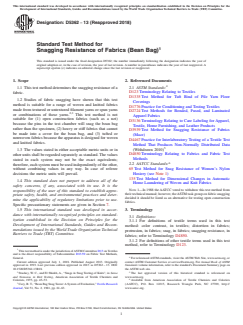
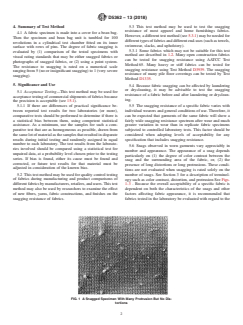
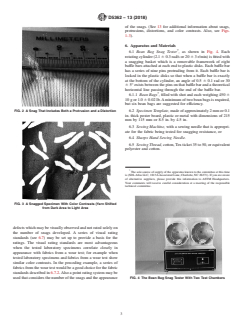
of fabrics during manufacturing and product comparisons of ogy such as color contrast, distortion, and protrusion See Figs.
differentfabricsbymanufacturers,retailers,andusers.Thistest 1-3 . Because the overall acceptability of a specific fabric is
method may also be used by researchers to examine the effect dependent on both the characteristics of the snags and other
of new fibers, yarns, fabric constructions, and finishes on the factors affecting fabric appearance, it is recommended that
snagging resistance of fabrics. fabrics tested in the laboratory be evaluated with regard to the
FIG. 1 A Snagged Specimen With Many Protrusion But No Dis-
tortions
D5362 − 13 (2018)
of the snags. (See 13 for additional information about snags,
protrusions, distortions, and color contrasts. Also, see Figs.
1-3).
6. Apparatus and Materials
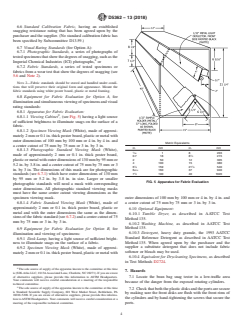
6.1 Bean Bag Snag Tester , as shown in Fig. 4. Each
rotatingcylinder(2.1 60.3rad/sor20 63r/min)isfittedwith
a snagging basket which is a removable framework of eight
baffle bars attached at each end to plastic disks. Each baffle bar
has a series of nine pins protruding from it. Each baffle bar is
locked in the plastic disks so that when a baffle bar is exactly
at the bottom of the cylinder, an angle of 0.5 6 0.1 rad or 30
65°existsbetweenthepinsonthatbafflebarandatheoretical
horizontal line passing through the end of the baffle bar.
6.1.1 Bean Bags , filled with shot and each weighing 450 6
10gor1.0 60.02lb.Aminimumoftwobeanbagsisrequired,
but six bean bags are suggested for efficiency.
FIG. 2 A Snag That Includes Both a Protrusion and a Distortion
6.2 Specimen Template,madeofapproximately2mmor0.1
in. thick poster board, plastic or metal with dimensions of 215
mm by 115 mm or 8.5 in. by 4.5 in.
6.3 Sewing Machine, with a sewing needle that is appropri-
ate for the fabric being tested for snagging resistance, or
6.4 Sharps Hand Sewing Needle.
6.5 SewingThread,cotton,Texticket35to50,orequivalent
polyester and cotton.
The sole source of supply of the apparatus known to the committee at this time
is(SDLAtlasLLC,1813AAssociatedLane,Charlotte,NC28271).Ifyouareaware
of alternative suppliers, please provide this information to ASTM Headquarters.
Your comments will receive careful consideration at a meeting of the responsible
technical committee.
FIG. 3 A Snagged Specimen With Color Contrasts (Yarn Shifted
from Dark Area to Light Area
defectswhichmaybevisuallyobservedandnotratedsolelyon
the number of snags developed. A series of visual rating
standards (see 6.7) may be set up to provide a basis for the
ratings. The visual rating standards are most advantageous
when the tested laboratory specimens correlate closely in
appearance with fabrics from a wear test; for example when
tested laboratory specimens and fabrics from a wear test show
similar color contrasts. In the preceding example, a series of
fabricsfromtheweartestwouldbeagoodchoiceforthefabric
standards described in 6.7.2.Also a point rating system may be
usedthatconsidersthenumberofthesnagsandtheappearance FIG. 4 The Bean Bag Snag Tester With Two Test Chambers
D5362 − 13 (2018)
6.6 Standard Calibration Fabric, having an established
snagging resistance rating that has been agreed upon by the
purchaser and the supplier. (No standard calibration fabric has
been specified by Subcommittee D13.59.)
6.7 Visual Rating Standards (for Option A):
6.7.1 Photographic Standards, a series of photographs of
testedspecimensthatshowthedegreesofsnagging,suchasthe
Imperial Chemical Industries (ICI) photographs, or
6.7.2 Fabric Standards, a series of tested specimens or
fabrics from a wear test that show the degrees of snagging (see
5.6 and Note 2).
NOTE 2—Fabric standards should be stored and handled under condi-
tions that will preserve their original form and appearance. Mount the
fabric standards using white poster board, plastic or metal framing.
6.8 Equipment for Fabric Evaluation for Option A, for
illuminationandsimultaneousviewingofspecimensandvisual
rating standards:
6.8.1 Apparatus for Fabric Evaluation:
6.8.1.1 Viewing Cabinet , (see Fig. 5) having a light source
of sufficient brightness to illuminate snags on the surface of a
fabric.
6.8.1.2 Specimen Viewing Mask (White), made of approxi-
mately 2 mm or 0.1 in. thick poster board, plastic or metal with
outer dimensions of 100 mm by 100 mm or 4 in. by 4 in. and
Metric Equivalents
a center cutout of 75 mm by 75 mm or 3 in. by 3 in.
in. mm in. mm
6.8.1.3 Photographic Standard Viewing Mask (White),
⁄32 1 8 203
made of approximately 2 mm or 0.1 in. thick poster board,
0.7 18 8 ⁄2 215
2 50 12 305
plastic or metal with outer dimensions of 130 mm by 95 mm or
4 100 15 380
5.2 in. by 3.8 in. and a center cutout of 75 mm by 75 mm or 3
1 1
6 ⁄4 159 21 ⁄4 540
in. by 3 in. The dimensions of this mask are for photographic 5
6 ⁄16 160 37 940
standards (see 6.7.1) which have outer dimensions of 130 mm 7 ⁄2 190 40 1020
by 95 mm or 5.2 in. by 3.8 in. in size. Larger or smaller
FIG. 5 Apparatus for Fabric Evaluation
photographic standards will need a mask with corresponding
outer dimensions. All photographic standard viewing masks
must have the same center cutout viewing dimensions as the
outer dimensions of 100 mm by 100 mm or 4 in. by 4 in. and
specimen viewing mask.
6.8.1.4 Fabric Standard Viewing Mask (White), made of a center cutout of 75 mm by 75 mm or 3 in. by 3 in.
approximately 2 mm or 0.1 in. thick poster board, plastic or
6.10 Optional Equipment:
metal and with the outer dimensions the same as the dimen-
6.10.1 Tumble Dryer, as described in AATCC Test
sionsofthefabricstandard(see6.7.2)andacentercutoutof75
Method 135.
mm by 75 mm or 3 in. by 3 in.
6.10.2 Washing Machine, as described in AATCC Test
Method 135.
6.9 Equipment for Fabric Evaluation for Option B, for
6.10.3 Detergent, heavy duty granule, the 1993 AATCC
illumination and viewing of specimens:
Standard Reference Detergent as described in AATCC Test
6.9.1 Desk Lamp, having a light source of sufficient bright-
Method 135. When agreed upon by the purchaser and the
ness to illuminate snags on the surface of a fabric.
supplier a substitute detergent that does not include fabric
6.9.2 Specimen Viewing Mask (White), made of approxi-
softener or bleach may be used.
mately 2 mm or 0.1 in. thick poster board, plastic or metal with
6.10.4 Equivalent for Drycleaning Specimens, as described
in Test Methods D2724.
The sole source of supply of the apparatus known to the committee at this time
7. Hazards
is(SDLAtlasLLC,1813AAssociatedLane,Charlotte,NC28271).Ifyouareaware
of alternative suppliers, please provide this information to ASTM Headquarters.
7.1 Locate the bean bag snag tester in a low-traffic area
Your comments will receive careful consideration at a meeting of the responsible
because of the danger from the exposed rotating cylinders.
technical committee.
The sole source of supply of the apparatus known to the committee at this time
7.2 Checkthatboththeplasticdisksandtheportsaresecure
is Standard Scientific Supply Company, 601 West Market Street, Bethlehem, PA
by making sure the front disks are flush with the front rims of
18018-5208. If you are aware of alternative suppliers, please provide this informa-
the cylinders and by hand-tightening the screws that secure the
tion toASTM Headquarters. Your comments will receive careful consideration at a
meeting of the responsible technical committee. ports.
D5362 − 13 (2018)
7.3 Wear protective gloves when examining the pins or 9.2.1 Similarly cut specimens from laundered or drycleaned
removing debris from the cylinders as described in 11.1. swatches when required.
7.4 Observe the following safety precautions when operat-
9.3 Foldeachspecimeninhalfbyplacingthetwoshortends
ing the tester: (1) do not wear loose or dangling clothing that together. After folding, the surface to be tested for snagging
can get caught in the pins or moving parts, (2) do not attempt
resistance is on the inside of the folded specimen, and the size
to load or unload the chambers while the cylinders are rotating, of the folded specimen is 107 mm by 115 mm or 4.2 in. by 4.5
and(3)donotinjureyourhandsonthesharppinswhenplacing
in.
specimens in the chambers.
9.4 Using a minimum of 0.4 stitches per millimetre or 10
stitches per inch, machine or hand sew a seam approximately
8. Sampling
6.5 mm or 0.25 in. from the edge of each of the 107 mm or 4.2
8.1 LotSample—Asalotsampleforacceptancetesting,take
in. sides of each of the folded specimens to form “socks.”
at random the number of rolls of fabric directed in an
9.5 Turn each specimen inside out to expose the surface for
applicable material specification or other agreement between
testing.
thepurchaserandthesupplier.Considerrollsoffabrictobethe
primary sampling units.
10. Conditioning
8.2 Laboratory Sample Unit—As a laboratory sampling unit
for acceptance testing, take a full width swatch 1 m or 1 yd 10.1 Preconditioning is not necessary. Place all the speci-
mens and bean bags (see 6.1.1) in the standard atmosphere for
long from the end of each roll of fabric in the lot sample, after
first discarding the outermost layer of fabric. When laundering testing textiles, which is 21 61°C(70 6 2 °F) and 65 62%
relative humidity (see Practice D1776), for a minimum of 4
and drycleaning tests are to be performed, take additional
swatches for the laundering and drycleaning tests. hours before testing. While this conditioning does not neces-
sarily result in equilibrium moisture content in the specimens,
8.3 Specimens—Test three specimens from each swatch.
it is deemed adequate for the purposes of this test method.
When drycleaning and laundering tests are to be performed,
test three additional specimens for drycleaning and three
11. Calibration of the Apparatus
additional specimens for laundering.
11.1 Open the port for each cylinder. Using protective
9. Preparation of the Specimens
gloves, pull the two snagging baskets (unit with pins) straight
9.1 When snagging resistance after laundering or dryclean-
out of the cylinders by pulling on the inside rim of each plastic
ing is to be evaluated, launder or dryclean swatches as directed
disk. Examine the pins for barbs, roughness and other damage,
in 9.1.1 or 9.1.2 before cutting the specimens.
and replace any damaged parts. Remove any fibers, yarns, and
9.1.1 Laundering—Load the washer with a 3.5 kg or 8 lb
other debris from the cylinders.
total load of swatches that comprise a homogeneous
...
Questions, Comments and Discussion
Ask us and Technical Secretary will try to provide an answer. You can facilitate discussion about the standard in here.
Loading comments...