

ASTM D579/D579M-24
(Practice)Standard Practice for Greige Woven Glass Fabrics
General Information
- Abstract
ABSTRACT
This specification covers the general and physical requirements for greige fabrics woven from “E” electrical glass fiber yarns. The yarn shall be a continuous filament, free of any free alkali metal salts, such as soda or potash, and foreign particles, dirt, and other impurities. The fabric shall be furnished in rolls and shall be wound in spiral tubes. The materials shall be tested and shall conform to the following requirements: fabric count; yarn numbers for both the warp and filling yarns; filament diameter; strand construction; twist direction wherein the primary twist in the singles strands shall be “Z” twist and the final twist in the plied yarns shall be “S” twist; twist level; fabric weave type which shall include crowfoot, leno, mock leno, plain, eight-harness satin, and twelve-harness satin; mass per unit area; thickness; breaking strength; width including both selvages but excluding any feathered edges; fabric roll length, length between splices, and number of splices per roll; and ignition loss. The fabrics shall also be examined for defects such as bias or bowed filling; baggy, ridged, or wavy cloth; cut or tear; hole; spots, streaks, or stains; foreign inclusions; tender or weak spot; smash; broken, missing ends or picks; floats and skips; light and heavy marks; crease; waste; weave separation; brittle or fused area; selvage defects; selvage leno ends out; and feather edges.
SCOPE
1.1 This practice covers greige fabrics woven from “E” electrical glass fiber yarns. This practice can also be applied to fabrics made of other glass fiber types as agreed upon between the purchaser and the supplier.
1.2 This practice specifies the terminology, definitions, general requirements and physical requirements for greige glass fiber fabrics. This practice permits the application of organic materials to the glass fiber yarn during manufacture that helps facilitate weaving.
1.3 The values stated in either SI units or inch-pound units are to be regarded separately as standard. The values stated in each system are not necessarily exact equivalents; therefore, to ensure conformance with the standard, each system shall be used independently of the other, and values from the two systems shall not be combined.
1.4 This practice is one of a series to provide a substitute for Military Specifications: MIL-Y-1140 Yarn, Cord, Sleeving, Cloth, and Tape-Glass and MIL-C-9084 Cloth, Glass Finished for Resin Laminates.
1.5 Additional ASTM practices in this series have been drafted and appear in current editions of the Annual Book of ASTM Standards. These include finished glass fabrics, unfinished glass fabrics, glass tapes, glass sleevings, glass cords, glass sewing threads, and finished laminates made from finished glass fabrics.
1.6 This standard does not purport to address all of the safety concerns, if any, associated with its use. It is the responsibility of the user of this standard to establish appropriate safety, health, and environmental practices and determine the applicability of regulatory limitations prior to use.
1.7 This international standard was developed in accordance with internationally recognized principles on standardization established in the Decision on Principles for the Development of International Standards, Guides and Recommendations issued by the World Trade Organization Technical Barriers to Trade (TBT) Committee.
- Status
- Published
- Publication Date
- 31-Dec-2023
- Technical Committee
- D13 - Textiles
- Drafting Committee
- D13.18 - Glass Fiber and its Products
Overview
ASTM D579/D579M-24 defines the standard practice for greige woven glass fabrics, primarily constructed from “E” type electrical glass fiber yarns. This international standard, developed by ASTM, specifies the general and physical requirements for glass fiber fabrics that are supplied in their unfinished, or greige, state. These fabrics are widely used in composites, insulation, electrical, and structural applications.
The standard ensures consistency in fabric properties, appearance, and performance by establishing terminology, quality requirements, test methods, and acceptance criteria for both suppliers and purchasers. It also provides practical substitutes for certain military specifications, thereby supporting both commercial and defense industry needs.
Key Topics
Material Requirements
- Utilizes continuous filament “E” glass fiber yarns, which must be free of free alkali metal salts and impurities.
- Allows for the use of organic sizing agents to facilitate weaving.
Physical Properties
- Reveals requirements for fabric count (warp and filling yarn numbers), filament diameter, strand construction, twist direction (“Z” for singles, “S” for plied), twist level, and acceptable weave types (e.g., plain, leno, crowfoot, eight-harness satin, twelve-harness satin).
- Specifies tolerances for properties such as mass per unit area, thickness, and width.
Defect Classification and Quality Assurance
- Details major and minor fabric defects (such as bowed filling, bagginess, tears, holes, stains, broken ends or picks, selvage flaws, and foreign inclusions).
- Sets acceptable quality levels (AQLs) for inspection and batch acceptance.
Testing and Sampling Methods
- Refers to industry-standard ASTM test methods for determining fabric count, yarn properties, thickness, mass, strength, and ignition loss.
- Provides protocols for lot sampling, laboratory sample sizing, and specimen preparation.
Applications
Composite Manufacturing
Greige woven glass fabrics serve as reinforcement material in composite laminates, used for aerospace, automotive, and marine components due to their high strength-to-weight ratio and electrical insulation properties.Electrical Insulation and Equipment
"E" glass fabrics are valued for their dielectric properties, making them suitable for insulating electrical components and as substrates in printed circuit boards.Construction and Civil Engineering
Used in structural supports, overlays, and other applications where fire resistance and dimensional stability are critical.Filtration and Industrial Textiles
The chemical stability and uniformity of glass fiber fabrics make them ideal for filtration systems and industrial process textiles.Military and Defense
ASTM D579/D579M-24 is recognized as a replacement for older military specifications (MIL-Y-1140, MIL-C-9084) for yarns, tapes, and cloths in defense equipment.
Related Standards
- ASTM D578/D578M - Specification for Glass Fiber Strands
- ASTM D123 - Terminology Relating to Textiles
- ASTM D1059 - Test Method for Yarn Number
- ASTM D1423/D1423M - Test Method for Twist in Yarns
- ASTM D1776/D1776M - Practice for Conditioning and Testing Textiles
- ASTM D3775 - Test Method for Fabric Count
- ASTM D3776/D3776M - Test Methods for Mass Per Unit Area
- ASTM D1777 - Test Method for Thickness of Textile Materials
- ASTM D5035 - Test Method for Breaking Force and Elongation of Textile Fabrics
- ANSI/ASQC Z1.4 - Sampling Procedures for Inspection by Attributes
ASTM D579/D579M-24 provides a robust framework for the specification, testing, and quality assurance of greige woven glass fiber fabrics. By consistently applying this standard, manufacturers and users can ensure reliable performance in critical applications across industries. The document is essential for those sourcing, applying, or certifying glass fiber woven fabrics for advanced technical uses.
Relations
- Effective Date
- 01-Jan-2024
- Effective Date
- 01-Feb-2015
- Effective Date
- 01-Jan-2024
- Effective Date
- 01-Jan-2024
- Effective Date
- 01-Jan-2024
- Effective Date
- 01-Jan-2024
- Effective Date
- 01-Jan-2024
- Effective Date
- 01-Jan-2024
Get Certified
Connect with accredited certification bodies for this standard

Control Union Certifications
Global certification for agriculture and sustainability.

Hohenstein Institut
Textile testing and certification.

Bureau Veritas Bangladesh
Bureau Veritas certification services in Bangladesh.
Sponsored listings
Frequently Asked Questions
ASTM D579/D579M-24 is a standard published by ASTM International. Its full title is "Standard Practice for Greige Woven Glass Fabrics". This standard covers: ABSTRACT This specification covers the general and physical requirements for greige fabrics woven from “E” electrical glass fiber yarns. The yarn shall be a continuous filament, free of any free alkali metal salts, such as soda or potash, and foreign particles, dirt, and other impurities. The fabric shall be furnished in rolls and shall be wound in spiral tubes. The materials shall be tested and shall conform to the following requirements: fabric count; yarn numbers for both the warp and filling yarns; filament diameter; strand construction; twist direction wherein the primary twist in the singles strands shall be “Z” twist and the final twist in the plied yarns shall be “S” twist; twist level; fabric weave type which shall include crowfoot, leno, mock leno, plain, eight-harness satin, and twelve-harness satin; mass per unit area; thickness; breaking strength; width including both selvages but excluding any feathered edges; fabric roll length, length between splices, and number of splices per roll; and ignition loss. The fabrics shall also be examined for defects such as bias or bowed filling; baggy, ridged, or wavy cloth; cut or tear; hole; spots, streaks, or stains; foreign inclusions; tender or weak spot; smash; broken, missing ends or picks; floats and skips; light and heavy marks; crease; waste; weave separation; brittle or fused area; selvage defects; selvage leno ends out; and feather edges. SCOPE 1.1 This practice covers greige fabrics woven from “E” electrical glass fiber yarns. This practice can also be applied to fabrics made of other glass fiber types as agreed upon between the purchaser and the supplier. 1.2 This practice specifies the terminology, definitions, general requirements and physical requirements for greige glass fiber fabrics. This practice permits the application of organic materials to the glass fiber yarn during manufacture that helps facilitate weaving. 1.3 The values stated in either SI units or inch-pound units are to be regarded separately as standard. The values stated in each system are not necessarily exact equivalents; therefore, to ensure conformance with the standard, each system shall be used independently of the other, and values from the two systems shall not be combined. 1.4 This practice is one of a series to provide a substitute for Military Specifications: MIL-Y-1140 Yarn, Cord, Sleeving, Cloth, and Tape-Glass and MIL-C-9084 Cloth, Glass Finished for Resin Laminates. 1.5 Additional ASTM practices in this series have been drafted and appear in current editions of the Annual Book of ASTM Standards. These include finished glass fabrics, unfinished glass fabrics, glass tapes, glass sleevings, glass cords, glass sewing threads, and finished laminates made from finished glass fabrics. 1.6 This standard does not purport to address all of the safety concerns, if any, associated with its use. It is the responsibility of the user of this standard to establish appropriate safety, health, and environmental practices and determine the applicability of regulatory limitations prior to use. 1.7 This international standard was developed in accordance with internationally recognized principles on standardization established in the Decision on Principles for the Development of International Standards, Guides and Recommendations issued by the World Trade Organization Technical Barriers to Trade (TBT) Committee.
ABSTRACT This specification covers the general and physical requirements for greige fabrics woven from “E” electrical glass fiber yarns. The yarn shall be a continuous filament, free of any free alkali metal salts, such as soda or potash, and foreign particles, dirt, and other impurities. The fabric shall be furnished in rolls and shall be wound in spiral tubes. The materials shall be tested and shall conform to the following requirements: fabric count; yarn numbers for both the warp and filling yarns; filament diameter; strand construction; twist direction wherein the primary twist in the singles strands shall be “Z” twist and the final twist in the plied yarns shall be “S” twist; twist level; fabric weave type which shall include crowfoot, leno, mock leno, plain, eight-harness satin, and twelve-harness satin; mass per unit area; thickness; breaking strength; width including both selvages but excluding any feathered edges; fabric roll length, length between splices, and number of splices per roll; and ignition loss. The fabrics shall also be examined for defects such as bias or bowed filling; baggy, ridged, or wavy cloth; cut or tear; hole; spots, streaks, or stains; foreign inclusions; tender or weak spot; smash; broken, missing ends or picks; floats and skips; light and heavy marks; crease; waste; weave separation; brittle or fused area; selvage defects; selvage leno ends out; and feather edges. SCOPE 1.1 This practice covers greige fabrics woven from “E” electrical glass fiber yarns. This practice can also be applied to fabrics made of other glass fiber types as agreed upon between the purchaser and the supplier. 1.2 This practice specifies the terminology, definitions, general requirements and physical requirements for greige glass fiber fabrics. This practice permits the application of organic materials to the glass fiber yarn during manufacture that helps facilitate weaving. 1.3 The values stated in either SI units or inch-pound units are to be regarded separately as standard. The values stated in each system are not necessarily exact equivalents; therefore, to ensure conformance with the standard, each system shall be used independently of the other, and values from the two systems shall not be combined. 1.4 This practice is one of a series to provide a substitute for Military Specifications: MIL-Y-1140 Yarn, Cord, Sleeving, Cloth, and Tape-Glass and MIL-C-9084 Cloth, Glass Finished for Resin Laminates. 1.5 Additional ASTM practices in this series have been drafted and appear in current editions of the Annual Book of ASTM Standards. These include finished glass fabrics, unfinished glass fabrics, glass tapes, glass sleevings, glass cords, glass sewing threads, and finished laminates made from finished glass fabrics. 1.6 This standard does not purport to address all of the safety concerns, if any, associated with its use. It is the responsibility of the user of this standard to establish appropriate safety, health, and environmental practices and determine the applicability of regulatory limitations prior to use. 1.7 This international standard was developed in accordance with internationally recognized principles on standardization established in the Decision on Principles for the Development of International Standards, Guides and Recommendations issued by the World Trade Organization Technical Barriers to Trade (TBT) Committee.
ASTM D579/D579M-24 is classified under the following ICS (International Classification for Standards) categories: 59.080.30 - Textile fabrics. The ICS classification helps identify the subject area and facilitates finding related standards.
ASTM D579/D579M-24 has the following relationships with other standards: It is inter standard links to ASTM D579/D579M-24, ASTM D579/D579M-15, ASTM D579/D579M-24, ASTM D7556-10(2019), ASTM D4595/D4595M-23, ASTM D580/D580M-24, ASTM E2098/E2098M-13(2023), ASTM D1668/D1668M-97a(2021). Understanding these relationships helps ensure you are using the most current and applicable version of the standard.
ASTM D579/D579M-24 is available in PDF format for immediate download after purchase. The document can be added to your cart and obtained through the secure checkout process. Digital delivery ensures instant access to the complete standard document.
Standards Content (Sample)
This international standard was developed in accordance with internationally recognized principles on standardization established in the Decision on Principles for the
Development of International Standards, Guides and Recommendations issued by the World Trade Organization Technical Barriers to Trade (TBT) Committee.
Designation: D579/D579M − 24
Standard Practice for
Greige Woven Glass Fabrics
This standard is issued under the fixed designation D579/D579M; the number immediately following the designation indicates the year
of original adoption or, in the case of revision, the year of last revision. A number in parentheses indicates the year of last reapproval.
A superscript epsilon (´) indicates an editorial change since the last revision or reapproval.
This standard has been approved for use by agencies of the U.S. Department of Defense.
1. Scope Development of International Standards, Guides and Recom-
mendations issued by the World Trade Organization Technical
1.1 This practice covers greige fabrics woven from “E”
Barriers to Trade (TBT) Committee.
electrical glass fiber yarns. This practice can also be applied to
fabrics made of other glass fiber types as agreed upon between
2. Referenced Documents
the purchaser and the supplier.
2.1 ASTM Standards:
1.2 This practice specifies the terminology, definitions, gen-
D123 Terminology Relating to Textiles
eral requirements and physical requirements for greige glass
D578/D578M Specification for Glass Fiber Strands
fiber fabrics. This practice permits the application of organic
D579/D579M Specification for Greige Woven Glass Fabrics
materials to the glass fiber yarn during manufacture that helps
D1059 Test Method for Yarn Number Based on Short-
facilitate weaving.
Length Specimens
D1423/D1423M Test Method for Twist in Yarns by Direct-
1.3 The values stated in either SI units or inch-pound units
Counting
are to be regarded separately as standard. The values stated in
D1776/D1776M Practice for Conditioning and Testing Tex-
each system are not necessarily exact equivalents; therefore, to
tiles
ensure conformance with the standard, each system shall be
D1777 Test Method for Thickness of Textile Materials
used independently of the other, and values from the two
D3773/D3773M Test Methods for Length of Woven Fabric
systems shall not be combined.
D3774 Test Method for Width of Textile Fabric
1.4 This practice is one of a series to provide a substitute for
D3775 Test Method for End (Warp) and Pick (Filling) Count
Military Specifications: MIL-Y-1140 Yarn, Cord, Sleeving,
of Woven Fabrics
Cloth, and Tape-Glass and MIL-C-9084 Cloth, Glass Finished
D3776/D3776M Test Methods for Mass Per Unit Area
for Resin Laminates.
(Weight) of Fabric
1.5 Additional ASTM practices in this series have been
D4963/D4963M Test Method for Ignition Loss of Glass
drafted and appear in current editions of the Annual Book of
Fiber Strands and Fabrics
ASTM Standards. These include finished glass fabrics, unfin-
D5035 Test Method for Breaking Force and Elongation of
ished glass fabrics, glass tapes, glass sleevings, glass cords,
Textile Fabrics (Strip Method)
glass sewing threads, and finished laminates made from fin-
D7018/D7018M Terminology Relating to Glass Fiber and
ished glass fabrics.
Its Products (Withdrawn 2021)
2.2 ANSI Standards:
1.6 This standard does not purport to address all of the
ANSI/ASQC Z1.4 Sampling Procedures for Inspection by
safety concerns, if any, associated with its use. It is the
Attributes
responsibility of the user of this standard to establish appro-
2.3 Military Standard and Specifications:
priate safety, health, and environmental practices and deter-
MIL-Y-1140H Yarn, Cord, Sleeving, Cloth and Tape-Glass
mine the applicability of regulatory limitations prior to use.
MIL-C-9084C Cloth, Glass Finished for Resin Laminates
1.7 This international standard was developed in accor-
dance with internationally recognized principles on standard-
For referenced ASTM standards, visit the ASTM website, www.astm.org, or
ization established in the Decision on Principles for the
contact ASTM Customer Service at service@astm.org. For Annual Book of ASTM
Standards volume information, refer to the standard’s Document Summary page on
the ASTM website.
1 3
This specification is under the jurisdiction of ASTM Committee D13 on The last approved version of this historical standard is referenced on
Textiles and is the direct responsibility of Subcommittee D13.18 on Glass Fiber and www.astm.org.
its Products. Available from American National Standards Institute (ANSI), 25 W. 43rd St.,
Current edition approved Jan. 1, 2024. Published February 2024. Originally 4th Floor, New York, NY 10036, http://www.ansi.org.
approved in 1940. Last previous edition approved in 2015 as D579/D579M – 15. Available from DLA Document Services, Building 4/D, 700 Robbins Ave.,
DOI: 10.1520/D0579_D0579M-24. Philadelphia, PA 19111-5094, http://quicksearch.dla.mil.
Copyright © ASTM International, 100 Barr Harbor Drive, PO Box C700, West Conshohocken, PA 19428-2959. United States
D579/D579M − 24
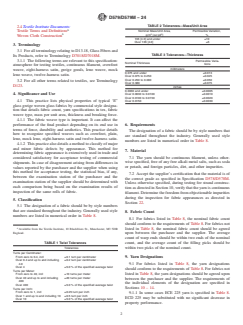
TABLE 2 Tolerances—Mass/Unit Area
2.4 Textile Institute Documents:
Textile Terms and Definitions Nominal Mass/Unit Area, Permissible Variation,
2 2
g/m [oz ⁄yd ] %
Woven Cloth Construction
136 [4.0] and under ±10
Over 136 [4.0] ±6
3. Terminology
3.1 For all terminology relating to D13.18, Glass Fibers and
TABLE 3 Tolerances—Thickness
Its Products, refer to Terminology D7018/D7018M.
3.1.1 The following terms are relevant to this specification: Permissible Varia-
Nominal Thickness
tions
atmosphere for testing textiles, continuous filament, crowfoot
millimeters
weave, eight-harness satin, greige goods, leno weave, mock
0.075 and under ±0.013
leno weave, twelve-harness satin.
Over 0.075 to 0.250 ±0.025
Over 0.250 to 0.380 ±0.050
3.2 For all other terms related to textiles, see Terminology
Over 0.380 ±0.075
D123.
inches
0.0030 and under ±0.0005
Over 0.0030 to 0.0100 ±0.0010
4. Significance and Use
Over 0.0100 to 0.0150 ±0.0020
4.1 This practice lists physical properties of typical ‘E” Over 0.0150 ±0.0030
glass greige woven glass fabrics by commercial style designa-
tion that details fabric count, yarn specifications in tex, fabric
weave type, mass per unit area, thickness and breaking force.
4.1.1 The fabric weave type is important. It can affect the
performance of the final product depending on its end use in
6. Requirements
terms of force, durability and aesthetics. This practice details
The designation of a fabric should be by style numbers that
how to recognize specified weaves such as crowfoot, plain,
are standard throughout the industry. Generally used style
leno, mock leno, eight-harness satin and twelve-harness satin.
numbers are listed in numerical order in Table 8.
4.1.2 This practice also details a method to classify of major
and minor fabric defects by appearance. This method for
7. Material
determining fabric appearance is extensively used in trade and
7.1 The yarn should be continuous filament, unless other-
considered satisfactory for acceptance testing of commercial
wise specified, free of any free alkali metal salts, such as soda
shipments. In case of disagreement arising from differences in
or potash, and foreign particles, dirt, and other impurities.
values reported by the purchaser and the supplier when using
this method for acceptance testing, the statistical bias, if any,
7.2 Accept the supplier’s certification that the material is of
between the examination station of the purchaser and the
the correct grade as specified in Specification D578/D578M.
examination station of the supplier should be determined with
Unless otherwise specified, during testing for strand construc-
each comparison being based on the examination results of
tion as directed in Section 10, verify that the yarn is continuous
inspection of the same rolls of fabric.
filament. Determine the freedom from objectionable impurities
during the inspection for fabric appearances as directed in
5. Classification
Section 22.
5.1 The designation of a fabric should be by style numbers
that are standard throughout the industry. Generally used style
8. Fabric Count
numbers are listed in numerical order in Table 8.
8.1 For fabrics listed in Table 8, the nominal fabric count
should conform to the requirements of Table 8. For fabrics not
listed in Table 8, the nominal fabric count should be agreed
Available from the Textile Institute, 10 Blackfriars St., Manchester, M3 5DR
England. upon between the purchaser and the supplier. The average
count of warp ends should be within two ends of the nominal
TABLE 1 Twist Tolerances count, and the average count of the filling picks should be
within two picks of the nominal count.
Tolerances
Turns per Centimeter:
From zero to 0.4, incl ±0.1 turn per centimeter
9. Yarn Designations
Over 0.4 and up to and including ±0.2 turn per centimeter
4.0
9.1 For fabrics listed in Table 8, the yarn designations
Over 4 ±5.0 % of the specified average twist
should conform to the requirements of Table 8. For fabrics not
Turns per Meter:
listed in Table 8, the yarn designations should be agreed upon
From zero to 40, incl ±10 turns per meter
Over 40 and up to and including ±20 turns per meter
between the purchaser and the supplier. The requirements of
the individual elements of the designation are specified in
Over 400 ±5.0 % of the specified average twist
Sections 10 – 14.
Turns per Inch:
From zero to 1, incl ±0.25 turn per inch
9.1.1 In some cases ECE 225 yarn is specified in Table 8.
Over 1 and up to and including 10 ±0.5 turn per inch
ECD 225 may be substituted with no significant decrease in
Over 10 ±5.0 % of the specified average twist
property performance.
D579/D579M − 24
A
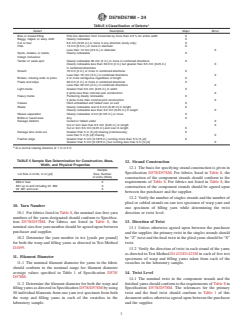
TABLE 4 Classification of Defects
Defect Description Major Minor
Bias or bowed filling Pick line distortion from horizontal by more than 2.5 % for entire width X
Baggy, ridged, or wavy cloth Clearly noticeable X
Cut or tear 6.5 mm [0.25 in.] or more in any direction (body only) X
Hole 13 mm [0.5 in.] or more in diameter X
Less than 13 mm [0.5 in.] in diameter X
Spots, streaks, or stains, Clearly noticeable X
foreign inclusions
Tender or weak spot Clearly noticeable 50 mm [2 in.] or more in combined directions X
Clearly noticeable less than 50 mm [2 in.] but greater than 6.5 mm [0.25 in.] X
in combined directions
Smash 76 mm [3 in.] or more in combined directions X
Less than 76 mm [3 in.] in combined directions X
Broken, missing ends or picks 2 or more contiguous regardless of length X
Floats and skips 50 mm [2 in.] or more in combined directions X
Less than 50 mm [2 in.] in combined directions X
Light marks Greater than 6.5 mm [0.25 in.] in width X
2 picks less than nominal pick construction X
Heavy marks Puckering clearly noticeable X
2 picks more than nominal pick construction X
Crease Hard embedded and folded over on self X
Waste Clearly noticeable over 6.5 mm [0.25 in] in length X
Clearly noticeable less than 6.5 mm [0.25 in.] in length X
Weave separation Clearly noticeable 3 mm [0.125 in.] or more X
Brittle or fused area Any X
Selvage Defects Curled or folded under X
Cut or torn less than 6.5 mm [0.25 in.] in length X
Cut or torn 6.5 mm [0.25 in.] and over in length X
Selvage leno ends out Greater than 5 m [5 yd] missing (continuously) X
Less than 5 m [5 yd] missing X
Feather edge Greater than 5 mm [0.1875 in.] running more than 5 m [5 yd] X
Greater than 5 mm [0.1875 in.] but running less than 5 m [5 yd] X
A
At a normal viewing distance of 1 m or 3 ft.
TABLE 5 Sample Size Determination for Construction, Mass,
12. Strand Construction
Width, and Physical Properties
12.1 The basis for specifying strand construction is given in
Sample
Specification D578/D578M. For fabrics listed in Table 8, the
Lot Size in Units, m or [yd] Size, Number
of Units (Rolls)
construction of the component strands should conform to the
800 or less 2 requirements of Table 8. For fabrics not listed in Table 8, the
801 up to and including 22 000 3
construction of the component strands should be agreed upon
22 001 and over 5
between the purchaser and the supplier.
12.2 Verify the number of singles strands and the number of
plied or cabled strands on one test specimen of warp yarn and
10. Yarn Number
one specimen of filling yarn while determining the twist
direction or twist level.
10.1 For fabrics listed in Table 8, the nominal size-free yarn
numbers of the yarns designated should conform to Specifica-
13. Direction of Twist
tion D578/D578M. For fabrics not listed in Table 8, the
nominal size-free yarn number should be agreed upon between
13.1 Unless otherwise agreed upon between the purchaser
purchaser and supplier.
and the supplier, the primary twist in the singles strands should
be “Z” twist and the final twist in the plied yarns should be “S”
10.2 Determine the yarn number in tex [yards per pound]
twist.
for both the warp and filling yarns as directed in Test Method
D1059.
13.2 Verify the direction of twist in each strand of the yarns
as directed in Test Method D1423/D1423M in each of five test
11. Filament Diameter
specimens of warp and filling yarns taken from each of the
11.1 The nominal filament diameter for yarns in the fabric
swatches in the laboratory sample.
should conform to the nominal range for filament diameter
average values specified in Table 1 of Specification D578/ 14. Twist Level
D578M.
14.1 The nominal twist in the component strands and the
11.2 Determine the filament diameter for both the warp and finished yarns should conform to the requirements of Table 8 in
filling yarns as directed in Specification D578/D578M by using Specification D578/D578M. The tolerances for the primary
50 individual filaments from one yarn test specimen from both twist and the final twist should conform to Table 1 of this
the warp and filling yarns in each of the swatches in the document unless otherwise agreed upon between the purchaser
laboratory sample. and the supplier.
D579/D579M − 24
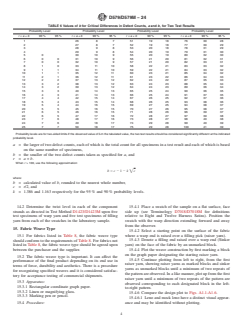
TABLE 6 Values of b for Critical Differences in Defect Counts, a and b, for Two Test Results
Probability Level Probability Level Probability Level Probability Level
r = a + b 90 % 95 % r = a + b 90 % 95 % r = a + b 90 % 95 % r = a + b 90 % 95 %
1 26 8 7 51 19 18 76 30 28
2 27 8 7 52 19 18 77 30 29
3 28 9 8 53 20 18 78 31 29
4 29 9 8 54 20 19 79 31 30
5 0 30 10 9 55 20 19 80 32 30
6 0 0 31 10 9 56 21 20 81 32 31
7 0 0 32 10 9 57 21 20 82 33 31
8 1 0 33 11 10 58 22 21 83 33 32
9 1 1 34 11 10 59 22 21 84 33 32
10 1 1 35 12 11 60 23 21 85 34 32
11 2 1 36 12 11 61 23 22 86 34 33
12 2 2 37 13 12 62 24 22 87 35 33
13 3 2 38 13 12 63 24 23 88 35 34
14 3 2 39 13 12 64 24 23 89 36 34
15 3 3 40 14 13 65 25 24 90 36 35
16 4 3 41 14 13 66 25 24 91 37 35
17 4 4 42 15 14 67 26 25 92 37 36
18 5 4 43 15 14 68 26 25 93 38 36
19 5 4 44 16 15 69 27 25 94 38 37
20 5 5 45 16 15 70 27 26 95 38 37
21 6 5 46 16 15 71 28 26 96 39 37
22 6 5 47 17 16 72 28 27 97 39 38
23 7 6 48 17 16 73 28 27 98 40 38
24 7 6 49 18 17 74 29 28 99 40 39
25 7 7 50 18 17 75 29 28 100 41 39
Probability levels are for two-sided limits.If the observed value of |Lm the tabulated value, the two test results should be considered significantly different at the indicated
probability level.
a = the larger of two defect counts, each of which is the total count for all specimens in a test result and each of which is based
on the same number of specimens,
b = the smaller of the two defect counts taken as specified for a, and
r = a + b.
When r > 100, use the following approximation:
b 5 c 2 1 2 k =c
where:
b = calculated value of b, rounded to the nearest whole number,
c = r/2, and
k = 1.386 and 1.163 respectively for the 95 % and 90 % probability levels.
14.2 Determine the twist level in each of the component 15.4.1 Place a swatch of the sample on a flat surface, face
strands as directed in Test Method D1423/D1423M upon five side up (see Terminology D7018/D7018M for definitions
test specimens of warp yarn and five test specimens of filling relative to Eight and Twelve Harness Satins). Position the
yarn from each of the swatches in the laboratory sample. swatch with the warp direction extending forward and away
from the observer.
15. Fabric Weave Type
15.4.2 Select a starting point on the surface of the fabric
15.1 For fabrics listed in Table 8, the fabric weave type where a warp end is raised over a filling pick (raiser yarn).
should conform to the requirements of Table 8. For fabrics not 15.4.3 Denote a filling end raised over a warp end (Sinker
listed in Table 8, the fabric weave type should be agreed upon yarn) on the face of the fabric by an unmarked block.
between the purchaser and the supplier. 15.4.4 Plot the weave construction by first marking a block
on the graph paper designating the starting raiser yarn.
15.2 The fabric weave type is important. It can affect the
15.4.5 Continue plotting from left to right, from the first
performance of the final product depending on its end use in
raiser yarn, showing raiser yarns as marked blocks and sinker
terms of force, durability and aesthetics. There is a procedure
yarns as unmarked blocks until a minimum of two repeats of
for recognizing specified weaves and it is considered satisfac-
the pattern are observed. In a like manner, plot up from the first
tory for acceptance testing of commercial shipments.
raiser yarn until a minimum of two repeats of the pattern are
15.3 Apparatus:
observed corresponding to each designated block in the left-
15.3.1 Rectangular coordinate graph paper.
to-right pattern.
15.3.2 Linen or magnifying glass.
15.4.6 Compare the design plot to Figs. A1.1-A1.6.
15.3.3 Marking pen or pencil.
15.4.6.1 Leno and mock leno have a distinct visual appear-
15.4 Procedure: ance and may be identified without plotting.
D579/D579M − 24
TABLE 7 95 % Confidence Limits for Number of Defect Counts
17.3 For glass fabrics and tapes made with continuous
per Test Result
filament yarns, use Table 1 Option 3 of Method D1777. For
Observed Count Lower Limit Upper Limit
fabrics made with textured or open-end yarns, use Table 1
0 0.0 3.7
Option 1 of Method D1777.
5 1.6 11.7
10 4.8 18.4
18. Breaking Force
15 8.4 24.7
20 12.2 30.9
18.1 For fabrics listed in Table 8, the minimum breaking
25 16.2 36.9
30 20.2 42.8
force should conform to the requirements of Table 8. For those
35 24.4 48.7
fabrics in which breaking force is not listed in Table 8, the
40 28.6 54.5
minimum breaking force should be agreed upon between the
45 32.8 60.2
50 37.1 65.9
purchaser and the supplier. The average breaking force for the
60 45.8 77.2
lot shall exceed the specified breaking force, and no individual
70 54.6 88.4
break should be less than 80 % of the specified minimum
80 63.4 99.6
90 72.4 110.6
breaking force.
100 81.4 121.6
18.2 Determine the breaking force in newtons per 25 mm
120 99.5 143.5
140 117.8 165.2
[or pounds-force per inch] of fabric in both the warp and filling
160 136.2 186.8
directions as directed in Test Method D5035. There may be no
180 154.7 208.3
200 173.2 229.7 overall correlation between the results obtained with the CRE
machine and the CRT machine. Consequently, these two testers
Lower confidence limit for counts = c[1 − (1 ⁄9c) − t(1 ⁄9c) ⁄2 ]
cannot be used interchangeably. In case of controversy the
Upper confidence limit for count = d[1 − (1 ⁄9d) + t(1 ⁄9d) ⁄2 ]
CRE tensile tester should prevail.
where:
18.2.1 The use of hydraulic pneumatic clamping systems
c = observed number of counts,
with 50 mm by 75 mm [2 in. by 3 in.] serrated jaw faces is
d = c + 1, and
recommended for testing samples prepared as directed in 18.5
t = 1.960, the value of Student’s t for infinite degrees of
and 18.6. The 50 mm [2 in.] dimension of the jaw face should
freedom, two-sided limits, and the 95 % probability
be in the direction of test. Manual clamping is permitted.
level.
NOTE 1—When using jaw faces other than serrated, minimize crushing
and cutting of the glass yarns in the test specimens by lining the inside
surface of the jaws with cardboard 0.25 mm to 0.40 mm [0.010 in. to
15.5 Report:
0.015 in.] in thickness or moleskin. Secure the end of the jaws with
15.5.1 State that the fabric weave type of the rolls of fabric
pressure-sensitive tape.
was determined as directed in Section 15 of Specification
18.3 Prepare specimens as directed in 18.4, 18.5, or 18.6, as
D579/D579M. Describe the material or product sampled and
applicable.
the method of sampling used.
18.4 Procedure 1—Procedure 1 is for fabrics having break-
15.5.2 Report the fabric weave type for each roll including
ing forces of 445 N/25 mm [100 lbf/in.] or less.
the raiser/sinker pattern in terms of the warp ends up and down.
NOTE 2—Fabrics having breaking force less than 445 N/25 mm [100
16. Mass Per Unit Area
lbf/in.] can be prepared as outlined in 18.5 with no effect on the obtained
16.1 For fabrics listed in Table 8, the nominal mass per unit value. Preparation Procedure 1 is provided to allow for a lower test
specimen preparation cost when extensive preparation is not required.
area should conform to the requirement of Table 8. For fabrics
not listed in Table 8, the nominal mass per unit area should be
18.4.1 Reagents and Materials:
agreed upon between the purchaser and the supplier. The
18.4.1.1 Butyl Methacrylate Solution—is prepared by mix-
average mass per unit area for the lot should conform to the
ing 45 parts by mass of butyl methacrylate with 55 parts by
requirements of Table 2.
weight of toluene or xylene and adding a small amount of
oil-soluble dye. The viscosity of this solution should be about
16.2 Determine the mass per unit area of the fabric as
mPa·s (3000 cP), approximately that of honey at room tem-
directed in Test Method D3776/D3776M, Option A, using each
perature. It may be necessary to change the consistency for
of the rolls in the laboratory sample.
some types of fabrics to permit complete penetration of all
17. Thickness
interstices and to prevent capillary migration of the solution
along the yarns into the test area.
17.1 For fabrics listed in Table 8, the nominal thickness
should conform to the requirements of Table 8. For fabrics not
NOTE 3—Substitute solutions can be used providing specimen damage
listed in Table 8, the nominal thickness should be agreed upon
does not occur or that specimens break or slip at the jaw faces.
between the purchaser and the supplier. The average thickness
18.4.1.2 Warning—Butyl methacrylate solution ingredients
of the fabric in the lot should conform to the requirements of
are flammable. Keep away from heat, sparks and open flame.
Table 3, unless specified otherwise.
Keep containers closed. Use only with adequate ventilation.
17.2 Determine the thickness of the fabric as directed in Test Avoid prolonged breathing of vapor or spray mist. Avoid
Method D1777, using ten test specimens from each swatch in prolonged or repeated contact with skin. Spillage and fire
the laboratory sample. instructions will depend on nature of solution.
D579/D579M − 24
18.4.1.3 Multipurpose Paper, 20 lb bond or greater (as 18.5.4 Uniformly apply a resin solution on the cardboard
needed to prevent slippage in the grips). along the drawn lines and outwards for a distance of 50 mm 6
1 mm [2.0 in. 6 0.05 in.] . Do not include the center 75 mm 6
18.4.1.4 Paint Brush, 16 mm to 25 mm [0.6 in. to 1.0 in.]
,with bristles 25 mm [1 in.] long. 1 mm [3.0 6 0.05 in.] between the drawn lines.
18.4.2 Cut two swatches of fabric from the laboratory
NOTE 5—A mixture by weight of 60 parts Epoxy resin and 40 parts
sample each 200 mm by 250 mm [8 in. by 10 in.], one with the
polyamide resin has been found suitable for this purpose.
warp yarns and the other with filling yarns parallel to the 200
18.5.5 Lay the cut swatches of fabrics each 200 mm by 250
mm [8 in] direction
mm [8 in. by 10 in.], one with the warp yarns and the other
18.4.3 Lay each sample cut as directed in 18.4.2 on a piece
with the filling yarns parallel to the 200 mm [8 in.] direction,
of wrapping paper of similar size. Lay out five test specimens
centrally and equally spaced on the resin prepared cardboard.
38 mm by 150 mm [1.5 in. by 6 in.] on the fabric by drawing
The shorter direction of the sample is perpendicular to the
light lines with a soft, black wax pencil so that the yarns to be
drawn lines.
tested, warp or filling, are parallel to the longer direction. Draw
18.5.6 Uniformly reapply the resin mixture on the specimen
lines across the specimens 40 mm [1.6 in] from each end, using
directly above the first application.
very light pressure on the wax pencil to avoid possible damage
18.5.7 Place a 50 mm 6 1 mm [2.0 in. 6 0.05 in.] by 250
to the surface filaments. Thoroughly impregnate the 40 mm
mm [10 in.] strip of cardboard over the resin-impregnated area
[1.625 in.] specimen end strips with butyl methacrylate solu-
of the specimen. Allow to dry a minimum of 16 h.
tion (or substitute) which must soak through the fabric in order
to secure firm adhesion to the paper. Spread the solution in an
NOTE 6—When substitute solutions are used, drying time may vary.
even film to secure a uniform pressure from the testing
18.5.8 Cut five specimens, 150 mm by 38 mm [8.0 in. by
machine jaws against the test specimen. Dry the impregnated
1.5 in.] in each of the warp and filling directions, and label
sample slowly, 24 h without forcing, until the solvent is
accordingly, having the longer direction in the direction of test.
completely removed. Be sure to have the impregnant cover the
18.5.9 Ravel a sufficient number of yarns from each side of
cross lines to reinforce those sections where some of the
the specimen so that the central portion is a 25 mm [1.0 in.]
surface fibers may have been fractured when those lines were
width plus two yarns.
drawn. On thick fabrics, paint both sides of the specimens by
18.5.10 After the specimen is loaded in the test clamps, cut
applying a coat of the impregnant to the back of the fabric or
and ravel one yarn from each side of the test specimen and cut
to the top surface of the backing paper.
the cardboard backing across, midway between the ends,
18.4.4 Cut the 150 mm by 38 mm [6 in. by 1.5 in.] test
taking care not to damage the fabric specimen.
specimen strips from the prepared sample without removing
18.5.11 In the case of hydraulic pneumatic clamps, apply a
the paper backing. Ravel the central unimpregnated portion of
pressure of 6750 N to 7650 N [1500 lbf to 1700 lbf] to the
the specimen to 25 mm [1 in.] in width as directed in Test
clamp faces. In the case of manual clamping, tighten suffi-
Method D5035. After raveling, load samples in the test clamps,
ciently to prevent slippage of the test specimen.
cut the 38 mm [1.5 in.] wide paper backing across midway
18.6 Procedure 3—Procedure 3 is for fabrics having break-
between the ends, taking care not to damage the fabric
specimen. ing forces greater than 2224 N/25 mm [500 lbf/in.] or that
show cascading breaks across the specimen when using Pro-
18.4.5 Cut the 150 mm by 38 mm [6 in. by 1.5 in.] test
cedure 2 stated in 18.5 or both.
specimen strips from the prepared sample without removing
the paper backing. Ravel the central unimpregnated portion of
NOTE 7—Glass yarns have a tendency to move within some fabrics
the specimen to 25 mm [1 in.] in width as directed in Test
when cut and handled in the greige state. This procedure is designed to
Method D5035. After raveling, load samples in the test clamps,
ensure straightness of individual yarn components throughout the test.
cut the 38 mm [1.5 in.] wide paper backing across midway
18.6.1 Cut five specimens, 300 mm by 50 mm [12 in. by 2
between the ends, taking care not to damage the fabric
in.] from the laboratory sample in each of the warp and filling
specimen.
directions, and label accordingly, having the longer direction in
NOTE 4—Raveling of the specimen can be facilitated by slitting each the direction of test.
test specimen at its center, perpendicular to the yarn components severing
18.6.2 Draw two legible lines 75 mm 6 1 mm [3.0 in. 6
all yarns except those in the central 25 mm [1 in.].
0.05 in.] from each other and parallel to the long directions and
18.5 Procedure 2—Procedure 2 is for fabrics having break- across the center section of a 200 mm by 280 mm [8 in. by 11
ing forces greater than 445 N/mm [100 lbf/in.] or tending to in.] piece of Sub 65 white cardboard. Prepare one for each the
consistently break in, or slip from, the jaws when using
warp and filling directions.
Procedure 1 stated in 18.4.
18.6.3 Place the cardboard sections at the outer edge of a
18.5.1 Prepare test specimens as directed in 18.4 except as workbench that is covered with a 0.19 mm [75 in.] thick piece
described in 18.5.2–18.5.10.
of plywood. The 280 mm [11 in.] length is parallel to the bench
edge.
18.5.2 Substitute Sub 65 grade white cardboard in place of
the wrapping paper.
18.6.4 Lay the cut specimens on the lined cardboard so that
18.5.3 Draw two legible lines 75 mm 6 1 mm [3.0 in. 6 one end is 25 mm [1 in.] above the cardboard and the other end
0.05 in.] from each other and parallel across the center section is hanging over the bench edge. Secure the top edge of the
of the cardboard. specimen to the plywood base by nailing through a 25 mm by
D579/D579M − 24
50 mm [1 in. by 2 in.] 19 mm [0.75 in.] plywood block placed purchaser and supplier. All splices must be thermoset unless
above the specimen to the base. The 50 mm [2 in.] dimension otherwise agreed upon between the purchaser and supplier.
is placed parallel to the specimen width. Four or five 32 mm
20.2 Measure the length of each roll in the lot sample as
[1.25 in.] nails equally spaced have been found acceptable for
directed in Test Methods D3773/D3773M, using any one of the
this purpose.
four optional procedures. Verify that none of the sample rolls
NOTE 8—A permanent fixture can be designed to replace the wooden contains more than the allowable number of pieces. Total the
blocks to facilitate testing.
yardages for each of the rolls measured and compare the total
to the total of the yardages specified on the identification labels
18.6.5 Place two similar wooden blocks, one on each side of
for those rolls. In case of dispute, use Option A of Test Methods
the other end of the specimen so that the fabric is sandwiched
D3773/D3773M to resolve the dispute.
between the blocks. Nail the blocks and fabric together.
18.6.6 Fold the specimen upwards and away from the lined
21. Ignition Loss
cardboard.
21.1 The ignition loss of greige fabric should be less than
18.6.7 Apply a resin solution as directed in 18.5.4.
4.0 % unless otherwise agreed upon between the purchaser and
18.6.8 Secure a 2.3-kg [5-lb] mass to the free specimen end.
the supplier.
With an arc motion, apply the load to the specimen while
placing the specimen on the resin prepared cardboard, allowing
21.2 Determine the ignition loss as directed in Test Method
the weight to hang over the bench edge.
D4963/D4963M, unless otherwise agreed upon between the
18.6.9 Reapply the resin mixture on the specimen directly
purchaser and the supplier.
above the first application.
18.6.10 Proceed as directed in 18.5.8-18.5.10. 22. Fabric Appearance
18.6.11 If a specimen slips in the jaws, breaks at the edge of,
22.1 The woven greige fabric should be generally uniform
or in, the jaws, or if for any reason attributed to faulty operation
in quality and condition, clean, smooth, and free of foreign
the result falls markedly below the average for the set of
particles and defects detrimental to fabrication, appearance, or
specimens, discard the result and take another specimen.
performance.
Continue this procedure until the required number of accept-
22.2 The fabric in the laboratory sample for the fabric
able breaks have been obtained.
appearance should be examined for the defects listed in Table
NOTE 9—The decision to reject a break should be based on observation
4 and the acceptable quality levels (AQLs) are 2.5 major and
of the specimen during the test and upon the inherent variability of the
6.5 total (major and minor combined) defects per hundred units
fabric. In the absence of other criteria for rejecting a so-called jaw break,
of fabric unless otherwise agreed upon between the purchaser
any break occurring within 6 mm [0.25 in.] of the jaws that results in a
value below 50 % of the average of all the other breaks should be and the supplier.
discarded. No other break should be discarded unless it is known to be
22.3 When specified, the warp direction of the fabric should
faulty.
be marked by blue direction-indicator yarns running warpwise
NOTE 10—It is difficult to determine the precise reason why certain
specimens break near the edge of the jaws or specimen tab edges. If this in the cloth and spaced approximately 150 mm [6 in.] apart.
is caused by damage to the specimen by the jaws, then the results should
22.4 This method for determining fabric appearance is
be discarded. If, however, it is merely due to randomly distributed weak
considered satisfactory for acceptance testing of commercial
places, it is a perfectly legitimate result. In some cases, it may also be
caused by a concentration of stress in the area adjacent to the jaws or
shipments because the method has been used extensively in the
specimen tab edges because they prevent the specimen from contracting in
trade for fabric appearance acceptance determination. In cases
width as the force is applied. In these cases, a break near the edge of the
of disagreement arising from differences in values reported by
jaws or specimen tab edges is inevitable and should be accepted as a
the purchaser and the supplier when using this method for
characteristic of the particular test method.
acceptance testing, the statistical bias, if any, between the
19. Width
examination station of the purchaser and the examination
19.1 Fabric width should be agreed upon between the
station of the supplier should be determined with each com-
purchaser and the supplier. The fabric width, including both parison being based on the examination results of inspection of
selvages but excluding any feathered edges, should be no
the same rolls of fabric
narrower than the specified width and no more than 13 mm [0.5
22.5 Apparatus:
in.] wider than the specified width.
22.5.1 Fabric-Inspection Machine—that provides a flat
NOTE 11—During the processing of glass fabrics, the selvages may be viewing area and an interruptable controlled fabric-rewinding
slit to minimize tension influences. This slit distance is generally excluded
mechanism.
when measuring the fabric width.
22.5.2 Lighting Source—mounted parallel to the viewing
19.2 Determine the width of the fabric as directed in Test
surface of the fabric-inspection machine so as to illuminate the
Methods D3774, Option A, and the free-of-tension procedure,
surface with overhead direct perpendicular impinging light
except that five measurements per roll should be made on each
rays that produce a minimum illumination level of 1075 lx (100
of the rolls in the lot sample.
fc).
22.6 Conditioning—There are no specific requirements for
20. Length
conditioning.
20.1 The fabric roll length, length between splices, and
number of splices per roll should be agreed upon between 22.7 Procedure:
D579/D579M − 24
22.7.1 Visually examine (inspect) each roll in the lot sample 24.1.1 When small multiple shipments are made from an
in the linear direction, full width, on the face side of the fabric. inspected lot, the shipments may be made without additional
Examine the entire length of each roll. inspection as agreed upon between the purchaser and the
supplier.
22.7.2 Traverse the fabric longitudinally through the inspec-
tion machine at a compatible visual inspection speed.
24.2 Lot Sample—Take at random as a lot sample the
22.7.3 View and inspect the moving fabric from a distance
number of rolls of fabric specified in ANSI/ASQC Z1.4 and a
of approximately 1 m [1 yd]. Stop and traverse to affirm
single sampling plan, unless otherwise agreed upon.
marginal or suspected defects.
24.3 Laboratory Sample—As a laboratory sample, take the
22.7.3.1 Count all defects found, regardless of their prox-
following samples:
imity to one another, except where two or more defects
24.3.1 For fabric appearance, fabric width, mass per unit
represent a single local condition (one linear meter or yard) of
area, and fabric length, the rolls in the lot sample serve as the
the fabric. In this case, count only the more serious defect as
laboratory sample.
one defect. A continuous defect is counted as one defect for
24.3.2 For other properties, take at random from the rolls in
each lengthwise meter or yard, or fraction thereof, in the
the lot sample the number of rolls specified in Table 5. From
sample which it appears. Classify the defects as listed in Table
each roll in the laboratory sample, take a 1 m [1 yd] full-width
4.
swatch from the end of the roll after first discarding a minimum
of 1 m [1 yd] of fabric from the very outside of the roll.
22.8 Report:
Remove only the outer layer of fabric if the circumference of
22.8.1 State that the rolls of fabric were visually inspected
the roll is less than 1 m [1 yd].
for defects as directed in Section 22 of Specification D579/
D579M. Describe the fabric sampled, method of sampling, and 24.4 Test Specimens—For fabric appearance, fabric width,
the roll widths and lengths sampled.
and fabric length, the rolls in the lot sample serve as test
specimens. For other properties, take test specimens from the
22.8.2 Report, for each roll, the number and type of defects
swatches in the laboratory sample as directed in the respective
per roll length
test methods in this specification.
22.8.3 Report, for the lot average, the number and type of
defects for each roll visually inspected.
25. Packaging
22.8.4 Report the Quality Level (QL) of the major and the
25.1 Each roll of fabric, put up as specified, should be
total (major and minor combined) defects per 100 units (meters
packaged to afford adequate protection against physical dam-
or yards).
age during shipment from the supply source to the receiving
22.9 Critical Differences—Table 6 contains criteria for de-
activity. The supplier may use his standard practice when it
termining if the total defect counts for two test results, each
meets this requirement.
based on the same number of rolls of fabric of a stated size,
25.2 Unless otherwise agreed upon, as when specified in an
should be considered significantly different at the indicated
applicable contract or purchase order, each roll should be
probability levels. No justifiable statement can be made about
wrapped in polyethylene not less than 0.05 mm [0.002 in.]
the between-laboratory precision of this procedure until the
thick in such a manner as to ensure that the fabric, during
amount of bias, if any, between the two specific laboratories
shipment and storage, will be protected against damage from
has been established by comparisons based on recent data
exposure to moisture, weather, or any other normal hazard.
obtained on rolls of fabric randomly drawn from one sample of
material of the type to be tested
26. Marking
22.10 Confidence Limits—Table 7 shows the 95 % confi-
26.1 Each package should be marked to show the informa-
dence limits for the total defect count in a single test result
tion listed below, unless specified otherwise by the purchaser
obtained as directed in the specification
and the supplier. Characters should be of such size as to be
clearly legible and should not be obliterated by normal
23. Put-Up
handling to:
23.1 Fabric should be furnished in rolls and should be
100 % Fiber Glass Cloth
Style
wound on spiral tubes. The tube dimensions should be as
Length
agreed upon between the purchaser and supplier. The maxi-
Width
mum number of pieces contained in any roll should be as
Purchase Order Number
Manufacturer’s Identification
specified in 20.1.
Finish Designation
23.2 During the sampling and testing of the shipment,
26.1.1 All fabrics will be considered Type “E” electrical
verify the correctness of put-up, packaging, and marking.
unless specified otherwise. If glass type is other than electrical
“E,” each package should be marked accordingly.
24. Sampling
27. Conditioning
24.1 Lot Size—A lot should consist of each 9000 m [10 000
yd] of a single fabric style unless otherwise agreed upon 27.1 Condition the laboratory samples without
between the purchaser and the supplier. preconditioning, for a period of at least 5 h in the atmosphere
D579/D579M − 24
for testing glass textiles as directed in Practice D1776/ tured and tested in accordance with this specification together
D1776M, unless otherwise specified. with a report of the test results should be furnished at the time
of shipment.
28. Conformance
28.4 Upon the request of the purchaser in the contract or
28.1 The test results for the lot must conform to the
order, the certification of an independent third party indicating
requirements for all characteristics listed in this specification
conformance to the requirements of this specification may be
for the lot to be considered acceptable.
accepted instead of the manufacturer’s certification.
28.2 The purchaser and the supplier should agree on other
procedures to establish conformance, including control charts
29. Keywords
furnished by the supplier, and other sampling plans such as
sequential or double-sampling.
29.1 appearance; classification; construction; fabric weave;
glass fabrics; organic content; twist; yarn number
28.3 Upon request of the purchaser in the contract or order,
a manufacturer’s certification that the material was manufac-
D579/D579M − 24
TABLE 8 Physical Properties of Typical “E” Glass Greige Woven Glass Fabrics
Fabric Yarn Designation,
Mass per
A
Breaking
Count, tex [inch-pound units] Thick-
Commercial Fabric Unit C
Force, min,
Warp × Fill ness,
Style Weave Area,
Warp × Fill
yarns/25 mm
B 2
Designation Type g/m N/5 cm
mm [in.]
Warp Filling [lbf/in.]
[oz/yd ]
[yarns/in.]
100 79 × 69 EC5 5.5 1 × 0 EC5 2.75 1 × 0 plain 27 0.038 438 × 175
80 × 70 ECD 900 1/0 ECD 1800 1/0 0.80 0.0015 50 × 20
101 74 × 74 EC5 2.75 1 × 0 EC5 2.75 1 × 0 plain 16.9 0.020 162 × 162
75 × 75 ECD 1800 1/0 ECD 1800 1/0 0.50 0.0008 19 × 19
104 59 × 51 EC5 5.5 1 × 0 EC5 2.75 1 × 0 plain 18.6 0.028 260 × 112
60 × 52 ECD 900 1/0 ECD 1800 1/0 0.55 0.0011 30 × 13
105 59 × 51 EC5 5.5 1 × 0 EC5 5.5 1 × 0 plain 25 0.038 420 × 192
60 × 52 ECD 900 1/0 ECD 900 1/0 0.73 0.015 48 × 42
106 55 × 55 EC5 5.5 1 × 0 EC5 5.5 1 × 0 plain 24.4 0.033 242 × 242
56 × 56 D900 1/0 D900 1/0 0.72 0.0013 28 × 28
107 59 × 34 EC5 5.5 1 × 2 EC5 5.5 1 × 0 plain 35 0.043 613 × 175
60 × 35 ECD 900 1/2 ECD 900 1/0 1.06 0.0017 70 × 20
108 59 × 46 EC5 5.5 1 × 2 EC5 5.5 1 × 2 plain 47.5 0.061 578 × 456
60 × 47 D900 1/2 D900 1/2 1.40 0.0024 66 × 52
112 39 × 38 EC5 11 1 × 2 EC5 11 1 × 2 plain 71 0.082 718 × 701
40 × 39 ECD 450 1/2 ECD 450 1/2 2.10 0.0032 82 × 80
113 59 × 63 EC5 11 1 × 2 EC5 5.5 1 × 2 plain 83 0.076 1077 × 525
60 × 64 ECD 450 1/2 ECD 900 1/2 2.46 0.0030 123 × 60
116 59 × 57 EC5 11 1 × 2 EC5 11 1 × 2 plain 107 0.089 1095 × 1051
60 × 58 ECD 450 1/2 ECD 450 1/2 3.16 0.0035 125 × 120
117 53 × 38 EC5 11 1 × 2 EC5 11 1 × 2 plain 84 0.089 1007 × 727
54 × 39 ECD 450 1/2 ECD 450 1/2 2.49 0.0035 115 × 83
118 89 × 59 EC5 11 1 × 2 EC5 11 1 × 2 crowfoot 136 0.127 1664 × 1226
90 × 60 ECD 450 1/2 ECD 450 1/2 4.00 0.0050 190 × 140
119 53 × 49 EC5 11 1 × 2 EC5 11 1 × 2 plain 95 0.086 963 × 876
54 × 50 ECD 450 1/2 ECD 450 1/2 2.80 0.0034 110 × 100
120 59 × 57 EC5 11 1 × 2 EC5 11 1 × 2 crowfoot 107 0.089 1095 × 1051
60 × 58 ECD 450 1/2 ECD 450 1/2 3.16 0.0035 125 × 120
125 35 × 33 EC5 11 2 × 2 EC5 11 2 × 2 plain 127 0.127 1313 × 1226
36 × 34 ECD 450 2/2 ECD 450 2/2 3.75 0.0050 150 × 140
126 33 × 31 EC5 11 3 × 2 EC5 11 3 × 2 plain 180 0.178 1970 × 1751
34 × 32 ECD 450 3/2 ECD 450 3/2 5.30 0.0070 225 × 200
127 41 × 31 EC5 11 3 × 2 EC5 11 3 × 2 plain 203 0.191 2189 × 1751
42 × 32 ECD 450 3/2 ECD 450 3/2 6.00 0.0075 250 × 200
128 41 × 31 EC7 22 1 × 3 EC7 22 1 × 3 plain 201 0.165 2189 × 1751
42 × 32 ECE 225 1/3 ECE 225 1/3 5.94 0.0065 250 × 200
132 47 × 31 EC9 33 2 × 2 EC9 33 2 × 2 crowfoot 441 0.406 5254 × 3503
48 × 32 ECG 150 2/2 ECG 150 2/2 13.00 0.0160 600 × 400
138 63 × 59 EC5 11 2 × 2 EC5 11 2 × 2 crowfoot 227 0.178 2277 × 2145
64 × 60 ECD 450 2/2 ECD 450 2/2 6.70 0.0070 260 × 245
139 63 × 55 EC7 22 1 × 2 EC7 22 1 × 2 crowfoot 217 0.178 2277 × 2014
64 × 56 ECE 225 1/2 ECE 225 1/2 6.41 0.0070 260 × 230
141 31 × 21 EC7 22 3 × 2 EC7 22 3 × 2 plain 297 0.279 3503 × 25
...
This document is not an ASTM standard and is intended only to provide the user of an ASTM standard an indication of what changes have been made to the previous version. Because
it may not be technically possible to adequately depict all changes accurately, ASTM recommends that users consult prior editions as appropriate. In all cases only the current version
of the standard as published by ASTM is to be considered the official document.
Designation: D579/D579M − 15 D579/D579M − 24
Standard SpecificationPractice for
Greige Woven Glass Fabrics
This standard is issued under the fixed designation D579/D579M; the number immediately following the designation indicates the year
of original adoption or, in the case of revision, the year of last revision. A number in parentheses indicates the year of last reapproval.
A superscript epsilon (´) indicates an editorial change since the last revision or reapproval.
This standard has been approved for use by agencies of the U.S. Department of Defense.
1. Scope
1.1 This specificationpractice covers greige fabrics woven from “E” electrical glass fiber yarns. This specificationpractice can also
be applied to fabrics made of other glass fiber types as agreed upon between the purchaser and the supplier.
1.2 This specificationpractice specifies the terminology, definitions, general requirements and physical requirements for greige
glass fiber fabrics. This specificationpractice permits the application of organic materials to the glass fiber yarn during manufacture
that helps facilitate weaving.
1.3 The values stated in either SI units or inch-pound units are to be regarded separately as standard. The values stated in each
system are not necessarily exact equivalents; therefore, to ensure conformance with the standard, each system shall be used
independently of the other, and values from the two systems shall not be combined.
1.4 This specificationpractice is one of a series to provide a substitute for Military Specifications: MIL-Y-1140 Yarn, Cord,
Sleeving, Cloth, and Tape-Glass;Tape-Glass and MIL-C-9084 Cloth, Glass Finished for Resin Laminates.
1.5 Additional ASTM specificationspractices in this series have been drafted and appear in current editions of the Annual Book
of ASTM Standards. These include finished glass fabrics, unfinished glass fabrics, glass tapes, glass sleevings, glass cords, glass
sewing threads, and finished laminates made from finished glass fabrics.
1.6 This standard does not purport to address all of the safety concerns, if any, associated with its use. It is the responsibility
of the user of this standard to establish appropriate safety and healthsafety, health, and environmental practices and determine
the applicability of regulatory limitations prior to use.
1.7 This international standard was developed in accordance with internationally recognized principles on standardization
established in the Decision on Principles for the Development of International Standards, Guides and Recommendations issued
by the World Trade Organization Technical Barriers to Trade (TBT) Committee.
2. Referenced Documents
2.1 ASTM Standards:
D123 Terminology Relating to Textiles
D578D578/D578M Specification for Glass Fiber Strands
This specification is under the jurisdiction of ASTM Committee D13 on Textiles and is the direct responsibility of Subcommittee D13.18 on Glass Fiber and its Products.
Current edition approved Feb. 1, 2015Jan. 1, 2024. Published March 2015February 2024. Originally approved in 1940. Last previous edition approved in 20102015 as
D579D579/D579M – 10. DOI: 10.1520/D0579-15.15. DOI: 10.1520/D0579_D0579M-24.
For referenced ASTM standards, visit the ASTM website, www.astm.org, or contact ASTM Customer Service at service@astm.org. For Annual Book of ASTM Standards
volume information, refer to the standard’s Document Summary page on the ASTM website.
Copyright © ASTM International, 100 Barr Harbor Drive, PO Box C700, West Conshohocken, PA 19428-2959. United States
D579/D579M − 24
D579/D579M Practice for Greige Woven Glass Fabrics
D1059 Test Method for Yarn Number Based on Short-Length Specimens
D1423D1423/D1423M Test Method for Twist in Yarns by Direct-Counting
D1776D1776/D1776M Practice for Conditioning and Testing Textiles
D1777 Test Method for Thickness of Textile Materials
D3773D3773/D3773M Test Methods for Length of Woven Fabric
D3774 Test Method for Width of Textile Fabric
D3775 Test Method for End (Warp) and Pick (Filling) Count of Woven Fabrics
D3776D3776/D3776M Test Methods for Mass Per Unit Area (Weight) of Fabric
D4963D4963/D4963M Test Method for Ignition Loss of Glass Fiber Strands and Fabrics
D5035 Test Method for Breaking Force and Elongation of Textile Fabrics (Strip Method)
D7018D7018/D7018M Terminology Relating to Glass Fiber and Its Products (Withdrawn 2021)
2.2 ANSI Standards:
ANSI/ASQC Z1.4 Sampling Procedures for Inspection by Attributes
2.3 Military Standard and Specifications:
MIL-Y-1140H Yarn, Cord, Sleeving, Cloth and Tape-Glass
MIL-C-9084C Cloth, Glass Finished for Resin Laminates
2.4 Textile Institute Documents:
Textile Terms and Definitions
Woven Cloth Construction
3. Terminology
3.1 For all terminology relating to D13.18, Glass Fibers and Its Products, refer to Terminology D7018D7018/D7018M.
3.1.1 The following terms are relevant to this specification: atmosphere for testing textiles, continuous filament, crowfoot weave,
eight-harness satin, greige goods, leno weave, mock leno weave, twelve-harness satinsatin.
3.2 For all other terms related to textiles, see Terminology D123.
CLASSIFICATION
4. Significance and Use
4.1 This practice lists physical properties of typical ‘E” glass greige woven glass fabrics by commercial style designation that
details fabric count, yarn specifications in tex, fabric weave type, mass per unit area, thickness and breaking force.
4.1.1 The fabric weave type is important. It can affect the performance of the final product depending on its end use in terms of
force, durability and aesthetics. This practice details how to recognize specified weaves such as crowfoot, plain, leno, mock leno,
eight-harness satin and twelve-harness satin.
4.1.2 This practice also details a method to classify of major and minor fabric defects by appearance. This method for determining
fabric appearance is extensively used in trade and considered satisfactory for acceptance testing of commercial shipments. In case
of disagreement arising from differences in values reported by the purchaser and the supplier when using this method for
acceptance testing, the statistical bias, if any, between the examination station of the purchaser and the examination station of the
supplier should be determined with each comparison being based on the examination results of inspection of the same rolls of
fabric.
5. Classification
5.1 The designation of a fabric shallshould be by style numbers that are standard throughout the industry. Generally used style
numbers are listed in numerical order in Table 8.
The last approved version of this historical standard is referenced on www.astm.org.
Available from American National Standards Institute (ANSI), 25 W. 43rd St., 4th Floor, New York, NY 10036, http://www.ansi.org.
Available from Standardization Documents Order Desk, Bldg. 4 Section D, DLA Document Services, Building 4/D, 700 Robbins Ave., Philadelphia, PA 19111-5094,
Attn: NPODS.http://quicksearch.dla.mil.
Available from the Textile Institute, 10 Blackfriars St., Manchester, M3 5DR England.
D579/D579M − 24
TABLE 1 Twist Tolerances
Tolerances
Turns per Centimetre:
Turns per Centimeter:
From zero to 0.4, incl ±0.1 turn per centimetre
From zero to 0.4, incl ±0.1 turn per centimeter
Over 0.4 and up to and including ±0.2 turn per centimetre
4.0
Over 0.4 and up to and including ±0.2 turn per centimeter
4.0
Over 4 ±5.0 % of the specified average twist
Turns per Metre:
Turns per Meter:
From zero to 40, incl ±10 turns per metre
From zero to 40, incl ±10 turns per meter
Over 40 and up to and including ±20 turns per metre
Over 40 and up to and including ±20 turns per meter
Over 400 ±5.0 % of the specified average twist
Turns per Inch:
From zero to 1, incl ±0.25 turn per inch
Over 1 and up to and including 10 ±0.5 turn per inch
Over 10 ±5.0 % of the specified average twist
TABLE 2 Tolerances—Mass/Unit Area
Nominal Mass/Unit Area, Permissible Variation,
2 2
g/m [oz ⁄yd ] %
136 [4.0] and under ±10
Over 136 [4.0] ±6
TABLE 3 Tolerances—Thickness
Permissible Varia-
Nominal Thickness
tions
millimetres
millimeters
0.075 and under ±0.013
Over 0.075 to 0.250 ±0.025
Over 0.250 to 0.380 ±0.050
Over 0.380 ±0.075
inches
0.0030 and under ±0.0005
Over 0.0030 to 0.0100 ±0.0010
Over 0.0100 to 0.0150 ±0.0020
Over 0.0150 ±0.0030
REQUIREMENTS
6. Requirements
The designation of a fabric should be by style numbers that are standard throughout the industry. Generally used style numbers
are listed in numerical order in Table 8.
7. Material
7.1 The yarn shallshould be continuous filament, unless otherwise specified, free of any free alkali metal salts, such as soda or
potash, and foreign particles, dirt, and other impurities.
7.2 Accept the supplier’s certification that the material is of the correct grade as specified in Specification D578/D578M. Unless
otherwise specified, during testing for strand construction as directed in Section 10, verify that the yarn is continuous filament.
Determine the freedom from objectionable impurities during the inspection for fabric appearances as directed in Section 22.
8. Fabric Count
8.1 For fabrics listed in Table 8, the nominal fabric count shallshould conform to the requirements of Table 8. For fabrics not listed
D579/D579M − 24
A
TABLE 4 Classification of Defects
Defect Description Major Minor
Bias or bowed filling Pick line distortion from horizontal by more than 2.5 % for entire width X
Baggy, ridged, or wavy cloth Clearly noticeable X
Cut or tear 6.5 mm [0.25 in.] or more in any direction (body only) X
Hole 13 mm [0.5 in.] or more in diameter X
Less than 13 mm [0.5 in.] in diameter X
Spots, streaks, or stains, Clearly noticeable X
foreign inclusions
Tender or weak spot Clearly noticeable 50 mm [2 in.] or more in combined directions X
Clearly noticeable less than 50 mm [2 in.] but greater than 6.5 mm [0.25 in.] X
in combined directions
Smash 76 mm [3 in.] or more in combined directions X
Less than 76 mm [3 in.] in combined directions X
Broken, missing ends or picks 2 or more contiguous regardless of length X
Floats and skips 50 mm [2 in.] or more in combined directions X
Less than 50 mm [2 in.] in combined directions X
Light marks Greater than 6.5 mm [0.25 in.] in width X
2 picks less than nominal pick construction X
Heavy marks Puckering clearly noticeable X
2 picks more than nominal pick construction X
Crease Hard embedded and folded over on self X
Waste Clearly noticeable over 6.5 mm [0.25 in] in length X
Clearly noticeable less than 6.5 mm [0.25 in.] in length X
Weave separation Clearly noticeable 3 mm [0.125 in.] or more X
Brittle or fused area Any X
Selvage Defects Curled or folded under X
Cut or torn less than 6.5 mm [0.25 in.] in length X
Cut or torn 6.5 mm [0.25 in.] and over in length X
Selvage leno ends out Greater than 5 m [5 yd] missing (continuously) X
Less than 5 m [5 yd] missing X
Feather edge Greater than 5 mm [0.1875 in.] running more than 5 m [5 yd] X
Greater than 5 mm [0.1875 in.] but running less than 5 m [5 yd] X
A
At a normal viewing distance of 1 m or 3 ft.
TABLE 5 Sample Size Determination for Construction, Mass,
Width, and Physical Properties
Sample
Lot Size in Units, m or [yd] Size, Number
of Units (Rolls)
800 or less 2
801 up to and including 22 000 3
22 001 and over 5
in Table 8, the nominal fabric count shallshould be agreed upon between the purchaser and the supplier. The average count of warp
ends shallshould be within two ends of the nominal count, and the average count of the filling picks shallshould be within two picks
of the nominal count.
9. Yarn Designations
9.1 For fabrics listed in Table 8, the yarn designations shallshould conform to the requirements of Table 8. For fabrics not listed
in Table 8, the yarn designations shallshould be agreed upon between the purchaser and the supplier. The requirements of the
individual elements of the designation are specified in Sections 810 – 1214.
9.1.1 In some cases ECE 225 yarn is specified in Table 8. ECD 225 may be substituted with no significant decrease in property
performance.
10. Yarn Number
10.1 For fabrics listed in Table 8, the nominal size-free yarn numbers of the yarns designated shallshould conform to Specification
D578D578/D578M. For fabrics not listed in Table 8, the nominal size-free yarn number shallshould be agreed upon between
purchaser and supplier.
10.2 Determine the yarn number in tex [yards per pound] for both the warp and filling yarns as directed in Test Method D1059.
D579/D579M − 24
TABLE 6 Values of b for Critical Differences in Defect Counts,a andb, for Two Test Results
Probability Level Probability Level Probability Level Probability Level
r = a + b 90 % 95 % r = a + b 90 % 95 % r = a + b 90 % 95 % r = a + b 90 % 95 %
1 26 8 7 51 19 18 76 30 28
2 27 8 7 52 19 18 77 30 29
3 28 9 8 53 20 18 78 31 29
4 29 9 8 54 20 19 79 31 30
5 0 30 10 9 55 20 19 80 32 30
6 0 0 31 10 9 56 21 20 81 32 31
7 0 0 32 10 9 57 21 20 82 33 31
8 1 0 33 11 10 58 22 21 83 33 32
9 1 1 34 11 10 59 22 21 84 33 32
10 1 1 35 12 11 60 23 21 85 34 32
11 2 1 36 12 11 61 23 22 86 34 33
12 2 2 37 13 12 62 24 22 87 35 33
13 3 2 38 13 12 63 24 23 88 35 34
14 3 2 39 13 12 64 24 23 89 36 34
15 3 3 40 14 13 65 25 24 90 36 35
16 4 3 41 14 13 66 25 24 91 37 35
17 4 4 42 15 14 67 26 25 92 37 36
18 5 4 43 15 14 68 26 25 93 38 36
19 5 4 44 16 15 69 27 25 94 38 37
20 5 5 45 16 15 70 27 26 95 38 37
21 6 5 46 16 15 71 28 26 96 39 37
22 6 5 47 17 16 72 28 27 97 39 38
23 7 6 48 17 16 73 28 27 98 40 38
24 7 6 49 18 17 74 29 28 99 40 39
25 7 7 50 18 17 75 29 28 100 41 39
Probability levels are for two-sided limits.If the observed value of |Lm the tabulated value, the two test results should be considered significantly different at the indicated
probability level.
a = the larger of two defect counts, each of which is the total count for all specimens in a test result and each of which is based
on the same number of specimens,
b = the smaller of the two defect counts taken as specified for a, and
r = a + b.
When r > 100, use the following approximation:
b 5 c 2 12 k =c
where:
b = calculated value of b, rounded to the nearest whole number,
c = r/2, and
k = 1.386 and 1.163 respectively for the 95 % and 90 % probability levels.
11. Filament Diameter
11.1 The nominal filament diameter for yarns in the fabric shallshould conform to the nominal range for filament diameter average
values specified in Table 1 of Specification D578D578/D578M.
11.2 Determine the filament diameter for both the warp and filling yarns as directed in Specification D578/D578M by using 50
individual filaments from one yarn test specimen from both the warp and filling yarns in each of the swatches in the laboratory
sample.
12. Strand Construction
12.1 The basis for specifying strand construction is given in Specification D578D578/D578M. For fabrics listed in Table 8, the
construction of the component strands shallshould conform to the requirements of Table 8. For fabrics not listed in Table 8, the
construction of the component strands shallshould be agreed upon between the purchaser and the supplier.
D579/D579M − 24
TABLE 7 95 % Confidence Limits for Number of Defect Counts
per Test Result
Observed Count Lower Limit Upper Limit
0 0.0 3.7
5 1.6 11.7
10 4.8 18.4
15 8.4 24.7
20 12.2 30.9
25 16.2 36.9
30 20.2 42.8
35 24.4 48.7
40 28.6 54.5
45 32.8 60.2
50 37.1 65.9
60 45.8 77.2
70 54.6 88.4
80 63.4 99.6
90 72.4 110.6
100 81.4 121.6
120 99.5 143.5
140 117.8 165.2
160 136.2 186.8
180 154.7 208.3
200 173.2 229.7
Lower confidence limit for counts = c[1 − (1 ⁄9c) − t(1 ⁄9c) ⁄2]
Upper confidence limit for count = d[1 − (1 ⁄9d) + t(1 ⁄9d) ⁄2]
where:
c = observed number of counts,
d = c + 1, and
t = 1.960, the value of Student’s t for infinite degrees of
freedom, two-sided limits, and the 95 % probability
level.
12.2 Verify the number of singles strands and the number of plied or cabled strands on one test specimen of warp yarn and one
specimen of filling yarn while determining the twist direction or twist level.
11. Direction of Twist
11.1 Unless otherwise agreed upon between the purchaser and the supplier, the primary twist in the singles strands shall be “Z”
twist and the final twist in the plied yarns shall be “S” twist.
12. Twist Level
12.1 The nominal twist in the component strands and the finished yarns shall conform to the requirements of Table 8 in
Specification D578. The tolerances for the primary twist and the final twist shall conform to Table 1 of this document unless
otherwise agreed upon between the purchaser and the supplier.
13. Fabric Weave Type
13.1 For fabrics listed in Table 8, the fabric weave type shall conform to the requirements of Table 8. For fabrics not listed in Table
8, the fabric weave type shall be agreed upon between the purchaser and the supplier.
14. Mass Per Unit Area
14.1 For fabrics listed in Table 8, the nominal mass per unit area shall conform to the requirement of Table 8. For fabrics not listed
in Table 8, the nominal mass per unit area shall be agreed upon between the purchaser and the supplier. The average mass per unit
area for the lot shall conform to the requirements of Table 2.
D579/D579M − 24
15. Thickness
15.1 For fabrics listed in Table 8, the nominal thickness shall conform to the requirements of Table 8. For fabrics not listed in Table
8, the nominal thickness shall be agreed upon between the purchaser and the supplier. The average thickness of the fabric in the
lot shall conform to the requirements of Table 3, unless specified otherwise.
16. Breaking Force
16.1 For fabrics listed in Table 8, the minimum breaking force shall conform to the requirements of Table 8. For those fabrics in
which breaking force is not listed in Table 8, the minimum breaking force shall be agreed upon between the purchaser and the
supplier. The average breaking force for the lot shall exceed the specified breaking force, and no individual break shall be less than
80 % of the specified minimum breaking force.
17. Width
17.1 Fabric width shall be agreed upon between the purchaser and the supplier. The fabric width, including both selvages but
excluding any feathered edges, shall be no narrower than the specified width and no more than 13 mm [0.5 in.] wider than the
specified width.
NOTE 1—During the processing of glass fabrics, the selvages may be slit to minimize tension influences. This slit distance is generally excluded when
measuring the fabric width.
18. Length
18.1 The fabric roll length, length between splices, and number of splices per roll shall be agreed upon between purchaser and
supplier. All splices must be thermoset unless otherwise agreed upon between the purchaser and supplier.
19. Ignition Loss
19.1 The ignition loss of greige fabric shall be less than 4.0 % unless otherwise agreed upon between the purchaser and the
supplier.
20. Fabric Appearance
20.1 The woven greige fabric shall be generally uniform in quality and condition, clean, smooth, and free of foreign particles and
defects detrimental to fabrication, appearance, or performance.
20.2 The fabric in the laboratory sample for the fabric appearance shall be examined for the defects listed in Table 4 and the
acceptable quality levels (AQLs) are 2.5 major and 6.5 total (major and minor combined) defects per hundred units of fabric unless
otherwise agreed upon between the purchaser and the supplier.
20.3 When specified, the warp direction of the fabric shall be marked by blue direction-indicator yarns running warpwise in the
cloth and spaced approximately 150 mm [6 in.] apart.
21. Put-Up
21.1 Fabric shall be furnished in rolls and shall be wound on spiral tubes. The tube dimensions shall be shall be as agreed upon
between the purchaser and supplier. The maximum number of pieces contained in any roll shall be as specified in 18.1.
22. Sampling
22.1 Lot Size—A lot shall consist of each 9000 m [10 000 yd] of a single fabric style unless otherwise agreed upon between the
purchaser and the supplier.
22.1.1 When small multiple shipments are made from an inspected lot, the shipments may be made without additional inspection
as agreed upon between the purchaser and the supplier.
D579/D579M − 24
22.2 Lot Sample—Take at random as a lot sample the number of rolls of fabric specified in ANSI/ASQC Z1.4 and a single
sampling plan, unless otherwise agreed upon.
22.3 Laboratory Sample—As a laboratory sample, take the following samples:
22.3.1 For fabric appearance, fabric width, mass per unit area, and fabric length, the rolls in the lot sample serve as the laboratory
sample.
22.3.2 For other properties, take at random from the rolls in the lot sample the number of rolls specified in Table 5. From each
roll in the laboratory sample, take a 1 m [1 yd] full-width swatch from the end of the roll after first discarding a minimum of 1
m [1 yd] of fabric from the very outside of the roll. Remove only the outer layer of fabric if the circumference of the roll is less
than 1 m [1 yd].
22.4 Test Specimens—For fabric appearance, fabric width, and fabric length, the rolls in the lot sample serve as test specimens.
For other properties, take test specimens from the swatches in the laboratory sample as directed in the respective test methods in
this specification.
23. Packaging
23.1 Each roll of fabric, put up as specified, shall be packaged to afford adequate protection against physical damage during
shipment from the supply source to the receiving activity. The supplier may use his standard practice when it meets this
requirement.
23.2 Unless otherwise agreed upon, as when specified in an applicable contract or purchase order, each roll shall be wrapped in
polyethylene not less than 0.05 mm [0.002 in.] thick in such a manner as to ensure that the fabric, during shipment and storage,
will be protected against damage from exposure to moisture, weather, or any other normal hazard.
24. Marking
24.1 Each package shall be marked to show the information listed below, unless specified otherwise by the purchaser and the
supplier. Characters shall be of such size as to be clearly legible and shall not be obliterated by normal handling to:
100 % Fiber Glass Cloth
Style
Length
Width
Purchase Order Number
Manufacturer’s Identification
Finish Designation
24.1.1 All fabrics will be considered Type “E” electrical unless specified otherwise. If glass type is other than electrical“ E,” each
package shall be marked accordingly.
SAMPLING AND CONDITIONING
25. Conditioning
25.1 Condition the laboratory samples without preconditioning, for a period of at least 5 h in the atmosphere for testing glass
textiles as directed in Practice D1776, unless otherwise specified.
TEST METHODS
26. Material
26.1 Accept the supplier’s certification that the material is of the correct grade as specified in Specification D578. Unless otherwise
D579/D579M − 24
specified, during testing for strand construction as directed in Section 30, verify that the yarn is continuous filament. Determine
the freedom from objectionable impurities during the inspection for fabric appearances as directed in Section 40.
27. Fabric Count
27.1 Determine the fabric count as directed in Test Method D3775, making one count in each direction on each of the swatches
in the laboratory sample.
28. Yarn Number
28.1 Determine the yarn number in tex [yards per pound] for both the warp and filling yarns as directed in Test Method D1059.
29. Filament Diameter
29.1 Determine the filament diameter for both the warp and filling yarns as directed in Specification D578 by using 50 individual
filaments from one yarn test specimen from both the warp and filling yarns in each of the swatches in the laboratory sample.
30. Strand Construction
30.1 Verify the number of singles strands and the number of plied or cabled strands on one test specimen of warp yarn and one
specimen of filling yarn while determining the twist direction or twist level.
13. Direction of Twist
13.1 Unless otherwise agreed upon between the purchaser and the supplier, the primary twist in the singles strands should be “Z”
twist and the final twist in the plied yarns should be “S” twist.
13.2 Verify the direction of twist in each strand of the yarns as directed in Test Method D1423D1423/D1423M in each of five test
specimens of warp and filling yarns taken from each of the swatches in the laboratory sample.
14. Twist Level
14.1 The nominal twist in the component strands and the finished yarns should conform to the requirements of Table 8 in
Specification D578/D578M. The tolerances for the primary twist and the final twist should conform to Table 1 of this document
unless otherwise agreed upon between the purchaser and the supplier.
14.2 Determine the twist level in each of the component strands as directed in Test Method D1423D1423/D1423M upon five test
specimens of warp yarn and five test specimens of filling yarn from each of the swatches in the laboratory sample.
15. Fabric Weave Type
15.1 Scope—This method covers theFor fabrics listed in Table 8recognition of the six fabric weave types referred , the fabric
weave type should conform to the requirements of Table 8. For fabrics not listed in Table 8. The weaves included are: crowfoot,
leno, mock leno, plain, eight-harness satin, and twelve-harness satin. , the fabric weave type should be agreed upon between the
purchaser and the supplier.
15.2 Significance and Use: The fabric weave type is important. It can affect the performance of the final product depending on
its end use in terms of force, durability and aesthetics. There is a procedure for recognizing specified weaves and it is considered
satisfactory for acceptance testing of commercial shipments.
33.2.1 The fabric weave type is important. It can affect the performance of the final product depending on its end use in terms
of force, durability and aesthetics. This method specifies a procedure for recognizing specified weaves.
33.2.2 This procedure for recognizing fabric weave type is considered satisfactory for acceptance testing of commercial
shipments.
15.3 Apparatus:
D579/D579M − 24
15.3.1 Rectangular Coordinate Graph Paper. Rectangular coordinate graph paper.
15.3.2 Linen or Magnifying Glass. Linen or magnifying glass.
15.3.3 Marking Pen or Pencil. Marking pen or pencil.
15.4 Procedure:
15.4.1 Place a swatch of the sample on a flat surface, face side up (see Terminology D7018D7018/D7018M for definitions relative
to Eight and Twelve Harness Satins). Position the swatch with the warp direction extending forward and away from the observer.
15.4.2 Select a starting point on the surface of the fabric where a warp end is raised over a filling pick (raiser yarn).
15.4.3 Denote a filling end raised over a warp end (Sinker yarn) on the face of the fabric by an unmarked block.
15.4.4 Plot the weave construction by first marking a block on the graph paper designating the starting raiser yarn.
15.4.5 Continue plotting from left to right, from the first raiser yarn, showing raiser yarns as marked blocks and sinker yarns as
unmarked blocks until a minimum of two repeats of the pattern are observed. In a like manner, plot up from the first raiser yarn
until a minimum of two repeats of the pattern are observed corresponding to each designated block in the left-to-right pattern.
15.4.6 Compare the design plot to Figs. A1.1-A1.6.
15.4.6.1 Leno and mock leno have a distinct visual appearance and may be identified without plotting.
15.5 Report:
15.5.1 State that the fabric weave type of the rolls of fabric was determined as directed in Section 3315 of Specification
D579D579/D579M. Describe the material or product sampled and the method of sampling used.
15.5.2 Report the fabric weave type for each roll including the raiser/sinker pattern in terms of the warp ends up and down.
33.6 Precision and Bias—No justifiable statement can be made either on the precision or on the bias of this procedure since the
procedure merely determines whether the weave in the test specimen conforms to that specified.
34. Mass Per Unit Area
34.1 Determine the mass per unit area of the fabric as directed in Test Method D3776, Option A, using each of the rolls in the
laboratory sample.
16. Mass Per Unit Area
16.1 For fabrics listed in Table 8, the nominal mass per unit area should conform to the requirement of Table 8. For fabrics not
listed in Table 8, the nominal mass per unit area should be agreed upon between the purchaser and the supplier. The average mass
per unit area for the lot should conform to the requirements of Table 2.
16.2 Determine the mass per unit area of the fabric as directed in Test Method D3776/D3776M, Option A, using each of the rolls
in the laboratory sample.
17. Thickness
17.1 For fabrics listed in Table 8, the nominal thickness should conform to the requirements of Table 8. For fabrics not listed in
Table 8, the nominal thickness should be agreed upon between the purchaser and the supplier. The average thickness of the fabric
in the lot should conform to the requirements of Table 3, unless specified otherwise.
D579/D579M − 24
17.2 Determine the thickness of the fabric as directed in Test Method D1777, using ten test specimens from each swatch in the
laboratory sample.
17.3 For glass fabrics and tapes made with continuous filament yarns, use Table 1 Option 3 of Method D1777. For fabrics made
with textured or open-end yarns, use Table 1 Option 1 of Method D1777.
18. Breaking Force
18.1 For fabrics listed in Table 8, the minimum breaking force should conform to the requirements of Table 8. For those fabrics
in which breaking force is not listed in Table 8, the minimum breaking force should be agreed upon between the purchaser and
the supplier. The average breaking force for the lot shall exceed the specified breaking force, and no individual break should be
less than 80 % of the specified minimum breaking force.
18.2 Determine the breaking force in newtons per 25 mm [or pounds-force per inch] of fabric in both the warp and filling
directions as directed in Test Method D5035. There may be no overall correlation between the results obtained with the CRE
machine and the CRT machine. Consequently, these two testers cannot be used interchangeably. In case of controversy the CRE
tensile tester shallshould prevail.
18.2.1 The use of hydraulic pneumatic clamping systems with 50 by 75-mm [2 by 3-in.]50 mm by 75 mm [2 in. by 3 in.] serrated
jaw faces is recommended for testing samples prepared as directed in 36.418.5 and 36.518.6. The 50-mm [2-in.]50 mm [2 in.]
dimension of the jaw face shallshould be in the direction of test. Manual clamping is permitted.
NOTE 1—When using jaw faces other than serrated, minimize crushing and cutting of the glass yarns in the test specimens by lining the inside surface
of the jaws with cardboard 0.25 mm to 0.40 mm [0.010[0.010 in. to 0.015 in.] in thickness or moleskin. Secure the end of the jaws with pressure-sensitive
tape.
18.3 Prepare specimens as directed in 36.318.4, 36.418.5, or 36.518.6, as applicable.
18.4 Procedure 1—Procedure 1—Procedure 1 is for fabrics having breaking forces of 445 N/25 mm [100 lbf/in.] or less.
NOTE 2—Fabrics having breaking force less than 445 N/25 mm [100 lbf/in.] can be prepared as outlined in 36.418.5 with no effect on the obtained value.
Preparation Procedure 1 is provided to allow for a lower test specimen preparation cost when extensive preparation is not required.
18.4.1 Reagents and Materials:
18.4.1.1 Butyl Methacrylate Solution Solution—is prepared by mixing 45 parts by mass of butyl methacrylate with 55 parts by
weight of toluene or xylene and adding a small amount of oil-soluble dye. The viscosity of this solution should be about mPa·s
(3000 cP), approximately that of honey at room temperature. It may be necessary to change the consistency for some types of
fabrics to permit complete penetration of all interstices and to prevent capillary migration of the solution along the yarns into the
test area.
NOTE 3—Substitute solutions can be used providing specimen damage does not occur or that specimens break or slip at the jaw faces.
18.4.1.2 Warning—Butyl methacrylate solution ingredients are flammable. Keep away from heat, sparks and open flame. Keep
containers closed. Use only with adequate ventilation. Avoid prolonged breathing of vapor or spray mist. Avoid prolonged or
repeated contact with skin. Spillage and fire instructions will depend on nature of solution.Precaution—Butyl methacrylate solution
ingredients are flammable. Keep away from heat, sparks and open flame. Keep containers closed. Use only with adequate
ventilation. Avoid prolonged breathing of vapor or spray mist. Avoid prolonged or repeated contact with skin. Spillage and fire
instructions will depend on nature of solution.
18.4.1.3 Multipurpose Paper, 20 lb bond or greater (as needed to prevent slippage in the grips).
18.4.1.4 Paint Brush, 1616 mm to 25 mm [0.6[0.6 in. to 1.0 in.] ,with bristles 25 mm [1 in.] long.
D579/D579M − 24
18.4.2 Cut two swatches of fabric from the laboratory sample each 200 mm by 250 mm [8 in. by 10 in],in.], one with the warp
yarns and the other with filling yarns parallel to the 200 mm [8 in] direction.direction
18.4.3 Lay each sample cut as directed in 36.3.218.4.2 on a piece of wrapping paper of similar size. Lay out five test specimens
38 mm by 150 mm [1.5 in. by 6 in.] on the fabric by drawing light lines with a soft, black wax pencil so that the yarns to be tested,
warp or filling, are parallel to the longer direction. Draw lines across the specimens 40 mm [1.6 in] from each end, using very light
pressure on the wax pencil to avoid possible damage to the surface filaments. Thoroughly impregnate the 40 mm [1.625 in.]
specimen end strips with butyl methacrylate solution (or substitute) which must soak through the fabric in order to secure firm
adhesion to the paper. Spread the solution in an even film to secure a uniform pressure from the testing machine jaws against the
test specimen. Dry the impregnated sample slowly, 24 h without forcing, until the solvent is completely removed. Be sure to have
the impregnant cover the cross lines to reinforce those sections where some of the surface fibers may have been fractured when
those lines were drawn. On thick fabrics, paint both sides of the specimens by applying a coat of the impregnant to the back of
the fabric or to the top surface of the backing paper.
18.4.4 Cut the 150 mm by 38 mm [6[6 in. by 1.5 in.] test specimen strips from the prepared sample without removing the paper
backing. Ravel the central unimpregnated portion of the specimen to 25 mm [1 in.] in width as directed in Test Method D5035.
After raveling, load samples in the test clamps, cut the 38 mm [1.5 in.] wide paper backing across midway between the ends, taking
care not to damage the fabric specimen.
NOTE 5—Raveling of the specimen can be facilitated by slitting each test specimen at its center, perpendicular to the yarn components severing all yarns
except those in the central 25 mm [1 in.].
18.4.5 Cut the 150 mm by 38 mm [6 in. by 1.5 in.] test specimen strips from the prepared sample without removing the paper
backing. Ravel the central unimpregnated portion of the specimen to 25 mm [1 in.] in width as directed in Test Method D5035.
After raveling, load samples in the test clamps, cut the 38 mm [1.5 in.] wide paper backing across midway between the ends, taking
care not to damage the fabric specimen.
NOTE 4—Raveling of the specimen can be facilitated by slitting each test specimen at its center, perpendicular to the yarn components severing all yarns
except those in the central 25 mm [1 in.].
18.5 Procedure 2—Procedure 2 is for fabrics having breaking forces greater than 445 N/mm [100 lbf/in.] or tending to consistently
break in, or slip from, the jaws when using Procedure 1 stated in 36.318.4.
18.5.1 Prepare test specimens as directed in 36.318.4 except as described in 36.4.2 – 36.4.1018.5.2–18.5.10.
18.5.2 Substitute Sub 65 grade white cardboard in place of the wrapping paper.
18.5.3 Draw two legible lines 75 mm 6 1 mm [3.0[3.0 in. 6 0.05 in.] from each other and parallel across the center section of
the cardboard.
18.5.4 Uniformly apply a resin solution on the cardboard along the drawn lines and outwards for a distance of 5050 mm 6 1 mm
[2.0[2.0 in. 6 0.05 in.] . Do not include the center 7575 mm 6 1 mm [3.0 6 0.05 in.] between the drawn lines.
NOTE 5—A mixture by weight of 60 parts CIBA Giegy 6004 Epoxy resin and 40 parts General Mills Versimid 125 polyamide resin has been found suitable
for this purpose.
18.5.5 Lay the cut swatches of fabrics each 200200 mm by 250 mm [8[8 in. by 10 in.], one with the warp yarns and the other
with the filling yarns parallel to the 200 mm [8 in.] direction, centrally and equally spaced on the resin prepared cardboard. The
shorter direction of the sample is perpendicular to the drawn lines.
18.5.6 Uniformly reapply the resin mixture on the specimen directly above the first application.
18.5.7 Place a 5050 mm 6 1 mm [2.0[2.0 in. 6 0.05 in.] by 250 mm [10 in.] strip of cardboard over the resin-impregnated area
of the specimen. Allow to dry a minimum of 16 h.
NOTE 6—When substitute solutions are used, drying time may vary.
D579/D579M − 24
18.5.8 Cut five specimens, 150150 mm by 38 mm [8.0[8.0 in. by 1.5 in.] in each of the warp and filling directions, and label
accordingly, having the longer direction in the direction of test.
18.5.9 Ravel a sufficient number of yarns from each side of the specimen so that the central portion is a 25 mm [1.0 in.] width
plus two yarns.
18.5.10 After the specimen is loaded in the test clamps, cut and ravel one yarn from each side of the test specimen and cut the
cardboard backing across, midway between the ends, taking care not to damage the fabric specimen.
18.5.11 In the case of hydraulic pneumatic clamps, apply a pressure of 67506750 N to 7650 N [1500[1500 lbf to 1700 lbf] to the
clamp faces. In the case of manual clamping, tighten sufficiently to prevent slippage of the test specimen.
18.6 Procedure 3—Procedure 3 is for fabrics having breaking forces greater than 2224 N/25 mm [500 lbf/in.] or that show
cascading breaks across the specimen when using Procedure 2 stated in 36.418.5, or both.
NOTE 7—Glass yarns have a tendency to move within some fabrics when cut and handled in the greige state. This procedure is designed to ensure
straightness of individual yarn components throughout the test.
18.6.1 Cut five specimens, 300300 mm by 50 mm [12[12 in. by 2 in.] from the laboratory sample in each of the warp and filling
directions, and label accordingly, having the longer direction in the direction of test.
18.6.2 Draw two legible lines 7575 mm 6 1 mm [3.0[3.0 in. 6 0.05 in.] from each other and parallel to the long directions and
across the center section of a 200200 mm by 280 mm [8[8 in. by 11 in.] piece of Sub 65 white cardboard. Prepare one for each
the warp and filling directions.
18.6.3 Place the cardboard sections at the outer edge of a workbench that is covered with a 0.19 mm [75 in.] thick piece of
plywood. The 280 mm [11 in.] length is parallel to the bench edge.
18.6.4 Lay the cut specimens on the lined cardboard so that one end is 25 mm [1 in.] above the cardboard and the other end is
hanging over the bench edge. Secure the top edge of the specimen to the plywood base by nailing through a 2525 mm by 50 mm
[1[1 in. by 2 in.] 19 mm [0.75 in.] plywood block placed above the specimen to the base. The 50 mm [2 in.] dimension is placed
parallel to the specimen width. Four or five 32 mm [1.25 in.] nails equally spaced have been found acceptable for this purpose.
NOTE 8—A permanent fixture can be designed to replace the wooden blocks to facilitate testing.
18.6.5 Place two similar wooden blocks, one on each side of the other end of the specimen so that the fabric is sandwiched
between the blocks. Nail the blocks and fabric together.
18.6.6 Fold the specimen upwards and away from the lined cardboard.
18.6.7 Apply a resin solution as directed in 36.4.418.5.4.
18.6.8 Secure a 2.3-kg [5-lb] mass to the free specimen end. With an arc motion, apply the load to the specimen while placing
the specimen on the resin prepared cardboard, allowing the weight to hang over the bench edge.
18.6.9 Reapply the resin mixture on the specimen directly above the first application.
18.6.10 Proceed as directed in 36.4.8 – 36.4.1018.5.8-18.5.10.
18.6.11 If a specimen slips in the jaws, breaks at the edge of, or in, the jaws, or if for any reason attributed to faulty operation
the result falls markedly below the average for the set of specimens, discard the result and take another specimen. Continue this
procedure until the required number of acceptable breaks have been obtained.
NOTE 9—The decision to reject a break shallshould be based on observation of the specimen during the test and upon the inherent variability of the fabric.
In the absence of other criteria for rejecting a so-called jaw break, any break occurring within 6 mm [0.25 in.] of the jaws that results in a value below
50 % of the average of all the other breaks shallshould be discarded. No other break shallshould be discarded unless it is known to be faulty.
D579/D579M − 24
NOTE 10—It is difficult to determine the precise reason why certain specimens break near the edge of the jaws or specimen tab edges. If this is caused
by damage to the specimen by the jaws, then the results should be discarded. If, however, it is merely due to randomly distributed weak places, it is a
perfectly legitimate result. In some cases, it may also be caused by a concentration of stress in the area adjacent to the jaws or specimen tab edges because
they prevent the specimen from contracting in width as the force is applied. In these cases, a break near the edge of the jaws or specimen tab edges is
inevitable and shallshould be accepted as a characteristic of the particular test method.
36.5.12 Precision and Bias—The precision and bias of this procedure are as specified in Test Method D5035.
19. Width
19.1 Fabric width should be agreed upon between the purchaser and the supplier. The fabric width, including both selvages but
excluding any feathered edges, should be no narrower than the specified width and no more than 13 mm [0.5 in.] wider than the
specified width.
NOTE 11—During the processing of glass fabrics, the selvages may be slit to minimize tension influences. This slit distance is generally excluded when
measuring the fabric width.
19.2 Determine the width of the fabric as directed in Test Methods D3774, Option A, and the free-of-tension procedure, except
that five measurements per roll shallshould be made on each of the rolls in the lot sample.
20. Length
20.1 The fabric roll length, length between splices, and number of splices per roll should be agreed upon between purchaser and
supplier. All splices must be thermoset unless otherwise agreed upon between the purchaser and supplier.
20.2 Measure the length of each roll in the lot sample as directed in Test Methods D3773D3773/D3773M, using any one of the
four optional procedures. Verify that none of the sample rolls contains more than the allowable number of pieces. Total the
yardages for each of the rolls measured and compare the total to the total of the yardages specified on the identification labels for
those rolls. In case of dispute, use Option A of Test Methods D3773D3773/D3773M to resolve the dispute.
21. Ignition Loss
21.1 The ignition loss of greige fabric should be less than 4.0 % unless otherwise agreed upon between the purchaser and the
supplier.
21.2 Determine the ignition loss as directed in Test Method D4963D4963/D4963M, unless otherwise agreed upon between the
purchaser and the supplier.
22. Fabric Appearance
22.1 The woven greige fabric should be generally uniform in quality and condition, clean, smooth, and free of foreign particles
and defects detrimental to fabrication, appearance, or performance.
22.2 Th
...