


ASTM D3885-07a(2019)
(Test Method)Standard Test Method for Abrasion Resistance of Textile Fabrics (Flexing and Abrasion Method)
Standard Test Method for Abrasion Resistance of Textile Fabrics (Flexing and Abrasion Method)
SIGNIFICANCE AND USE
5.1 This test method is not recommended for acceptance testing of commercial shipments because information on between-laboratory precision is known to be poor.
5.1.1 If there are differences of practical significance between reported test results for two laboratories (or more), comparative tests should be performed to determine if there is a statistical bias between them, using competent statistical assistance. As a minimum, the test samples to be used are as homogenous as possible, are drawn from the material from which the disparate test results were obtained, and are randomly assigned in equal numbers to each laboratory for testing. Other fabrics with established test values may be used for this purpose. The test results from the two laboratories should be compared using a statistical test for unpaired data, at a probability level chosen prior to the testing series. If a bias is found, either its cause must be found and corrected, or future test results must be adjusted in consideration of the known bias.
5.2 The measurement of the resistance to abrasion of textile fabrics is very complex. The resistance to abrasion is affected by many factors that include the inherent mechanical properties of the fibers; the dimensions of the fibers; the structure of the yarns; the construction of the fabrics; the type, kind, and amount of treatment added to the fibers, yarns, or fabric; the nature of the abradant; the variable action of the abradant over the specimen area abraded; the tension on the specimen; the pressure between the specimen and the abradant; and the dimensional changes in the specimen.
5.3 The measurement of the relative amount of abrasion can be affected by the method of evaluation and is often influenced by the judgment of the operator. It is recognized that with this test method other means of evaluation besides cycles to rupture and breaking strength have been used by the industry, such as color change, appearance change, and so forth. Experience...
SCOPE
1.1 This test method2 covers the determination of the abrasion resistance of woven or nonwoven textile fabrics using the flexing and abrasion tester.
1.2 This test method applies to most woven and nonwoven fabrics providing they do not stretch excessively. It is not applicable to floor coverings.
1.3 The values stated in either SI units or inch-pound units are to be regarded separately as the standard. Within the text, the inch-pound units are shown in parentheses. The values stated in each system may not be exact equivalents; therefore, each system shall be used independently of the other. Combining values from the two systems may result in nonconformance with this test method.
1.4 This standard does not purport to address all of the safety concerns, if any, associated with its use. It is the responsibility of the user of this standard to establish appropriate safety, health, and environmental practices and determine the applicability of regulatory limitations prior to use.
Note 1: For other test methods for abrasion resistance of textiles refer to Test Methods D3884, D3886, D4157, D4158, D4966, and AATCC93.
1.5 This international standard was developed in accordance with internationally recognized principles on standardization established in the Decision on Principles for the Development of International Standards, Guides and Recommendations issued by the World Trade Organization Technical Barriers to Trade (TBT) Committee.
General Information
Buy Standard
Standards Content (Sample)
NOTICE: This standard has either been superseded and replaced by a new version or withdrawn.
Contact ASTM International (www.astm.org) for the latest information
Designation: D3885 − 07a (Reapproved 2019)
Standard Test Method for
Abrasion Resistance of Textile Fabrics (Flexing and
Abrasion Method)
This standard is issued under the fixed designation D3885; the number immediately following the designation indicates the year of
original adoption or, in the case of revision, the year of last revision. A number in parentheses indicates the year of last reapproval. A
superscript epsilon (´) indicates an editorial change since the last revision or reapproval.
1. Scope 2. Referenced Documents
2 3
1.1 This test method covers the determination of the 2.1 ASTM Standards:
abrasion resistance of woven or nonwoven textile fabrics using D76 Specification for Tensile Testing Machines for Textiles
the flexing and abrasion tester. D123 Terminology Relating to Textiles
D1776 Practice for Conditioning and Testing Textiles
1.2 This test method applies to most woven and nonwoven
D2904 Practice for Interlaboratory Testing of a Textile Test
fabrics providing they do not stretch excessively. It is not
Method that Produces Normally Distributed Data (With-
applicable to floor coverings.
drawn 2008)
1.3 The values stated in either SI units or inch-pound units
D2906 Practice for Statements on Precision and Bias for
are to be regarded separately as the standard. Within the text,
Textiles (Withdrawn 2008)
the inch-pound units are shown in parentheses. The values
D3884 Guide for Abrasion Resistance of Textile Fabrics
stated in each system may not be exact equivalents; therefore,
(Rotary Platform, Double-Head Method)
each system shall be used independently of the other. Combin-
D3886 Test Method for Abrasion Resistance of Textile
ingvaluesfromthetwosystemsmayresultinnonconformance
Fabrics (Inflated Diaphragm Apparatus)
with this test method.
D4157 Test Method for Abrasion Resistance of Textile
1.4 This standard does not purport to address all of the Fabrics (Oscillatory Cylinder Method)
safety concerns, if any, associated with its use. It is the
D4158 Guide for Abrasion Resistance of Textile Fabrics
responsibility of the user of this standard to establish appro- (Uniform Abrasion)
priate safety, health, and environmental practices and deter-
D4850 Terminology Relating to Fabrics and Fabric Test
mine the applicability of regulatory limitations prior to use.
Methods
D4966 Test Method for Abrasion Resistance of Textile
NOTE 1—For other test methods for abrasion resistance of textiles refer
Fabrics (Martindale Abrasion Tester Method)
to Test Methods D3884, D3886, D4157, D4158, D4966, and AATCC93.
D5035 Test Method for Breaking Force and Elongation of
1.5 This international standard was developed in accor-
Textile Fabrics (Strip Method)
dance with internationally recognized principles on standard-
2.2 AATCC Test Method:
ization established in the Decision on Principles for the
Development of International Standards, Guides and Recom- AATCC 93 Abrasion Resistance of Fabrics: Accelerotor
Method
mendations issued by the World Trade Organization Technical
Barriers to Trade (TBT) Committee.
1 3
This test method is under the jurisdiction ofASTM Committee D13 on Textiles For referenced ASTM standards, visit the ASTM website, www.astm.org, or
and is the direct responsibility of Subcommittee D13.60 on Fabric Test Methods, contact ASTM Customer Service at service@astm.org. For Annual Book of ASTM
Specific. Standards volume information, refer to the standard’s Document Summary page on
Current edition approved July 1, 2019. Published July 2019. Originally approved the ASTM website.
in 1980. Last previous edition approved in 2015 as D3885 – 07a(2015). DOI: The last approved version of this historical standard is referenced on
10.1520/D3885-07AR19. www.astm.org.
2 5
This test method is based upon the development described by Stoll, R.G.,“ Available from American Association of Textile Chemists and Colorists
ImprovedMultipurposeAbrasionTesteranditsApplicationfortheEvaluationofthe (AATCC), P.O. Box 12215, Research Triangle Park, NC 27709-2215, http://
Wear Resistance of Textiles,” Textile Research Journal, July, 1949, p. 394. www.aatcc.org.
Copyright © ASTM International, 100 Barr Harbor Drive, PO Box C700, West Conshohocken, PA 19428-2959. United States
D3885 − 07a (2019)
3. Terminology breaking strength and cycles to rupture are the recommended
means of evaluation because they are considered the least
3.1 For all terminology related to D13.60, Fabric Test
variable and interlaboratory agreement is likely to be obtained
Methods, Specific, see Terminology D4850.
more easily.
3.2 The following terms are relevant to this standard:
5.4 Abrasiontestsaresubjecttovariationsduetochangesin
abrasion, abrasion cycle, breaking force, double-stroke,
the abradant bar during specific tests. The abradant bar is
flexibility, standard atmosphere for preconditioning textiles,
considered a permanent abradant that uses a hardened metal
standard atmosphere for testing textiles.
surface. It is assumed that the abradant will not change
3.3 For all other terminology related to textiles, see Termi-
appreciably in a specific series of tests, but obviously similar
nology D123.
abradantsusedindifferentlaboratorieswillnotlikelychangeat
the same rate due to differences in usage. Permanent abradants
4. Summary of Test Method
may also change due to pickup of treatments or other material
4.1 Abrasion resistance is measured by subjecting the speci-
from test fabrics and must accordingly be cleaned at frequent
men to unidirectional reciprocal folding and rubbing over a
intervals. Consequently, depending upon its usage, the abrad-
specificbarunderspecifiedconditionsofpressure,tension,and
ant bar must be checked periodically against a standard.
abrasive action. Resistance to abrasion is evaluated by either
5.5 The resistance of textile materials to abrasion as mea-
determining the percent loss in breaking force of an abraded
sured by this test method does not include all the factors which
specimen compared to an unabraded specimen or the cycles to
accountforwearperformanceordurabilityinactualuse.While
rupture, or both.
the abrasion resistance stated in terms of the number of cycles
and durability (defined as the ability to withstand deterioration
5. Significance and Use
or wearing out in use, including the effects of abrasion) are
5.1 This test method is not recommended for acceptance
frequently related, the relationship varies with different end
testing of commercial shipments because information on
uses. Different factors may be necessary in any calculation of
between-laboratory precision is known to be poor.
predicted durability from specific abrasion data.
5.1.1 If there are differences of practical significance be-
5.5.1 Laboratory tests may be reliable as an indication of
tween reported test results for two laboratories (or more),
relative end use in cases where the difference in abrasion
comparative tests should be performed to determine if there is
resistance of various materials is large, but they should not be
a statistical bias between them, using competent statistical
relied upon where differences in laboratory test findings are
assistance. As a minimum, the test samples to be used are as
small. In general, the results should not be relied upon for
homogenous as possible, are drawn from the material from
prediction of performance during actual wear life for specific
which the disparate test results were obtained, and are ran-
end uses unless there are data showing the specific relationship
domlyassignedinequalnumberstoeachlaboratoryfortesting.
between laboratory abrasion tests and actual wear in the
Other fabrics with established test values may be used for this
intended end use.
purpose. The test results from the two laboratories should be
5.6 This test method is useful for pretreating material for
compared using a statistical test for unpaired data, at a
subsequent testing for strength or barrier performance.
probability level chosen prior to the testing series. If a bias is
5.7 The pressure and tension used is varied, depending on
found, either its cause must be found and corrected, or future
themassandnatureofthematerialandtheend-useapplication.
test results must be adjusted in consideration of the known
Whenever possible, all materials that are to be compared with
bias.
each other should be tested under the same pressure and
5.2 The measurement of the resistance to abrasion of textile
tension.
fabrics is very complex. The resistance to abrasion is affected
5.8 When abrasion tests are continued to total destruction,
bymanyfactorsthatincludetheinherentmechanicalproperties
abrasion resistance comparisons are not practical for fabrics
of the fibers; the dimensions of the fibers; the structure of the
having a different mass because the change in abrasion
yarns; the construction of the fabrics; the type, kind, and
resistance is not directly proportional to the change in the
amount of treatment added to the fibers, yarns, or fabric; the
fabric mass.
nature of the abradant; the variable action of the abradant over
the specimen area abraded; the tension on the specimen; the
5.9 All the test methods and instruments that have been
pressure between the specimen and the abradant; and the
developed for abrasion resistance may show a high degree of
dimensional changes in the specimen.
variability in results obtained by different operators and in
different laboratories, however, they represent the methods
5.3 The measurement of the relative amount of abrasion can
most widely used in the industry. Because there is a definite
be affected by the method of evaluation and is often influenced
need for measuring the relative resistance to abrasion, this test
by the judgment of the operator. It is recognized that with this
method is one of several standardized test methods that is
testmethodothermeansofevaluationbesidescyclestorupture
useful to help minimize the inherent variation that may occur
and breaking strength have been used by the industry, such as
in results.
color change, appearance change, and so forth. Experience has
shown these to be highly variable parameters and they are not 5.10 These general observations apply to most fabrics,
recommended without exact criteria identified in an applicable including woven and nonwoven fabrics that are used in
material specification or contract. Consequently, the criteria of automotive, household, and wearing apparel applications.
D3885 − 07a (2019)
6. Apparatus 6.1.3 Thumb Screw, that allows moving the clamp to pro-
6 vide slack take-up of the specimen.
6.1 Flex Abrasion Testing Machine (see Figs. 1 and 2),
6.1.4 Machine Stopping Mechanism, a microswitch, or
consisting of the following:
equivalent, to stop the machine, actuated by the release of the
6.1.1 BalancedHeadandFlexBlockAssembly, that has two
tension on the specimen when it ruptures.
parallel, smooth plates.
6.1.5 Cycle Counter, to record the number of cycles (double
6.1.1.1 The balanced head is rigidly supported by a double-
strokes) and stop the machine at fabric failure.
lever assembly to provide free movement in a direction
6.1.6 Automatic Shutoff, as part of the cycle counter or
perpendicular to the plate of the flex block. This head must
in-line timer, or equivalent, with set and stop mechanism
remain stationary during the test and must be balanced to
capable of stopping the machine at a predetermined number of
maintain a uniform vertical pressure from the dead weights.
cycles.
6.1.1.2 The flex block is capable of reciprocating at 115 6
6.1.7 CalibratedTensionWeights, with individual masses of
10 double strokes per minute of 25 6 2-mm (1 6 0.1-in.)
250, 500, and 1000 g ( ⁄2, 1, and 2 lbf) that can provide up to
stroke length.
a total of 2500 g (5 lbf) that fit on a weight rack that is attached
6.1.1.3 Clamps are secured to the front of each plate of the
by cables to the yoke to adjust tension to the specimen.
head and flex-block assemblies to permit mounting of the
Individual weight tolerances are 61%.
specimen. The clamps have surfaces that prevent slippage of
6.1.8 Calibrated Head Weights, with individual masses of
the specimen and permit the specimen after it has been folded
250, 500, and 1000 g ( ⁄2, 1, and 2 lbf) that can provide up to
over the abradant bar to be centrally positioned and aligned
a total of 2500 g (5 lbf) that fits on the balanced head, to apply
with its long direction parallel to the reciprocating flex bar.
pressure to the specimen. Individual weight tolerances are
6.1.2 Flexing Bar Yoke, sufficiently rigid to prevent distor-
61%.
tion during the specimen loading and capable of applying
6.2 Working Flex Bar, used for testing, 1.6 6 0.4 by 11.2 6
tension to the rigidly secured flexing bar with the force acting
1 1 7 7
1.6mm( ⁄16 6 ⁄64by ⁄16 6 ⁄16in.)incrosssection,madewith
parallel to the surface of the head and block assembly plates
tool steel tipped with an edge of cemented carbide. The top,
and perpendicular to the fold of the specimen such that an
bottom,andedgeofthebarthatisincontactwiththespecimen
evenly distributed tension is provided across the fold of the
is finished by grinding and polishing, leveling off the micro-
specimen.
scopicprojectionwithoutbreakingtheedgesofthebar.Thebar
6.1.2.1 A positioning device is provided to position the
is capable of firmly attaching to the yoke.
flexingbarandyokeassemblywhileloadingthespecimensuch
that the edge of the flexing bar is parallel to the fold of the
6.3 Standardized Master Flex Bar, to standardize the work-
specimen during the test. The positioning device is capable of
ing flex bar, including storage container to prevent bar damage,
moving into contact with the yoke prior to loading the
available from the manufacturer.
specimen and moving away from contact with the yoke just
6.4 CalibrationRibbon ,fusedacetateribbon,25mm(1in.)
prior to starting the test machine.
wide, available from the manufacturer.
6.5 TensileTestingMachine, of the CRE, CRL, or CRTtype
conforming to Specification D76, with respect to force
Apparatus and accessories are commercially available.
FIG. 1 Schematic Diagram of Flexing and Abrasion Tester
D3885 − 07a (2019)
FIG. 2 Commercial Flexing and Abrasion Tester
indication, working range, capacity, and elongation indicator abrasion and parallel to the filling yarns for widthwise abra-
and designed for operation at a speed of 300 6 10 mm/min (12 sion. For nonwoven fabrics or fabrics not easily raveled, cut
6 0.5 in./min); or, a variable speed drive, change gears, or each specimen 25 mm wide. Take lengthwise specimens from
interchangeable full-scale force range as required to obtain 20 different positions across the width of the fabric. Take width-
...
This document is not an ASTM standard and is intended only to provide the user of an ASTM standard an indication of what changes have been made to the previous version. Because
it may not be technically possible to adequately depict all changes accurately, ASTM recommends that users consult prior editions as appropriate. In all cases only the current version
of the standard as published by ASTM is to be considered the official document.
Designation: D3885 − 07a (Reapproved 2015) D3885 − 07a (Reapproved 2019)
Standard Test Method for
Abrasion Resistance of Textile Fabrics (Flexing and
Abrasion Method)
This standard is issued under the fixed designation D3885; the number immediately following the designation indicates the year of
original adoption or, in the case of revision, the year of last revision. A number in parentheses indicates the year of last reapproval. A
superscript epsilon (´) indicates an editorial change since the last revision or reapproval.
1. Scope
1.1 This test method covers the determination of the abrasion resistance of woven or nonwoven textile fabrics using the flexing
and abrasion tester.
1.2 This test method applies to most woven and nonwoven fabrics providing they do not stretch excessively. It is not applicable
to floor coverings.
1.3 The values stated in either SI units or inch-pound units are to be regarded separately as the standard. Within the text, the
inch-pound units are shown in parentheses. The values stated in each system may not be exact equivalents; therefore, each system
shall be used independently of the other. Combining values from the two systems may result in nonconformance with this test
method.
1.4 This standard does not purport to address all of the safety concerns, if any, associated with its use. It is the responsibility
of the user of this standard to establish appropriate safety safety, health, and healthenvironmental practices and determine the
applicability of regulatory limitations prior to use.
NOTE 1—For other test methods for abrasion resistance of textiles refer to Test Methods D3884, D3886, D4157, D4158, D4966, and AATCC93.
1.5 This international standard was developed in accordance with internationally recognized principles on standardization
established in the Decision on Principles for the Development of International Standards, Guides and Recommendations issued
by the World Trade Organization Technical Barriers to Trade (TBT) Committee.
2. Referenced Documents
2.1 ASTM Standards:
D76 Specification for Tensile Testing Machines for Textiles
D123 Terminology Relating to Textiles
D1776 Practice for Conditioning and Testing Textiles
D2904 Practice for Interlaboratory Testing of a Textile Test Method that Produces Normally Distributed Data (Withdrawn 2008)
D2906 Practice for Statements on Precision and Bias for Textiles (Withdrawn 2008)
D3884 Guide for Abrasion Resistance of Textile Fabrics (Rotary Platform, Double-Head Method)
D3886 Test Method for Abrasion Resistance of Textile Fabrics (Inflated Diaphragm Apparatus)
D4157 Test Method for Abrasion Resistance of Textile Fabrics (Oscillatory Cylinder Method)
D4158 Guide for Abrasion Resistance of Textile Fabrics (Uniform Abrasion)
D4850 Terminology Relating to Fabrics and Fabric Test Methods
D4966 Test Method for Abrasion Resistance of Textile Fabrics (Martindale Abrasion Tester Method)
D5035 Test Method for Breaking Force and Elongation of Textile Fabrics (Strip Method)
This test method is under the jurisdiction of ASTM Committee D13 on Textiles and is the direct responsibility of Subcommittee D13.60 on Fabric Test Methods, Specific.
Current edition approved July 1, 2015July 1, 2019. Published September 2015July 2019. Originally approved in 1980. Last previous edition approved in 20112015 as
D3885 – 07a(2011).(2015). DOI: 10.1520/D3885-07AR15.10.1520/D3885-07AR19.
This test method is based upon the development described by Stoll, R.G.,“ Improved Multipurpose Abrasion Tester and its Application for the Evaluation of the Wear
Resistance of Textiles,” Textile Research Journal, July, 1949, p. 394.
For referenced ASTM standards, visit the ASTM website, www.astm.org, or contact ASTM Customer Service at service@astm.org. For Annual Book of ASTM Standards
volume information, refer to the standard’s Document Summary page on the ASTM website.
The last approved version of this historical standard is referenced on www.astm.org.
Copyright © ASTM International, 100 Barr Harbor Drive, PO Box C700, West Conshohocken, PA 19428-2959. United States
D3885 − 07a (2019)
2.2 AATCC Test Method:
AATCC 93 Abrasion Resistance of Fabrics: Accelerotor Method
3. Terminology
3.1 For all terminology related to D13.60, Fabric Test Methods, Specific, see Terminology D4850.
3.2 The following terms are relevant to this standard: abrasion, abrasion cycle, breaking force, double-stroke, flexibility,
standard atmosphere for preconditioning textiles, standard atmosphere for testing textiles.
3.3 For all other terminology related to textiles, see Terminology D123.
4. Summary of Test Method
4.1 Abrasion resistance is measured by subjecting the specimen to unidirectional reciprocal folding and rubbing over a specific
bar under specified conditions of pressure, tension, and abrasive action. Resistance to abrasion is evaluated by either determining
the percent loss in breaking force of an abraded specimen compared to an unabraded specimen or the cycles to rupture, or both.
5. Significance and Use
5.1 This test method is not recommended for acceptance testing of commercial shipments because information on
between-laboratory precision is known to be poor.
5.1.1 If there are differences of practical significance between reported test results for two laboratories (or more), comparative
tests should be performed to determine if there is a statistical bias between them, using competent statistical assistance. As a
minimum, the test samples to be used are as homogenous as possible, are drawn from the material from which the disparate test
results were obtained, and are randomly assigned in equal numbers to each laboratory for testing. Other fabrics with established
test values may be used for this purpose. The test results from the two laboratories should be compared using a statistical test for
unpaired data, at a probability level chosen prior to the testing series. If a bias is found, either its cause must be found and corrected,
or future test results must be adjusted in consideration of the known bias.
5.2 The measurement of the resistance to abrasion of textile fabrics is very complex. The resistance to abrasion is affected by
many factors that include the inherent mechanical properties of the fibers; the dimensions of the fibers; the structure of the yarns;
the construction of the fabrics; the type, kind, and amount of treatment added to the fibers, yarns, or fabric; the nature of the
abradant; the variable action of the abradant over the specimen area abraded; the tension on the specimen; the pressure between
the specimen and the abradant; and the dimensional changes in the specimen.
5.3 The measurement of the relative amount of abrasion can be affected by the method of evaluation and is often influenced
by the judgment of the operator. It is recognized that with this test method other means of evaluation besides cycles to rupture and
breaking strength have been used by the industry, such as color change, appearance change, and so forth. Experience has shown
these to be highly variable parameters and they are not recommended without exact criteria identified in an applicable material
specification or contract. Consequently, the criteria of breaking strength and cycles to rupture are the recommended means of
evaluation because they are considered the least variable and interlaboratory agreement is likely to be obtained more easily.
5.4 Abrasion tests are subject to variations due to changes in the abradant bar during specific tests. The abradant bar is
considered a permanent abradant that uses a hardened metal surface. It is assumed that the abradant will not change appreciably
in a specific series of tests, but obviously similar abradants used in different laboratories will not likely change at the same rate
due to differences in usage. Permanent abradants may also change due to pickup of treatments or other material from test fabrics
and must accordingly be cleaned at frequent intervals. Consequently, depending upon its usage, the abradant bar must be checked
periodically against a standard.
5.5 The resistance of textile materials to abrasion as measured by this test method does not include all the factors which account
for wear performance or durability in actual use. While the abrasion resistance stated in terms of the number of cycles and
durability (defined as the ability to withstand deterioration or wearing out in use, including the effects of abrasion) are frequently
related, the relationship varies with different end uses. Different factors may be necessary in any calculation of predicted durability
from specific abrasion data.
5.5.1 Laboratory tests may be reliable as an indication of relative end use in cases where the difference in abrasion resistance
of various materials is large, but they should not be relied upon where differences in laboratory test findings are small. In general,
the results should not be relied upon for prediction of performance during actual wear life for specific end uses unless there are
data showing the specific relationship between laboratory abrasion tests and actual wear in the intended end use.
5.6 This test method is useful for pretreating material for subsequent testing for strength or barrier performance.
5.7 The pressure and tension used is varied, depending on the mass and nature of the material and the end-use application.
Whenever possible, all materials that are to be compared with each other should be tested under the same pressure and tension.
Available from the American Association of Textile Chemists and Colorists, Colorists (AATCC), P.O. Box 12215, Research Triangle Park, NC 27709.27709-2215,
http://www.aatcc.org.
D3885 − 07a (2019)
5.8 When abrasion tests are continued to total destruction, abrasion resistance comparisons are not practical for fabrics having
a different mass because the change in abrasion resistance is not directly proportional to the change in the fabric mass.
5.9 All the test methods and instruments that have been developed for abrasion resistance may show a high degree of variability
in results obtained by different operators and in different laboratories, however, they represent the methods most widely used in
the industry. Because there is a definite need for measuring the relative resistance to abrasion, this test method is one of several
standardized test methods that is useful to help minimize the inherent variation that may occur in results.
5.10 These general observations apply to most fabrics, including woven and nonwoven fabrics that are used in automotive,
household, and wearing apparel applications.
6. Apparatus
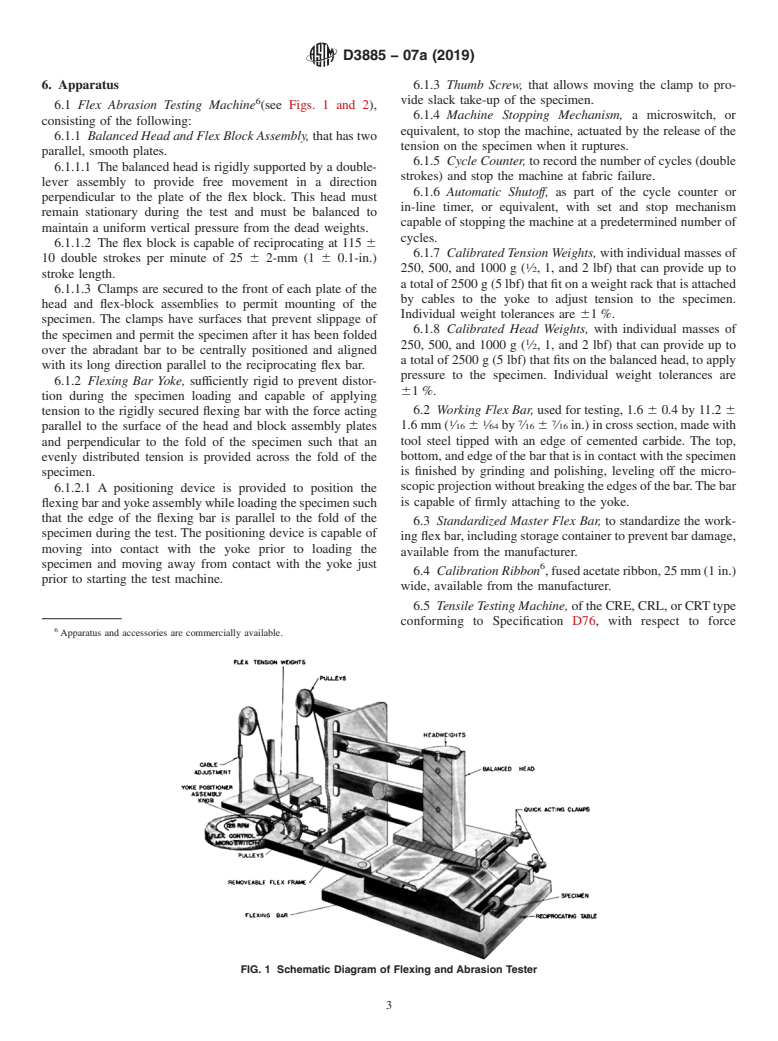
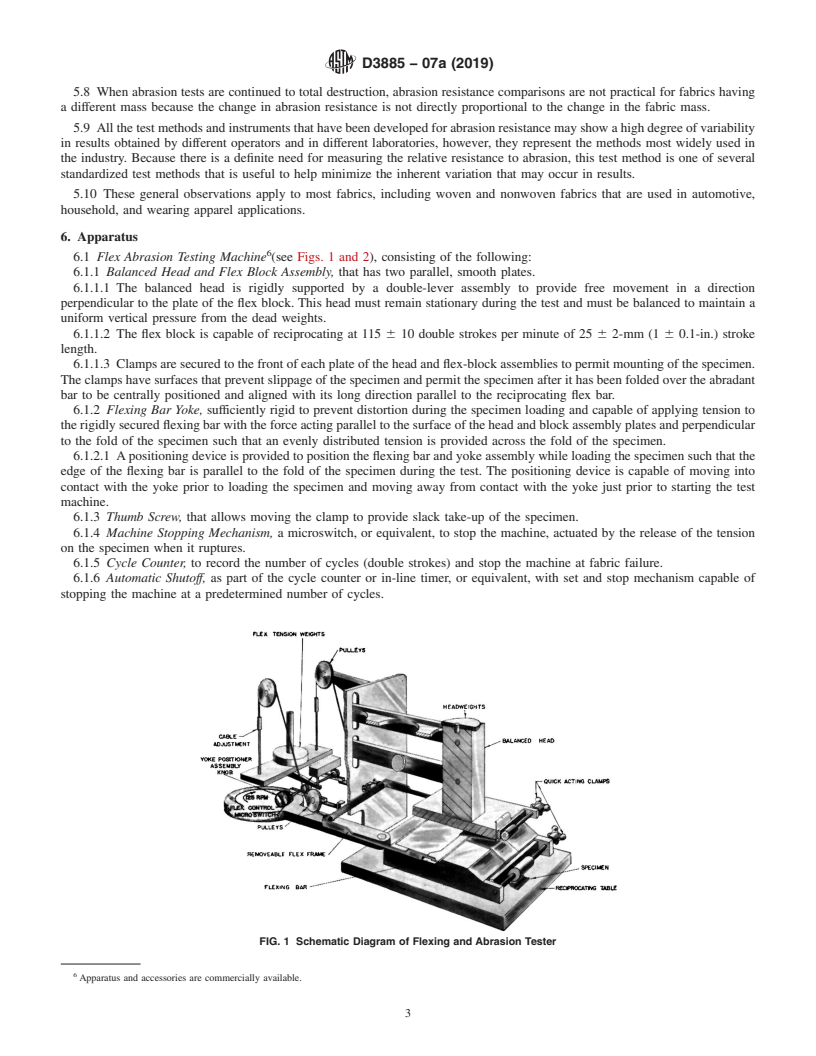
6.1 Flex Abrasion Testing Machine (see Figs. 1 and 2), consisting of the following:
6.1.1 Balanced Head and Flex Block Assembly, that has two parallel, smooth plates.
6.1.1.1 The balanced head is rigidly supported by a double-lever assembly to provide free movement in a direction
perpendicular to the plate of the flex block. This head must remain stationary during the test and must be balanced to maintain a
uniform vertical pressure from the dead weights.
6.1.1.2 The flex block is capable of reciprocating at 115 6 10 double strokes per minute of 25 6 2-mm (1 6 0.1-in.) stroke
length.
6.1.1.3 Clamps are secured to the front of each plate of the head and flex-block assemblies to permit mounting of the specimen.
The clamps have surfaces that prevent slippage of the specimen and permit the specimen after it has been folded over the abradant
bar to be centrally positioned and aligned with its long direction parallel to the reciprocating flex bar.
6.1.2 Flexing Bar Yoke, sufficiently rigid to prevent distortion during the specimen loading and capable of applying tension to
the rigidly secured flexing bar with the force acting parallel to the surface of the head and block assembly plates and perpendicular
to the fold of the specimen such that an evenly distributed tension is provided across the fold of the specimen.
6.1.2.1 A positioning device is provided to position the flexing bar and yoke assembly while loading the specimen such that the
edge of the flexing bar is parallel to the fold of the specimen during the test. The positioning device is capable of moving into
contact with the yoke prior to loading the specimen and moving away from contact with the yoke just prior to starting the test
machine.
6.1.3 Thumb Screw, that allows moving the clamp to provide slack take-up of the specimen.
6.1.4 Machine Stopping Mechanism, a microswitch, or equivalent, to stop the machine, actuated by the release of the tension
on the specimen when it ruptures.
6.1.5 Cycle Counter, to record the number of cycles (double strokes) and stop the machine at fabric failure.
6.1.6 Automatic Shutoff, as part of the cycle counter or in-line timer, or equivalent, with set and stop mechanism capable of
stopping the machine at a predetermined number of cycles.
FIG. 1 Schematic Diagram of Flexing and Abrasion Tester
Apparatus and accessories are commercially available.
D3885 − 07a (2019)
FIG. 2 Commercial Flexing and Abrasion Tester
6.1.7 Calibrated Tension Weights, with individual masses of 250, 500, and 1000 g ( ⁄2, 1, and 2 lbf) that can provide up to a
total of 2500 g (5 lbf) that fit on a weight rack that is attached by cables to the yoke to adjust tension to the specimen. Individual
weight tolerances are 61 %.
6.1.8 Calibrated Head Weights, with individual masses of 250, 500, and 1000 g ( ⁄2, 1, and 2 lbf) that can provide up to a total
of 2500 g (5 lbf) that fits on the balanced head, to apply pressure to the specimen. Individual weight tolerances are 61 %.
1 1 7 7
6.2 Working Flex Bar, used for testing, 1.6 6 0.4 by 11.2 6 1.6 mm ( ⁄16 6 ⁄64 by ⁄16 6 ⁄16 in.) in cross section, made with
tool steel tipped with an edge of cemented carbide. The top, bottom, and edge of the bar that is in contact with the specimen is
finished by grinding and polishing, leveling off the microscopic projection without breaking the edges of the bar. The bar is capable
of firmly attaching to the yoke.
6.3 Standardized Master Flex Bar, to standardize the working flex bar, including storage container to prevent bar damage,
available from the manufacturer.
6.4 Calibration Ribbon , fused acetate ribbon, 25 mm (1 in.) wide, available from the manufacturer.
6.5 Tensile Testing Machine, of the CRE, CRL, or CRT type conforming to Specification D7
...
Questions, Comments and Discussion
Ask us and Technical Secretary will try to provide an answer. You can facilitate discussion about the standard in here.