

ASTM D243/D243M-22
(Test Method)Standard Test Method for Residue of Specified Penetration
General Information
- Abstract
SIGNIFICANCE AND USE
5.1 This test method is used to determine the percentage of residue having a specified penetration at 100 g/5 s at 25 °C [77 °F]. This test method provides a residue for quality control or for use in other tests as desired.
Note 1: The quality of the results produced by this standard are dependent on the competence of the personnel performing the procedure and the capability, calibration, and maintenance of the equipment used. Agencies that meet the criteria of Specification D3666 are generally considered capable of competent and objective testing, sampling, inspection, etc. Users of this standard are cautioned that compliance with Specification D3666 alone does not completely ensure reliable results. Reliable results depend on many factors; following the suggestions of Specification D3666 or some similar acceptable guideline provides a means of evaluating and controlling some of those factors.
SCOPE
1.1 This test method is used to thermally reduce cutback asphalt, a road oil or a semisolid asphalt, having a penetration greater than 100, to a residue of specified penetration. It is primarily used with slow-curing cutback asphalt as specified in Specification D2026/D2026M.
1.2 The values stated in either SI units or inch-pound units are to be regarded separately as standard. The values stated in each system are not necessarily exact equivalents; therefore, to ensure conformance with the standard, each system shall be used independently of the other, and values from the two systems shall not be combined.
1.3 Warning—Mercury has been designated by the United States Environmental Protection Agency (EPA) and many state agencies as a hazardous material that can cause central nervous system, kidney, and liver damage. Mercury, or its vapor, may be hazardous to health and corrosive to materials. Caution should be taken when handling mercury and mercury-containing products. See the applicable product Material Safety Data Sheet (MSDS) for details and EPA’s website—http://www.epa.gov/mercury/—for additional information. Users should be aware that selling mercury, mercury-containing products, or both, into your state may be prohibited by state law.
1.4 The text of this standard references notes and footnotes which provide explanatory material. These notes and footnotes (excluding those in tables and figures) shall not be considered as requirements of the standard.
1.5 This standard does not purport to address all of the safety concerns, if any, associated with its use. It is the responsibility of the user of this standard to establish appropriate safety, health, and environmental practices and determine the applicability of regulatory limitations prior to use.
1.6 This international standard was developed in accordance with internationally recognized principles on standardization established in the Decision on Principles for the Development of International Standards, Guides and Recommendations issued by the World Trade Organization Technical Barriers to Trade (TBT) Committee.
- Status
- Published
- Publication Date
- 31-Jul-2022
- Technical Committee
- D04 - Road and Paving Materials
- Drafting Committee
- D04.46 - Durability and Distillation Tests


Overview
ASTM D243/D243M-22: Standard Test Method for Residue of Specified Penetration is an important standard developed by ASTM International. This test method is used to determine the percentage of residue from cutback asphalt, road oil, or semisolid asphalt-materials having a penetration greater than 100-after thermal reduction to a residue of specified penetration. The test is carried out at 25°C (77°F) with a 100 g load for 5 seconds, and is especially applicable to slow-curing cutback asphalts as outlined in ASTM Specification D2026/D2026M. The results support quality control in asphalt production and can be used as a basis for further testing.
Key Topics
- Penetration Testing: Quantifies the consistency of asphalt residue by measuring penetration depth under defined conditions.
- Thermal Reduction: The method rapidly heats the asphaltic material, evaporating volatiles and leaving a solid residue for analysis.
- Sample Preparation and Accuracy: Test reliability strongly depends on sample uniformity, equipment calibration, and operator competence.
- Residue Calculation: The remaining mass post-heating is used to calculate the percentage of residue meeting the specified penetration requirement.
- Units and Conformance: Results can be expressed in either SI or inch-pound units, but must not be combined. Each unit system must be used separately to ensure compliance.
- Health and Safety Considerations: The method highlights the safe handling of hazardous materials, such as mercury thermometers, and encourages the use of safer alternatives and compliance with environmental regulations.
- Quality Assurance: Emphasizes adherence to ASTM D3666 for laboratory qualification to ensure dependable results.
Applications
The ASTM D243/D243M-22 standard is widely applied across the pavement and construction industries for:
- Quality Control in Asphalt Manufacturing: Ensuring the chemical and physical consistency of cutback asphalt products before their use in road construction.
- Evaluation of Road Oils: Analyzing semisolid or slow-curing asphalts to confirm their suitability for specific applications, such as street or highway surfacing.
- Research and Development: Providing data for improving asphalt formulations or meeting project-specific requirements.
- Compliance and Specification: Manufacturers and contractors use this method to document adherence to procurement and regulatory specifications.
- Supporting Further Testing: The residue obtained can be used in additional tests for properties such as durability and resistance to environmental stresses.
Related Standards
- ASTM D5/D5M – Test Method for Penetration of Bituminous Materials: Used in conjunction with D243/D243M to determine residue penetration.
- ASTM D8 – Terminology Relating to Materials for Roads and Pavements: Reference for definitions and terminology.
- ASTM D2026/D2026M – Specification for Cutback Asphalt (Slow-Curing Type): Provides the classification and requirements for slow-curing cutback asphalts.
- ASTM D3666 – Specification for Minimum Requirements for Agencies Testing and Inspecting Road and Paving Materials: Ensures laboratory competency and integrity.
- ASTM D8055 – Guide for Selecting Electronic Thermometers for Asphalt Testing: Helps in choosing safer substitutes for mercury thermometers.
- ASTM E1, E230/E230M, E77, E563, E644 – Standards for thermometric equipment calibration, usage, and reference temperature practices.
- IEC 60584 – Thermocouples-Part 3: Extension and Compensating Cables-Tolerances and Identification System.
Conclusion
The ASTM D243/D243M-22 standard plays a critical role in the production and application of asphalt materials by defining a consistent, reliable approach to measuring residue of specified penetration. This ensures materials meet performance standards, thereby supporting the construction of durable, safe roadways. Adhering to this test method, alongside related ASTM and international standards, enables organizations to maintain high-quality outputs and regulatory compliance within the asphalt industry.
Relations
- Effective Date
- 01-Nov-2023
- Effective Date
- 01-May-2023
- Effective Date
- 15-Dec-2019
- Effective Date
- 01-Aug-2019
- Effective Date
- 15-Dec-2018
- Effective Date
- 15-Aug-2018
- Effective Date
- 01-Jul-2018
- Effective Date
- 01-Feb-2018
- Effective Date
- 15-Jul-2017
- Effective Date
- 15-Jun-2017
- Effective Date
- 01-May-2017
- Effective Date
- 01-Mar-2017
- Effective Date
- 01-Dec-2016
- Effective Date
- 01-Oct-2016
- Effective Date
- 15-Sep-2016
Get Certified
Connect with accredited certification bodies for this standard

Zavod za gradbeništvo Slovenije (ZAG) - Inšpekcija
ZAG inspection body for construction products, structures, and materials.
Sponsored listings
Frequently Asked Questions
ASTM D243/D243M-22 is a standard published by ASTM International. Its full title is "Standard Test Method for Residue of Specified Penetration". This standard covers: SIGNIFICANCE AND USE 5.1 This test method is used to determine the percentage of residue having a specified penetration at 100 g/5 s at 25 °C [77 °F]. This test method provides a residue for quality control or for use in other tests as desired. Note 1: The quality of the results produced by this standard are dependent on the competence of the personnel performing the procedure and the capability, calibration, and maintenance of the equipment used. Agencies that meet the criteria of Specification D3666 are generally considered capable of competent and objective testing, sampling, inspection, etc. Users of this standard are cautioned that compliance with Specification D3666 alone does not completely ensure reliable results. Reliable results depend on many factors; following the suggestions of Specification D3666 or some similar acceptable guideline provides a means of evaluating and controlling some of those factors. SCOPE 1.1 This test method is used to thermally reduce cutback asphalt, a road oil or a semisolid asphalt, having a penetration greater than 100, to a residue of specified penetration. It is primarily used with slow-curing cutback asphalt as specified in Specification D2026/D2026M. 1.2 The values stated in either SI units or inch-pound units are to be regarded separately as standard. The values stated in each system are not necessarily exact equivalents; therefore, to ensure conformance with the standard, each system shall be used independently of the other, and values from the two systems shall not be combined. 1.3 Warning—Mercury has been designated by the United States Environmental Protection Agency (EPA) and many state agencies as a hazardous material that can cause central nervous system, kidney, and liver damage. Mercury, or its vapor, may be hazardous to health and corrosive to materials. Caution should be taken when handling mercury and mercury-containing products. See the applicable product Material Safety Data Sheet (MSDS) for details and EPA’s website—http://www.epa.gov/mercury/—for additional information. Users should be aware that selling mercury, mercury-containing products, or both, into your state may be prohibited by state law. 1.4 The text of this standard references notes and footnotes which provide explanatory material. These notes and footnotes (excluding those in tables and figures) shall not be considered as requirements of the standard. 1.5 This standard does not purport to address all of the safety concerns, if any, associated with its use. It is the responsibility of the user of this standard to establish appropriate safety, health, and environmental practices and determine the applicability of regulatory limitations prior to use. 1.6 This international standard was developed in accordance with internationally recognized principles on standardization established in the Decision on Principles for the Development of International Standards, Guides and Recommendations issued by the World Trade Organization Technical Barriers to Trade (TBT) Committee.
SIGNIFICANCE AND USE 5.1 This test method is used to determine the percentage of residue having a specified penetration at 100 g/5 s at 25 °C [77 °F]. This test method provides a residue for quality control or for use in other tests as desired. Note 1: The quality of the results produced by this standard are dependent on the competence of the personnel performing the procedure and the capability, calibration, and maintenance of the equipment used. Agencies that meet the criteria of Specification D3666 are generally considered capable of competent and objective testing, sampling, inspection, etc. Users of this standard are cautioned that compliance with Specification D3666 alone does not completely ensure reliable results. Reliable results depend on many factors; following the suggestions of Specification D3666 or some similar acceptable guideline provides a means of evaluating and controlling some of those factors. SCOPE 1.1 This test method is used to thermally reduce cutback asphalt, a road oil or a semisolid asphalt, having a penetration greater than 100, to a residue of specified penetration. It is primarily used with slow-curing cutback asphalt as specified in Specification D2026/D2026M. 1.2 The values stated in either SI units or inch-pound units are to be regarded separately as standard. The values stated in each system are not necessarily exact equivalents; therefore, to ensure conformance with the standard, each system shall be used independently of the other, and values from the two systems shall not be combined. 1.3 Warning—Mercury has been designated by the United States Environmental Protection Agency (EPA) and many state agencies as a hazardous material that can cause central nervous system, kidney, and liver damage. Mercury, or its vapor, may be hazardous to health and corrosive to materials. Caution should be taken when handling mercury and mercury-containing products. See the applicable product Material Safety Data Sheet (MSDS) for details and EPA’s website—http://www.epa.gov/mercury/—for additional information. Users should be aware that selling mercury, mercury-containing products, or both, into your state may be prohibited by state law. 1.4 The text of this standard references notes and footnotes which provide explanatory material. These notes and footnotes (excluding those in tables and figures) shall not be considered as requirements of the standard. 1.5 This standard does not purport to address all of the safety concerns, if any, associated with its use. It is the responsibility of the user of this standard to establish appropriate safety, health, and environmental practices and determine the applicability of regulatory limitations prior to use. 1.6 This international standard was developed in accordance with internationally recognized principles on standardization established in the Decision on Principles for the Development of International Standards, Guides and Recommendations issued by the World Trade Organization Technical Barriers to Trade (TBT) Committee.
ASTM D243/D243M-22 is classified under the following ICS (International Classification for Standards) categories: 93.080.20 - Road construction materials. The ICS classification helps identify the subject area and facilitates finding related standards.
ASTM D243/D243M-22 has the following relationships with other standards: It is inter standard links to ASTM E230/E230M-23a, ASTM E230/E230M-23, ASTM D5/D5M-19a, ASTM D8-19, ASTM D8-18c, ASTM D8-18b, ASTM D8-18a, ASTM D8-18, ASTM D8-17c, ASTM D8-17b, ASTM D8-17a, ASTM D8-17, ASTM D8-16b, ASTM D3666-16, ASTM D8-16a. Understanding these relationships helps ensure you are using the most current and applicable version of the standard.
ASTM D243/D243M-22 is available in PDF format for immediate download after purchase. The document can be added to your cart and obtained through the secure checkout process. Digital delivery ensures instant access to the complete standard document.
Standards Content (Sample)
This international standard was developed in accordance with internationally recognized principles on standardization established in the Decision on Principles for the
Development of International Standards, Guides and Recommendations issued by the World Trade Organization Technical Barriers to Trade (TBT) Committee.
Designation:D243/D243M −22
Standard Test Method for
Residue of Specified Penetration
This standard is issued under the fixed designation D243/D243M; the number immediately following the designation indicates the year
of original adoption or, in the case of revision, the year of last revision. A number in parentheses indicates the year of last reapproval.
A superscript epsilon (´) indicates an editorial change since the last revision or reapproval.
1. Scope Development of International Standards, Guides and Recom-
mendations issued by the World Trade Organization Technical
1.1 This test method is used to thermally reduce cutback
Barriers to Trade (TBT) Committee.
asphalt, a road oil or a semisolid asphalt, having a penetration
greater than 100, to a residue of specified penetration. It is
2. Referenced Documents
primarily used with slow-curing cutback asphalt as specified in
2.1 ASTM Standards:
Specification D2026/D2026M.
D5/D5M Test Method for Penetration of Bituminous Mate-
1.2 The values stated in either SI units or inch-pound units
rials
are to be regarded separately as standard. The values stated in
D8 Terminology Relating to Materials for Roads and Pave-
each system are not necessarily exact equivalents; therefore, to
ments
ensure conformance with the standard, each system shall be
D2026/D2026M Specification for Cutback Asphalt (Slow-
used independently of the other, and values from the two
Curing Type)
systems shall not be combined.
D3666 Specification for Minimum Requirements for Agen-
1.3 Warning—Mercury has been designated by the United cies Testing and Inspecting Road and Paving Materials
States Environmental ProtectionAgency (EPA) and many state D8055 Guide for Selecting an Appropriate Electronic Ther-
agencies as a hazardous material that can cause central nervous mometer for Replacing Mercury Thermometers in D04
system, kidney, and liver damage. Mercury, or its vapor, may Road and Paving Standards
be hazardous to health and corrosive to materials. Caution E1 Specification for ASTM Liquid-in-Glass Thermometers
should be taken when handling mercury and mercury- E230/E230M Specification for Temperature-Electromotive
containing products. See the applicable product Material Force (emf) Tables for Standardized Thermocouples
Safety Data Sheet (MSDS) for details and EPA’s website— 2.2 IEC Standards:
http://www.epa.gov/mercury/—for additional information. Us- IEC60584 Thermocouples—Part3:ExtensionandCompen-
ers should be aware that selling mercury, mercury-containing sating Cables—Tolerances and Identification System
products, or both, into your state may be prohibited by state
3. Terminology
law.
3.1 Definitions of terms used in this practice may be found
1.4 The text of this standard references notes and footnotes
in Terminology D8, determined from common English usage,
which provide explanatory material. These notes and footnotes
or combinations of both.
(excluding those in tables and figures) shall not be considered
as requirements of the standard.
4. Summary of Test Method
1.5 This standard does not purport to address all of the
4.1 The material to be tested is rapidly heated to 249 °C
safety concerns, if any, associated with its use. It is the
[480 °F] and maintained at 249 to 260 °C [480 to 500 °F]
responsibility of the user of this standard to establish appro-
duringevaporationofthevolatiles.Penetrationoftheresidueis
priate safety, health, and environmental practices and deter-
determined and if not within the specified limits, the evapora-
mine the applicability of regulatory limitations prior to use.
tion procedure is repeated. Change in sample mass is used to
1.6 This international standard was developed in accor-
calculate the percentage of residue having the specified pen-
dance with internationally recognized principles on standard-
etration.
ization established in the Decision on Principles for the
For referenced ASTM standards, visit the ASTM website, www.astm.org, or
This test method is under the jurisdiction of ASTM Committee D04 on Road contact ASTM Customer Service at service@astm.org. For Annual Book of ASTM
and Paving Materials and is the direct responsibility of Subcommittee D04.46 on Standards volume information, refer to the standard’s Document Summary page on
Durability and Distillation Tests. the ASTM website.
Current edition approved Aug. 1, 2022. Published August 2022. Originally Available from International Electrotechnical Commission (IEC), 3, rue de
approved in 1926. Last previous edition approved in 2020 as D243/D243M – 20. Varembé, 1st floor, P.O. Box 131, CH-1211, Geneva 20, Switzerland, https://
DOI: 10.1520/D0243_D0243M-22. www.iec.ch.
Copyright © ASTM International, 100 Barr Harbor Drive, PO Box C700, West Conshohocken, PA 19428-2959. United States
D243/D243M−22
5. Significance and Use 6.1.3 Hot Plate—The air bath shall be heated upon a
suitably mounted hot plate, heated either electrically or by
5.1 This test method is used to determine the percentage of
means of a gas flame.The plate shall be capable of maintaining
residue having a specified penetration at 100 g/5 s at 25 °C
the sample continuously at the required temperature, and
[77 °F]. This test method provides a residue for quality control
apparatus necessary to fulfill this requirement, such as a
or for use in other tests as desired.
rheostat or gas pressure regulator, shall be provided.
NOTE 1—The quality of the results produced by this standard are
6.1.4 Thermometer—Athermometer for measuring the tem-
dependent on the competence of the personnel performing the procedure
perature of the sample during evaporation. The thermometer
and the capability, calibration, and maintenance of the equipment used.
shall have a measurement temperature range of 200 to 300 °C
Agencies that meet the criteria of Specification D3666 are generally
[392 to 572 °F] and an accuracy of at least 2.8 °C [5 °F] and
considered capable of competent and objective testing, sampling,
inspection, etc. Users of this standard are cautioned that compliance with
shall be one of the following (see Note 3):
Specification D3666 alone does not completely ensure reliable results.
6.1.4.1 Specification E1 thermometers that meet the tem-
Reliable results depend on many factors; following the suggestions of
perature and tolerance range requirements.
Specification D3666 o
...
This document is not an ASTM standard and is intended only to provide the user of an ASTM standard an indication of what changes have been made to the previous version. Because
it may not be technically possible to adequately depict all changes accurately, ASTM recommends that users consult prior editions as appropriate. In all cases only the current version
of the standard as published by ASTM is to be considered the official document.
Designation: D243/D243M − 20 D243/D243M − 22
Standard Test Method for
Residue of Specified Penetration
This standard is issued under the fixed designation D243/D243M; the number immediately following the designation indicates the year
of original adoption or, in the case of revision, the year of last revision. A number in parentheses indicates the year of last reapproval.
A superscript epsilon (´) indicates an editorial change since the last revision or reapproval.
1. Scope
1.1 This test method is used to thermally reduce cutback asphalt, a road oil or a semisolid asphalt, having a penetration greater
than 100, to a residue of specified penetration. It is primarily used with slow-curing cutback asphalt as specified in Specification
D2026/D2026M.
1.2 The values stated in either SI units or inch-pound units are to be regarded separately as standard. The values stated in each
system are not necessarily exact equivalents; therefore, to ensure conformance with the standard, each system shall be used
independently of the other, and values from the two systems shall not be combined.
1.3 Warning—Mercury has been designated by the United States Environmental Protection Agency (EPA) and many state
agencies as a hazardous material that can cause central nervous system, kidney, and liver damage. Mercury, or its vapor, may be
hazardous to health and corrosive to materials. Caution should be taken when handling mercury and mercury-containing products.
See the applicable product Material Safety Data Sheet (MSDS) for details and EPA’s website—http://www.epa.gov/mercury/—for
additional information. Users should be aware that selling mercury, mercury-containing products, or both, into your state may be
prohibited by state law.
1.4 The text of this standard references notes and footnotes which provide explanatory material. These notes and footnotes
(excluding those in tables and figures) shall not be considered as requirements of the standard.
1.5 This standard does not purport to address all of the safety concerns, if any, associated with its use. It is the responsibility
of the user of this standard to establish appropriate safety, health, and environmental practices and determine the applicability of
regulatory limitations prior to use.
1.6 This international standard was developed in accordance with internationally recognized principles on standardization
established in the Decision on Principles for the Development of International Standards, Guides and Recommendations issued
by the World Trade Organization Technical Barriers to Trade (TBT) Committee.
2. Referenced Documents
2.1 ASTM Standards:
D5/D5M Test Method for Penetration of Bituminous Materials
D8 Terminology Relating to Materials for Roads and Pavements
D2026/D2026M Specification for Cutback Asphalt (Slow-Curing Type)
This test method is under the jurisdiction of ASTM Committee D04 on Road and Paving Materials and is the direct responsibility of Subcommittee D04.46 on Durability
and Distillation Tests.
Current edition approved Nov. 1, 2020Aug. 1, 2022. Published November 2020August 2022. Originally approved in 1926. Last previous edition approved in 20142020
as D243/D243M – 14.D243/D243M – 20. DOI: 10.1520/D0243_D0243M-20.10.1520/D0243_D0243M-22.
For referenced ASTM standards, visit the ASTM website, www.astm.org, or contact ASTM Customer Service at service@astm.org. For Annual Book of ASTM Standards
volume information, refer to the standard’s Document Summary page on the ASTM website.
Copyright © ASTM International, 100 Barr Harbor Drive, PO Box C700, West Conshohocken, PA 19428-2959. United States
D243/D243M − 22
D3666 Specification for Minimum Requirements for Agencies Testing and Inspecting Road and Paving Materials
D8055 Guide for Selecting an Appropriate Electronic Thermometer for Replacing Mercury Thermometers in D04 Road and
Paving Standards
E1 Specification for ASTM Liquid-in-Glass Thermometers
E77E230/E230M Test Method for Inspection and Verification of ThermometersSpecification for Temperature-Electromotive
Force (emf) Tables for Standardized Thermocouples
E563 Practice for Preparation and Use of an Ice-Point Bath as a Reference Temperature
E644 Test Methods for Testing Industrial Resistance Thermometers
2.2 IEC Standards:
IEC 60584 Thermocouples—Part 3: Extension and Compensating Cables—Tolerances and Identification System
3. Terminology
3.1 Definitions of terms used in this practice may be found in Terminology D8, determined from common English usage, or
combinations of both.
4. Summary of Test Method
4.1 The material to be tested is rapidly heated to 249 °C [480 °F] and maintained at 249 to 260 °C [480 to 500 °F] during
evaporation of the volatiles. Penetration of the residue is determined and if not within the specified limits, the evaporation
procedure is repeated. Change in sample mass is used to calculate the percentage of residue having the specified penetration.
5. Significance and Use
5.1 This test method is used to determine the percentage of residue having a specified penetration at 100 g/5 s at 25 °C [77 °F].
This test method provides a residue for quality control or for use in other tests as desired.
NOTE 1—The quality of the results produced by this standard are dependent on the competence of the personnel performing the procedure and the
capability, calibration, and maintenance of the equipment used. Agencies that meet the criteria of Specification D3666 are generally considered capable
of competent and objective testing, sampling, inspection, etc. Users of this standard are cautioned that compliance with Specification D3666 alone does
not completely ensure reliable results. Reliable results depend on many factors; following the suggestions of Specification D3666 or some similar
acceptable guideline provides a means of evaluating and controlling some of those factors.
6. Apparatus
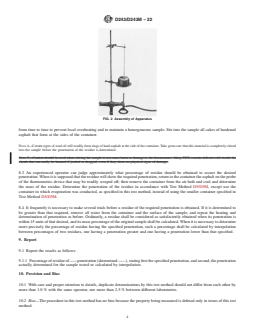
6.1 The apparatus shall consist of a container, heating bath, hot plate, and thermometric device, with necessary accessory
apparatus as follows:
6.1.1 Container—The container in which the sample is to be tested shall be a flat-bottom, cylindrical seamless tin box,
approximately 70 mm in diameter and 45 mm in depth.
NOTE 2—Containers known in the pharmaceutical industry as seamless “ointment boxes” may be obtained in dimensions conforming to the above
requirements.
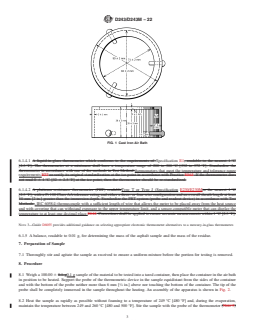
6.1.2 Heating Bath—The heating bath shall be a cast iron air bath, or equivalent, permitting the immersion of the container to a
depth of 32 6 5 mm through an opening 3 6 2 mm larger in diameter than the container. It shall support the container 6 6 2 mm
above the hot plate, and with at least 6.4 mm free air space between the sides of the container and of the air bath below the opening.
A suitable air bath is shown in Fig. 1.
6.1.3 Hot Plate—The air bath shall be heated upon a suitably mounted hot plate, heated either electrically or by means of a gas
flame. The plate shall be capable of maintaining the sample continuously at the required temperature, and apparatus necessary to
fulfill this requirement, such as a rheostat or gas pressure regulator, shall be provided.
6.1.4 Thermometer—A
...