


ASTM F3034-15(2020)
(Specification)Standard Specification for Billets made by Winding Molten Extruded Stress-Rated High Density Polyethylene (HDPE)
Standard Specification for Billets made by Winding Molten Extruded Stress-Rated High Density Polyethylene (HDPE)
SCOPE
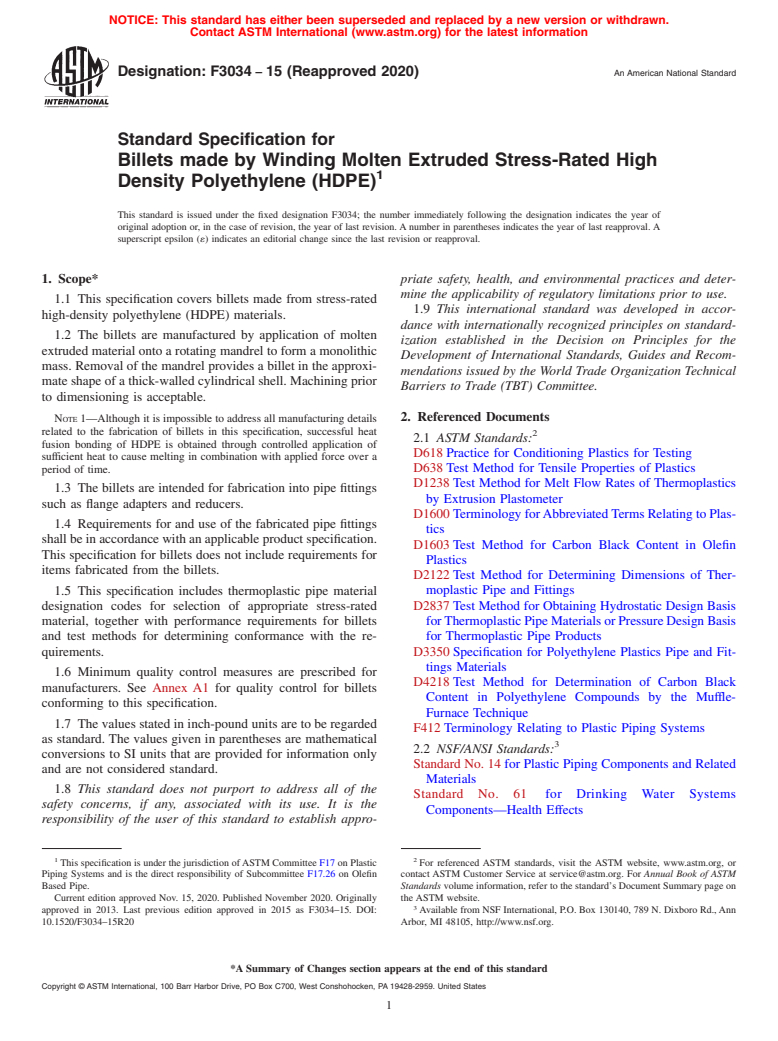
1.1 This specification covers billets made from stress-rated high-density polyethylene (HDPE) materials.
1.2 The billets are manufactured by application of molten extruded material onto a rotating mandrel to form a monolithic mass. Removal of the mandrel provides a billet in the approximate shape of a thick-walled cylindrical shell. Machining prior to dimensioning is acceptable.
Note 1: Although it is impossible to address all manufacturing details related to the fabrication of billets in this specification, successful heat fusion bonding of HDPE is obtained through controlled application of sufficient heat to cause melting in combination with applied force over a period of time.
1.3 The billets are intended for fabrication into pipe fittings such as flange adapters and reducers.
1.4 Requirements for and use of the fabricated pipe fittings shall be in accordance with an applicable product specification. This specification for billets does not include requirements for items fabricated from the billets.
1.5 This specification includes thermoplastic pipe material designation codes for selection of appropriate stress-rated material, together with performance requirements for billets and test methods for determining conformance with the requirements.
1.6 Minimum quality control measures are prescribed for manufacturers. See Annex A1 for quality control for billets conforming to this specification.
1.7 The values stated in inch-pound units are to be regarded as standard. The values given in parentheses are mathematical conversions to SI units that are provided for information only and are not considered standard.
1.8 This standard does not purport to address all of the safety concerns, if any, associated with its use. It is the responsibility of the user of this standard to establish appropriate safety, health, and environmental practices and determine the applicability of regulatory limitations prior to use.
1.9 This international standard was developed in accordance with internationally recognized principles on standardization established in the Decision on Principles for the Development of International Standards, Guides and Recommendations issued by the World Trade Organization Technical Barriers to Trade (TBT) Committee.
General Information
Buy Standard
Standards Content (Sample)
NOTICE: This standard has either been superseded and replaced by a new version or withdrawn.
Contact ASTM International (www.astm.org) for the latest information
Designation:F3034 −15 (Reapproved 2020) An American National Standard
Standard Specification for
Billets made by Winding Molten Extruded Stress-Rated High
Density Polyethylene (HDPE)
This standard is issued under the fixed designation F3034; the number immediately following the designation indicates the year of
original adoption or, in the case of revision, the year of last revision. A number in parentheses indicates the year of last reapproval. A
superscript epsilon (´) indicates an editorial change since the last revision or reapproval.
1. Scope* priate safety, health, and environmental practices and deter-
mine the applicability of regulatory limitations prior to use.
1.1 This specification covers billets made from stress-rated
1.9 This international standard was developed in accor-
high-density polyethylene (HDPE) materials.
dance with internationally recognized principles on standard-
1.2 The billets are manufactured by application of molten
ization established in the Decision on Principles for the
extruded material onto a rotating mandrel to form a monolithic
Development of International Standards, Guides and Recom-
mass. Removal of the mandrel provides a billet in the approxi-
mendations issued by the World Trade Organization Technical
mate shape of a thick-walled cylindrical shell. Machining prior
Barriers to Trade (TBT) Committee.
to dimensioning is acceptable.
2. Referenced Documents
NOTE 1—Although it is impossible to address all manufacturing details
related to the fabrication of billets in this specification, successful heat
2.1 ASTM Standards:
fusion bonding of HDPE is obtained through controlled application of
D618 Practice for Conditioning Plastics for Testing
sufficient heat to cause melting in combination with applied force over a
D638 Test Method for Tensile Properties of Plastics
period of time.
D1238 Test Method for Melt Flow Rates of Thermoplastics
1.3 The billets are intended for fabrication into pipe fittings
by Extrusion Plastometer
such as flange adapters and reducers.
D1600 Terminology forAbbreviatedTerms Relating to Plas-
1.4 Requirements for and use of the fabricated pipe fittings
tics
shall be in accordance with an applicable product specification.
D1603 Test Method for Carbon Black Content in Olefin
This specification for billets does not include requirements for
Plastics
items fabricated from the billets.
D2122 Test Method for Determining Dimensions of Ther-
1.5 This specification includes thermoplastic pipe material moplastic Pipe and Fittings
designation codes for selection of appropriate stress-rated D2837 Test Method for Obtaining Hydrostatic Design Basis
material, together with performance requirements for billets forThermoplasticPipeMaterialsorPressureDesignBasis
and test methods for determining conformance with the re- for Thermoplastic Pipe Products
quirements. D3350 Specification for Polyethylene Plastics Pipe and Fit-
tings Materials
1.6 Minimum quality control measures are prescribed for
D4218 Test Method for Determination of Carbon Black
manufacturers. See Annex A1 for quality control for billets
Content in Polyethylene Compounds by the Muffle-
conforming to this specification.
Furnace Technique
1.7 The values stated in inch-pound units are to be regarded
F412 Terminology Relating to Plastic Piping Systems
as standard. The values given in parentheses are mathematical
2.2 NSF/ANSI Standards:
conversions to SI units that are provided for information only
Standard No. 14 for Plastic Piping Components and Related
and are not considered standard.
Materials
1.8 This standard does not purport to address all of the
Standard No. 61 for Drinking Water Systems
safety concerns, if any, associated with its use. It is the
Components—Health Effects
responsibility of the user of this standard to establish appro-
1 2
This specification is under the jurisdiction ofASTM Committee F17 on Plastic For referenced ASTM standards, visit the ASTM website, www.astm.org, or
Piping Systems and is the direct responsibility of Subcommittee F17.26 on Olefin contact ASTM Customer Service at service@astm.org. For Annual Book of ASTM
Based Pipe. Standards volume information, refer to the standard’s Document Summary page on
Current edition approved Nov. 15, 2020. Published November 2020. Originally the ASTM website.
approved in 2013. Last previous edition approved in 2015 as F3034–15. DOI: Available from NSF International, P.O. Box 130140, 789 N. Dixboro Rd.,Ann
10.1520/F3034–15R20 Arbor, MI 48105, http://www.nsf.org.
*A Summary of Changes section appears at the end of this standard
Copyright © ASTM International, 100 Barr Harbor Drive, PO Box C700, West Conshohocken, PA 19428-2959. United States
F3034−15 (2020)
2.3 PPI Standards: 190/2.16, the resulting value shall be ≤0.15 g/10 min. When
PPI TR-3 Policies and Procedures for Developing Hydro- tested at condition 190/21.6, the resulting value shall be ≤20
static Design Basis (HDB), Pressure Design Basis (PDB), g/10 min.
Strength Design Basis (SDB), and Minimum Required
4.2 Potable Water Requirement—When required by the
Strength (MRS) Ratings for Thermoplastic Piping Mate-
purchaser, billets intended for fabrication into products in-
rials or Pipe
tended for contact with potable water shall utilize PE com-
PPI TR-4 HDB/SDB/PDB/MRS Listed Materials, PPI List-
pounds certified for conformance with NSF/ANSI Standard
ing of Hydrostatic Design Basis (HDB), Strength Design
No. 61 or the health effects portion of NSF/ANSI Standard No.
Basis(SDB),PressureDesignBasis(PDB),andMinimum
14 by an acceptable certifying organization.
Required Strength (MRS) Ratings for Thermoplastic Pip-
4.3 Rework Material—Clean polyethylene compound from
ing Materials or Pipe
the manufacturer’s own production that meets 4.1 and 4.2 of
3. Terminology this specification as new compound is suitable for reextrusion
into billet, when blended with new compound of the same
3.1 Unlessotherwisespecified,definitionsareinaccordance
thermoplastic pipe material designation code. Billet containing
with Terminology F412 and abbreviations are in accordance
rework material shall meet the requirements of this specifica-
with Terminology D1600.
tion.
3.2 Definitions of Terms Specific to This Standard:
3.2.1 average outside diameter, n—the average distance
5. Requirements
following all forming and machining operations when mea-
5.1 Workmanship—The billet shall be uniform in appear-
sured in accordance with 6.3.1.
ance and consistent throughout. The walls shall be free of
3.2.2 billet, n—a mass formed from a single polyethylene
cracks, holes, blisters, voids, foreign inclusion, or other defects
compound in the approximate shape of a thick-walled cylin-
that are visible to the naked eye and that affect the wall
drical shell.
integrity (see Annex A1). A single hole deliberately placed in
3.2.3 mid-wall, n—the location half-way between the out-
the center of the billet is required.
sidediameterandtheinsidediameterfollowingallformingand
NOTE 3—Manufacturers should use appropriate quality assurance
machining operations.
procedures to ensure that billets are free from injurious defects including
3.2.4 minimum wall thickness, n—the minimum distance
laminations.
following all forming and machining operations when mea-
5.2 Dimensions and Tolerances: Requirements for dimen-
sured in accordance with 6.3.2.
sions shall only apply to a billet that is transferred from a seller
to a buyer prior to being fabricated into one or more pipe
4. Materials
fittings. When a billet is produced and fabricated into pipe
4.1 Polyethylene Compound—Polyethylene compounds
fittings by a single manufacturer, there are no dimensional
used in the manufacture of billet under this specification shall
requirements specified for the billet by this Standard. All
have thermoplastic pipe materials designation code PE3608,
dimensional requirements for pipe fittings are as given in the
PE4608 or PE4710; shall have a minimum Specification
applicable product standard.
D3350 cell classification of 333344C and shall meet all other
5.2.1 Average Outside Diameter and Minimum Wall
requirements of Specification D3350.
Thickness— The average outside diameter and minimum wall
4.1.1 General—The PE compound used to make billet shall
thickness shall fall within the range of acceptable values
be virgin PE compound or reworked PE compound (see 4.3)
established in either Table 1 or Table 2 depending on nominal
and shall have a hydrostatic design basis listed in Plastics Pipe
mandrel dimensions for billets manufactured to meet a stan-
Institute (PPI) TR-4.
dard size. When measured in accordance with Test Method
4.1.2 Color and Ultraviolet (UV) Stabilization—
D2122 conditioning is required according to Practice D618,
Polyethylene compounds shall meet Specification D3350 code
ProcedureAto standard temperature without regard to relative
C. In addition, Code C polyethylene compounds shall have 2.0
humidity.
to 3.0 percent carbon black.
5.2.2 Length—Any length shall be allowable, provided it is
4.1.3 Hydrostatic Design Basis (HDB) Substantiation—The
agreeable to both buyer and seller. When specified, the mini-
HDB for PE compound at 73 °F (23 °C) shall be substantiated
mum length shall be measured following conditioning accord-
to be linear to 50 years as described in Substantiation of the
ing to Practice D618, Procedure A to standard temperature
HDB for Polyethylene Materials in Test Method D2837.
without regard to relative humidity.
5.2.3 Special Sizes—Where existing system conditions or
NOTE 2—This is 5.7 in the 2011 publication of Test Method D2837.
special local requirements make other average outside diam-
4.1.4 Melt Flow Requirement—Polyethylene compounds
eters or minimum wall thicknesses necessary, other average
shall be tested in conformance with Test Method D1238 either
outside diameters or minimum wall thicknesses, or both, shall
at condition 190/2.16 or 190/21.6. When tested at condition
be acceptable when mutually agreed upon by the customer and
the manufacturer, provided the billet meets all other require-
ments of this specification. For average outside diameters not
Available from Plastics Pipe Institute (PPI), 105 Decker Court, Suite 825,
Irving, TX 75062, http://www.plasticpipe.org. shown in Table 1 or Table 2, the tolerance shall be the same
F3034−15 (2020)
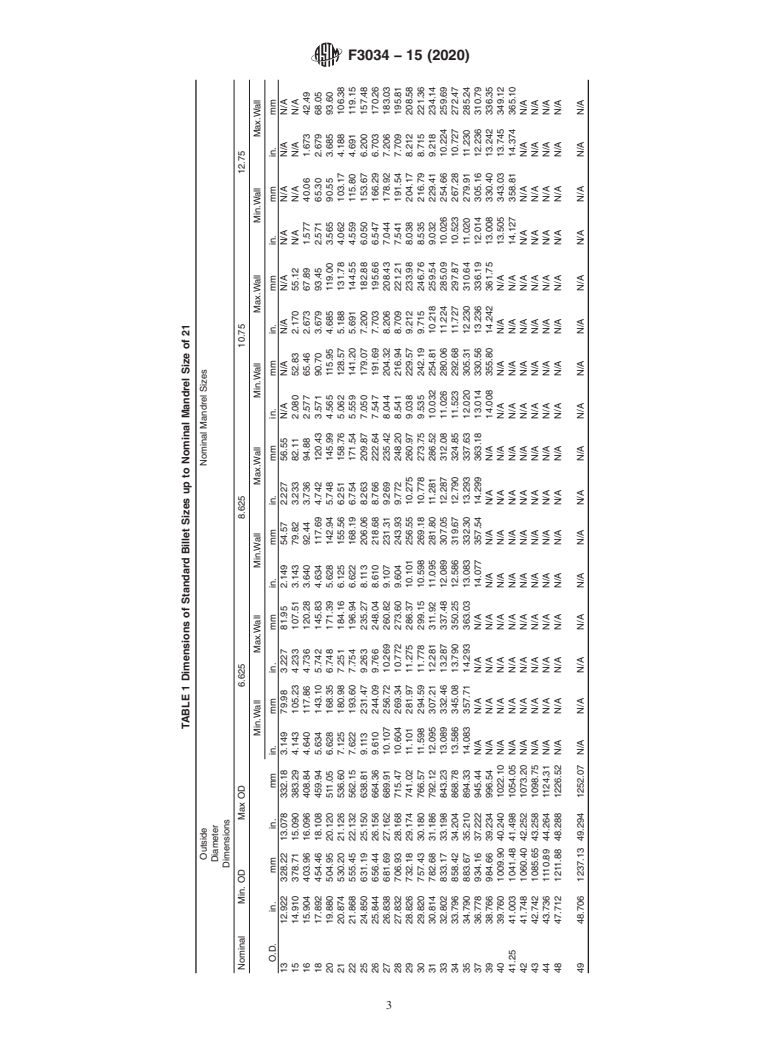
TABLE 1 Dimensions of Standard Billet Sizes up to Nominal Mandrel Size of 21
Outside Nominal Mandrel Sizes
Diameter
Dimensions
Nominal Min. OD Max OD 6.625 8.625 10.75 12.75
Min.Wall Max.Wall Min.Wall Max.Wall Min.Wall Max.Wall Min.Wall Max.Wall
O.D. in. mm in. mm in. mm in. mm in. mm in. mm in. mm in. mm in. mm in. mm
13 12.922 328.22 13.078 332.18 3.149 79.98 3.227 81.95 2.149 54.57 2.227 56.55 N/A N/A N/A N/A N/A N/A N/A N/A
15 14.910 378.71 15.090 383.29 4.143 105.23 4.233 107.51 3.143 79.82 3.233 82.11 2.080 52.83 2.170 55.12 N/A N/A N/A N/A
16 15.904 403.96 16.096 408.84 4.640 117.86 4.736 120.28 3.640 92.44 3.736 94.88 2.577 65.46 2.673 67.89 1.577 40.06 1.673 42.49
18 17.892 454.46 18.108 459.94 5.634 143.10 5.742 145.83 4.634 117.69 4.742 120.43 3.571 90.70 3.679 93.45 2.571 65.30 2.679 68.05
20 19.880 504.95 20.120 511.05 6.628 168.35 6.748 171.39 5.628 142.94 5.748 145.99 4.565 115.95 4.685 119.00 3.565 90.55 3.685 93.60
21 20.874 530.20 21.126 536.60 7.125 180.98 7.251 184.16 6.125 155.56 6.251 158.76 5.062 128.57 5.188 131.78 4.062 103.17 4.188 106.38
22 21.868 555.45 22.132 562.15 7.622 193.60 7.754 196.94 6.622 168.19 6.754 171.54 5.559 141.20 5.691 144.55 4.559 115.80 4.691 119.15
25 24.850 631.19 25.150 638.81 9.113 231.47 9.263 235.27 8.113 206.06 8.263 209.87 7.050 179.07 7.200 182.88 6.050 153.67 6.200 157.48
26 25.844 656.44 26.156 664.36 9.610 244.09 9.766 248.04 8.610 218.68 8.766 222.64 7.547 191.69 7.703 195.66 6.547 166.29 6.703 170.26
27 26.838 681.69 27.162 689.91 10.107 256.72 10.269 260.82 9.107 231.31 9.269 235.42 8.044 204.32 8.206 208.43 7.044 178.92 7.206 183.03
28 27.832 706.93 28.168 715.47 10.604 269.34 10.772 273.60 9.604 243.93 9.772 248.20 8.541 216.94 8.709 221.21 7.541 191.54 7.709 195.81
29 28.826 732.18 29.174 741.02 11.101 281.97 11.275 286.37 10.101 256.55 10.275 260.97 9.038 229.57 9.212 233.98 8.038 204.17 8.212 208.58
30 29.820 757.43 30.180 766.57 11.598 294.59 11.778 299.15 10.598 269.18 10.778 273.75 9.535 242.19 9.715 246.76 8.535 216.79 8.715 221.36
31 30.814 782.68 31.186 792.12 12.095 307.21 12.281 311.92 11.095 281.80 11.281 286.52 10.032 254.81 10.218 259.54 9.032 229.41 9.218 234.14
33 32.802 833.17 33.198 843.23 13.089 332.46 13.287 337.48 12.089 307.05 12.287 312.08 11.026 280.06 11.224 285.09 10.026 254.66 10.224 259.69
34 33.796 858.42 34.204 868.78 13.586 345.08 13.790 350.25 12.586 319.67 12.790 324.85 11.523 292.68 11.727 297.87 10.523 267.28 10.727 272.47
35 34.790 883.67 35.210 894.33 14.083 357.71 14.293 363.03 13.083 332.30 13.293 337.63 12.020 305.31 12.230 310.64 11.020 279.91 11.230 285.24
37 36.778 934.16 37.222 945.44 N/A N/A N/A N/A 14.077 357.54 14.299 363.18 13.014 330.56 13.236 336.19 12.014 305.16 12.236 310.79
39 38.766 984.66 39.234 996.54 N/A N/A N/A N/A N/A N/A N/A N/A 14.008 355.80 14.242 361.75 13.008 330.40 13.242 336.35
40 39.760 1009.90 40.240 1022.10 N/A N/A N/A N/A N/A N/A N/A N/A N/A N/A N/A N/A 13.505 343.03 13.745 349.12
41.25 41.003 1041.48 41.498 1054.05 N/A N/A N/A N/A N/A N/A N/A N/A N/A N/A N/A N/A 14.127 358.81 14.374 365.10
42 41.748 1060.40 42.252 1073.20 N/A N/A N/A N/A N/A N/A N/A N/A N/A N/A N/A N/A N/A N/A N/A N/A
43 42.742 1085.65 43.258 1098.75 N/A N/A N/A N/A N/A N/A N/A N/A N/A N/A N/A N/A N/A N/A N/A N/A
44 43.736 1110.89 44.264 1124.31 N/A N/A N/A N/A N/A N/A N/A N/A N/A N/A N/A N/A N/A N/A N/A N/A
48 47.712 1211.88 48.288 1226.52 N/A N/A N/A N/A N/A N/A N/A N/A N/A N/A N/A N/A N/A N/A N/A N/A
49 48.706 1237.13 49.294 1252.07 N/A N/A N/A N/A N/A N/A N/A N/A N/A N/A N/A N/A N/A N/A N/A N/A
F3034−15 (2020)
TABLE 1 Dimensions of Standard Billet Sizes up to Nominal Mandrel Size of 21 (continued)
Nominal Mandrel Sizes
Nominal 14 16 18 21
Min.Wall Max.Wall Min.Wall Max.Wall Min.Wall Max.Wall Min.Wall Max.Wall
O.D. in. mm in. mm in. mm in. mm in. mm in. mm in. mm in. mm
13 N/A N/A N/A N/A N/A N/A N/A N/A N/A N/A N/A N/A N/A N/A N/A N/A
15 N/A N/A N/A N/A N/A N/A N/A N/A N/A N/A N/A N/A N/A N/A N/A N/A
16 N/A N/A N/A N/A N/A N/A N/A N/A N/A N/A N/A N/A N/A N/A N/A N/A
18 1.946 49.43 2.054 52.17 N/A N/A N/A N/A N/A N/A N/A N/A N/A N/A N/A N/A
20 2.940 74.68 3.060 77.72 1.940 49.28 2.060 52.32 N/A N/A N/A N/A N/A N/A N/A N/A
21 3.437 87.30 3.563 90.50 2.437 61.90 2.563 65.10 1.437 36.50 1.563 39.70 N/A N/A N/A N/A
22 3.934 99.92 4.066 103.28 2.934 74.52 3.066 77.88 1.934 49.12 2.0
...
This document is not an ASTM standard and is intended only to provide the user of an ASTM standard an indication of what changes have been made to the previous version. Because
it may not be technically possible to adequately depict all changes accurately, ASTM recommends that users consult prior editions as appropriate. In all cases only the current version
of the standard as published by ASTM is to be considered the official document.
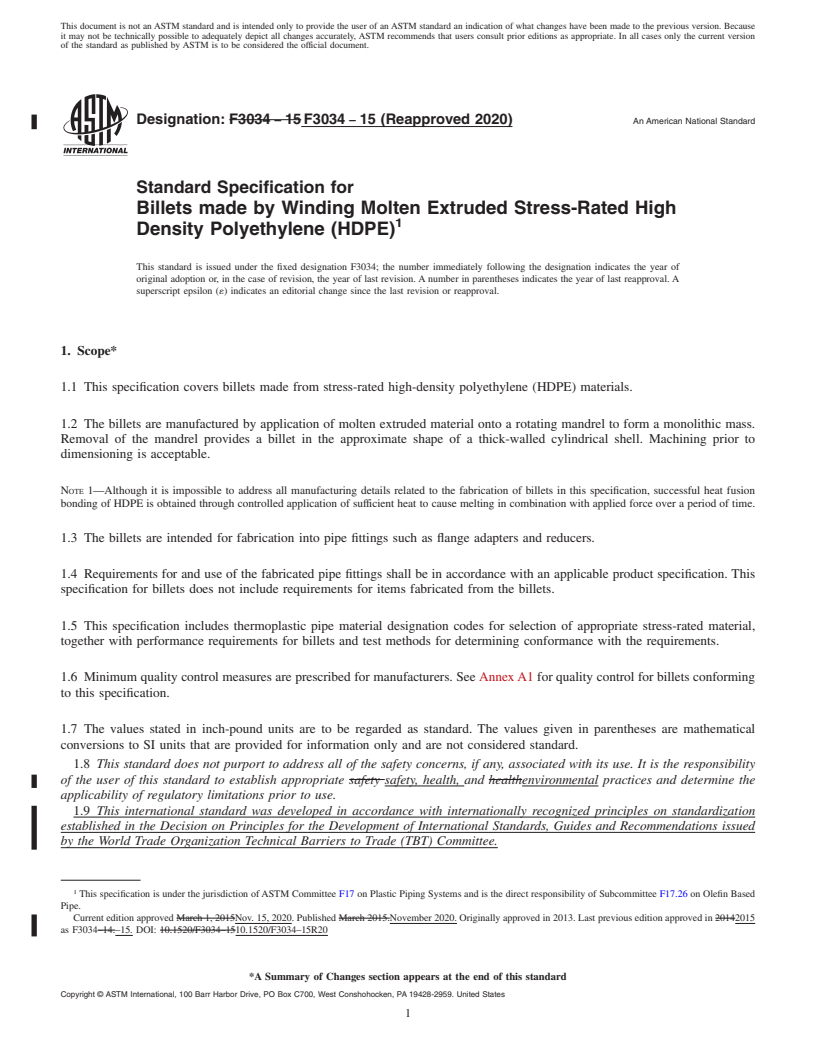
Designation: F3034 − 15 F3034 − 15 (Reapproved 2020) An American National Standard
Standard Specification for
Billets made by Winding Molten Extruded Stress-Rated High
Density Polyethylene (HDPE)
This standard is issued under the fixed designation F3034; the number immediately following the designation indicates the year of
original adoption or, in the case of revision, the year of last revision. A number in parentheses indicates the year of last reapproval. A
superscript epsilon (´) indicates an editorial change since the last revision or reapproval.
1. Scope*
1.1 This specification covers billets made from stress-rated high-density polyethylene (HDPE) materials.
1.2 The billets are manufactured by application of molten extruded material onto a rotating mandrel to form a monolithic mass.
Removal of the mandrel provides a billet in the approximate shape of a thick-walled cylindrical shell. Machining prior to
dimensioning is acceptable.
NOTE 1—Although it is impossible to address all manufacturing details related to the fabrication of billets in this specification, successful heat fusion
bonding of HDPE is obtained through controlled application of sufficient heat to cause melting in combination with applied force over a period of time.
1.3 The billets are intended for fabrication into pipe fittings such as flange adapters and reducers.
1.4 Requirements for and use of the fabricated pipe fittings shall be in accordance with an applicable product specification. This
specification for billets does not include requirements for items fabricated from the billets.
1.5 This specification includes thermoplastic pipe material designation codes for selection of appropriate stress-rated material,
together with performance requirements for billets and test methods for determining conformance with the requirements.
1.6 Minimum quality control measures are prescribed for manufacturers. See Annex A1 for quality control for billets conforming
to this specification.
1.7 The values stated in inch-pound units are to be regarded as standard. The values given in parentheses are mathematical
conversions to SI units that are provided for information only and are not considered standard.
1.8 This standard does not purport to address all of the safety concerns, if any, associated with its use. It is the responsibility
of the user of this standard to establish appropriate safety safety, health, and healthenvironmental practices and determine the
applicability of regulatory limitations prior to use.
1.9 This international standard was developed in accordance with internationally recognized principles on standardization
established in the Decision on Principles for the Development of International Standards, Guides and Recommendations issued
by the World Trade Organization Technical Barriers to Trade (TBT) Committee.
This specification is under the jurisdiction of ASTM Committee F17 on Plastic Piping Systems and is the direct responsibility of Subcommittee F17.26 on Olefin Based
Pipe.
Current edition approved March 1, 2015Nov. 15, 2020. Published March 2015.November 2020. Originally approved in 2013. Last previous edition approved in 20142015
as F3034–14.–15. DOI: 10.1520/F3034–1510.1520/F3034–15R20
*A Summary of Changes section appears at the end of this standard
Copyright © ASTM International, 100 Barr Harbor Drive, PO Box C700, West Conshohocken, PA 19428-2959. United States
F3034 − 15 (2020)
2. Referenced Documents
2.1 ASTM Standards:
D618 Practice for Conditioning Plastics for Testing
D638 Test Method for Tensile Properties of Plastics
D1238 Test Method for Melt Flow Rates of Thermoplastics by Extrusion Plastometer
D1600 Terminology for Abbreviated Terms Relating to Plastics
D1603 Test Method for Carbon Black Content in Olefin Plastics
D2122 Test Method for Determining Dimensions of Thermoplastic Pipe and Fittings
D2837 Test Method for Obtaining Hydrostatic Design Basis for Thermoplastic Pipe Materials or Pressure Design Basis for
Thermoplastic Pipe Products
D3350 Specification for Polyethylene Plastics Pipe and Fittings Materials
D4218 Test Method for Determination of Carbon Black Content in Polyethylene Compounds by the Muffle-Furnace Technique
F412 Terminology Relating to Plastic Piping Systems
2.2 NSF/ANSI Standards:
Standard No. 14 for Plastic Piping Components and Related Materials
Standard No. 61 for Drinking Water Systems Components—Health Effects
2.3 PPI Standards:
PPI TR-3 Policies and Procedures for Developing Hydrostatic Design Basis (HDB), Pressure Design Basis (PDB), Strength
Design Basis (SDB), and Minimum Required Strength (MRS) Ratings for Thermoplastic Piping Materials or Pipe
PPI TR-4 HDB/SDB/PDB/MRS Listed Materials, PPI Listing of Hydrostatic Design Basis (HDB), Strength Design Basis
(SDB), Pressure Design Basis (PDB), and Minimum Required Strength (MRS) Ratings for Thermoplastic Piping Materials
or Pipe
3. Terminology
3.1 Unless otherwise specified, definitions are in accordance with Terminology F412 and abbreviations are in accordance with
Terminology D1600.
3.2 Definitions of Terms Specific to This Standard:
3.2.1 average outside diameter, n—the average distance following all forming and machining operations when measured in
accordance with 6.3.1.
3.2.2 billet, n—a mass formed from a single polyethylene compound in the approximate shape of a thick-walled cylindrical shell.
3.2.3 mid-wall, n—the location half-way between the outside diameter and the inside diameter following all forming and
machining operations.
3.2.4 minimum wall thickness, n—the minimum distance following all forming and machining operations when measured in
accordance with 6.3.2.
4. Materials
4.1 Polyethylene Compound—Polyethylene compounds used in the manufacture of billet under this specification shall have
thermoplastic pipe materials designation code PE3608, PE4608 or PE4710; shall have a minimum Specification D3350 cell
classification of 333344C and shall meet all other requirements of Specification D3350.
4.1.1 General—The PE compound used to make billet shall be virgin PE compound or reworked PE compound (see 4.3) and shall
have a hydrostatic design basis listed in Plastics Pipe Institute (PPI) TR-4.
4.1.2 Color and Ultraviolet (UV) Stabilization—Polyethylene compounds shall meet Specification D3350 code C. In addition,
Code C polyethylene compounds shall have 2.0 to 3.0 percent carbon black.
For referenced ASTM standards, visit the ASTM website, www.astm.org, or contact ASTM Customer Service at service@astm.org. For Annual Book of ASTM Standards
volume information, refer to the standard’s Document Summary page on the ASTM website.
Available from NSF International, P.O. Box 130140, 789 N. Dixboro Rd., Ann Arbor, MI 48113-0140,48105, http://www.nsf.org.
Available from Plastics Pipe Institute (PPI), 105 Decker Court, Suite 825, Irving, TX 75062, http://www.plasticpipe.org.
F3034 − 15 (2020)
4.1.3 Hydrostatic Design Basis (HDB) Substantiation—The HDB for PE compound at 73°F (23°C)73 °F (23 °C) shall be
substantiated to be linear to 50 years as described in Substantiation of the HDB for Polyethylene Materials in Test Method D2837.
NOTE 2—This is 5.7 in the 2011 publication of Test Method D2837.
4.1.4 Melt Flow Requirement—Polyethylene compounds shall be tested in conformance with Test Method D1238 either at
condition 190/2.16 or 190/21.6. When tested at condition 190/2.16, the resulting value shall be ≤0.15 g/10 min. When tested at
condition 190/21.6, the resulting value shall be ≤20 g/10 min.
4.2 Potable Water Requirement—When required by the purchaser, billets intended for fabrication into products intended for
contact with potable water shall utilize PE compounds certified for conformance with NSF/ANSI Standard No. 61 or the health
effects portion of NSF/ANSI Standard No. 14 by an acceptable certifying organization.
4.3 Rework Material—Clean polyethylene compound from the manufacturer’s own production that meets 4.1 and 4.2 of this
specification as new compound is suitable for reextrusion into billet, when blended with new compound of the same thermoplastic
pipe material designation code. Billet containing rework material shall meet the requirements of this specification.
5. Requirements
5.1 Workmanship—The billet shall be uniform in appearance and consistent throughout. The walls shall be free of cracks, holes,
blisters, voids, foreign inclusion, or other defects that are visible to the naked eye and that affect the wall integrity (see Annex A1).
A single hole deliberately placed in the center of the billet is required.
NOTE 3—Manufacturers should use appropriate quality assurance procedures to ensure that billets are free from injurious defects including laminations.
5.2 Dimensions and Tolerances: Dimensions and Tolerances: Requirements for dimensions shall only apply to a billet that is
transferred from a seller to a buyer prior to being fabricated into one or more pipe fittings. When a billet is produced and fabricated
into pipe fittings by a single manufacturer, there are no dimensional requirements specified for the billet by this Standard. All
dimensional requirements for pipe fittings are as given in the applicable product standard.
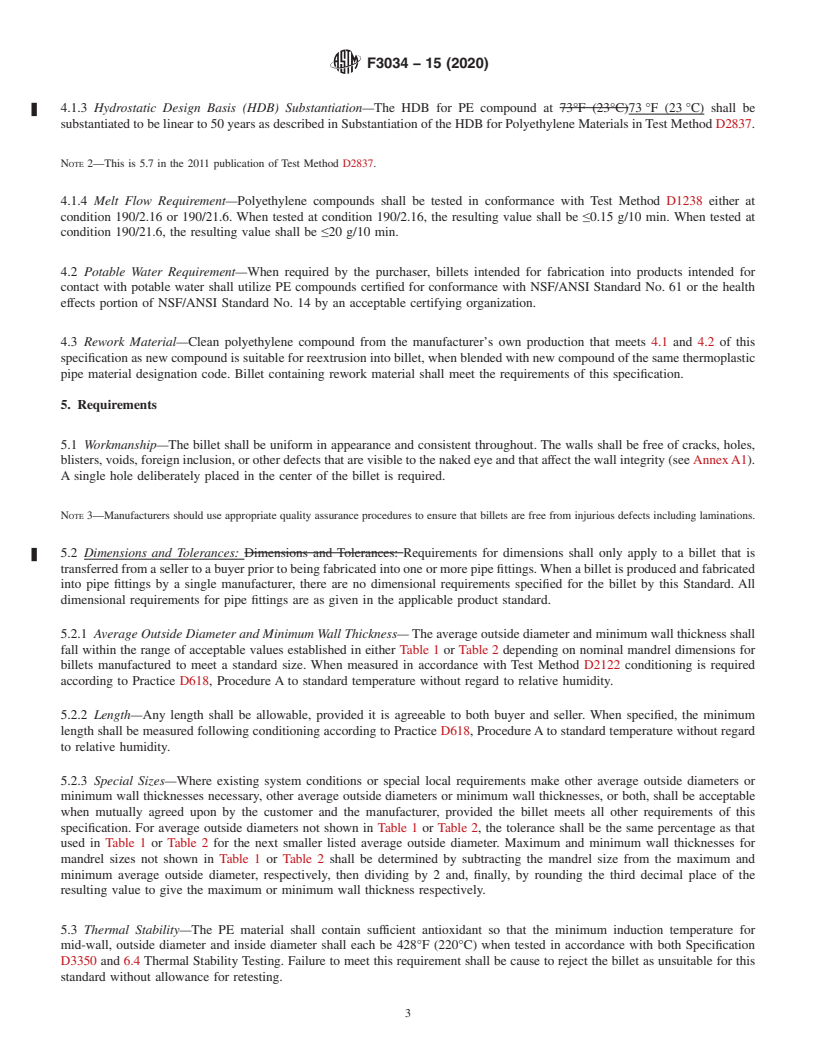
5.2.1 Average Outside Diameter and Minimum Wall Thickness— The average outside diameter and minimum wall thickness shall
fall within the range of acceptable values established in either Table 1 or Table 2 depending on nominal mandrel dimensions for
billets manufactured to meet a standard size. When measured in accordance with Test Method D2122 conditioning is required
according to Practice D618, Procedure A to standard temperature without regard to relative humidity.
5.2.2 Length—Any length shall be allowable, provided it is agreeable to both buyer and seller. When specified, the minimum
length shall be measured following conditioning according to Practice D618, Procedure A to standard temperature without regard
to relative humidity.
5.2.3 Special Sizes—Where existing system conditions or special local requirements make other average outside diameters or
minimum wall thicknesses necessary, other average outside diameters or minimum wall thicknesses, or both, shall be acceptable
when mutually agreed upon by the customer and the manufacturer, provided the billet meets all other requirements of this
specification. For average outside diameters not shown in Table 1 or Table 2, the tolerance shall be the same percentage as that
used in Table 1 or Table 2 for the next smaller listed average outside diameter. Maximum and minimum wall thicknesses for
mandrel sizes not shown in Table 1 or Table 2 shall be determined by subtracting the mandrel size from the maximum and
minimum average outside diameter, respectively, then dividing by 2 and, finally, by rounding the third decimal place of the
resulting value to give the maximum or minimum wall thickness respectively.
5.3 Thermal Stability—The PE material shall contain sufficient antioxidant so that the minimum induction temperature for
mid-wall, outside diameter and inside diameter shall each be 428°F (220°C) when tested in accordance with both Specification
D3350 and 6.4 Thermal Stability Testing. Failure to meet this requirement shall be cause to reject the billet as unsuitable for this
standard without allowance for retesting.
F3034 − 15 (2020)
TABLE 1 Dimensions of Standard Billet Sizes up to Nominal Mandrel Size of 21
Outside Nominal Mandrel Sizes
Diameter
Dimensions
Nominal Min. OD Max OD 6.625 8.625 10.75 12.75
Min.Wall Max.Wall Min.Wall Max.Wall Min.Wall Max.Wall Min.Wall Max.Wall
O.D. in. mm in. mm in. mm in. mm in. mm in. mm in. mm in. mm in. mm in. mm
13 12.922 328.22 13.078 332.18 3.149 79.98 3.227 81.95 2.149 54.57 2.227 56.55 N/A N/A N/A N/A N/A N/A N/A N/A
15 14.910 378.71 15.090 383.29 4.143 105.23 4.233 107.51 3.143 79.82 3.233 82.11 2.080 52.83 2.170 55.12 N/A N/A N/A N/A
16 15.904 403.96 16.096 408.84 4.640 117.86 4.736 120.28 3.640 92.44 3.736 94.88 2.577 65.46 2.673 67.89 1.577 40.06 1.673 42.49
18 17.892 454.46 18.108 459.94 5.634 143.10 5.742 145.83 4.634 117.69 4.742 120.43 3.571 90.70 3.679 93.45 2.571 65.30 2.679 68.05
20 19.880 504.95 20.120 511.05 6.628 168.35 6.748 171.39 5.628 142.94 5.748 145.99 4.565 115.95 4.685 119.00 3.565 90.55 3.685 93.60
21 20.874 530.20 21.126 536.60 7.125 180.98 7.251 184.16 6.125 155.56 6.251 158.76 5.062 128.57 5.188 131.78 4.062 103.17 4.188 106.38
22 21.868 555.45 22.132 562.15 7.622 193.60 7.754 196.94 6.622 168.19 6.754 171.54 5.559 141.20 5.691 144.55 4.559 115.80 4.691 119.15
25 24.850 631.19 25.150 638.81 9.113 231.47 9.263 235.27 8.113 206.06 8.263 209.87 7.050 179.07 7.200 182.88 6.050 153.67 6.200 157.48
26 25.844 656.44 26.156 664.36 9.610 244.09 9.766 248.04 8.610 218.68 8.766 222.64 7.547 191.69 7.703 195.66 6.547 166.29 6.703 170.26
27 26.838 681.69 27.162 689.91 10.107 256.72 10.269 260.82 9.107 231.31 9.269 235.42 8.044 204.32 8.206 208.43 7.044 178.92 7.206 183.03
28 27.832 706.93 28.168 715.47 10.604 269.34 10.772 273.60 9.604 243.93 9.772 248.20 8.541 216.94 8.709 221.21 7.541 191.54 7.709 195.81
29 28.826 732.18 29.174 741.02 11.101 281.97 11.275 286.37 10.101 256.55 10.275 260.97 9.038 229.57 9.212 233.98 8.038 204.17 8.212 208.58
30 29.820 757.43 30.180 766.57 11.598 294.59 11.778 299.15 10.598 269.18 10.778 273.75 9.535 242.19 9.715 246.76 8.535 216.79 8.715 221.36
31 30.814 782.68 31.186 792.12 12.095 307.21 12.281 311.92 11.095 281.80 11.281 286.52 10.032 254.81 10.218 259.54 9.032 229.41 9.218 234.14
33 32.802 833.17 33.198 843.23 13.089 332.46 13.287 337.48 12.089 307.05 12.287 312.08 11.026 280.06 11.224 285.09 10.026 254.66 10.224 259.69
34 33.796 858.42 34.204 868.78 13.586 345.08 13.790 350.25 12.586 319.67 12.790 324.85 11.523 292.68 11.727 297.87 10.523 267.28 10.727 272.47
35 34.790 883.67 35.210 894.33 14.083 357.71 14.293 363.03 13.083 332.30 13.293 337.63 12.020 305.31 12.230 310.64 11.020 279.91 11.230 285.24
37 36.778 934.16 37.222 945.44 N/A N/A N/A N/A 14.077 357.54 14.299 363.18 13.014 330.56 13.236 336.19 12.014 305.16 12.236 310.79
39 38.766 984.66 39.234 996.54 N/A N/A N/A N/A N/A N/A N/A N/A 14.008 355.80 14.242 361.75 13.008 330.40 13.242 336.35
40 39.760 1009.90 40.240 1022.10 N/A N/A N/A N/A N/A N/A N/A N/A N/A N/A N/A N/A 13.505 343.03 13.745 349.12
41.25 41.003 1041.48 41.498 1054.05 N/A N/A N/A N/A N/A N/A N/A N/A N/A N/A N/A N/A 14.127 358.81 14.374 365.10
...
Questions, Comments and Discussion
Ask us and Technical Secretary will try to provide an answer. You can facilitate discussion about the standard in here.