


ASTM F964-13(2019)
(Specification)Standard Specification for Rigid Poly (Vinyl Chloride) (PVC) Exterior Profiles Used for Fencing and Railing
Standard Specification for Rigid Poly (Vinyl Chloride) (PVC) Exterior Profiles Used for Fencing and Railing
ABSTRACT
This specification deals with rigid poly vinyl-chloride (PVC) exterior profiles used for agricultural, commercial, residential fencing and railing. The material used in these exterior profiles is limited to rigid poly (vinyl chloride) (PVC) compounds in a single homogeneous extrusion or in a coextrusion of two or more PVC compounds in distinct layers. Loadbearing characteristics for fence and railing assemblies are not addressed within this specification (for example, windload, horizontal or vertical guardrail loading). Materials shall be tested and shall conform to requirements for the material properties and physical properties, including dimensional tolerances, extrusion quality, and weatherability. Methods for testing and for identifying exterior profile extrusions, such as impact resistance, warp, dimensional stability, and impact test on weathered specimen that comply with this specification are also provided.
SIGNIFICANCE AND USE
4.1 The purpose of this specification is to establish a recognized standard of quality for rigid poly vinyl chloride (PVC) exterior profiles for use in assembling agricultural, commercial, and residential fencing and railing. The term “PVC fence” refers to complete fencing and railings systems in which the primary structural members such as posts, rails, spindles, pickets, and gates are made from PVC exterior profiles. Accessory components (not included in this specification), including bolts, screws, hinges, latches, caps, and brackets, may be made from PVC or non-PVC materials, or both. The information contained in this specification is intended to be helpful to producers, distributors, and users and to promote understanding between purchasers and sellers.
SCOPE
1.1 This specification establishes requirements for the material properties and physical properties, including dimensional tolerances, extrusion quality, and weatherability, of rigid poly vinyl-chloride (PVC) exterior profiles used for agricultural, commercial, residential fencing and railing. Methods for testing and for identifying exterior profile extrusions that comply with this specification are also provided.
Note 1: Information with regard to application, assembly, and installation should be obtained from the manufacturer or in accordance with Practice F1999, or both.
Note 2: Loadbearing characteristics for fence and railing assemblies are not addressed within this specification (for example, windload, horizontal or vertical guardrail loading).
1.2 The material used in these exterior profiles is limited to rigid poly (vinyl chloride) (PVC) compounds in a single homogeneous extrusion or in a coextrusion of two or more PVC compounds in distinct layers.
1.3 The values stated in inch-pound units are to be regarded as the standard. The values in parentheses are provided for information only.
1.4 This standard does not purport to address all of the safety concerns, if any, associated with its use. It is the responsibility of the user of this standard to establish appropriate safety, health, and environmental practices and determine the applicability of regulatory limitations prior to use.
1.5 This international standard was developed in accordance with internationally recognized principles on standardization established in the Decision on Principles for the Development of International Standards, Guides and Recommendations issued by the World Trade Organization Technical Barriers to Trade (TBT) Committee.
General Information
Relations
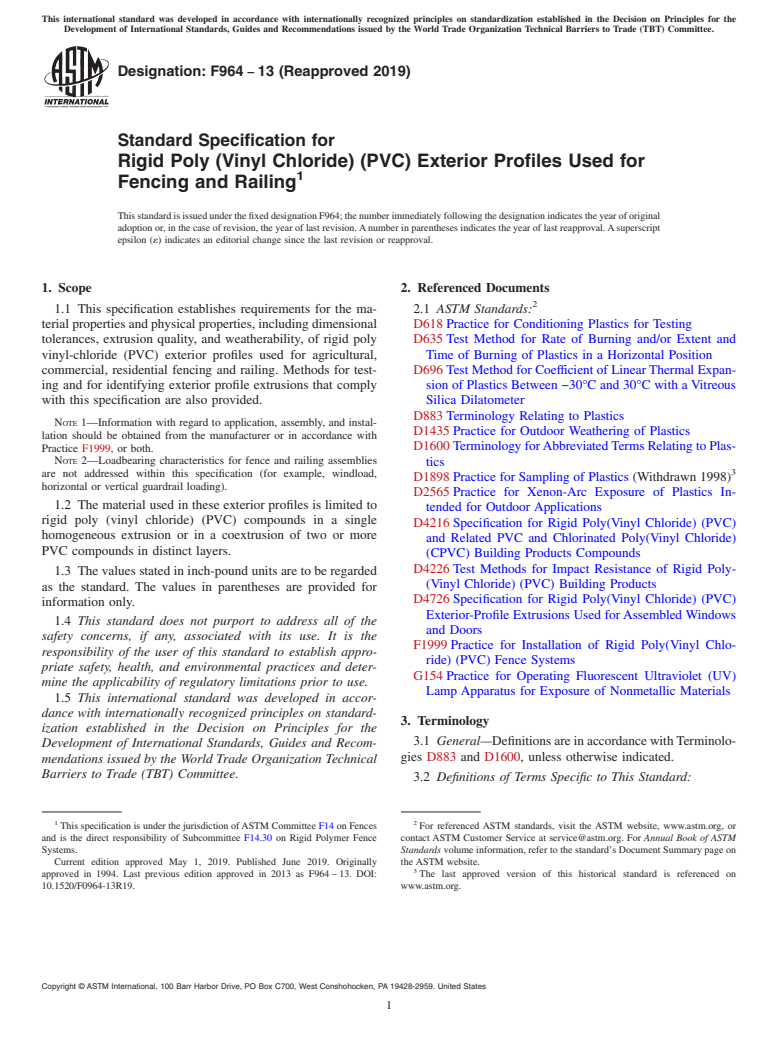
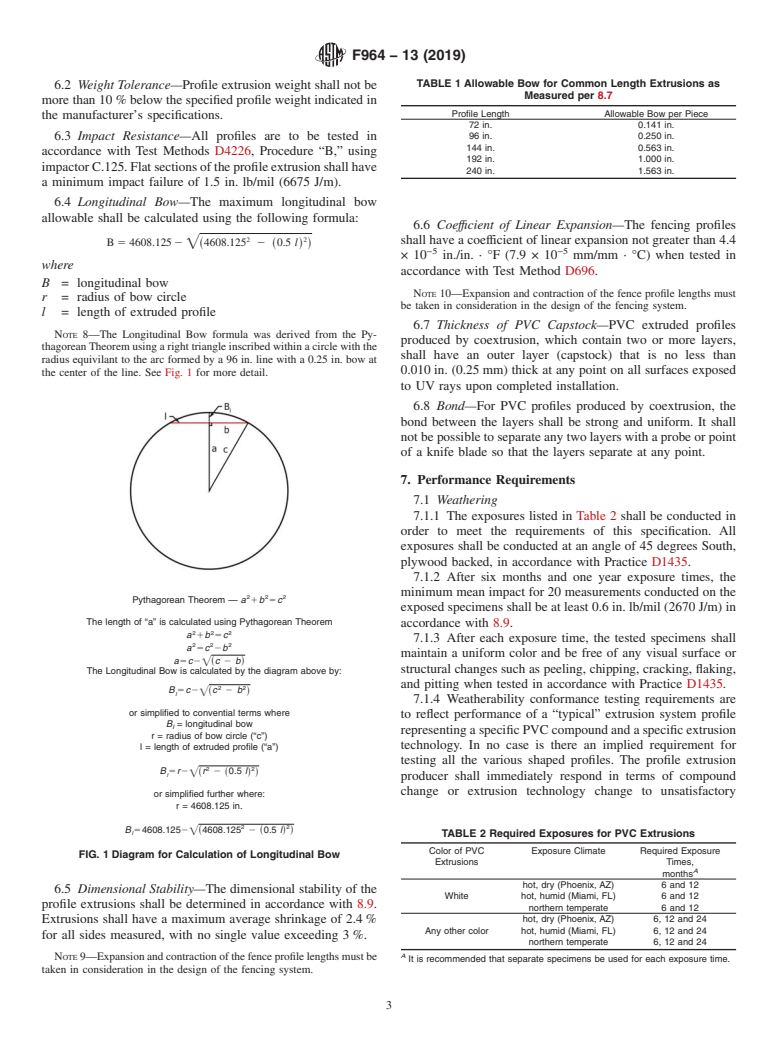
Standards Content (Sample)
This international standard was developed in accordance with internationally recognized principles on standardization established in the Decision on Principles for the
Development of International Standards, Guides and Recommendations issued by the World Trade Organization Technical Barriers to Trade (TBT) Committee.
Designation:F964 −13 (Reapproved 2019)
Standard Specification for
Rigid Poly (Vinyl Chloride) (PVC) Exterior Profiles Used for
1
Fencing and Railing
ThisstandardisissuedunderthefixeddesignationF964;thenumberimmediatelyfollowingthedesignationindicatestheyearoforiginal
adoptionor,inthecaseofrevision,theyearoflastrevision.Anumberinparenthesesindicatestheyearoflastreapproval.Asuperscript
epsilon (´) indicates an editorial change since the last revision or reapproval.
1. Scope 2. Referenced Documents
2
1.1 This specification establishes requirements for the ma- 2.1 ASTM Standards:
terialpropertiesandphysicalproperties,includingdimensional D618Practice for Conditioning Plastics for Testing
tolerances, extrusion quality, and weatherability, of rigid poly D635Test Method for Rate of Burning and/or Extent and
vinyl-chloride (PVC) exterior profiles used for agricultural, Time of Burning of Plastics in a Horizontal Position
commercial, residential fencing and railing. Methods for test- D696TestMethodforCoefficientofLinearThermalExpan-
ing and for identifying exterior profile extrusions that comply sion of Plastics Between −30°C and 30°C with a Vitreous
with this specification are also provided. Silica Dilatometer
D883Terminology Relating to Plastics
NOTE 1—Information with regard to application, assembly, and instal-
D1435Practice for Outdoor Weathering of Plastics
lation should be obtained from the manufacturer or in accordance with
D1600TerminologyforAbbreviatedTermsRelatingtoPlas-
Practice F1999, or both.
NOTE 2—Loadbearing characteristics for fence and railing assemblies
tics
3
are not addressed within this specification (for example, windload,
D1898Practice for Sampling of Plastics (Withdrawn 1998)
horizontal or vertical guardrail loading).
D2565Practice for Xenon-Arc Exposure of Plastics In-
1.2 The material used in these exterior profiles is limited to
tended for Outdoor Applications
rigid poly (vinyl chloride) (PVC) compounds in a single
D4216Specification for Rigid Poly(Vinyl Chloride) (PVC)
homogeneous extrusion or in a coextrusion of two or more
and Related PVC and Chlorinated Poly(Vinyl Chloride)
PVC compounds in distinct layers.
(CPVC) Building Products Compounds
D4226Test Methods for Impact Resistance of Rigid Poly-
1.3 The values stated in inch-pound units are to be regarded
(Vinyl Chloride) (PVC) Building Products
as the standard. The values in parentheses are provided for
D4726Specification for Rigid Poly(Vinyl Chloride) (PVC)
information only.
Exterior-Profile Extrusions Used forAssembled Windows
1.4 This standard does not purport to address all of the
and Doors
safety concerns, if any, associated with its use. It is the
F1999Practice for Installation of Rigid Poly(Vinyl Chlo-
responsibility of the user of this standard to establish appro-
ride) (PVC) Fence Systems
priate safety, health, and environmental practices and deter-
G154Practice for Operating Fluorescent Ultraviolet (UV)
mine the applicability of regulatory limitations prior to use.
Lamp Apparatus for Exposure of Nonmetallic Materials
1.5 This international standard was developed in accor-
dance with internationally recognized principles on standard-
3. Terminology
ization established in the Decision on Principles for the
3.1 General—DefinitionsareinaccordancewithTerminolo-
Development of International Standards, Guides and Recom-
gies D883 and D1600, unless otherwise indicated.
mendations issued by the World Trade Organization Technical
Barriers to Trade (TBT) Committee.
3.2 Definitions of Terms Specific to This Standard:
1 2
This specification is under the jurisdiction ofASTM Committee F14 on Fences For referenced ASTM standards, visit the ASTM website, www.astm.org, or
and is the direct responsibility of Subcommittee F14.30 on Rigid Polymer Fence contact ASTM Customer Service at service@astm.org. For Annual Book of ASTM
Systems. Standards volume information, refer to the standard’s Document Summary page on
Current edition approved May 1, 2019. Published June 2019. Originally the ASTM website.
3
approved in 1994. Last previous edition approved in 2013 as F964–13. DOI: The last approved version of this historical standard is referenced on
10.1520/F0964-13R19. www.astm.org.
Copyright © ASTM International, 100 Barr Harbor Drive, PO Box C700, West Conshohocken, PA 19428-2959. United States
1
---------------------- Page: 1 ----------------------
F964−13 (2019)
3.2.1 capstock—the outer layer in a coextrusion exposed to Compounds that have higher cell classification because one or
weathering. morepropertiesaresuperiortothoseinthespecifiedcompound
are acceptable.
3.2.2 coextrusion—the process of coextruding profiles from
two or more concentric str
...
Questions, Comments and Discussion
Ask us and Technical Secretary will try to provide an answer. You can facilitate discussion about the standard in here.