

ASTM E1832-08(2017)
(Practice)Standard Practice for Describing and Specifying a Direct Current Plasma Atomic Emission Spectrometer
General Information
- Abstract
SIGNIFICANCE AND USE
4.1 This practice describes the essential components of the DCP spectrometer. This description allows the user or potential user to gain a basic understanding of this system. It also provides a means of comparing and evaluating this system with similar systems, as well as understanding the capabilities and limitations of each instrument.
SCOPE
1.1 This practice describes the components of a direct current plasma (DCP) atomic emission spectrometer. This practice does not attempt to specify component tolerances or performance criteria. This practice does, however, attempt to identify critical factors affecting bias, precision, and sensitivity. Before placing an order a prospective user should consult with the manufacturer to design a testing protocol for demonstrating that the instrument meets all anticipated needs.
1.2 This standard does not purport to address all of the safety concerns, if any, associated with its use. It is the responsibility of the user of this standard to establish appropriate safety and health practices and determine the applicability of regulatory limitations prior to use. Specific hazards statements are give in Section 9.
1.3 This international standard was developed in accordance with internationally recognized principles on standardization established in the Decision on Principles for the Development of International Standards, Guides and Recommendations issued by the World Trade Organization Technical Barriers to Trade (TBT) Committee.
- Status
- Published
- Publication Date
- 30-Apr-2017
- Technical Committee
- E01 - Analytical Chemistry for Metals, Ores, and Related Materials
- Drafting Committee
- E01.20 - Fundamental Practices
Overview
ASTM E1832-08(2017) provides a standardized practice for describing and specifying the components of a Direct Current Plasma (DCP) Atomic Emission Spectrometer. Developed by ASTM International, this standard helps users and manufacturers understand the key elements of DCP spectrometers, supporting informed selection, evaluation, and comparison with similar analytical instruments. Although it does not set performance criteria or component tolerances, it identifies critical factors that affect bias, precision, and sensitivity during elemental analysis.
Key Topics
Essential Components: The standard details the primary assemblies of a DCP atomic emission spectrometer, such as:
- Direct current electrical source
- Sample introduction system
- Plasma generation and containment
- Optical assemblies (entrance/exit slits, collimating mirrors, dispersing elements, photomultipliers)
- Control panels and dedicated computer systems
Critical Factors for Accuracy: ASTM E1832-08(2017) emphasizes factors impacting analytical results, including:
- Optical alignment
- Wavelength selection and calibration
- Gas flow rates and plasma conditions
- Background correction and spectral interference management
Operational Safety: The document highlights safety precautions, such as:
- Proper venting for toxic gases
- Implementing door interlocks and cooling systems
- Ensuring electrical safety and proper operator training
Performance Characteristics: Key metrics such as dynamic range, detection limit, and stability are identified for describing and comparing instrument capabilities.
User Guidance: The standard encourages users to consult with manufacturers for test protocols to ensure instruments align with specific operational needs.
Applications
DCP atomic emission spectrometers are widely utilized in analytical chemistry for routine and advanced elemental analysis. The practical applications include:
- Metals and Alloys Analysis: Determining trace and major elements in industrial metals, ores, and related materials.
- Environmental Testing: Measuring elemental concentrations in water, soils, and waste streams.
- Pharmaceuticals and Life Sciences: Assessing elemental impurities in formulations.
- Quality Control Laboratories: Ensuring product conformity and safety by rapid multi-element detection.
By establishing a common language for DCP spectrometer specification and performance, ASTM E1832-08(2017) supports procurement, laboratory accreditation, method validation, and cross-laboratory comparison.
Related Standards
ASTM E1832-08(2017) references and complements several related ASTM standards and guides, including:
- ASTM E135 - Terminology Relating to Analytical Chemistry for Metals, Ores, and Related Materials
- ASTM E158 - Practice for Fundamental Calculations to Convert Intensities into Concentrations in Optical Emission Spectrochemical Analysis (Withdrawn)
- ASTM E172 - Practice for Describing and Specifying the Excitation Source in Emission Spectrochemical Analysis (Withdrawn)
- ASTM E406 - Practice for Using Controlled Atmospheres in Spectrochemical Analysis
- ASTM E416 - Practice for Planning and Safe Operation of a Spectrochemical Laboratory (Withdrawn)
- ASTM E520 - Practice for Describing Photomultiplier Detectors in Emission and Absorption Spectrometry
- ASTM E528 - Practice for Grounding Basic Optical Emission Spectrochemical Equipment (Withdrawn)
- ASTM E1097 - Guide for Determination of Various Elements by Direct Current Plasma Atomic Emission Spectrometry
These related documents provide expanded guidance on terminology, safety protocols, instrumentation specifics, and best practices for emission spectrometry.
Keywords: direct current plasma, atomic emission spectrometer, DCP spectrometer, ASTM E1832, emission spectrochemical analysis, elemental analysis, instrument specification, laboratory safety
For more information or access to the standard, visit ASTM International.
Relations
- Effective Date
- 01-May-2017
- Effective Date
- 01-Apr-2023
- Effective Date
- 01-Jan-2020
- Refers
ASTM E406-19 - Standard Practice for Using Controlled Atmospheres in Atomic Emission Spectrometry - Effective Date
- 01-Oct-2019
- Effective Date
- 15-May-2019
- Effective Date
- 15-May-2016
- Effective Date
- 01-Jul-2015
- Effective Date
- 15-May-2015
- Effective Date
- 15-Aug-2014
- Effective Date
- 01-Apr-2014
- Effective Date
- 15-Feb-2014
- Effective Date
- 01-Dec-2013
- Refers
ASTM E406-81(2012) - Standard Practice for Using Controlled Atmospheres in Spectrochemical Analysis - Effective Date
- 01-Dec-2012
- Effective Date
- 01-Jun-2012
- Effective Date
- 15-Sep-2011
Get Certified
Connect with accredited certification bodies for this standard

BSMI (Bureau of Standards, Metrology and Inspection)
Taiwan's standards and inspection authority.
Sponsored listings
Frequently Asked Questions
ASTM E1832-08(2017) is a standard published by ASTM International. Its full title is "Standard Practice for Describing and Specifying a Direct Current Plasma Atomic Emission Spectrometer". This standard covers: SIGNIFICANCE AND USE 4.1 This practice describes the essential components of the DCP spectrometer. This description allows the user or potential user to gain a basic understanding of this system. It also provides a means of comparing and evaluating this system with similar systems, as well as understanding the capabilities and limitations of each instrument. SCOPE 1.1 This practice describes the components of a direct current plasma (DCP) atomic emission spectrometer. This practice does not attempt to specify component tolerances or performance criteria. This practice does, however, attempt to identify critical factors affecting bias, precision, and sensitivity. Before placing an order a prospective user should consult with the manufacturer to design a testing protocol for demonstrating that the instrument meets all anticipated needs. 1.2 This standard does not purport to address all of the safety concerns, if any, associated with its use. It is the responsibility of the user of this standard to establish appropriate safety and health practices and determine the applicability of regulatory limitations prior to use. Specific hazards statements are give in Section 9. 1.3 This international standard was developed in accordance with internationally recognized principles on standardization established in the Decision on Principles for the Development of International Standards, Guides and Recommendations issued by the World Trade Organization Technical Barriers to Trade (TBT) Committee.
SIGNIFICANCE AND USE 4.1 This practice describes the essential components of the DCP spectrometer. This description allows the user or potential user to gain a basic understanding of this system. It also provides a means of comparing and evaluating this system with similar systems, as well as understanding the capabilities and limitations of each instrument. SCOPE 1.1 This practice describes the components of a direct current plasma (DCP) atomic emission spectrometer. This practice does not attempt to specify component tolerances or performance criteria. This practice does, however, attempt to identify critical factors affecting bias, precision, and sensitivity. Before placing an order a prospective user should consult with the manufacturer to design a testing protocol for demonstrating that the instrument meets all anticipated needs. 1.2 This standard does not purport to address all of the safety concerns, if any, associated with its use. It is the responsibility of the user of this standard to establish appropriate safety and health practices and determine the applicability of regulatory limitations prior to use. Specific hazards statements are give in Section 9. 1.3 This international standard was developed in accordance with internationally recognized principles on standardization established in the Decision on Principles for the Development of International Standards, Guides and Recommendations issued by the World Trade Organization Technical Barriers to Trade (TBT) Committee.
ASTM E1832-08(2017) is classified under the following ICS (International Classification for Standards) categories: 17.180.30 - Optical measuring instruments. The ICS classification helps identify the subject area and facilitates finding related standards.
ASTM E1832-08(2017) has the following relationships with other standards: It is inter standard links to ASTM E1832-08(2012), ASTM E520-08(2023)e1, ASTM E135-20, ASTM E406-19, ASTM E135-19, ASTM E135-16, ASTM E135-15a, ASTM E135-15, ASTM E135-14b, ASTM E135-14a, ASTM E135-14, ASTM E135-13a, ASTM E406-81(2012), ASTM E1097-12, ASTM E135-11b. Understanding these relationships helps ensure you are using the most current and applicable version of the standard.
ASTM E1832-08(2017) is available in PDF format for immediate download after purchase. The document can be added to your cart and obtained through the secure checkout process. Digital delivery ensures instant access to the complete standard document.
Standards Content (Sample)
This international standard was developed in accordance with internationally recognized principles on standardization established in the Decision on Principles for the
Development of International Standards, Guides and Recommendations issued by the World Trade Organization Technical Barriers to Trade (TBT) Committee.
Designation: E1832 − 08 (Reapproved 2017)
Standard Practice for
Describing and Specifying a Direct Current Plasma Atomic
Emission Spectrometer
This standard is issued under the fixed designation E1832; the number immediately following the designation indicates the year of
original adoption or, in the case of revision, the year of last revision. A number in parentheses indicates the year of last reapproval. A
superscript epsilon (´) indicates an editorial change since the last revision or reapproval.
1. Scope SourceinEmissionSpectrochemicalAnalysis(Withdrawn
2001)
1.1 This practice describes the components of a direct
E406 Practice for Using Controlled Atmospheres in Spec-
current plasma (DCP) atomic emission spectrometer. This
trochemical Analysis
practice does not attempt to specify component tolerances or
E416 Practice for Planning and Safe Operation of a Spec-
performance criteria. This practice does, however, attempt to
trochemical Laboratory (Withdrawn 2005)
identifycriticalfactorsaffectingbias,precision,andsensitivity.
E520 Practice for Describing Photomultiplier Detectors in
Before placing an order a prospective user should consult with
Emission and Absorption Spectrometry
the manufacturer to design a testing protocol for demonstrating
E528 Practice for Grounding Basic Optical Emission Spec-
that the instrument meets all anticipated needs.
trochemical Equipment (Withdrawn 1998)
1.2 This standard does not purport to address all of the
E1097 Guide for Determination of Various Elements by
safety concerns, if any, associated with its use. It is the
Direct Current Plasma Atomic Emission Spectrometry
responsibility of the user of this standard to establish appro-
priate safety and health practices and determine the applica-
3. Terminology
bility of regulatory limitations prior to use. Specific hazards
3.1 For terminology relating to emission spectrometry, refer
statements are give in Section 9.
to Terminology E135.
1.3 This international standard was developed in accor-
dance with internationally recognized principles on standard-
4. Significance and Use
ization established in the Decision on Principles for the
Development of International Standards, Guides and Recom- 4.1 This practice describes the essential components of the
mendations issued by the World Trade Organization Technical DCPspectrometer.This description allows the user or potential
Barriers to Trade (TBT) Committee.
user to gain a basic understanding of this system. It also
providesameansofcomparingandevaluatingthissystemwith
2. Referenced Documents similar systems, as well as understanding the capabilities and
2 limitations of each instrument.
2.1 ASTM Standards:
E135 Terminology Relating to Analytical Chemistry for
5. Overview
Metals, Ores, and Related Materials
5.1 A DCP spectrometer is an instrument for determining
E158 Practice for Fundamental Calculations to Convert
Intensities into Concentrations in Optical Emission Spec- concentration of elements in solution. It typically is comprised
of several assemblies including a direct current (dc) electrical
trochemical Analysis (Withdrawn 2004)
E172 Practice for Describing and Specifying the Excitation source, a sample introduction system, components to form and
contain the plasma, an entrance slit, elements to disperse
radiation emitted from the plasma, one or more exit slits, one
or more photomultipliers for converting the emitted radiation
This practice is under the jurisdiction of ASTM Committee E01 on Analytical
into electrical current, one or more electrical capacitors for
Chemistry for Metals, Ores, and Related Materials and is the direct responsibility of
Subcommittee E01.20 on Fundamental Practices.
storing this current as electrical charge, electrical circuitry for
Current edition approved May 1, 2017. Published June 2017. Originally
measuring the voltage on each storage device, and a dedicated
approved in 1996. Last previous edition approved in 2012 as E1832 – 08(2012).
computer with printer. The liquid sample is introduced into a
DOI: 10.1520/E1832-08R17.
spray chamber at a right angle to a stream of argon gas. The
For referenced ASTM standards, visit the ASTM website, www.astm.org, or
contact ASTM Customer Service at service@astm.org. For Annual Book of ASTM
sampleisbrokenupintoafineaerosolbythisargonstreamand
Standards volume information, refer to the standard’s Document Summary page on
carriedintotheplasmaproducedbyadc-arcdischargebetween
the ASTM website.
a tungsten electrode and two or more graphite electrodes.
The last approved version of this historical standard is referenced on
www.astm.org. When the sample passes through the plasma, it is vaporized
Copyright © ASTM International, 100 Barr Harbor Drive, PO Box C700, West Conshohocken, PA 19428-2959. United States
E1832 − 08 (2017)
and atomized, and many elements are ionized. Free atoms and
ions are excited from their ground states. When electrons of
excited atoms and ions fall to a lower-energy state, photons of
specific wavelengths unique to each emitting species are
emitted.Thisradiation,focussedbyalensontotheentranceslit
of the spectrometer and directed to an echelle grating and
quartz prism, is dispersed into higher orders of diffraction.
Control on the diffraction order is accomplished by the
low-dispersion echelle grating. Radiation of specific wave-
lengthorwavelengthspassesthroughexitslitsandimpingeson
a photomultiplier or photomultipliers. The current outputs
charge high-quality capacitors, and the voltages thus generated
are measured and directed to the computer. Using calibration
solutions, a calibration curve is generated for each element of
interest. The computer compares the signals arising from the
many elements in the sample to the appropriate calibration
curve and then calculates the concentration of each element.
Over seventy elements may be determined. Detection limits in
a simple aqueous solution are less than 1 mg/L for most of
these elements. Mineral acids or organic liquids also may be
used as solvents, and detection limits are usually within an
order of magnitude of those obtained with water. Detection
limits may be improved by using preconcentration procedures.
Solid samples are dissolved before analysis.
FIG. 1 Echelle Grating Spectrometer
6. Description of Equipment
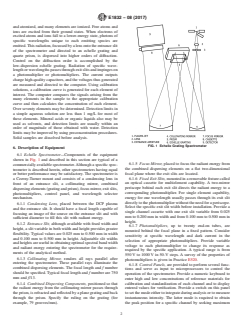
6.1 Echelle Spectrometer—Components of the equipment
shown in Fig. 1 and described in this section are typical of a
6.1.5 Focus Mirror, placed to focus the radiant energy from
commercially available spectrometer.Although a specific spec-
the combined dispersing elements on a flat two-dimensional
trometer is described herein, other spectrometers having equal
focal plane where the exit slits are located.
or better performance may be satisfactory. The spectrometer is
6.1.6 FixedExitSlits, mounted in a removable fixture called
a Czerny-Turner mount and consists of a condensing lens in
an optical cassette for multielement capability. A two-mirror
front of an entrance slit, a collimating mirror, combined
periscope behind each exit slit directs the radiant energy to a
dispersingelements(gratingandprism),focusmirror,exitslits,
corresponding photomultiplier. For single element capability,
photomultipliers, control panel, and wavelength selector
energy for one wavelength usually passes through its exit slit
mechanism.
directlytothephotomultiplierwithouttheneedforaperiscope.
6.1.1 Condensing Lens, placed between the DCP plasma
Select the specific exit slit width before installation. Provide a
and the entrance slit. It should have a focal length capable of
single channel cassette with one exit slit variable from 0.025
focusing an image of the source on the entrance slit and with
mm to 0.200 mm in width and from 0.100 mm to 0.500 mm in
sufficient diameter to fill this slit with radiant energy.
height.
6.1.2 Entrance Slit, although available with fixed width and
6.1.7 Photomultipliers, up to twenty end-on tubes, are
height, a slit variable in both width and height provides greater
mounted behind the focal plane in a fixed pattern. Consider
flexibility. Typical values are 0.025 mm to 0.500 mm in width
sensitivity at specific wavelength and dark current in the
and 0.100 mm to 0.500 mm in height. Adjustable slit widths
selection of appropriate photomultipliers. Provide variable
and heights are useful in obtaining optimal spectral band width
voltage to each photomultiplier to change its response as
and radiant energy entering the spectrometer for the require-
required by the specific application. A typical range is from
ments of the analytical method.
550 V to 1000 V in 50-V steps. A survey of the properties of
6.1.3 Collimating Mirror, renders all rays parallel after
photomultipliers is given in Practice E520.
entering the spectrometer. These parallel rays illuminate the
6.1.8 Control Panels, are provided to perform several func-
combined dispersing elements. The focal length and f number
tions and serve as input to microprocessors to control the
should be specified. Typical focal length and f number are 750
operation of the spectrometer. Provide a numeric keyboard to
mm and f/13.
enter high and low concentrations of reference materials for
6.1.4 Combined Dispersing Components, positioned so that calibration and standardization of each channel and to display
the radiant energy from the collimating mirror passes through
entered values for verification. Provide a switch on this panel
the prism, is refracted and reflected by a plane grating and back tosetthemodeeithertointegrateduringanalysisortomeasure
through the prism. Specify the ruling on the grating (for
instantaneous intensity. The latter mode is required to obtain
example, 79 grooves/mm). the peak position for a specific channel by seeking maximum
E1832 − 08 (2017)
intensity by wavelength adjustment and verifying by wave-
length scanning. Conduct interference and background inves-
tigations with this mode. Scanning is required if automatic
background correction is to be performed. Provide other
necessary switches for the following purposes: to calibrate or
standardize the spectrometer, start analysis, interrupt the func-
tion being performed, set integration time and the number of
replicate analyses, and direct the output to a printer, display, or
storage medium. Impose a fixed time delay of 10 s before
integration can begin to ensure that the solution being analyzed
is aspirated into the DCPdischarge. Provide digital and analog
voltmeters for displaying the instantaneous or integrated inten-
sities during peaking, scanning, or analysis. If a computer is an
integral part of the spectrometer, most of the control functions
are accomplished with software.
6.1.9 Wavelength Adjustment, provided to adjust the wave-
length range and diffraction order for peaking the spectrometer
because a two-dimensional spectrum is produced. Both coarse
and fine control of these adjustments are required. To maintain
optical alignment, the spectrometer should be thermally iso-
FIG. 2 DCP Source
lated from the DCP source or heated. A heated base on which
the spectrometer rests has been satisfactory for this purpose.
6.2.3.1 Providing argon gas delivered at a pressure of 80 psi
6.1.10 Dispersion and Spectral Band Pass—Typical disper-
(5.62 kg/cm ) to the discharge sustaining gas and sample
sion and spectral band pass with a 0.025-mm slit width vary
nebulization.
from 0.061 nm/mm and 0.0015 nm at 200 nm to 0.244 nm/mm
6.2.3.2 Providing a pneumatic system to extend the anode
and 0.0060 nm at 800 nm, respectively.
and cathode out of their sleeves and move the cathode block
6.2 DCPSource, composed of several distinct parts, namely
downwards so that the cathode electrode makes contact with
the electrode, direct current power supply, gas flow, sample
one of the anodes and initiates the plasma.
introduction, exhaust, water cooling, and safety systems. Refer
6.2.3.3 Providing gas pressures of 15 psi to 30 psi (1.05
2 2
to Practice E172 for a list of the electrical source parameters
kg/cm to 2.01 kg/cm ) for nebulization and 50 psi (3.52
that should be specified in a DCP method.
kg/cm ) for other functions. Needle valves are used to adjust
these pressures, as well as provide for division of gas flows
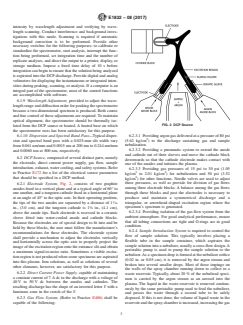
6.2.1 Electrode System, Fig. 2, consists of two graphite
anodes fixed in a vertical plane and at a typical angle of 60° to among three electrode blocks. A balance among the gas flows
through these blocks and past the electrodes is necessary to
one another, and a tungsten cathode fixed in a horizontal plane
produce and maintain a symmetrical discharge and a
at an angle of 45° to the optic axis. In their operating position,
triangular- or arrowhead-shaped excitation region where the
the tips of the two anodes are separated by a distance of 1 ⁄16
specimen’s spectrum is generated.
in., (3.0 cm), and the tungsten cathode is 1 ⁄8 in., (4.1 cm),
6.2.3.4 Providing isolation of the gas flow system from the
above the anode tips. Each electrode is recessed in a ceramic
ambient atmosphere. For good analytical performance, ensure
sleeve fitted into water-cooled anode and cathode blocks.
that all tubing connections are tight and O-rings are in good
Because the electrodes are of special design to fit into and be
condition.
held by these blocks, the user must follow the manufacturer’s
6.2.4 Sample Introduction System is required to control the
recommendations for these electrodes. The electrode system
flow of sample solution. This typically involves placing a
shall provide a mechanism to adjust the electrodes vertically
flexible tube in the sample container, which aspirates the
and horizontally across the optic axis to properly project the
sample solution into a nebulizer, usually a cross-flow design.A
image of the excitation region onto the entrance slit and obtain
peristaltic pump is used to pump the sample solution to the
a maximum signal-to-noise ratio. Sometimes a visible excita-
nebulizer.As a specimen drop is formed at the nebulizer orifice
tion region is not produced when some specimens are aspirated
(0.02 in. or 0.05 cm), it is removed by the argon stream and
into this plasma. Iron solutions, as well as solutions of several
broken into several smaller drops. Most of these impinge on
other elements, however, are satisfactory for this purpose.
the walls of the spray chamber running down to collect in a
6.2.2 Direct Current Power Supply, capable of maintaining
waste reservoir. Typically, about 20 % of the nebulized speci-
a constant current of 7 A dc in the discharge with a voltage of
men is carried by the argon stream as an aerosol into the
40 V to 50 V dc between the anodes and cathodes. The
plasma. The liquid in the waste reservoir is removed continu-
resulting discharge has the shape of an inverted letter Y with a
ously by the same peristaltic pump used to feed the nebulizer,
luminous zone in the crotch of the Y.
and passes the waste through a second tube to be safely
6.2.3 Gas Flow System, (Refer to Practice E406) shall be
disposed. If this is not done, the volume of liquid waste in the
capable of the following: reservoirandthespraychamberisincreased,increasingthegas
E1832 − 08 (2017)
pressure and volume of the specimen injected into the plasma, 7.2 Computer—Commercially available instruments may
thus ex
...