

ASTM G84-89(2020)
(Practice)Standard Practice for Measurement of Time-of-Wetness on Surfaces Exposed to Wetting Conditions as in Atmospheric Corrosion Testing
General Information
- Abstract
SIGNIFICANCE AND USE
3.1 This practice provides a methodology for measuring the duration of wetness on a sensing element mounted on a surface in a location of interest. Experience has shown that the sensing element reacts to factors that cause wetness in the same manner as the surface on which it is mounted.
3.2 Surface moisture plays a critical role in the corrosion of metals and the deterioration of nonmetallics. The deposition of moisture on a surface can be caused by atmospheric or climatic phenomena such as direct precipitation of rain or snow, condensation, the deliquescence (or at least the hygroscopic nature) of corrosion products or salt deposits on the surface, and others. A measure of atmospheric or climatic factors responsible for moisture deposition does not necessarily give an accurate indication of the TOW. For example, the surface temperature of an object may be above or below both the ambient and the dew point temperatures. As a result condensation will occur without an ambient meteorological indication that a surface has been subjected to a condensation cycle.
3.3 Structural design factors and orientation can be responsible for temperature differences and the consequent effect on TOW as discussed in 4.2. As a result, some surfaces may be shielded from rain or snow fall; drainage may be facilitated or prevented from given areas, and so forth. Therefore various components of a structure can be expected to perform differently depending on mass, orientation, air flow patterns, and so forth. A knowledge of TOW at different points on large structures can be useful in the interpretation of corrosion or other testing results.
3.4 In order to improve comparison of data obtained from test locations separated on a macrogeographical basis, a uniform orientation of sensor elements boldly exposed in the direction of the prevailing wind, at an angle of 30° above the horizontal is recommended. Elevation of the sensor above ground level should be recorded.
3.5 Although this...
SCOPE
1.1 This practice covers a technique for monitoring time-of-wetness (TOW) on surfaces exposed to cyclic atmospheric conditions which produce depositions of moisture.
1.2 The practice is also applicable for detecting and monitoring condensation within a wall or roof assembly and in test apparatus.
1.3 Exposure site calibration or characterization can be significantly enhanced if TOW is measured for comparison with other sites, particularly if this data is used in conjunction with other site-specific instrumentation techniques.
1.4 The values stated in SI units are to be regarded as standard. No other units of measurement are included in this standard.
1.5 This standard does not purport to address all of the safety concerns, if any, associated with its use. It is the responsibility of the user of this standard to establish appropriate safety, health, and environmental practices and determine the applicability of regulatory limitations prior to use.
1.6 This international standard was developed in accordance with internationally recognized principles on standardization established in the Decision on Principles for the Development of International Standards, Guides and Recommendations issued by the World Trade Organization Technical Barriers to Trade (TBT) Committee.
- Status
- Published
- Publication Date
- 14-Nov-2020
- Technical Committee
- G01 - Corrosion of Metals
Overview
ASTM G84-89(2020), Standard Practice for Measurement of Time-of-Wetness on Surfaces Exposed to Wetting Conditions as in Atmospheric Corrosion Testing, establishes a methodology for quantifying the duration of surface wetness under various atmospheric and climatic conditions. This standardized practice is essential for assessing the effects of moisture on material degradation, including metal corrosion and deterioration of nonmetallic materials. The measurement of time-of-wetness (TOW) is especially valuable in atmospheric corrosion testing, as it provides data directly related to one of the primary drivers of corrosion processes.
Key Topics
- Time-of-Wetness (TOW) Detection: The standard outlines the use and placement of moisture-sensing elements to measure how long a surface remains wet due to influences like precipitation, condensation, and hygroscopic effects of corrosion products or salts.
- Influence of Environmental Factors: Recognizes that TOW is affected by microclimate conditions such as temperature variances, precipitation, relative humidity, and local structural features (e.g., surface orientation, shielding, drainage).
- Sensor Orientation and Placement: Recommends uniform sensor orientation-exposing the element in the direction of prevailing winds at an angle of 30° above horizontal-and noting sensor elevation above ground to enable meaningful site-to-site comparisons.
- Site Calibration and Data Interpretation: Encourages the integration of TOW data with other site-specific instrumentation for comprehensive environmental characterization and improved comparative analysis between different test locations.
Applications
ASTM G84-89(2020) is a key reference for industries and researchers involved in:
- Atmospheric Corrosion Testing: Monitoring TOW informs the interpretation of corrosion rates and helps predict material performance under real environmental exposure.
- Structural and Material Maintenance: Facility managers and engineers use TOW data to identify locations within large structures that experience greater wetness, thereby targeting maintenance and protection measures more effectively.
- Building Envelope Research: TOW measurement is applicable in studying and managing condensation within wall or roof assemblies, helping prevent moisture-induced damage and improving building durability.
- Comparative Site Analysis: By standardizing TOW measurement across different geographical sites, organizations can better understand how local climates impact material longevity, supporting the development of localized protective strategies.
- Product Testing: Manufacturers of coatings, paints, and protective treatments rely on TOW data to validate product effectiveness against real-world moisture exposure.
Related Standards
Organizations implementing ASTM G84-89(2020) often reference other standards in their corrosion and environmental testing programs, including:
- ASTM G01 Standards: Covering the broader scope of corrosion of metals in natural atmospheric and aqueous environments.
- ASTM STP 767 and STP 435: Provide foundational research and supporting methodologies for atmospheric corrosion studies and TOW measurements.
- ISO Standards on Corrosion Testing: For international harmonization and comparison of corrosion test results.
- Building and Materials Codes: Refer to TOW measurement strategies in moisture management and building envelope requirements.
Practical Value
Adopting ASTM G84-89(2020) ensures consistent, scientifically validated measurement of surface wetness, crucial for:
- Enhancing the reliability of corrosion testing data
- Supporting maintenance and asset management decisions
- Improving the durability and lifecycle performance of structural and building materials
- Facilitating cross-site and international comparisons of environmental effects on materials
Keywords: time-of-wetness, atmospheric corrosion, surface moisture, TOW monitoring, ASTM G84, moisture sensing, corrosion testing, environmental exposure, building envelope, site calibration.
Get Certified
Connect with accredited certification bodies for this standard

BSMI (Bureau of Standards, Metrology and Inspection)
Taiwan's standards and inspection authority.
Sponsored listings
Frequently Asked Questions
ASTM G84-89(2020) is a standard published by ASTM International. Its full title is "Standard Practice for Measurement of Time-of-Wetness on Surfaces Exposed to Wetting Conditions as in Atmospheric Corrosion Testing". This standard covers: SIGNIFICANCE AND USE 3.1 This practice provides a methodology for measuring the duration of wetness on a sensing element mounted on a surface in a location of interest. Experience has shown that the sensing element reacts to factors that cause wetness in the same manner as the surface on which it is mounted. 3.2 Surface moisture plays a critical role in the corrosion of metals and the deterioration of nonmetallics. The deposition of moisture on a surface can be caused by atmospheric or climatic phenomena such as direct precipitation of rain or snow, condensation, the deliquescence (or at least the hygroscopic nature) of corrosion products or salt deposits on the surface, and others. A measure of atmospheric or climatic factors responsible for moisture deposition does not necessarily give an accurate indication of the TOW. For example, the surface temperature of an object may be above or below both the ambient and the dew point temperatures. As a result condensation will occur without an ambient meteorological indication that a surface has been subjected to a condensation cycle. 3.3 Structural design factors and orientation can be responsible for temperature differences and the consequent effect on TOW as discussed in 4.2. As a result, some surfaces may be shielded from rain or snow fall; drainage may be facilitated or prevented from given areas, and so forth. Therefore various components of a structure can be expected to perform differently depending on mass, orientation, air flow patterns, and so forth. A knowledge of TOW at different points on large structures can be useful in the interpretation of corrosion or other testing results. 3.4 In order to improve comparison of data obtained from test locations separated on a macrogeographical basis, a uniform orientation of sensor elements boldly exposed in the direction of the prevailing wind, at an angle of 30° above the horizontal is recommended. Elevation of the sensor above ground level should be recorded. 3.5 Although this... SCOPE 1.1 This practice covers a technique for monitoring time-of-wetness (TOW) on surfaces exposed to cyclic atmospheric conditions which produce depositions of moisture. 1.2 The practice is also applicable for detecting and monitoring condensation within a wall or roof assembly and in test apparatus. 1.3 Exposure site calibration or characterization can be significantly enhanced if TOW is measured for comparison with other sites, particularly if this data is used in conjunction with other site-specific instrumentation techniques. 1.4 The values stated in SI units are to be regarded as standard. No other units of measurement are included in this standard. 1.5 This standard does not purport to address all of the safety concerns, if any, associated with its use. It is the responsibility of the user of this standard to establish appropriate safety, health, and environmental practices and determine the applicability of regulatory limitations prior to use. 1.6 This international standard was developed in accordance with internationally recognized principles on standardization established in the Decision on Principles for the Development of International Standards, Guides and Recommendations issued by the World Trade Organization Technical Barriers to Trade (TBT) Committee.
SIGNIFICANCE AND USE 3.1 This practice provides a methodology for measuring the duration of wetness on a sensing element mounted on a surface in a location of interest. Experience has shown that the sensing element reacts to factors that cause wetness in the same manner as the surface on which it is mounted. 3.2 Surface moisture plays a critical role in the corrosion of metals and the deterioration of nonmetallics. The deposition of moisture on a surface can be caused by atmospheric or climatic phenomena such as direct precipitation of rain or snow, condensation, the deliquescence (or at least the hygroscopic nature) of corrosion products or salt deposits on the surface, and others. A measure of atmospheric or climatic factors responsible for moisture deposition does not necessarily give an accurate indication of the TOW. For example, the surface temperature of an object may be above or below both the ambient and the dew point temperatures. As a result condensation will occur without an ambient meteorological indication that a surface has been subjected to a condensation cycle. 3.3 Structural design factors and orientation can be responsible for temperature differences and the consequent effect on TOW as discussed in 4.2. As a result, some surfaces may be shielded from rain or snow fall; drainage may be facilitated or prevented from given areas, and so forth. Therefore various components of a structure can be expected to perform differently depending on mass, orientation, air flow patterns, and so forth. A knowledge of TOW at different points on large structures can be useful in the interpretation of corrosion or other testing results. 3.4 In order to improve comparison of data obtained from test locations separated on a macrogeographical basis, a uniform orientation of sensor elements boldly exposed in the direction of the prevailing wind, at an angle of 30° above the horizontal is recommended. Elevation of the sensor above ground level should be recorded. 3.5 Although this... SCOPE 1.1 This practice covers a technique for monitoring time-of-wetness (TOW) on surfaces exposed to cyclic atmospheric conditions which produce depositions of moisture. 1.2 The practice is also applicable for detecting and monitoring condensation within a wall or roof assembly and in test apparatus. 1.3 Exposure site calibration or characterization can be significantly enhanced if TOW is measured for comparison with other sites, particularly if this data is used in conjunction with other site-specific instrumentation techniques. 1.4 The values stated in SI units are to be regarded as standard. No other units of measurement are included in this standard. 1.5 This standard does not purport to address all of the safety concerns, if any, associated with its use. It is the responsibility of the user of this standard to establish appropriate safety, health, and environmental practices and determine the applicability of regulatory limitations prior to use. 1.6 This international standard was developed in accordance with internationally recognized principles on standardization established in the Decision on Principles for the Development of International Standards, Guides and Recommendations issued by the World Trade Organization Technical Barriers to Trade (TBT) Committee.
ASTM G84-89(2020) is classified under the following ICS (International Classification for Standards) categories: 17.040.20 - Properties of surfaces. The ICS classification helps identify the subject area and facilitates finding related standards.
ASTM G84-89(2020) is available in PDF format for immediate download after purchase. The document can be added to your cart and obtained through the secure checkout process. Digital delivery ensures instant access to the complete standard document.
Standards Content (Sample)
This international standard was developed in accordance with internationally recognized principles on standardization established in the Decision on Principles for the
Development of International Standards, Guides and Recommendations issued by the World Trade Organization Technical Barriers to Trade (TBT) Committee.
Designation: G84 − 89 (Reapproved 2020)
Standard Practice for
Measurement of Time-of-Wetness on Surfaces Exposed to
Wetting Conditions as in Atmospheric Corrosion Testing
ThisstandardisissuedunderthefixeddesignationG84;thenumberimmediatelyfollowingthedesignationindicatestheyearoforiginal
adoptionor,inthecaseofrevision,theyearoflastrevision.Anumberinparenthesesindicatestheyearoflastreapproval.Asuperscript
epsilon (´) indicates an editorial change since the last revision or reapproval.
1. Scope zinc is used as an electrode material, the effects of the
hygroscopic nature of the corrosion products on the perfor-
1.1 This practice covers a technique for monitoring time-
mance of the sensor should be kept in mind. Also, the use of
of-wetness (TOW) on surfaces exposed to cyclic atmospheric
copper as a sensor material should be avoided in sulfur
conditions which produce depositions of moisture.
dioxide-laden atmospheres to avoid premature deterioration of
1.2 The practice is also applicable for detecting and moni-
the sensor’s copper substrate. The output (potential) from this
toring condensation within a wall or roof assembly and in test
cellisfedthroughasignalconditioningcircuittoanindicating
apparatus.
or recording device. The objective is to record the time that
1.3 Exposure site calibration or characterization can be moisture is present on the sensing element during any given
period. The fact that a potential is generated is critical to this
significantly enhanced if TOW is measured for comparison
with other sites, particularly if this data is used in conjunction technique.Aspertainstothispractice,theabsolutevalueofthe
potential generated is essentially of academic interest.
with other site-specific instrumentation techniques.
1.4 The values stated in SI units are to be regarded as
2.2 This practice describes the moisture-sensing element,
standard. No other units of measurement are included in this
procedures for conditioning the elements to develop stable
standard.
films on the electrodes and verifying the sensing-element
function, and use of the element to record TOW.
1.5 This standard does not purport to address all of the
safety concerns, if any, associated with its use. It is the
3. Significance and Use
responsibility of the user of this standard to establish appro-
priate safety, health, and environmental practices and deter-
3.1 This practice provides a methodology for measuring the
mine the applicability of regulatory limitations prior to use.
durationofwetnessonasensingelementmountedonasurface
1.6 This international standard was developed in accor-
inalocationofinterest.Experiencehasshownthatthesensing
dance with internationally recognized principles on standard-
elementreactstofactorsthatcausewetnessinthesamemanner
ization established in the Decision on Principles for the
as the surface on which it is mounted.
Development of International Standards, Guides and Recom-
3.2 Surface moisture plays a critical role in the corrosion of
mendations issued by the World Trade Organization Technical
metals and the deterioration of nonmetallics.The deposition of
Barriers to Trade (TBT) Committee.
moistureonasurfacecanbecausedbyatmosphericorclimatic
phenomena such as direct precipitation of rain or snow,
2. Summary of Practice
condensation, the deliquescence (or at least the hygroscopic
2.1 This practice describes a technique for detecting and
nature) of corrosion products or salt deposits on the surface,
recording surface moisture conditions. The moisture serves as
and others. A measure of atmospheric or climatic factors
an electrolyte to generate a potential in a moisture sensing
responsible for moisture deposition does not necessarily give
element galvanic cell that consists of alternate electrodes of
an accurate indication of the TOW. For example, the surface
copper and gold, silver and platinum, or zinc and gold. The
temperature of an object may be above or below both the
spacing of the electrodes may be 100 to 200 µm, the width
ambient and the dew point temperatures. As a result conden-
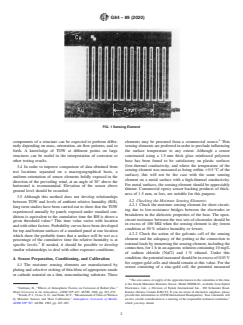
dimension is not considered critical (Fig. 1). However, when
sationwilloccurwithoutanambientmeteorologicalindication
that a surface has been subjected to a condensation cycle.
3.3 Structural design factors and orientation can be respon-
This practice is under the jurisdiction ofASTM Committee G01 on Corrosion
of Metals and is the direct responsibility of Subcommittee G01.04 on Corrosion of
sible for temperature differences and the consequent effect on
Metals in Natural Atmospheric and Aqueous Environments.
TOW as discussed in 4.2. As a result, some surfaces may be
Current edition approved Nov. 15, 2020. Published November 2020. Originally
shielded from rain or snow fall; drainage may be facilitated or
approved in 1981. Last previous edition approved in 2012 as G84–89(2012). DOI:
10.1520/G0084-89R20. prevented from given areas, and so forth. Therefore various
Copyright © ASTM International, 100 Barr Harbor Drive, PO Box C700, West Conshohocken, PA 19428-2959. United States
G84 − 89 (2020)
FIG. 1 Sensing Element
components of a structure can be expected to perform differ- elements may be procured from a commercial source. Thin
ently depending on mass, orientation, air flow patterns, and so sensing elements are preferred in order to preclude influencing
forth. A knowledge of TOW at different points on large the surface temperature to any extent. Although a sensor
structures can be useful in the interpretation of corrosion or constructed using a 1.5mm thick glass reinforced polyester
other testing results. base has been found to be satisfactory on plastic surfaces
(low-thermal conductivity, and where the temperature of the
3.4 In order to improve comparison of data obtained from
sensing element was measured as being within 60.5°C of the
test locations separated on a macrogeographical basis, a
surface), this will not be the case with the same sensing
uniform orientation of sensor elements boldly exposed in the
element on a metal surface with a high-thermal conductivity.
direction of the prevailing wind, at an angle of 30° above the
For metal surfaces, the sensing element should be appreciably
horizontal is recommended. Elevation of the sensor above
thinner. Commercial epoxy sensor backing products of thick-
ground level should be recorded.
ness of 1.5 mm, or less, are suitable for this purpose.
3.5 Although this method does not develop relationships
4.2 Checking the Moisture Sensing Elements:
between TOW and levels of ambient relative humidity (RH),
4.2.1 Check the moisture sensing element for short circuit-
long term studies have been carried out to show that the TOW
ing due to low-resistance bridges between the electrodes or
experienced annually by panels exposed under standard con-
breakdown in the dielectric properties of the base. The open-
ditions is equivalent to the cumulative time the RH is above a
2 circuit resistance between the two sets of electrodes should be
given threshold value. This time value varies with location
in excess of 100 MΩ when the sensing element is dry (room
andwithotherfactors.Probabilitycurveshavebeendeveloped
condition at 50% relative humidity or lower).
for top and bottom surfaces of a standard panel at one location
4.2.2 Check the action of the galvanic cell of the sensing
which show the probable times that a surface will be wet as a
element and the adequacy of the potting at the connection to
percentage of the cumulative time the relative humidity is at
externalleadsbyimmersingthesensingelement,includingthe
specific levels. If needed, it should be possible to develop
connection, for1hinan aqueous solution containing 10 mg/L
similar relationships to deal with other exposure conditions.
of sodium chloride (NaCl) and 1% ethanol. Under this
condition,thepotentialmeasuredshouldbeinexcessof0.03V
4. Sensor Preparation, Conditioning, and Calibration
for copper-gold cells and should remain at this value. For the
4.1 The moisture sensing elements are manufactured by
sensor consisting of a zinc-gold cell, the potential measured
plating and selective etching of thin films of appropriate anode
or cathode material on a thin, nonconducting substrate. These
The sole source of supply of the apparatus known to the committee at this time
is the Sereda Miniature Moisture Sensor, Model SMMS-01, available from Epitek
Guttman, H., “Effects of Atmospheric Factors on Corrosion of Rolled Zinc,” Electronics, Ltd., a Division of Epitek International Inc., 100 Schneider Road,
Metal Corrosion in the Atmosphere, ASTM STP 435. ASTM, 1968, pp. 223–239. Kanata, Ontario, Canada K2K1Y2. If you are aware of alternative suppliers, please
Sereda, P. J., Cross, S. G., and Slade, H. F., “Measurement ofTime-of-Wetness provide this information toASTM International Headquarters.Your comments will
by Moisture Sensors and Their Calibration,” Atmospheric Corrosion of Metals, receive careful consideration at a meeting of the responsible technical committee,
ASTM STP 767, ASTM, 1982, pp. 267–285. which you may attend.
G84 − 89 (2020)
under this test should be in excess of 0.4 V. After immersion,
rinse the sensor in distilled water and allow to dry.
4.3 Conditioning of the Sensing Element:
4.3.1 Activatesensorsbyspreading1dropofNaClsolution
(10mg/LofNaClcontainingawettingagentof1%ethanolor
0.1% polyoxyethylene isooctylphenol) on the electrode grid.
4.3.2 Expose the activated sensor at 100% relative humid-
ity (in a desiccator over water) for a week. The resulting
corrosion product film makes the activation more permanent.
After being verified (see 4.4), store the sensor in a desiccator
until ready for use.
4.3.2.1 Warning—The atmosphere in many laboratories
can have contaminants that can affect the operation of the
sensors (that is, HCl and SO fumes, contact with fingers,
organic nonwetting agents, and so forth). Since contamination
effects have been observed, handle the sensors with care.
4.3.3 Fig. 2 and Fig. 3 illustrate a design of a simple
conditioning chamber in which the sensing element can be
exposed to 100% relative humidity. To attain the desired
conditions, mount the apparatus in a thermally insulated box
located in a constant temperature room. It is desirable that the
temperature of the humidity source in the chamber be con-
trolled to 60.2°C.
4.4 Verification of Sensing Element Functioning:
4.4.1 At 100% RH, the copper-gold sensors should gener-
ate a potential in excess of 0.01 V and a potential in excess of
0.1 V for zinc-gold sensors. (The potential is essentially the
voltage drop across a 10 MΩ resistance with the load and
recorder having an input impedance in excess of 1000 MΩ.)
The potential measured will decrease with time of measure-
ment because of the depletion of available ions in the electro-
lyte. Leave the sensor cells in an open circuit while they are
being verified. This step can take as little as1hifthe
temperatures are constant.
5. Field Installation and Maintenance of Sensor
5.1 Mount the sensing element in intimate contact with the
surface to be monitored using suitable adhesive or a double-
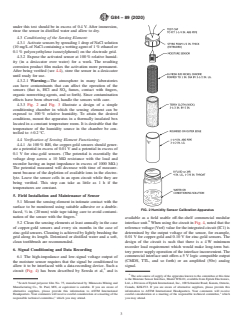
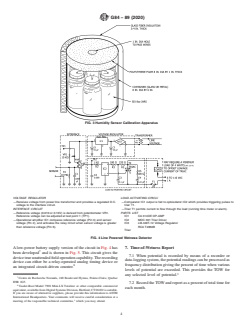
FIG. 2 Humidity Sensor Calibration Apparatus
faced, ⁄4in. (20mm) wide tape taking care to avoid contami-
nation of the sensor with the fingers.
available as a field usable off-the-shelf commercial modular
5.2 Clean the sensing elements at least annually in the case interface unit. When using the circuit in Fig. 4, noted that the
of copper-gold sensors and every six months in the case of referencevoltage(Vref)valuefortheintegratedcircuit(IC1)is
zinc-goldsensors.Cleaningisachievedbylightlybrushingthe determined by the output voltage of the sensor, for example,
grid along its length. Deionized or distilled water and a soft, 0.01
...