

ASTM D5630-22
(Test Method)Standard Test Method for Ash Content in Plastics
General Information
- Abstract
SIGNIFICANCE AND USE
5.1 Inorganic residues from plastics ashing may be antiblock, fillers, reinforcements, catalyst residues, colorants, etc. The quantitative amounts of each are important variables of the manufacturing process.
SCOPE
1.1 This test method was developed to determine the inorganic content of plastics by destructive ashing procedures. Ash levels of 0.01 % or above are covered by this test method.
1.2 These ashing procedures are used only to quantify the residual solids in the polymer and can not be used to identify the individual chemical components of the ash, qualitatively.
1.3 This test method is limited to those materials (including glass) that are stable to 900°C. Test Method D2584 is recommended for unknown samples, and in instances where fusion of the inorganic portions may be of concern.
1.4 Fluorinated polymers and polymers containing halogenated components have not been included in these procedures.
1.5 Two procedures for determining the inorganic residue in plastics are listed as follows:
1.5.1 Procedure A, Muffle-Furnace Technique— For 5 – 50 gram samples. Samples are flamed over a burner prior to being ashed in a muffle furnace.
1.5.2 Procedure B, Rapid-Ash Muffle-Furnace Technique— For 2–10 gram samples. Samples are ignited and ashed in a muffle furnace.
Note 1: For more efficient ashing, the plastic sample should be in the form of powder or pellet.
Note 2: This test method provides consistent results of filler content for a specific filler in a specific resin. However, this method may not provide the absolute filler content in all cases. This includes polymers filled with CaCO3, nano clays, and Carbon Black.
Note 3: Procedure B is equivalent to ISO 3451/1-(E), Method A.
1.6 The values stated in SI units are to be regarded as the standard.
1.7 This standard does not purport to address all of the safety concerns, if any, associated with its use. It is the responsibility of the user of this standard to establish appropriate safety, health, and environmental practices and determine the applicability of regulatory limitations prior to use. See Section 9 for specific precautionary statements.
1.8 This international standard was developed in accordance with internationally recognized principles on standardization established in the Decision on Principles for the Development of International Standards, Guides and Recommendations issued by the World Trade Organization Technical Barriers to Trade (TBT) Committee.
- Status
- Published
- Publication Date
- 31-Oct-2022
- Technical Committee
- D20 - Plastics
- Drafting Committee
- D20.70 - Analytical Methods
Overview
ASTM D5630-22: Standard Test Method for Ash Content in Plastics establishes procedures to determine the inorganic content (ash) present in plastic materials by means of destructive ashing methods. Developed by ASTM International, this test method is essential for accurately quantifying residues such as fillers, reinforcements, antiblock agents, catalyst residues, and colorants in polymers. Ash levels as low as 0.01% can be effectively measured, offering valuable insights for plastics manufacturing, processing, and quality control.
Key Topics
Scope of Application:
- Specifically designed for polymers and composites stable up to 900°C
- Not suitable for fluorinated or halogenated polymers
- Limited to materials where fusion of inorganic portions is not a concern
Procedures for Ash Determination:
- Procedure A: Muffle-Furnace Technique
- Used for 5 – 50 gram samples
- Involves direct combustion of samples after pre-flaming
- Procedure B: Rapid-Ash Muffle-Furnace Technique
- Used for 2 – 10 gram samples
- Samples are ignited and ashed in the furnace
- Equivalent to ISO 3451/1-(E), Method A
- Procedure A: Muffle-Furnace Technique
Results and Limitations:
- Accurately quantifies residual solids but does not identify specific inorganic constituents
- Provides reliable results for a given filler in a specific resin, but not always for absolute filler content across all polymer systems (e.g. CaCO₃, nano clays, Carbon Black)
Safety and Precautions:
- Users must establish appropriate safety, health, and environmental practices
- Laboratory procedures involve high-temperature furnaces and open flames, requiring personal protective equipment and proper ventilation
Applications
Quality Control in Plastics Manufacturing:
ASTM D5630-22 is commonly employed to monitor and control the levels of inorganic additives during production. Ash content directly affects material properties such as strength, color, and stability.Research and Development:
Laboratories and R&D teams use this standard test method to characterize new polymer compounds and formulations, ensuring consistency and performance across batches.Certification and Regulatory Compliance:
Ash content measurement is often necessary to verify material composition for regulatory or customer requirements, especially where specific filler levels are mandated.Material Identification and Verification:
Though not suitable for detailed chemical identification of inorganics, this method provides a rapid quantitative check on overall residue content in resins, sheets, films, molded articles, and reinforced composites.
Related Standards
ASTM D2584 - Test Method for Ignition Loss of Cured Reinforced Resins:
Recommended for unknown materials or where inorganic fusion may be a concern.ISO 3451/1-(E) Plastics-Determination of Ash-Part 1:
Method A in ASTM D5630-22 is equivalent to this widely recognized international standard.ASTM D883 - Terminology Relating to Plastics:
Provides referenced definitions for plastics terminology used within D5630-22.ASTM D1600 - Terminology for Abbreviated Terms Relating to Plastics:
Supports the standard with consistent use of abbreviated terms.
Practical Value
By following ASTM D5630-22, organizations ensure consistent, reproducible evaluation of ash content in plastics-an essential factor for the development, quality assurance, and regulatory compliance in the plastics industry. Its robust, standardized approach makes it a critical tool for laboratories and manufacturers worldwide seeking precise control over inorganic constituents in polymers. Incorporating this test method facilitates improved product integrity and material performance across a diverse range of plastic applications.
Relations
- Effective Date
- 01-Feb-2024
- Effective Date
- 01-Nov-2023
- Effective Date
- 01-Jan-2020
- Effective Date
- 01-Aug-2019
- Effective Date
- 15-Apr-2019
- Effective Date
- 01-Feb-2019
- Effective Date
- 01-Dec-2018
- Effective Date
- 01-Nov-2018
- Effective Date
- 15-Sep-2018
- Refers
ASTM D1600-18 - Standard Terminology for Abbreviated Terms Relating to Plastics (Withdrawn 2024) - Effective Date
- 01-Jan-2018
- Effective Date
- 15-Aug-2017
- Effective Date
- 01-Feb-2014
- Effective Date
- 01-May-2013
- Effective Date
- 15-Apr-2013
- Effective Date
- 15-Nov-2012
Get Certified
Connect with accredited certification bodies for this standard

DIN CERTCO
DIN Group product certification.

Smithers Quality Assessments
US management systems and product certification.
Sponsored listings
Frequently Asked Questions
ASTM D5630-22 is a standard published by ASTM International. Its full title is "Standard Test Method for Ash Content in Plastics". This standard covers: SIGNIFICANCE AND USE 5.1 Inorganic residues from plastics ashing may be antiblock, fillers, reinforcements, catalyst residues, colorants, etc. The quantitative amounts of each are important variables of the manufacturing process. SCOPE 1.1 This test method was developed to determine the inorganic content of plastics by destructive ashing procedures. Ash levels of 0.01 % or above are covered by this test method. 1.2 These ashing procedures are used only to quantify the residual solids in the polymer and can not be used to identify the individual chemical components of the ash, qualitatively. 1.3 This test method is limited to those materials (including glass) that are stable to 900°C. Test Method D2584 is recommended for unknown samples, and in instances where fusion of the inorganic portions may be of concern. 1.4 Fluorinated polymers and polymers containing halogenated components have not been included in these procedures. 1.5 Two procedures for determining the inorganic residue in plastics are listed as follows: 1.5.1 Procedure A, Muffle-Furnace Technique— For 5 – 50 gram samples. Samples are flamed over a burner prior to being ashed in a muffle furnace. 1.5.2 Procedure B, Rapid-Ash Muffle-Furnace Technique— For 2–10 gram samples. Samples are ignited and ashed in a muffle furnace. Note 1: For more efficient ashing, the plastic sample should be in the form of powder or pellet. Note 2: This test method provides consistent results of filler content for a specific filler in a specific resin. However, this method may not provide the absolute filler content in all cases. This includes polymers filled with CaCO3, nano clays, and Carbon Black. Note 3: Procedure B is equivalent to ISO 3451/1-(E), Method A. 1.6 The values stated in SI units are to be regarded as the standard. 1.7 This standard does not purport to address all of the safety concerns, if any, associated with its use. It is the responsibility of the user of this standard to establish appropriate safety, health, and environmental practices and determine the applicability of regulatory limitations prior to use. See Section 9 for specific precautionary statements. 1.8 This international standard was developed in accordance with internationally recognized principles on standardization established in the Decision on Principles for the Development of International Standards, Guides and Recommendations issued by the World Trade Organization Technical Barriers to Trade (TBT) Committee.
SIGNIFICANCE AND USE 5.1 Inorganic residues from plastics ashing may be antiblock, fillers, reinforcements, catalyst residues, colorants, etc. The quantitative amounts of each are important variables of the manufacturing process. SCOPE 1.1 This test method was developed to determine the inorganic content of plastics by destructive ashing procedures. Ash levels of 0.01 % or above are covered by this test method. 1.2 These ashing procedures are used only to quantify the residual solids in the polymer and can not be used to identify the individual chemical components of the ash, qualitatively. 1.3 This test method is limited to those materials (including glass) that are stable to 900°C. Test Method D2584 is recommended for unknown samples, and in instances where fusion of the inorganic portions may be of concern. 1.4 Fluorinated polymers and polymers containing halogenated components have not been included in these procedures. 1.5 Two procedures for determining the inorganic residue in plastics are listed as follows: 1.5.1 Procedure A, Muffle-Furnace Technique— For 5 – 50 gram samples. Samples are flamed over a burner prior to being ashed in a muffle furnace. 1.5.2 Procedure B, Rapid-Ash Muffle-Furnace Technique— For 2–10 gram samples. Samples are ignited and ashed in a muffle furnace. Note 1: For more efficient ashing, the plastic sample should be in the form of powder or pellet. Note 2: This test method provides consistent results of filler content for a specific filler in a specific resin. However, this method may not provide the absolute filler content in all cases. This includes polymers filled with CaCO3, nano clays, and Carbon Black. Note 3: Procedure B is equivalent to ISO 3451/1-(E), Method A. 1.6 The values stated in SI units are to be regarded as the standard. 1.7 This standard does not purport to address all of the safety concerns, if any, associated with its use. It is the responsibility of the user of this standard to establish appropriate safety, health, and environmental practices and determine the applicability of regulatory limitations prior to use. See Section 9 for specific precautionary statements. 1.8 This international standard was developed in accordance with internationally recognized principles on standardization established in the Decision on Principles for the Development of International Standards, Guides and Recommendations issued by the World Trade Organization Technical Barriers to Trade (TBT) Committee.
ASTM D5630-22 is classified under the following ICS (International Classification for Standards) categories: 83.080.20 - Thermoplastic materials. The ICS classification helps identify the subject area and facilitates finding related standards.
ASTM D5630-22 has the following relationships with other standards: It is inter standard links to ASTM D883-24, ASTM D883-23, ASTM D883-20, ASTM D883-19c, ASTM D883-19a, ASTM D883-19, ASTM D883-18a, ASTM D883-18, ASTM D2584-18, ASTM D1600-18, ASTM D883-17, ASTM D1600-14, ASTM E691-13, ASTM D1600-13, ASTM D883-12e1. Understanding these relationships helps ensure you are using the most current and applicable version of the standard.
ASTM D5630-22 is available in PDF format for immediate download after purchase. The document can be added to your cart and obtained through the secure checkout process. Digital delivery ensures instant access to the complete standard document.
Standards Content (Sample)
This international standard was developed in accordance with internationally recognized principles on standardization established in the Decision on Principles for the
Development of International Standards, Guides and Recommendations issued by the World Trade Organization Technical Barriers to Trade (TBT) Committee.
Designation: D5630 − 22
Standard Test Method for
Ash Content in Plastics
This standard is issued under the fixed designation D5630; the number immediately following the designation indicates the year of
original adoption or, in the case of revision, the year of last revision. A number in parentheses indicates the year of last reapproval. A
superscript epsilon (´) indicates an editorial change since the last revision or reapproval.
1. Scope 1.8 This international standard was developed in accor-
dance with internationally recognized principles on standard-
1.1 This test method was developed to determine the inor-
ization established in the Decision on Principles for the
ganic content of plastics by destructive ashing procedures.Ash
Development of International Standards, Guides and Recom-
levels of 0.01 % or above are covered by this test method.
mendations issued by the World Trade Organization Technical
1.2 These ashing procedures are used only to quantify the
Barriers to Trade (TBT) Committee.
residual solids in the polymer and can not be used to identify
the individual chemical components of the ash, qualitatively. 2. Referenced Documents
1.3 This test method is limited to those materials (including 2.1 ASTM Standards:
glass) that are stable to 900°C. Test Method D2584 is recom- D883 Terminology Relating to Plastics
mendedforunknownsamples,andininstanceswherefusionof D1600 Terminology forAbbreviatedTerms Relating to Plas-
the inorganic portions may be of concern. tics
D2584 Test Method for Ignition Loss of Cured Reinforced
1.4 Fluorinated polymers and polymers containing haloge-
Resins
nated components have not been included in these procedures.
E691 Practice for Conducting an Interlaboratory Study to
1.5 Two procedures for determining the inorganic residue in
Determine the Precision of a Test Method
plastics are listed as follows:
2.2 ISO Standard:
1.5.1 Procedure A, Muffle-Furnace Technique—For5–50
ISO 3451/1-(E) Plastics—Determination of Ash—Part 1:
gram samples. Samples are flamed over a burner prior to being
General Methods, Method A—Direct Calcination
ashed in a muffle furnace.
3. Terminology
1.5.2 Procedure B, Rapid-Ash Muffle-Furnace Technique—
For 2–10 gram samples. Samples are ignited and ashed in a
3.1 Definitions—For definitions of plastics terms, see Ter-
muffle furnace.
minologies D883 and D1600. There are no terms in this test
method that require new or other than dictionary definitions.
NOTE 1—For more efficient ashing, the plastic sample should be in the
form of powder or pellet.
4. Summary of Test Method
NOTE 2—This test method provides consistent results of filler content
for a specific filler in a specific resin. However, this method may not
4.1 This test method is based on a loss in weight of a plastic
provide the absolute filler content in all cases. This includes polymers
sample when combusted to oxidize all organic matter.
filled with CaCO , nano clays, and Carbon Black.
NOTE 3—Procedure B is equivalent to ISO 3451/1-(E), Method A.
5. Significance and Use
1.6 The values stated in SI units are to be regarded as the
5.1 Inorganic residues from plastics ashing may be
standard.
antiblock, fillers, reinforcements, catalyst residues, colorants,
1.7 This standard does not purport to address all of the
etc. The quantitative amounts of each are important variables
safety concerns, if any, associated with its use. It is the
of the manufacturing process.
responsibility of the user of this standard to establish appro-
priate safety, health, and environmental practices and deter-
6. Interferences
mine the applicability of regulatory limitations prior to use.
6.1 A flame height of over 2.5 cm from the burner is likely
See Section 9 for specific precautionary statements.
to cause a loss of fine particles.
1 2
This test method is under the jurisdiction ofASTM Committee D20 on Plastics For referenced ASTM standards, visit the ASTM website, www.astm.org, or
and is the direct responsibility of Subcommittee D20.70 on Analytical Methods. contact ASTM Customer Service at service@astm.org. For Annual Book of ASTM
Current edition approved Nov. 1, 2022. Published November 2022. Originally Standards volume information, refer to the standard’s Document Summary page on
approvedin1994.Lastpreviouseditionapprovedin2013asD5630 - 13,whichwas the ASTM website.
withdrawn January 2022 and reinstated in November 2022. DOI: 10.1520/D5630- Available fromAmerican National Standards Institute (ANSI), 25 W. 43rd St.,
22. 4th Floor, New York, NY 10036, http://www.ansi.org.
Copyright © ASTM International, 100 Barr Harbor Drive, PO Box C700, West Conshohocken, PA 19428-2959. United States
D5630 − 22
flow with a wet test meter or bubblemeter to yield a flow rate
of approximately 30 L/min.
7.5 Burner.
7.6 Desiccator.
8. Reagents and Materials
8.1 Desiccant—Materials suitable for use in the desiccator
may be chosen from the following:
8.1.1 Anhydrous Calcium Sulfate.
8.1.2 Silica Gel.
9. Safety Precautions
9.1 Always wear safety glasses when working in the labo-
ratory.
9.2 Exercise all normal safety precautions when working
with open flames and high temperatures. Use insulated gloves
and long crucible tongs when transferring crucibles.
9.3 Always work with an appropriately vented muffle fur-
nace or under a fume hood when ashing. Irritant fumes are
given off by the polymer during ashing.
10. Sampling, Test Specimens, and Test Units
10.1 For hygroscopic materials such as nylons, etc., dry
sample specimens to constant weight before testing.
11. Preparation and Apparatus
FIG. 1 Cooling Assembly
11.1 Crucible Preparation—Cleantheporcelainorplatinum
crucibles with tap water and an abrasive detergent. Ensure that
6.2 Largesamplesizes(Note5)couldresultintheevolution
anybaked-inresidueisremovedfromthecruciblescompletely.
of pyrolysis products that could affect the ash recovery.
Quartz-fiber crucibles are disposable items and do not require
6.3 Furnace doors must be in the closed position during the
cleaning.
ignition period to prevent too-rapid oxidation and combustion
11.2 Fire (condition) the clean crucibles in a muffle furnace
of the sample (Note 7).
at the set operating temperature for 5 min to burn off any
6.4 Ensure that all crucibles are cooled to ambient tempera-
residue in the crucibles.
ture before weighing.
11.3 After firing (conditioning) the crucibles, place them in
a desiccator to cool for 20 to 30 min (porcelain or platinum
7. Apparatus
crucibles) or 2 min (quartz-fiber crucibles). Handle the cru-
7.1 Balance—A balance having the capability to weigh the
cibles with tongs only.
sample to the nearest 0.0001 g. The balance shall be checked
periodically to ensure accuracy.
12. Calibration and Standardization
7.2 Crucibles—Porcelain, platinum, or quartz-fiber, of suf-
12.1 Calibrate the analytical balances in accordance with
ficient size and inert to the material being tested. The quartz-
the manufacturer’s procedure.
fiber crucible is only used in Procedure B.
7.3 Muffle Furnace—Electric-resistance-heated or 13. Procedure A—Muffle Furnace Technique
microwave-heated furnace, capable of maintaining a tempera-
13.1 Sample Type—Determine the type of polymer and
ture of 900 6 25°C.
anticipated amount of inorganics in the polymer to be ashed.
Determine the ashing temperature, ashing time, and sample
NOTE 4—If an electric muffle furnace is used, it should be positioned in
a well-ventilated hood. If a microwave furnace is used, it should be
size required to perform the ash analysis in accordance with
positioned within or adjacent to the hood and the exhaust tube vented into
Table A1.1.
the hood or to the atmosphere through duct work to prevent breathing of
13.2 Preashing Procedure—Weigh a clean, dry porcelain or
the byproducts of the combustion. A microwave furnace capable of
providing an air flow of 2.8 m /min to be moved through the microwave
platinum crucible to the nearest 0.0001 g. Record the resulting
cavity is recommended.
value as W .
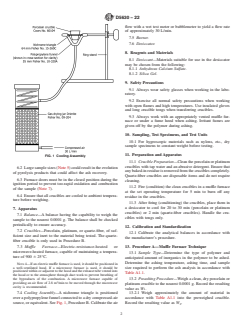
7.4 Cooling Assembly—A nichrome triangle is positioned 13.2.1 Weigh approximately the amount of material in
over a polypropylene funnel connected to a dry compressed-air accordance with Table A1.1 into the preweighed crucible.
source, or equivalent. See Fig. 1, Procedure B. Calibrate the air Record the resulting value as W .
D5630 − 22
13.2.2 Place the crucible on a burner. (The diameter of the 14.4 After the prescribed duration in the muffle furnace (as
flame equals approximately 2.5 cm, and the height of the flame specifiedinTableA1.2),carefullyremovethecruciblefromthe
equals just enough to touch the wire gauze holding the muffle furnace and place it in a dessicator until cool.
crucible.) Ensure that the material does not overflow the
NOTE 8—The residual ash should be free of any carbonaceous matter
crucible.Whentheflashpointofthepolymerisattained(which
aftertheignitionperiod.Duetovariationsinfurnacedesignandgeometry,
is approximately 600°C for most plastics), the polymer begins
however,minorvariationsinigni
...