

ASTM C949-80(2020)
(Test Method)Standard Test Method for Porosity in Vitreous Whitewares by Dye Penetration
General Information
- Abstract
SIGNIFICANCE AND USE
5.1 This test method provides a means for readily determining if a ceramic is properly fired (matured). Penetration of any extent may negate the usefulness of the ceramic, or, arbitrarily, some degree of penetration may be acceptable for the use or commercial quality of the item being tested.
SCOPE
1.1 This test method covers procedures for detecting pores, cracks, or other voids that may be present in otherwise impermeable whiteware ceramics, or as porosity in underfired ware.
Note 1: This test method was partially derived from ANSI C29.1.
1.2 This standard does not purport to address all of the safety concerns, if any, associated with its use. It is the responsibility of the user of this standard to establish appropriate safety, health, and environmental practices and determine the applicability of regulatory limitations prior to use.
1.3 This international standard was developed in accordance with internationally recognized principles on standardization established in the Decision on Principles for the Development of International Standards, Guides and Recommendations issued by the World Trade Organization Technical Barriers to Trade (TBT) Committee.
- Status
- Published
- Publication Date
- 31-Oct-2020
- Technical Committee
- C21 - Ceramic Whitewares and Related Products
- Drafting Committee
- C21.03 - Methods for Whitewares and Environmental Concerns

Overview
ASTM C949-80(2020), titled Standard Test Method for Porosity in Vitreous Whitewares by Dye Penetration, provides an established procedure for detecting pores, cracks, and voids in vitreous whiteware ceramics. Developed by ASTM International, this standard offers a reliable method to assess whether ceramic materials are properly fired (matured), a property crucial to their structural integrity and suitability for intended applications. The dye penetration method is especially significant in quality assurance within the ceramics industry, helping manufacturers and laboratories identify imperfections that can affect the performance or commercial value of whiteware products.
Key Topics
- Porosity Detection: This standard outlines how to identify the presence and extent of pores, cracks, and voids that may compromise the impermeability of vitreous whiteware ceramics.
- Dye Penetration Method: Unglazed ceramic fragments are immersed in a brightly colored dye solution, using specific pressure and time protocols to force the dye into potential defects.
- Pressure Vessels: The test calls for specialized pressure vessels capable of maintaining pressures up to 10,000 psi (68.9 MPa) to facilitate effective dye absorption. Atmospheric pressure immersion is also permitted for adaptable testing needs.
- Test Interpretation: After dye immersion, specimens are broken open and visually inspected. The presence and depth of dye penetration indicate areas of porosity or insufficient firing.
- Reporting Requirements: Documentation must describe whether dye penetration occurred, to what depth, the applied pressure, and duration of exposure.
Applications
The dye penetration test as described in ASTM C949-80(2020) is widely used across multiple sectors:
- Quality Control in Ceramic Manufacturing: Ensures finished whiteware products such as tiles, insulators, and sanitary ware meet required impermeability standards.
- Research and Development: Supports evaluation of new ceramic compositions or firing methods by providing direct feedback on maturation and structural uniformity.
- Failure Analysis: Helps identify causes of ceramic product failures, such as unexpected porosity leading to leaks, structural weakness, or compromised insulation properties.
- Regulatory Compliance: Demonstrates conformance with international product standards for ceramics, supporting trade and acceptance in global markets.
Related Standards
For a comprehensive approach to ceramic testing and terminology, the following standards are frequently referenced alongside ASTM C949-80(2020):
- ASTM C242 – Terminology of Ceramic Whitewares and Related Products: Provides essential definitions and common language for ceramic testing and analysis.
- ANSI C29.1 – Test Methods for Electrical Power Insulators: Contains test principles for insulators, from which some aspects of the dye penetration method originate.
Practical Value
Implementing ASTM C949-80(2020) enables laboratories and manufacturers to:
- Identify and Eliminate Defective Products: Rapidly detect and classify porosity, ensuring only high-quality ceramic goods reach customers.
- Optimize Firing Processes: Fine-tune kiln settings and production parameters based on empirical feedback, minimizing resource waste and product rejections.
- Ensure Customer Satisfaction: Deliver reliable, defect-free products for applications where leak resistance and mechanical integrity are critical, such as in medical, domestic, or electrical ceramics.
Keywords: ASTM C949-80, dye penetration, ceramic porosity, vitreous whitewares, ceramic testing, quality control, whiteware defects, ceramic standards, pressure vessel test, laboratory ceramic analysis.
Relations
- Effective Date
- 01-Feb-2020
- Effective Date
- 01-Oct-2019
- Effective Date
- 01-Aug-2019
- Effective Date
- 01-Feb-2018
- Effective Date
- 01-Mar-2015
- Effective Date
- 01-Feb-2014
- Effective Date
- 01-May-2012
- Effective Date
- 01-Nov-2007
- Effective Date
- 10-Jul-2001
- Effective Date
- 10-Jul-2001
- Effective Date
- 10-Jul-2001
Frequently Asked Questions
ASTM C949-80(2020) is a standard published by ASTM International. Its full title is "Standard Test Method for Porosity in Vitreous Whitewares by Dye Penetration". This standard covers: SIGNIFICANCE AND USE 5.1 This test method provides a means for readily determining if a ceramic is properly fired (matured). Penetration of any extent may negate the usefulness of the ceramic, or, arbitrarily, some degree of penetration may be acceptable for the use or commercial quality of the item being tested. SCOPE 1.1 This test method covers procedures for detecting pores, cracks, or other voids that may be present in otherwise impermeable whiteware ceramics, or as porosity in underfired ware. Note 1: This test method was partially derived from ANSI C29.1. 1.2 This standard does not purport to address all of the safety concerns, if any, associated with its use. It is the responsibility of the user of this standard to establish appropriate safety, health, and environmental practices and determine the applicability of regulatory limitations prior to use. 1.3 This international standard was developed in accordance with internationally recognized principles on standardization established in the Decision on Principles for the Development of International Standards, Guides and Recommendations issued by the World Trade Organization Technical Barriers to Trade (TBT) Committee.
SIGNIFICANCE AND USE 5.1 This test method provides a means for readily determining if a ceramic is properly fired (matured). Penetration of any extent may negate the usefulness of the ceramic, or, arbitrarily, some degree of penetration may be acceptable for the use or commercial quality of the item being tested. SCOPE 1.1 This test method covers procedures for detecting pores, cracks, or other voids that may be present in otherwise impermeable whiteware ceramics, or as porosity in underfired ware. Note 1: This test method was partially derived from ANSI C29.1. 1.2 This standard does not purport to address all of the safety concerns, if any, associated with its use. It is the responsibility of the user of this standard to establish appropriate safety, health, and environmental practices and determine the applicability of regulatory limitations prior to use. 1.3 This international standard was developed in accordance with internationally recognized principles on standardization established in the Decision on Principles for the Development of International Standards, Guides and Recommendations issued by the World Trade Organization Technical Barriers to Trade (TBT) Committee.
ASTM C949-80(2020) is classified under the following ICS (International Classification for Standards) categories: 81.060.20 - Ceramic products. The ICS classification helps identify the subject area and facilitates finding related standards.
ASTM C949-80(2020) has the following relationships with other standards: It is inter standard links to ASTM C242-20, ASTM C242-19a, ASTM C242-19, ASTM C242-18, ASTM C242-15, ASTM C242-14, ASTM C242-12, ASTM C242-01(2007), ASTM C242-00a, ASTM C242-00, ASTM C242-01. Understanding these relationships helps ensure you are using the most current and applicable version of the standard.
ASTM C949-80(2020) is available in PDF format for immediate download after purchase. The document can be added to your cart and obtained through the secure checkout process. Digital delivery ensures instant access to the complete standard document.
Standards Content (Sample)
This international standard was developed in accordance with internationally recognized principles on standardization established in the Decision on Principles for the
Development of International Standards, Guides and Recommendations issued by the World Trade Organization Technical Barriers to Trade (TBT) Committee.
Designation: C949 − 80 (Reapproved 2020)
Standard Test Method for
Porosity in Vitreous Whitewares by Dye Penetration
This standard is issued under the fixed designation C949; the number immediately following the designation indicates the year of
original adoption or, in the case of revision, the year of last revision. A number in parentheses indicates the year of last reapproval. A
superscript epsilon (´) indicates an editorial change since the last revision or reapproval.
1. Scope one or more pressures for prescribed times. After drying, the
specimens are broken and inspected for the extent of dye
1.1 This test method covers procedures for detecting pores,
penetration into the body, or into defects present in the body.
cracks, or other voids that may be present in otherwise
impermeable whiteware ceramics, or as porosity in underfired
5. Significance and Use
ware.
5.1 This test method provides a means for readily determin-
NOTE 1—This test method was partially derived from ANSI C29.1.
ing if a ceramic is properly fired (matured). Penetration of any
1.2 This standard does not purport to address all of the
extent may negate the usefulness of the ceramic, or, arbitrarily,
safety concerns, if any, associated with its use. It is the
some degree of penetration may be acceptable for the use or
responsibility of the user of this standard to establish appro-
commercial quality of the item being tested.
priate safety, health, and environmental practices and deter-
mine the applicability of regulatory limitations prior to use.
6. Apparatus
1.3 This international standard was developed in accor-
6.1 Vessel, capable of applying and holding a pressure of
dance with internationally recognized principles on standard-
10 000 psi (68.9 MPa).
ization established in the Decision on Principles for the
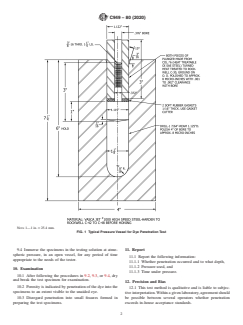
6.1.1 Fig. 1 illustrates a satisfactory device.
Development of International Standards, Guides and Recom-
NOTE 2—Fig. 1 does not represent the only possible design or
mendations issued by the World Trade Organization Technical
configuration. It is representative of a device that has been successfully
Barriers to Trade (TBT) Committee.
used.
2. Referenced Documents
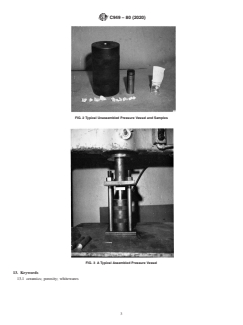
6.1.2 Fig. 2 illustrates an actual device and typical ex-
amples.
2.1 ASTM Standards:
C242 Terminology of Ceramic Whitewares and Related 6.1.3 Fig. 3 illustrates an assembled device, including
fixture, under pressure.
Products
2.2 ANSI Standard:
7. Testing Solution
C29.1 Test Methods for Electrical Power Insulators
7.1 Use a solution consisting of1gof basic fuchsine dye
3. Terminology
dissolved in 1 L of 50 % alcohol.
3.1 Definitions:
NOTE 3—The alcohol used should not react with the dye to cause
3.1.1 For definitions of terms used in this test method, refer
fading.
to Terminology C242.
8. Preparation of Test Specimens
4. Summary of Test Method
8.1 Use freshly broken fragments, approximately ⁄4 in.
4.1 Randomly selected unglazed fragments of vitreous
(6 mm) in the smallest dimension, up to ⁄4 in. (19 mm) in the
whiteware products are immersed in a fuchsine dye solution, at
largest dimension, of the whiteware ceramic. At least 75 % of
the surface shall be free of glaze or other surface treatment.
This test method is under the jurisdiction ofASTM Committee C21 on Ceramic
Whitewares and Related Productsand is the direct responsibility of Subcommittee
C21.03 on Methods for Whitewares and Environmental Concerns. 9. Procedure
Current edition appro
...