


ASTM C833-23
(Specification)Standard Specification for Sintered (Uranium-Plutonium) Dioxide Pellets for Light Water Reactors
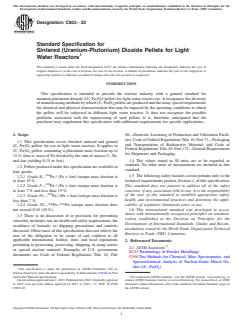
Standard Specification for Sintered (Uranium-Plutonium) Dioxide Pellets for Light Water Reactors
ABSTRACT
This specification covers finished sintered and ground (uranium-plutonium) dioxide pellets for use in thermal reactors. It applies to uranium-plutonium dioxide pellets containing plutonium additions up to 15 % weight. The diversity of manufacturing methods shall be recognized by which uranium-plutonium dioxide pellets are produced and the many special requirements for chemical and physical characterization that may be imposed by the operating conditions to which the pellets will be subjected in specific reactor systems. The following are different chemical requirements that shall be determined: uranium content, plutonium content, impurity content, stoichiometry, moisture content, gas content, and americium-241 content. Nuclear requirements such as isotopic content, plutonium equivalent at a given date, equivalent boron content, and reactivity shall also be determined. Physical properties of the pellets like dimensions, density, grain size, pore morphology, plutonium-oxide homogeneity, plutonium-oxide particle size, plutonium-oxide particle distribution, integrity, and surface cracks shall be determined as well. The surfaces of finished pellets shall be visually free of loose chips, oil, macroscopic inclusions, and foreign materials. An estimate of the fuel pellet irradiation stability shall be obtained unless adequate allowance for such effects are factored into the fuel rod design. The estimate of the stability shall consist of either conformance to the thermal stability test as specified in the or by adequate correlation of manufacturing process or microstructure to in-reactor behavior, or both.
SCOPE
1.1 This specification covers finished sintered and ground (U, Pu)O2 pellets for use in light water reactors. It applies to (U, Pu)O2 pellets containing a plutonium mass fraction up to 15 % (that is, mass of Pu divided by the sum of masses U, Pu, and Am yielding 0.15 or less).
1.2 Pellets produced under this specification are available in four grades.
1.2.1 Grade R—240Pu / (Pu + Am) isotope mass fraction is at least 19 %.
1.2.2 Grade F—240Pu / (Pu + Am) isotope mass fraction is at least 7 % and less than 19 %.
1.2.3 Grade N1—240Pu / (Pu + Am) isotope mass fraction is less than 7 %.
1.2.4 Grade N2—240Pu /239Pu isotope mass fraction does not exceed 0.10 (10 %).
1.3 There is no discussion of or provision for preventing criticality incidents, nor are health and safety requirements, the avoidance of hazards, or shipping precautions and controls discussed. Observance of this specification does not relieve the user of the obligation to be aware of and conform to all applicable international, federal, state, and local regulations pertaining to possessing, processing, shipping, or using source or special nuclear material. Examples of U.S. government documents are Code of Federal Regulations Title 10, Part 50—Domestic Licensing of Production and Utilization Facilities; Code of Federal Regulations Title 10, Part 71—Packaging and Transportation of Radioactive Material; and Code of Federal Regulations Title 49, Part 173—General Requirements for Shipments and Packaging.
1.4 The values stated in SI units are to be regarded as standard. No other units of measurement are included in this standard.
1.5 The following safety hazards caveat pertains only to the technical requirements portion, Section 4, of this specification: This standard does not purport to address all of the safety concerns, if any, associated with its use. It is the responsibility of the user of this standard to establish appropriate safety, health, and environmental practices and determine the applicability of regulatory limitations prior to use.
1.6 This international standard was developed in accordance with internationally recognized principles on standardization established in the Decision on Principles for the Development of International Standards, Guides and Recommendations issued by the World Trade Organization Technic...
General Information
- Status
- Published
- Publication Date
- 31-May-2023
- Technical Committee
- C26 - Nuclear Fuel Cycle
- Drafting Committee
- C26.02 - Fuel and Fertile Material Specifications
Relations
- Effective Date
- 01-Jan-2024
- Effective Date
- 01-Oct-2018
- Effective Date
- 01-Jul-2016
- Effective Date
- 01-Jun-2016
- Effective Date
- 01-Apr-2016
- Effective Date
- 01-Feb-2016
- Effective Date
- 15-Jun-2014
- Effective Date
- 15-Jan-2014
- Effective Date
- 01-Nov-2013
- Effective Date
- 01-Jun-2013
- Effective Date
- 01-May-2013
- Effective Date
- 15-Nov-2012
- Effective Date
- 15-Jul-2012
- Effective Date
- 15-Nov-2011
- Effective Date
- 01-Nov-2010
Overview
ASTM C833-23: Standard Specification for Sintered (Uranium-Plutonium) Dioxide Pellets for Light Water Reactors specifies requirements for finished sintered and ground uranium-plutonium dioxide [(U, Pu)O₂] pellets intended for use in thermal and light water reactor (LWR) nuclear fuel applications. The standard covers pellets containing plutonium additions up to 15% by weight, addressing the wide range of chemical, nuclear, and physical testing requirements necessary for safe and effective reactor operation. Developed by ASTM Committee C26, this specification serves as a key reference for manufacturers, suppliers, and regulatory bodies in the nuclear energy sector.
Key Topics
- Grades and Isotopic Criteria: The standard provides four grades (R, F, N1, N2) based on specific isotope mass fractions of plutonium-240, tailored for various reactor requirements.
- Chemical Composition Requirements: Specifies limits for uranium, plutonium, americium-241, and impurity elements to ensure fuel integrity and performance.
- Nuclear Characteristics: Outlines methods for determining isotopic content, plutonium equivalent, boron equivalence, and reactivity necessary for reactor core design and operation.
- Physical Properties and Inspection: Includes detailed criteria for pellet dimensions, density, grain size, pore morphology, plutonium-oxide homogeneity, and visual integrity, all critical for reliable reactor fuel performance.
- Quality Control and Certification: Describes requirements for sampling, lot integrity, manufacturer testing, and documentation, ensuring traceability and regulatory compliance.
- Packaging and Labeling: Requirements for secure and clearly labeled containers support safe handling, storage, and transport of nuclear fuel pellets.
Applications
ASTM C833-23 plays a vital role in the fabrication and supply of nuclear fuel for light water reactors, which are prevalent in commercial nuclear power plants globally. Key applications include:
- Fuel Pellet Manufacturing: Standardizes acceptance criteria for nuclear-grade uranium-plutonium dioxide pellets, promoting consistency in fuel performance and safety.
- Supply Chain Assurance: Facilitates procurement and quality assurance for utilities, fuel fabricators, and regulators.
- Regulatory Compliance: Supports adherence to international, federal, and local safety and transportation regulations governing nuclear materials, such as the U.S. Code of Federal Regulations (10 CFR 50, 10 CFR 71, 49 CFR 173).
- Nuclear Reactor Operations: Ensures that the fuel pellets meet the stringent physical and chemical properties necessary for predictable in-reactor behavior, efficient use, and minimal reactor downtime.
- Plutonium Disposition: Provides standards for mixed oxide (MOX) fuel fabrication, aiding in controlled plutonium disposition in alignment with non-proliferation and environmental goals.
Related Standards
For comprehensive quality and safety in nuclear fuel manufacturing, the following standards are often referenced alongside ASTM C833-23:
- ASTM B243: Terminology of Powder Metallurgy
- ASTM C698: Chemical, Mass Spectrometric, and Spectrochemical Analysis of Nuclear-Grade Mixed Oxides
- ASTM C753: Specification for Nuclear-Grade, Sinterable Uranium Dioxide Powder
- ASTM C757: Specification for Nuclear-Grade Plutonium Dioxide Powder for LWRs
- ASTM C859: Terminology Relating to Nuclear Materials
- ASTM C1233: Practice for Determining Equivalent Boron Contents of Nuclear Materials
- ASTM E105: Guide for Probability Sampling of Materials
- ASTM E112: Test Methods for Determining Average Grain Size
- ASME NQA-1: Quality Assurance Requirements for Nuclear Facility Applications
By following ASTM C833-23 and its related standards, organizations can enhance fuel reliability, promote nuclear safety, and maintain regulatory compliance within the nuclear fuel cycle.
Keywords: light water reactors, nuclear fuel pellets, uranium-plutonium dioxide, MOX fuel, mixed oxide, ASTM C833, fuel manufacturing, nuclear standards, reactor fuel quality, plutonium disposal.
Buy Documents
ASTM C833-23 - Standard Specification for Sintered (Uranium-Plutonium) Dioxide Pellets for Light Water Reactors
REDLINE ASTM C833-23 - Standard Specification for Sintered (Uranium-Plutonium) Dioxide Pellets for Light Water Reactors
Get Certified
Connect with accredited certification bodies for this standard

DNV
DNV is an independent assurance and risk management provider.

Lloyd's Register
Lloyd's Register is a global professional services organisation specialising in engineering and technology.
DNV Energy Systems
Energy and renewable energy certification.
Sponsored listings
Frequently Asked Questions
ASTM C833-23 is a technical specification published by ASTM International. Its full title is "Standard Specification for Sintered (Uranium-Plutonium) Dioxide Pellets for Light Water Reactors". This standard covers: ABSTRACT This specification covers finished sintered and ground (uranium-plutonium) dioxide pellets for use in thermal reactors. It applies to uranium-plutonium dioxide pellets containing plutonium additions up to 15 % weight. The diversity of manufacturing methods shall be recognized by which uranium-plutonium dioxide pellets are produced and the many special requirements for chemical and physical characterization that may be imposed by the operating conditions to which the pellets will be subjected in specific reactor systems. The following are different chemical requirements that shall be determined: uranium content, plutonium content, impurity content, stoichiometry, moisture content, gas content, and americium-241 content. Nuclear requirements such as isotopic content, plutonium equivalent at a given date, equivalent boron content, and reactivity shall also be determined. Physical properties of the pellets like dimensions, density, grain size, pore morphology, plutonium-oxide homogeneity, plutonium-oxide particle size, plutonium-oxide particle distribution, integrity, and surface cracks shall be determined as well. The surfaces of finished pellets shall be visually free of loose chips, oil, macroscopic inclusions, and foreign materials. An estimate of the fuel pellet irradiation stability shall be obtained unless adequate allowance for such effects are factored into the fuel rod design. The estimate of the stability shall consist of either conformance to the thermal stability test as specified in the or by adequate correlation of manufacturing process or microstructure to in-reactor behavior, or both. SCOPE 1.1 This specification covers finished sintered and ground (U, Pu)O2 pellets for use in light water reactors. It applies to (U, Pu)O2 pellets containing a plutonium mass fraction up to 15 % (that is, mass of Pu divided by the sum of masses U, Pu, and Am yielding 0.15 or less). 1.2 Pellets produced under this specification are available in four grades. 1.2.1 Grade R—240Pu / (Pu + Am) isotope mass fraction is at least 19 %. 1.2.2 Grade F—240Pu / (Pu + Am) isotope mass fraction is at least 7 % and less than 19 %. 1.2.3 Grade N1—240Pu / (Pu + Am) isotope mass fraction is less than 7 %. 1.2.4 Grade N2—240Pu /239Pu isotope mass fraction does not exceed 0.10 (10 %). 1.3 There is no discussion of or provision for preventing criticality incidents, nor are health and safety requirements, the avoidance of hazards, or shipping precautions and controls discussed. Observance of this specification does not relieve the user of the obligation to be aware of and conform to all applicable international, federal, state, and local regulations pertaining to possessing, processing, shipping, or using source or special nuclear material. Examples of U.S. government documents are Code of Federal Regulations Title 10, Part 50—Domestic Licensing of Production and Utilization Facilities; Code of Federal Regulations Title 10, Part 71—Packaging and Transportation of Radioactive Material; and Code of Federal Regulations Title 49, Part 173—General Requirements for Shipments and Packaging. 1.4 The values stated in SI units are to be regarded as standard. No other units of measurement are included in this standard. 1.5 The following safety hazards caveat pertains only to the technical requirements portion, Section 4, of this specification: This standard does not purport to address all of the safety concerns, if any, associated with its use. It is the responsibility of the user of this standard to establish appropriate safety, health, and environmental practices and determine the applicability of regulatory limitations prior to use. 1.6 This international standard was developed in accordance with internationally recognized principles on standardization established in the Decision on Principles for the Development of International Standards, Guides and Recommendations issued by the World Trade Organization Technic...
ABSTRACT This specification covers finished sintered and ground (uranium-plutonium) dioxide pellets for use in thermal reactors. It applies to uranium-plutonium dioxide pellets containing plutonium additions up to 15 % weight. The diversity of manufacturing methods shall be recognized by which uranium-plutonium dioxide pellets are produced and the many special requirements for chemical and physical characterization that may be imposed by the operating conditions to which the pellets will be subjected in specific reactor systems. The following are different chemical requirements that shall be determined: uranium content, plutonium content, impurity content, stoichiometry, moisture content, gas content, and americium-241 content. Nuclear requirements such as isotopic content, plutonium equivalent at a given date, equivalent boron content, and reactivity shall also be determined. Physical properties of the pellets like dimensions, density, grain size, pore morphology, plutonium-oxide homogeneity, plutonium-oxide particle size, plutonium-oxide particle distribution, integrity, and surface cracks shall be determined as well. The surfaces of finished pellets shall be visually free of loose chips, oil, macroscopic inclusions, and foreign materials. An estimate of the fuel pellet irradiation stability shall be obtained unless adequate allowance for such effects are factored into the fuel rod design. The estimate of the stability shall consist of either conformance to the thermal stability test as specified in the or by adequate correlation of manufacturing process or microstructure to in-reactor behavior, or both. SCOPE 1.1 This specification covers finished sintered and ground (U, Pu)O2 pellets for use in light water reactors. It applies to (U, Pu)O2 pellets containing a plutonium mass fraction up to 15 % (that is, mass of Pu divided by the sum of masses U, Pu, and Am yielding 0.15 or less). 1.2 Pellets produced under this specification are available in four grades. 1.2.1 Grade R—240Pu / (Pu + Am) isotope mass fraction is at least 19 %. 1.2.2 Grade F—240Pu / (Pu + Am) isotope mass fraction is at least 7 % and less than 19 %. 1.2.3 Grade N1—240Pu / (Pu + Am) isotope mass fraction is less than 7 %. 1.2.4 Grade N2—240Pu /239Pu isotope mass fraction does not exceed 0.10 (10 %). 1.3 There is no discussion of or provision for preventing criticality incidents, nor are health and safety requirements, the avoidance of hazards, or shipping precautions and controls discussed. Observance of this specification does not relieve the user of the obligation to be aware of and conform to all applicable international, federal, state, and local regulations pertaining to possessing, processing, shipping, or using source or special nuclear material. Examples of U.S. government documents are Code of Federal Regulations Title 10, Part 50—Domestic Licensing of Production and Utilization Facilities; Code of Federal Regulations Title 10, Part 71—Packaging and Transportation of Radioactive Material; and Code of Federal Regulations Title 49, Part 173—General Requirements for Shipments and Packaging. 1.4 The values stated in SI units are to be regarded as standard. No other units of measurement are included in this standard. 1.5 The following safety hazards caveat pertains only to the technical requirements portion, Section 4, of this specification: This standard does not purport to address all of the safety concerns, if any, associated with its use. It is the responsibility of the user of this standard to establish appropriate safety, health, and environmental practices and determine the applicability of regulatory limitations prior to use. 1.6 This international standard was developed in accordance with internationally recognized principles on standardization established in the Decision on Principles for the Development of International Standards, Guides and Recommendations issued by the World Trade Organization Technic...
ASTM C833-23 is classified under the following ICS (International Classification for Standards) categories: 27.120.30 - Fissile materials and nuclear fuel technology. The ICS classification helps identify the subject area and facilitates finding related standards.
ASTM C833-23 has the following relationships with other standards: It is inter standard links to ASTM C859-24, ASTM B243-18, ASTM B243-16, ASTM C698-16, ASTM C757-16, ASTM C753-16, ASTM C859-14a, ASTM C859-14, ASTM B243-13, ASTM C859-13a, ASTM C859-13, ASTM E112-12, ASTM B243-12, ASTM B243-11, ASTM C859-10b. Understanding these relationships helps ensure you are using the most current and applicable version of the standard.
ASTM C833-23 is available in PDF format for immediate download after purchase. The document can be added to your cart and obtained through the secure checkout process. Digital delivery ensures instant access to the complete standard document.
Standards Content (Sample)
This international standard was developed in accordance with internationally recognized principles on standardization established in the Decision on Principles for the
Development of International Standards, Guides and Recommendations issued by the World Trade Organization Technical Barriers to Trade (TBT) Committee.
Designation: C833 − 23
Standard Specification for
Sintered (Uranium-Plutonium) Dioxide Pellets for Light
Water Reactors
This standard is issued under the fixed designation C833; the number immediately following the designation indicates the year of
original adoption or, in the case of revision, the year of last revision. A number in parentheses indicates the year of last reapproval. A
superscript epsilon (´) indicates an editorial change since the last revision or reapproval.
INTRODUCTION
This specification is intended to provide the nuclear industry with a general standard for
uranium-plutonium dioxide ((U, Pu)O ) pellets for light water reactor use. It recognizes the diversity
of manufacturing methods by which (U, Pu)O pellets are produced and the many special requirements
for chemical and physical characterization that may be imposed by the operating conditions to which
the pellets will be subjected in different light water reactors. It does not recognize the possible
problems associated with the reprocessing of such pellets. It is, therefore, anticipated that the
purchaser may supplement this specification with additional requirements for specific applications.
1. Scope 50—Domestic Licensing of Production and Utilization Facili-
ties; Code of Federal Regulations Title 10, Part 71—Packaging
1.1 This specification covers finished sintered and ground
and Transportation of Radioactive Material; and Code of
(U, Pu)O pellets for use in light water reactors. It applies to
Federal Regulations Title 49, Part 173—General Requirements
(U, Pu)O pellets containing a plutonium mass fraction up to
for Shipments and Packaging.
15 % (that is, mass of Pu divided by the sum of masses U, Pu,
and Am yielding 0.15 or less). 1.4 The values stated in SI units are to be regarded as
standard. No other units of measurement are included in this
1.2 Pellets produced under this specification are available in
standard.
four grades.
1.5 The following safety hazards caveat pertains only to the
1.2.1 Grade R— Pu / (Pu + Am) isotope mass fraction is
technical requirements portion, Section 4, of this specification:
at least 19 %.
This standard does not purport to address all of the safety
1.2.2 Grade F— Pu / (Pu + Am) isotope mass fraction is
concerns, if any, associated with its use. It is the responsibility
at least 7 % and less than 19 %.
of the user of this standard to establish appropriate safety,
1.2.3 Grade N1— Pu / (Pu + Am) isotope mass fraction is
health, and environmental practices and determine the appli-
less than 7 %.
240 239
cability of regulatory limitations prior to use.
1.2.4 Grade N2— Pu / Pu isotope mass fraction does
1.6 This international standard was developed in accor-
not exceed 0.10 (10 %).
dance with internationally recognized principles on standard-
1.3 There is no discussion of or provision for preventing
ization established in the Decision on Principles for the
criticality incidents, nor are health and safety requirements, the
Development of International Standards, Guides and Recom-
avoidance of hazards, or shipping precautions and controls
mendations issued by the World Trade Organization Technical
discussed. Observance of this specification does not relieve the
Barriers to Trade (TBT) Committee.
user of the obligation to be aware of and conform to all
applicable international, federal, state, and local regulations
2. Referenced Documents
pertaining to possessing, processing, shipping, or using source
2.1 ASTM Standards:
or special nuclear material. Examples of U.S. government
B243 Terminology of Powder Metallurgy
documents are Code of Federal Regulations Title 10, Part
C698 Test Methods for Chemical, Mass Spectrometric, and
Spectrochemical Analysis of Nuclear-Grade Mixed Ox-
ides ((U, Pu)O )
This specification is under the jurisdiction of ASTM Committee C26 on
Nuclear Fuel Cycle and is the direct responsibility of Subcommittee C26.02 on Fuel
and Fertile Material Specifications. For referenced ASTM standards, visit the ASTM website, www.astm.org, or
Current edition approved June 1, 2023. Published July 2023. Originally approved contact ASTM Customer Service at service@astm.org. For Annual Book of ASTM
in 1976. Last previous edition approved in 2017 as C833 – 17. DOI: 10.1520/ Standards volume information, refer to the standard’s Document Summary page on
C0833-23. the ASTM website.
Copyright © ASTM International, 100 Barr Harbor Drive, PO Box C700, West Conshohocken, PA 19428-2959. United States
C833 − 23
A
TABLE 1 Impurity Elements and Maximum Concentration Limits
C753 Specification for Nuclear-Grade, Sinterable Uranium
Maximum Concentration
Dioxide Powder
B
Element Limit (μg/g of U + Pu +
C757 Specification for Nuclear-Grade Plutonium Dioxide
Am)
Powder for Light Water Reactors
Aluminum (Al) 250
C859 Terminology Relating to Nuclear Materials
Carbon (C) 100
Calcium (Ca) 200
C1233 Practice for Determining Equivalent Boron Contents
+ magnesium (Mg)
of Nuclear Materials
Chlorine (Cl) 25
E105 Guide for Probability Sampling of Materials
Chromium (Cr) 250
Cobalt (Co) 100
E112 Test Methods for Determining Average Grain Size
Fluorine (F) 25
2.2 ASME Standard:
Hydrogen (H, total from 1.3
ASME NQA-1 Quality Assurance Requirements for Nuclear all sources)
Iron (Fe) 500
Facility Applications
Nickel (Ni) 250
2.3 U.S. Government Documents:
Nitrogen (N) 75
Silicon (Si) 250
USNRC Regulatory Guide 1.126 An Acceptable Model and
A
Related Statistical Methods for the Analysis of Fuel Higher impurity limits should be acceptable for restricted burnups and linear
power ratings if there is evidence to substantiate the relaxation. Higher impurity
Densification
levels of 450 ppm aluminum, 250 ppm carbon, 250 ppm nitrogen, and 450 ppm
Code of Federal Regulations Title 10, Part 50 Domestic
silicon have been supported for burnups of less than 35 000 MWd/t. The extension
Licensing of Production and Utilization Facilities of the burnup limit may be determined by agreement between the buyer and seller
as supporting data are accumulated.
Code of Federal Regulations Title 10, Part 71 Packaging and
B
Any additional potential impurities, added by the fabrication process for example,
Transportation of Radioactive Material
beyond those listed here shall be evaluated (for example, in terms of equivalent
Code of Federal Regulations Title 49, Part 173 General boron) and associated limits established and agreed upon between the buyer and
seller.
Requirements for Shipments and Packaging
3. Terminology
TABLE 2 Additional Impurity Elements
3.1 Definitions—Definitions of terms are as given in Termi-
Element
nologies B243 and C859.
Beryllium (Be) Silver (Ag)
Bismuth (Bi) Sodium (Na)
4. Technical Requirements
Copper (Cu) Sulfur (S)
Indium (In) Tantalum (Ta)
4.1 Chemical Requirements—All chemical analyses shall be
Lead (Pb) Thorium (Th)
performed on portions of the representative sample prepared in
Lithium (Li) Tin (Sn)
Manganese (Mn) Titanium (Ti)
accordance with Section 6. Analytical chemistry methods shall
Molybdenum (Mo) Tungsten (W)
be as stated in Test Methods C698 (latest edition) or demon-
Neptunium (Np) Vanadium (V)
strated equivalent as mutually agreed to between the buyer and Niobium (Nb) Zinc (Zn)
Phosphorous (P) Zirconium (Zr)
the seller.
Potassium (K)
4.1.1 Uranium and Plutonium Content—Unless agreed
upon by the buyer and seller, individual powders shall meet the
requirements of Specifications C753 and C757. The combined
U and Pu mass fractions shall be a minimum of 87.7 % on a dry
determination of total impurities. Impurity elements measured
weight basis compensated for the Americium 241 ( Am)
and their associated limits may differ from what is listed in this
content. (Dry weight is defined as the sample weight minus the
specification as agreed upon between the buyer and seller.
moisture content). The content shall be that specified by the
4.1.3 Stoichiometry—The oxygen-to-heavy metal ratio
buyer, up to the limits covered in this specification (that is,
(O/(U + Pu + Am)) of sintered fuel pellets shall be within the
15 wt%).
range from 1.98 to 2.02. The nominal value and allowable
4.1.2 Impurity Content—The impurity content shall not
tolerance shall be agreed upon between the buyer and seller.
exceed the individual element limit specified in Table 1 based
4.1.4 Moisture Content—The moisture content limit is in-
on the heavy metal content (U + Pu + Am). The summation of
cluded in the total hydrogen limit (see Table 1).
the contribution of each of the impurity elements listed in Table
4.1.5 Gas Content—The gas content, exclusive of moisture,
1 shall not exceed 1500 μg/g (U + Pu + Am). Some other
shall be determined as agreed upon between the buyer and the
elements such as those listed in Table 2 may also be of concern
seller. Typical methods include calculation based on C, N , and
for the buyer and should be measured and reported if re-
H contents or determination by high temperature vacuum
quested. If an element analysis is reported as “less than” a
extraction, or combinations thereof.
given concentration, this “less than” value shall be used in the
4.1.6 Americium-241 Content—The Am content shall be
measured by the seller and reported to the buyer. The Am
content or activity is important in the handling of (U, Pu)O
Available from American Society of Mechanical Engineers (ASME), ASME
International Headquarters, Two Park Ave., New York, NY 10016-5990, http://
pellets and subsequent helium generation from alpha decay
www.asme.org.
during irradiation and will vary with time. The maximum
Available from U.S. Government Printing Office Superintendent of Documents,
acceptable Am content on a given date along with the date
732 N. Capitol St., NW, Mail Stop: SDE, Washington, DC 20401, http://
www.gpo.gov. of analysis shall be agreed upon between the buyer and seller.
C833 − 23
The analysis dates shall be reported; methods of reporting shall 4.3.4.1 Plutonium Homogeneity Within a Pellet Lot—
be agreed upon between the buyer and seller. Homogeneity of the Pu content shall be demonstrated through
analyses of multiple pellets. Each sample for analysis should
4.2 Nuclear Requirements:
be one pellet or a fragment thereof. The range of the equivalent
4.2.1 Isotopic Content—The isotopic content of the U and
Pu content shall not exceed 65.0 % relative or 60.2 %
Pu in the (U, Pu)O pellets shall be determined and the date of
234 235 236 238 absolute for Pu content less than 5 %, whichever is less
the determination recorded. The U, U, U, and U
restrictive in accordance with fuel management method. Alter-
content of the uranium shall be reported on a U basis, and the
238 239 240 241 242 241 native methods and criteria that may be agreed upon between
Pu, Pu, Pu, Pu, Pu, and Am content of the Pu
the buyer and the seller are possible for evaluation of Pu
shall be reported on a Pu or Pu + Am basis. The equivalent Pu
homogeneity within a lot.
content based on U and Pu isotopic concentrations shall be as
4.3.4.2 Plutonium-Rich Cluster Size and Distribution
agreed upon between the buyer and se
...
This document is not an ASTM standard and is intended only to provide the user of an ASTM standard an indication of what changes have been made to the previous version. Because
it may not be technically possible to adequately depict all changes accurately, ASTM recommends that users consult prior editions as appropriate. In all cases only the current version
of the standard as published by ASTM is to be considered the official document.
Designation: C833 − 17 C833 − 23
Standard Specification for
Sintered (Uranium-Plutonium) Dioxide Pellets for Light
Water Reactors
This standard is issued under the fixed designation C833; the number immediately following the designation indicates the year of
original adoption or, in the case of revision, the year of last revision. A number in parentheses indicates the year of last reapproval. A
superscript epsilon (´) indicates an editorial change since the last revision or reapproval.
INTRODUCTION
This specification is intended to provide the nuclear industry with a general standard for
uranium-plutonium dioxide ((U, Pu)O ) pellets for light water reactor use. It recognizes the diversity
of manufacturing methods by which (U, Pu)O pellets are produced and the many special requirements
for chemical and physical characterization that may be imposed by the operating conditions to which
the pellets will be subjected in different light water reactors. It does not recognize the possible
problems associated with the reprocessing of such pellets. It is, therefore, anticipated that the
purchaser may supplement this specification with additional requirements for specific applications.
1. Scope
1.1 This specification covers finished sintered and ground (U, Pu)O pellets for use in light water reactors. It applies to (U, Pu)O
2 2
pellets containing plutonium additions up to 15 weight % (wt%; that is, 0.15 g Pu / g (U + Pu + Am)). a plutonium mass fraction
up to 15 % (that is, mass of Pu divided by the sum of masses U, Pu, and Am yielding 0.15 or less).
1.2 Pellets produced under this specification are available in four grades.
240 240
1.2.1 Grade R— Pu content of / (Pu + Am) (that is, gisotope mass fraction Pu / g (Pu + Am)) is at least 19 %.19 %.
1.2.2 Grade F— Pu content of / (Pu + Am) isotope mass fraction is at least 7 % 7 % and less than 19 %.19 %.
1.2.3 Grade N1— Pu content of / (Pu + Am) isotope mass fraction is less than 7 %.7 %.
240 239
1.2.4 Grade N2— Pu / Pu isotope mass fraction does not exceed 0.10.0.10 (10 %).
1.3 There is no discussion of or provision for preventing criticality incidents, nor are health and safety requirements, the avoidance
of hazards, or shipping precautions and controls discussed. Observance of this specification does not relieve the user of the
obligation to be aware of and conform to all applicable international, federal, state, and local regulations pertaining to possessing,
processing, shipping, or using source or special nuclear material. Examples of U.S. government documents are Code of Federal
Regulations Title 10, Part 50—Domestic Licensing of Production and Utilization Facilities; Code of Federal Regulations Title 10,
Part 71—Packaging and Transportation of Radioactive Material; and Code of Federal Regulations Title 49, Part 173—General
Requirements for Shipments and Packaging.
This specification is under the jurisdiction of ASTM Committee C26 on Nuclear Fuel Cycle and is the direct responsibility of Subcommittee C26.02 on Fuel and Fertile
Material Specifications.
Current edition approved Jan. 1, 2017June 1, 2023. Published January 2017July 2023. Originally approved in 1976. Last previous edition approved in 20132017 as
C833 – 13.C833 – 17. DOI: 10.1520/C0833-17.10.1520/C0833-23.
Copyright © ASTM International, 100 Barr Harbor Drive, PO Box C700, West Conshohocken, PA 19428-2959. United States
C833 − 23
1.4 The values stated in SI units are to be regarded as standard. No other units of measurement are included in this standard.
1.5 The following safety hazards caveat pertains only to the technical requirements portion, Section 4, of this specification: This
standard does not purport to address all of the safety concerns, if any, associated with its use. It is the responsibility of the user
of this standard to establish appropriate safety and health practices and determine the applicability of regulatory limitations prior
to use.
1.5 The following safety hazards caveat pertains only to the technical requirements portion, Section 4, of this specification: This
standard does not purport to address all of the safety concerns, if any, associated with its use. It is the responsibility of the user
of this standard to establish appropriate safety, health, and environmental practices and determine the applicability of regulatory
limitations prior to use.
1.6 This international standard was developed in accordance with internationally recognized principles on standardization
established in the Decision on Principles for the Development of International Standards, Guides and Recommendations issued
by the World Trade Organization Technical Barriers to Trade (TBT) Committee.
2. Referenced Documents
2.1 ASTM Standards:
B243 Terminology of Powder Metallurgy
C698 Test Methods for Chemical, Mass Spectrometric, and Spectrochemical Analysis of Nuclear-Grade Mixed Oxides ((U,
Pu)O )
C753 Specification for Nuclear-Grade, Sinterable Uranium Dioxide Powder
C757 Specification for Nuclear-Grade Plutonium Dioxide Powder for Light Water Reactors
C859 Terminology Relating to Nuclear Materials
C1233 Practice for Determining Equivalent Boron Contents of Nuclear Materials
E105 Guide for Probability Sampling of Materials
E112 Test Methods for Determining Average Grain Size
2.2 ASME Standard:
ASME NQA-1 Quality Assurance Requirements for Nuclear Facility Applications
2.3 U.S. Government Documents:
USNRC Regulatory Guide 1.126 An Acceptable Model and Related Statistical Methods for the Analysis of Fuel Densification
Code of Federal Regulations Title 10, Part 50 Domestic Licensing of Production and Utilization Facilities
Code of Federal Regulations Title 10, Part 71 Packaging and Transportation of Radioactive Material
Code of Federal Regulations Title 49, Part 173 General Requirements for Shipments and Packaging
3. Terminology
3.1 Definitions—Definitions of terms are as given in Terminologies B243 and C859.
4. Technical Requirements
4.1 Chemical Requirements—All chemical analyses shall be performed on portions of the representative sample prepared in
accordance with Section 6. Analytical chemistry methods shall be as stated in Test Methods C698 (latest edition) or demonstrated
equivalent as mutually agreed to between the buyer and the seller.
4.1.1 Uranium and Plutonium Content—Unless agreed upon by the buyer and seller, individual powders shall meet the
requirements of Specifications C753 and C757. The combined U and Pu contents combinedmass fractions shall be a minimum of
87.7 wt%87.7 % on a dry weight basis compensated for the Americium 241 ( Am) content. (Dry weight is defined as the sample
weight minus the moisture content). The content shall be that specified by the buyer, up to the limits covered in this specification
(that is, 15 wt%).
For referenced ASTM standards, visit the ASTM website, www.astm.org, or contact ASTM Customer Service at service@astm.org. For Annual Book of ASTM Standards
volume information, refer to the standard’s Document Summary page on the ASTM website.
Available from American Society of Mechanical Engineers (ASME), ASME International Headquarters, Two Park Ave., New York, NY 10016-5990, http://
www.asme.org.
Available from U.S. Government Printing Office Superintendent of Documents, 732 N. Capitol St., NW, Mail Stop: SDE, Washington, DC 20401, http://www.gpo.gov.
C833 − 23
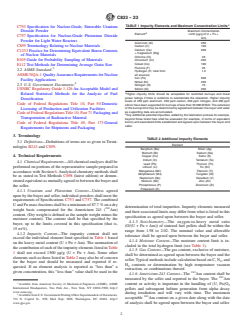
4.1.2 Impurity Content—The impurity content shall not exceed the individual element limit specified in Table 1 based on the heavy
metal content (U + Pu + Am). The summation of the contribution of each of the impurity elements listed in Table 1 shall not exceed
1500 μg/g (U + Pu + Am). Some other elements such as those listed in Table 2 may also be of concern for the buyer and should
be measured and reported if requested. If an element analysis is reported as “less than” a given concentration, this “less than” value
shall be used in the determination of total impurities. Impurity elements measured and their associated limits may differ from what
is listed in this specification as agreed upon between the buyer and seller.
4.1.3 Stoichiometry—The oxygen-to-heavy metal ratio (O/(U + Pu + Am)) of sintered fuel pellets shall be within the range from
1.98 to 2.02. The nominal value and allowable tolerance shall be agreed upon between the buyer and seller.
4.1.4 Moisture Content—The moisture content limit is included in the total hydrogen limit (see Table 1).
4.1.5 Gas Content—The gas content, exclusive of moisture, shall be determined as agreed upon between the buyer and the seller.
Typical methods include calculation based on C, N , and H contents or determination by high temperature vacuum extraction, or
2 2
combinations thereof.
241 241
4.1.6 Americium-241 Content—The Am content shall be measured by the seller and reported to the buyer. The Am content
or activity is important in the handling of (U, Pu)O pellets and subsequent helium generation from alpha decay during irradiation
and will vary with time. The maximum acceptable Am content on a given date along with the date of analysis shall be agreed
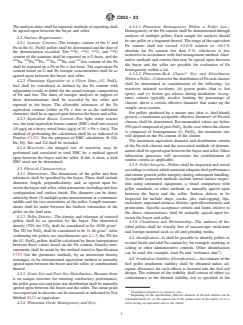
upon between the buyer and seller. The analysis dates shall be reported; methods of reporting shall be agreed upon between the
buyer and seller.
4.2 Nuclear Requirements:
4.2.1 Isotopic Content—The isotopic content of the U and Pu in the (U, Pu)O pellets shall be determined and the date of the
234 235 236 238 238
determination recorded. The U, U, U, and U content of the uranium shall be reported on a U basis, and the Pu,
239 240 241 242 241
Pu, Pu, Pu, Pu, and Am content of the Pu shall be reported on a Pu or Pu + Am basis. The equivalent Pu content based
on U and Pu isotopic concentrations shall be as agreed upon between the buyer and seller.
4.2.2 Plutonium Equivalent at a Given Date—(U, Pu)O fuel shall be considered as defined by the Pu content with adjustment
(credit or debit) for the actual isotopic composition of Pu and Am. The dates of isotopic analyses in support of these determinations
shall be recorded by the seller and reported to the buyer. The allowable tolerances of the Pu equivalent content (either as Pu + Am
or as the individual elements) shall be as agreed upon between the buyer and seller.
A
TABLE 1 Impurity Elements and Maximum Concentration Limits
Maximum Concentration
B
Element Limit (μg/g of U + Pu +
Am)
Aluminum (Al) 250
Carbon (C) 100
Calcium (Ca) 200
+ magnesium (Mg)
Chlorine (Cl) 25
Chromium (Cr) 250
Cobalt (Co) 100
Fluorine (F) 25
Hydrogen (H, total from 1.3
all sources)
Iron (Fe) 500
Nickel (Ni) 250
Nitrogen (N) 75
Silicon (Si) 250
A
Higher impurity limits should be acceptable for restricted burnups and linear
power ratings if there is evidence to substantiate the relaxation. Higher impurity
levels of 450 ppm aluminum, 250 ppm carbon, 250 ppm nitrogen, and 450 ppm
silicon have been supported for burnups of less than 35 000 MWd/t. The extension
of the burnup limit may be determined by agreement between the buyer and seller
as supporting data are accumulated.
B
Any additional potential impurities, added by the fabrication process for example,
beyond those listed here shall be evaluated (for example, in terms of equivalent
boron) and associated limits established and agreed upon between the buyer and
seller.
C833 − 23
TABLE 2 Additional Impurity Elements
Element
Beryllium (Be) Silver (Ag)
Bismuth (Bi) Sodium (Na)
Copper (Cu) Sulfur (S)
Indium (In) Tantalum (Ta)
Lead (Pb) Thorium (Th)
Lithium (Li) Tin (Sn)
Manganese (Mn) Titanium (Ti)
M
...
Questions, Comments and Discussion
Ask us and Technical Secretary will try to provide an answer. You can facilitate discussion about the standard in here.
Loading comments...