

ASTM F2880-21
(Specification)Standard Specification for Lap-Joint Type Flange Adapters for Polyethylene Pressure Pipe in Nominal Pipe Sizes 34 in. to 65 in.
General Information
- Abstract
ABSTRACT
This specification covers the polyethylene material and dimensions applicable to flange adapters (FAs) used to connect polyethylene pipes to other flanged pipe and components such as valves and flanged fittings. It describes outside diameter controlled polyethylene (PE) pipe FAs which may be manufactured by various methods including injection molding, compression molding, and machining from thick-wall polyethylene pipe.
SCOPE
1.1 This specification covers the polyethylene material and dimensions applicable to flange adapters (FAs) used to connect polyethylene pipes to other flanged pipe and components such as valves and flanged fittings. This standard describes outside diameter controlled polyethylene (PE) pipe flange adapters (FAs) in diameters ranging from 3/4 in. through 65 in. (12 mm through 1600 mm). The flange adapters may be manufactured by various methods including injection molding, compression molding, and machining from billet or thick-wall polyethylene pipe.
1.2 The flange adapter (FA) is the principal component of the lap-joint flanged assembly widely used for several decades in low-pressure to high-pressure polyethylene pipe systems for all types of pressurized flow (gas and liquid) applications. The flange adapter’s physical shape consists of the pipe-like Neck which is monolithic with its Hub. The Neck is intended to be butt-fused or fusion coupled to the pipe-line; while the Hub face is intended to affect the seal when subjected to the distributed load from the back up ring with its properly torqued bolt-studs and nuts.
Note 1: Polyethylene pipe flange adapters with slip on bolt rings are intended for use being bolted to each other or to be bolted to metal flanges having (primarily) Class 150 bolt hole patterns such as those presented in metal flange standards ASME B16.5, ASME B16.47 and AWWA C207.
1.3 The values stated in inch-pound units are to be regarded as standard. The values given in parentheses are mathematical conversions to SI units that are provided for information only and are not considered standard.
1.4 The use of gaskets and gasket selection are often an integral component of the flange adapter assembly. See the Plastic Pipe Institute Technical Note TN-38 for more information regarding HDPE flanged joints.
1.5 This standard does not purport to address all of the safety concerns, if any, associated with its use. It is the responsibility of the user of this standard to establish appropriate safety, health, and environmental practices and determine the applicability of regulatory limitations prior to use.
1.6 This international standard was developed in accordance with internationally recognized principles on standardization established in the Decision on Principles for the Development of International Standards, Guides and Recommendations issued by the World Trade Organization Technical Barriers to Trade (TBT) Committee.
- Status
- Published
- Publication Date
- 31-Oct-2021
- Technical Committee
- F17 - Plastic Piping Systems
- Drafting Committee
- F17.10 - Fittings
Buy Documents
ASTM F2880-21 - Standard Specification for Lap-Joint Type Flange Adapters for Polyethylene Pressure Pipe in Nominal Pipe Sizes <fraction><num>3</num><den>4</den></fraction > in. to 65 in.
REDLINE ASTM F2880-21 - Standard Specification for Lap-Joint Type Flange Adapters for Polyethylene Pressure Pipe in Nominal Pipe Sizes <fraction><num>3</num><den>4</den></fraction > in. to 65 in.
Overview
ASTM F2880-21 is the standard specification developed by ASTM International for lap-joint type flange adapters used with polyethylene (PE) pressure pipe. This specification covers PE material and geometric requirements for flange adapters (FAs) designed to connect PE pipes to other flanged pipes, valves, or flanged fittings. The standard applies to outside-diameter-controlled polyethylene pipe systems in nominal pipe sizes ranging from 3/4 inch to 65 inches (12 mm to 1600 mm). Flange adapters can be manufactured through injection molding, compression molding, or machining from PE billets or thick-wall PE pipe.
Lap-joint flange adapters are widely used in both low- and high-pressure polyethylene piping systems for transporting pressurized fluids such as water and gas. They provide a key solution for joining PE systems with other piping materials using flanged connections.
Key Topics
- Flange Adapter Design: The flange adapter consists of two main shapes: a pipe-like neck, which is fusion-joined to the pipeline, and a hub, which provides a sealing face for the flange connection.
- Manufacturing Methods: Adapters may be made by injection molding, compression molding, or machining from billets or thick-wall PE pipe.
- Material Requirements: Only commercial-grade virgin or rework PE materials complying with ASTM D3350 classifications are acceptable. The standard outlines necessary material properties for performance under pressure and exposure to potable water.
- Dimensions and Pressure Ratings: The specification details dimension ratios (DR) and minimum wall thicknesses, ensuring adapters meet specific strength and pressure performance requirements.
- Marking and Certification: Adapters must be permanently marked with essential information such as size, dimension ratio, materials designation code, manufacturer identification, production date, pressure rating, and applicable certifications.
Applications
ASTM F2880-21-compliant flange adapters are used extensively in:
- Water Distribution Systems: Connecting PE water mains to metal valves and fittings.
- Gas Transmission: Creating pressure-tight joints in PE gas piping installations.
- Municipal and Industrial Piping: Facilitating transitions between PE pipes and other system components, such as pumps and tanks, using standard flanged connections.
- Irrigation and Agricultural Piping: Allowing for reliable flanged interfaces between PE pipes and control equipment.
- Potable Water Applications: When PE materials are certified to meet NSF/ANSI 14 or 61 for drinking water system components.
The adaptability in manufacturing, broad size range, and robust pressure ratings make these flange adapters a practical choice for many pressurized piping systems.
Related Standards
ASTM F2880-21 refers to and aligns with several other standards to ensure comprehensive performance:
- ASTM D3350: Specification for PE plastic pipe and fittings materials
- ASTM D3261: Butt heat fusion PE plastic fittings for PE pipe and tubing
- ASTM F714 and D3035: Specifications for PE plastic pipe based on controlled outside diameter
- ASME B16.5 and B16.47: Standards for pipe flanges and fittings (bolt hole patterns and dimensions)
- AWWA C901 and C906: Standards for PE pipe and fittings for waterworks
- NSF/ANSI 14 and 61: Certification for components used in potable water systems
- PPI TN-38: Bolt torque for PE flanged joints
Practical Value
Implementing ASTM F2880-21 in the design and installation of polyethylene pressure piping systems ensures:
- Compatibility with standard flanged fittings and valves
- Reliable Pressure Performance through defined dimension ratios and material requirements
- Durability and Safety in a variety of environmental and operational conditions
- Ease of Inspection and Maintenance with standardized marking and certification requirements
These advantages make this standard essential for engineers, contractors, and asset owners involved in the specification, procurement, and installation of PE piping systems using flange adapters.
Relations
- Effective Date
- 01-Feb-2024
- Effective Date
- 01-Feb-2024
- Refers
ASTM F2206-19 - Standard Specification for Fabricated Fittings of Butt-Fused Polyethylene (PE) - Effective Date
- 15-Jan-2019
- Refers
ASTM D2513-18 - Standard Specification for Polyethylene (PE) Gas Pressure Pipe, Tubing, and Fittings - Effective Date
- 15-Apr-2018
- Effective Date
- 15-Dec-2016
- Refers
ASTM D2513-16 - Standard Specification for Polyethylene (PE) Gas Pressure Pipe, Tubing, and Fittings - Effective Date
- 01-Dec-2016
- Effective Date
- 01-Nov-2016
- Effective Date
- 15-Dec-2015
- Refers
ASTM D2122-15 - Standard Test Method for Determining Dimensions of Thermoplastic Pipe and Fittings - Effective Date
- 15-Mar-2015
- Refers
ASTM F2206-14 - Standard Specification for Fabricated Fittings of Butt-Fused Polyethylene (PE) - Effective Date
- 01-Dec-2014
- Effective Date
- 01-Aug-2014
- Effective Date
- 25-Apr-2014
- Effective Date
- 25-Apr-2014
- Effective Date
- 01-Mar-2014
- Effective Date
- 15-Nov-2013
Buy Documents
ASTM F2880-21 - Standard Specification for Lap-Joint Type Flange Adapters for Polyethylene Pressure Pipe in Nominal Pipe Sizes <fraction><num>3</num><den>4</den></fraction > in. to 65 in.
REDLINE ASTM F2880-21 - Standard Specification for Lap-Joint Type Flange Adapters for Polyethylene Pressure Pipe in Nominal Pipe Sizes <fraction><num>3</num><den>4</den></fraction > in. to 65 in.
Get Certified
Connect with accredited certification bodies for this standard

Institut za varilstvo d.o.o. (Welding Institute)
Slovenia's leading welding institute since 1952. ISO 3834, EN 1090, pressure equipment certification, NDT personnel, welder qualification. Only IIW Au
Sponsored listings
Frequently Asked Questions
ASTM F2880-21 is a technical specification published by ASTM International. Its full title is "Standard Specification for Lap-Joint Type Flange Adapters for Polyethylene Pressure Pipe in Nominal Pipe Sizes <fraction><num>3</num><den>4</den></fraction > in. to 65 in.". This standard covers: ABSTRACT This specification covers the polyethylene material and dimensions applicable to flange adapters (FAs) used to connect polyethylene pipes to other flanged pipe and components such as valves and flanged fittings. It describes outside diameter controlled polyethylene (PE) pipe FAs which may be manufactured by various methods including injection molding, compression molding, and machining from thick-wall polyethylene pipe. SCOPE 1.1 This specification covers the polyethylene material and dimensions applicable to flange adapters (FAs) used to connect polyethylene pipes to other flanged pipe and components such as valves and flanged fittings. This standard describes outside diameter controlled polyethylene (PE) pipe flange adapters (FAs) in diameters ranging from 3/4 in. through 65 in. (12 mm through 1600 mm). The flange adapters may be manufactured by various methods including injection molding, compression molding, and machining from billet or thick-wall polyethylene pipe. 1.2 The flange adapter (FA) is the principal component of the lap-joint flanged assembly widely used for several decades in low-pressure to high-pressure polyethylene pipe systems for all types of pressurized flow (gas and liquid) applications. The flange adapter’s physical shape consists of the pipe-like Neck which is monolithic with its Hub. The Neck is intended to be butt-fused or fusion coupled to the pipe-line; while the Hub face is intended to affect the seal when subjected to the distributed load from the back up ring with its properly torqued bolt-studs and nuts. Note 1: Polyethylene pipe flange adapters with slip on bolt rings are intended for use being bolted to each other or to be bolted to metal flanges having (primarily) Class 150 bolt hole patterns such as those presented in metal flange standards ASME B16.5, ASME B16.47 and AWWA C207. 1.3 The values stated in inch-pound units are to be regarded as standard. The values given in parentheses are mathematical conversions to SI units that are provided for information only and are not considered standard. 1.4 The use of gaskets and gasket selection are often an integral component of the flange adapter assembly. See the Plastic Pipe Institute Technical Note TN-38 for more information regarding HDPE flanged joints. 1.5 This standard does not purport to address all of the safety concerns, if any, associated with its use. It is the responsibility of the user of this standard to establish appropriate safety, health, and environmental practices and determine the applicability of regulatory limitations prior to use. 1.6 This international standard was developed in accordance with internationally recognized principles on standardization established in the Decision on Principles for the Development of International Standards, Guides and Recommendations issued by the World Trade Organization Technical Barriers to Trade (TBT) Committee.
ABSTRACT This specification covers the polyethylene material and dimensions applicable to flange adapters (FAs) used to connect polyethylene pipes to other flanged pipe and components such as valves and flanged fittings. It describes outside diameter controlled polyethylene (PE) pipe FAs which may be manufactured by various methods including injection molding, compression molding, and machining from thick-wall polyethylene pipe. SCOPE 1.1 This specification covers the polyethylene material and dimensions applicable to flange adapters (FAs) used to connect polyethylene pipes to other flanged pipe and components such as valves and flanged fittings. This standard describes outside diameter controlled polyethylene (PE) pipe flange adapters (FAs) in diameters ranging from 3/4 in. through 65 in. (12 mm through 1600 mm). The flange adapters may be manufactured by various methods including injection molding, compression molding, and machining from billet or thick-wall polyethylene pipe. 1.2 The flange adapter (FA) is the principal component of the lap-joint flanged assembly widely used for several decades in low-pressure to high-pressure polyethylene pipe systems for all types of pressurized flow (gas and liquid) applications. The flange adapter’s physical shape consists of the pipe-like Neck which is monolithic with its Hub. The Neck is intended to be butt-fused or fusion coupled to the pipe-line; while the Hub face is intended to affect the seal when subjected to the distributed load from the back up ring with its properly torqued bolt-studs and nuts. Note 1: Polyethylene pipe flange adapters with slip on bolt rings are intended for use being bolted to each other or to be bolted to metal flanges having (primarily) Class 150 bolt hole patterns such as those presented in metal flange standards ASME B16.5, ASME B16.47 and AWWA C207. 1.3 The values stated in inch-pound units are to be regarded as standard. The values given in parentheses are mathematical conversions to SI units that are provided for information only and are not considered standard. 1.4 The use of gaskets and gasket selection are often an integral component of the flange adapter assembly. See the Plastic Pipe Institute Technical Note TN-38 for more information regarding HDPE flanged joints. 1.5 This standard does not purport to address all of the safety concerns, if any, associated with its use. It is the responsibility of the user of this standard to establish appropriate safety, health, and environmental practices and determine the applicability of regulatory limitations prior to use. 1.6 This international standard was developed in accordance with internationally recognized principles on standardization established in the Decision on Principles for the Development of International Standards, Guides and Recommendations issued by the World Trade Organization Technical Barriers to Trade (TBT) Committee.
ASTM F2880-21 is classified under the following ICS (International Classification for Standards) categories: 23.040.45 - Plastics fittings. The ICS classification helps identify the subject area and facilitates finding related standards.
ASTM F2880-21 has the following relationships with other standards: It is inter standard links to ASTM D3261-24, ASTM F714-24, ASTM F2206-19, ASTM D2513-18, ASTM D2513-16a, ASTM D2513-16, ASTM D3261-16, ASTM D3261-15, ASTM D2122-15, ASTM F2206-14, ASTM D3035-14a, ASTM D2513-14, ASTM D2513-14e1, ASTM D3035-14, ASTM D2837-13. Understanding these relationships helps ensure you are using the most current and applicable version of the standard.
ASTM F2880-21 is available in PDF format for immediate download after purchase. The document can be added to your cart and obtained through the secure checkout process. Digital delivery ensures instant access to the complete standard document.
Standards Content (Sample)
This international standard was developed in accordance with internationally recognized principles on standardization established in the Decision on Principles for the
Development of International Standards, Guides and Recommendations issued by the World Trade Organization Technical Barriers to Trade (TBT) Committee.
Designation:F2880 −21 An American National Standard
Standard Specification for
Lap-Joint Type Flange Adapters for Polyethylene Pressure
Pipe in Nominal Pipe Sizes ⁄4 in. to 65 in.
This standard is issued under the fixed designation F2880; the number immediately following the designation indicates the year of
original adoption or, in the case of revision, the year of last revision.Anumber in parentheses indicates the year of last reapproval.A
superscript epsilon (´) indicates an editorial change since the last revision or reapproval.
1. Scope* priate safety, health, and environmental practices and deter-
mine the applicability of regulatory limitations prior to use.
1.1 This specification covers the polyethylene material and
1.6 This international standard was developed in accor-
dimensionsapplicabletoflangeadapters(FAs)usedtoconnect
dance with internationally recognized principles on standard-
polyethylene pipes to other flanged pipe and components such
ization established in the Decision on Principles for the
as valves and flanged fittings. This standard describes outside
Development of International Standards, Guides and Recom-
diameter controlled polyethylene (PE) pipe flange adapters
mendations issued by the World Trade Organization Technical
(FAs) in diameters ranging from ⁄4 in. through 65 in. (12 mm
Barriers to Trade (TBT) Committee.
through 1600 mm). The flange adapters may be manufactured
by various methods including injection molding, compression
2. Referenced Documents
molding, and machining from billet or thick-wall polyethylene
2.1 ASTM Standards:
pipe.
D2122Test Method for Determining Dimensions of Ther-
1.2 The flange adapter (FA) is the principal component of
moplastic Pipe and Fittings
the lap-joint flanged assembly widely used for several decades
D2513Specification for Polyethylene (PE) Gas Pressure
inlow-pressuretohigh-pressurepolyethylenepipesystemsfor
Pipe, Tubing, and Fittings
all types of pressurized flow (gas and liquid) applications. The
D2837Test Method for Obtaining Hydrostatic Design Basis
flange adapter’s physical shape consists of the pipe-like Neck
forThermoplasticPipeMaterialsorPressureDesignBasis
which is monolithic with its Hub. The Neck is intended to be
for Thermoplastic Pipe Products
butt-fused or fusion coupled to the pipe-line; while the Hub
D3035SpecificationforPolyethylene(PE)PlasticPipe(DR-
face is intended to affect the seal when subjected to the
PR) Based on Controlled Outside Diameter
distributedloadfromthebackupringwithitsproperlytorqued
D3261SpecificationforButtHeatFusionPolyethylene(PE)
bolt-studs and nuts.
Plastic Fittings for Polyethylene (PE) Plastic Pipe and
NOTE 1—Polyethylene pipe flange adapters with slip on bolt rings are
Tubing
intendedforusebeingboltedtoeachotherortobeboltedtometalflanges
D3350Specification for Polyethylene Plastics Pipe and Fit-
having (primarily) Class 150 bolt hole patterns such as those presented in
tings Materials
metal flange standards ASME B16.5, ASME B16.47 and AWWA C207.
F714Specification for Polyethylene (PE) Plastic Pipe (DR-
1.3 Thevaluesstatedininch-poundunitsaretoberegarded
PR) Based on Outside Diameter
as standard. The values given in parentheses are mathematical
F2206Specification for Fabricated Fittings of Butt-Fused
conversions to SI units that are provided for information only
Polyethylene (PE)
and are not considered standard.
F3034Specification for Billets made by Winding Molten
1.4 The use of gaskets and gasket selection are often an Extruded Stress-Rated High Density Polyethylene
integral component of the flange adapter assembly. See the (HDPE)
Plastic Pipe Institute Technical Note TN-38 for more informa-
2.2 ASME Standards:
tion regarding HDPE flanged joints.
B16.5“Pipe Flanges and Flanged Fittings”
B16.47“Large Diameter Steel Flanges: NPS 26 through
1.5 This standard does not purport to address all of the
safety concerns, if any, associated with its use. It is the
responsibility of the user of this standard to establish appro-
For referenced ASTM standards, visit the ASTM website, www.astm.org, or
contact ASTM Customer Service at service@astm.org. For Annual Book of ASTM
This specification is under the jurisdiction ofASTM Committee F17 on Plastic Standards volume information, refer to the standard’s Document Summary page on
PipingSystemsandisthedirectresponsibilityofSubcommitteeF17.10onFittings. the ASTM website.
Current edition approved Nov. 1, 2021. Published January 2022. Originally Available from American Society of Mechanical Engineers (ASME), ASME
approved in 2011. Last previous edition approved in 2014 as F2880–14. DOI: International Headquarters, Two Park Ave., New York, NY 10016-5990, http://
10.1520/F2880-21. www.asme.org.
*A Summary of Changes section appears at the end of this standard
Copyright © ASTM International, 100 Barr Harbor Drive, PO Box C700, West Conshohocken, PA 19428-2959. United States
F2880−21
NPS 60” Class #150 – Series A 3.1.2 dimension ratio (DR)—The ratio of a pipe’s specified
B36.10MWelded and Seamless Wrought Steel Pipe nominal outside diameter to its specified minimum wall
B36.19MStainless Steel Pipe thickness. DR as applied to Flange Adapters is Neck OD ÷
2.3 AWWA Standards: neck minimum wall.
C207“Standard for Steel Pipe Flanges for Waterworks
3.1.3 DIPS—Ductile-Iron Pipe Size; the outside diameter
Service, Sizes 4 In. Through 144 In. (100 mm Through
(OD) of plastic pipe that matches the nominal standard
3,600 mm) ; Class #150 /Series B,D&E.
diameters of metal ductile iron, or, cast-iron pipes; also
C901“Standard for Polyethylene (PE) pressure pipe and
commonly referred to as DIOD, Ductile Iron Outside
tubing, ⁄2 ” through 3” for Water Service.”
Diameter, previously known as CIOD or cast-iron OD.
C906Standard for Polyethylene (PE) Pressure Pipe and
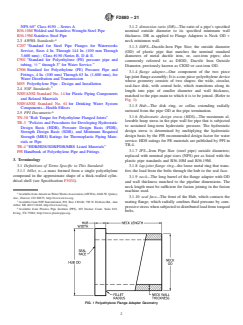
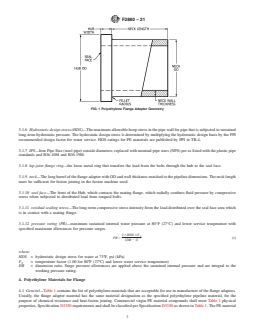
3.1.4 flange adapter—One component of the two piece
Fittings, 4 In. (100 mm) Through 63 In. (1,600 mm), for
lap-jointflangeassembly;Itisaonepiecepolyethylenedevice
Water Distribution and Transmission
whose geometry consists of two shapes: the wide, circular,
M55 Polyethylene Pipe - Design and Installation
seal-face disk, with central hole, which transitions along its
2.4 NSF Standards:
length into pipe of smaller diameter and wall thickness,
NSF/ANSI Standard No. 14for Plastic Piping Components
matched to the pipe-main to which it is to be joined. (Refer to
and Related Materials
Fig. 1).
NSF/ANSI Standard No. 61for Drinking Water System
3.1.5 Hub—The disk ring, or collar, extending radially
Components—Health Effects
outward from the pipe OD at the pipe termination.
2.5 PPI Documents:
3.1.6 Hydrostatic design stress (HDS)—The maximum al-
TN-38“Bolt Torque for Polyethylene Flanged Joints”
lowable hoop stress in the pipe wall for pipe that is subjected
TR-3 “Policies and Procedures for Developing Hydrostatic
to sustained long-term hydrostatic pressure. The hydrostatic
Design Basis (HDB), Pressure Design Basis (PDB),
design stress is determined by multiplying the hydrostatic
Strength Design Basis (SDB), and Minimum Required
design basis by the PPI recommended design factor for water
Strength (MRS) Ratings for Thermoplastic Piping Mate-
service. HDS ratings for PE materials are published by PPI in
rials or Pipe
TR-4.
TR-4“HDB/HDS/SDB/PDB/MRS Listed Materials”
3.1.7 IPS—Iron Pipe Size (steel pipe) outside diameters;
PPIHandbook of Polyethylene Pipe and Fittings
replaced with nominal pipe sizes (NPS) per as listed with the
3. Terminology
plastic pipe standards and B36.10M and B36.19M.
3.1 Definitions of Terms Specific to This Standard: 3.1.8 lap-joint flange ring—the loose metal ring that trans-
3.1.1 billet, n—a mass formed from a single polyethylene
fers the load from the bolts through the hub to the seal face.
compound in the approximate shape of a thick-walled cylin-
3.1.9 neck—The long barrel of the flange adapter with OD
drical shell (see Specification F3034).
and wall thickness matched to the pipeline dimensions. The
neck length must be sufficient for fusion joining in the fusion
machine used.
Available fromAmericanWaterWorksAssociation (AWWA), 6666W. Quincy
3.1.10 seal face—The front of the Hub, which contacts the
Ave., Denver, CO 80235, http://www.awwa.org.
Available from NSF International, P.O. Box 130140, 789 N. Dixboro Rd.,Ann mating flange, which radially confines fluid pressure by com-
Arbor, MI 48113-0140, http://www.nsf.org.
pressivestresswhensubjectedtodistributedloadfromtorqued
Available from Plastics Pipe Institute (PPI), 105 Decker Court, Suite 825,
bolts.
Irving, TX 75062, http://www.plasticpipe.org.
FIG. 1Polyethylene Flange Adapter Geometry
F2880−21
3.1.11 residual sealing stress—The long-term compressive which it is added, and (b) the rework materials complied with
stressintensityfromtheloaddistributedoverthesealfacearea applicable requirements as virgin materials.
which is in contact with a mating flange.
4.4 PotableWater—Materialsusedforproductsintendedfor
3.1.12 pressure rating (PR)—maximum sustained internal
use in the transport of potable water shall be evaluated and
water pressure at 80°F (27°C) and lower service temperature
certifiedassafeforthispurposebyatestingagencyacceptable
with specified maximum allowances for pressure surges.
to the local health authority. The evaluation shall be in
accordance with requirements for chemical extraction, taste,
2 3HDS 3F
T
PR 5 (1)
and odor that are no less restrictive than those included in
DR 21
~ !
NSF/ANSI Standard No. 14 or NSF/ANSI Standard No. 61.
where:
The seal or mark of the laboratory making the evaluation
HDS = hydrostatic design stress for water at 73ºF, psi (kPa)
should be included on the piping per 7.1.3.7.
F = temperature factor (1.00 for 80ºF (27ºC) and lower
T
water service temperature)
5. Flange Adaptor Dimensions and Working Pressure
DR = dimension ratio. Surge pressure allowances are ap-
Ratings
plied above the sustained internal pressure and are
5.1 General—This standard describes 10 dimension ratios
integral to the working pressure rating.
(DR’s) for nominal flange adapter sizes ranging from ⁄4in.
through 65 in. (12 mm through 1600 mm). Flange adapter
4. Polyethylene Materials for Flange
outside diameters (ODs) conform to the outside diameter
4.1 General—Table 1 contains the list of polyethylene
dimensions of iron pipe sizes (IPS), or to equivalent outside
materials that are acceptable for use in manufacture of the
diameters for ductile-iron (DI) pipe (DIPS). Polyethylene
flange adapters. Usually, the flange adapter material has the
flange adapters are classified by dimension ratios (DR’s)
same material designation as the specified polyethylene pipe-
ranging from 7.0 to 32.5. The resultant combinations of PE
line material, for the purpose of chemical resistance and
material designations and DR’s define flange adapters with
heat-fusion joining. Commercial virgin PE material com-
pressure ratings ranging from 40 psig to 333 psig (276 kPa to
pounds shall meet Table 1 physical properties, Specification
2299 kPa) when conveying water at 80ºF (27ºC) and lower
D3350 requirements and shall be classified per Specification
temperatures. Use at temperatures above 80ºF (27ºC) up to
D3350 as shown in Table 1. The PE material compound shall
140ºF (60ºC) is acceptable at pressure ratings that are
have HDB ratings at 73°F (23°C) and at 140°F (60°C) and
appropriately reduced for the service temperature.
HDS ratings at 73°F (23°C) determined in accordance with
5.2 Outsidediameters—TheneckOutsideDiameter(OD)of
Test Method D2837 and PPI TR-3.
the flange adapter measured at 73°F 6 4°F (23°C 6 2°C)
4.2 Color—The PE material in the pipe shall contain color
shall conform to the applicable OD dimension requirements
and ultraviolet (UV) stabilizer meeting the requirements of
specified in the related polyethylene pipe standards : Specifi-
Code C or E per Specification D3350. Code C material shall
cations F714, D2513, D3035, and AWWA C901 and C906.
contain between 2 to 3 percent carbon black by weight.
Measurements shall be made according to the methods speci-
4.3 Rework—Clean rework pipe-grade polyethylene mate- fied in Test Method D2122. The tolerance on outside diameter
rial derived from pipe and or fittings production by the same shall not exceed 60.45 percent of the average outside
manufacturer are acceptable as part of a blend with virgin diameter, as presented in the tables for NPS 4 and larger.
material for the production of flange adapters provided that (a) 5.2.1 Special Sizes—Where existing system conditions or
the cell classification or materials designation code of the special local requirement make other diameters or dimension
reworkmaterialisthesameasthevirginmaterialcompoundto
ratios necessary, other sizes or dimension ratios, or both, shall
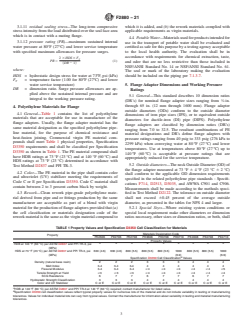
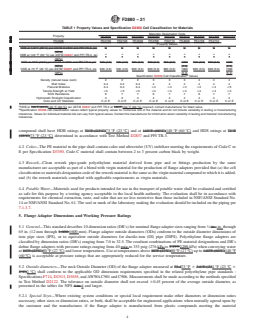
TABLE 1 Property Values and Specification D3350 Cell Classification for Materials
Materials Designation Code
Property
PE2606 PE2706 PE2708 PE3608 PE3708 PE3710 PE4608 PE4708 PE4710
Property Values
AA A A A A A A A
HDB at 140 °F (60 °C) per ASTM D2837 and PPI TR-3, psi
(MPa)
HDS at 73 °F (23 °C) per ASTM D2837 and PPI TR-3, psi 630 (4.6) 630 (4.6) 800 (5.5) 800 (5.5) 800 (5.5) 1000 800 (5.5) 800 (5.5) 1000
(MPa) (6.9) (6.9)
B
Specification D3350 Cell Classification Values
Density (natural base resin) 2 2 2 3 3 3 4 4 4
Melt Index 3-4 3-4 3-4 4 4 4 4 4 4
Flexural Modulus 3-4 3-4 3-4 $4 $4 $4 $4 $4 $5
Tensile Strength at Yield $3 $3 $3 $4 $4 $4 $4 $4 $4
SCG Resistance 6 7 7 6 7 7 6 7 7
Hydrostatic Strength Classification 3 3 3 4 4 4 4 4 4
Color and UV Stabilizer CorE CorE CorE CorE CorE CorE CorE CorE CorE
A
HDB at 140 °F (60 °C) per ASTM D2837 and PPI TR-3 at 140 °F (60 °C) required; contact manufacturer for listed value.
B
Specification D3350 cell classification values reflect typical property values for numerous lots of the material and do not include variability in testing or manufacturing
tolerances. Values for individual material lots can vary from typical values. Contact the manufacturer for information about variability in testing and material manufacturing
tolerances.
F2880−21
be acceptable for engineered applications when mutually moment flexing, to resist pipe beam bending, and to distribute
agreed upon by the customer and the manufacturer, if the concentrated back up ring load across the seal-face. The hub
flange adapter is manufactured from plastic compounds meet- minimum width shall be at least 1.10 times the nominal neck
ing the material requirements of this specification, and the wall thickness for a specified neck DR. Hub width shall be the
strength and design requirements are calculated on the same minimum or thicker, as specified by the Target Hub Width in
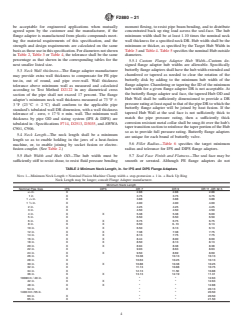
basisasthoseuseinthisspecification.Fordiametersnotshown Table3andTable4.Table5specifiesthenominalHuboutside
in Table 2, Table 3 or Table 4, the tolerance shall be the same diameters.
percentage as that shown in the corresponding tables for the
5.5.1 Custom Flange Adapter Hub Width—Custom de-
next smaller listed size.
signed flange adapter hub widths are allowable. Specifically
butterflyflangeadaptersshallhavethehubwidthextendedand
5.3 Neck Wall thickness—The flange adapter manufacturer
chamfered or tapered as needed to clear the rotation of the
may provide extra wall thickness to compensate for PE pipe
butterfly disk by adding to the minimum hub width of the
toe-in, out of round, and pipe over-wall. Wall thickness
flange adapter. Chamfering or tapering the ID of the minimum
tolerance above minimum wall as measured and calculated
hub width for a given flange adapter DR is not acceptable.At
according to Test Method D2122 in any diametrical cross
the butterfly flange adapter seal face, the tapered Hub OD and
section of the pipe shall not exceed 17 percent. The flange
Hub Wall shall be sufficiently dimensioned to provide a DR
adapter’s minimum neck wall thickness measured at 73°F 6
pressureratingatleastequaltothatofthepipeDRtowhichthe
3°F (23°C 6 2°C) shall conform to the applicable pipe
butterfly flange adapter will be joined by heat fusion. If the
standard’s tabulated wall DR dimension, with a wall thickness
tapered Hub Wall at the seal face is not sufficiently thick to
tolerance of - zero, + 17% × min. wall. The minimum wall
match the pipe pressure rating, then
...
This document is not an ASTM standard and is intended only to provide the user of an ASTM standard an indication of what changes have been made to the previous version. Because
it may not be technically possible to adequately depict all changes accurately, ASTM recommends that users consult prior editions as appropriate. In all cases only the current version
of the standard as published by ASTM is to be considered the official document.
Designation: F2880 − 14 F2880 − 21 An American National Standard
Standard Specification for
Lap-Joint Type Flange Adapters for Polyethylene Pressure
Pipe in Nominal Pipe Sizes ⁄4 in. to 65 in.
This standard is issued under the fixed designation F2880; the number immediately following the designation indicates the year of
original adoption or, in the case of revision, the year of last revision. A number in parentheses indicates the year of last reapproval. A
superscript epsilon (´) indicates an editorial change since the last revision or reapproval.
1. Scope*
1.1 This specification covers the polyethylene material and dimensions applicable to flange adapters (FAs) used to connect
polyethylene pipes to other flanged pipe and components such as valves and flanged fittings. This standard describes outside
diameter controlled polyethylene (PE) pipe flange adapters (FAs) in diameters ranging from ⁄4 in. through 65 in. (12 mm through
1600 mm). The flange adapters may be manufactured by various methods including injection molding, compression molding, and
machining from billet or thick-wall polyethylene pipe.
1.2 The flange adapter (FA) is the principal component of the lap-joint flanged assembly widely used for several decades in
low-pressure to high-pressure polyethylene pipe systems for all types of pressurized flow (gas and liquid) applications. The flange
adapter’s physical shape consists of the pipe-like Neck which is monolithic with its Hub. The Neck is intended to be butt-fused
or fusion coupled to the pipe-line; while the Hub face is intended to affect the seal when subjected to the distributed load from
the back up ring with its properly torqued bolt-studs and nuts.
NOTE 1—Polyethylene pipe flange adapters with slip on bolt rings are intended for use being bolted to each other or to be bolted to metal flanges having
(primarily) Class 150 bolt hole patterns such as those presented in metal flange standards ASME B16.5, ASME B16.47 and AWWA C207.
1.3 The values stated in inch-pound units are to be regarded as standard. The values given in parentheses are mathematical
conversions to SI units that are provided for information only and are not considered standard.
1.4 The use of gaskets and gasket selection are often an integral component of the flange adapter assembly. See the Plastic Pipe
Institute Technical Note TN-38 for more information regarding HDPE flanged joints.
1.5 This standard does not purport to address all of the safety concerns, if any, associated with its use. It is the responsibility
of the user of this standard to establish appropriate safety safety, health, and healthenvironmental practices and determine the
applicability of regulatory limitations prior to use.
1.6 This international standard was developed in accordance with internationally recognized principles on standardization
established in the Decision on Principles for the Development of International Standards, Guides and Recommendations issued
by the World Trade Organization Technical Barriers to Trade (TBT) Committee.
2. Referenced Documents
2.1 ASTM Standards:
This specification is under the jurisdiction of ASTM Committee F17 on Plastic Piping Systems and is the direct responsibility of Subcommittee F17.10 on Fittings.
Current edition approved May 1, 2014Nov. 1, 2021. Published June 2014January 2022. Originally approved in 2011. Last previous edition approved in 20112014 as
F2880–11a.–14. DOI: 10.1520/F2880-14.10.1520/F2880-21.
For referenced ASTM standards, visit the ASTM website, www.astm.org, or contact ASTM Customer Service at service@astm.org. For Annual Book of ASTM Standards
volume information, refer to the standard’s Document Summary page on the ASTM website.
*A Summary of Changes section appears at the end of this standard
Copyright © ASTM International, 100 Barr Harbor Drive, PO Box C700, West Conshohocken, PA 19428-2959. United States
F2880 − 21
D2122 Test Method for Determining Dimensions of Thermoplastic Pipe and Fittings
D2513 Specification for Polyethylene (PE) Gas Pressure Pipe, Tubing, and Fittings
D2837 Test Method for Obtaining Hydrostatic Design Basis for Thermoplastic Pipe Materials or Pressure Design Basis for
Thermoplastic Pipe Products
D3035 Specification for Polyethylene (PE) Plastic Pipe (DR-PR) Based on Controlled Outside Diameter
D3261 Specification for Butt Heat Fusion Polyethylene (PE) Plastic Fittings for Polyethylene (PE) Plastic Pipe and Tubing
D3350 Specification for Polyethylene Plastics Pipe and Fittings Materials
F714 Specification for Polyethylene (PE) Plastic Pipe (DR-PR) Based on Outside Diameter
F2206 Specification for Fabricated Fittings of Butt-Fused Polyethylene (PE)
F3034 Specification for Billets made by Winding Molten Extruded Stress-Rated High Density Polyethylene (HDPE)
2.2 ASME Standards:
B16.5 “Pipe Flanges and Flanged Fittings”
B16.47 “Large Diameter Steel Flanges: NPS 26 through NPS 60” Class #150 – Series A
B36.10M Welded and Seamless Wrought Steel Pipe
B36.19M Stainless Steel Pipe
2.3 AWWA Standards:
C207 “Standard for Steel Pipe Flanges for Waterworks Service, Sizes 4 In. Through 144 In. (100 mm Through 3,600 mm) ; Class
#150 /Series B, D & E.
C901 “Standard for Polyethylene (PE) pressure pipe and tubing, ⁄2 ” through 3” for Water Service.”
C906 Standard for Polyethylene (PE) Pressure Pipe and Fittings, 4 In. (100 mm) Through 63 In. (1,600 mm), for Water
Distribution and Transmission
M55 Polyethylene Pipe - Design and Installation
2.4 NSF Standards:
NSF/ANSI Standard No. 14 for Plastic Piping Components and Related Materials
NSF/ANSI Standard No. 61 for Drinking Water System Components—Health Effects
2.5 PPI Documents:
TN-38 “Bolt Torque for Polyethylene Flanged Joints”
TR-3 “Policies and Procedures for Developing Hydrostatic Design Basis (HDB), Pressure Design Basis (PDB), Strength Design
Basis (SDB), and Minimum Required Strength (MRS) Ratings for Thermoplastic Piping Materials or Pipe
TR-4 “HDB/HDS/SDB/PDB/MRS Listed Materials”
PPI Handbook of Polyethylene Pipe and Fittings
3. Terminology
3.1 Definitions of Terms Specific to This Standard:
3.1.1 billet, n—a mass formed from a single polyethylene compound in the approximate shape of a thick-walled cylindrical shell
(see Specification F3034).
3.1.2 dimension ratio (DR)—The ratio of a pipe’s specified nominal outside diameter to its specified minimum wall thickness. DR
as applied to Flange Adapters is Neck OD ÷ neck minimum wall.
3.1.3 DIPS—Ductile-Iron Pipe Size; the outside diameter (OD) of plastic pipe that matches the nominal standard diameters of
metal ductile iron, or, cast-iron pipes; also commonly referred to as DIOD, Ductile Iron Outside Diameter, previously known as
CIOD or cast-iron OD.
3.1.4 flange adapter—One component of the two piece lap-joint flange assembly; It is a one piece polyethylene device whose
geometry consists of two shapes: the wide, circular, seal-face disk, with central hole, which transitions along its length into pipe
of smaller diameter and wall thickness, matched to the pipe-main to which it is to be joined. (Refer to Fig. 1).
3.1.5 Hub—The disk ring, or collar, extending radially outward from the pipe OD at the pipe termination.
Available from American Society of Mechanical Engineers (ASME), ASME International Headquarters, ThreeTwo Park Ave., New York, NY 10016-5990,
http://www.asme.org.
Available from American Water Works Association (AWWA), 6666 W. Quincy Ave., Denver, CO 80235, http://www.awwa.org.
Available from NSF International, P.O. Box 130140, 789 N. Dixboro Rd., Ann Arbor, MI 48113-0140, http://www.nsf.org.
Available from Plastics Pipe Institute (PPI), 105 Decker Court, Suite 825, Irving, TX 75062, http://www.plasticpipe.org.
F2880 − 21
FIG. 1 Polyethylene Flange Adapter Geometry
3.1.6 Hydrostatic design stress (HDS)—The maximum allowable hoop stress in the pipe wall for pipe that is subjected to sustained
long-term hydrostatic pressure. The hydrostatic design stress is determined by multiplying the hydrostatic design basis by the PPI
recommended design factor for water service. HDS ratings for PE materials are published by PPI in TR-4.
3.1.7 IPS—Iron Pipe Size (steel pipe) outside diameters; replaced with nominal pipe sizes (NPS) per as listed with the plastic pipe
standards and B36.10M and B36.19M.
3.1.8 lap-joint flange ring—the loose metal ring that transfers the load from the bolts through the hub to the seal face.
3.1.9 neck—The long barrel of the flange adapter with OD and wall thickness matched to the pipeline dimensions. The neck length
must be sufficient for fusion joining in the fusion machine used.
3.1.10 seal face—The front of the Hub, which contacts the mating flange, which radially confines fluid pressure by compressive
stress when subjected to distributed load from torqued bolts.
3.1.11 residual sealing stress—The long-term compressive stress intensity from the load distributed over the seal face area which
is in contact with a mating flange.
3.1.12 pressure rating (PR)—maximum sustained internal water pressure at 80°F (27°C) and lower service temperature with
specified maximum allowances for pressure surges.
23HDS 3F
T
PR 5 (1)
DR 2 1
~ !
where:
HDS = hydrostatic design stress for water at 73ºF, psi (kPa)
F = temperature factor (1.00 for 80ºF (27ºC) and lower water service temperature)
T
DR = dimension ratio. Surge pressure allowances are applied above the sustained internal pressure and are integral to the
working pressure rating.
4. Polyethylene Materials for Flange
4.1 General—Table 1 contains the list of polyethylene materials that are acceptable for use in manufacture of the flange adapters.
Usually, the flange adapter material has the same material designation as the specified polyethylene pipeline material, for the
purpose of chemical resistance and heat-fusion joining. Commercial virgin PE material compounds shall meet Table 1 physical
properties, Specification D3350 requirements and shall be classified per Specification D3350 as shown in Table 1. The PE material
F2880 − 21
TABLE 1 Property Values and Specification D3350 Cell Classification for Materials
Materials Designation Code
Property
A A A
PE2606 PE2706 PE2708 PE3608 PE3708 PE3710 PE4608 PE4708 PE4710
PE2606 PE2706 PE2708 PE3608 PE3708 PE3710 PE4608 PE4708 PE4710
Property Values
HDB at 140°F (60°C) per ASTM D 2837 and PPI TR-3, psi C C C C C C C C C
(MPa)
A A A A A A A A A
HDB at 140 °F (60 °C) per ASTM D2837 and PPI TR-3, psi
(MPa)
HDS at 73°F (23°C) per ASTM D 2837 and PPI TR-3, psi 630 (4.6) 630 (4.6) 800 (5.5) 800 (5.5) 800 (5.5) 1000 800 (5.5) 800 (5.5) 1000
(MPa) (6.9) (6.9)
HDS at 73 °F (23 °C) per ASTM D2837 and PPI TR-3, psi 630 (4.6) 630 (4.6) 800 (5.5) 800 (5.5) 800 (5.5) 1000 800 (5.5) 800 (5.5) 1000
(MPa) (6.9) (6.9)
B
Specification D3350 Cell Classification Values
Density (natural base resin) 2 2 2 3 3 3 4 4 4
Melt Index 3-4 3-4 3-4 4 4 4 4 4 4
Flexural Modulus 3-4 3-4 3-4 $4 $4 $4 $4 $4 $5
Tensile Strength at Yield $3 $3 $3 $4 $4 $4 $4 $4 $4
SCG Resistance 6 7 7 6 7 7 6 7 7
Hydrostatic Strength Classification 3 3 3 4 4 4 4 4 4
Color and UV Stabilizer C or E C or E C or E C or E C or E C or E C or E C or E C or E
A
HDB at 140°F (60°C)140 °F (60 °C) per ASTM D2837 and PPI TR-3 at 140°F 140 °F (60 °C) required; contact manufacturer for listed value.
B
Specification D3350 cell classification values reflect typical property values for numerous lots of the material and do not include variability in testing or manufacturing
tolerances. Values for individual material lots can vary from typical values. Contact the manufacturer for information about variability in testing and material manufacturing
tolerances.
compound shall have HDB ratings at 73°F (23°C)73 °F (23 °C) and at 140°F (60°C)140 °F (60 °C) and HDS ratings at 73°F
(23°C)73 °F (23 °C) determined in accordance with Test Method D2837 and PPI TR-3.
4.2 Color—The PE material in the pipe shall contain color and ultraviolet (UV) stabilizer meeting the requirements of Code C or
E per Specification D3350. Code C material shall contain between 2 to 3 percent carbon black by weight.
4.3 Rework—Clean rework pipe-grade polyethylene material derived from pipe and or fittings production by the same
manufacturer are acceptable as part of a blend with virgin material for the production of flange adapters provided that (a) the cell
classification or materials designation code of the rework material is the same as the virgin material compound to which it is added,
and (b) the rework materials complied with applicable requirements as virgin materials.
4.4 Potable Water—Materials used for products intended for use in the transport of potable water shall be evaluated and certified
as safe for this purpose by a testing agency acceptable to the local health authority. The evaluation shall be in accordance with
requirements for chemical extraction, taste, and odor that are no less restrictive than those included in NSF/ANSI Standard No.
14 or NSF/ANSI Standard No. 61. The seal or mark of the laboratory making the evaluation should be included on the piping per
7.1.3.7.
5. Flange Adaptor Dimensions and Working Pressure Ratings
5.1 General—This standard describes 10 dimension ratios (DR’s) for nominal flange adapter sizes ranging from ⁄4 in. in. through
65 in. (12 mm through 1 600 1600 mm). Flange adapter outside diameters (ODs) conform to the outside diameter dimensions of
iron pipe sizes (IPS), or to equivalent outside diameters for ductile-iron (DI) pipe (DIPS). Polyethylene flange adapters are
classified by dimension ratios (DR’s) ranging from 7.0 to 32.5. The resultant combinations of PE material designations and DR’s
define flange adapters with pressure ratings ranging from 40 psig to 333 psig (276 kPa to 2 299 2299 kPa) when conveying water
at 80ºF (27ºC)80 ºF (27 ºC) and lower temperatures. Use at temperatures above 80ºF (27ºC)80 ºF (27 ºC) up to 140ºF (60ºC)140 ºF
(60 ºC) is acceptable at pressure ratings that are appropriately reduced for the service temperature.
5.2 Outside diameters—The neck Outside Diameter (OD) of the flange adapter measured at 73.473 °F 6 3.6°F (234 °F (23 °C 6
2°C)2 °C) shall conform to the applicable OD dimension requirements specified in the related polyethylene pipe standards :
Specifications F714, D2513, D3035, and AWWA C901 and C906. Measurements shall be made according to the methods specified
in Test Method D2122. The tolerance on outside diameter shall not exceed 60.45 percent of the average outside diameter, as
presented in the tables for NPS 4-in.4 and larger.
5.2.1 Special Sizes—Where existing system conditions or special local requirement make other diameters or dimension ratios
necessary, other sizes or dimension ratios, or both, shall be acceptable for engineered applications when mutually agreed upon by
the customer and the manufacturer, if the flange adapter is manufactured from plastic compounds meeting the material
F2880 − 21
requirements of this specification, and the strength and design requirements are calculated on the same basis as those use in this
specification. For diameters not shown in Table 2, Table 3 or Table 4, the tolerance shall be the same percentage as that shown
in the corresponding tables for the next smaller listed size.
5.3 Neck Wall thickness—The flange adapter manufacturer may provide extra wall thickness to compensate for PE pipe toe-in, out
of round, and pipe over-wall. Wall thickness tolerance above minimum wall as measured and calculated according to Test Method
D2122 in any diametrical cross section of the pipe shall not exceed 17 percent. The flange adapter’s minimum neck wall thickness
measured at 73.473 °F 6 3.6ºF (233 °F (23 °C 6 2ºC)2 °C) shall conform to the applicable pipe standard’s tabulated wall DR
dimension, with a wall thickness tolerance of - zero, + 17%17 % × min. wall. The minimum wall thickness by pipe OD and sizing
system (IPS & DIPS) are tabulated in : Specifications F714, D2513, D3035, and AWWA C901, C906.
5.4 Neck Length—The neck length shall be a minimum length so as to enable holding in the jaws of a heat-fusion machine, or,
to enable joining by socket fusion or electro-fusion coupler. (See Table 2.)
5.5 Hub Width and Hub OD—The hub width must be sufficiently stiff to resist shear, to resist fluid pressure bending moment
flexing, to resist pipe beam bending, and to distribute concentrated back up ring load across the seal-face. The hub minimum width
shall be at least 1.10 times the nominal neck wall thickness for a specified neck DR. The ratio of the hub width to neck wall
thickness may exceed 1.5 when a lower DR flange adapter is machined into a thinner wall, higher DR flange adapter. Hub width
mayHub width shall be the minimum or thicker, as specified by the Target Hub Width in Table 3 and Table 4. Table 5 specifies
the nominal Hub outside diameters.
5.5.1 Custom Flange Adapter Hub Width—Custom designed flange adapter hub widths are allowable. Specifically butterfly flange
adapters shall have the hub width extended and chamfered or tapered as needed to clear the rotation of the butter
...