


ASTM D1795-13(2021)
(Test Method)Standard Test Method for Intrinsic Viscosity of Cellulose
Standard Test Method for Intrinsic Viscosity of Cellulose
SIGNIFICANCE AND USE
4.1 This test is a sensitive measure of the degradation of cellulose resulting from the action of heat, light, acids, alkalies, oxidizing and reducing agents, and the like, used in its processing or purification. The intrinsic viscosity value may be converted to degree of polymerization (DP) or to intrinsic fluidity, if desired.
4.2 Solutions of cellulose are not Newtonian liquids; that is, their viscosity depends upon the rate-of-shear or velocity gradient during measurement. This effect is smaller for samples of low molecular mass (DP) and at low concentrations than for high-DP samples and at high concentrations. For the celluloses and concentrations included within the limits set forth in this test method, the effect of rate-of-shear is assumed to be negligible for referee purposes. For other conditions and for research purposes this assumption may be invalid, but to discuss ways of accounting for this effect is beyond the scope of the present test method.
SCOPE
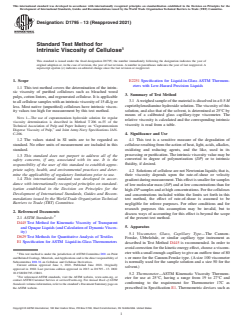
1.1 This test method covers the determination of the intrinsic viscosity of purified celluloses such as bleached wood pulps, cotton linters, and regenerated cellulose. It is applicable to all cellulose samples with an intrinsic viscosity of 15 dL/g or less. Most native (unpurified) celluloses have intrinsic viscosity values too high for measurement by this test method.
Note 1: The use of cuprammonium hydroxide solution for regular viscosity determination is described in Method T 206 m-55 of the Technical Association of Pulp and Paper Industry on “Cuprammonium Disperse Viscosity of Pulp,” and Joint Army-Navy Specifications JAN-C-206.
1.2 The values stated in SI units are to be regarded as standard. No other units of measurement are included in this standard.
1.3 This standard does not purport to address all of the safety concerns, if any, associated with its use. It is the responsibility of the user of this standard to establish appropriate safety, health, and environmental practices and determine the applicability of regulatory limitations prior to use.
1.4 This international standard was developed in accordance with internationally recognized principles on standardization established in the Decision on Principles for the Development of International Standards, Guides and Recommendations issued by the World Trade Organization Technical Barriers to Trade (TBT) Committee.
General Information
- Status
- Published
- Publication Date
- 31-May-2021
- Technical Committee
- D01 - Paint and Related Coatings, Materials, and Applications
- Drafting Committee
- D01.36 - Cellulose and Cellulose Derivatives
Relations
- Effective Date
- 01-Apr-2024
- Effective Date
- 01-Nov-2023
- Effective Date
- 15-Dec-2016
- Effective Date
- 01-Feb-2015
- Effective Date
- 01-Jul-2014
- Effective Date
- 01-Jul-2014
- Effective Date
- 01-May-2013
- Effective Date
- 15-Apr-2012
- Effective Date
- 01-May-2011
- Effective Date
- 01-Nov-2010
- Effective Date
- 01-Aug-2008
- Effective Date
- 01-Nov-2007
- Effective Date
- 01-Nov-2007
- Effective Date
- 15-May-2006
- Effective Date
- 01-Nov-2005
Overview
ASTM D1795-13(2021) is the internationally-recognized standard test method for determining the intrinsic viscosity of purified cellulose materials. Developed and published by ASTM International, this method is crucial for assessing the condition and quality of cellulose products by providing a sensitive measure of their degradation due to heat, light, chemical agents, or mechanical processing.
This test method primarily applies to purified celluloses such as bleached wood pulps, cotton linters, and regenerated cellulose, with intrinsic viscosities up to 15 dL/g. It is not suitable for most native, unpurified celluloses, which typically exceed this intrinsic viscosity threshold.
Key Topics
- Intrinsic Viscosity Measurement: Offers a precise evaluation of cellulose degradation. Intrinsic viscosity reflects the molecular size and overall structural integrity of the cellulose polymer, which is vital for quality control and research.
- Testing Range: Applicable to cellulose samples with intrinsic viscosities of 15 dL/g or less.
- Viscometric Principles: The viscosity of cellulose solutions is determined using capillary-type viscometers at 25°C in a controlled environment. The use of specialized solvents, such as cupriethylenediamine hydroxide, is essential for complete dissolution and accurate measurement.
- Non-Newtonian Nature of Cellulose Solutions: Acknowledges that viscosity may vary with shear rate but assumes this effect is negligible for referee purposes within the specified testing limits.
- Data Utilization: Intrinsic viscosity values can be converted to the degree of polymerization (DP) or expressed as intrinsic fluidity, enhancing the relevance and usability of the results for broader applications.
Applications
- Quality Control in Cellulose Manufacturing: Ensures product consistency and performance in pulp, textile, paper, and regenerated cellulose industries by monitoring molecular integrity.
- Assessment of Processing Effects: Detects degradation caused by processing conditions, including thermal, chemical, and mechanical treatments, enabling optimization and validation of manufacturing processes.
- R&D and Product Development: Provides a foundation for comparing new cellulose materials, blends, or purification methods to established benchmarks.
- Material Compliance and Certification: Facilitates industry-wide acceptance and regulatory compliance by adhering to a standardized approach recognized under the World Trade Organization’s TBT framework.
Typical use cases include:
- Pulp and paper mills validating raw material or finished goods quality.
- Textile manufacturers assessing cotton linters or rayon.
- Laboratories investigating environmental or chemical impacts on cellulose polymers.
Related Standards
For comprehensive quality assurance and cross-referencing, related standards include:
- ASTM D445 - Standard Test Method for Kinematic Viscosity of Transparent and Opaque Liquids.
- ASTM D629 - Standard Test Methods for Quantitative Analysis of Textiles.
- ASTM E1 - Specification for ASTM Liquid-in-Glass Thermometers.
- ASTM E2251 - Specification for Liquid-in-Glass ASTM Thermometers with Low-Hazard Precision Liquids.
- TAPPI Method T 206 m-55 - Cuprammonium Disperse Viscosity of Pulp.
- Joint Army-Navy Specifications JAN-C-206 for related pulp viscosity determinations.
Practical Value
Implementing ASTM D1795-13(2021) provides:
- Reliable, reproducible measurement of intrinsic viscosity in cellulose, strengthening quality assurance protocols and supporting research innovation.
- International harmonization - Ensures consistent terminology, procedures, and reporting for global commerce and collaboration.
- Support for regulatory and customer requirements in industries dependent on high-quality cellulose materials.
By following ASTM D1795-13(2021), stakeholders gain actionable insights into cellulose quality, enabling improved product performance, reduced waste, and enhanced competitiveness in the global marketplace.
Keywords: ASTM D1795-13, intrinsic viscosity, cellulose, cellulose degradation, quality control, pulp testing, regenerated cellulose, polymerization degree, viscometry.
Get Certified
Connect with accredited certification bodies for this standard

Control Union Certifications
Global certification for agriculture and sustainability.

Gozdarski inštitut Slovenije
Slovenian Forestry Institute. Forest management certification support, timber testing.
Sponsored listings
Frequently Asked Questions
ASTM D1795-13(2021) is a standard published by ASTM International. Its full title is "Standard Test Method for Intrinsic Viscosity of Cellulose". This standard covers: SIGNIFICANCE AND USE 4.1 This test is a sensitive measure of the degradation of cellulose resulting from the action of heat, light, acids, alkalies, oxidizing and reducing agents, and the like, used in its processing or purification. The intrinsic viscosity value may be converted to degree of polymerization (DP) or to intrinsic fluidity, if desired. 4.2 Solutions of cellulose are not Newtonian liquids; that is, their viscosity depends upon the rate-of-shear or velocity gradient during measurement. This effect is smaller for samples of low molecular mass (DP) and at low concentrations than for high-DP samples and at high concentrations. For the celluloses and concentrations included within the limits set forth in this test method, the effect of rate-of-shear is assumed to be negligible for referee purposes. For other conditions and for research purposes this assumption may be invalid, but to discuss ways of accounting for this effect is beyond the scope of the present test method. SCOPE 1.1 This test method covers the determination of the intrinsic viscosity of purified celluloses such as bleached wood pulps, cotton linters, and regenerated cellulose. It is applicable to all cellulose samples with an intrinsic viscosity of 15 dL/g or less. Most native (unpurified) celluloses have intrinsic viscosity values too high for measurement by this test method. Note 1: The use of cuprammonium hydroxide solution for regular viscosity determination is described in Method T 206 m-55 of the Technical Association of Pulp and Paper Industry on “Cuprammonium Disperse Viscosity of Pulp,” and Joint Army-Navy Specifications JAN-C-206. 1.2 The values stated in SI units are to be regarded as standard. No other units of measurement are included in this standard. 1.3 This standard does not purport to address all of the safety concerns, if any, associated with its use. It is the responsibility of the user of this standard to establish appropriate safety, health, and environmental practices and determine the applicability of regulatory limitations prior to use. 1.4 This international standard was developed in accordance with internationally recognized principles on standardization established in the Decision on Principles for the Development of International Standards, Guides and Recommendations issued by the World Trade Organization Technical Barriers to Trade (TBT) Committee.
SIGNIFICANCE AND USE 4.1 This test is a sensitive measure of the degradation of cellulose resulting from the action of heat, light, acids, alkalies, oxidizing and reducing agents, and the like, used in its processing or purification. The intrinsic viscosity value may be converted to degree of polymerization (DP) or to intrinsic fluidity, if desired. 4.2 Solutions of cellulose are not Newtonian liquids; that is, their viscosity depends upon the rate-of-shear or velocity gradient during measurement. This effect is smaller for samples of low molecular mass (DP) and at low concentrations than for high-DP samples and at high concentrations. For the celluloses and concentrations included within the limits set forth in this test method, the effect of rate-of-shear is assumed to be negligible for referee purposes. For other conditions and for research purposes this assumption may be invalid, but to discuss ways of accounting for this effect is beyond the scope of the present test method. SCOPE 1.1 This test method covers the determination of the intrinsic viscosity of purified celluloses such as bleached wood pulps, cotton linters, and regenerated cellulose. It is applicable to all cellulose samples with an intrinsic viscosity of 15 dL/g or less. Most native (unpurified) celluloses have intrinsic viscosity values too high for measurement by this test method. Note 1: The use of cuprammonium hydroxide solution for regular viscosity determination is described in Method T 206 m-55 of the Technical Association of Pulp and Paper Industry on “Cuprammonium Disperse Viscosity of Pulp,” and Joint Army-Navy Specifications JAN-C-206. 1.2 The values stated in SI units are to be regarded as standard. No other units of measurement are included in this standard. 1.3 This standard does not purport to address all of the safety concerns, if any, associated with its use. It is the responsibility of the user of this standard to establish appropriate safety, health, and environmental practices and determine the applicability of regulatory limitations prior to use. 1.4 This international standard was developed in accordance with internationally recognized principles on standardization established in the Decision on Principles for the Development of International Standards, Guides and Recommendations issued by the World Trade Organization Technical Barriers to Trade (TBT) Committee.
ASTM D1795-13(2021) is classified under the following ICS (International Classification for Standards) categories: 85.040 - Pulps. The ICS classification helps identify the subject area and facilitates finding related standards.
ASTM D1795-13(2021) has the following relationships with other standards: It is inter standard links to ASTM D445-24, ASTM D445-23, ASTM D445-16, ASTM D629-15, ASTM D445-14e1, ASTM D445-14, ASTM E1-13, ASTM D445-12, ASTM E2251-11, ASTM E2251-10, ASTM D629-08, ASTM E2251-07, ASTM E1-07, ASTM D445-06, ASTM E1-05. Understanding these relationships helps ensure you are using the most current and applicable version of the standard.
ASTM D1795-13(2021) is available in PDF format for immediate download after purchase. The document can be added to your cart and obtained through the secure checkout process. Digital delivery ensures instant access to the complete standard document.
Standards Content (Sample)
This international standard was developed in accordance with internationally recognized principles on standardization established in the Decision on Principles for the
Development of International Standards, Guides and Recommendations issued by the World Trade Organization Technical Barriers to Trade (TBT) Committee.
Designation: D1795 − 13 (Reapproved 2021)
Standard Test Method for
Intrinsic Viscosity of Cellulose
This standard is issued under the fixed designation D1795; the number immediately following the designation indicates the year of
original adoption or, in the case of revision, the year of last revision.Anumber in parentheses indicates the year of last reapproval.A
superscript epsilon (´) indicates an editorial change since the last revision or reapproval.
1. Scope E2251Specification for Liquid-in-Glass ASTM Thermom-
eters with Low-Hazard Precision Liquids
1.1 This test method covers the determination of the intrin-
sic viscosity of purified celluloses such as bleached wood
3. Summary of Test Method
pulps, cotton linters, and regenerated cellulose. It is applicable
3.1 Aweighedsampleofthematerialisdissolvedina0.5M
toallcellulosesampleswithanintrinsicviscosityof15dL/gor
cupriethylenediamine hydroxide solution.The viscosity of this
less. Most native (unpurified) celluloses have intrinsic viscos-
solution, and also that of the solvent, is determined at 25°C by
ity values too high for measurement by this test method.
means of a calibrated glass capillary-type viscometer. The
NOTE 1—The use of cuprammonium hydroxide solution for regular
relative viscosity is calculated and the corresponding intrinsic
viscosity determination is described in Method T206 m-55 of the
viscosity is read from a table.
Technical Association of Pulp and Paper Industry on “Cuprammonium
Disperse Viscosity of Pulp,” and Joint Army-Navy Specifications JAN-
C-206. 4. Significance and Use
1.2 The values stated in SI units are to be regarded as
4.1 This test is a sensitive measure of the degradation of
standard. No other units of measurement are included in this
celluloseresultingfromtheactionofheat,light,acids,alkalies,
standard. oxidizing and reducing agents, and the like, used in its
processingorpurification.Theintrinsicviscosityvaluemaybe
1.3 This standard does not purport to address all of the
converted to degree of polymerization (DP) or to intrinsic
safety concerns, if any, associated with its use. It is the
fluidity, if desired.
responsibility of the user of this standard to establish appro-
priate safety, health, and environmental practices and deter-
4.2 SolutionsofcellulosearenotNewtonianliquids;thatis,
mine the applicability of regulatory limitations prior to use.
their viscosity depends upon the rate-of-shear or velocity
1.4 This international standard was developed in accor-
gradientduringmeasurement.Thiseffectissmallerforsamples
dance with internationally recognized principles on standard-
oflowmolecularmass(DP)andatlowconcentrationsthanfor
ization established in the Decision on Principles for the
high-DPsamplesandathighconcentrations.Forthecelluloses
Development of International Standards, Guides and Recom-
and concentrations included within the limits set forth in this
mendations issued by the World Trade Organization Technical
test method, the effect of rate-of-shear is assumed to be
Barriers to Trade (TBT) Committee.
negligible for referee purposes. For other conditions and for
research purposes this assumption may be invalid, but to
2. Referenced Documents
discuss ways of accounting for this effect is beyond the scope
2.1 ASTM Standards: of the present test method.
D445Test Method for Kinematic Viscosity of Transparent
5. Apparatus
and Opaque Liquids (and Calculation of DynamicViscos-
ity)
5.1 Viscometer, Glass, Capillary Type—The Cannon-
D629Test Methods for Quantitative Analysis of Textiles
Fenske, Ubbelohde, or similar capillary type instrument as
E1Specification for ASTM Liquid-in-Glass Thermometers
described in Test Method D445 is recommended. In order to
avoidcorrectionforthekineticenergyeffect,chooseaviscom-
eterwithasmallenoughcapillarytogiveanoutflowtimeof80
This test method is under the jurisdiction of ASTM Committee D01 on Paint
s or more for the Cannon-Fenske type. (Asize 100 viscometer
and Related Coatings, Materials, andApplications and is the direct responsibility of
Subcommittee D01.36 on Cellulose and Cellulose Derivatives.
is normally used for the sample solution and a size 50 for the
Current edition approved June 1, 2021. Published June 2021. Originally
solvent.)
approved in 1960. Last previous edition approved in 2013 as D1795–13. DOI:
10.1520/D1795-13R21.
5.2 Thermometer—ASTM Kinematic Viscosity Thermom-
For referenced ASTM standards, visit the ASTM website, www.astm.org, or
eter for use at 25°C, having a range from 19 to 27°C and
contact ASTM Customer Service at service@astm.org. For Annual Book of ASTM
conforming to the requirement for Thermometer 17C as
Standards volume information, refer to the standard’s Document Summary page on
the ASTM website. prescribed in Specification E1. Thermometric devices such as
Copyright © ASTM International, 100 Barr Harbor Drive, PO Box C700, West Conshohocken, PA 19428-2959. United States
D1795 − 13 (2021)
TABLE 1 Viscosity Oil Standards
RTDs, thermistors and liquid-in-glass thermometers (as speci-
fied in Specification E2251) of equal or better accuracy in the Viscometer Viscosity Oil Standard
Approximate
specified temperature range, may be used.
Absolute Viscosity
Size Designation Absolute Viscosity
A
Range, cP
at 25°C, cP
5.3 Bath—Aconstant-temperature bath at 25°C suitable for
50 0.9to3.5 S-3 3.3
immersion of the viscometer so that the reservoir or the top of
100 3.3 to 13.3 S-6 7.7
the capillary, whichever is uppermost, is immersed at least 50
A
For solution with density of 0.9.
mm, and with provision for visibility of the instrument and the
thermometer. Firm supports for the viscometer shall be pro-
vided; or the viscometer may be sealed in as an integral part of
having known viscosities approximately equal to those of the
the bath. Either a liquid bath with thermostatic regulation and
solvent and cellulose solutions respectively (1.2 and 12 cP,
astirreroravaporbathwithpressureregulationispermissible.
approximately).
The efficiency of the stirring and the balance between heat
losses and heat input must be such that the temperature of the
NOTE 3—Detailed specifications and directions for filling, calibrating,
and measurement with types of capillary viscometers most used are given
bath medium does not vary by more than 60.1°C over the
in Test Method D445.
length of the viscometer, or from viscometer to viscometer in
NOTE4—Calibrationoftheviscometersmaybeavoidedifbothsolvent
the various bath positions. If a vapor bath is used, there must
and solution are measured in the same instrument. Then the relative
be no temperature gradient over the length of the viscometer
viscosity is nearly the ratio of outflow times for solution and solvent,
greater than that permitted in a liquid bath.
respectively. This simplification involves two assumptions. The first, that
the densities of solution and solvent are equal, holds very well for the
5.4 Timer—A stop watch or other spring-activated timing
dilute solutions used in these tests. The second, that the kinetic energy
device or electrical timing device shall be used, graduated in
correction is zero, depends upon the choice of viscometer. If the one used
divisions of 0.2 s or less, and accurate to within 0.05% when
gives convenient outflow times for the solution of less than 150 s, then it
will be too fast for the solvent. The kinetic energy correction is zero,
tested over not less than a 10-min period. Such electrical
depending upon flow. On the other hand, if one is chosen so that the
timing devices shall be used only on electrical circuits of
outflow time for the solvent is large enough (80 s or more), then the times
continuously controlled frequency. Frequency-controlled de-
for the solutions will in most cases be inconveniently long. For some
vices of suitable capacity for laboratory purposes, accurate to
work, however, it may be desirable to make some sacrifice in accuracy or
within 1 part in 10 000 should be used. Errors exceeding
in convenience during measurement in order to avoid calibration and
using two sizes of viscometers.
0.05% of a 10-min interval may occur in timing devices
actuated by electrical synchronous motors driven by most
8.2 Bymeansofapipet,add7.0mLofthecalibratingliquid
public power systems, which are intermittently and not con-
totheviscometer,inaconstant-temperaturebathat25 60.1°C
tinuously controlled.
(or fill as described in Test Method D445, Appendix A).
8.3 When the liquid has reached temperature equilibrium
6. Reagent
with the bath (in about 5 min), determine the outflow time t by
6.1 Cupriethylenediamine Hydroxide Solution (1.00 6 0.01
drawingthetopmeniscusoftheliquidabovethemarkbetween
M), in copper, with the molar ratio of ethylenediamine to
thetwobulbsandmeasuringthetimerequiredforthemeniscus
copper of 2 6 0.1 to 1. This solvent may be prepared in the
to pass from this mark to the mark below the lower bulb. Take
laboratory. It is also commercially available.
the average of two or more observations, which should differ
by not more than 0.2 s.
7. Reference Materials
8.4 Determine the viscometer constant C by the equation:
7.1 Viscosity Oil Standards—Calibrating oils in the speci-
C 5 η/dt (1)
fiedrangesofviscosity. Aqueoussolutionsofglycerolmaybe
used instead of standardized oils; the compositions for various
where:
viscosities are given in chemical handbooks. The applicable
η = viscosity of the calibrating liquid, cP,
viscosity oil standards (Note 2) are listed in Table 1.
d = density, g/mL, and
t = time, s.
NOTE 2—The viscosity oil standards are available only as 4.7-m (1-pt)
samples. More than 1 pt of any given oil (for example, duplicate samples)
are supplied only when it is established that 1 pt is inadequate.
9. Preparation of Sample
9.1 To avoid undesirable effects from long heating at high
8. Calibration of Viscometer
temperature, samples should be air-dried and the moisture
8.1 The following directions apply to the Cannon-Fenske
content determined on a portion that is not used for measure-
viscometer(Note3).Theyshouldbemodifiedaccordingtothe
ment of viscosity. The mass of air-dried samples is then
operating instructions for other types of viscometers. The
corrected for moisture to obtain the mass of oven-dried
viscometers shall be calibrated (Note 4) by means of liquids
cellulose used to calculate concentration.
9.2 Soft, sheeted pulp should be picked apart with tweezers
Thesolesourceofsupplyoftheviscosityoilstandardsknowntothecommittee
orscrapedwithadullknife.Hard-pressedorharshpulpshould
atthistimeisCannonInstrumentCo.,P.O.Box16,StateCollege,PA16801.Ifyou
be slurried in water, formed into thin sheets on a Büchner
are aware of alternative suppliers, please provide this information to ASTM
funnel, and dried at a temperature below 100°C (preferably
International Headquarters. Your comments will receive careful consideration at a
meeting of the responsible technical committee, which you may attend. roomtemperature).Loosepulpshouldbepickedapartbyhand
D1795 − 13 (2021)
to break up any lumps. Slurried or slush pulps should be lose(correctedtooven-drymass)andtransferquantitativelyto
formed into thin sheets and dried. Yarn and staple should be a suitable glass or polyethylene container (capacity somewhat
washed in warm water containing a little detergent to remove more than 50 mL) that can be tightly closed by a stopper or
the finish, rinsed thoroughly, dried (at low temperature), and screwcap.Add25.0mLofdistilledwaterfromapipetorburet,
fluffed.(Itwillbefoundhelpfultocutyarnandlongstapleinto insert the stopper or cap, and shake in order to wet out and
short lengths, say 13 mm ( ⁄2 in.), before washing.) Fabrics disperse the sample. Sweep the air from the vessel with a
should be cut into small pieces, desized (see Test Methods streamofnitrogenand,withthenitrogenstillflowing,add25.0
D629), thoroughly washed, and dried. Raveling will be helpful mLof solvent. Stopper or cap tightly and shake vigorously by
before dissolving samples that tend to get in the solvent. handorinamechanicalshakeruntilthecelluloseiscompletely
Materials containing a considerable amount of non-cellulosic dissolved.
matter must first be purified; such treatments lie outside the
NOTE 5—Most work pulp and regenerated celluloses dissolve within 5
scope of this test method.
min. Mercerized celluloses do not dissolve as easily in cupriethylenedi-
amine as in cuprammonium solvent and require longer times (up to 1 h).
10. Preparation of Solution
Some operators report difficulty in dissolving native celluloses including
cotton linters with degree of polymerization (DP) as low as that of wood
10.1 The sample size is dependent upon the nature of the
pulps.Thedifficultyshowsupbymuchpoorerprecisionofresultsthanthe
material,smallermassesofhigh-viscositycellulosesandlarger
1 to 2% that is normally obtained between measurements made with two
masses of low-viscosity celluloses being used in order to keep
ormoresolutionsofthesamesample.Evensolutionsthatleavenoresidue
on fritted-glass filters have been observed to give erratic results. Inad-
the viscosity of the solutions within rather narrow limits.
equate dispersion of the sample is apparently the cause, and two
(Working at nearly constant viscosity reduces the effect of rate
modifications in procedure have been recommended in such cases. One is
of shear upon the measurements.) The concentration for eac
...
Questions, Comments and Discussion
Ask us and Technical Secretary will try to provide an answer. You can facilitate discussion about the standard in here.
Loading comments...