

ASTM D5400-15(2021)
(Test Method)Standard Test Methods for Hydroxypropylcellulose
General Information
- Abstract
SIGNIFICANCE AND USE
5.1 The results of this test are used for calculating the total solids in the sample; and, by common usage, all materials volatile at this test temperature are designated as moisture.
5.2 Moisture analysis (along with residue on ignition) is a measure of the amount of active polymer in the material and must be considered when determining the amount of hydroxypropylcellulose to use in various formulations.
SCOPE
1.1 These test methods cover the testing of hydroxypropylcellulose.
1.2 The test procedures appear in the following order:
Sections
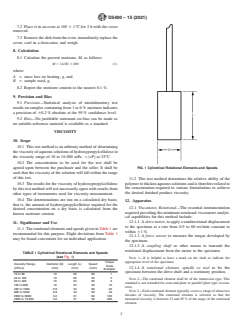
Moisture
4 – 9
Viscosity
10 – 16
pH
17 – 21
Residue on Ignition
22 – 28
Hydroxypropoxy Content
29 – 36
1.3 The values stated in SI units are to be regarded as the standard. The values given in parentheses are for information only.
1.4 This standard does not purport to address all of the safety concerns, if any, associated with its use. It is the responsibility of the user of this standard to establish appropriate safety, health, and environmental practices and determine the applicability of regulatory limitations prior to use. For specific hazard statements, see 26.6.
1.5 This international standard was developed in accordance with internationally recognized principles on standardization established in the Decision on Principles for the Development of International Standards, Guides and Recommendations issued by the World Trade Organization Technical Barriers to Trade (TBT) Committee.
- Status
- Published
- Publication Date
- 31-May-2021
- Technical Committee
- D01 - Paint and Related Coatings, Materials, and Applications
- Drafting Committee
- D01.36 - Cellulose and Cellulose Derivatives
Overview
ASTM D5400-15(2021): Standard Test Methods for Hydroxypropylcellulose defines internationally recognized procedures for analyzing hydroxypropylcellulose (HPC), a versatile cellulose ether widely used in pharmaceuticals, food, coatings, and industrial products. Developed by ASTM International, this standard outlines methods for determining key material characteristics, including moisture content, viscosity, pH, residue on ignition, and hydroxypropoxy content. Reliable characterization of these attributes ensures quality control, regulatory compliance, and optimal performance in product formulations.
Key Topics
ASTM D5400-15(2021) covers the following main test methods for hydroxypropylcellulose:
Moisture Content
Calculates total solids in a sample and quantifies volatile components at the test temperature, commonly designated as "moisture." Moisture analysis is essential for determining the active polymer content.Viscosity
Evaluates the viscosity of aqueous HPC solutions within a broad range, providing key information about HPC's thickening and flow properties.pH Determination
Measures the acidity or alkalinity of HPC aqueous solutions, which can affect material compatibility, equipment selection, and application suitability.Residue on Ignition
Determines the inorganic residue remaining after sample ignition, used to assess purity and active polymer concentration. This is crucial for HPC grades applied in sensitive formulations.Hydroxypropoxy Content
Quantifies the degree of hydroxypropyl substitution on the cellulose backbone, influencing solubility, rheology, and performance in end-use applications.
Each procedure employs SI units as a standard, promoting consistency and comparability between laboratories worldwide.
Applications
Proper implementation of ASTM D5400-15(2021) enables manufacturers, formulators, and quality professionals to:
Ensure Batch-to-Batch Consistency
Monitor and control critical parameters such as moisture, pH, and hydroxypropoxy content in raw HPC materials.Meet Regulatory and Industry Specifications
Demonstrate compliance with pharmacopeial requirements, food safety standards, and industrial product specifications.Optimize Product Formulation
Use analytic results to accurately calculate the amount of active hydroxypropylcellulose in various blends, ensuring reliable viscosity and functional performance.Assess Material Purity
Evaluate residue on ignition and moisture content to verify high-purity grades for sensitive uses in pharmaceuticals, nutraceuticals, and food additives.Support Research and Development
Characterize new HPC grades and support the development of innovative applications in films, coatings, adhesives, and controlled-release systems.
Adhering to these standardized methods assures reliable data, supports supply chain quality assurance, and helps minimize the risks associated with variable raw materials.
Related Standards
Several other ASTM and international standards complement the methods in ASTM D5400-15(2021):
- ASTM D3876 - Test Method for Methoxyl and Hydroxypropyl Substitution in Cellulose Ether Products by Gas Chromatography
- ASTM E70 - Test Method for pH of Aqueous Solutions With the Glass Electrode
- United States Pharmacopeia (USP) and National Formulary (NF) monographs for hydroxypropylcellulose
- ISO and FDA guidance on cellulose ether characterization for regulated industries
Implementing ASTM D5400-15(2021) alongside these standards ensures comprehensive quality control and regulatory compliance for hydroxypropylcellulose materials.
Keywords: hydroxypropylcellulose, ASTM D5400, standard test methods, moisture content, viscosity, pH measurement, residue on ignition, hydroxypropoxy content, cellulose ether analysis, quality control, HPC characterization, material testing, formulation optimization
Relations
- Effective Date
- 01-Jan-2024
- Effective Date
- 01-Jun-2015
- Effective Date
- 01-Jun-2007
- Effective Date
- 01-Jan-2001
- Effective Date
- 01-Jan-2001
Get Certified
Connect with accredited certification bodies for this standard

Control Union Certifications
Global certification for agriculture and sustainability.

Gozdarski inštitut Slovenije
Slovenian Forestry Institute. Forest management certification support, timber testing.
Sponsored listings
Frequently Asked Questions
ASTM D5400-15(2021) is a standard published by ASTM International. Its full title is "Standard Test Methods for Hydroxypropylcellulose". This standard covers: SIGNIFICANCE AND USE 5.1 The results of this test are used for calculating the total solids in the sample; and, by common usage, all materials volatile at this test temperature are designated as moisture. 5.2 Moisture analysis (along with residue on ignition) is a measure of the amount of active polymer in the material and must be considered when determining the amount of hydroxypropylcellulose to use in various formulations. SCOPE 1.1 These test methods cover the testing of hydroxypropylcellulose. 1.2 The test procedures appear in the following order: Sections Moisture 4 – 9 Viscosity 10 – 16 pH 17 – 21 Residue on Ignition 22 – 28 Hydroxypropoxy Content 29 – 36 1.3 The values stated in SI units are to be regarded as the standard. The values given in parentheses are for information only. 1.4 This standard does not purport to address all of the safety concerns, if any, associated with its use. It is the responsibility of the user of this standard to establish appropriate safety, health, and environmental practices and determine the applicability of regulatory limitations prior to use. For specific hazard statements, see 26.6. 1.5 This international standard was developed in accordance with internationally recognized principles on standardization established in the Decision on Principles for the Development of International Standards, Guides and Recommendations issued by the World Trade Organization Technical Barriers to Trade (TBT) Committee.
SIGNIFICANCE AND USE 5.1 The results of this test are used for calculating the total solids in the sample; and, by common usage, all materials volatile at this test temperature are designated as moisture. 5.2 Moisture analysis (along with residue on ignition) is a measure of the amount of active polymer in the material and must be considered when determining the amount of hydroxypropylcellulose to use in various formulations. SCOPE 1.1 These test methods cover the testing of hydroxypropylcellulose. 1.2 The test procedures appear in the following order: Sections Moisture 4 – 9 Viscosity 10 – 16 pH 17 – 21 Residue on Ignition 22 – 28 Hydroxypropoxy Content 29 – 36 1.3 The values stated in SI units are to be regarded as the standard. The values given in parentheses are for information only. 1.4 This standard does not purport to address all of the safety concerns, if any, associated with its use. It is the responsibility of the user of this standard to establish appropriate safety, health, and environmental practices and determine the applicability of regulatory limitations prior to use. For specific hazard statements, see 26.6. 1.5 This international standard was developed in accordance with internationally recognized principles on standardization established in the Decision on Principles for the Development of International Standards, Guides and Recommendations issued by the World Trade Organization Technical Barriers to Trade (TBT) Committee.
ASTM D5400-15(2021) is classified under the following ICS (International Classification for Standards) categories: 85.040 - Pulps. The ICS classification helps identify the subject area and facilitates finding related standards.
ASTM D5400-15(2021) has the following relationships with other standards: It is inter standard links to ASTM E70-24, ASTM E70-07(2015), ASTM D3876-96(2007), ASTM D3876-96, ASTM D3876-96(2001). Understanding these relationships helps ensure you are using the most current and applicable version of the standard.
ASTM D5400-15(2021) is available in PDF format for immediate download after purchase. The document can be added to your cart and obtained through the secure checkout process. Digital delivery ensures instant access to the complete standard document.
Standards Content (Sample)
This international standard was developed in accordance with internationally recognized principles on standardization established in the Decision on Principles for the
Development of International Standards, Guides and Recommendations issued by the World Trade Organization Technical Barriers to Trade (TBT) Committee.
Designation: D5400 − 15 (Reapproved 2021)
Standard Test Methods for
Hydroxypropylcellulose
This standard is issued under the fixed designation D5400; the number immediately following the designation indicates the year of
original adoption or, in the case of revision, the year of last revision.Anumber in parentheses indicates the year of last reapproval.A
superscript epsilon (´) indicates an editorial change since the last revision or reapproval.
1. Scope 3. Reagents
1.1 These test methods cover the testing of hydroxypropy- 3.1 Purity of Reagents—Reagent grade chemicals shall be
used in all tests. Unless otherwise indicated, it is intended that
lcellulose.
all reagents shall conform to the specifications of the Commit-
1.2 The test procedures appear in the following order:
tee onAnalytical Reagents of theAmerican Chemical Society,
Sections
where such specifications are available. Other grades may be
Moisture 4–9
used, provided it is first ascertained that the reagent is of
Viscosity 10–16
pH 17–21
sufficiently high purity to permit its use without lessening the
Residue on Ignition 22–28
accuracy of the determination.
Hydroxypropoxy Content 29–36
3.2 Purity of Water—Unless otherwise indicated, references
1.3 The values stated in SI units are to be regarded as the
to water shall be understood to mean distilled water.
standard. The values given in parentheses are for information
only.
MOISTURE
1.4 This standard does not purport to address all of the
4. Scope
safety concerns, if any, associated with its use. It is the
responsibility of the user of this standard to establish appro- 4.1 Thistestmethodcoversthedeterminationofthevolatile
priate safety, health, and environmental practices and deter- content of hydroxypropylcellulose.
mine the applicability of regulatory limitations prior to use.
5. Significance and Use
For specific hazard statements, see 26.6.
5.1 The results of this test are used for calculating the total
1.5 This international standard was developed in accor-
solids in the sample; and, by common usage, all materials
dance with internationally recognized principles on standard-
volatile at this test temperature are designated as moisture.
ization established in the Decision on Principles for the
Development of International Standards, Guides and Recom-
5.2 Moisture analysis (along with residue on ignition) is a
mendations issued by the World Trade Organization Technical
measure of the amount of active polymer in the material and
Barriers to Trade (TBT) Committee.
must be considered when determining the amount of hydroxy-
propylcellulose to use in various formulations.
2. Referenced Documents
6. Apparatus
2.1 ASTM Standards:
6.1 Oven, gravity convection, capable of maintaining a
D3876Test Method for Methoxyl and Hydroxypropyl Sub-
temperature of 105 6 3°C.
stitution in Cellulose Ether Products by Gas Chromatog-
raphy 6.2 Weighing Dish, glass or aluminum, with cover, 50 mm
E70Test Method for pH of Aqueous Solutions With the
in diameter, 25 mm in height, or equivalent.
Glass Electrode
6.3 Analytical Balance.
7. Procedure
These test methods are under the jurisdiction of ASTM Committee D01 on 7.1 Weigh about5gof sample to the nearest 0.001 g in a
Paint and Related Coatings, Materials, and Applications and are the direct
tared and covered weighing dish.
responsibility of Subcommittee D01.36 on Cellulose and Cellulose Derivatives.
Current edition approved June 1, 2021. Published June 2021. Originally
approved in 1993. Last previous edition approved in 2015 as D5400–15. DOI: ACS Reagent Chemicals, Specifications and Procedures for Reagents and
10.1520/D5400-15R21. Standard-Grade Reference Materials, American Chemical Society, Washington,
For referenced ASTM standards, visit the ASTM website, www.astm.org, or DC. For suggestions on the testing of reagents not listed by theAmerican Chemical
contact ASTM Customer Service at service@astm.org. For Annual Book of ASTM Society, see Analar Standards for Laboratory Chemicals, BDH Ltd., Poole, Dorset,
Standards volume information, refer to the standard’s Document Summary page on U.K., and the United States Pharmacopeia and National Formulary, U.S. Pharma-
the ASTM website. copeial Convention, Inc. (USPC), Rockville, MD.
Copyright © ASTM International, 100 Barr Harbor Drive, PO Box C700, West Conshohocken, PA 19428-2959. United States
D5400 − 15 (2021)
7.2 Place it in an oven at 105 6 1°C for 3 h with the cover
removed.
7.3 Removethedishfromtheoven,immediatelyreplacethe
cover, cool in a desiccator, and weigh.
8. Calculation
8.1 Calculate the percent moisture, M, as follows:
M 5 ~A/B! 3100 (1)
where:
A = mass loss on heating, g, and
B = sample used, g.
8.2 Report the moisture content to the nearest 0.1%.
9. Precision and Bias
9.1 Precision—Statistical analysis of intralaboratory test
resultsonsamplescontainingfrom1to6%moistureindicates
a precision of 60.2% absolute at the 95% confidence level.
9.2 Bias—No justifiable statement on bias can be made as
no suitable reference material is available as a standard.
VISCOSITY
10. Scope
10.1 This test method is an arbitrary method of determining
theviscosityofaqueoussolutionsofhydroxypropylcellulosein
the viscosity range of 10 to 16 000 mPa · s (cP) at 25°C.
10.2 The concentration to be used for the test shall be
agreed upon between the purchaser and the seller. It shall be FIG. 1 Cylindrical Rotational Elements and Speeds
such that the viscosity of the solution will fall within the range
of this test.
11.2 This test method determines the relative ability of the
polymertothickenaqueoussolutionsandisthereforerelatedto
10.3 The results for the viscosity of hydroxypropylcellulose
the concentration required in various formulations to achieve
by this test method will not necessarily agree with results from
the desired finished product viscosity.
other types of instruments used for viscosity measurement.
10.4 The determinations are run on a calculated dry basis;
12. Apparatus
that is, the amount of hydroxypropylcellulose required for the
12.1 Viscometer, Rotational—The essential instrumentation
desired concentration on a dry basis is calculated from the
required providing the minimum rotational viscometer analyti-
known moisture content.
cal capabilities for this method include:
12.1.1 A drive motor,toapplyaunidirectionaldisplacement
11. Significance and Use
to the specimen at a rate from 0.5 to 60 rev/min constant to
11.1 TherotationalelementsandspeedsgiveninTable1are
within 61%.
recommended for this purpose. Slight deviations from Table 1
12.1.2 A force sensor to measure the torque developed by
may be found convenient for an individual application.
the specimen.
12.1.3 A coupling shaft or other means to transmit the
rotational displacement from the motor to the specimen.
TABLE 1 Cylindrical Rotational Elements and Speeds
(see Fig. 1)
NOTE 1—It is helpful to have a mark on the shaft to indicate the
appropriate level of the specimen.
Torque
Viscosity Range, Diameter (D) Length (L) Speed
Scale
12.1.4 A rotational element, spindle or tool to fix the
(mPa·s) (mm) (mm) (rmin)
Multiplier
specimen between the drive shaft and a stationary position.
10 to 80 19 65 60 1
20 to 160 19 65 30 2
NOTE 2—The rotational element shall be of the immersion type. This
50 to 400 10 54 60 5
standard is not intended for cone-and-plate or parallel plate type viscom-
100 to 800 10 54 30 10
eters.
400 to 1600 5.9 43 60 20
NOTE 3—Each rotational element typically covers a range of about two
800 to 3200 5.9 43 30 40
decades of viscosity. The rotational element is selected so that the
2000 to 8000 3.2 31 60 100
4000 to 16 000 3.2 31 30 200 measured viscosity is between 15 and 95% of the range of the rotational
element.
D5400 − 15 (2021)
12.1.5 A guard to protect the rotational element from A 3100
S 5 (2)
mechanical damage. 100 2 B
12.1.6 A temperature sensor to provide an indication of the
where:
specimen temperature of the range of 20 to 30°C to within
A = desired dry mass of sample, g, and
0.1°C.
B = percent moisture in the weighed sample.
12.1.7 A data collection device, to provide a means of
acquiring, storing, and displaying measured or calculated 13.3 Calculate the mass of water required, W, in grams as
follows:
signals, or both. The minimum output signals required for
rotationalviscometryaretorque,rotationalspeed,temperature,
W 5 250 2 S (3)
and time.
where:
12.1.8 A stand,tosupport,level,andadjusttheheightofthe
S = sample mass, g.
drive motor, shaft, and rotational element.
12.1.9 Container, glass bottle, 350-cm (12-oz) approxi-
13.4 Weighthewaterintotheglassbottleandplaceitonthe
mately64mm(2 ⁄2in.)inoutsidediameterand152mm(6in.)
stirrer,mixingataspeedsufficienttocauseavortexbutnotfast
high.
enough to splash.
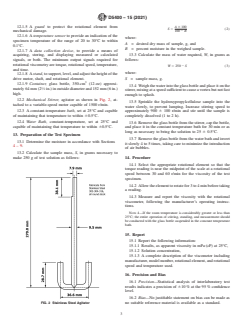
12.2 Mechanical Stirrer, agitator as shown in Fig. 2, at-
13.5 Sprinkle the hydroxypropylcellulose sample into the
tached to a variable-speed motor capable of 1500 r/min.
water slowly, to prevent lumping. Increase stirring speed to
12.3 A constant-temperature bath, set at 25°C and capable
approximately 900 6 100 r/min and stir until the sample is
of maintaining that temperature to within 60.5°C. completely dissolved (1 to 2 h).
12.4 Water Bath, constant-temperature, set at 25°C and
13.6 Removetheglassbottlefromthestirrer,capthebottle,
capable of maintaining that temperature to within 60.5°C. and place it in the constant temperature bath for 30 min or as
long as necessary to bring the solution to 25 6 0.5°C.
13. Preparation of the Test Specimen
13.7 Removetheglassbottlefromthewaterbathandinvert
13.1 Determine the moisture in accordance with Sections
it slowly 4 to 5 times, taking care to minimize the introduction
4–9.
of air bubbles.
13.2 Calculate the sample mass, S, in grams necessary to
make 250 g of test solution as follows:
14. Procedure
14.1 Select the appropriate rotational element so that the
torque reading is near the midpoint of the scale at a rotational
speed between 30 and 60 r/min for the viscosity of the test
specimen.
14.2 Allowtheelementtorotatefor3to4minbeforetaking
a reading.
14.3 Measure and report the viscosity with the rotational
viscometer, following the manufacturer’s operating instruc-
tions.
NOTE 4—If the room temperature is considerably greater or less than
25°C; the entire operation of stirring, standing, and measurement should
be conducted with the glass bottle suspended in the constant temperature
bath.
15. Report
15.1 Report the following information:
15.1.1 Results, as apparent viscosity in mPa·(cP) at 25°C,
15.1.2 Solution concentration,
15.1.3 A complete description of the viscometer including
manufacturer,modelnumber,rotationalelement,androtational
speed and temperature used.
16. Precision and Bias
16.1 Precision—Statistical analysis of interlaboratory test
results indicates a precision of 610% at the 95% confidence
level.
16.2 Bias—No justifiable statement on bias can be made as
FIG. 2 Stainless Steel Agitator no suitable reference material is available as a standard.
--------
...