

ASTM D6188-17(2022)
(Test Method)Standard Test Method for Viscosity of Cellulose by Cuprammonium Ball Fall
General Information
- Abstract
SIGNIFICANCE AND USE
5.1 This test method is suitable for use as a rapid control test for pulp manufacture or for careful determination of the viscometric molecular weight of purified cotton or wood derived pulps.
5.2 This test method is applicable over a very large range of cellulose molecular weights because seven sample sizes are defined. (Sample weights are reduced as cellulose molecular weight increases.)
5.3 Cotton and high molecular weight pulps may be difficult to dissolve. (Warning—This test method is only valid if the sample dissolves completely without gels.)
SCOPE
1.1 This test method describes the procedure for estimating the molecular weight of cellulose by determining the viscosity of cuprammonium (CuAm) solutions of cellulosic materials, such as wood pulp, cotton, and cotton linters. This test method is suitable for rapid, routine testing of large numbers of samples with high accuracy and precision. This test method updates and extends the procedure reported by the American Chemical Society (ACS).2
1.2 The values stated in SI units are to be regarded as the standard. The values given in parentheses are for information only.
1.3 This standard does not purport to address all of the safety concerns, if any, associated with its use. It is the responsibility of the user of this standard to establish appropriate safety, health, and environmental practices and determine the applicability of regulatory limitations prior to use.
1.4 This international standard was developed in accordance with internationally recognized principles on standardization established in the Decision on Principles for the Development of International Standards, Guides and Recommendations issued by the World Trade Organization Technical Barriers to Trade (TBT) Committee.
- Status
- Published
- Publication Date
- 31-May-2022
- Technical Committee
- D01 - Paint and Related Coatings, Materials, and Applications
- Drafting Committee
- D01.36 - Cellulose and Cellulose Derivatives
Overview
ASTM D6188-17(2022), Standard Test Method for Viscosity of Cellulose by Cuprammonium Ball Fall, establishes a procedure for measuring the viscosity of cellulose using the cuprammonium (CuAm) solution ball fall technique. This internationally recognized method provides a reliable means to estimate the molecular weight of cellulose in various materials, including wood pulp, cotton, and cotton linters. Applied widely as both a rapid process control test and a detailed analytical procedure, ASTM D6188 ensures accurate and precise results over a broad range of cellulose molecular weights.
This test is suitable for both in-process and finished products, making it highly applicable in pulp and paper manufacturing, textile processing, and quality control laboratories. It aligns with global standardization principles as set forth by the World Trade Organization Technical Barriers to Trade (TBT) Committee.
Key Topics
- Viscosity Determination: Measures the time for a glass bead to fall through a solution of dissolved cellulose in cuprammonium, reflecting cellulose's molecular characteristics.
- Sample Versatility: Accommodates seven defined sample sizes, allowing analysis across a wide molecular weight spectrum of cellulose.
- Process Control: Offers rapid, routine testing suitable for manufacturing environments and high-throughput laboratories.
- Precision Requirements: Emphasizes accurate sample weighing, complete dissolution, strict temperature control (25 ± 2°C), and correction factors to ensure result reliability.
- Interference Factors: Addresses the necessity to remove residual chemicals and to avoid high drying temperatures to prevent alteration of results.
- Safety Considerations: Highlights the corrosive nature of cuprammonium solutions, requiring appropriate protective equipment and procedures.
Applications
- Pulp and Paper Industry: Enables real-time quality monitoring during pulp manufacture, supporting adjustments to process parameters and product consistency.
- Textile Manufacturing: Used in assessing purified cotton and cotton linters for applications demanding precise viscosity and molecular weight specifications.
- Research and Development: Helps scientists estimate the viscometric molecular weight, informing cellulose modification or derivative production.
- Quality Control Laboratories: Facilitates regular checks of cellulose molecular properties, ensuring compliance with material or product specifications.
By implementing ASTM D6188, industries benefit from a robust, standardized viscosity measurement method that supports product development, certification, and regulatory compliance.
Related Standards
ASTM D6188 references and complements several other standards relevant to cellulose and laboratory practices, including:
- ASTM D1193: Specification for Reagent Water - sets the quality requirements for water used in the test.
- ASTM D1695: Terminology of Cellulose and Cellulose Derivatives - provides definitions crucial for interpreting results.
- ASTM E438: Specification for Glasses in Laboratory Apparatus - details necessary material properties for glassware used in testing.
Other related standards in cellulose analysis and viscosity determination may apply, depending on the specific application, industry, or regulatory framework.
Keywords: ASTM D6188, cellulose viscosity, cuprammonium ball fall, molecular weight, pulp testing, cotton viscosity, wood pulp analysis, process control, quality assurance, laboratory standards.
Relations
- Effective Date
- 01-Feb-2024
- Effective Date
- 01-Dec-2019
- Effective Date
- 01-Jan-2018
- Effective Date
- 01-Jun-2012
- Effective Date
- 01-Dec-2011
- Effective Date
- 01-Jul-2007
- Effective Date
- 01-Nov-2006
- Effective Date
- 01-Mar-2006
- Effective Date
- 01-Jan-2001
- Effective Date
- 01-Jan-2001
- Effective Date
- 10-Feb-1999
- Effective Date
- 10-Feb-1999
- Effective Date
- 15-Aug-1993
- Effective Date
- 15-Aug-1993
Get Certified
Connect with accredited certification bodies for this standard

Control Union Certifications
Global certification for agriculture and sustainability.

Gozdarski inštitut Slovenije
Slovenian Forestry Institute. Forest management certification support, timber testing.
Sponsored listings
Frequently Asked Questions
ASTM D6188-17(2022) is a standard published by ASTM International. Its full title is "Standard Test Method for Viscosity of Cellulose by Cuprammonium Ball Fall". This standard covers: SIGNIFICANCE AND USE 5.1 This test method is suitable for use as a rapid control test for pulp manufacture or for careful determination of the viscometric molecular weight of purified cotton or wood derived pulps. 5.2 This test method is applicable over a very large range of cellulose molecular weights because seven sample sizes are defined. (Sample weights are reduced as cellulose molecular weight increases.) 5.3 Cotton and high molecular weight pulps may be difficult to dissolve. (Warning—This test method is only valid if the sample dissolves completely without gels.) SCOPE 1.1 This test method describes the procedure for estimating the molecular weight of cellulose by determining the viscosity of cuprammonium (CuAm) solutions of cellulosic materials, such as wood pulp, cotton, and cotton linters. This test method is suitable for rapid, routine testing of large numbers of samples with high accuracy and precision. This test method updates and extends the procedure reported by the American Chemical Society (ACS).2 1.2 The values stated in SI units are to be regarded as the standard. The values given in parentheses are for information only. 1.3 This standard does not purport to address all of the safety concerns, if any, associated with its use. It is the responsibility of the user of this standard to establish appropriate safety, health, and environmental practices and determine the applicability of regulatory limitations prior to use. 1.4 This international standard was developed in accordance with internationally recognized principles on standardization established in the Decision on Principles for the Development of International Standards, Guides and Recommendations issued by the World Trade Organization Technical Barriers to Trade (TBT) Committee.
SIGNIFICANCE AND USE 5.1 This test method is suitable for use as a rapid control test for pulp manufacture or for careful determination of the viscometric molecular weight of purified cotton or wood derived pulps. 5.2 This test method is applicable over a very large range of cellulose molecular weights because seven sample sizes are defined. (Sample weights are reduced as cellulose molecular weight increases.) 5.3 Cotton and high molecular weight pulps may be difficult to dissolve. (Warning—This test method is only valid if the sample dissolves completely without gels.) SCOPE 1.1 This test method describes the procedure for estimating the molecular weight of cellulose by determining the viscosity of cuprammonium (CuAm) solutions of cellulosic materials, such as wood pulp, cotton, and cotton linters. This test method is suitable for rapid, routine testing of large numbers of samples with high accuracy and precision. This test method updates and extends the procedure reported by the American Chemical Society (ACS).2 1.2 The values stated in SI units are to be regarded as the standard. The values given in parentheses are for information only. 1.3 This standard does not purport to address all of the safety concerns, if any, associated with its use. It is the responsibility of the user of this standard to establish appropriate safety, health, and environmental practices and determine the applicability of regulatory limitations prior to use. 1.4 This international standard was developed in accordance with internationally recognized principles on standardization established in the Decision on Principles for the Development of International Standards, Guides and Recommendations issued by the World Trade Organization Technical Barriers to Trade (TBT) Committee.
ASTM D6188-17(2022) is classified under the following ICS (International Classification for Standards) categories: 85.040 - Pulps. The ICS classification helps identify the subject area and facilitates finding related standards.
ASTM D6188-17(2022) has the following relationships with other standards: It is inter standard links to ASTM E438-92(2024), ASTM D1695-07(2019), ASTM E438-92(2018), ASTM D1695-07(2012), ASTM E438-92(2011), ASTM D1695-07, ASTM E438-92(2006), ASTM D1193-06, ASTM D1695-96, ASTM D1695-96(2001), ASTM D1193-99, ASTM D1193-99e1, ASTM E438-92(2001)e1, ASTM E438-92(1996). Understanding these relationships helps ensure you are using the most current and applicable version of the standard.
ASTM D6188-17(2022) is available in PDF format for immediate download after purchase. The document can be added to your cart and obtained through the secure checkout process. Digital delivery ensures instant access to the complete standard document.
Standards Content (Sample)
This international standard was developed in accordance with internationally recognized principles on standardization established in the Decision on Principles for the
Development of International Standards, Guides and Recommendations issued by the World Trade Organization Technical Barriers to Trade (TBT) Committee.
Designation: D6188 − 17 (Reapproved 2022)
Standard Test Method for
Viscosity of Cellulose by Cuprammonium Ball Fall
This standard is issued under the fixed designation D6188; the number immediately following the designation indicates the year of
original adoption or, in the case of revision, the year of last revision.Anumber in parentheses indicates the year of last reapproval.A
superscript epsilon (´) indicates an editorial change since the last revision or reapproval.
1. Scope 3. Terminology
3.1 This standard terminology of cellulose and cellulose
1.1 This test method describes the procedure for estimating
derivatives, see Terminology D1695.
the molecular weight of cellulose by determining the viscosity
of cuprammonium (CuAm) solutions of cellulosic materials,
4. Summary of Test Method
such as wood pulp, cotton, and cotton linters.This test method
is suitable for rapid, routine testing of large numbers of
4.1 An in-process or finished product sample is taken. All
samples with high accuracy and precision. This test method cooking and bleaching chemicals must be washed out of
updates and extends the procedure reported by the American in-process samples. Dry samples are wetted with demineral-
Chemical Society (ACS). ized water. Samples are either squeezed or pressed to 20 to
40% consistency as necessary, then passed through a picker.
1.2 The values stated in SI units are to be regarded as the
4.2 The wet pulp sample is dried with air whose maximum
standard. The values given in parentheses are for information
temperatureis120°Candweighedunderconditionsthatcause
only.
the specified quantity of sample to be obtained. The weighed
1.3 This standard does not purport to address all of the
sample is placed in a glass 120-mL(4-oz) bottle, steel shot are
safety concerns, if any, associated with its use. It is the
added, a vacuum is pulled on the bottle, and 97 mL of
responsibility of the user of this standard to establish appro-
cuprammonium solution are added to the bottle. The bottle is
priate safety, health, and environmental practices and deter-
placed on a shaker to mix and dissolve the pulp sample in the
mine the applicability of regulatory limitations prior to use.
CuAm solution.
1.4 This international standard was developed in accor-
4.3 The dissolved sample is transferred to a glass viscosity
dance with internationally recognized principles on standard-
tube. The tube is mounted vertically with a bright light behind
ization established in the Decision on Principles for the
the tube. A special glass bead (see 7.13) is dropped into the
Development of International Standards, Guides and Recom-
center of the solution in the tube. The time is measured in
mendations issued by the World Trade Organization Technical
seconds(s)fortheglassbeadtopassbetweentwomarksonthe
Barriers to Trade (TBT) Committee.
tubewhichare20cmapart.Thistime(s)istheuncorrected“as
is” cuprammonium ball fall viscosity. The temperature of the
2. Referenced Documents
solution is determined, and the correction factor for this
temperature is multiplied by the uncorrected viscosity of the
2.1 ASTM Standards:
sample. This gives the “as is” cuprammonium ball fall viscos-
D1193Specification for Reagent Water
ity value.
D1695Terminology of Cellulose and Cellulose Derivatives
E438Specification for Glasses in Laboratory Apparatus
4.4 The “as is” viscosity value for the sample size used is
converted to the 2.50-g ACS viscosity by the equations
provided in 14.4. The viscosity is reported in “ACS seconds.”
This test method is under the jurisdiction of ASTM Committee D01 on Paint
5. Significance and Use
and Related Coatings, Materials, andApplications and is the direct responsibility of
Subcommittee D01.36 on Cellulose and Cellulose Derivatives.
5.1 Thistestmethodissuitableforuseasarapidcontroltest
CurrenteditionapprovedJune1,2022.PublishedJuly2022.Originallyapproved
for pulp manufacture or for careful determination of the
in 1997. Last previous edition approved in 2017 as D6188–17. DOI: 10.1520/
D6188-17R22.
viscometric molecular weight of purified cotton or wood
Carver et al., “A Standard Method for Determining the Viscosity of Cellulose
derived pulps.
in Cuprammonium Hydroxide,” Industrial and Engineering Chemistry, Analytical
Edition, Vol 1, No 1, 1929, pp. 49-51.
5.2 Thistestmethodisapplicableoveraverylargerangeof
For referenced ASTM standards, visit the ASTM website, www.astm.org, or
cellulose molecular weights because seven sample sizes are
contact ASTM Customer Service at service@astm.org. For Annual Book of ASTM
defined. (Sample weights are reduced as cellulose molecular
Standards volume information, refer to the standard’s Document Summary page on
the ASTM website. weight increases.)
Copyright © ASTM International, 100 Barr Harbor Drive, PO Box C700, West Conshohocken, PA 19428-2959. United States
D6188 − 17 (2022)
TABLE 2 Effect of Volume Errors on Viscosity Error
5.3 Cottonandhighmolecularweightpulpsmaybedifficult
to dissolve. (Warning—This test method is only valid if the Volume Percent Viscosity Error
Error, (mL) Low Volume High Volume
sample dissolves completely without gels.)
1 4.0 3.9
2 8.2 7.6
6. Interferences
5 21.8 17.9
10 48.3 32.6
6.1 High temperature drying of pulp causes a reduction in
viscosity. Therefore, limit the maximum temperature of the air
usedtodrythesampleto120°Candthemaximumdryingtime
TABLE 3 Temperature Correction Factors
to 20 min to keep viscosity loss to a minimum.All in-process
Temperature Correction Factor
samples must be washed to remove cooking and bleaching
Error, °C Low Temperature High Temperature
chemicals,becausethepresenceofchemicalswhiledryingwill
1 0.971 1.030
2 0.943 1.061
increase viscosity loss.
3 0.915 1.093
4 0.888 1.126
6.2 The weight of sample used with this test method is
5 0.863 1.159
critical. The effect of incorrect sample weight on viscosity is
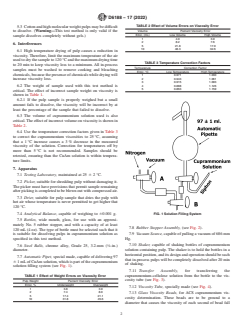
shown in Table 1.
6.2.1 If the pulp sample is properly weighed but a small
amount fails to dissolve, the viscosity will be incorrect by at
least the percentage of the sample that failed to dissolve.
6.3 The volume of cuprammonium solution used is also
critical.Theeffectofincorrectvolumeonviscosityisshownin
Table 2.
6.4 Use the temperature correction factors given in Table 3
to correct the cuprammonium viscosities to 25°C, assuming
that a 1°C increase causes a 3% decrease in the measured
viscosity of the solution. Correction for temperatures off by
more than 5°C is not recommended. Samples should be
retested, ensuring than the CuAm solution is within tempera-
ture limits.
7. Apparatus
7.1 Testing Laboratory, maintained at 25 6 2°C.
7.2 Picker, suitable for shredding pulp without damaging it.
The picker must have provisions that permit sample remaining
afterpickingiscompletedtobeblownoutwithcompressedair.
7.3 Drier, suitable for pulp sample that dries the pulp with
hot air whose temperature is never permitted to get higher that
120°C.
7.4 Analytical Balance, capable of weighing to 60.001 g. FIG. 1 Solution Filling System
7.5 Bottles, wide mouth, glass, for use with an approxi-
mately No. 5 rubber stopper, and with a capacity of at least
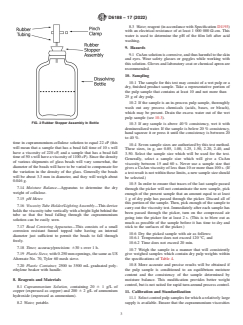
7.8 Rubber Stopper Assembly, (see Fig. 2).
120mL(4oz). The type of bottle must be selected such that it
7.9 VacuumSource,capableofpullingavacuumof686mm
is suitable for dissolving pulps in cuprammonium solution as
Hg.
specified in this test method.
7.10 Shaker, capable of shaking bottles of cuprammonium
7.6 Steel Balls, chrome alloy, Grade 25, 3.2-mm ( ⁄8-in.)
solution containing pulp. The shaker is to hold the bottles in a
diameter.
horizontalposition,anditsdesignandoperationshouldbesuch
7.7 Automatic Pipet, special made, capable of delivering 97
thatin-processpulpswillbecompletelydissolvedafter20min
61mLofCuAmsolution,whichispartofthecuprammonium
of shaking.
solution filling system (see Fig. 1).
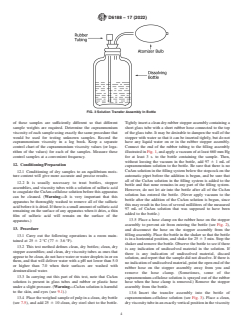
7.11 Transfer Assembly, for transferring the
cuprammonium-cellulose solution from the bottle to the vis-
TABLE 1 Effect of Weight Errors on Viscosity Error
cosity tube (see Fig. 3).
Pulp Weight Percent Viscosity Error
Error, % Underweight Overweight
7.12 Viscosity Tube, specially made (see Fig. 4).
1 3.8 3.9
2 7.4 8.0
7.13 Glass Viscosity Beads, for ACS cuprammonium vis-
5 17.4 21.1
cosity determination. These beads are to be ground to a
10 31.8 45.6
diameter that causes the viscosity of each second of bead fall
D6188 − 17 (2022)
8.3 Water,reagent(inaccordancewithSpecificationD1193)
with an electrical resistance of at least 1 000 000Ω-cm. This
water is used to determine the pH of the film left after acid
washing.
9. Hazards
9.1 CuAmsolutioniscorrosive,andthusharmfultotheskin
and eyes. Wear safety glasses or goggles while working with
thissolution.Glovesandlaboratorycoatorchemicalapronare
recommended.
10. Sampling
10.1 The sample for this test may consist of a wet pulp or a
dry, finished product sample. Take a representative portion of
the pulp sample that contains at least 10 and not more than
25 g of dry pulp.
10.2 If the sample is an in-process pulp sample, thoroughly
wash out any process chemicals (acids, bases, or bleach),
which may be present. Drain the excess water out of the wet
pulp sample (see 10.3).
FIG. 2 Rubber Stopper Assembly In Bottle
10.3 If any sample is above 40% consistency, wet it with
demineralized water. If the sample is below 20% consistency,
hand squeeze it or press it until the consistency is between 20
to 40%.
time in cuprammonium-cellulose solution to equal 22 cP (this
10.4 Seven sample sizes are authorized by this test method.
will mean that a sample that has a bead fall time of 10 s will
These sizes, in g, are 0.85, 1.00, 1.25, 1.50, 2.20, 2.40, and
have a viscosity of 220 cP, and a sample that has a bead fall
3.50. Select the sample size which will be used for the test.
timeof50swillhaveaviscosityof1100cP).Sincethedensity
Generally, select a sample size which will give a CuAm
of various shipments of glass beads will vary somewhat, the
viscosity between 15 and 60 s. Never use a sample size that
diameter of the beads will have to be varied to compensate for
gives a CuAm viscosity of less than 10 or more than 100 s. (If
the variation in the density of the glass. Generally the beads
atestresultisnotwithintheselimits,anewsamplesizeshould
will be about 3.3 mm in diameter, and they will weigh about
be selected.)
0.046 g.
10.5 In order to ensure that traces of the last sample passed
7.14 Moisture Balance—Apparatus to determine the dry
through the picker will not contaminate the new sample, pick
weight of cellulose.
enough of the present sample that an amount equal to at least
1 g of dry pulp has passed through the picker. Discard all of
7.15 pH Meter.
this portion of the sample. Then, pick enough of the sample to
7.16 ViscosityTubeHolder/LightingAssembly—Thisdevice
carry out the viscosity test. Immediately after each sample has
holdstheviscositytubeverticallywithabrightlightbehindthe
been passed through the picker, turn on the compressed air
tube so that the bead falling through the cuprammonium
going into the picker for at least 2 s. (This is to blow out as
solution can be easily seen.
much as possible of the sample before it has time to dry and
7.17 Bead Centering Apparatus—This consists of a small
stick to the surfaces of the picker.)
corrosion resistant funnel topped tube having an internal
10.6 Dry the picked sample with air as follows:
diameter just sufficient to permit the beads to fall through
10.6.1 Temperature does not exceed 120°C, and
freely.
10.6.2 Time does not exceed 20 min.
7.18 Timer, accuracy/precision: 630sover1h.
10.7 Weigh the sample in a manner that will consistently
7.19 PlasticSieve,with0.250mmopenings,thesameasUS
give weighed samples which contain dry pulp weights within
Alternate No. 70, Tyler 60 mesh sieve. the specifications of Table 4.
10.8 More accurate and
...