

ASTM B516-24
(Specification)Standard Specification for Welded Nickel-Chromium-Aluminum Alloy and Nickel-Chromium-Iron Alloy Tubes
General Information
- Abstract
ABSTRACT
This specification covers the standard requirements for welded nickel-chromium-iron alloy (UNS N06600, UNS N06603, UNS N06025, and UNS N06045) boiler, heat exchanger, and condenser tubes for use in general corrosion resisting and low- or high-temperature services. Tube shall be made from flat-rolled alloy by an automatic welding process with no addition or filler metal and shall be furnished with the oxide removed. The material shall undergo cold working in either the weld metal only or both weld and base metal subsequent to welding and prior to final annealing. The tubes shall be subjected to flattening test to check for superficial ruptures resulting from surface imperfections, flange test, and one of the following nondestructive tests: hydrostatic or pneumatic (air underwater) for leak testing and eddy current or ultrasonic for electric testing. The material shall conform to the chemical composition limits for nickel, chromium, iron, manganese, carbon, copper, silicon, sulfur, aluminum, titanium, phosphorus, zirconium, yttrium, and cerium. Tensile strength, yield strength, and elongation shall also meet the mechanical property requirements.
SCOPE
1.1 This specification covers welded UNS N06600,2 N06601, N06603, N06025, N06045, UNS N06690, UNS N06693, and UNS N06699 alloy boiler, heat exchanger, and condenser tubes for general corrosion resisting and low or high-temperature service.
1.2 This specification covers tubes 1/8 in. to 5 in. (3.18 mm to 127 mm), inclusive, in outside diameter and 0.015 in. to 0.500 in. (0.38 mm to 12.70 mm), inclusive, in wall thickness. Table 2 of Specification B751 lists the dimensional requirements of these sizes. Tubes having other dimensions may be furnished provided such tubing complies with all other requirements of this specification.
1.3 The values stated in inch-pound units are to be regarded as standard. The values given in parentheses are mathematical conversions to SI units that are provided for information only and are not considered standard.
1.4 This standard does not purport to address all of the safety concerns, if any, associated with its use. It is the responsibility of the user of this standard to become familiar with all hazards including those identified in the appropriate Safety Data Sheet (SDS) for this product/material as provided by the manufacturer, to establish appropriate safety, health, and environmental practices, and determine the applicability of regulatory limitations prior to use.
1.5 This international standard was developed in accordance with internationally recognized principles on standardization established in the Decision on Principles for the Development of International Standards, Guides and Recommendations issued by the World Trade Organization Technical Barriers to Trade (TBT) Committee.
- Status
- Published
- Publication Date
- 31-Mar-2024
- Technical Committee
- B02 - Nonferrous Metals and Alloys
- Drafting Committee
- B02.07 - Refined Nickel and Cobalt and Their Alloys
Buy Documents
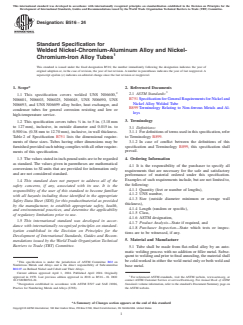
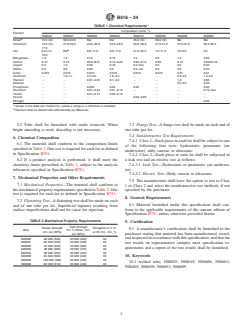


ASTM B516-24 - Standard Specification for Welded Nickel-Chromium-Aluminum Alloy and Nickel-Chromium-Iron Alloy Tubes
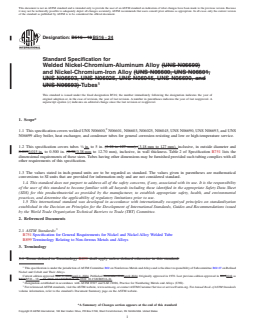
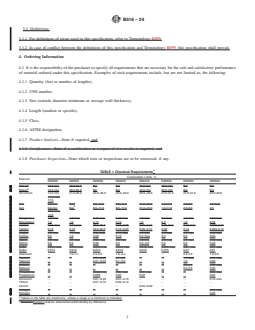

REDLINE ASTM B516-24 - Standard Specification for Welded Nickel-Chromium-Aluminum Alloy and Nickel-Chromium-Iron Alloy Tubes
Overview
ASTM B516-24: Standard Specification for Welded Nickel-Chromium-Aluminum Alloy and Nickel-Chromium-Iron Alloy Tubes defines requirements for the production and testing of welded tubes used in corrosive, high-temperature, and pressure-resistant applications. This standard, issued by ASTM International, covers welded nickel-chromium-aluminum and nickel-chromium-iron alloy tubes (including UNS N06600, N06601, N06603, N06025, N06045, N06690, N06693, and N06699) with outside diameters from 1/8 in. to 5 in. (3.18 mm to 127 mm) and wall thicknesses from 0.015 in. to 0.500 in. (0.38 mm to 12.70 mm).
These welded alloy tubes are commonly used in boiler, heat exchanger, and condenser systems where durability, chemical stability, and resistance to both general and high-temperature corrosion are critical.
Key Topics
Material and Manufacture
- Tubes are produced from flat-rolled alloys using automatic welding processes, without filler metal.
- Post-welding, tubes are cold-worked (in weld metal or both weld and base metal), followed by final annealing.
- Tubes are provided oxide-free, unless bright annealing is performed.
Chemical Composition
- The standard specifies strict chemical composition limits for elements such as nickel, chromium, iron, aluminum, copper, silicon, sulfur, manganese, carbon, titanium, niobium, phosphorus, zirconium, yttrium, cerium, and nitrogen.
- Each alloy designation has unique composition requirements to ensure optimal performance in designated environments.
Mechanical Properties
- Tubes must meet minimum values for tensile strength, yield strength, and elongation to ensure mechanical integrity.
- Reference values are outlined for each alloy.
Testing and Quality Assurance
- Required tests include flattening and flange tests for material integrity.
- Nondestructive testing (NDT) options: hydrostatic, pneumatic (air-underwater), eddy current, or ultrasonic testing.
- Manufacturers must certify that all supplied tubing complies with the specification and provide relevant test reports.
Dimensional Requirements
- Tubes must conform to specific diameter and wall thickness tolerances in line with ASTM B751.
Applications
Welded nickel-chromium and nickel-chromium-iron alloy tubes manufactured to ASTM B516-24 are essential for:
- Boilers: Providing corrosion and oxidation resistance in power generation and industrial steam production.
- Heat Exchangers: Withstanding high-temperature, high-pressure operating conditions and maintaining long-term structural stability.
- Condensers: Delivering reliable performance in chemical and petrochemical plants exposed to aggressive environments.
- General Corrosion-Resistant Piping: Used wherever high resistance to acids, alkalis, and elevated temperatures is required.
The specified alloys are selected for their proven ability to operate under severe service conditions, offering reliability in the most demanding industrial systems.
Related Standards
- ASTM B751 - General Requirements for Nickel and Nickel Alloy Welded Tube: Provides dimensional and mechanical guidelines referenced within ASTM B516.
- ASTM B899 - Terminology Relating to Non-ferrous Metals and Alloys: Defines key terms used in ASTM B516-24 and related specifications.
Other industry-specific standards may apply to the design, fabrication, and safety assessment of installations using welded nickel alloy tubes, including those covering quality systems, inspection, and installation practices.
Summary
ASTM B516-24 establishes stringent production, composition, and testing requirements for welded nickel-chromium-aluminum and nickel-chromium-iron alloy tubes, underpinning their use in the most rigorous corrosion-resistant and high-temperature applications. Compliance with this standard ensures reliable performance and longevity in critical systems such as boilers, heat exchangers, and condensers. For manufacturers, users, and specifiers in the chemical, power, and industrial sectors, adherence to ASTM B516-24 supports both safety and operational excellence.
Relations
- Effective Date
- 01-Apr-2024
- Effective Date
- 01-Apr-2024
- Effective Date
- 01-Apr-2024
- Effective Date
- 01-Apr-2024
- Effective Date
- 01-Apr-2024
- Effective Date
- 01-Apr-2024
Buy Documents
ASTM B516-24 - Standard Specification for Welded Nickel-Chromium-Aluminum Alloy and Nickel-Chromium-Iron Alloy Tubes
REDLINE ASTM B516-24 - Standard Specification for Welded Nickel-Chromium-Aluminum Alloy and Nickel-Chromium-Iron Alloy Tubes
Get Certified
Connect with accredited certification bodies for this standard

Institut za varilstvo d.o.o. (Welding Institute)
Slovenia's leading welding institute since 1952. ISO 3834, EN 1090, pressure equipment certification, NDT personnel, welder qualification. Only IIW Au
Sponsored listings
Frequently Asked Questions
ASTM B516-24 is a technical specification published by ASTM International. Its full title is "Standard Specification for Welded Nickel-Chromium-Aluminum Alloy and Nickel-Chromium-Iron Alloy Tubes". This standard covers: ABSTRACT This specification covers the standard requirements for welded nickel-chromium-iron alloy (UNS N06600, UNS N06603, UNS N06025, and UNS N06045) boiler, heat exchanger, and condenser tubes for use in general corrosion resisting and low- or high-temperature services. Tube shall be made from flat-rolled alloy by an automatic welding process with no addition or filler metal and shall be furnished with the oxide removed. The material shall undergo cold working in either the weld metal only or both weld and base metal subsequent to welding and prior to final annealing. The tubes shall be subjected to flattening test to check for superficial ruptures resulting from surface imperfections, flange test, and one of the following nondestructive tests: hydrostatic or pneumatic (air underwater) for leak testing and eddy current or ultrasonic for electric testing. The material shall conform to the chemical composition limits for nickel, chromium, iron, manganese, carbon, copper, silicon, sulfur, aluminum, titanium, phosphorus, zirconium, yttrium, and cerium. Tensile strength, yield strength, and elongation shall also meet the mechanical property requirements. SCOPE 1.1 This specification covers welded UNS N06600,2 N06601, N06603, N06025, N06045, UNS N06690, UNS N06693, and UNS N06699 alloy boiler, heat exchanger, and condenser tubes for general corrosion resisting and low or high-temperature service. 1.2 This specification covers tubes 1/8 in. to 5 in. (3.18 mm to 127 mm), inclusive, in outside diameter and 0.015 in. to 0.500 in. (0.38 mm to 12.70 mm), inclusive, in wall thickness. Table 2 of Specification B751 lists the dimensional requirements of these sizes. Tubes having other dimensions may be furnished provided such tubing complies with all other requirements of this specification. 1.3 The values stated in inch-pound units are to be regarded as standard. The values given in parentheses are mathematical conversions to SI units that are provided for information only and are not considered standard. 1.4 This standard does not purport to address all of the safety concerns, if any, associated with its use. It is the responsibility of the user of this standard to become familiar with all hazards including those identified in the appropriate Safety Data Sheet (SDS) for this product/material as provided by the manufacturer, to establish appropriate safety, health, and environmental practices, and determine the applicability of regulatory limitations prior to use. 1.5 This international standard was developed in accordance with internationally recognized principles on standardization established in the Decision on Principles for the Development of International Standards, Guides and Recommendations issued by the World Trade Organization Technical Barriers to Trade (TBT) Committee.
ABSTRACT This specification covers the standard requirements for welded nickel-chromium-iron alloy (UNS N06600, UNS N06603, UNS N06025, and UNS N06045) boiler, heat exchanger, and condenser tubes for use in general corrosion resisting and low- or high-temperature services. Tube shall be made from flat-rolled alloy by an automatic welding process with no addition or filler metal and shall be furnished with the oxide removed. The material shall undergo cold working in either the weld metal only or both weld and base metal subsequent to welding and prior to final annealing. The tubes shall be subjected to flattening test to check for superficial ruptures resulting from surface imperfections, flange test, and one of the following nondestructive tests: hydrostatic or pneumatic (air underwater) for leak testing and eddy current or ultrasonic for electric testing. The material shall conform to the chemical composition limits for nickel, chromium, iron, manganese, carbon, copper, silicon, sulfur, aluminum, titanium, phosphorus, zirconium, yttrium, and cerium. Tensile strength, yield strength, and elongation shall also meet the mechanical property requirements. SCOPE 1.1 This specification covers welded UNS N06600,2 N06601, N06603, N06025, N06045, UNS N06690, UNS N06693, and UNS N06699 alloy boiler, heat exchanger, and condenser tubes for general corrosion resisting and low or high-temperature service. 1.2 This specification covers tubes 1/8 in. to 5 in. (3.18 mm to 127 mm), inclusive, in outside diameter and 0.015 in. to 0.500 in. (0.38 mm to 12.70 mm), inclusive, in wall thickness. Table 2 of Specification B751 lists the dimensional requirements of these sizes. Tubes having other dimensions may be furnished provided such tubing complies with all other requirements of this specification. 1.3 The values stated in inch-pound units are to be regarded as standard. The values given in parentheses are mathematical conversions to SI units that are provided for information only and are not considered standard. 1.4 This standard does not purport to address all of the safety concerns, if any, associated with its use. It is the responsibility of the user of this standard to become familiar with all hazards including those identified in the appropriate Safety Data Sheet (SDS) for this product/material as provided by the manufacturer, to establish appropriate safety, health, and environmental practices, and determine the applicability of regulatory limitations prior to use. 1.5 This international standard was developed in accordance with internationally recognized principles on standardization established in the Decision on Principles for the Development of International Standards, Guides and Recommendations issued by the World Trade Organization Technical Barriers to Trade (TBT) Committee.
ASTM B516-24 is classified under the following ICS (International Classification for Standards) categories: 23.040.15 - Non-ferrous metal pipes. The ICS classification helps identify the subject area and facilitates finding related standards.
ASTM B516-24 has the following relationships with other standards: It is inter standard links to ASTM B516-18, ASTM B751-21, ASTM E2181/E2181M-19, ASTM B366/B366M-23, ASTM B924-02(2022), ASTM E585/E585M-23. Understanding these relationships helps ensure you are using the most current and applicable version of the standard.
ASTM B516-24 is available in PDF format for immediate download after purchase. The document can be added to your cart and obtained through the secure checkout process. Digital delivery ensures instant access to the complete standard document.
Standards Content (Sample)
This international standard was developed in accordance with internationally recognized principles on standardization established in the Decision on Principles for the
Development of International Standards, Guides and Recommendations issued by the World Trade Organization Technical Barriers to Trade (TBT) Committee.
Designation: B516 − 24
Standard Specification for
Welded Nickel-Chromium-Aluminum Alloy and Nickel-
Chromium-Iron Alloy Tubes
This standard is issued under the fixed designation B516; the number immediately following the designation indicates the year of
original adoption or, in the case of revision, the year of last revision. A number in parentheses indicates the year of last reapproval. A
superscript epsilon (´) indicates an editorial change since the last revision or reapproval.
1. Scope* 2. Referenced Documents
2.1 ASTM Standards:
1.1 This specification covers welded UNS N06600,
B751 Specification for General Requirements for Nickel and
N06601, N06603, N06025, N06045, UNS N06690, UNS
Nickel Alloy Welded Tube
N06693, and UNS N06699 alloy boiler, heat exchanger, and
B899 Terminology Relating to Non-ferrous Metals and Al-
condenser tubes for general corrosion resisting and low or
loys
high-temperature service.
3. Terminology
1.2 This specification covers tubes ⁄8 in. to 5 in. (3.18 mm
to 127 mm), inclusive, in outside diameter and 0.015 in. to
3.1 Definitions:
0.500 in. (0.38 mm to 12.70 mm), inclusive, in wall thickness. 3.1.1 For definitions of terms used in this specification, refer
Table 2 of Specification B751 lists the dimensional require- to Terminology B899.
3.1.2 In case of conflict between the definitions of this
ments of these sizes. Tubes having other dimensions may be
specification and Terminology B899, this specification shall
furnished provided such tubing complies with all other require-
prevail.
ments of this specification.
1.3 The values stated in inch-pound units are to be regarded 4. Ordering Information
as standard. The values given in parentheses are mathematical
4.1 It is the responsibility of the purchaser to specify all
conversions to SI units that are provided for information only
requirements that are necessary for the safe and satisfactory
and are not considered standard.
performance of material ordered under this specification.
Examples of such requirements include, but are not limited to,
1.4 This standard does not purport to address all of the
the following:
safety concerns, if any, associated with its use. It is the
4.1.1 Quantity (feet or number of lengths),
responsibility of the user of this standard to become familiar
4.1.2 UNS number,
with all hazards including those identified in the appropriate
4.1.3 Size (outside diameter minimum or average wall
Safety Data Sheet (SDS) for this product/material as provided
thickness),
by the manufacturer, to establish appropriate safety, health,
4.1.4 Length (random or specific),
and environmental practices, and determine the applicability
4.1.5 Class,
of regulatory limitations prior to use.
4.1.6 ASTM designation,
1.5 This international standard was developed in accor-
4.1.7 Product Analysis—State if required, and
dance with internationally recognized principles on standard-
4.1.8 Purchaser Inspection—State which tests or inspec-
ization established in the Decision on Principles for the
tions are to be witnessed, if any.
Development of International Standards, Guides and Recom-
5. Material and Manufacture
mendations issued by the World Trade Organization Technical
Barriers to Trade (TBT) Committee.
5.1 Tube shall be made from flat-rolled alloy by an auto-
matic welding process with no addition or filler metal. Subse-
quent to welding and prior to final annealing, the material shall
be cold-worked in either the weld metal only or both weld and
This specification is under the jurisdiction of ASTM Committee B02 on
Nonferrous Metals and Alloys and is the direct responsibility of Subcommittee
base metal.
B02.07 on Refined Nickel and Cobalt and Their Alloys.
Current edition approved April 1, 2024. Published April 2024. Originally
approved in 1970. Last previous edition approved in 2018 as B516 – 18. DOI: For referenced ASTM standards, visit the ASTM website, www.astm.org, or
10.1520/B0516-24. contact ASTM Customer Service at service@astm.org. For Annual Book of ASTM
Designation established in accordance with ASTM E527 and SAE J1086, Standards volume information, refer to the standard’s Document Summary page on
Practice for Numbering Metals and Alloys (UNS). the ASTM website.
*A Summary of Changes section appears at the end of this standard
Copyright © ASTM International, 100 Barr Harbor Drive, PO Box C700, West Conshohocken, PA 19428-2959. United States
B516 − 24
A
TABLE 1 Chemical Requirements
Composition Limits, %
Element
N06600 N06601 N06603 N06025 N06045 N06690 N06693 N06699
B
Nickel 72.0 min 58.0-63.0 Bal Bal 45.0 min 58.0 min Bal Bal
Chromium 14.0 min 21.0-25.0 24.0–26.0 24.0–26.0 26.0–29.0 27.0-31.0 27.0-31.0 26.0-30.0
17.0
B
Iron 6.0 min Bal 8.0–11.0 8.0–11.0 21.0–25.0 7.0-11.0 2.5-6.0 2.5
10.0
Manganese 1.0 1.0 0.15 0.15 1.0 0.5 1.0 0.50
Carbon 0.15 0.10 20.0-40.0 0.15–0.25 0.05–0.12 0.05
...
This document is not an ASTM standard and is intended only to provide the user of an ASTM standard an indication of what changes have been made to the previous version. Because
it may not be technically possible to adequately depict all changes accurately, ASTM recommends that users consult prior editions as appropriate. In all cases only the current version
of the standard as published by ASTM is to be considered the official document.
Designation: B516 − 18 B516 − 24
Standard Specification for
Welded Nickel-Chromium-Aluminum Alloy (UNS N06699)
and Nickel-Chromium-Iron Alloy (UNS N06600, UNS N06601,
UNS N06603, UNS N06025, UNS N06045, UNS N06690, and
UNS N06693) Tubes
This standard is issued under the fixed designation B516; the number immediately following the designation indicates the year of
original adoption or, in the case of revision, the year of last revision. A number in parentheses indicates the year of last reapproval. A
superscript epsilon (´) indicates an editorial change since the last revision or reapproval.
1. Scope*
1.1 This specification covers welded UNS N06600, N06601, N06603, N06025, N06045, UNS N06690, UNS N06693, and UNS
N06699 alloy boiler, heat exchanger, and condenser tubes for general corrosion resisting and low or high-temperature service.
1.2 This specification covers tubes ⁄8 in. to 5 in. (3.18 to 127 mm), (3.18 mm to 127 mm), inclusive, in outside diameter and
0.0150.015 in. to 0.500 in. (0.38(0.38 mm to 12.70 mm), inclusive, in wall thickness. Table 2 of Specification B751 lists the
dimensional requirements of these sizes. Tubes having other dimensions may be furnished provided such tubing complies with all
other requirements of this specification.
1.3 The values stated in inch-pound units are to be regarded as standard. The values given in parentheses are mathematical
conversions to SI units that are provided for information only and are not considered standard.
1.4 This standard does not purport to address all of the safety concerns, if any, associated with its use. It is the responsibility
of the user of this standard to become familiar with all hazards including those identified in the appropriate Safety Data Sheet
(SDS) for this product/material as provided by the manufacturer, to establish appropriate safety, health, and environmental
practices, and determine the applicability of regulatory limitations prior to use.
1.5 This international standard was developed in accordance with internationally recognized principles on standardization
established in the Decision on Principles for the Development of International Standards, Guides and Recommendations issued
by the World Trade Organization Technical Barriers to Trade (TBT) Committee.
2. Referenced Documents
2.1 ASTM Standards:
B751 Specification for General Requirements for Nickel and Nickel Alloy Welded Tube
B899 Terminology Relating to Non-ferrous Metals and Alloys
3. Terminology
3.1 Terms defined in Terminology B899 shall apply unless defined otherwise in this standard.
This specification is under the jurisdiction of ASTM Committee B02 on Nonferrous Metals and Alloys and is the direct responsibility of Subcommittee B02.07 on Refined
Nickel and Cobalt and Their Alloys.
Current edition approved Nov. 1, 2018April 1, 2024. Published November 2018April 2024. Originally approved in 1970. Last previous edition approved in 20152018 as
B516B516 – 18. – 15. DOI: 10.1520/B0516-18. DOI: 10.1520/B0516-24.
Designation established in accordance with ASTM E527 and SAE J1086, Practice for Numbering Metals and Alloys (UNS).
For referenced ASTM standards, visit the ASTM website, www.astm.org, or contact ASTM Customer Service at service@astm.org. For Annual Book of ASTM Standards
volume information, refer to the standard’s Document Summary page on the ASTM website.
*A Summary of Changes section appears at the end of this standard
Copyright © ASTM International, 100 Barr Harbor Drive, PO Box C700, West Conshohocken, PA 19428-2959. United States
B516 − 24
3.1 Definitions:
3.1.1 For definitions of terms used in this specification, refer to Terminology B899.
3.1.2 In case of conflict between the definitions of this specification and Terminology B899, this specification shall prevail.
4. Ordering Information
4.1 It is the responsibility of the purchaser to specify all requirements that are necessary for the safe and satisfactory performance
of material ordered under this specification. Examples of such requirements include, but are not limited to, the following:
4.1.1 Quantity (feet or number of lengths),
4.1.2 UNS number,
4.1.3 Size (outside diameter minimum or average wall thickness),
4.1.4 Length (random or specific),
4.1.5 Class,
4.1.6 ASTM designation,
4.1.7 Product Analysis—State if required, and
4.1.8 Certification—State if a certification or a report of test results is required, and
4.1.8 Purchaser Inspection—State which tests or inspections are to be witnessed, if any.
A
TABLE 1 Chemical Requirements
Composition Limits, %
Element
N06600 N06601 N06603 N06025 N06045 N06690 N06693 N06699
A
Nickel 72.0 min 58.0-63.0 Bal Bal 45.0 min 58.0 min Bal Bal
B
Nickel 72.0 min 58.0-63.0 Bal Bal 45.0 min 58.0 min Bal Bal
Chromium 14.0 min 21.0-25.0 24.0–26.0 24.0–26.0 26.0–29.0 27.0-31.0 27.0-31.0 26.0-30.0
17.0 max
17.0
A
Iron 6.0 min Bal 8.0–11.0 8.0–11.0 21.0–25.0 7.0-11.0 2.5-6.0 2.5 max
B
Iron 6.0 min Bal 8.0–11.0 8.0–11.0 21.0–25.0 7.0-11.0 2.5-6.0 2.5
10.0 max
10.0
Manganese 1.0 max 1.0 max 0.15 max 0.15 max 1.0 max 0.5 max 1.0 max 0.50 max
Manganese 1.0 1.0 0.15 0.15 1.0 0.5 1.0 0.50
Carbon 0.15 max 0.10 max 20.0-40.0 0.15–0.25 0.05–0.12 0.05 max 0.15 max 0.005-0.10
Carbon 0.15 0.10 20.0-40.0 0.15–0.25 0.05–0.12 0.05 0.15 0.005-0.10
Copper 0.5 max 1.0 max 0.50 max 0.10 max 0.3 max 0.5 max 0.5 max 0.50 max
Copper 0.5 1.0 0.50 0.10 0.3 max 0.5 0.5 0.50
Silicon 0.5 max 0.5 max 0.50 max 0.5 max 2.5–3.0 0.5 max 0.5 max 0.50 max
Silicon 0.5 0
...