


ASTM D1388-14
(Test Method)Standard Test Method for Stiffness of Fabrics
Standard Test Method for Stiffness of Fabrics
SIGNIFICANCE AND USE
5.1 Both test options in this test method are considered satisfactory for acceptance testing of commercial shipments since current estimates of between-laboratory precision are acceptable and the method is used extensively in the trade for acceptance testing.
5.1.1 In case of a dispute arising from differences in reported test results when using this test method for acceptance testing of commercial shipments, the purchaser and the supplier should conduct comparative tests to determine if there is a statistical bias between their laboratories. Competent statistical assistance is recommended for the investigation of bias. As a minimum, the two parties should take a group of test specimens that are as homogeneous as possible and that are from a lot of material of the type in question. Test specimens should then be randomly assigned in equal numbers to each laboratory for testing. The average results from the two laboratories should be compared using the appropriate statistical analysis and an acceptable probability level chosen by the two parties before testing is begun. If a bias is found, either its cause must be found and corrected or the purchaser and the supplier must agree to interpret future test results with consideration to the known bias.
5.2 In general, these procedures are more suitable for testing woven fabrics than knit fabrics.
5.3 The Cantilever Test Option is the preferred procedure because it is simpler to perform. It is, however, not suitable for very limp fabrics or those that show a marked tendency to curl or twist at a cut edge.
5.4 The Heart Loop Test Option is suitable for fabrics that show a tendency to curl or twist.
5.5 Both options can provide a correlation with a subjective evaluation of a given fabric type. That is, a higher number represents a stiffer fabric.
5.6 The stiffness of a fabric may change with storage.
5.7 No evidence has been found showing that bending length is dependent on the width. The tendency for spe...
SCOPE
1.1 This test method covers the measurement of stiffness properties of fabrics. Bending length is measured and flexural rigidity is calculated. Two procedures are provided.
1.1.1 Option A—Cantilever Test, employing the principle of cantilever bending of the fabric under its own mass.
1.1.2 Option B—Heart Loop Test, employing the principle of a loop formed in a fabric strip and hung vertically.
1.2 This test method applies to most fabrics including woven fabrics, air bag fabrics, blankets, napped fabrics, knitted fabrics, layered fabrics, pile fabrics. The fabrics may be untreated, heavily sized, coated, resin-treated, or otherwise treated.
1.3 The values stated in SI units are to be regarded as the standard. The U.S. customary units may be approximate.
1.4 This standard does not purport to address all of the safety concerns, if any, associated with its use. It is the responsibility of the user of this standard to establish appropriate safety and health practices and determine the applicability of regulatory limitations prior to use.
General Information
- Status
- Historical
- Publication Date
- 30-Jun-2014
- Technical Committee
- D13 - Textiles
- Drafting Committee
- D13.60 - Fabric Physical Test Methods B
- Current Stage
Relations
- Effective Date
- 01-Jul-2014
- Effective Date
- 01-Jul-2014
- Effective Date
- 01-Jul-2014
- Effective Date
- 01-Jul-2014
- Effective Date
- 01-Jul-2014
- Effective Date
- 01-Jul-2014
- Effective Date
- 01-Jul-2014
- Referred By
ASTM F3260-18 - Standard Test Method for Determining the Flexural Stiffness of Medical Textiles - Effective Date
- 01-Jul-2014
- Effective Date
- 01-Jul-2014
- Referred By
ASTM D6828-02(2019) - Standard Test Method for Stiffness of Fabric by Blade/Slot Procedure - Effective Date
- 01-Jul-2014
- Effective Date
- 01-Jul-2014
- Effective Date
- 01-Jul-2014
- Referred By
ASTM D4032-08(2016) - Standard Test Method for Stiffness of Fabric by the Circular Bend Procedure - Effective Date
- 01-Jul-2014




Frequently Asked Questions
ASTM D1388-14 is a standard published by ASTM International. Its full title is "Standard Test Method for Stiffness of Fabrics". This standard covers: SIGNIFICANCE AND USE 5.1 Both test options in this test method are considered satisfactory for acceptance testing of commercial shipments since current estimates of between-laboratory precision are acceptable and the method is used extensively in the trade for acceptance testing. 5.1.1 In case of a dispute arising from differences in reported test results when using this test method for acceptance testing of commercial shipments, the purchaser and the supplier should conduct comparative tests to determine if there is a statistical bias between their laboratories. Competent statistical assistance is recommended for the investigation of bias. As a minimum, the two parties should take a group of test specimens that are as homogeneous as possible and that are from a lot of material of the type in question. Test specimens should then be randomly assigned in equal numbers to each laboratory for testing. The average results from the two laboratories should be compared using the appropriate statistical analysis and an acceptable probability level chosen by the two parties before testing is begun. If a bias is found, either its cause must be found and corrected or the purchaser and the supplier must agree to interpret future test results with consideration to the known bias. 5.2 In general, these procedures are more suitable for testing woven fabrics than knit fabrics. 5.3 The Cantilever Test Option is the preferred procedure because it is simpler to perform. It is, however, not suitable for very limp fabrics or those that show a marked tendency to curl or twist at a cut edge. 5.4 The Heart Loop Test Option is suitable for fabrics that show a tendency to curl or twist. 5.5 Both options can provide a correlation with a subjective evaluation of a given fabric type. That is, a higher number represents a stiffer fabric. 5.6 The stiffness of a fabric may change with storage. 5.7 No evidence has been found showing that bending length is dependent on the width. The tendency for spe... SCOPE 1.1 This test method covers the measurement of stiffness properties of fabrics. Bending length is measured and flexural rigidity is calculated. Two procedures are provided. 1.1.1 Option A—Cantilever Test, employing the principle of cantilever bending of the fabric under its own mass. 1.1.2 Option B—Heart Loop Test, employing the principle of a loop formed in a fabric strip and hung vertically. 1.2 This test method applies to most fabrics including woven fabrics, air bag fabrics, blankets, napped fabrics, knitted fabrics, layered fabrics, pile fabrics. The fabrics may be untreated, heavily sized, coated, resin-treated, or otherwise treated. 1.3 The values stated in SI units are to be regarded as the standard. The U.S. customary units may be approximate. 1.4 This standard does not purport to address all of the safety concerns, if any, associated with its use. It is the responsibility of the user of this standard to establish appropriate safety and health practices and determine the applicability of regulatory limitations prior to use.
SIGNIFICANCE AND USE 5.1 Both test options in this test method are considered satisfactory for acceptance testing of commercial shipments since current estimates of between-laboratory precision are acceptable and the method is used extensively in the trade for acceptance testing. 5.1.1 In case of a dispute arising from differences in reported test results when using this test method for acceptance testing of commercial shipments, the purchaser and the supplier should conduct comparative tests to determine if there is a statistical bias between their laboratories. Competent statistical assistance is recommended for the investigation of bias. As a minimum, the two parties should take a group of test specimens that are as homogeneous as possible and that are from a lot of material of the type in question. Test specimens should then be randomly assigned in equal numbers to each laboratory for testing. The average results from the two laboratories should be compared using the appropriate statistical analysis and an acceptable probability level chosen by the two parties before testing is begun. If a bias is found, either its cause must be found and corrected or the purchaser and the supplier must agree to interpret future test results with consideration to the known bias. 5.2 In general, these procedures are more suitable for testing woven fabrics than knit fabrics. 5.3 The Cantilever Test Option is the preferred procedure because it is simpler to perform. It is, however, not suitable for very limp fabrics or those that show a marked tendency to curl or twist at a cut edge. 5.4 The Heart Loop Test Option is suitable for fabrics that show a tendency to curl or twist. 5.5 Both options can provide a correlation with a subjective evaluation of a given fabric type. That is, a higher number represents a stiffer fabric. 5.6 The stiffness of a fabric may change with storage. 5.7 No evidence has been found showing that bending length is dependent on the width. The tendency for spe... SCOPE 1.1 This test method covers the measurement of stiffness properties of fabrics. Bending length is measured and flexural rigidity is calculated. Two procedures are provided. 1.1.1 Option A—Cantilever Test, employing the principle of cantilever bending of the fabric under its own mass. 1.1.2 Option B—Heart Loop Test, employing the principle of a loop formed in a fabric strip and hung vertically. 1.2 This test method applies to most fabrics including woven fabrics, air bag fabrics, blankets, napped fabrics, knitted fabrics, layered fabrics, pile fabrics. The fabrics may be untreated, heavily sized, coated, resin-treated, or otherwise treated. 1.3 The values stated in SI units are to be regarded as the standard. The U.S. customary units may be approximate. 1.4 This standard does not purport to address all of the safety concerns, if any, associated with its use. It is the responsibility of the user of this standard to establish appropriate safety and health practices and determine the applicability of regulatory limitations prior to use.
ASTM D1388-14 is classified under the following ICS (International Classification for Standards) categories: 59.080.30 - Textile fabrics. The ICS classification helps identify the subject area and facilitates finding related standards.
ASTM D1388-14 has the following relationships with other standards: It is inter standard links to ASTM D1388-08(2012), ASTM F2320-18(2022), ASTM D6575/D6575M-22, ASTM D4850-23, ASTM F2150-19, ASTM D1048-22, ASTM D5446-08(2019), ASTM F3260-18, ASTM F3510-21, ASTM D6828-02(2019), ASTM F2733-21, ASTM F1891-19, ASTM D4032-08(2016). Understanding these relationships helps ensure you are using the most current and applicable version of the standard.
ASTM D1388-14 is available in PDF format for immediate download after purchase. The document can be added to your cart and obtained through the secure checkout process. Digital delivery ensures instant access to the complete standard document.
Standards Content (Sample)
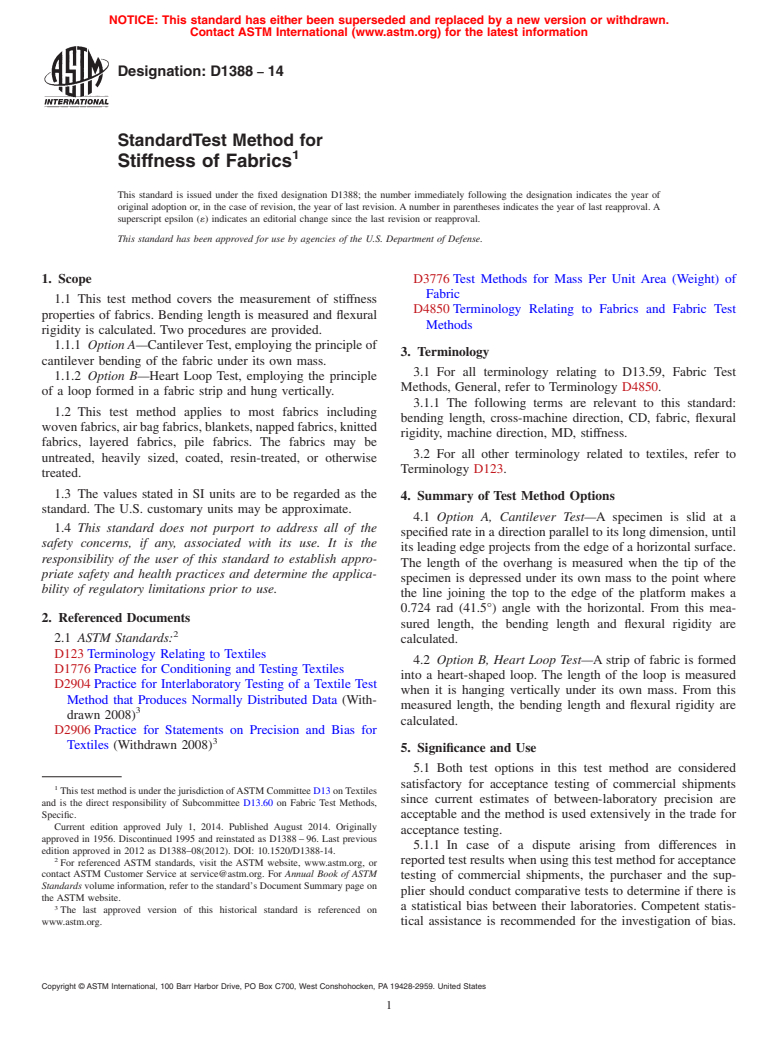
NOTICE: This standard has either been superseded and replaced by a new version or withdrawn.
Contact ASTM International (www.astm.org) for the latest information
Designation: D1388 − 14
StandardTest Method for
Stiffness of Fabrics
This standard is issued under the fixed designation D1388; the number immediately following the designation indicates the year of
original adoption or, in the case of revision, the year of last revision.Anumber in parentheses indicates the year of last reapproval.A
superscript epsilon (´) indicates an editorial change since the last revision or reapproval.
This standard has been approved for use by agencies of the U.S. Department of Defense.
1. Scope D3776Test Methods for Mass Per Unit Area (Weight) of
Fabric
1.1 This test method covers the measurement of stiffness
D4850Terminology Relating to Fabrics and Fabric Test
properties of fabrics. Bending length is measured and flexural
Methods
rigidity is calculated. Two procedures are provided.
1.1.1 Option A—CantileverTest,employingtheprincipleof
3. Terminology
cantilever bending of the fabric under its own mass.
3.1 For all terminology relating to D13.59, Fabric Test
1.1.2 Option B—Heart Loop Test, employing the principle
Methods, General, refer to Terminology D4850.
of a loop formed in a fabric strip and hung vertically.
3.1.1 The following terms are relevant to this standard:
1.2 This test method applies to most fabrics including
bending length, cross-machine direction, CD, fabric, flexural
wovenfabrics,airbagfabrics,blankets,nappedfabrics,knitted
rigidity, machine direction, MD, stiffness.
fabrics, layered fabrics, pile fabrics. The fabrics may be
3.2 For all other terminology related to textiles, refer to
untreated, heavily sized, coated, resin-treated, or otherwise
Terminology D123.
treated.
1.3 The values stated in SI units are to be regarded as the
4. Summary of Test Method Options
standard. The U.S. customary units may be approximate.
4.1 Option A, Cantilever Test—A specimen is slid at a
1.4 This standard does not purport to address all of the
specified rate in a direction parallel to its long dimension, until
safety concerns, if any, associated with its use. It is the
its leading edge projects from the edge of a horizontal surface.
responsibility of the user of this standard to establish appro-
The length of the overhang is measured when the tip of the
priate safety and health practices and determine the applica-
specimen is depressed under its own mass to the point where
bility of regulatory limitations prior to use.
the line joining the top to the edge of the platform makes a
0.724 rad (41.5°) angle with the horizontal. From this mea-
2. Referenced Documents
sured length, the bending length and flexural rigidity are
2.1 ASTM Standards: calculated.
D123Terminology Relating to Textiles
4.2 Option B, Heart Loop Test—A strip of fabric is formed
D1776Practice for Conditioning and Testing Textiles
into a heart-shaped loop. The length of the loop is measured
D2904Practice for Interlaboratory Testing of a Textile Test
when it is hanging vertically under its own mass. From this
Method that Produces Normally Distributed Data (With-
measured length, the bending length and flexural rigidity are
drawn 2008)
calculated.
D2906Practice for Statements on Precision and Bias for
Textiles (Withdrawn 2008)
5. Significance and Use
5.1 Both test options in this test method are considered
satisfactory for acceptance testing of commercial shipments
ThistestmethodisunderthejurisdictionofASTMCommitteeD13onTextiles
since current estimates of between-laboratory precision are
and is the direct responsibility of Subcommittee D13.60 on Fabric Test Methods,
Specific.
acceptable and the method is used extensively in the trade for
Current edition approved July 1, 2014. Published August 2014. Originally
acceptance testing.
approved in 1956. Discontinued 1995 and reinstated as D1388–96. Last previous
5.1.1 In case of a dispute arising from differences in
edition approved in 2012 as D1388–08(2012). DOI: 10.1520/D1388-14.
reportedtestresultswhenusingthistestmethodforacceptance
For referenced ASTM standards, visit the ASTM website, www.astm.org, or
contact ASTM Customer Service at service@astm.org. For Annual Book of ASTM
testing of commercial shipments, the purchaser and the sup-
Standards volume information, refer to the standard’s Document Summary page on
plier should conduct comparative tests to determine if there is
the ASTM website.
a statistical bias between their laboratories. Competent statis-
The last approved version of this historical standard is referenced on
www.astm.org. tical assistance is recommended for the investigation of bias.
Copyright © ASTM International, 100 Barr Harbor Drive, PO Box C700, West Conshohocken, PA 19428-2959. United States
D1388 − 14
As a minimum, the two parties should take a group of test 6.1.1.1 Indicator, inclined at an angle of 0.724 6 0.01 rad
specimens that are as homogeneous as possible and that are (41.5 6 0.5°) below the plane of the platform surface.
from a lot of material of the type in question. Test specimens 6.1.1.2 Movable Slide, consisting of a metal bar not less
should then be randomly assigned in equal numbers to each than25by200mm(1by8in.)byapproximately3mm( ⁄8in.)
laboratory for testing. The average results from the two thick and having a mass of 270 6 5 g (0.6 6 0.01 lb).
laboratories should be compared using the appropriate statis- 6.1.1.3 Scale and Reference Point, to measure the length of
ticalanalysisandanacceptableprobabilitylevelchosenbythe the overhang.
two parties before testing is begun. If a bias is found, either its 6.1.1.4 Specimen Feed Unit, motorized (see Fig. 1) set to
cause must be found and corrected or the purchaser and the 120 mm/min (4.75 in./min) 65%, or manual equivalent.
supplier must agree to interpret future test results with consid- 6.1.2 Cutting Die—25 61mmby200 61mm(1 6 0.04
eration to the known bias. in. by 8 6 0.04 in.).
5.2 Ingeneral,theseproceduresaremoresuitablefortesting 6.2 Option B—Heart Loop Tester.
woven fabrics than knit fabrics. 6.2.1 Clamp and Stand, for hanging the specimen.
6.2.2 Scale,suitablymountedonthestandformeasuringthe
5.3 The Cantilever Test Option is the preferred procedure
length of the specimen loop and calibrated either in cm (in.) or
becauseitissimplertoperform.Itis,however,notsuitablefor
directly in bending length.
very limp fabrics or those that show a marked tendency to curl
or twist at a cut edge.
NOTE 1—If a constant strip length is adopted, the scale may be
calibrated to read directly in units of bending length.
5.4 The Heart Loop Test Option is suitable for fabrics that
6.2.3 Brass Bars, two, 25 × 75 × 3 6 0.1 mm
show a tendency to curl or twist.
(1×3×0.1256 0.005 in.).
5.5 Both options can provide a correlation with a subjective
6.2.4 Pressure Sensitive Tape.
evaluation of a given fabric type. That is, a higher number
6.2.5 Jig, constructed to allow positioning of the two bars
represents a stiffer fabric.
withtheirinneredgesparallelandatadistancefromeachother
5.6 The stiffness of a fabric may change with storage.
equal to the selected strip length.
5.7 No evidence has been found showing that bending
7. Sampling and Test Specimens
length is dependent on the width. The tendency for specimens
to curl or twist will affect the result, because of the rigidity 7.1 Lot Sample—As a lot sample for acceptance testing,
providedattheedge.Consequently,thewiderthestrip,theless randomlyselectthenumberofrollsorpiecesoffabricdirected
important is the edge effect. in an applicable material specification or other agreement
between the purchaser and the supplier. Consider the rolls or
6. Apparatus
pieces of fabric to be the primary sampling units. In the
absence of such an agreement, take the number of fabric rolls
6.1 Option A—Cantilever Bending Tester (Fig. 1).
specified in Table 1.
6.1.1 Horizontal Platform, with a minimum area of 38 by
200 mm (1.5 by 8 in.) and having a smooth low-friction, flat
NOTE 2—An adequate specification or other agreement between the
surface such as polished metal or plastic. A leveling bubble
purchaserandsupplierrequirestakingintoaccountthevariabilitybetween
rolls or pieces of fabric and between specimens from a swatch from a roll
shall be incorporated in the platform.
orpieceoffabrictoprovideasamplingplanwithameaningfulproducer’s
risk, consumer’s risk, acceptable quality level, and limiting quality level.
7.2 Laboratory Sample—For acceptance testing, take a
Apparatus is available commercially.
swatch extending the width of the fabric and approximately 1
m(1yd)alongthemachinedirectionfromeachrollorpiecein
the lot sample. For rolls of fabric, take a sample that will
excludefabricfromtheouterwrapoftherollortheinnerwrap
around the core of the roll of fabric, or any end piece.
7.3 Direction of Test—Consider the long dimension of the
specimen as the direction of test.
7.4 Number of Test Specimens—From each laboratory sam-
plingunit,takefourspecimensfromthemachinedirectionand
TABLE 1 Number of Rolls, or Pieces, of Fabric in the Lot Sample
Number of Rolls or Pieces
Number of Rolls or Pieces in Lot Sample
in Lot, Inclusive
1to3 all
4to24 4
25 to 50 5
over 50 10 % to a max of 10 rolls or pieces
FIG. 1 Example of a Motorized Cantilever Test Apparatus
D1388 − 14
NOTE 5—The bending length using the heart loop option is not entirely
four specimens from the cross-machine direction as applicable
independent of the strip length. In general, the bending length rises with
to a material specification or contract order.
the strip length up to a value that remains relatively constant as the strip
7.5 Cutting Test Specimens—Cut the specimens to be used
length is further increased.An additional rise may further be encountered
for much longer strip lengths. Whenever possible, compare fabrics in the
for the measurement of machine direction with the longer
range where bending length is independent of strip length.
dimensionparalleltothemachinedirection.Cutthespecimens
to be used for the measurement of the cross-machine direction
8. Preparation of Test Apparatus and Calibration
with the longer dimension parallel to the cross-machine direc-
tion. Label to maintain specimen identity. 8.1 Option A—Cantilever Test:
7.5.1 Take specimens, representing a broad distribution
8.1.1 Set the tester on a table or bench with the horizontal
across the width and length, preferably along the diagonal of platform and inclined reference lines. Adjust the platform to
thelaboratorysample,andnonearertheedgethanone-tenthits
horizontal as indicated by the leveling bubble.
width.Ensurespecimensarefreeoffolds,creases,orwrinkles.
8.1.2 Verify that the bend angle indicator is at the 0.724 rad
Avoid getting oil, water, grease, etc. on the specimens when
(41.5°) angle marked on the scale.
handling.
7.5.2 Cantilever Test—Cut test specimens 25 by 200 mm,
9. Conditioning
61mm(1by8in. 6 0.04 in.).
9.1 Precondition the specimens by bringing them to ap-
7.5.3 Heart Loop Test—No standard size for the test speci-
proximate moisture equilibrium in the standard atmosphere for
men is required. Cut test specimens 50 mm (2 in.) longer than
preconditioning textiles as directed in Practice D1776, unless
the selected strip length to allow for clamping at the ends. See
otherwise directed in a material specification or contract order.
Table 2.
9.2 After preconditioning, bring the test specimens to mois-
7.5.3.1 Select a specimen width at least 25 mm (1 in.) and
ture equilibrium for testing in the standard atmosphere for
no more than 75 mm (3 in.) with respect to the tendency of the
testing textiles as directed in Practice D1776 or, if applicable,
fabric to curl. For fabrics having a slight tendency to curl, a 25
in the specified atmosphere in which the testing is to be
61mm(1 6 0.04 in.) wide specimen has been found to be
performed,unlessotherwisedirectedinamaterialspecification
satisfactory.As the tendency to curl becomes greater, increase
or contract order.
the width up to a maximum of 75 mm (3 in.).
7.5.3.2 Make several trial tests using various strip lengths
selected from Table 2. Select a suitable strip length for a 10. Procedure
corresponding loop length from Table 2, such that the bending
10.1 Test the conditioned specimens in the standard atmo-
length is relatively independent of strip length.
sphere for testing textiles, which is 21 6 1°C (70 6 2°F) and
65 6 2% relative humidity, unless otherwise directed in a
NOTE 3—Strip length is the circumferential length of the unclamped
portion of the specimen.
material specification or contract order.
NOTE 4—Specimen strip widths greater than 75 mm (3 in.) have not
10.2 Option A—Cantilever Test:
been investigated and are not recommended since reliability of results are
questionable.
10.2.1 Remove the movable slide. Place the specimen on
thehorizontalplatformwiththelengthofthespecimenparallel
to the platform edge.Align the edge of the specimen with the
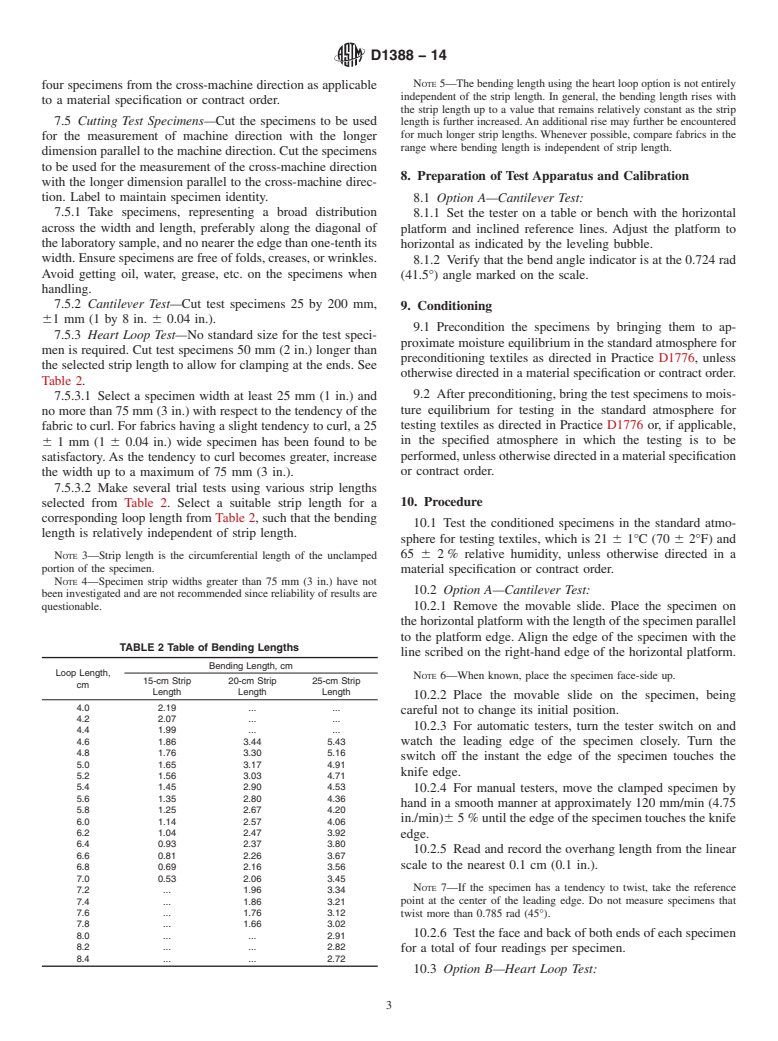
TABLE 2 Table of Bending Lengths
line scribed on the right-hand edge of the horizontal platform.
Bending Length, cm
Loop Length,
NOTE 6—When known, place the specimen face-side up.
15-cm Strip 20-cm Strip 25-cm Strip
cm
Length Length Length
10.2.2 Place the movable slide on the specimen, being
4.0 2.19 . .
care
...
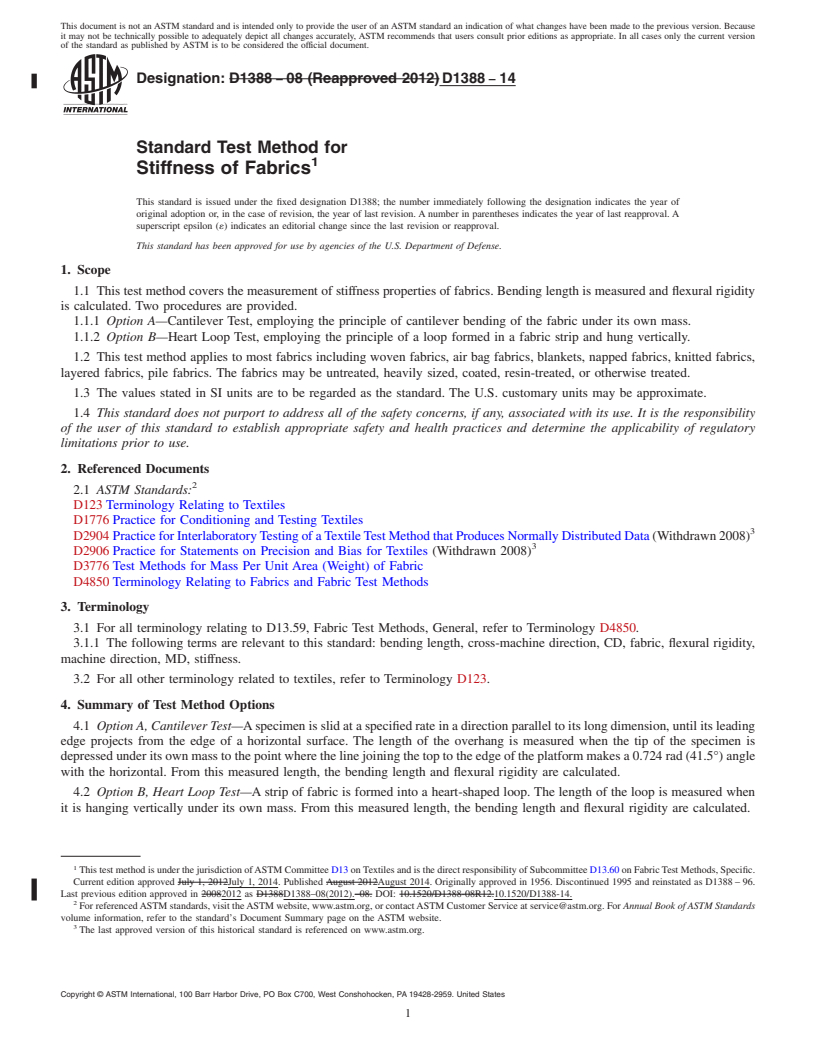
This document is not an ASTM standard and is intended only to provide the user of an ASTM standard an indication of what changes have been made to the previous version. Because
it may not be technically possible to adequately depict all changes accurately, ASTM recommends that users consult prior editions as appropriate. In all cases only the current version
of the standard as published by ASTM is to be considered the official document.
Designation: D1388 − 08 (Reapproved 2012) D1388 − 14
Standard Test Method for
Stiffness of Fabrics
This standard is issued under the fixed designation D1388; the number immediately following the designation indicates the year of
original adoption or, in the case of revision, the year of last revision. A number in parentheses indicates the year of last reapproval. A
superscript epsilon (´) indicates an editorial change since the last revision or reapproval.
This standard has been approved for use by agencies of the U.S. Department of Defense.
1. Scope
1.1 This test method covers the measurement of stiffness properties of fabrics. Bending length is measured and flexural rigidity
is calculated. Two procedures are provided.
1.1.1 Option A—Cantilever Test, employing the principle of cantilever bending of the fabric under its own mass.
1.1.2 Option B—Heart Loop Test, employing the principle of a loop formed in a fabric strip and hung vertically.
1.2 This test method applies to most fabrics including woven fabrics, air bag fabrics, blankets, napped fabrics, knitted fabrics,
layered fabrics, pile fabrics. The fabrics may be untreated, heavily sized, coated, resin-treated, or otherwise treated.
1.3 The values stated in SI units are to be regarded as the standard. The U.S. customary units may be approximate.
1.4 This standard does not purport to address all of the safety concerns, if any, associated with its use. It is the responsibility
of the user of this standard to establish appropriate safety and health practices and determine the applicability of regulatory
limitations prior to use.
2. Referenced Documents
2.1 ASTM Standards:
D123 Terminology Relating to Textiles
D1776 Practice for Conditioning and Testing Textiles
D2904 Practice for Interlaboratory Testing of a Textile Test Method that Produces Normally Distributed Data (Withdrawn 2008)
D2906 Practice for Statements on Precision and Bias for Textiles (Withdrawn 2008)
D3776 Test Methods for Mass Per Unit Area (Weight) of Fabric
D4850 Terminology Relating to Fabrics and Fabric Test Methods
3. Terminology
3.1 For all terminology relating to D13.59, Fabric Test Methods, General, refer to Terminology D4850.
3.1.1 The following terms are relevant to this standard: bending length, cross-machine direction, CD, fabric, flexural rigidity,
machine direction, MD, stiffness.
3.2 For all other terminology related to textiles, refer to Terminology D123.
4. Summary of Test Method Options
4.1 Option A, Cantilever Test—A specimen is slid at a specified rate in a direction parallel to its long dimension, until its leading
edge projects from the edge of a horizontal surface. The length of the overhang is measured when the tip of the specimen is
depressed under its own mass to the point where the line joining the top to the edge of the platform makes a 0.724 rad (41.5°) angle
with the horizontal. From this measured length, the bending length and flexural rigidity are calculated.
4.2 Option B, Heart Loop Test—A strip of fabric is formed into a heart-shaped loop. The length of the loop is measured when
it is hanging vertically under its own mass. From this measured length, the bending length and flexural rigidity are calculated.
This test method is under the jurisdiction of ASTM Committee D13 on Textiles and is the direct responsibility of Subcommittee D13.60 on Fabric Test Methods, Specific.
Current edition approved July 1, 2012July 1, 2014. Published August 2012August 2014. Originally approved in 1956. Discontinued 1995 and reinstated as D1388 – 96.
Last previous edition approved in 20082012 as D1388D1388–08(2012).–08. DOI: 10.1520/D1388-08R12.10.1520/D1388-14.
For referenced ASTM standards, visit the ASTM website, www.astm.org, or contact ASTM Customer Service at service@astm.org. For Annual Book of ASTM Standards
volume information, refer to the standard’s Document Summary page on the ASTM website.
The last approved version of this historical standard is referenced on www.astm.org.
Copyright © ASTM International, 100 Barr Harbor Drive, PO Box C700, West Conshohocken, PA 19428-2959. United States
D1388 − 14
5. Significance and Use
5.1 Both test options in this test method are considered satisfactory for acceptance testing of commercial shipments since current
estimates of between-laboratory precision are acceptable and the method is used extensively in the trade for acceptance testing.
5.1.1 In case of a dispute arising from differences in reported test results when using this test method for acceptance testing of
commercial shipments, the purchaser and the supplier should conduct comparative tests to determine if there is a statistical bias
between their laboratories. Competent statistical assistance is recommended for the investigation of bias. As a minimum, the two
parties should take a group of test specimens that are as homogeneous as possible and that are from a lot of material of the type
in question. Test specimens should then be randomly assigned in equal numbers to each laboratory for testing. The average results
from the two laboratories should be compared using the appropriate statistical analysis and an acceptable probability level chosen
by the two parties before testing is begun. If a bias is found, either its cause must be found and corrected or the purchaser and the
supplier must agree to interpret future test results with consideration to the known bias.
5.2 In general, these procedures are more suitable for testing woven fabrics than knit fabrics.
5.3 The Cantilever Test Option is the preferred procedure because it is simpler to perform. It is, however, not suitable for very
limp fabrics or those that show a marked tendency to curl or twist at a cut edge.
5.4 The Heart Loop Test Option is suitable for fabrics that show a tendency to curl or twist.
5.5 Both options can provide a correlation with a subjective evaluation of a given fabric type. That is, a higher number
represents a stiffer fabric.
5.6 The stiffness of a fabric may change with storage.
5.7 No evidence has been found showing that bending length is dependent on the width. The tendency for specimens to curl
or twist will affect the result, because of the rigidity provided at the edge. Consequently, the wider the strip, the less important is
the edge effect.
6. Apparatus
6.1 Option A—Cantilever Bending Tester (Fig. 1).
6.1.1 Horizontal Platform, with a minimum area of 38 by 200 mm (1.5 by 8 in.) and having a smooth low-friction, flat surface
such as polished metal or plastic. A leveling bubble shall be incorporated in the platform.
6.1.1.1 Indicator, inclined at an angle of 0.724 6 0.01 rad (41.5 6 0.5°) below the plane of the platform surface.
6.1.1.2 Movable Slide, consisting of a metal bar not less than 25 by 200 mm (1 by 8 in.) by approximately 3 mm ( ⁄8 in.) thick
and having a mass of 270 6 5 g (0.6 6 0.01 lb).
6.1.1.3 Scale and Reference Point, to measure the length of the overhang.
6.1.1.4 Specimen Feed Unit, motorized (see Fig. 1) set to 120 mm/min (4.75 in./min) 65 %, or manual equivalent.
6.1.2 Cutting Die—25 6 1 mm by 200 6 1 mm (1 6 0.04 in. by 8 6 0.04 in.).
6.2 Option B—Heart Loop Tester.
6.2.1 Clamp and Stand, for hanging the specimen.
Apparatus is available commercially.
FIG. 1 Example of a Motorized Cantilever Test Apparatus
D1388 − 14
6.2.2 Scale, suitably mounted on the stand for measuring the length of the specimen loop and calibrated either in cm (in.) or
directly in bending length.
NOTE 1—If a constant strip length is adopted, the scale may be calibrated to read directly in units of bending length.
6.2.3 Brass Bars, two, 25 × 75 × 3 6 0.1 mm (1 × 3 × 0.1256 0.005 in.).
6.2.4 Pressure Sensitive Tape.
6.2.5 Jig, constructed to allow positioning of the two bars with their inner edges parallel and at a distance from each other equal
to the selected strip length.
7. Sampling and Test Specimens
7.1 Lot Sample—As a lot sample for acceptance testing, randomly select the number of rolls or pieces of fabric directed in an
applicable material specification or other agreement between the purchaser and the supplier. Consider the rolls or pieces of fabric
to be the primary sampling units. In the absence of such an agreement, take the number of fabric rolls specified in Table 1.
NOTE 2—An adequate specification or other agreement between the purchaser and supplier requires taking into account the variability between rolls
or pieces of fabric and between specimens from a swatch from a roll or piece of fabric to provide a sampling plan with a meaningful producer’s risk,
consumer’s risk, acceptable quality level, and limiting quality level.
7.2 Laboratory Sample—For acceptance testing, take a swatch extending the width of the fabric and approximately 1 m (1 yd)
along the machine direction from each roll or piece in the lot sample. For rolls of fabric, take a sample that will exclude fabric
from the outer wrap of the roll or the inner wrap around the core of the roll of fabric, or any end piece.
7.3 Direction of Test—Consider the long dimension of the specimen as the direction of test.
7.4 Number of Test Specimens—From each laboratory sampling unit, take four specimens from the machine direction and four
specimens from the cross-machine direction as applicable to a material specification or contract order.
7.5 Cutting Test Specimens—Cut the specimens to be used for the measurement of machine direction with the longer dimension
parallel to the machine direction. Cut the specimens to be used for the measurement of the cross-machine direction with the longer
dimension parallel to the cross-machine direction. Label to maintain specimen identity.
7.5.1 Take specimens, representing a broad distribution across the width and length, preferably along the diagonal of the
laboratory sample, and no nearer the edge than one-tenth its width. Ensure specimens are free of folds, creases, or wrinkles. Avoid
getting oil, water, grease, etc. on the specimens when handling.
7.5.2 Cantilever Test—Cut test specimens 25 by 200 mm, 61 mm (1 by 8 in. 6 0.04 in.).
7.5.3 Heart Loop Test—No standard size for the test specimen is required. Cut test specimens 50 mm (2 in.) longer than the
selected strip length to allow for clamping at the ends. See Table 2.
7.5.3.1 Select a specimen width at least 25 mm (1 in.) and no more than 75 mm (3 in.) with respect to the tendency of the fabric
to curl. For fabrics having a slight tendency to curl, a 25 6 1 mm (1 6 0.04 in.) wide specimen has been found to be satisfactory.
As the tendency to curl becomes greater, increase the width up to a maximum of 75 mm (3 in.).
7.5.3.2 Make several trial tests using various strip lengths selected from Table 2. Select a suitable strip length for a
corresponding loop length from Table 2, such that the bending length is relatively independent of strip length.
NOTE 3—Strip length is the circumferential length of the unclamped portion of the specimen.
NOTE 4—Specimen strip widths greater than 75 mm (3 in.) have not been investigated and are not recommended since reliability of results are
questionable.
NOTE 5—The bending length using the heart loop option is not entirely independent of the strip length. In general, the bending length rises with the
strip length up to a value that remains relatively constant as the strip length is further increased. An additional rise may further be encountered for much
longer strip lengths. Whenever possible, compare fabrics in the range where bending length is independent of strip length.
8. Preparation of Test Apparatus and Calibration
8.1 Option A—Cantilever Test:
8.1.1 Set the tester on a table or bench with the horizontal platform and inclined reference lines. Adjust the platform to
horizontal as indicated by the leveling bubble.
8.1.2 Verify that the bend angle indicator is at the 0.724 rad (41.5°) angle marked on the scale.
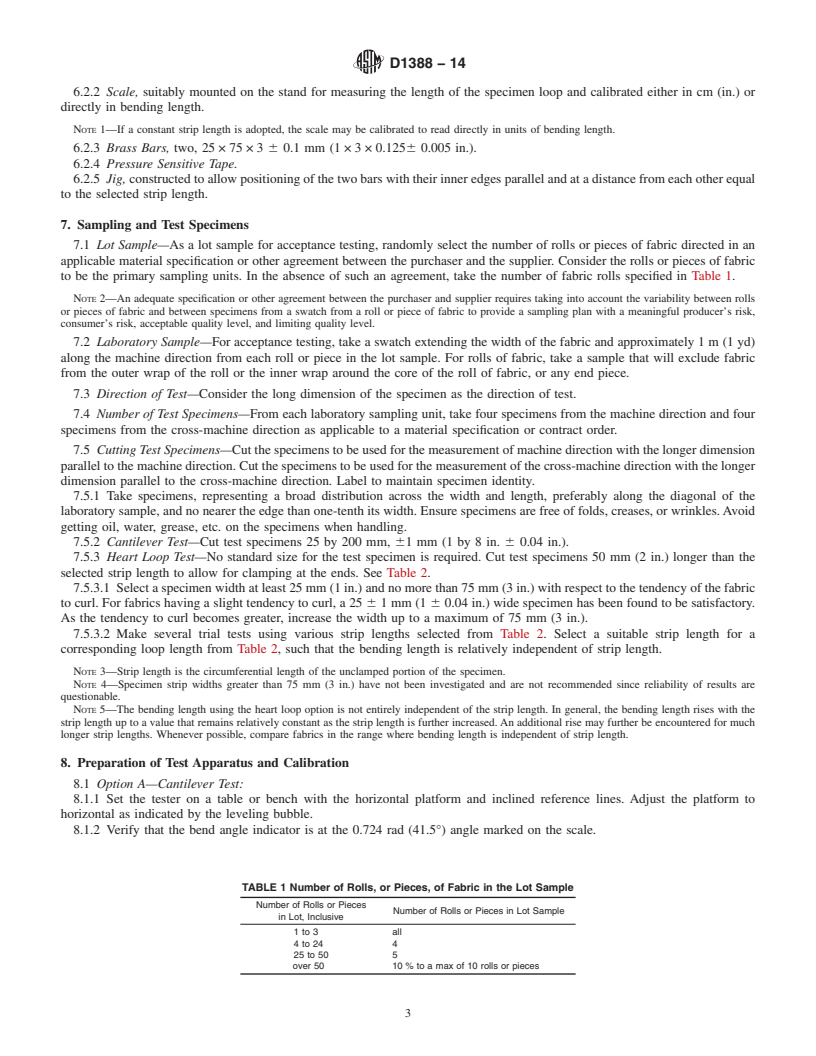
TABLE 1 Number of Rolls, or Pieces, of Fabric in the Lot Sample
Number of Rolls or Pieces
Number of Rolls or Pieces in Lot Sample
in Lot, Inclusive
1 to 3 all
4 to 24 4
25 to 50 5
over 50 10 % to a max of 10 rolls or pieces
D1388 − 14
TABLE 2 Table of Bending Lengths
Bending Length, cm
Loop Length,
15-cm Strip 20-cm Strip 25-cm Strip
cm
Length Length Length
4.0 2.19 . .
4.2 2.07 . .
4.4 1.99 . .
4.6 1.86 3.44 5.43
4.8 1.76 3.30 5.16
5.0 1.65 3.17 4.91
5.2 1.56 3.03 4.71
5.4 1.45 2.90 4.53
5.6 1.35 2.80 4.36
5.8 1.25 2.67 4.20
6.0 1.14 2.57 4.06
6.2 1.04 2.47 3.92
6.4 0.93 2.37 3.80
6.6 0.81 2.26 3.67
6.8 0.69 2.16 3.56
7.0 0.53 2.06 3.45
7.2 . 1.96 3.34
7.4 . 1.86 3.21
7.6 . 1.76 3.12
7.8 . 1.66 3.02
8.0 . . 2.91
8.2 . . 2.82
8.4 . . 2.72
9. Conditioning
9.1 Precondition the specimens by bringing them to approximate moisture equilibrium in the standard atmosphere for
preconditioning textiles as directed in Practice D1776, unless otherwise directed in a material specification or contract order.
9.2 After preconditioning, bring the test specimens to moisture equilibrium for testing in the standard atmosphere for testing
textiles as directed in Practice D1776 or, if applicable, in the specified atmosphere in which the testing is to be performed, unless
otherwise directed in a material
...
Questions, Comments and Discussion
Ask us and Technical Secretary will try to provide an answer. You can facilitate discussion about the standard in here.
Loading comments...