

ASTM D6792-23c
(Practice)Standard Practice for Quality Management Systems in Petroleum Products, Liquid Fuels, and Lubricants Testing Laboratories
General Information
- Abstract
SIGNIFICANCE AND USE
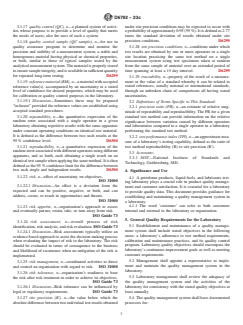
4.1 A petroleum products, liquid fuels, and lubricants testing laboratory plays a crucial role in product quality management and customer satisfaction. It is essential for a laboratory to provide quality data. This document provides guidance for establishing and maintaining a quality management system in a laboratory.
4.1.1 The word ‘customer’ can refer to both customers internal and external to the laboratory or organization.
SCOPE
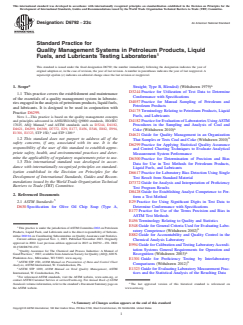
1.1 This practice covers the establishment and maintenance of the essentials of a quality management system in laboratories engaged in the analysis of petroleum products, liquid fuels, and lubricants. It is designed to be used in conjunction with Practice D6299.
Note 1: This practice is based on the quality management concepts and principles advocated in ANSI/ISO/ASQ Q9000 standards, ISO/IEC 17025, ASQ Manual,2 and ASTM standards such as D3244, D4182, D4621, D6299, D6300, D7372, E29, E177, E456, E548, E882, E994, E1301, E1323, STP 15D,3 and STP 1209.4
1.2 This standard does not purport to address all of the safety concerns, if any, associated with its use. It is the responsibility of the user of this standard to establish appropriate safety, health, and environmental practices and determine the applicability of regulatory requirements prior to use.
1.3 This international standard was developed in accordance with internationally recognized principles on standardization established in the Decision on Principles for the Development of International Standards, Guides and Recommendations issued by the World Trade Organization Technical Barriers to Trade (TBT) Committee.
- Status
- Published
- Publication Date
- 31-Oct-2023
- Technical Committee
- D02 - Petroleum Products, Liquid Fuels, and Lubricants
- Drafting Committee
- D02.94 - Coordinating Subcommittee on Quality Assurance and Statistics
Buy Documents
ASTM D6792-23c - Standard Practice for Quality Management Systems in Petroleum Products, Liquid Fuels, and Lubricants Testing Laboratories
REDLINE ASTM D6792-23c - Standard Practice for Quality Management Systems in Petroleum Products, Liquid Fuels, and Lubricants Testing Laboratories
Overview
ASTM D6792-23c, titled Standard Practice for Quality Management Systems in Petroleum Products, Liquid Fuels, and Lubricants Testing Laboratories, establishes essential requirements to help laboratories maintain robust quality management systems. This practice is especially crucial for laboratories engaged in the analysis of petroleum products, liquid fuels, and lubricants, ensuring that quality data is consistently delivered to meet both internal and external customer requirements. The guidance provided by this standard is designed for use alongside ASTM D6299, and is aligned with internationally recognized quality management principles including those found in ISO standards.
Implementing this standard supports product quality, regulatory compliance, and customer satisfaction, making it vital for laboratories aiming for excellence and competitiveness in the global petroleum sector.
Key Topics
- Quality Management System (QMS) Essentials: Details the framework for establishing, documenting, and continuously improving a laboratory QMS, including management roles, annual reviews, and documentation procedures.
- Sampling and Sample Management: Defines best practices for receiving, identifying, handling, storing, and disposing of test samples, with reference to applicable industry standards and regulatory requirements.
- Data, Records, and Document Control: Outlines procedures for recording test data, calibration logs, and maintenance records; maintaining traceability and version control of documentation; and managing laboratory information systems (LIMS).
- Test Methods and Method Control: Requires use of customer or specification-defined methods, managing any modifications with justification, documentation, and customer acceptance.
- Equipment Calibration and Maintenance: Sets protocols for calibration, routine verification, and maintenance of laboratory instrumentation to ensure reliable, traceable measurement results.
- Quality Control and Proficiency Testing: Establishes minimum frequencies for quality control sample testing and details statistical methods (aligned with Practice D6299) for ongoing assessment of laboratory precision, proficiency, and data integrity.
- Personnel Competence and Training: Emphasizes ensuring that laboratory staff are adequately trained and competent to perform assigned tests and maintain quality requirements.
Applications
ASTM D6792-23c is implemented in:
- Petroleum Testing Laboratories: Facilitates accurate analysis of crude oil, refined products, liquid fuels, and lubricants by providing a consistent framework for managing quality.
- Quality Assurance Programs: Serves as a benchmark for laboratories seeking accreditation or recognition to international quality standards, such as ISO/IEC 17025.
- Regulatory Compliance: Helps organizations meet governmental and contractual requirements concerning testing, reporting, and traceability in the petroleum industry.
- Customer Assurance and Performance Monitoring: Supports petroleum producers, refiners, and distributors by establishing confidence in the reliability of laboratory data and maintaining high customer satisfaction through verifiable results.
By following ASTM D6792-23c, laboratories can reduce risk, minimize errors, and provide data that is demonstrably fit for its intended use, thereby supporting regulatory submissions, product development, and market acceptance.
Related Standards
This practice harmonizes with and references several major national and international standards, including:
- ASTM D6299: Practice for Statistical Quality Assurance and Control Charting Techniques in Analytical Measurement Systems.
- ISO/IEC 17025: General requirements for the competence of testing and calibration laboratories.
- ISO 9000: Fundamentals and vocabulary for quality management systems.
- ISO 31000 and ISO Guide 73: Risk management vocabulary and guidelines.
- ASTM E29, E177, E882: Practices and guides for statistical methods, laboratory competence, and accountability.
- Practice D4057: For manual sampling of petroleum and petroleum products.
Adopting ASTM D6792-23c, along with related standards, enables laboratories to meet industry best practices for quality management and ensure continuous improvement across all aspects of petroleum testing operations.
Keywords: ASTM D6792-23c, quality management systems, petroleum testing laboratory, liquid fuels analysis, lubricants quality assurance, laboratory accreditation, ISO 17025, laboratory proficiency, data integrity, equipment calibration.
Relations
- Effective Date
- 01-Nov-2023
- Effective Date
- 01-Mar-2024
- Refers
ASTM D4175-23a - Standard Terminology Relating to Petroleum Products, Liquid Fuels, and Lubricants - Effective Date
- 15-Dec-2023
- Effective Date
- 01-Dec-2023
- Effective Date
- 01-Dec-2023
- Effective Date
- 01-Jul-2023
- Refers
ASTM D4175-23e1 - Standard Terminology Relating to Petroleum Products, Liquid Fuels, and Lubricants - Effective Date
- 01-Jul-2023
- Effective Date
- 01-Apr-2022
- Effective Date
- 01-Apr-2022
- Effective Date
- 01-Nov-2023
- Effective Date
- 01-Nov-2023
- Referred By
ASTM D3237-22 - Standard Test Method for Lead in Gasoline by Atomic Absorption Spectroscopy - Effective Date
- 01-Nov-2023
- Effective Date
- 01-Nov-2023
- Effective Date
- 01-Nov-2023
- Effective Date
- 01-Nov-2023
Buy Documents
ASTM D6792-23c - Standard Practice for Quality Management Systems in Petroleum Products, Liquid Fuels, and Lubricants Testing Laboratories
REDLINE ASTM D6792-23c - Standard Practice for Quality Management Systems in Petroleum Products, Liquid Fuels, and Lubricants Testing Laboratories
Get Certified
Connect with accredited certification bodies for this standard

Element Materials Technology
Materials testing and product certification.

ABS Group Brazil
ABS Group certification services in Brazil.

ABS Quality Evaluations Inc.
American Bureau of Shipping quality certification.
Sponsored listings
Frequently Asked Questions
ASTM D6792-23c is a standard published by ASTM International. Its full title is "Standard Practice for Quality Management Systems in Petroleum Products, Liquid Fuels, and Lubricants Testing Laboratories". This standard covers: SIGNIFICANCE AND USE 4.1 A petroleum products, liquid fuels, and lubricants testing laboratory plays a crucial role in product quality management and customer satisfaction. It is essential for a laboratory to provide quality data. This document provides guidance for establishing and maintaining a quality management system in a laboratory. 4.1.1 The word ‘customer’ can refer to both customers internal and external to the laboratory or organization. SCOPE 1.1 This practice covers the establishment and maintenance of the essentials of a quality management system in laboratories engaged in the analysis of petroleum products, liquid fuels, and lubricants. It is designed to be used in conjunction with Practice D6299. Note 1: This practice is based on the quality management concepts and principles advocated in ANSI/ISO/ASQ Q9000 standards, ISO/IEC 17025, ASQ Manual,2 and ASTM standards such as D3244, D4182, D4621, D6299, D6300, D7372, E29, E177, E456, E548, E882, E994, E1301, E1323, STP 15D,3 and STP 1209.4 1.2 This standard does not purport to address all of the safety concerns, if any, associated with its use. It is the responsibility of the user of this standard to establish appropriate safety, health, and environmental practices and determine the applicability of regulatory requirements prior to use. 1.3 This international standard was developed in accordance with internationally recognized principles on standardization established in the Decision on Principles for the Development of International Standards, Guides and Recommendations issued by the World Trade Organization Technical Barriers to Trade (TBT) Committee.
SIGNIFICANCE AND USE 4.1 A petroleum products, liquid fuels, and lubricants testing laboratory plays a crucial role in product quality management and customer satisfaction. It is essential for a laboratory to provide quality data. This document provides guidance for establishing and maintaining a quality management system in a laboratory. 4.1.1 The word ‘customer’ can refer to both customers internal and external to the laboratory or organization. SCOPE 1.1 This practice covers the establishment and maintenance of the essentials of a quality management system in laboratories engaged in the analysis of petroleum products, liquid fuels, and lubricants. It is designed to be used in conjunction with Practice D6299. Note 1: This practice is based on the quality management concepts and principles advocated in ANSI/ISO/ASQ Q9000 standards, ISO/IEC 17025, ASQ Manual,2 and ASTM standards such as D3244, D4182, D4621, D6299, D6300, D7372, E29, E177, E456, E548, E882, E994, E1301, E1323, STP 15D,3 and STP 1209.4 1.2 This standard does not purport to address all of the safety concerns, if any, associated with its use. It is the responsibility of the user of this standard to establish appropriate safety, health, and environmental practices and determine the applicability of regulatory requirements prior to use. 1.3 This international standard was developed in accordance with internationally recognized principles on standardization established in the Decision on Principles for the Development of International Standards, Guides and Recommendations issued by the World Trade Organization Technical Barriers to Trade (TBT) Committee.
ASTM D6792-23c is classified under the following ICS (International Classification for Standards) categories: 75.080 - Petroleum products in general; 75.100 - Lubricants, industrial oils and related products. The ICS classification helps identify the subject area and facilitates finding related standards.
ASTM D6792-23c has the following relationships with other standards: It is inter standard links to ASTM D6792-23b, ASTM D6300-24, ASTM D4175-23a, ASTM D6300-23a, ASTM D6299-23a, ASTM D6300-23, ASTM D4175-23e1, ASTM E456-13a(2022)e1, ASTM E456-13a(2022), ASTM D8322-20, ASTM D3244-21a, ASTM D3237-22, ASTM D5501-20, ASTM D8519-23, ASTM D7279-20. Understanding these relationships helps ensure you are using the most current and applicable version of the standard.
ASTM D6792-23c is available in PDF format for immediate download after purchase. The document can be added to your cart and obtained through the secure checkout process. Digital delivery ensures instant access to the complete standard document.
Standards Content (Sample)
This international standard was developed in accordance with internationally recognized principles on standardization established in the Decision on Principles for the
Development of International Standards, Guides and Recommendations issued by the World Trade Organization Technical Barriers to Trade (TBT) Committee.
Designation: D6792 − 23c An American National Standard
Standard Practice for
Quality Management Systems in Petroleum Products, Liquid
Fuels, and Lubricants Testing Laboratories
This standard is issued under the fixed designation D6792; the number immediately following the designation indicates the year of
original adoption or, in the case of revision, the year of last revision. A number in parentheses indicates the year of last reapproval. A
superscript epsilon (´) indicates an editorial change since the last revision or reapproval.
1. Scope* Straight; Type B, Blended) (Withdrawn 1979)
D3244 Practice for Utilization of Test Data to Determine
1.1 This practice covers the establishment and maintenance
Conformance with Specifications
of the essentials of a quality management system in laborato-
D4057 Practice for Manual Sampling of Petroleum and
ries engaged in the analysis of petroleum products, liquid fuels,
Petroleum Products
and lubricants. It is designed to be used in conjunction with
D4175 Terminology Relating to Petroleum Products, Liquid
Practice D6299.
Fuels, and Lubricants
NOTE 1—This practice is based on the quality management concepts
D4182 Practice for Evaluation of Laboratories Using ASTM
and principles advocated in ANSI/ISO/ASQ Q9000 standards, ISO/IEC
17025, ASQ Manual, and ASTM standards such as D3244, D4182,
Procedures in the Sampling and Analysis of Coal and
D4621, D6299, D6300, D7372, E29, E177, E456, E548, E882, E994,
Coke (Withdrawn 2010)
3 4
E1301, E1323, STP 15D, and STP 1209.
D4621 Guide for Quality Management in an Organization
1.2 This standard does not purport to address all of the
That Samples or Tests Coal and Coke (Withdrawn 2010)
safety concerns, if any, associated with its use. It is the
D6299 Practice for Applying Statistical Quality Assurance
responsibility of the user of this standard to establish appro-
and Control Charting Techniques to Evaluate Analytical
priate safety, health, and environmental practices and deter-
Measurement System Performance
mine the applicability of regulatory requirements prior to use.
D6300 Practice for Determination of Precision and Bias
1.3 This international standard was developed in accor-
Data for Use in Test Methods for Petroleum Products,
dance with internationally recognized principles on standard-
Liquid Fuels, and Lubricants
ization established in the Decision on Principles for the
D6617 Practice for Laboratory Bias Detection Using Single
Development of International Standards, Guides and Recom-
Test Result from Standard Material
mendations issued by the World Trade Organization Technical
D7372 Guide for Analysis and Interpretation of Proficiency
Barriers to Trade (TBT) Committee.
Test Program Results
D8428 Guide for Establishing Analyst Competence to Per-
2. Referenced Documents
form a Test Method
2.1 ASTM Standards: E29 Practice for Using Significant Digits in Test Data to
D630 Specification for Olive Oil Chip Soap (Type A, Determine Conformance with Specifications
E177 Practice for Use of the Terms Precision and Bias in
ASTM Test Methods
E456 Terminology Relating to Quality and Statistics
E548 Guide for General Criteria Used for Evaluating Labo-
This practice is under the jurisdiction of ASTM Committee D02 on Petroleum
ratory Competence (Withdrawn 2002)
Products, Liquid Fuels, and Lubricants and is the direct responsibility of Subcom-
mittee D02.94 on Coordinating Subcommittee on Quality Assurance and Statistics. E882 Guide for Accountability and Quality Control in the
Current edition approved Nov. 1, 2023. Published November 2023. Originally
Chemical Analysis Laboratory
approved in 2002. Last previous edition approved in 2023 as D6792 – 23b. DOI:
E994 Guide for Calibration and Testing Laboratory Accredi-
10.1520/D6792-23C.
2 tation Systems General Requirements for Operation and
“Quality Assurance for The Chemical and Process Industries: A Manual of
Good Practices,” 1987, available from American Society for Quality (ASQ), 600 N.
Recognition (Withdrawn 2003)
Plankinton Ave., Milwaukee, WI 53203. www.asq.org.
E1301 Guide for Proficiency Testing by Interlaboratory
ASTM STP 15D, ASTM Manual on Presentation of Data and Control Chart
Comparisons (Withdrawn 2012)
Analysis, ASTM International, W. Conshohocken, PA.
E1323 Guide for Evaluating Laboratory Measurement Prac-
ASTM STP 1209, ASTM Manual on Total Quality Management, ASTM
International, W. Conshohocken, PA.
tices and the Statistical Analysis of the Resulting Data
For referenced ASTM standards, visit the ASTM website, www.astm.org, or
contact ASTM Customer Service at service@astm.org. For Annual Book of ASTM
Standards volume information, refer to the standard’s Document Summary page on The last approved version of this historical standard is referenced on
the ASTM website. www.astm.org.
*A Summary of Changes section appears at the end of this standard
Copyright © ASTM International, 100 Barr Harbor Drive, PO Box C700, West Conshohocken, PA 19428-2959. United States
D6792 − 23c
E2476 Guide for Risk Assessment and Risk Control as it to the applicable quality management system standard, such as
Impacts the Design, Development, and Operation of PAT described in this practice.
Processes for Pharmaceutical Manufacture
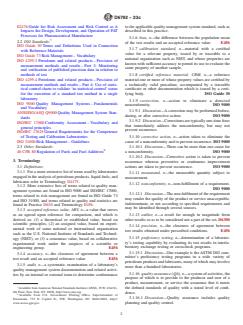
3.1.6 bias, n—the difference between the population mean
2.2 ISO Standards:
of the test results and an accepted reference value. E456
ISO Guide 30 Terms and Definitions Used in Connection
3.1.7 calibration standard, n—material with a certified
with Reference Materials
value for a relevant property, issued by or traceable to a
ISO Guide 73 Risk Management – Vocabulary
national organization such as NIST, and whose properties are
ISO 4259-3 Petroleum and related products – Precision of
known with sufficient accuracy to permit its use to evaluate the
measurement methods and results – Part 3: Monitoring
same property of another sample.
and verification of published precision data in relation to
3.1.8 certified reference material, CRM, n—a reference
methods of test
ISO 4259-4 Petroleum and related products – Precision of material one or more of whose property values are certified by
a technically valid procedure, accompanied by a traceable
measurement methods and results – Part 4: Use of statis-
tical control charts to validate ‘in-statistical-control’ status certificate or other documentation which is issued by a certi-
for the execution of a standard test method in a single fying body. ISO Guide 30
laboratory
3.1.9 correction, n—action to eliminate a detected
ISO 9000 Quality Management Systems – Fundamentals
nonconformity. ISO 9000
and Vocabulary
3.1.9.1 Discussion—A correction may be performed before,
ANSI/ISO/ASQ Q9000 Quality Management System Stan-
during, or after corrective action. ISO 9000
dards
3.1.9.2 Discussion—Corrections are typically one-time fixes
ISO/IEC 17000 Conformity Assessment – Vocabulary and
that immediately address the nonconformity, but may not
general principles
prevent recurrence.
ISO/IEC 17025 General Requirements for the Competence
3.1.10 corrective action, n—action taken to eliminate the
of Testing and Calibration Laboratories
ISO 31000 Risk Management – Guidelines cause of a nonconformity and to prevent recurrence. ISO 9000
2.3 Other Standards: 3.1.10.1 Discussion—There can be more than one cause for
a nonconformity. ISO 9000
40 CFR 80 Regulation of Fuels and Fuel Additives
3.1.10.2 Discussion—Corrective action is taken to prevent
3. Terminology
recurrence whereas preventive or continuous improvement
actions are taken to prevent occurrence. ISO 9000
3.1 Definitions:
3.1.1 For a more extensive list of terms used by laboratories
3.1.11 measurand, n—the measurable quantity subject to
engaged in the analysis of petroleum products, liquid fuels, and
measurement.
lubricants refer to Terminology D4175.
3.1.12 nonconformity, n—non-fulfillment of a requirement.
3.1.2 More extensive lists of terms related to quality man-
ISO 9000
agement systems are found in ISO 9000 and ISO/IEC 17000,
3.1.12.1 Discussion—The non-fulfilment of the requirement
terms related to risk management are found in ISO Guide 73
may render the quality of the product or service unacceptable,
and ISO 31000, and terms related to quality and statistics are
indeterminate, or not according to specified requirements and
found in Practice D630 and Terminology E456.
may be identified through several sources.
3.1.3 accepted reference value, ARV, n—a value that serves
as an agreed upon reference for comparison, and which is 3.1.13 outlier, n—a result far enough in magnitude from
derived as: (1) a theoretical or established value, based on
other results so as to be considered not a part of the set. D6300
scientific principles, (2) an assigned value, based on experi-
3.1.14 precision, n—the closeness of agreement between
mental work of some national or international organization
test results obtained under prescribed conditions. E456
such as the U.S. National Institute of Standards and Technol-
3.1.15 proficiency testing, n—determination of a laborato-
ogy (NIST), or (3) a consensus value, based on collaborative
ry’s testing capability by evaluating its test results in interla-
experimental work under the auspices of a scientific or
boratory exchange testing or crosscheck programs.
engineering group. E456
3.1.15.1 Discussion—One example is the ASTM D02 com-
3.1.4 accuracy, n—the closeness of agreement between a
mittee’s proficiency testing programs in a wide variety of
test result and an accepted reference value. E456
petroleum products and lubricants, many of which may involve
3.1.5 audit, n—a systematic examination of a laboratory’s
more than a hundred laboratories.
quality management system documentation and related activi-
3.1.16 quality assurance (QA), n—a system of activities, the
ties by an internal or external team to determine conformance
purpose of which is to provide to the producer and user of a
product, measurement, or service the assurance that it meets
Available from American National Standards Institute (ANSI), 25 W. 43rd St., the defined standards of quality with a stated level of confi-
4th Floor, New York, NY 10036, http://www.ansi.org.
dence.
Available from U.S. Government Printing Office, Superintendent of
3.1.16.1 Discussion—Quality assurance includes quality
Documents, 732 N. Capitol St., NW, Washington, DC 20401-0001, http://
www.access.gpo.gov. planning and quality control.
D6792 − 23c
3.1.17 quality control (QC), n—a planned system of activi- under site precision conditions may be expected to occur with
ties whose purpose is to provide a level of quality that meets a probability of approximately 0.95 (95 %). It is defined as 2.77
the needs of users; also the uses of such a system. times the standard deviation of results obtained under site
precision conditions. D6299
3.1.18 quality control sample (QC sample), n—for use in
quality assurance program to determine and monitor the 3.1.28 site precision conditions, n—conditions under which
precision and stability of a measurement system; a stable and test results are obtained by one or more operators in a single
homogenous material having physical or chemical properties, site location practicing the same test method on a single
or both, similar to those of typical samples tested by the measurement system using test specimens taken at random
analytical measurement system. The material is properly stored from the same sample of material over an extended period of
to ensure sample integrity, and is available in sufficient quantity time spanning at least a 15 day interval. D6299
for repeated long-term testing. D6299
3.1.29 traceability, n—property of the result of a measure-
3.1.19 reference material (RM), n—a material with accepted ment or the value of a standard whereby it can be related to
reference value(s), accompanied by an uncertainty at a stated stated references, usually national or international standards,
through an unbroken chain of comparisons all having stated
level of confidence for desired properties, which may be used
for calibration or quality control purposes in the laboratory. uncertainties.
3.1.19.1 Discussion—Sometimes these may be prepared
3.2 Definitions of Terms Specific to This Standard:
“in-house” provided the reference values are established using
3.2.1 precision ratio (PR), n—an estimate of relative mag-
accepted standard procedures.
nitude of repeatability and reproducibility. The PR for a given
3.1.20 repeatability, n—the quantitative expression of the standard test method can provide information on the relative
random error associated with a single operator in a given significance between variation caused by different operators
laboratory obtaining repetitive results with the same apparatus and laboratories compared to a single operator in a laboratory
under constant operating conditions on identical test material. performing the standard test method.
It is defined as the difference between two such results at the
3.2.2 test performance index (TPI), n—an approximate mea-
95 % confidence level. D6300
sure of a laboratory’s testing capability, defined as the ratio of
3.1.21 reproducibility, n—a quantitative expression of the test method reproducibility (R) to site precision (R').
random error associated with different operators using different
3.3 Acronyms:
apparatus, and so forth, each obtaining a single result on an
3.3.1 NIST—National Institute of Standards and
identical test sample when applying the same method. It is then
Technology, Gaithersburg, MD.
defined as the 95 % confidence limit for the difference between
two such single and independent results. D6300
4. Significance and Use
3.1.22 risk, n—effect of uncertainty on objectives.
4.1 A petroleum products, liquid fuels, and lubricants test-
ISO 31000
ing laboratory plays a crucial role in product quality manage-
3.1.22.1 Discussion—An effect is a deviation from the
ment and customer satisfaction. It is essential for a laboratory
expected and can be positive, negative, or both, and can
to provide quality data. This document provides guidance for
address, create, or result in opportunities and threats.
establishing and maintaining a quality management system in
ISO 31000
a laboratory.
4.1.1 The word ‘customer’ can refer to both customers
3.1.23 risk appetite, n—organization’s approach to assess
and eventually pursue, retain, take, or turn away from risk. internal and external to the laboratory or organization.
ISO Guide 73
5. General Quality Requirements for the Laboratory
3.1.24 risk assessment, n—overall process of risk
5.1 Establishment and maintenance of a quality manage-
identification, risk analysis, and risk evaluation. ISO Guide 73
ment system shall include stated objectives in the following
3.1.24.1 Discussion—Risk assessments typically utilize an
areas: a laboratory’s adherence to test method requirements,
evidence based approach to assist the decision making process
calibration and maintenance practices, and its quality control
when evaluating the impact of risk to the laboratory. The risk
program. Laboratory quality objectives should encompass the
should be evaluated in terms of consequence to the business
laboratory’s continuous improvement goals as well as meeting
and likelihood of recurrence when no mitigation of the risk is
customer requirements.
implemented.
5.2 Management shall appoint a representative to imple-
3.1.25 risk management, n—coordinated activities to direct
ment and maintain the quality management system in the
and control an organization with regard to risk. ISO 31000
laboratory.
3.1.26 risk tolerance, n—organization’s readiness to bear
the risk after risk treatment in order to achieve its objectives. 5.3 Laboratory management shall review the adequacy of
the quality management system and the activities of the
ISO Guide 73
3.1.26.1 Discussion—Risk tolerance can be influenced by laboratory for consistency with the stated quality objectives at
least annually.
legal or regulatory requirements. ISO Guide 73
3.1.27 site precision (R'), n—the value below which the 5.4 The quality management system shall have documented
absolute difference between two individual test results obtained processes for:
D6792 − 23c
5.4.1 Sampling and sample management (see Section 6), accreditation authority requirements, or combinations thereof,
5.4.2 Data, records, and document management and control and all other relevant information required for interpretation of
(see Section 7), the results.
5.4.3 Control and implementation of test methods (see
NOTE 3—Reports are typically printed or electronic for external
Section 8),
customers, however reports for internal customers may just be an entry in
5.4.4 Equipment calibration, verification, and maintenance
a Laboratory Information Management System (LIMS) or equivalent
(see Section 9), system.
5.4.5 Quality control (see 10.1),
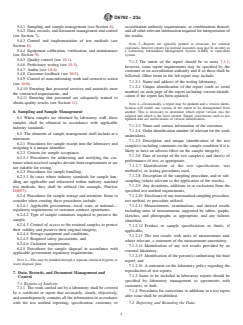
7.1.2 The intent of the report should be to meet 7.1.1;
5.4.6 Proficiency testing (see 10.3),
however, some report requirements may be specified by the
5.4.7 Audits (see 10.4),
customer or an accreditation authority and if so these shall be
5.4.8 Customer feedback (see 10.5),
followed. Other items in the lab report may include:
5.4.9 Control of nonconforming work and corrective action
7.1.2.1 Name and address of the testing laboratory,
(see 10.6),
7.1.2.2 Unique identification of the report (such as serial
5.4.10 Ensuring that procured services and materials meet
number) on each page of the report including version identifi-
the contracted requirements, and
cation if the report has been updated,
5.4.11 Ensuring that personnel are adequately trained to
obtain quality results (see Section 11).
NOTE 4—Occasionally, a report may be updated and a version identi-
fication will enable one version of the report to be distinguished from
another. This is necessary to determine which report version was the
6. Sampling and Sample Management
original and which is the most current. Simple conventions such as last
6.1 When samples are obtained by laboratory staff, these
updated date are useful means of version identification.
samples shall be obtained in accordance with applicable
7.1.2.3 Name and contact information of the customer,
industry standards.
7.1.2.4 Order identification number (if relevant for the work
6.2 The elements of sample management shall include at a
undertaken),
minimum:
7.1.2.5 Description and unique identification of the test
6.2.1 Procedures for sample receipt into the laboratory and
sample(s) including comments on the sample condition if it is
assigning it a unique identifier.
likely to have an adverse effect on the sample integrity,
6.2.2 Criteria for sample acceptance.
7.1.2.6 Date of receipt of the test sample(s) and date(s) of
6.2.2.1 Procedures for addressing and notifying the cus-
performance of test, as appropriate,
tomer when received samples deviate from requirements or are
7.1.2.7 Identification of the test specification, test
not suitable for testing.
method(s), or testing procedures used,
6.2.3 Procedures for sample handling.
7.1.2.8 Description of the sampling procedure, and or sub-
6.2.3.1 In cases where industry standards for sample han-
sampling (where relevant to the application of the results),
dling are applicable and referenced within industry standard
7.1.2.9 Any deviations, additions to or exclusions from the
test methods, they shall be utilized (for example, Practice
specified test method requirements,
D4057).
6.2.4 Procedures for sample storage and retention. Items to 7.1.2.10 Disclosure of any nonstandard sampling procedure,
consider when creating these procedures include: test method, or procedure utilized,
6.2.4.1 Applicable government—local, state, or national—
7.1.2.11 Measurements, examinations, and derived results
regulatory requirements or customer contract agreements.
including units of measurement, supported by tables, graphs,
6.2.4.2 Type of sample containers required to preserve the
sketches, and photographs as appropriate, and any failures
sample,
identified,
6.2.4.3 Control of access to the retained samples to protect
7.1.2.12 Product or sample specifications or limits, if
their validity and preserve their original integrity,
applicable,
6.2.4.4 Storage equipment and conditions,
7.1.2.13 The test results with units of measurement and,
6.2.4.5 Required safety precautions, and
where relevant, a statement of the measurement uncertainty,
6.2.4.6 Customer requirements.
7.1.2.14 Identification of any test results provided by an
6.2.5 Procedures for sample disposal in accordance with
external laboratory,
applicable government regulatory requirements.
7.1.2.15 Identification of the person(s) authorizing the final
NOTE 2—This may be handled through a separate chemical hygiene or
report, and
waste disposal plan.
7.1.2.16 A statement on the laboratory policy regarding the
reproduction of test reports.
7. Data, Records, and Document Management and
7.1.3 Items to be included in laboratory reports should be
Control
specified by laboratory management or agreements with
7.1 Reports of Analysis:
customers, or both.
7.1.1 The work carried out by a laboratory shall be covered
7.1.4 Procedures for corrections or additions to a test report
by a certificate or report that accurately, clearly, objectively,
after issue shall be established.
and unambiguously contains all the information in accordance
with the test method reporting, specification, customer, or 7.2 Reporting and Rounding the Data:
D6792 − 23c
7.2.1 The reporting requirements specified in the test replication of the test and recalculation of the results, and if
method or procedure shall be used (unless specifically required changes have been made from the original record then these
otherwise by the customer or applicable regulations). changes can be tracked to a previous or original record.
7.2.2 If rounding is performed, the rounding protocol of 7.5.4 The original records shall be held in a suitable
environment to prevent loss, damage, deterioration, unauthor-
Practice E29 should be used unless otherwise specified in the
method, procedure, or governing specification. ized access, or amendment. A system shall exist that allows
locating the required documents in a reasonable period of time.
7.2.3 The test results should be reviewed and authorized
7.5.5 All issued reports should be retained and disposed of
before reporting to the customer.
in line with customer or regulatory requirements.
7.3 Records of Calibration, Verification, and Maintenance:
7.6 Document Control:
7.3.1 Procedures shall be established for the management of
7.6.1 Document, implement, and maintain procedures to
instrument calibration records. The procedures used shall be in
describe the control of documents in the laboratory. These
compliance with that required in the test method reported. Such
procedures shall establish the process by which only authorized
records usually indicate the instrument calibrated, method or
and appropriate (typically the most current) version of docu-
procedure used for calibration, the dates of last and next
ments are available to the staff in the area of use. As a
scheduled calibrations, the person performing the calibration,
minimum, for laboratory procedures (for example, standard
the values obtained before and after calibration, permissible
operating procedures, SOPs) and laboratory test procedures (if
tolerances, and the metrological traceability (if applicable) of
used), a document control process shall address version/
the calibration materials used (that is, certified values). Records
revision identification, unique identification, authorization for
may be electronic.
use by relevant personnel, review and update period, and a
7.3.2 Procedures shall be established for the management of
system whereby unintended use of obsolete documents is
instrument maintenance records. Such records usually indicate
prevented.
the instrument maintained, description of the maintenance
performed, the dates of last and next maintenance, and the
7.7 Laboratory Information Management System (LIMS):
person performing the maintenance. Records may be elec-
7.7.1 The LIMS system in use should suit the laboratory’s
tronic.
circumstances and can be electronic or non-electronic in nature
or a mixture of both.
NOTE 5—For instruments that require calibration, calibration and
7.7.2 Procedures for backup and recovery of electronic data
maintenance records may be combined.
shall be established.
7.4 Quality Control (QC) Testing Records:
7.7.3 Procedures shall be established for changes to LIMS
7.4.1 The laboratory shall have documented procedures for
system and should include authorization, documentation, and
creating and maintaining records for analysis of QC samples
validation of the change.
where it has been identified as a QC tool. The QC procedures
7.7.4 Procedures shall be established to protect the system
used shall be in compliance with that required in the test
from unauthorized access and tampering to maintain the
method reported. It is recommended that such records include
integrity of the data reported.
the QC sample name, material, and source (if known), the test
7.7.5 Calculations and data transfers performed directly
method(s) for which it is to be used, the assigned values and
from instruments should be validated as accurate on a periodic
their uncertainty where applicable, and values obtained upon
basis.
analysis. Additionally, it is recommended that the receipt date
or the date the QC material was put into active use in the
8. Test Methods
laboratory be documented, along with the expiration date (if
applicable).
8.1 The laboratory shall have documented test methods and
7.4.2 Procedures for initial setup and re-evaluation of the procedures for performing the required tests.
chart control limits, ongoing evaluation of the control charts,
8.2 The test methods that are stated in the product specifi-
and retaining completed control charts should be established. It
cations or agreements with customers shall be used for sample
is recommended that these records include the date the control
analysis.
charts were changed and the reason for the change.
8.3 The laboratory shall have procedures for reporting
7.5 Record Retention and Disposal:
modifications to the test method requirements.
7.5.1 The record retention and disposal system should suit
8.4 The laboratory shall have procedures which include a
the laboratory’s particular circumstances and comply with any
review, justification and approval for modifying any test
existing regulations and customer requirements.
method.
7.5.2 All data shall be maintained, archived, and disposed
8.4.1 Any modification shall be documented and accepted
according to laboratory, company, customer, or regulatory
by the customer prior to testing the customer’s samples.
agency requirements, or a combination thereof.
7.5.3 Procedures for retaining and disposal of records, 8.5 The test methods shall be maintained up-to-date and be
readily available to the laboratory staff.
including electronic, of all original observations, calculations
and derived data, calibration records, and final test reports for 8.5.1 If a previous version of a test method is required a
an appropriate period shall be established. The records for each version number, revision number or year of adoption as
test should contain sufficient information to permit satisfactory appropriate should indicate its identity.
D6792 − 23c
NOTE 6—Some specifications or regulations may require the use of a
9.3.1 Use the verification material as specified in the test
specific year version of a test method.
method.
9.3.2 Materials analyzed in proficiency testing programs
9. Equipment Calibration, Verification, and Maintenance
meeting the requirements of Practice D6300 or ISO 4259-3
9.1 Calibration and Verification:
may be used as verification materials, provided no obvious bias
9.1.1 Perform calibrations and verifications as specified in
or unusual frequency distribution of results are observed. The
the test methods and maintain these records.
consensus value is most likely the value closest to the true
9.1.2 If an instrument is found to be out of calibration, or
value of this material; however, the uncertainty attached to this
does not pass the verification and the situation cannot be
mean value will be dependent on the precision and the total
immediately addressed, then the instrument shall be taken out
number of the participating laboratories.
of operation and tagged as such until the situation is corrected
NOTE 9—Some proficiency testing material may change composition
(see 10.6).
once the sample is opened.
9.1.3 The performance of apparatus and equipment used in
9.3.3 Secondary standards may be used to verify calibration
the laboratory but not calibrated in that laboratory (that is,
of equipment.
precalibrated, vendor supplied) should be verified by using a
documented, technically valid procedure at periodic intervals. 9.3.4 Expiry dates of verification material shall be docu-
mented. Do not use this material beyond the assigned expiry
9.1.4 Procedures shall be established to verify the measur-
ing and testing equipment in-calibration status, at a scheduled date.
frequency, including equipment pre-calibrated by the vendor.
9.4 The laboratory shall establish procedures for the storage
Items to consider when creating these procedures include:
of reference materials in a manner to ensure their safety,
9.1.4.1 Records of calibration, verification and maintenance
integrity, and protection from contamination (see 6.2.4).
(see 7.3),
9.5 Maintenance:
NOTE 7—The calibration and verification frequency and protocol may
9.5.1 Document and maintain procedures and schedules for
vary with the instrument type, test method requirements and its frequency
performing maintenance and preventative maintenance of
of use.
inspection, testing and measuring equipment.
9.1.4.2 Traceability to national or international standards for
9.5.2 Perform maintenance as required and maintain records
calibration records,
that contain all relevant data and indicate completion of the
NOTE 8—Where the concept of traceability to national or international maintenance activity.
standards of measurement is not applicable, the testing laboratory shall
9.5.3 A reliability strategy should be developed which may
provide satisfactory evidence of test result accuracy (for example, by
include the following:
participation in a program of interlaboratory comparisons or use of
9.5.3.1 Equipment age and performance,
CRMs).
9.5.3.2 Back-up equipment justification based on
9.1.4.3 Customers and test method requirements and,
utilization,
9.1.4.4 Corrective actions (see 10.6).
9.5.3.3 Critical spare parts, and
9.2 Calibration Standards and Materials:
9.5.3.4 Inventory of equipment.
9.2.1 Use the calibration material as specified in the test
method.
10. Performance Measures
9.2.2 Calibration material shall be appropriate for the
10.1 Quality Control:
method and characterized with the accuracy demanded by the
10.1.1 Quality Control Practices:
analysis to be performed. Quantitative calibration standards
10.1.1.1 Quality control practices shall be established.
should be prepared from constituents of known purity. Use the
primary calibration standards or CRMs specified or allowed in
NOTE 10—Practice D6299 provides industry best practice statistical
the test method.
quality assurance and control chart technique guidance for Gaussian data.
9.2.3 Where appropriate, values for reference materials
10.1.1.2 QC sample testing frequency shall be established
should be produced following the certification protocol used by
for each applicable test method. Principal f
...
This document is not an ASTM standard and is intended only to provide the user of an ASTM standard an indication of what changes have been made to the previous version. Because
it may not be technically possible to adequately depict all changes accurately, ASTM recommends that users consult prior editions as appropriate. In all cases only the current version
of the standard as published by ASTM is to be considered the official document.
Designation: D6792 − 23b D6792 − 23c An American National Standard
Standard Practice for
Quality Management Systems in Petroleum Products, Liquid
Fuels, and Lubricants Testing Laboratories
This standard is issued under the fixed designation D6792; the number immediately following the designation indicates the year of
original adoption or, in the case of revision, the year of last revision. A number in parentheses indicates the year of last reapproval. A
superscript epsilon (´) indicates an editorial change since the last revision or reapproval.
1. Scope*
1.1 This practice covers the establishment and maintenance of the essentials of a quality management system in laboratories
engaged in the analysis of petroleum products, liquid fuels, and lubricants. It is designed to be used in conjunction with Practice
D6299.
NOTE 1—This practice is based on the quality management concepts and principles advocated in ANSI/ISO/ASQ Q9000 standards, ISO/IEC 17025, ASQ
2 3
Manual, and ASTM standards such as D3244, D4182, D4621, D6299, D6300, D7372, E29, E177, E456, E548, E882, E994, E1301, E1323, STP 15D,
and STP 1209.
1.2 This standard does not purport to address all of the safety concerns, if any, associated with its use. It is the responsibility
of the user of this standard to establish appropriate safety, health, and environmental practices and determine the applicability of
regulatory requirements prior to use.
1.3 This international standard was developed in accordance with internationally recognized principles on standardization
established in the Decision on Principles for the Development of International Standards, Guides and Recommendations issued
by the World Trade Organization Technical Barriers to Trade (TBT) Committee.
2. Referenced Documents
2.1 ASTM Standards:
D630 Specification for Olive Oil Chip Soap (Type A, Straight; Type B, Blended) (Withdrawn 1979)
D3244 Practice for Utilization of Test Data to Determine Conformance with Specifications
D4057 Practice for Manual Sampling of Petroleum and Petroleum Products
D4175 Terminology Relating to Petroleum Products, Liquid Fuels, and Lubricants
D4182 Practice for Evaluation of Laboratories Using ASTM Procedures in the Sampling and Analysis of Coal and Coke
(Withdrawn 2010)
D4621 Guide for Quality Management in an Organization That Samples or Tests Coal and Coke (Withdrawn 2010)
D6299 Practice for Applying Statistical Quality Assurance and Control Charting Techniques to Evaluate Analytical Measure-
ment System Performance
This practice is under the jurisdiction of ASTM Committee D02 on Petroleum Products, Liquid Fuels, and Lubricants and is the direct responsibility of Subcommittee
D02.94 on Coordinating Subcommittee on Quality Assurance and Statistics.
Current edition approved Oct. 1, 2023Nov. 1, 2023. Published November 2023. Originally approved in 2002. Last previous edition approved in 2023 as
D6792 – 23a.D6792 – 23b. DOI: 10.1520/D6792-23B.10.1520/D6792-23C.
“Quality Assurance for The Chemical and Process Industries: A Manual of Good Practices,” 1987, available from American Society for Quality (ASQ), 600 N. Plankinton
Ave., Milwaukee, WI 53203. www.asq.org.
ASTM STP 15D, ASTM Manual on Presentation of Data and Control Chart Analysis, ASTM International, W. Conshohocken, PA.
ASTM STP 1209, ASTM Manual on Total Quality Management, ASTM International, W. Conshohocken, PA.
For referenced ASTM standards, visit the ASTM website, www.astm.org, or contact ASTM Customer Service at service@astm.org. For Annual Book of ASTM Standards
volume information, refer to the standard’s Document Summary page on the ASTM website.
The last approved version of this historical standard is referenced on www.astm.org.
*A Summary of Changes section appears at the end of this standard
Copyright © ASTM International, 100 Barr Harbor Drive, PO Box C700, West Conshohocken, PA 19428-2959. United States
D6792 − 23c
D6300 Practice for Determination of Precision and Bias Data for Use in Test Methods for Petroleum Products, Liquid Fuels, and
Lubricants
D6617 Practice for Laboratory Bias Detection Using Single Test Result from Standard Material
D7372 Guide for Analysis and Interpretation of Proficiency Test Program Results
D8428 Guide for Establishing Analyst Competence to Perform a Test Method
E29 Practice for Using Significant Digits in Test Data to Determine Conformance with Specifications
E177 Practice for Use of the Terms Precision and Bias in ASTM Test Methods
E456 Terminology Relating to Quality and Statistics
E548 Guide for General Criteria Used for Evaluating Laboratory Competence (Withdrawn 2002)
E882 Guide for Accountability and Quality Control in the Chemical Analysis Laboratory
E994 Guide for Calibration and Testing Laboratory Accreditation Systems General Requirements for Operation and Recognition
(Withdrawn 2003)
E1301 Guide for Proficiency Testing by Interlaboratory Comparisons (Withdrawn 2012)
E1323 Guide for Evaluating Laboratory Measurement Practices and the Statistical Analysis of the Resulting Data
E2476 Guide for Risk Assessment and Risk Control as it Impacts the Design, Development, and Operation of PAT Processes
for Pharmaceutical Manufacture
2.2 ISO Standards:
ISO Guide 30 Terms and Definitions Used in Connection with Reference Materials
ISO Guide 73 Risk Management – Vocabulary
ISO 4259-3 Petroleum and related products – Precision of measurement methods and results – Part 3: Monitoring and
verification of published precision data in relation to methods of test
ISO 4259-4 Petroleum and related products – Precision of measurement methods and results – Part 4: Use of statistical control
charts to validate ‘in-statistical-control’ status for the execution of a standard test method in a single laboratory
ISO 9000 Quality Management Systems – Fundamentals and Vocabulary
ANSI/ISO/ASQ Q9000 Quality Management System Standards
ISO/IEC 17000 Conformity Assessment – Vocabulary and general principles
ISO/IEC 17025 General Requirements for the Competence of Testing and Calibration Laboratories
ISO 31000 Risk Management – Guidelines
2.3 Other Standards:
40 CFR 80 Regulation of Fuels and Fuel Additives
3. Terminology
3.1 Definitions:
3.1.1 For a more extensive list of terms used by laboratories engaged in the analysis of petroleum products, liquid fuels, and
lubricants refer to Terminology D4175.
3.1.2 More extensive lists of terms related to quality management systems are found in ISO 9000 and ISO/IEC 17000, terms
related to risk management are found in ISO Guide 73 and ISO 31000, and terms related to quality and statistics are found in
Practice D630 and Terminology E456.
3.1.3 accepted reference value, ARV, n—a value that serves as an agreed upon reference for comparison, and which is derived as:
(1) a theoretical or established value, based on scientific principles, (2) an assigned value, based on experimental work of some
national or international organization such as the U.S. National Institute of Standards and Technology (NIST), or (3) a consensus
value, based on collaborative experimental work under the auspices of a scientific or engineering group. E456
3.1.4 accuracy, n—the closeness of agreement between a test result and an accepted reference value. E456
3.1.5 audit, n—a systematic examination of a laboratory’s quality management system documentation and related activities by an
internal or external team to determine conformance to the applicable quality management system standard, such as described in
this practice.
3.1.6 bias, n—the difference between the population mean of the test results and an accepted reference value. E456
Available from American National Standards Institute (ANSI), 25 W. 43rd St., 4th Floor, New York, NY 10036, http://www.ansi.org.
Available from U.S. Government Printing Office, Superintendent of Documents, 732 N. Capitol St., NW, Washington, DC 20401-0001, http://www.access.gpo.gov.
D6792 − 23c
3.1.7 calibration standard, n—material with a certified value for a relevant property, issued by or traceable to a national
organization such as NIST, and whose properties are known with sufficient accuracy to permit its use to evaluate the same property
of another sample.
3.1.8 certified reference material, CRM, n—a reference material one or more of whose property values are certified by a
technically valid procedure, accompanied by a traceable certificate or other documentation which is issued by a certifying body.
ISO Guide 30
3.1.9 correction, n—action to eliminate a detected nonconformity. ISO 9000
3.1.9.1 Discussion—
A correction may be performed before, during, or after corrective action. ISO 9000
3.1.9.2 Discussion—
Corrections are typically one-time fixes that immediately address the nonconformity, but may not prevent recurrence.
3.1.10 corrective action, n—action taken to eliminate the cause of a nonconformity and to prevent recurrence. ISO 9000
3.1.10.1 Discussion—
There can be more than one cause for a nonconformity. ISO 9000
3.1.10.2 Discussion—
Corrective action is taken to prevent recurrence whereas preventive or continuous improvement actions are taken to prevent
occurrence. ISO 9000
3.1.11 measurand, n—the measurable quantity subject to measurement.
3.1.12 nonconformity, n—non-fulfillment of a requirement. ISO 9000
3.1.12.1 Discussion—
The non-fulfilment of the requirement may render the quality of the product or service unacceptable, indeterminate, or not
according to specified requirements and may be identified through several sources.
3.1.13 outlier, n—a result far enough in magnitude from other results so as to be considered not a part of the set. D6300
3.1.14 precision, n—the closeness of agreement between test results obtained under prescribed conditions. E456
3.1.15 proficiency testing, n—determination of a laboratory’s testing capability by evaluating its test results in interlaboratory
exchange testing or crosscheck programs.
3.1.15.1 Discussion—
One example is the ASTM D02 committee’s proficiency testing programs in a wide variety of petroleum products and lubricants,
many of which may involve more than a hundred laboratories.
3.1.16 quality assurance (QA), n—a system of activities, the purpose of which is to provide to the producer and user of a product,
measurement, or service the assurance that it meets the defined standards of quality with a stated level of confidence.
3.1.16.1 Discussion—
Quality assurance includes quality planning and quality control.
3.1.17 quality control (QC), n—a planned system of activities whose purpose is to provide a level of quality that meets the needs
of users; also the uses of such a system.
3.1.18 quality control sample (QC sample), n—for use in quality assurance program to determine and monitor the precision and
stability of a measurement system; a stable and homogenous material having physical or chemical properties, or both, similar to
those of typical samples tested by the analytical measurement system. The material is properly stored to ensure sample integrity,
and is available in sufficient quantity for repeated long-term testing. D6299
3.1.19 reference material (RM), n—a material with accepted reference value(s), accompanied by an uncertainty at a stated level
of confidence for desired properties, which may be used for calibration or quality control purposes in the laboratory.
D6792 − 23c
3.1.19.1 Discussion—
Sometimes these may be prepared “in-house” provided the reference values are established using accepted standard procedures.
3.1.20 repeatability, n—the quantitative expression of the random error associated with a single operator in a given laboratory
obtaining repetitive results with the same apparatus under constant operating conditions on identical test material. It is defined as
the difference between two such results at the 95 % confidence level. D6300
3.1.21 reproducibility, n—a quantitative expression of the random error associated with different operators using different
apparatus, and so forth, each obtaining a single result on an identical test sample when applying the same method. It is then defined
as the 95 % confidence limit for the difference between two such single and independent results. D6300
3.1.22 risk, n—effect of uncertainty on objectives.
ISO 31000
3.1.22.1 Discussion—
An effect is a deviation from the expected and can be positive, negative, or both, and can address, create, or result in opportunities
and threats.
ISO 31000
3.1.23 risk appetite, n—organization’s approach to assess and eventually pursue, retain, take, or turn away from risk.
ISO Guide 73
3.1.24 risk assessment, n—overall process of risk identification, risk analysis, and risk evaluation. ISO Guide 73
3.1.24.1 Discussion—
Risk assessments typically utilize an evidence based approach to assist the decision making process when evaluating the impact
of risk to the laboratory. The risk should be evaluated in terms of consequence to the business and likelihood of recurrence when
no mitigation of the risk is implemented.
3.1.25 risk management, n—coordinated activities to direct and control an organization with regard to risk. ISO 31000
3.1.26 risk tolerance, n—organization’s readiness to bear the risk after risk treatment in order to achieve its objectives. ISO Guide
3.1.26.1 Discussion—
Risk tolerance can be influenced by legal or regulatory requirements. ISO Guide 73
3.1.27 site precision (R'), n—the value below which the absolute difference between two individual test results obtained under site
precision conditions may be expected to occur with a probability of approximately 0.95 (95 %). It is defined as 2.77 times the
standard deviation of results obtained under site precision conditions. D6299
3.1.28 site precision conditions, n—conditions under which test results are obtained by one or more operators in a single site
location practicing the same test method on a single measurement system using test specimens taken at random from the same
sample of material over an extended period of time spanning at least a 15 day interval. D6299
3.1.29 traceability, n—property of the result of a measurement or the value of a standard whereby it can be related to stated
references, usually national or international standards, through an unbroken chain of comparisons all having stated uncertainties.
3.2 Definitions of Terms Specific to This Standard:
3.2.1 precision ratio (PR), n—an estimate of relative magnitude of repeatability and reproducibility. The PR for a given standard
test method can provide information on the relative significance between variation caused by different operators and laboratories
compared to a single operator in a laboratory performing the standard test method.
3.2.2 test performance index (TPI), n—an approximate measure of a laboratory’s testing capability, defined as the ratio of test
method reproducibility (R) to site precision (R').
3.3 Acronyms:
3.3.1 NIST—National Institute of Standards and Technology, Gaithersburg, MD.
D6792 − 23c
4. Significance and Use
4.1 A petroleum products, liquid fuels, and lubricants testing laboratory plays a crucial role in product quality management and
customer satisfaction. It is essential for a laboratory to provide quality data. This document provides guidance for establishing and
maintaining a quality management system in a laboratory.
4.1.1 The word ‘customer’ can refer to both customers internal and external to the laboratory or organization.
5. General Quality Requirements for the Laboratory
5.1 Establishment and maintenance of a quality management system shall include stated objectives in the following areas: a
laboratory’s adherence to test method requirements, calibration and maintenance practices, and its quality control program.
Laboratory quality objectives should encompass the laboratory’s continuous improvement goals as well as meeting customer
requirements.
5.2 Management shall appoint a representative to implement and maintain the quality management system in the laboratory.
5.3 Laboratory management shall review the adequacy of the quality management system and the activities of the laboratory for
consistency with the stated quality objectives at least annually.
5.4 The quality management system shall have documented processes for:
5.4.1 Sampling and sample management (see Section 6),
5.4.2 Data, records, and document management and control (see Section 7),
5.4.3 Control and implementation of test methods (see Section 8),
5.4.4 Equipment calibration, verification, and maintenance (see Section 9),
5.4.5 Quality control (see 10.1),
5.4.6 Proficiency testing (see 10.210.3),
5.4.7 Audits (see 10.310.4),
5.4.8 Customer feedback (see 10.410.5),
5.4.9 Control of nonconforming work and corrective action (see 10.510.6),
5.4.10 Ensuring that procured services and materials meet the contracted requirements, and
5.4.11 Ensuring that personnel are adequately trained to obtain quality results (see Section 11).
6. Sampling and Sample Management
6.1 When samples are obtained by laboratory staff, these samples shall be obtained in accordance with applicable industry
standards.
6.2 The elements of sample management shall include at a minimum:
6.2.1 Procedures for sample receipt into the laboratory and assigning it a unique identifier.
6.2.2 Criteria for sample acceptance.
6.2.2.1 Procedures for addressing and notifying the customer when received samples deviate from requirements or are not suitable
for testing.
D6792 − 23c
6.2.3 Procedures for sample handling.
6.2.3.1 In cases where industry standards for sample handling are applicable and referenced within industry standard test methods,
they shall be utilized (for example, Practice D4057).
6.2.4 Procedures for sample storage and retention. Items to consider when creating these procedures include:
6.2.4.1 Applicable government—local, state, or national—regulatory requirements or customer contract agreements.
6.2.4.2 Type of sample containers required to preserve the sample,
6.2.4.3 Control of access to the retained samples to protect their validity and preserve their original integrity,
6.2.4.4 Storage equipment and conditions,
6.2.4.5 Required safety precautions, and
6.2.4.6 Customer requirements.
6.2.5 Procedures for sample disposal in accordance with applicable government regulatory requirements.
NOTE 2—This may be handled through a separate chemical hygiene or waste disposal plan.
7. Data, Records, and Document Management and Control
7.1 Reports of Analysis:
7.1.1 The work carried out by a laboratory shall be covered by a certificate or report that accurately, clearly, objectively, and
unambiguously contains all the information in accordance with the test method reporting, specification, customer, or accreditation
authority requirements, or combinations thereof, and all other relevant information required for interpretation of the results.
NOTE 3—Reports are typically printed or electronic for external customers, however reports for internal customers may just be an entry in a Laboratory
Information Management System (LIMS) or equivalent system.
7.1.2 The intent of the report should be to meet 7.1.1; however, some report requirements may be specified by the customer or
an accreditation authority and if so these shall be followed. Other items in the lab report may include:
7.1.2.1 Name and address of the testing laboratory,
7.1.2.2 Unique identification of the report (such as serial number) on each page of the report including version identification if
the report has been updated,
NOTE 4—Occasionally, a report may be updated and a version identification will enable one version of the report to be distinguished from another. This
is necessary to determine which report version was the original and which is the most current. Simple conventions such as last updated date are useful
means of version identification.
7.1.2.3 Name and contact information of the customer,
7.1.2.4 Order identification number (if relevant for the work undertaken),
7.1.2.5 Description and unique identification of the test sample(s) including comments on the sample condition if it is likely to
have an adverse effect on the sample integrity,
7.1.2.6 Date of receipt of the test sample(s) and date(s) of performance of test, as appropriate,
7.1.2.7 Identification of the test specification, test method(s), or testing procedures used,
D6792 − 23c
7.1.2.8 Description of the sampling procedure, and or subsampling (where relevant to the application of the results),
7.1.2.9 Any deviations, additions to or exclusions from the specified test method requirements,
7.1.2.10 Disclosure of any nonstandard sampling procedure, test method, or procedure utilized,
7.1.2.11 Measurements, examinations, and derived results including units of measurement, supported by tables, graphs, sketches,
and photographs as appropriate, and any failures identified,
7.1.2.12 Product or sample specifications or limits, if applicable,
7.1.2.13 The test results with units of measurement and, where relevant, a statement of the measurement uncertainty,
7.1.2.14 Identification of any test results provided by an external laboratory,
7.1.2.15 Identification of the person(s) authorizing the final report, and
7.1.2.16 A statement on the laboratory policy regarding the reproduction of test reports.
7.1.3 Items to be included in laboratory reports should be specified by laboratory management or agreements with customers, or
both.
7.1.4 Procedures for corrections or additions to a test report after issue shall be established.
7.2 Reporting and Rounding the Data:
7.2.1 The reporting requirements specified in the test method or procedure shall be used (unless specifically required otherwise
by the customer or applicable regulations).
7.2.2 If rounding is performed, the rounding protocol of Practice E29 should be used unless otherwise specified in the method,
procedure, or governing specification.
7.2.3 The test results should be reviewed and authorized before reporting to the customer.
7.3 Records of Calibration, Verification, and Maintenance:
7.3.1 Procedures shall be established for the management of instrument calibration records. The procedures used shall be in
compliance with that required in the test method reported. Such records usually indicate the instrument calibrated, method or
procedure used for calibration, the dates of last and next scheduled calibrations, the person performing the calibration, the values
obtained before and after calibration, permissible tolerances, and the metrological traceability (if applicable) of the calibration
materials used (that is, certified values). Records may be electronic.
7.3.2 Procedures shall be established for the management of instrument maintenance records. Such records usually indicate the
instrument maintained, description of the maintenance performed, the dates of last and next maintenance, and the person
performing the maintenance. Records may be electronic.
NOTE 5—For instruments that require calibration, calibration and maintenance records may be combined.
7.4 Quality Control (QC) Testing Records:
7.4.1 The laboratory shall have documented procedures for creating and maintaining records for analysis of QC samples where
it has been identified as a QC tool. The QC procedures used shall be in compliance with that required in the test method reported.
It is recommended that such records include the QC sample name, material, and source (if known), the test method(s) for which
it is to be used, the assigned values and their uncertainty where applicable, and values obtained upon analysis. Additionally, it is
recommended that the receipt date or the date the QC material was put into active use in the laboratory be documented, along with
the expiration date (if applicable).
D6792 − 23c
7.4.2 Procedures for initial setup and re-evaluation of the chart control limits, ongoing evaluation of the control charts, and
retaining completed control charts should be established. It is recommended that these records include the date the control charts
were changed and the reason for the change.
7.5 Record Retention and Disposal:
7.5.1 The record retention and disposal system should suit the laboratory’s particular circumstances and comply with any existing
regulations and customer requirements.
7.5.2 All data shall be maintained, archived, and disposed according to laboratory, company, customer, or regulatory agency
requirements, or a combination thereof.
7.5.3 Procedures for retaining and disposal of records, including electronic, of all original observations, calculations and derived
data, calibration records, and final test reports for an appropriate period shall be established. The records for each test should
contain sufficient information to permit satisfactory replication of the test and recalculation of the results, and if changes have been
made from the original record then these changes can be tracked to a previous or original record.
7.5.4 The original records shall be held in a suitable environment to prevent loss, damage, deterioration, unauthorized access, or
amendment. A system shall exist that allows locating the required documents in a reasonable period of time.
7.5.5 All issued reports should be retained and disposed of in line with customer or regulatory requirements.
7.6 Document Control:
7.6.1 Document, implement, and maintain procedures to describe the control of documents in the laboratory. These procedures
shall establish the process by which only authorized and appropriate (typically the most current) version of documents are available
to the staff in the area of use. As a minimum, for laboratory procedures (for example, standard operating procedures, SOPs) and
laboratory test procedures (if used), a document control process shall address version/revision identification, unique identification,
authorization for use by relevant personnel, review and update period, and a system whereby unintended use of obsolete documents
is prevented.
7.7 Laboratory Information Management System (LIMS):
7.7.1 The LIMS system in use should suit the laboratory’s circumstances and can be electronic or non-electronic in nature or a
mixture of both.
7.7.2 Procedures for backup and recovery of electronic data shall be established.
7.7.3 Procedures shall be established for changes to LIMS system and should include authorization, documentation, and validation
of the change.
7.7.4 Procedures shall be established to protect the system from unauthorized access and tampering to maintain the integrity of
the data reported.
7.7.5 Calculations and data transfers performed directly from instruments should be validated as accurate on a periodic basis.
8. Test Methods
8.1 The laboratory shall have documented test methods and procedures for performing the required tests.
8.2 The test methods that are stated in the product specifications or agreements with customers shall be used for sample analysis.
8.3 The laboratory shall have procedures for reporting modifications to the test method requirements.
8.4 The laboratory shall have procedures which include a review, justification and approval for modifying any test method.
D6792 − 23c
8.4.1 Any modification shall be documented and accepted by the customer prior to testing the customer’s samples.
8.5 The test methods shall be maintained up-to-date and be readily available to the laboratory staff.
8.5.1 If a previous version of a test method is required a version number, revision number or year of adoption as appropriate should
indicate its identity.
NOTE 6—Some specifications or regulations may require the use of a specific year version of a test method.
9. Equipment Calibration, Verification, and Maintenance
9.1 Calibration and Verification:
9.1.1 Perform calibrations and verifications as specified in the test methods and maintain these records.
9.1.2 If an instrument is found to be out of calibration, or does not pass the verification and the situation cannot be immediately
addressed, then the instrument shall be taken out of operation and tagged as such until the situation is corrected (see 10.510.6).
9.1.3 The performance of apparatus and equipment used in the laboratory but not calibrated in that laboratory (that is,
precalibrated, vendor supplied) should be verified by using a documented, technically valid procedure at periodic intervals.
9.1.4 Procedures shall be established to verify the measuring and testing equipment in-calibration status, at a scheduled frequency,
including equipment pre-calibrated by the vendor. Items to consider when creating these procedures include:
9.1.4.1 Records of calibration, verification and maintenance (see 7.3),
NOTE 7—The calibration and verification frequency and protocol may vary with the instrument type, test method requirements and its frequency of use.
9.1.4.2 Traceability to national or international standards for calibration records,
NOTE 8—Where the concept of traceability to national or international standards of measurement is not applicable, the testing laboratory shall provide
satisfactory evidence of test result accuracy (for example, by participation in a program of interlaboratory comparisons or use of CRMs).
9.1.4.3 Customers and test method requirements and,
9.1.4.4 Corrective actions (see 10.510.6).
9.2 Calibration Standards and Materials:
9.2.1 Use the calibration material as specified in the test method.
9.2.2 Calibration material shall be appropriate for the method and characterized with the accuracy demanded by the analysis to
be performed. Quantitative calibration standards should be prepared from constituents of known purity. Use the primary calibration
standards or CRMs specified or allowed in the test method.
9.2.3 Where appropriate, values for reference materials should be produced following the certification protocol used by NIST or
other standards issuing bodies, and, should be traceable to the International System of Units (SI) units of measurement, if required
or appropriate.
9.2.4 Expiry dates of calibration standards shall be documented. If the expiry date is not stated by the vendor then this should
be established by a documented technically valid procedure. Do not use this material beyond the assigned expiry date.
The most current protocols for NIST certification of reference materials can be found in NIST SP260–136 (2020 Edition) found at https://nvlpubs.nist.gov/nistpubs/
SpecialPublications/NIST.SP.260-136-2020.pdf.
D6792 − 23c
9.3 Verification Standards and Materials:
9.3.1 Use the verification material as specified in the test method.
9.3.2 Materials analyzed in proficiency testing programs meeting the requirements of Practice D6300 or ISO 4259-3 may be used
as verification materials, provided no obvious bias or unusual frequency distribution of results are observed. The consensus value
is most likely the value closest to the true value of this material; however, the uncertainty attached to this mean value will be
dependent on the precision and the total number of the participating laboratories.
NOTE 9—Some proficiency testing material may change composition once the sample is opened.
9.3.3 Secondary standards may be used to verify calibration of equipment.
9.3.4 Expiry dates of verification material shall be documented. Do not use this material beyond the assigned expiry date.
9.4 The laboratory shall establish procedures for the storage of reference materials in a manner to ensure their safety, integrity,
and protection from contamination (see 6.2.4).
9.5 Maintenance:
9.5.1 Document and maintain procedures and schedules for performing maintenance and preventative maintenance of inspection,
testing and measuring equipment.
9.5.2 Perform maintenance as required and maintain records that contain all relevant data and indicate completion of the
maintenance activity.
9.5.3 A reliability strategy should be developed which may include the following:
9.5.3.1 Equipment age and performance,
9.5.3.2 Back-up equipment justification based on utilization,
9.5.3.3 Critical spare parts, and
9.5.3.4 Inventory of equipment.
10. Performance Measures
10.1 Quality Control:
10.1.1 Quality Control Practices:
10.1.1.1 Quality control practices shall be established.
NOTE 10—Practice D6299 provides industry best practice statistical quality assurance and control chart technique guidance for Gaussian data.
10.1.1.2 QC sample testing frequency shall be established for each applicable test method. Principal factors to be considered for
det
...