


ASTM D4419-90(2015)
(Test Method)Standard Test Method for Measurement of Transition Temperatures of Petroleum Waxes by Differential Scanning Calorimetry (DSC)
Standard Test Method for Measurement of Transition Temperatures of Petroleum Waxes by Differential Scanning Calorimetry (DSC)
SIGNIFICANCE AND USE
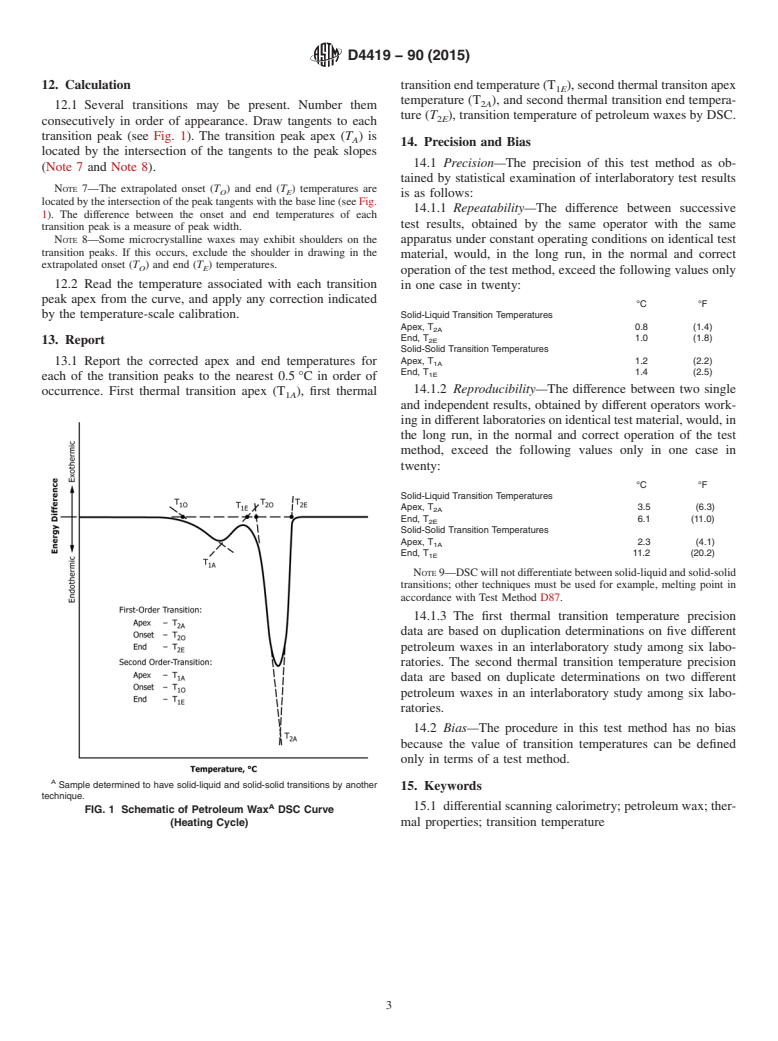
5.1 DSC in a convenient and rapid method for determining the temperature limits within which a wax undergoes during transitions. The highest temperature transition is a solid-liquid transition associated with complete melting; it can guide the choice of wax storage and application temperatures. The solid-solid temperature transition is related to the properties of the solid, that is, hardness and blocking temperature.
Note 2: For a relatively narrow cut petroleum wax, the lowest transition will be a solid-solid transition. A narrow cut wax is one obtained by deoiling a single petroleum distillate with a maximum range of 120 °F between its 5 % and 95 % vol in accordance with Test Method D1160 boiling points (converted to 760 torr). The DSC method cannot differentiate between solid-liquid and solid-solid transitions. Such information must be predetermined by other techniques. In the case of blends, the lower temperature transition may be envelopes of both solid-liquid and solid-solid transitions.
5.2 Since petroleum wax is a mixture of hydrocarbons with different molecular weights, its transitions occur over a temperature range. This range is one factor that influences the width, expressed in °C, of the DSC peaks. The highest temperature transition is a first-order transition. If, for a series of waxes, there is supporting evidence that the highest temperature transition of each wax is the major first-order transition, its relative width should correlate with the relative width of the wax's molecular weight distribution.
SCOPE
1.1 This test method covers the transition temperatures of petroleum waxes, including microcrystalline waxes, by differential scanning calorimetry (DSC). These transitions may occur as a solid-solid transition or as a solid-liquid transition.
1.2 The normal operating temperature range extends from 15 °C to 150 °C (Note 1).
1.3 The values stated in SI units are to be regarded as the standard.
1.4 This standard does not purport to address all of the safety concerns, if any, associated with its use. It is the responsibility of the user of this standard to establish appropriate safety and health practices and determine the applicability of regulatory limitations prior to use.
General Information
Buy Standard
Standards Content (Sample)
NOTICE: This standard has either been superseded and replaced by a new version or withdrawn.
Contact ASTM International (www.astm.org) for the latest information
Designation: D4419 − 90 (Reapproved 2015)
Standard Test Method for
Measurement of Transition Temperatures of Petroleum
Waxes by Differential Scanning Calorimetry (DSC)
This standard is issued under the fixed designation D4419; the number immediately following the designation indicates the year of
original adoption or, in the case of revision, the year of last revision. A number in parentheses indicates the year of last reapproval. A
superscript epsilon (´) indicates an editorial change since the last revision or reapproval.
1. Scope 3. Terminology
1.1 This test method covers the transition temperatures of 3.1 Definitions of Terms Specific to This Standard:
petroleum waxes, including microcrystalline waxes, by differ- 3.1.1 Differential Scanning Calorimetry (DSC)—A tech-
ential scanning calorimetry (DSC). These transitions may
nique in which the difference in energy inputs into a substance
occur as a solid-solid transition or as a solid-liquid transition. and a reference material is measured as a function of
temperature, while the substance and a reference material are
1.2 The normal operating temperature range extends from
subjected to a controlled temperature program. The record is
15 °C to 150 °C (Note 1).
the DSC curve. Two modes, power-compensation DSC and
1.3 The values stated in SI units are to be regarded as the
heat-flux DSC, can be distinguished depending on the method
standard.
of measurement used. For additional background information
1.4 This standard does not purport to address all of the
refer to Practice E472, Terminology E473, and Test Method
safety concerns, if any, associated with its use. It is the E474.
responsibility of the user of this standard to establish appro-
priate safety and health practices and determine the applica-
4. Summary of Test Method
bility of regulatory limitations prior to use.
4.1 Separate samples of petroleum wax and a reference
material or blank (empty sample container) are heated at a
2. Referenced Documents
controlled rate in an inert atmosphere. A sensor continuously
2.1 ASTM Standards:
monitors the difference in heat flow to the two samples. The
D87 Test Method for Melting Point of Petroleum Wax
DSC curve is a record of this difference versus temperature.A
(Cooling Curve)
transition in the wax involves the absorption of energy relative
D1160 Test Method for Distillation of Petroleum Products at
to the reference, resulting in an endothermic peak in the DSC
Reduced Pressure
curve. While the transition occurs over the temperature range
D3418 Test Method for Transition Temperatures and En-
spanned by the base of the peak, the temperature associated
thalpies of Fusion and Crystallization of Polymers by
with the peak apex is designated the nominal transition
Differential Scanning Calorimetry
temperature (Note 1).
E472 Practice for Reporting Thermoanalytical Data (With-
NOTE 1—Test Method D87 also monitors energy transfer between wax
drawn 1995)
and a standard environment. The highest temperature DSC transition may
E473 Terminology Relating to Thermal Analysis and Rhe-
differ from the melting point because the two methods approach the
ology
solid/liquid phase transition from different directions.
E474 Method for Evaluation of Temperature Scale for Dif-
ferential Thermal Analysis (Withdrawn 1986)
5. Significance and Use
5.1 DSC in a convenient and rapid method for determining
the temperature limits within which a wax undergoes during
This test method is under the jurisdiction of ASTM Committee D02 on
transitions. The highest temperature transition is a solid-liquid
Petroleum Products, Liquid Fuels, and Lubricantsand is the direct responsibility of
Subcommittee D02.10.0A on Physical/Chemical Properties.
transition associated with complete melting; it can guide the
Current edition approved April 1, 2015. Published May 2015. Originally
choice of wax storage and application temperatures. The
approved in 1984. Last previous edition approved in 2010 as D4419 – 90 (2010).
solid-solid temperature transition is related to the properties of
DOI: 10.1520/D4419-90R15.
For referenced ASTM standards, visit the ASTM website, www.astm.org, or the solid, that is, hardness and blocking temperature.
contact ASTM Customer Service at service@astm.org. For Annual Book of ASTM
NOTE 2—For a relatively narrow cut petroleum wax, the lowest
Standards volume information, refer to the standard’s Document Summary page on
transitionwillbeasolid-solidtransition.Anarrowcutwaxisoneobtained
the ASTM website.
The last approved version of this historical standard is referenced on by deoiling a single petroleum distillate with a maximum range of 120 °F
www.astm.org. between its 5 % and 95 % vol in accordance with Test Method D1160
Copyright © ASTM International, 100 Barr Harbor Drive, PO Box C700, West Conshohocken, PA 19428-2959. United States
D4419 − 90 (2015)
boiling points (converted to 760 torr). The DSC method cannot differen-
Melting Point
tiate between solid-liquid and solid-solid transitions. Such information
Standard 99 % Purity Min. °C K
must be predetermined by other techniques. In the case of blends, the
Phenoxybenzene (1) 26.9 300.0
lower temperature transition may be envelopes of both solid-liquid and
p-Nitrotoluene (2) 51.5 324.8
solid-solid transitions.
Naphthalene (3) 80.3 353.6
A
Benzoic Acid 122.4 395.7
5.2 Since petroleum wax is a mixture of hydrocarbons with
Adipic Acid (4) 153.0 426.3
Indium Metal (1) 156.6 429.9
different molecular weights, its transitions occur over a tem-
perature range. This range is one factor that influences the
A
SeeTestMethodD3418.99.98 %purityavailablefromU.S.BureauofStandards
width, expressed in °C, of the DSC peaks. The highest
as SRM 350.
temperature transition is a first-order transition. If, for a series
9.2 The specimen weight and test procedure should be those
of waxes, there is supporting evidence that the highest tem-
specified in Section 10, except that the precycle (11.3)is
perature transition of each wax is the major first-order
omitted.
transition, its relative width should correlate with the relative
width of the wax’s molecular weight distribution.
10. Specimen Preparation
6. Interferences
10.1 To ensure homogeneity, completely melt the entire
sample by heating it to 10 °C above the temperature at which
6.1 The test specimen must be homogeneous and represen-
the wax is completely molten. Using a clean eyedropper,
tative. The small sample size (10 mg) makes these require-
transferafewdropstothesurfaceofacleansheetofaluminum
ments particularly important.
foiltoformathinwaxfilm.Separatethewaxfromthefoil,and
break it into pieces.
6.2 Intimate thermal contact, sample-to-pan and pan-to-
sensor, is essential to obtain accurate and reproducible results.
11. Procedure
6.3 The heating rate must be the specified 10 °C⁄min 6
11.1 Weigh 10 mg 6 1 mg of the wax pieces into a sample
1 °C⁄min. Faster or slower rates will produce a different
pan, and insert the pan in the calorimeter sample compartment.
transition temperature and transition peak width.
NOTE 3—Intimate thermal contact, sample-to-pan and pan-to-sensor, is
7. Apparatus
essential. Ensure that pan bottoms are flat and also that sensor surfaces
where pans rest are clean. If the equipment is available, it is advantageous
7.1 Differential Scanning Calorimeter, operating in either
to ensure maximum sample-to-pan thermal contact by crimping a metal
power compensation or heat flux mode, capable of heating at
cover against the pan with the sample sandwiched in between. A thermal
precycle (see section 10.3 ) improves pan contact and establishes the same
10 °C⁄min 6 1 °C⁄min from 15 °C to 150 °C. Controlled
thermal
...
This document is not an ASTM standard and is intended only to provide the user of an ASTM standard an indication of what changes have been made to the previous version. Because
it may not be technically possible to adequately depict all changes accurately, ASTM recommends that users consult prior editions as appropriate. In all cases only the current version
of the standard as published by ASTM is to be considered the official document.
Designation: D4419 − 90 (Reapproved 2010) D4419 − 90 (Reapproved 2015)
Standard Test Method for
Measurement of Transition Temperatures of Petroleum
Waxes by Differential Scanning Calorimetry (DSC)
This standard is issued under the fixed designation D4419; the number immediately following the designation indicates the year of
original adoption or, in the case of revision, the year of last revision. A number in parentheses indicates the year of last reapproval. A
superscript epsilon (´) indicates an editorial change since the last revision or reapproval.
1. Scope
1.1 This test method covers the transition temperatures of petroleum waxes, including microcrystalline waxes, by differential
scanning calorimetry (DSC). These transitions may occur as a solid-solid transition or as a solid-liquid transition.
1.2 The normal operating temperature range extends from 15°C15 °C to 150°C150 °C (Note 1).
1.3 The values stated in SI units are to be regarded as the standard.
1.4 This standard does not purport to address all of the safety concerns, if any, associated with its use. It is the responsibility
of the user of this standard to establish appropriate safety and health practices and determine the applicability of regulatory
limitations prior to use.
2. Referenced Documents
2.1 ASTM Standards:
D87 Test Method for Melting Point of Petroleum Wax (Cooling Curve)
D1160 Test Method for Distillation of Petroleum Products at Reduced Pressure
D3418 Test Method for Transition Temperatures and Enthalpies of Fusion and Crystallization of Polymers by Differential
Scanning Calorimetry
E472 Practice for Reporting Thermoanalytical Data (Withdrawn 1995)
E473 Terminology Relating to Thermal Analysis and Rheology
E474 Method for Evaluation of Temperature Scale for Differential Thermal Analysis (Withdrawn 1986)
3. Terminology
3.1 Definitions of Terms Specific to This Standard:
3.1.1 Differential Scanning Calorimetry (DSC)—A technique in which the difference in energy inputs into a substance and a
reference material is measured as a function of temperature, while the substance and a reference material are subjected to a
controlled temperature program. The record is the DSC curve. Two modes, power-compensation DSC and heat-flux DSC, can be
distinguished depending on the method of measurement used. For additional background information refer to Practice E472,
Terminology E473, and Test Method E474.
4. Summary of Test Method
4.1 Separate samples of petroleum wax and a reference material or blank (empty sample container) are heated at a controlled
rate in an inert atmosphere. A sensor continuously monitors the difference in heat flow to the two samples. The DSC curve is a
record of this difference versus temperature. A transition in the wax involves the absorption of energy relative to the reference,
resulting in an endothermic peak in the DSC curve. While the transition occurs over the temperature range spanned by the base
of the peak, the temperature associated with the peak apex is designated the nominal transition temperature (Note 1).
NOTE 1—Test Method D87 also monitors energy transfer between wax and a standard environment. The highest temperature DSC transition may differ
from the melting point because the two methods approach the solid/liquid phase transition from different directions.
This test method is under the jurisdiction of ASTM Committee D02 on Petroleum Products Products, Liquid Fuels, and Lubricantsand is the direct responsibility of
Subcommittee D02.10.0A on Physical/Chemical Properties.
Current edition approved May 1, 2010April 1, 2015. Published May 2010 May 2015. Originally approved in 1984. Last previous edition approved in 20052010 as
D4419 – 90 (2005).(2010). DOI: 10.1520/D4419-90R10.10.1520/D4419-90R15.
For referenced ASTM standards, visit the ASTM website, www.astm.org, or contact ASTM Customer Service at service@astm.org. For Annual Book of ASTM Standards
volume information, refer to the standard’s Document Summary page on the ASTM website.
The last approved version of this historical standard is referenced on www.astm.org.
Copyright © ASTM International, 100 Barr Harbor Drive, PO Box C700, West Conshohocken, PA 19428-2959. United States
D4419 − 90 (2015)
5. Significance and Use
5.1 DSC in a convenient and rapid method for determining the temperature limits within which a wax undergoes during
transitions. The highest temperature transition is a solid-liquid transition associated with complete melting; it can guide the choice
of wax storage and application temperatures. The solid-solid temperature transition is related to the properties of the solid, that is,
hardness and blocking temperature.
NOTE 2—For a relatively narrow cut petroleum wax, the lowest transition will be a solid-solid transition. A narrow cut wax is one obtained by deoiling
a single petroleum distillate with a maximum range of 120°F120 °F between its 5 % and 95 % vol in accordance with Test Method D1160 boiling points
(converted to 760 torr). 760 torr). The DSC method cannot differentiate between solid-liquid and solid-solid transitions. Such information must be
predetermined by other techniques. In the case of blends, the lower temperature transition may be envelopes of both solid-liquid and solid-solid
transitions.
5.2 Since petroleum wax is a mixture of hydrocarbons with different molecular weights, its transitions occur over a temperature
range. This range is one factor that influences the width, expressed in °C, of the DSC peaks. The highest temperature transition
is a first-order transition. If, for a series of waxes, there is supporting evidence that the highest temperature transition of each wax
is the major first-order transition, its relative width should correlate with the relative width of the wax’s molecular weight
distribution.
6. Interferences
6.1 The test specimen must be homogeneous and representative. The small sample size (10 mg) (10 mg) makes these
requirements particularly important.
6.2 Intimate thermal contact, sample-to-pan and pan-to-sensor, is essential to obtain accurate and reproducible results.
6.3 The heating rate must be the specified 1010 °C ⁄min 6 1°C/min.1 °C ⁄min. Faster or slower rates will produce a different
transition temperature and transition peak width.
7. Apparatus
7.1 Differential Scanning Calorimeter, operating in either power compensation or heat flux mode, capable of heating at
1010 °C ⁄min 6 1°C/min1 °C ⁄min from 15°C15 °C to 150°C.150 °C. Controlled cooling capability is preferred but not essential.
The calorimeter must be able to record automatically the differential signal (WE or WT) versus temperature with a temperature
repeatability of 60.5°C.60.5 °C. If the differential record is versus time, the calorimeter must have the capability to make a
simultaneous record of temperature versus time.
7.2 Sample Pans, of aluminum or other metal of high thermal conductivity, excluding copper and its alloys.
7.3 Reference Material—Glass beads, alumina powder, silicon carbide, or any material known to be unaffected by repeated
heating and cooling and free from interfering transitions. The specific heat capacity of the reference should be as close as possible
to that of the test material.
7.4 Recorder, capable of recording heat flow versus temperature.
8. Reagent
8.1 Nitrogen, or other dry inert gas supply for flushing the sample compartment.
9. Calibration
9.1 Using the instrument manufacturer’s recommended procedure, calibrate the instrument’s temperature scale over the
temperature range of interest with appropriate standards. These include, but are not limited to:
Melting Point
Standard 99 % Purity Min. °C K
Phenoxybenzene (1) 26.9 300.0
p-Nitrotoluene (2) 51.5 324.8
Naphthalene
...
Questions, Comments and Discussion
Ask us and Technical Secretary will try to provide an answer. You can facilitate discussion about the standard in here.