

ASTM A426/A426M-18
(Specification)Standard Specification for Centrifugally Cast Ferritic Alloy Steel Pipe for High-Temperature Service
General Information
- Abstract
SCOPE
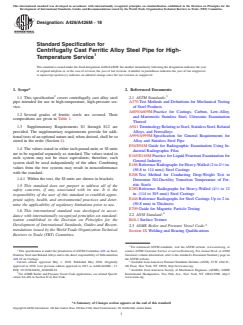
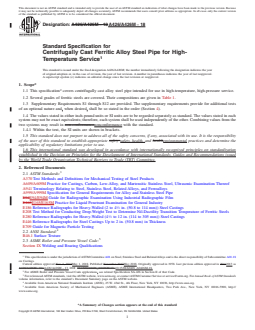
1.1 This specification2 covers centrifugally cast alloy steel pipe intended for use in high-temperature, high-pressure service.
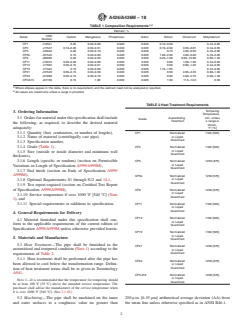
1.2 Several grades of ferritic steels are covered. Their compositions are given in Table 1. (A) Where ellipses appear in this table, there is no requirement, and the element need not be analyzed or reported.(B) All values are maximums unless a range is provided.
1.3 Supplementary Requirements S1 through S12 are provided. The supplementary requirements provide for additional tests of an optional nature and, when desired, shall be so stated in the order (Section 4).
1.4 The values stated in either inch-pound units or SI units are to be regarded separately as standard. The values stated in each system may not be exact equivalents; therefore, each system shall be used independently of the other. Combining values from the two systems may result in nonconformance with the standard.
1.4.1 Within the text, the SI units are shown in brackets.
1.5 This standard does not purport to address all of the safety concerns, if any, associated with its use. It is the responsibility of the user of this standard to establish appropriate safety, health, and environmental practices and determine the applicability of regulatory limitations prior to use.
1.6 This international standard was developed in accordance with internationally recognized principles on standardization established in the Decision on Principles for the Development of International Standards, Guides and Recommendations issued by the World Trade Organization Technical Barriers to Trade (TBT) Committee.
- Status
- Published
- Publication Date
- 30-Apr-2018
- Technical Committee
- A01 - Steel, Stainless Steel and Related Alloys
- Drafting Committee
- A01.18 - Castings
Buy Documents
ASTM A426/A426M-18 - Standard Specification for Centrifugally Cast Ferritic Alloy Steel Pipe for High-Temperature Service
REDLINE ASTM A426/A426M-18 - Standard Specification for Centrifugally Cast Ferritic Alloy Steel Pipe for High-Temperature Service
Overview
ASTM A426/A426M-18 is a standard specification developed by ASTM for centrifugally cast ferritic alloy steel pipe intended for high-temperature, high-pressure service. This specification outlines the requirements for several grades of alloy steel pipes, ensuring their suitability for demanding environments such as power generation, refinery, and chemical processing applications. ASTM A426/A426M-18 is recognized internationally and aligns with global principles for the development of standards, promoting consistency and reliability across industries that require robust piping solutions.
Key Topics
Scope and Purpose: ASTM A426/A426M-18 applies to a range of ferritic alloy steel grades produced by centrifugal casting, suitable for use in high-temperature and high-pressure conditions.
Grades Covered: The specification includes multiple pipe grades with defined chemical compositions and mechanical properties suitable for different service conditions.
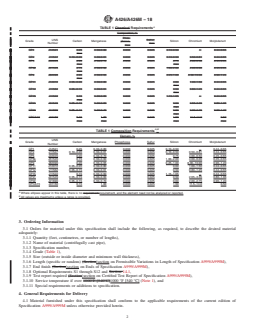
Chemical Composition: Detailed in Table 1, the specification provides requirements for elements such as carbon, manganese, phosphorus, sulfur, silicon, chromium, and molybdenum for each pipe grade.
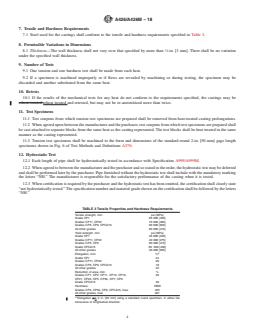
Mechanical Properties: ASTM A426/A426M-18 specifies minimum tensile strength, yield strength, elongation, reduction of area, and maximum hardness for each pipe grade to ensure performance and safety.
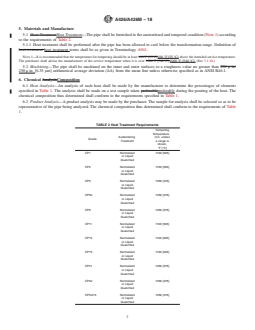
Heat Treatment and Manufacturing: Pipes must be supplied in an austenitized and tempered condition, and surface finish requirements are specified to ensure quality.
Testing Requirements:
- Hydrostatic testing for each length of pipe
- Tension and hardness tests from each heat
- Optional supplementary tests (e.g., radiographic, magnetic particle, ultrasonic, or Charpy impact testing) as agreed upon between manufacturer and purchaser
Dimensional Tolerances: Permissible variations in wall thickness and other dimensions are defined to maintain product consistency.
Product Marking: Each pipe is required to be clearly marked for traceability, including manufacturer, specification number, and heat or serial numbers.
Applications
ASTM A426/A426M-18 pipes are widely used in industries that require reliable performance under extreme conditions, including:
- Power Generation: High-temperature steam lines, heat exchangers, and boiler tubing in fossil and nuclear power plants.
- Refining and Petrochemical: Process piping exposed to high-temperature and high-pressure hydrocarbons and steam.
- Chemical Processing: Piping systems handling corrosive substances at elevated temperatures.
- Industrial Heating Equipment: Pipelines in furnaces, reactors, and heat treatment equipment.
The robust chemical and mechanical requirements of this standard make it ideal for applications where pipe integrity, longevity, and safety are paramount.
Related Standards
For effective specification, procurement, and use of centrifugally cast alloy steel pipe, the following standards are commonly referenced with ASTM A426/A426M-18:
- ASTM A370 - Test Methods and Definitions for Mechanical Testing of Steel Products
- ASTM A999/A999M - General Requirements for Alloy and Stainless Steel Pipe
- ASTM A609/A609M - Ultrasonic Examination of Steel Castings
- ASTM A941 - Terminology Relating to Steel, Stainless Steel, Related Alloys, and Ferroalloys
- ASME Boiler and Pressure Vessel Code, Section IX - Welding and Brazing Qualifications
- ANSI B46.1 - Surface Texture
These standards ensure comprehensive coverage of material properties, inspection practices, and performance verification for pipes intended for critical service.
Keywords: ASTM A426/A426M-18, ferritic alloy steel pipe, centrifugal casting, high-temperature service, high-pressure piping, mechanical properties, chemical composition, industrial standards, power generation, petrochemical piping, pipe testing, ASME compliance, alloy steel standards
Relations
- Effective Date
- 01-May-2018
- Effective Date
- 01-Mar-2024
- Effective Date
- 01-Mar-2024
- Effective Date
- 01-Nov-2023
- Effective Date
- 01-Jul-2019
- Effective Date
- 01-Dec-2017
- Refers
ASTM A370-17a - Standard Test Methods and Definitions for Mechanical Testing of Steel Products - Effective Date
- 15-Nov-2017
- Effective Date
- 01-Sep-2017
- Effective Date
- 01-Sep-2017
- Effective Date
- 01-Jan-2017
- Effective Date
- 01-Sep-2016
- Effective Date
- 01-Dec-2015
- Effective Date
- 01-Nov-2015
- Effective Date
- 01-Nov-2015
- Effective Date
- 15-May-2014
Buy Documents
ASTM A426/A426M-18 - Standard Specification for Centrifugally Cast Ferritic Alloy Steel Pipe for High-Temperature Service
REDLINE ASTM A426/A426M-18 - Standard Specification for Centrifugally Cast Ferritic Alloy Steel Pipe for High-Temperature Service
Get Certified
Connect with accredited certification bodies for this standard

Element Materials Technology
Materials testing and product certification.

Inštitut za kovinske materiale in tehnologije
Institute of Metals and Technology. Materials testing, metallurgical analysis, NDT.
Sponsored listings
Frequently Asked Questions
ASTM A426/A426M-18 is a technical specification published by ASTM International. Its full title is "Standard Specification for Centrifugally Cast Ferritic Alloy Steel Pipe for High-Temperature Service". This standard covers: SCOPE 1.1 This specification2 covers centrifugally cast alloy steel pipe intended for use in high-temperature, high-pressure service. 1.2 Several grades of ferritic steels are covered. Their compositions are given in Table 1. (A) Where ellipses appear in this table, there is no requirement, and the element need not be analyzed or reported.(B) All values are maximums unless a range is provided. 1.3 Supplementary Requirements S1 through S12 are provided. The supplementary requirements provide for additional tests of an optional nature and, when desired, shall be so stated in the order (Section 4). 1.4 The values stated in either inch-pound units or SI units are to be regarded separately as standard. The values stated in each system may not be exact equivalents; therefore, each system shall be used independently of the other. Combining values from the two systems may result in nonconformance with the standard. 1.4.1 Within the text, the SI units are shown in brackets. 1.5 This standard does not purport to address all of the safety concerns, if any, associated with its use. It is the responsibility of the user of this standard to establish appropriate safety, health, and environmental practices and determine the applicability of regulatory limitations prior to use. 1.6 This international standard was developed in accordance with internationally recognized principles on standardization established in the Decision on Principles for the Development of International Standards, Guides and Recommendations issued by the World Trade Organization Technical Barriers to Trade (TBT) Committee.
SCOPE 1.1 This specification2 covers centrifugally cast alloy steel pipe intended for use in high-temperature, high-pressure service. 1.2 Several grades of ferritic steels are covered. Their compositions are given in Table 1. (A) Where ellipses appear in this table, there is no requirement, and the element need not be analyzed or reported.(B) All values are maximums unless a range is provided. 1.3 Supplementary Requirements S1 through S12 are provided. The supplementary requirements provide for additional tests of an optional nature and, when desired, shall be so stated in the order (Section 4). 1.4 The values stated in either inch-pound units or SI units are to be regarded separately as standard. The values stated in each system may not be exact equivalents; therefore, each system shall be used independently of the other. Combining values from the two systems may result in nonconformance with the standard. 1.4.1 Within the text, the SI units are shown in brackets. 1.5 This standard does not purport to address all of the safety concerns, if any, associated with its use. It is the responsibility of the user of this standard to establish appropriate safety, health, and environmental practices and determine the applicability of regulatory limitations prior to use. 1.6 This international standard was developed in accordance with internationally recognized principles on standardization established in the Decision on Principles for the Development of International Standards, Guides and Recommendations issued by the World Trade Organization Technical Barriers to Trade (TBT) Committee.
ASTM A426/A426M-18 is classified under the following ICS (International Classification for Standards) categories: 77.140.80 - Iron and steel castings. The ICS classification helps identify the subject area and facilitates finding related standards.
ASTM A426/A426M-18 has the following relationships with other standards: It is inter standard links to ASTM A426/A426M-13, ASTM A941-24, ASTM A370-24, ASTM A609/A609M-12(2023), ASTM A370-19, ASTM E208-17, ASTM A370-17a, ASTM A941-17, ASTM A999/A999M-17, ASTM A370-17, ASTM A999/A999M-16, ASTM A999/A999M-15, ASTM A370-15, ASTM A941-15, ASTM A370-14. Understanding these relationships helps ensure you are using the most current and applicable version of the standard.
ASTM A426/A426M-18 is available in PDF format for immediate download after purchase. The document can be added to your cart and obtained through the secure checkout process. Digital delivery ensures instant access to the complete standard document.
Standards Content (Sample)
This international standard was developed in accordance with internationally recognized principles on standardization established in the Decision on Principles for the
Development of International Standards, Guides and Recommendations issued by the World Trade Organization Technical Barriers to Trade (TBT) Committee.
Designation: A426/A426M −18
Standard Specification for
Centrifugally Cast Ferritic Alloy Steel Pipe for High-
Temperature Service
This standard is issued under the fixed designationA426/A426M; the number immediately following the designation indicates the year
of original adoption or, in the case of revision, the year of last revision. A number in parentheses indicates the year of last reapproval.
A superscript epsilon (´) indicates an editorial change since the last revision or reapproval.
1. Scope* 2. Referenced Documents
2 3
1.1 This specification covers centrifugally cast alloy steel 2.1 ASTM Standards:
pipe intended for use in high-temperature, high-pressure ser- A370 Test Methods and Definitions for Mechanical Testing
vice. of Steel Products
A609/A609M Practice for Castings, Carbon, Low-Alloy,
1.2 Several grades of ferritic steels are covered. Their
and Martensitic Stainless Steel, Ultrasonic Examination
compositions are given in Table 1.
Thereof
1.3 Supplementary Requirements S1 through S12 are A941 TerminologyRelatingtoSteel,StainlessSteel,Related
Alloys, and Ferroalloys
provided. The supplementary requirements provide for addi-
tional tests of an optional nature and, when desired, shall be so A999/A999M Specification for General Requirements for
stated in the order (Section 4). Alloy and Stainless Steel Pipe
E94/E94M Guide for Radiographic Examination Using In-
1.4 The values stated in either inch-pound units or SI units
dustrial Radiographic Film
are to be regarded separately as standard. The values stated in
E165/E165M Practice for Liquid Penetrant Examination for
each system may not be exact equivalents; therefore, each
General Industry
system shall be used independently of the other. Combining
E186 Reference Radiographs for Heavy-Walled (2 to 4 ⁄2 in.
values from the two systems may result in nonconformance
(50.8 to 114 mm)) Steel Castings
with the standard.
E208 Test Method for Conducting Drop-Weight Test to
1.4.1 Within the text, the SI units are shown in brackets.
Determine Nil-Ductility Transition Temperature of Fer-
ritic Steels
1.5 This standard does not purport to address all of the
E280 Reference Radiographs for Heavy-Walled (4 ⁄2 to 12
safety concerns, if any, associated with its use. It is the
in. (114 to 305 mm)) Steel Castings
responsibility of the user of this standard to establish appro-
E446 Reference Radiographs for Steel Castings Up to 2 in.
priate safety, health, and environmental practices and deter-
(50.8 mm) in Thickness
mine the applicability of regulatory limitations prior to use.
E709 Guide for Magnetic Particle Testing
1.6 This international standard was developed in accor-
2.2 ANSI Standard:
dance with internationally recognized principles on standard-
B46.1 Surface Texture
ization established in the Decision on Principles for the
Development of International Standards, Guides and Recom-
2.3 ASME Boiler and Pressure Vessel Code:
mendations issued by the World Trade Organization Technical
Section IX Welding and Brazing Qualifications
Barriers to Trade (TBT) Committee.
For referenced ASTM standards, visit the ASTM website, www.astm.org, or
This specification is under the jurisdiction ofASTM Committee A01 on Steel, contact ASTM Customer Service at service@astm.org. For Annual Book of ASTM
Stainless Steel and Related Alloys and is the direct responsibility of Subcommittee Standards volume information, refer to the standard’s Document Summary page on
A01.18 on Castings. the ASTM website.
Current edition approved May 1, 2018. Published May 2018. Originally Available from American National Standards Institute (ANSI), 25 W. 43rd St.,
approved in 1958. Last previous edition approved in 2013 as A426/A426M – 13. 4th Floor, New York, NY 10036, http://www.ansi.org.
DOI: 10.1520/A0426_A0426M-18. Available from American Society of Mechanical Engineers (ASME), ASME
For ASME Boiler and Pressure Vessel Code applications, see related Specifi- International Headquarters, Two Park Ave., New York, NY 10016-5990, http://
cation SA-426 in Section II of that Code. www.asme.org.
*A Summary of Changes section appears at the end of this standard
Copyright © ASTM International, 100 Barr Harbor Drive, PO Box C700, West Conshohocken, PA 19428-2959. United States
A426/A426M − 18
A,B
TABLE 1 Composition Requirements
Element, %
UNS
Grade Carbon Manganese Phosphorus Sulfur Silicon Chromium Molybdenum
Number
CP1 J12521 0.25 0.30–0.80 0.030 0.025 0.10–0.50 . 0.44–0.65
CP2 J11547 0.10–0.20 0.30–0.61 0.030 0.025 0.10–0.50 0.50–0.81 0.44–0.65
CP5 J42045 0.20 0.30–0.70 0.030 0.025 0.75 4.00–6.50 0.45–0.65
CP5b J51545 0.15 0.30–0.60 0.030 0.025 1.00–2.00 4.00–6.00 0.45–0.65
CP9 J82090 0.20 0.30–0.65 0.030 0.025 0.25–1.00 8.00–10.00 0.90–1.20
CP11 J12072 0.05–0.20 0.30–0.80 0.030 0.025 0.60 1.00–1.50 0.44–0.65
CP12 J11562 0.05–0.15 0.30–0.61 0.030 0.025 0.50 0.80–1.25 0.44–0.65
CP15 J11522 0.15 0.30–0.60 0.030 0.025 1.15–1.65 . 0.44–0.65
CP21 J31545 0.05–0.15 0.30–0.60 0.030 0.025 0.50 2.65–3.35 0.80–1.06
CP22 J21890 0.05–0.15 0.30–0.70 0.030 0.025 0.60 2.00–2.75 0.90–1.20
CPCA15 J91150 0.15 1.00 0.030 0.025 1.50 11.5–14.0 0.50
A
Where ellipses appear in this table, there is no requirement, and the element need not be analyzed or reported.
B
All values are maximums unless a range is provided.
TABLE 2 Heat Treatment Requirements
Tempering
3. Ordering Information
Temperature,
Austenitizing min, unless
3.1 Orders for material under this specification shall include
Grade
Treatment a range is
the following, as required, to describe the desired material
shown,
adequately:
°F [°C]
3.1.1 Quantity (feet, centimetres, or number of lengths),
CP1 Normalized 1100 [595]
or Liquid
3.1.2 Name of material (centrifugally cast pipe),
Quenched
3.1.3 Specification number,
3.1.4 Grade (Table 1),
CP2 Normalized 1100 [595]
or Liquid
3.1.5 Size (outside or inside diameter and minimum wall
Quenched
thickness),
3.1.6 Length (specific or random) (section on Permissible CP5 Normalized 1250 [675]
or Liquid
Variations in Length of Specification A999/A999M),
Quenched
3.1.7 End finish (section on Ends of Specification A999/
A999M), CP5b Normalized 1250 [675]
or Liquid
3.1.8 Optional Requirements S1 through S12 and 14.1,
Quenched
3.1.9 Test report required (section on Certified Test Report
of Specification A999/A999M), CP9 Normalized 1250 [675]
or Liquid
3.1.10 Service temperature if over 1000 °F [540 °C] (Note
Quenched
1), and
CP11 Normalized 1100 [595]
3.1.11 Special requirements or additions to specification.
or Liquid
Quenched
4. General Requirements for Delivery
CP12 Normalized 1100 [595]
4.1 Material furnished under this specification shall con-
or Liquid
form to the applicable requirements of the current edition of
Quenched
Specification A999/A999M unless otherwise provided herein.
CP15 Normalized 1100 [595]
or Liquid
5. Materials and Manufacture
Quenched
5.1 Heat Treatment—The pipe shall be furnished in the
CP21 Normalized 1250 [675]
austenitized and tempered condition (Note 1) according to the
or Liquid
Quenched
requirements of Table 2.
5.1.1 Heat treatment shall be performed after the pipe has
CP22 Normalized 1250 [675]
been allowed to cool below the transformation range. Defini-
or Liquid
Quenched
tion of heat treatment terms shall be as given in Terminology
A941.
CPCA15 Normalized 1250 [675]
or Liquid
NOTE 1—It is recommended that the temperature for tempering should
Quenched
be at least 100 °F [55 °C] above the intended service temperature. The
purchaser shall advise the manufacturer of the service temperature when
it is over 1000 °F [540 °C]. (See 3.1.10.)
5.2 Machining—The pipe shall be machined on the inner 250 µ in. [6.35 µm] arithmetical average deviation (AA) from
and outer surfaces to a roughness value no greater than the mean line unless otherwise specified as in ANSI B46.1.
A426/A426M − 18
6. Chemical Composition 11. Test Specimens
6.1 Heat Analysis—An analysis of each heat shall be made 11.1 Test coupons from which tension test specimens are
by the manufacturer to determine the percentages of elements prepared shall be removed from heat-treated casting prolonga-
specified in Table 1. The analysis shall be made on a test tions.
sample taken preferably during the pouring of the heat. The
11.2 When agreed upon between the manufacturer and the
chemical composition thus determined shall conform to the
purchaser, test coupons from which test specimens are pre-
requirements specified in Table 1.
pared shall be cast attached to separate blocks from the same
6.2 Product Analysis—A product analysis may be made by heat as the casting represented. The test blocks shall be heat
thepurchaser.Thesampleforanalysisshallbeselectedsoasto treated in the same manner as the casting represented.
be representative of the pipe being analyzed. The chemical
11.3 Tension test specimens shall be machined to the form
compositionthusdeterminedshallconformtotherequirements
and dimensions of the standard round 2-in. [50-mm] gage
of Table 1.
length specimens shown in Fig. 6 of Test Methods and
Definitions A370.
7. Tensile and Hardness Requirements
12. Hydrostatic Test
7.1 Steel used for the castings shall conform to the tensile
and hardness requirements specified in Table 3.
12.1 Each length of pipe shall be hydrostatically tested in
accordance with Specification A999/A999M.
8. Permissible Variations in Dimensions
12.2 When agreed to between the manufacturer and the
8.1 Thickness—The wall thickness shall not vary over that
purchaserandsostatedintheorder,thehydrostatictestmaybe
specified by more than ⁄8 in. [3 mm]. There shall be no
deferred and shall be performed later by the purchaser. Pipe
variation under the specified wall thickness.
furnished without the hydrostatic test shall include with the
mandatory marking the letters “NH.” The manufacturer is
9. Number of Tests
responsible for the satisfactory performance of the casting
9.1 One tension and one hardness test shall be made from
when it is tested.
each heat.
12.3 When certification is required by the purchaser and the
9.2 If a specimen is machined improperly or if flaws are
hydrostatic test has been omitted, the certification shall clearly
revealed by machining or during testing, the specimen may be
state“nothydrostaticallytested.”Thespecificationnumberand
discarded and another substituted from the same heat.
material grade shown on the certification shall be followed by
the letters “NH.”
10. Retests
13. Visual Inspection
10.1 Iftheresultsofthemechanicaltestsforanyheatdonot
conform to the requirements specified, the castings may be
...
This document is not an ASTM standard and is intended only to provide the user of an ASTM standard an indication of what changes have been made to the previous version. Because
it may not be technically possible to adequately depict all changes accurately, ASTM recommends that users consult prior editions as appropriate. In all cases only the current version
of the standard as published by ASTM is to be considered the official document.
Designation: A426/A426M − 13 A426/A426M − 18
Standard Specification for
Centrifugally Cast Ferritic Alloy Steel Pipe for High-
Temperature Service
This standard is issued under the fixed designation A426/A426M; the number immediately following the designation indicates the year
of original adoption or, in the case of revision, the year of last revision. A number in parentheses indicates the year of last reapproval.
A superscript epsilon (´) indicates an editorial change since the last revision or reapproval.
1. Scope*
1.1 This specification covers centrifugally cast alloy steel pipe intended for use in high-temperature, high-pressure service.
1.2 Several grades of ferritic steels are covered. Their compositions are given in Table 1.
1.3 Supplementary Requirements S1 through S12 are provided. The supplementary requirements provide for additional tests
of an optional nature and, when desired, shall be so stated in the order (Section 4).
1.4 The values stated in either inch-pound units or SI units are to be regarded separately as standard. The values stated in each
system may not be exact equivalents; therefore, each system shall be used independently of the other. Combining values from the
two systems may result in non-conformancenonconformance with the standard.
1.4.1 Within the text, the SI units are shown in brackets.
1.5 This standard does not purport to address all of the safety concerns, if any, associated with its use. It is the responsibility
of the user of this standard to establish appropriate safety safety, health, and healthenvironmental practices and determine the
applicability of regulatory limitations prior to use.
1.6 This international standard was developed in accordance with internationally recognized principles on standardization
established in the Decision on Principles for the Development of International Standards, Guides and Recommendations issued
by the World Trade Organization Technical Barriers to Trade (TBT) Committee.
2. Referenced Documents
2.1 ASTM Standards:
A370 Test Methods and Definitions for Mechanical Testing of Steel Products
A609/A609M Practice for Castings, Carbon, Low-Alloy, and Martensitic Stainless Steel, Ultrasonic Examination Thereof
A941 Terminology Relating to Steel, Stainless Steel, Related Alloys, and Ferroalloys
A999/A999M Specification for General Requirements for Alloy and Stainless Steel Pipe
E94E94/E94M Guide for Radiographic Examination Using Industrial Radiographic Film
E165E165/E165M Practice for Liquid Penetrant Examination for General Industry
E186 Reference Radiographs for Heavy-Walled (2 to 4 ⁄2 in. (50.8 to 114 mm)) Steel Castings
E208 Test Method for Conducting Drop-Weight Test to Determine Nil-Ductility Transition Temperature of Ferritic Steels
E280 Reference Radiographs for Heavy-Walled (4 ⁄2 to 12 in. (114 to 305 mm)) Steel Castings
E446 Reference Radiographs for Steel Castings Up to 2 in. (50.8 mm) in Thickness
E709 Guide for Magnetic Particle Testing
2.2 ANSI Standard:
B46.1 Surface Texture
2.3 ASME Boiler and Pressure Vessel Code:
Section IX Welding and Brazing Qualifications
This specification is under the jurisdiction of ASTM Committee A01 on Steel, Stainless Steel and Related Alloys and is the direct responsibility of Subcommittee A01.18
on Castings.
Current edition approved Nov. 1, 2013May 1, 2018. Published November 2013May 2018. Originally approved in 1958. Last previous edition approved in 20112013 as
A426/A426M - 11a.A426/A426M – 13. DOI: 10.1520/A0426_A0426M-13. 10.1520/A0426_A0426M-18.
For ASME Boiler and Pressure Vessel Code applications, see related Specification SA-426 in Section II of that Code.
For referenced ASTM standards, visit the ASTM website, www.astm.org, or contact ASTM Customer Service at service@astm.org. For Annual Book of ASTM Standards
volume information, refer to the standard’s Document Summary page on the ASTM website.
Available from American National Standards Institute (ANSI), 25 W. 43rd St., 4th Floor, New York, NY 10036, http://www.ansi.org.
Available from American Society of Mechanical Engineers (ASME), ASME International Headquarters, Two Park Ave., New York, NY 10016-5990, http://
www.asme.org.
*A Summary of Changes section appears at the end of this standard
Copyright © ASTM International, 100 Barr Harbor Drive, PO Box C700, West Conshohocken, PA 19428-2959. United States
A426/A426M − 18
A
TABLE 1 Chemical Requirements
Composition, %
Phos-
UNS Sulfur,
Grade Carbon Manganese phorus, Silicon Chromium Molybdenum
Number max
max
CP1 J12521 0.25 0.30-0.80 0.030 0.025 0.10-0.50 . 0.44-0.65
max
CP2 J11547 0.10–0.20 0.30-0.61 0.030 0.025 0.10-0.50 0.50-0.81 0.44-0.65
CP5 J42045 0.20 0.30-0.70 0.030 0.025 0.75 4.00-6.50 0.45-0.65
max max
CP5b J51545 0.15 0.30-0.60 0.030 0.025 1.00-2.00 4.00-6.00 0.45-0.65
max
CP9 J82090 0.20 0.30-0.65 0.030 0.025 0.25-1.00 8.00-10.00 0.90-1.20
max
CP11 J12072 0.05–0.20 0.30-0.80 0.030 0.025 0.60 1.00-1.50 0.44-0.65
max
CP12 J11562 0.05–0.15 0.30-0.61 0.030 0.025 0.50 0.80-1.25 0.44-0.65
max
CP15 J11522 0.15 0.30-0.60 0.030 0.025 1.15-1.65 . 0.44-0.65
max
CP21 J31545 0.05–0.15 0.30-0.60 0.030 0.025 0.50 2.65-3.35 0.80-1.06
max
CP22 J21890 0.05–0.15 0.30-0.70 0.030 0.025 0.60 2.00-2.75 0.90-1.20
max
CPCA15 J91150 0.15 1.00 0.030 0.025 1.50 11.5-14.0 0.50
max max max max
A,B
TABLE 1 Composition Requirements
Element, %
UNS
Grade Carbon Manganese Phosphorus Sulfur Silicon Chromium Molybdenum
Number
CP1 J12521 0.25 0.30–0.80 0.030 0.025 0.10–0.50 . 0.44–0.65
CP2 J11547 0.10–0.20 0.30–0.61 0.030 0.025 0.10–0.50 0.50–0.81 0.44–0.65
CP5 J42045 0.20 0.30–0.70 0.030 0.025 0.75 4.00–6.50 0.45–0.65
CP5b J51545 0.15 0.30–0.60 0.030 0.025 1.00–2.00 4.00–6.00 0.45–0.65
CP9 J82090 0.20 0.30–0.65 0.030 0.025 0.25–1.00 8.00–10.00 0.90–1.20
CP11 J12072 0.05–0.20 0.30–0.80 0.030 0.025 0.60 1.00–1.50 0.44–0.65
CP12 J11562 0.05–0.15 0.30–0.61 0.030 0.025 0.50 0.80–1.25 0.44–0.65
CP15 J11522 0.15 0.30–0.60 0.030 0.025 1.15–1.65 . 0.44–0.65
CP21 J31545 0.05–0.15 0.30–0.60 0.030 0.025 0.50 2.65–3.35 0.80–1.06
CP22 J21890 0.05–0.15 0.30–0.70 0.030 0.025 0.60 2.00–2.75 0.90–1.20
CPCA15 J91150 0.15 1.00 0.030 0.025 1.50 11.5–14.0 0.50
A
Where ellipses appear in this table, there is no requirement.requirement, and the element need not be analyzed or reported.
B
All values are maximums unless a range is provided.
3. Ordering Information
3.1 Orders for material under this specification shall include the following, as required, to describe the desired material
adequately:
3.1.1 Quantity (feet, centimetres, or number of lengths),
3.1.2 Name of material (centrifugally cast pipe),
3.1.3 Specification number,
3.1.4 Grade (Table 1),
3.1.5 Size (outside or inside diameter and minimum wall thickness),
3.1.6 Length (specific or random) (Section(section on Permissible Variations in Length of Specification A999/A999M),
3.1.7 End finish (Section(section on Ends of Specification A999/A999M),
3.1.8 Optional Requirements S1 through S12 and Section 14.1,
3.1.9 Test report required (Section(section on Certified Test Report of Specification A999/A999M),
3.1.10 Service temperature if over 1000°F [540°C]1000 °F [540 °C] (Note 1), and
3.1.11 Special requirements or additions to specification.
4. General Requirements for Delivery
4.1 Material furnished under this specification shall conform to the applicable requirements of the current edition of
Specification A999/A999M unless otherwise provided herein.
A426/A426M − 18
5. Materials and Manufacture
5.1 Heat-TreatmentHeat Treatment—The pipe shall be furnished in the austenitized and tempered condition (Note 1) according
to the requirements of Table 2.
5.1.1 Heat treatment shall be performed after the pipe has been allowed to cool below the transformation range. Definition of
heat-treatment heat treatment terms shall be as given in Terminology A941.
NOTE 1—It is recommended that the temperature for tempering should be at least 100°F [55°C]100 °F [55 °C] above the intended service temperature.
The purchaser shall advise the manufacturer of the service temperature when it is over 1000°F [540°C].1000 °F [540 °C]. (See 3.1.10.)
5.2 Machining—The pipe shall be machined on the inner and outer surfaces to a roughness value no greater than 250 μ in.
250 μ in. [6.35 μm] arithmetical average deviation (AA) from the mean line unless otherwise specified as in ANSI B46.1.
6. Chemical AnalysisComposition
6.1 Heat Analysis—An analysis of each heat shall be made by the manufacturer to determine the percentages of elements
specified in Table 1. The analysis shall be made on a test sample taken preferablepreferably during the pouring of the heat. The
chemical composition thus determined shall conform to the requirements specified in Table 1.
6.2 Product Analysis—A product analysis may be made by the purchaser. The sample for analysis shall be selected so as to be
representative of the pipe being analyzed. The chemical composition thus determined shall conform to the requirements of Table
1.
TABLE 2 Heat Treatment Requirements
Tempering
Temperature,
Austenitizing min, unless
Grade
Treatment a range is
shown,
°F [°C]
CP1 Normalized 1100 [595]
or Liquid
Quenched
CP2 Normalized 1100 [595]
or Liquid
Quenched
CP5 Normalized 1250 [675]
or Liquid
Quenched
CP5b Normalized 1250 [675]
or Liquid
Quenched
CP9 Normalized 1250 [675]
or Liquid
Quenched
CP11 Normalized 1100 [595]
or Liquid
Quenched
CP12 Normalized 1100 [595]
or Liquid
Quenched
CP15 Normalized 1100 [595]
or Liquid
Quenched
CP21 Normalized 1250 [675]
or Liquid
Quenched
CP22 Normalized 1250 [675]
or Liquid
Quenched
CPCA15 Normalized 1250 [675]
or Liquid
Quenched
A426/A426M − 18
7. Tensile and Hardness Requirements
7.1 Steel used for the castings shall conform to the tensile and hardness requirements specified in Table 3.
8. Permissible Variations in Dimensions
8.1 Thickness—The wall thickness shall not vary over that specified by more than ⁄8 in. [3 mm]. There shall be no variation
under the specified wall thickness.
9. Number of Tests
9.1 One tension and one hardness test shall be made from each heat.
9.2 If a specimen is machined improperly or if flaws are revealed by machining or during testing, the specimen may be
discarded and another substituted from the same heat.
10. Retests
10.1 If the results of the mechanical tests for any heat do not conform to the requirements specified, the castings may be
reheat-treated reheat treated and retested, but may not be re-austenitized more than twice.
11. Test Specimens
11.1 Test coupons from which tension test specimens are prepared shall be removed from heat-treated casting prolongations.
11.2 When agreed upon between the manufacturer and the purchaser, test coupons from which test specimens are prepared shall
be cast attached to separate blocks from the same heat as the casting represented. The test blocks shall be heat treated in the same
manner as the casting represented.
11.3 Tension test specimens shall be machined to the form and dimensions of the standard round 2-in. [50-mm] gage length
specimens shown in Fig. 6 of Test Methods and Definitions A370.
12. Hydrostatic Test
12.1 Each length of pipe shall be hydrostatically tested in accordance with Specification A999/A999M.
12.2 When agreed to between the manufacturer and the purchaser and so
...