

ASTM A941-24
(Terminology)Standard Terminology Relating to Steel, Stainless Steel, Related Alloys, and Ferroalloys
General Information
- Abstract
SCOPE
1.1 This standard is a compilation of definitions of terms related to steel, stainless steel, related alloys, and ferroalloys.
1.2 When a term is used in an ASTM document for which Committee A01 is responsible, it is included herein only when judged, after review by Subcommittee A01.92, to be a generally usable term.
1.3 Some definitions include a discussion section, which is a mandatory part of the definition and contains additional information that is relevant to the meaning of the defined term.
1.4 Definitions of terms specific to a particular standard will appear in that standard and will supersede any definitions of identical terms in this standard.
1.5 This international standard was developed in accordance with internationally recognized principles on standardization established in the Decision on Principles for the Development of International Standards, Guides and Recommendations issued by the World Trade Organization Technical Barriers to Trade (TBT) Committee.
- Status
- Published
- Publication Date
- 29-Feb-2024
- Technical Committee
- A01 - Steel, Stainless Steel and Related Alloys
- Drafting Committee
- A01.92 - Terminology
Buy Documents
ASTM A941-24 - Standard Terminology Relating to Steel, Stainless Steel, Related Alloys, and Ferroalloys
REDLINE ASTM A941-24 - Standard Terminology Relating to Steel, Stainless Steel, Related Alloys, and Ferroalloys
Overview
ASTM A941-24: Standard Terminology Relating to Steel, Stainless Steel, Related Alloys, and Ferroalloys is a comprehensive compilation of definitions for terms commonly used in the steel industry. Developed by ASTM Committee A01, this terminology standard supports clear communication and consistency across specifications, technical documents, and quality certifications related to steels, stainless steels, alloys, and ferroalloys.
By standardizing the language used in documents, ASTM A941-24 ensures a common understanding among manufacturers, engineers, suppliers, and regulators. The standard is updated periodically to reflect advancements in materials technology, changing industry practices, and international trade requirements. It is developed under the internationally recognized principles of the World Trade Organization Technical Barriers to Trade (TBT) Committee.
Key Topics
ASTM A941-24 provides precise definitions and context for a wide range of fundamental and specialized concepts relevant to:
- Steel types and classifications - including carbon steel, alloy steel, stainless steel, and microalloyed steels.
- Heat treatment processes - such as annealing, normalizing, hardening, and quenching.
- Manufacturing and processing techniques - covering terms like cold working, hot working, batch furnace, diffusion coating, and rolling practices.
- Chemical composition and analysis - definitions for heat analysis, product analysis, residual and specified elements.
- Mechanical properties and transformations - such as hardenability, strain hardening, recrystallization, grain growth, and precipitations.
- Certification and compliance - terminology for certificates of compliance, certifying organizations, and conformance statements.
- Surface treatments and case hardening - terms such as carburizing, nitriding, case hardening, and shell hardening.
Each definition may include a discussion section to clarify ambiguities, explain practical relevance, or address specific industry interpretations.
Applications
ASTM A941-24 is essential in various areas where steel and related materials are specified, processed, or regulated, including:
- Material specifications and procurement - Ensures precise communication in contracts, purchase orders, and certifications.
- Quality assurance and inspection - Supports accurate reporting and interpretation of test results and manufacturing records.
- Engineering design and technical documentation - Provides a reliable reference for drafting standards, technical manuals, and safety data sheets.
- Regulatory compliance and international trade - Assures alignment with globally accepted terminology for import, export, and harmonization.
- Research and development - Establishes a foundational vocabulary that aids literature reviews, innovation, and knowledge transfer.
- Education and training - Serves as an authoritative glossary for industry professionals, new hires, and students in metallurgy and materials science.
Adherence to ASTM A941-24 terminology helps minimize errors and misinterpretations, promoting efficiency, product quality, and global interoperability in the steel industry.
Related Standards
Organizations and professionals using ASTM A941-24 often reference additional ASTM and international standards, such as:
- ASTM E112: Test Methods for Determining Average Grain Size
- Other ASTM specifications for steel products (e.g., ASTM A36, ASTM A240)
- International standards from ISO, EN, or JIS regarding steel classification and terminology
- Guidance from technical committees for industry harmonization
For current editions and supporting resources, users should consult ASTM International. Employing ASTM A941-24 as part of a standards-based approach ensures consistency and enhances communication in the global steel industry.
Relations
- Effective Date
- 01-Mar-2024
- Effective Date
- 01-Mar-2024
- Effective Date
- 01-Mar-2024
- Effective Date
- 01-Mar-2024
- Effective Date
- 01-Mar-2024
- Effective Date
- 01-Mar-2024
- Effective Date
- 01-Mar-2024
- Effective Date
- 01-Mar-2024
- Effective Date
- 01-Mar-2024
- Effective Date
- 01-Mar-2024
- Effective Date
- 01-Mar-2024
- Effective Date
- 01-Mar-2024
- Effective Date
- 01-Mar-2024
- Effective Date
- 01-Mar-2024
- Effective Date
- 01-Mar-2024
Buy Documents
ASTM A941-24 - Standard Terminology Relating to Steel, Stainless Steel, Related Alloys, and Ferroalloys
REDLINE ASTM A941-24 - Standard Terminology Relating to Steel, Stainless Steel, Related Alloys, and Ferroalloys
Get Certified
Connect with accredited certification bodies for this standard

Element Materials Technology
Materials testing and product certification.

Inštitut za kovinske materiale in tehnologije
Institute of Metals and Technology. Materials testing, metallurgical analysis, NDT.
Sponsored listings
Frequently Asked Questions
ASTM A941-24 is a standard published by ASTM International. Its full title is "Standard Terminology Relating to Steel, Stainless Steel, Related Alloys, and Ferroalloys". This standard covers: SCOPE 1.1 This standard is a compilation of definitions of terms related to steel, stainless steel, related alloys, and ferroalloys. 1.2 When a term is used in an ASTM document for which Committee A01 is responsible, it is included herein only when judged, after review by Subcommittee A01.92, to be a generally usable term. 1.3 Some definitions include a discussion section, which is a mandatory part of the definition and contains additional information that is relevant to the meaning of the defined term. 1.4 Definitions of terms specific to a particular standard will appear in that standard and will supersede any definitions of identical terms in this standard. 1.5 This international standard was developed in accordance with internationally recognized principles on standardization established in the Decision on Principles for the Development of International Standards, Guides and Recommendations issued by the World Trade Organization Technical Barriers to Trade (TBT) Committee.
SCOPE 1.1 This standard is a compilation of definitions of terms related to steel, stainless steel, related alloys, and ferroalloys. 1.2 When a term is used in an ASTM document for which Committee A01 is responsible, it is included herein only when judged, after review by Subcommittee A01.92, to be a generally usable term. 1.3 Some definitions include a discussion section, which is a mandatory part of the definition and contains additional information that is relevant to the meaning of the defined term. 1.4 Definitions of terms specific to a particular standard will appear in that standard and will supersede any definitions of identical terms in this standard. 1.5 This international standard was developed in accordance with internationally recognized principles on standardization established in the Decision on Principles for the Development of International Standards, Guides and Recommendations issued by the World Trade Organization Technical Barriers to Trade (TBT) Committee.
ASTM A941-24 is classified under the following ICS (International Classification for Standards) categories: 01.040.77 - Metallurgy (Vocabularies); 77.100 - Ferroalloys; 77.140.01 - Iron and steel products in general. The ICS classification helps identify the subject area and facilitates finding related standards.
ASTM A941-24 has the following relationships with other standards: It is inter standard links to ASTM A941-23, ASTM A949/A949M-01(2019), ASTM A20/A20M-20, ASTM A1120/A1120M-21, ASTM A1099/A1099M-20, ASTM A778/A778M-22, ASTM A6/A6M-23, ASTM A1110/A1110M-21, ASTM A962/A962M-23a, ASTM A1085/A1085M-22, ASTM A1039/A1039M-20, ASTM A749/A749M-14(2021), ASTM A1011/A1011M-23, ASTM A788/A788M-23, ASTM A571/A571M-01(2023)e1. Understanding these relationships helps ensure you are using the most current and applicable version of the standard.
ASTM A941-24 is available in PDF format for immediate download after purchase. The document can be added to your cart and obtained through the secure checkout process. Digital delivery ensures instant access to the complete standard document.
Standards Content (Sample)
This international standard was developed in accordance with internationally recognized principles on standardization established in the Decision on Principles for the
Development of International Standards, Guides and Recommendations issued by the World Trade Organization Technical Barriers to Trade (TBT) Committee.
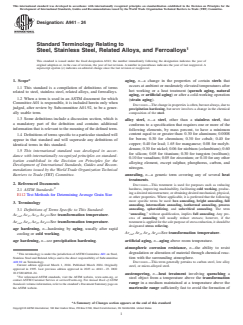
Designation: A941 − 24
Standard Terminology Relating to
Steel, Stainless Steel, Related Alloys, and Ferroalloys
This standard is issued under the fixed designation A941; the number immediately following the designation indicates the year of
original adoption or, in the case of revision, the year of last revision. A number in parentheses indicates the year of last reapproval. A
superscript epsilon (´) indicates an editorial change since the last revision or reapproval.
1. Scope* aging, n—a change in the properties of certain steels that
occurs at ambient or moderately elevated temperatures after
1.1 This standard is a compilation of definitions of terms
hot working or a heat treatment (quench aging, natural
related to steel, stainless steel, related alloys, and ferroalloys.
aging, or artificial aging) or after a cold-working operation
1.2 When a term is used in an ASTM document for which
(strain aging).
Committee A01 is responsible, it is included herein only when
DISCUSSION—The change in properties is often, but not always, due to
judged, after review by Subcommittee A01.92, to be a gener-
precipitation hardening, but never involves a change in the chemical
ally usable term. composition of the steel.
1.3 Some definitions include a discussion section, which is
alloy steel, n—a steel, other than a stainless steel, that
a mandatory part of the definition and contains additional
conforms to a specification that requires one or more of the
information that is relevant to the meaning of the defined term.
following elements, by mass percent, to have a minimum
content equal to or greater than: 0.30 for aluminum; 0.0008
1.4 Definitions of terms specific to a particular standard will
for boron; 0.30 for chromium; 0.30 for cobalt; 0.40 for
appear in that standard and will supersede any definitions of
copper; 0.40 for lead; 1.65 for manganese; 0.08 for molyb-
identical terms in this standard.
denum; 0.30 for nickel; 0.06 for niobium (columbium); 0.60
1.5 This international standard was developed in accor-
for silicon; 0.05 for titanium; 0.30 for tungsten (wolfram);
dance with internationally recognized principles on standard-
0.10 for vanadium; 0.05 for zirconium; or 0.10 for any other
ization established in the Decision on Principles for the
alloying element, except sulphur, phosphorus, carbon, and
Development of International Standards, Guides and Recom-
nitrogen.
mendations issued by the World Trade Organization Technical
Barriers to Trade (TBT) Committee. annealing, n—a generic term covering any of several heat
treatments.
2. Referenced Documents
DISCUSSION—This treatment is used for purposes such as reducing
hardness, improving machinability, facilitating cold working, produc-
2.1 ASTM Standards:
ing a desired microstructure, or obtaining desired mechanical, physical,
E112 Test Methods for Determining Average Grain Size
or other properties. Where applicable, it is preferred that the following
more specific terms be used: box annealing, bright annealing, full
3. Terminology
annealing, intermediate annealing, isothermal annealing, process
annealing, spheroidizing, and subcritical annealing. The term
3.1 Definitions of Terms Specific to This Standard:
“annealing,” without qualification, implies full annealing. Any pro-
Ac , Ac , Ac , Ac —See transformation temperature.
cm 1 3 4
cess of annealing will usually reduce stresses; however, if the
treatment is applied for the sole purpose of stress reduction, it should be
Ae , Ae , Ae , Ae —See transformation temperature.
cm 1 3 4
designated stress relieving.
age hardening, n—hardening by aging, usually after rapid
Ar , Ar , Ar , Ar —See transformation temperature.
cooling or cold working. cm 1 3 4
artificial aging, n—aging above room temperature.
age hardening, n—see precipitation hardening.
atmospheric corrosion resistance, n—the ability to resist
degradation or alteration of material through chemical reac-
This terminology is under the jurisdiction of ASTM Committee A01 on Steel,
tion with the surrounding atmosphere.
Stainless Steel and Related Alloys and is the direct responsibility of Subcommittee
A01.92 on Terminology.
DISCUSSION—This term generally pertains to carbon steel, low alloy
Current edition approved March 1, 2024. Published March 2024. Originally
steel, or micro-alloyed steel.
approved in 1995. Last previous edition approved in 2023 as A941 – 23. DOI:
10.1520/A0941-24.
austempering, n—heat treatment involving quenching a
For referenced ASTM standards, visit the ASTM website, www.astm.org, or
steel object from a temperature above the transformation
contact ASTM Customer Service at service@astm.org. For Annual Book of ASTM
range in a medium maintained at a temperature above the
Standards volume information, refer to the standard’s Document Summary page on
the ASTM website. martensite range sufficiently fast to avoid the formation of
*A Summary of Changes section appears at the end of this standard
Copyright © ASTM International, 100 Barr Harbor Drive, PO Box C700, West Conshohocken, PA 19428-2959. United States
A941 − 24
(b) for carbon steel castings, the specified maximum limit is not to
high temperature transformation products, and then holding
exceed: 0.10 for aluminum, 1.00 for silicon, and 0.050 for titanium.
it at that temperature until transformation is complete.
(c) for carbon steels that are required to be rephosphorized, the
austenitizing, n—forming austenite by heating a steel object specified minimum limit for phosphorus is not to be less than 0.040;
(d) for carbon steels that are required to be resulfurized, the specified
above the transformation range.
minimum limit for sulfur is not to be less than 0.060;
baking, n—heating to a low temperature in order to remove
(e) for carbon steels that are not required to be rephosphorized or
resulfurized, the specified maximum limit is not to exceed: 0.60 for
gases.
copper, 0.050 for phosphorus, and 0.060 for sulfur; and
batch furnace, n—a heating device within which steel objects
(f) for carbon steels that are required to contain boron, copper, or lead,
are held stationary or oscillated during the thermal process- the specified minimum limit is not to exceed: 0.0005 for boron, 0.35 for
copper, and 0.25 for lead.
ing cycle.
blank carburizing, n—simulating the carburizing operation carbonitriding, n—case hardening in which a suitable steel
without introducing carbon. object is heated above Ac in a gaseous atmosphere of such
DISCUSSION—This is usually accomplished by using an inert material
composition as to cause simultaneous absorption of carbon
in place of the carburizing agent, or by applying a suitable protective
and nitrogen by the surface and, by diffusion, to create a
coating on the object being heat treated.
concentration gradient.
blank nitriding, n—simulating the nitriding operation without
carburizing, n—a process in which an austenitized steel object
introducing nitrogen.
is brought into contact with a carbonaceous environment of
DISCUSSION—This is usually accomplished by using an inert material
sufficient carbon potential to cause absorption of carbon at
in place of the nitriding agent, or by applying a suitable protective
the surface and, by diffusion, to create a concentration
coating on the object being heat treated.
gradient.
bluing, n—subjecting the scale-free surface of a steel object to
the action of air, steam, or other agents at a suitable
case, n—in case hardening, the outer portion that has been
temperature, thereby forming a thin blue film of oxide and
made harder than the core as a result of altered composition
improving the object’s appearance and corrosion resistance.
or microstructure, or both, from treatments such as
DISCUSSION—This term is ordinarily applied to sheet, strip, or
carburizing, nitriding, and induction hardening.
finished parts. It is used also to denote the heating of springs after
fabrication in order to improve their properties.
case hardening, n—a generic term covering any of several
processes applicable to steel that change the chemical
box annealing, n—annealing in a sealed container under
composition or microstructure, or both, of the surface layer.
conditions that minimize oxidation.
DISCUSSION—The processes commonly used are: carburizing and
DISCUSSION—The charge is usually heated slowly to a temperature
quench hardening; nitriding; and carbonitriding. It is preferred that
below the transformation range, but sometimes above or within it,
the applicable specific process name be used.
and is then cooled slowly.
cast analysis—Deprecated term. Use the preferred term heat
bright annealing, n—annealing in a protective medium to
prevent discoloration of the bright surface. analysis.
capped steel, n—a rimmed steel in which, during ingot
cementation, n—the introduction of one or more elements into
solidification, the rimming action was limited by mechanical
the outer portion of a steel object by means of diffusion at
or chemical means.
high temperature.
carbon potential, n—the carbon content at the surface of a
certificate of compliance, n—in manufactured products, a
specimen of pure iron in equilibrium with the carburizing
document that states that the product was manufactured,
medium considered, and under the conditions specified.
sampled, tested, and inspected in accordance with the
requirements of the specification (including year of issue)
carbon restoration, n—replacing the carbon lost from the
and any other requirements specified in the purchase order or
surface layer in previous processing by carburizing this layer
contract, and has been found to meet such requirements.
to substantially the original carbon level.
DISCUSSION—A single document, containing test report information
carbon steel, n—a steel that conforms to a specification that
and certificate of compliance information, may be used.
prescribes a maximum limit, by heat analysis in mass
certifying organization, n—in product specifications, the
percent, of not more than: 2.00 for carbon and 1.65 for
entity responsible for the conformance and certification of
manganese, but does not prescribe a minimum limit for
the product to the specification requirements.
chromium, cobalt, molybdenum, nickel, niobium
(columbium), tungsten (wolfram), vanadium, or zirconium.
check analysis—Deprecated term. Use the preferred term
DISCUSSION—Except as required above, it is permissible for carbon
product analysis.
steel specifications to prescribe limits (minimum or maximum, or both)
for each specified alloying element, subject to the following restrictions
coarse grain practice, n—a steelmaking practice for other
for the heat analysis limits in mass percent:
than stainless steel that is intended to produce a killed steel
(a) for wrought carbon steel products, the specified maximum limit is
in which aluminum, niobium (columbium), titanium, and
not to exceed: 0.10 for aluminum, 0.60 for silicon, and 0.050 for
titanium; vanadium are residual elements.
A941 − 24
cold working, n—mechanical deformation of a metal at direct quenching, n—in thermochemical processing, quench-
temperatures below its recrystallization temperature. ing immediately following the thermochemical treatment.
direct quenching, n—in thermomechanical processing,
cold treatment, n—exposing a steel object to temperatures
quenching immediately following the final hot deformation.
below room temperature for the purpose of obtaining desired
conditions or properties, such as dimensional or structural
document, n—a written, printed, or electronic record that
stability.
provides information, evidence, or official statements.
conditioning heat treatment, n—a preliminary heat treat-
double aging, n—employment of two different aging
ment used to prepare a steel object for a desired reaction to
treatments, in sequence, to control the type of precipitate
a subsequent heat treatment.
formed from a supersaturated alloy matrix in order to obtain
the desired properties.
continuous-conveyance furnace, n—a heating device through
DISCUSSION—The first aging treatment, sometimes referred to as
which steel objects are intentionally moved at a constant rate
intermediate or stabilizing, is usually carried out at a higher tempera-
during the thermal processing cycle.
ture than the second.
controlled cooling, n—cooling a steel object from an elevated
double tempering, n—a treatment in which a quench-
temperature in a predetermined manner to avoid hardening,
hardened steel object is given two complete tempering
cracking, or internal damage, or to produce a desired
cycles at substantially the same temperature for the purpose
microstructure or mechanical properties.
of ensuring completion of the tempering reaction and pro-
moting stability of the resultant microstructure.
controlling cross section thickness (Tc), n—diameter of the
largest theoretical sphere that can be inscribed within the
electronic data interchange, n—the computer to computer
volume of the component.
exchange of business information in a standardized format.
DISCUSSION—The controlling cross section thickness (Tc) is used to
ellipsis, n—in a tabular entry, three periods (.) that indicate
determine the size of prolongations, test blocks, or representative test
pieces. It is calculated based on the dimensions of the component at the that there is no requirement.
time of heat treatment. Where components are heat treated with internal
ferritic steel, n—an inclusive term meaning carbon steel,
diameters the calculation is made based on the wall thickness.
low-alloy steel, high-strength low-alloy steel, microal-
core, n—in case hardening, the interior portion of unaltered
loyed steel, or alloy steel. (See individual definitions for
composition or microstructure, or both, of a case hardened
each.)
steel object.
DISCUSSION—The term ferritic stainless steel is defined separately.
core, n—in clad products, the central portion of a multilayer ferritizing anneal, n—a heat treatment that produces a
composite metallic material.
predominantly ferritic matrix in a steel object.
ferroalloy, n—an alloy of iron and one or more other metals,
critical cooling rate, n—the slowest rate of continuous cooling
at which austenite can be cooled from above the transfor- for use as an addition to the molten metal during the
manufacture of steels, nickel alloys, or cobalt alloys.
mation range to prevent its transformation above M .
s
ferrous material, n—metals and alloys that contain iron as the
cycle annealing, n—annealing employing a predetermined
principal component.
and closely controlled time-temperature cycle to produce
DISCUSSION—The iron content is not always stated in the specification
specific properties or a specific microstructure.
and is not always determined by chemical analysis. The iron content
may be taken to be 100 % minus the sum of the mean values permitted
decarburization, n—the loss of carbon from the surface of a
by the specification for all other elements having a specified range or a
steel object as a result of its being heated in a medium that
specified maximum. For conformance purposes, the mean value for
reacts with the carbon.
iron, whether specified or calculated, is compared on an individual
basis to the mean values permitted by the specification for each of the
defect, n—an imperfection of sufficient magnitude to warrant
other elements having a specified range or a specified maximum. If an
rejection based on the specified requirements.
element other than iron is not specified, but is listed as remainder or
balance, then, for conformance purposes the mean value for iron is
differential heating, n—heating that intentionally produces a
compared to the calculated value for that other element.
temperature gradient within a steel object such that, after
cooling, a desired stress distribution or variation in proper-
fine grain practice, n—a steelmaking practice for other than
ties is present within the object.
stainless steel that is intended to produce a killed steel that
is capable of meeting the requirements specified for fine
diffusion coating, n—any process whereby a base metal is
austenitic grain size when and if the as-rolled or as-forged
either coated with another metal and heated to a sufficient
product is reheated to a temperature at or above the
temperature in a suitable environment, or exposed to a
transformation temperature, Ac .
gaseous or liquid medium containing the other metal,
DISCUSSION—When stated as a requirement, fine grain practice
thereby causing diffusion of the coating or other metal into
normally involves the addition of one or more austenitic grain refining
the base metal, with a resultant change in the composition
elements in amounts that have been established by the steel producer as
and properties of its surface. being sufficient. Austenitic grain refining elements include, but are not
A941 − 24
limited to, aluminum, niobium (columbium), titanium, and vanadium. DISCUSSION—Where the analysis reported by the steel producer is not
A fine grain practice requirement (1) does not specify a minimum sufficiently complete for conformance with the heat analysis require-
austenitic grain refining element addition; (2) does not require prior ments of the applicable product specification to be fully assessed, the
austenite grain size testing or measurement, or both; (3) if tested, does manufacturer may complete the assessment of conformance with such
not require meeting any prior austenite grain size requirement; and (4) heat analysis requirements by using a product analysis for the specified
does not apply to, nor in any way control, the prior austenite grain size elements that were not reported by the steel producer, provided that
or the ferrite grain size of the steel in the as-rolled or as-forged product analysis tolerances are not applied and the heat analysis is not
condition. The prior austenitic grain size and the ferritic grain size of altered.
as-rolled or as-forged steel products are controlled by the manufactur-
heat number, n—the alpha, numeric, or alphanumeric desig-
ing process and may be assisted by suitable chemistry. The appropriate
manufacturing process controls needed to meet the mechanical property nator used to identify a specific heat of steel.
requirements of the specification in the asrolled or as-forged condition
heat treatment, n—heating and cooling a steel object in such
are neither defined nor implied by the inclusion of a fine grain practice
requirement. a way as to obtain desired conditions or properties.
DISCUSSION—Heating for the sole purpose of hot working is excluded
flame annealing, n—annealing in which the heat is applied
from the meaning of this definition.
directly by a flame.
high-strength low-alloy steel, n—a steel, other than a carbon
flame hardening, n—a process in which only the surface layer
steel or an interstitial-free steel, that conforms to a speci-
of a suitable steel object is heated by flame to above Ac or
fication that requires the minimum content for each specified
Ac , and then the object is quenched.
cm
alloying element to be lower than the applicable limit in the
definition for alloy steel, and the yield point or yield strength
fog quenching, n—quenching in a mist.
of the product to be at least 36 ksi or 250 MPa.
full annealing, n—annealing a steel object by austenitizing it
homogeneous carburizing, n—a process that converts a low-
and then cooling it slowly through the transformation
carbon steel to one of substantially uniform and higher
range.
carbon content throughout the section, so that a specific
DISCUSSION—The austenitizing temperature is usually above Ac for
hypoeutectoid steels and between Ac and Ac for hypereutectoid response to hardening may be obtained.
1 cm
steels.
homogenizing, n—holding a steel object at high temperature to
grain growth, n—an increase in the grain size of a steel object,
eliminate or decrease chemical segregation by diffusion.
usually as a result of exposure to elevated temperatures.
hot-cold working, n—the mechanical deformation of auste-
grain size, n—the dimensions of the grains or crystals in a
nitic and precipitation hardening steels at a temperature just
polycrystalline metal, exclusive of twinned regions and
below the recrystallization temperature to increase the
subgrains when present.
yield strength and hardness by plastic deformation or pre-
DISCUSSION—Grain size is usually estimated or measured on the
cipitation hardening effects induced by plastic deformation,
cross section of an aggregate of grains, and designated by an ASTM
or both.
grain size number. (See Test Methods E112.)
hot-finished, n—the condition of a product that has been
graphitization annealing, n—annealing a steel object in such
cooled directly after the last hot-working operation, without
a way that some or all of the carbon is precipitated as
cold-working (except for straightening or flattening), and
graphite.
independent of the temperature at which hot-working was
hardenability, n—the property that determines the depth and
completed.
distribution of hardness induced by quenching a steel
DISCUSSION—The tolerances and surface finish of hot-finished prod-
object.
uct can be different from those of cold-finished, cold-drawn, or
cold-rolled product.
hardening, n—increasing the hardness by suitable treatment,
usually involving heating and cooling.
hot quenching, n—an imprecise term used to cover a variety
DISCUSSION—Where applicable, it is preferred that the following
of quenching procedures in which the quenching medium is
more specific terms be used: age hardening, case hardening, flame
maintained at a prescribed temperature above 160 °F or
hardening, induction hardening, precipitation hardening, and
70 °C.
quench hardening.
heat, n—a generic term denoting a specific lot of steel, based hot working, n—mechanical deformation of a metal at tem-
upon steelmaking and casting considerations.
peratures above its recrystallization temperature.
DISCUSSION—Where it is necessary to be more definitive, the follow-
imperfection, n—a material discontinuity or irregularity that is
ing more specific terms are used: primary heat, multiple heat, and
detectable by inspection.
remelted heat. In product specifications, the term heat generally is
used, without qualification, to mean the primary, multiple, or re-
inclusion shape control, n—the addition of elements during
melted heat, whichever is applicable.
steel making in order to affect the inclusion morphology.
heat analysis, n—the chemical analysis determined by the
steel producer as being representative of a specific heat of induction hardening, n—in surface hardening, a process in
steel. which only the surface layer of a suitable steel object is
--------------
...
This document is not an ASTM standard and is intended only to provide the user of an ASTM standard an indication of what changes have been made to the previous version. Because
it may not be technically possible to adequately depict all changes accurately, ASTM recommends that users consult prior editions as appropriate. In all cases only the current version
of the standard as published by ASTM is to be considered the official document.
Designation: A941 − 23 A941 − 24
Standard Terminology Relating to
Steel, Stainless Steel, Related Alloys, and Ferroalloys
This standard is issued under the fixed designation A941; the number immediately following the designation indicates the year of
original adoption or, in the case of revision, the year of last revision. A number in parentheses indicates the year of last reapproval. A
superscript epsilon (´) indicates an editorial change since the last revision or reapproval.
1. Scope*
1.1 This standard is a compilation of definitions of terms related to steel, stainless steel, related alloys, and ferroalloys.
1.2 When a term is used in an ASTM document for which Committee A01 is responsible, it is included herein only when judged,
after review by Subcommittee A01.92, to be a generally usable term.
1.3 Some definitions include a discussion section, which is a mandatory part of the definition and contains additional information
that is relevant to the meaning of the defined term.
1.4 Definitions of terms specific to a particular standard will appear in that standard and will supersede any definitions of identical
terms in this standard.
1.5 This international standard was developed in accordance with internationally recognized principles on standardization
established in the Decision on Principles for the Development of International Standards, Guides and Recommendations issued
by the World Trade Organization Technical Barriers to Trade (TBT) Committee.
2. Referenced Documents
2.1 ASTM Standards:
E112 Test Methods for Determining Average Grain Size
3. Terminology
3.1 Definitions of Terms Specific to This Standard:
Ac ,Ac , Ac ,Ac —See transformation temperature.
cm 1 3 4
Ae , Ae , Ae , Ae —See transformation temperature.
cm 1 3 4
age hardening, n—hardening by aging, usually after rapid cooling or cold working.
age hardening, n—see precipitation hardening.
This terminology is under the jurisdiction of ASTM Committee A01 on Steel, Stainless Steel and Related Alloys and is the direct responsibility of Subcommittee A01.92
on Terminology.
Current edition approved May 1, 2023March 1, 2024. Published May 2023March 2024. Originally approved in 1995. Last previous edition approved in 20222023 as
A941 – 22a.A941 – 23. DOI: 10.1520/A0941-23.10.1520/A0941-24.
For referenced ASTM standards, visit the ASTM website, www.astm.org, or contact ASTM Customer Service at service@astm.org. For Annual Book of ASTM Standards
volume information, refer to the standard’s Document Summary page on the ASTM website.
*A Summary of Changes section appears at the end of this standard
Copyright © ASTM International, 100 Barr Harbor Drive, PO Box C700, West Conshohocken, PA 19428-2959. United States
A941 − 24
aging, n—a change in the properties of certain steels that occurs at ambient or moderately elevated temperatures after hot
working or a heat treatment (quench aging, natural aging, or artificial aging) or after a cold-working operation (strain aging).
DISCUSSION—
The change in properties is often, but not always, due to precipitation hardening, but never involves a change in the chemical composition of the
steel.
alloy steel, n—a steel, other than a stainless steel, that conforms to a specification that requires one or more of the following
elements, by mass percent, to have a minimum content equal to or greater than: 0.30 for aluminum; 0.0008 for boron; 0.30 for
chromium; 0.30 for cobalt; 0.40 for copper; 0.40 for lead; 1.65 for manganese; 0.08 for molybdenum; 0.30 for nickel; 0.06 for
niobium (columbium); 0.60 for silicon; 0.05 for titanium; 0.30 for tungsten (wolfram); 0.10 for vanadium; 0.05 for zirconium;
or 0.10 for any other alloying element, except sulphur, phosphorus, carbon, and nitrogen.
annealing, n—a generic term covering any of several heat treatments.
DISCUSSION—
This treatment is used for purposes such as reducing hardness, improving machinability, facilitating cold working, producing a desired microstructure,
or obtaining desired mechanical, physical, or other properties. Where applicable, it is preferred that the following more specific terms be used: box
annealing, bright annealing, full annealing, intermediate annealing, isothermal annealing, process annealing,spheroidizing, and subcritical
annealing. The term “annealing,” without qualification, implies full annealing. Any process of annealing will usually reduce stresses; however, if
the treatment is applied for the sole purpose of stress reduction, it should be designated stress relieving.
Ar , Ar , Ar , Ar —See transformation temperature.
cm 1 3 4
artificial aging, n—aging above room temperature.
atmospheric corrosion resistance, n—the ability to resist degradation or alteration of material through chemical reaction with
the surrounding atmosphere.
DISCUSSION—
This term generally pertains to carbon steel, low alloy steel, or micro-alloyed steel.
austempering, n—heat treatment involving quenching a steel object from a temperature above the transformation range in
a medium maintained at a temperature above the martensite range sufficiently fast to avoid the formation of high temperature
transformation products, and then holding it at that temperature until transformation is complete.
austenitizing, n—forming austenite by heating a steel object above the transformation range.
baking, n—heating to a low temperature in order to remove gases.
batch furnace, n—a heating device within which steel objects are held stationary or oscillated during the thermal processing
cycle.
blank carburizing, n—simulating the carburizing operation without introducing carbon.
DISCUSSION—
This is usually accomplished by using an inert material in place of the carburizing agent, or by applying a suitable protective coating on the object
being heat treated.
blank nitriding, n—simulating the nitriding operation without introducing nitrogen.
DISCUSSION—
This is usually accomplished by using an inert material in place of the nitriding agent, or by applying a suitable protective coating on the object being
heat treated.
bluing, n—subjecting the scale-free surface of a steel object to the action of air, steam, or other agents at a suitable temperature,
thereby forming a thin blue film of oxide and improving the object’s appearance and corrosion resistance.
A941 − 24
DISCUSSION—
This term is ordinarily applied to sheet, strip, or finished parts. It is used also to denote the heating of springs after fabrication in order to improve
their properties.
box annealing, n—annealing in a sealed container under conditions that minimize oxidation.
DISCUSSION—
The charge is usually heated slowly to a temperature below the transformation range, but sometimes above or within it, and is then cooled slowly.
bright annealing, n—annealing in a protective medium to prevent discoloration of the bright surface.
capped steel, n—a rimmed steel in which, during ingot solidification, the rimming action was limited by mechanical or
chemical means.
carbon potential, n—the carbon content at the surface of a specimen of pure iron in equilibrium with the carburizing medium
considered, and under the conditions specified.
carbon restoration, n—replacing the carbon lost from the surface layer in previous processing by carburizing this layer to
substantially the original carbon level.
carbon steel, n—a steel that conforms to a specification that prescribes a maximum limit, by heat analysis in mass percent, of
not more than: 2.00 for carbon and 1.65 for manganese, but does not prescribe a minimum limit for chromium, cobalt,
molybdenum, nickel, niobium (columbium), tungsten (wolfram), vanadium, or zirconium.
DISCUSSION—
Except as required above, it is permissible for carbon steel specifications to prescribe limits (minimum or maximum, or both) for each specified alloying
element, subject to the following restrictions for the heat analysis limits in mass percent:
(a) for wrought carbon steel products, the specified maximum limit is not to exceed: 0.10 for aluminum, 0.60 for silicon, and 0.050 for titanium;
(b) for carbon steel castings, the specified maximum limit is not to exceed: 0.10 for aluminum, 1.00 for silicon, and 0.050 for titanium.
(c) for carbon steels that are required to be rephosphorized, the specified minimum limit for phosphorus is not to be less than 0.040;
(d) for carbon steels that are required to be resulfurized, the specified minimum limit for sulfur is not to be less than 0.060;
(e) for carbon steels that are not required to be rephosphorized or resulfurized, the specified maximum limit is not to exceed: 0.60 for copper, 0.050
for phosphorus, and 0.060 for sulfur; and
(f) for carbon steels that are required to contain boron, copper, or lead, the specified minimum limit is not to exceed: 0.0005 for boron, 0.35 for copper,
and 0.25 for lead.
carbonitriding, n—case hardening in which a suitable steel object is heated above Ac in a gaseous atmosphere of such
composition as to cause simultaneous absorption of carbon and nitrogen by the surface and, by diffusion, to create a
concentration gradient.
carburizing, n—a process in which an austenitized steel object is brought into contact with a carbonaceous environment of
sufficient carbon potential to cause absorption of carbon at the surface and, by diffusion, to create a concentration gradient.
case, n—in case hardening, the outer portion that has been made harder than the core as a result of altered composition or
microstructure, or both, from treatments such as carburizing, nitriding, and induction hardening.
case hardening, n—a generic term covering any of several processes applicable to steel that change the chemical composition
or microstructure, or both, of the surface layer.
DISCUSSION—
The processes commonly used are: carburizing and quench hardening; nitriding; and carbonitriding. It is preferred that the applicable specific
process name be used.
cast analysis—Deprecated term. Use the preferred term heat analysis.
cementation, n—the introduction of one or more elements into the outer portion of a steel object by means of diffusion at high
temperature.
A941 − 24
certificate of compliance, n—in manufactured products, a document that states that the product was manufactured, sampled,
tested, and inspected in accordance with the requirements of the specification (including year of issue) and any other
requirements specified in the purchase order or contract, and has been found to meet such requirements.
DISCUSSION—
A single document, containing test report information and certificate of compliance information, may be used.
certifying organization, n—in product specifications, the entity responsible for the conformance and certification of the product
to the specification requirements.
check analysis—Deprecated term. Use the preferred term product analysis.
coarse grain practice, n—a steelmaking practice for other than stainless steel that is intended to produce a killed steel in which
aluminum, niobium (columbium), titanium, and vanadium are residual elements.
cold working, n—mechanical deformation of a metal at temperatures below its recrystallization temperature.
cold treatment, n—exposing a steel object to temperatures below room temperature for the purpose of obtaining desired
conditions or properties, such as dimensional or structural stability.
conditioning heat treatment, n—a preliminary heat treatment used to prepare a steel object for a desired reaction to a
subsequent heat treatment.
continuous-conveyance furnace, n—a heating device through which steel objects are intentionally moved at a constant rate
during the thermal processing cycle.
controlled cooling, n—cooling a steel object from an elevated temperature in a predetermined manner to avoid hardening,
cracking, or internal damage, or to produce a desired microstructure or mechanical properties.
controlling cross section thickness (Tc), n—diameter of the largest theoretical sphere that can be inscribed within the volume
of the component.
DISCUSSION—
The controlling cross section thickness (Tc) is used to determine the size of prolongations, test blocks, or representative test pieces. It is calculated
based on the dimensions of the component at the time of heat treatment. Where components are heat treated with internal diameters the calculation
is made based on the wall thickness.
core, n—in case hardening, the interior portion of unaltered composition or microstructure, or both, of a case hardened steel
object.
core, n—in clad products, the central portion of a multilayer composite metallic material.
critical cooling rate, n—the slowest rate of continuous cooling at which austenite can be cooled from above the transformation
range to prevent its transformation above M .
s
cycle annealing, n—annealing employing a predetermined and closely controlled time-temperature cycle to produce specific
properties or a specific microstructure.
decarburization, n—the loss of carbon from the surface of a steel object as a result of its being heated in a medium that reacts
with the carbon.
defect, n—an imperfection of sufficient magnitude to warrant rejection based on the specified requirements.
A941 − 24
differential heating, n—heating that intentionally produces a temperature gradient within a steel object such that, after cooling,
a desired stress distribution or variation in properties is present within the object.
diffusion coating, n—any process whereby a base metal is either coated with another metal and heated to a sufficient temperature
in a suitable environment, or exposed to a gaseous or liquid medium containing the other metal, thereby causing diffusion of
the coating or other metal into the base metal, with a resultant change in the composition and properties of its surface.
direct quenching, n—in thermochemical processing,quenching immediately following the thermochemical treatment.
direct quenching, n—in thermomechanical processing,quenching immediately following the final hot deformation.
document, n—a written, printed, or electronic record that provides information, evidence, or official statements.
double aging, n—employment of two different aging treatments, in sequence, to control the type of precipitate formed from a
supersaturated alloy matrix in order to obtain the desired properties.
DISCUSSION—
The first aging treatment, sometimes referred to as intermediate or stabilizing, is usually carried out at a higher temperature than the second.
double tempering, n—a treatment in which a quench-hardened steel object is given two complete tempering cycles at
substantially the same temperature for the purpose of ensuring completion of the tempering reaction and promoting stability of
the resultant microstructure.
electronic data interchange, n—the computer to computer exchange of business information in a standardized format.
ellipsis, n—in a tabular entry, three periods (.) that indicate that there is no requirement.
ferritic steel, n—an inclusive term meaning carbon steel,low-alloy steel,high-strength low-alloy steel,microalloyed steel, or
alloy steel. (See individual definitions for each.)
DISCUSSION—
The term ferritic stainless steel is defined separately.
ferritizing anneal, n—a heat treatment that produces a predominantly ferritic matrix in a steel object.
ferroalloy, n—an alloy of iron and one or more other metals, for use as an addition to the molten metal during the manufacture
of steels, nickel alloys, or cobalt alloys.
ferrous material, n—metals and alloys that contain iron as the principal component.
DISCUSSION—
The iron content is not always stated in the specification and is not always determined by chemical analysis. The iron content may be taken to be 100 %
minus the sum of the mean values permitted by the specification for all other elements having a specified range or a specified maximum. For
conformance purposes, the mean value for iron, whether specified or calculated, is compared on an individual basis to the mean values permitted by
the specification for each of the other elements having a specified range or a specified maximum. If an element other than iron is not specified, but
is listed as remainder or balance, then, for conformance purposes the mean value for iron is compared to the calculated value for that other element.
fine grain practice, n—a steelmaking practice for other than stainless steel that is intended to produce a killed steel that is
capable of meeting the requirements specified for fine austenitic grain size when and if the as-rolled or as-forged product is
reheated to a temperature at or above the transformation temperature, Ac .
DISCUSSION—
When stated as a requirement, fine grain practice normally involves the addition of one or more austenitic grain refining elements in amounts that
have been established by the steel producer as being sufficient. Austenitic grain refining elements include, but are not limited to, aluminum, niobium
(columbium), titanium, and vanadium. A fine grain practice requirement (1) does not specify a minimum austenitic grain refining element addition;
(2) does not require prior austenite grain size testing or measurement, or both; (3) if tested, does not require meeting any prior austenite grain size
A941 − 24
requirement; and (4) does not apply to, nor in any way control, the prior austenite grain size or the ferrite grain size of the steel in the as-rolled or
as-forged condition. The prior austenitic grain size and the ferritic grain size of as-rolled or as-forged steel products are controlled by the manufacturing
process and may be assisted by suitable chemistry. The appropriate manufacturing process controls needed to meet the mechanical property
requirements of the specification in the asrolled or as-forged condition are neither defined nor implied by the inclusion of a fine grain practice
requirement.
flame annealing, n—annealing in which the heat is applied directly by a flame.
flame hardening, n—a process in which only the surface layer of a suitable steel object is heated by flame to above Ac or Ac ,
3 cm
and then the object is quenched.
fog quenching, n—quenching in a mist.
full annealing, n—annealing a steel object by austenitizing it and then cooling it slowly through the transformation range.
DISCUSSION—
The austenitizing temperature is usually above Ac for hypoeutectoid steels and between Ac and Ac for hypereutectoid steels.
3 1 cm
grain growth, n—an increase in the grain size of a steel object, usually as a result of exposure to elevated temperatures.
grain size, n—the dimensions of the grains or crystals in a polycrystalline metal, exclusive of twinned regions and subgrains
when present.
DISCUSSION—
Grain size is usually estimated or measured on the cross section of an aggregate of grains, and designated by an ASTM grain size number. (See Test
Methods E112.)
graphitization annealing, n—annealing a steel object in such a way that some or all of the carbon is precipitated as graphite.
hardenability, n—the property that determines the depth and distribution of hardness induced by quenching a steel object.
hardening, n—increasing the hardness by suitable treatment, usually involving heating and cooling.
DISCUSSION—
Where applicable, it is preferred that the following more specific terms be used: age hardening, case hardening,flame hardening, induction
hardening,precipitation hardening, and quench hardening.
heat, n—a generic term denoting a specific lot of steel, based upon steelmaking and casting considerations.
DISCUSSION—
Where it is necessary to be more definitive, the following more specific terms are used: primary heat,multiple heat, and remelted heat. In product
specifications, the term heat generally is used, without qualification, to mean the primary,multiple, or remelted heat, whichever is applicable.
heat analysis, n—the chemical analysis determined by the steel producer as being representative of a specific heat of steel.
DISCUSSION—
Where the analysis reported by the steel producer is not sufficiently complete for conformance with the heat analysis requirements of the applicable
product specification to be fully assessed, the manufacturer may complete the assessment of conformance with such heat analysis requirements by
using a product analysis for the specified elements that were not reported by the steel producer, provided that product analysis tolerances are not
applied and the heat analysis is not altered.
heat number, n—the alpha, numeric, or alphanumeric designator used to identify a specific heat of steel.
heat treatment, n—heating and cooling a steel object in such a way as to obtain desired conditions or properties.
DISCUSSION—
Heating for the sole purpose of hot working is excluded from the meaning of this definition.
high-strength low-alloy steel, n—a steel, other than a carbon steel or an interstitial-free steel, that conforms to a specification
A941 − 24
that requires the minimum content for each specified alloying element to be lower than the applicable limit in the definition for
alloy steel, and the yield point or yield strength of the product to be at least 36 ksi or 250 MPa.
homogeneous carburizing, n—a process that converts a low-carbon steel to one of substantially uniform and higher carbon
content throughout the section, so that a specific response to hardening may be obtained.
homogenizing, n—holding a steel object at high temperature to eliminate or decrease chemical segregation by diffusion.
hot-cold working, n—the mechanical deformation of austenitic and precipitation hardening steels at a temperature just below
the recrystallization temperature to increase the yield strength and hardness by plastic deformation or precipitation hardening
effects induced by plastic deformation, or both.
hot-finished, n—the condition of a product that has been cooled directly after the last hot-working operation, without
cold-working (except for straightening or flattening), and independent of the temperature at which hot-working was completed.
DISCUSSION—
The tolerances and surface finish of hot-finished product can be different from those of cold-finished, cold-drawn, or cold-rolled product.
hot quenching, n—an imprecise term used to cover a variety of quenching procedures in which the quenching medium is
maintained at a prescribed temperature above 160 °F or 70 °C.
hot working, n—mechanical deformation of a metal at temperatures above its recrystallization temperature.
imperfection, n—a material discontinuity or irregularity that is detectable by inspection.
inclusion shape control, n—the addition of elements during steel making in order to affect the inclusion morphology.
induction hardening, n—in s
...