

ASTM D5237-14(2024)
(Guide)Standard Guide for Evaluating Fabric Softeners
General Information
- Abstract
SIGNIFICANCE AND USE
5.1 The methods in this guide can be used for screening of fabric softener products or to evaluate their performance, through a single cycle or multiple accumulative cycles, relative to a designated reference product or a comparative product(s).
5.2 A single assessment of each of the product characteristics tested by these methods will not predict overall performance of the softener product. A single test run under specified fixed conditions cannot be expected to reflect the comparative performance under many other possible conditions of use.
SCOPE
1.1 This guide evaluates the performance characteristics of fabric softener products. It provides guidance for evaluating the on fabric efficacy of treatment chemicals dosed into the wash, rinse, or dryer cycle in a home laundry washer or dryer. This guide can be used for screening of fabric softener products, or to evaluate the products through multiple accumulative cycles.
1.2 The relative ranking of products assessed by these procedures may be affected by such factors as machine type and settings, fabric load composition, as well as by the washing and drying procedures used.
1.3 The values stated in inch-pound units are to be regarded as standard. The values given in parentheses are mathematical conversions to SI units that are provided for information only and are not considered standard.
1.4 This standard does not purport to address all of the safety concerns, if any, associated with its use. It is the responsibility of the user of this standard to establish appropriate safety, health, and environmental practices and determine the applicability of regulatory limitations prior to use.
1.5 This international standard was developed in accordance with internationally recognized principles on standardization established in the Decision on Principles for the Development of International Standards, Guides and Recommendations issued by the World Trade Organization Technical Barriers to Trade (TBT) Committee.
- Status
- Published
- Publication Date
- 31-Dec-2023
- Technical Committee
- D12 - Soaps and Other Detergents
- Drafting Committee
- D12.15 - Physical Testing
Overview
ASTM D5237-14(2024): Standard Guide for Evaluating Fabric Softeners outlines procedures for assessing the performance characteristics of fabric softener products. Developed by ASTM International, the standard provides a comprehensive framework for evaluating the efficacy of treatment chemicals when dosed into the wash, rinse, or dryer cycle in home laundry applications. Its guidance supports both initial screening and comparative performance assessment through single or multiple laundry cycles.
Improved fabric softness, fragrance retention, water absorbency, static control, and whiteness retention are key outcomes evaluated under this standard. The methods recognize the influence of washing machine type, fabric load composition, and washing and drying procedures on the evaluation results, making the guide versatile across a range of real-world settings.
Key Topics
- Fabric Softener Performance Assessment: The standard details approaches for measuring the effectiveness of fabric softeners in giving softness, fragrance, static reduction, and other desirable qualities to textiles.
- Evaluation Procedure: It provides instructions for preparing test fabrics, conducting controlled laundry cycles, and applying products as per typical home laundering practices.
- Panel and Instrumental Testing: Methods include both sensory evaluations by test panels and objective, instrumental measurements to compare product effects.
- Variables Impacting Test Results: Results are influenced by variables such as machine type (front-loading HE, top-loading HE, deep-fill washers), cycle settings, fabric type, water hardness, and detergent used.
- Safety and Regulatory Considerations: Users are expected to address relevant safety, health, and environmental practices and ensure compliance with applicable regulations.
Applications
This standard is widely applicable in several contexts:
- Product Development: Manufacturers of fabric softener products, detergents, and dryer sheets use the standard to benchmark efficacy and improve formulations.
- Quality Control: Laboratories performing routine quality assessments rely on these methods to verify product consistency and performance.
- Comparative Product Testing: Consumer organizations and research institutions can use the guide to compare new and existing fabric softeners under varied, but controlled laundry conditions.
- Market Claims Substantiation: The documented procedures support substantiation of product claims related to softness, static reduction, absorbency, and fragrance retention, essential for marketing and regulatory compliance.
- Appliance Compatibility Studies: The guidance assists washing machine and dryer manufacturers in assessing the compatibility and impact of fabric softener products under various machine configurations.
- International Markets: The standard supports international trade by aligning with globally recognized principles for standardization, aiding cross-border product evaluations.
Related Standards
Several related ASTM and AATCC standards complement or are referenced by ASTM D5237-14(2024):
- ASTM E313: Practice for Calculating Yellowness and Whiteness Indices from Instrumentally Measured Color Coordinates - helpful for assessing fabric whiteness retention.
- ASTM E1958: Guide for Sensory Claim Substantiation - provides methods for sensory testing relevant to evaluating softness and fragrance.
- ASTM E2164: Test Method for Directional Difference Test - applicable for paired comparisons during sensory evaluation.
- AATCC Test Method 110: Whiteness of Textiles - relevant for examining impacts on textile brightness and appearance.
- ISO Standards, Consumer Goods Standards: For international alignment and broader regulatory acceptance.
Practical Value
By following ASTM D5237-14(2024), stakeholders gain objective and reproducible methods for evaluating fabric softener effectiveness. The comprehensive procedures accommodate real-world laundering variations, ensuring test results reflect consumer experiences. The standard empowers manufacturers, laboratories, and regulatory bodies to deliver improved, consistent, and compliant fabric care products to the global marketplace.
Keywords: ASTM D5237, fabric softener evaluation, laundry testing standards, textile performance, softness testing, static control, fragrance retention, whiteness retention, sensory evaluation, home laundering standards, comparative product assessment.
Relations
- Effective Date
- 01-Jan-2024
- Effective Date
- 01-Jan-2024
Get Certified
Connect with accredited certification bodies for this standard

ECOCERT
Organic and sustainability certification.

Eurofins Food Testing Global
Global leader in food, environment, and pharmaceutical product testing.

Intertek Bangladesh
Intertek certification and testing services in Bangladesh.
Sponsored listings
Frequently Asked Questions
ASTM D5237-14(2024) is a guide published by ASTM International. Its full title is "Standard Guide for Evaluating Fabric Softeners". This standard covers: SIGNIFICANCE AND USE 5.1 The methods in this guide can be used for screening of fabric softener products or to evaluate their performance, through a single cycle or multiple accumulative cycles, relative to a designated reference product or a comparative product(s). 5.2 A single assessment of each of the product characteristics tested by these methods will not predict overall performance of the softener product. A single test run under specified fixed conditions cannot be expected to reflect the comparative performance under many other possible conditions of use. SCOPE 1.1 This guide evaluates the performance characteristics of fabric softener products. It provides guidance for evaluating the on fabric efficacy of treatment chemicals dosed into the wash, rinse, or dryer cycle in a home laundry washer or dryer. This guide can be used for screening of fabric softener products, or to evaluate the products through multiple accumulative cycles. 1.2 The relative ranking of products assessed by these procedures may be affected by such factors as machine type and settings, fabric load composition, as well as by the washing and drying procedures used. 1.3 The values stated in inch-pound units are to be regarded as standard. The values given in parentheses are mathematical conversions to SI units that are provided for information only and are not considered standard. 1.4 This standard does not purport to address all of the safety concerns, if any, associated with its use. It is the responsibility of the user of this standard to establish appropriate safety, health, and environmental practices and determine the applicability of regulatory limitations prior to use. 1.5 This international standard was developed in accordance with internationally recognized principles on standardization established in the Decision on Principles for the Development of International Standards, Guides and Recommendations issued by the World Trade Organization Technical Barriers to Trade (TBT) Committee.
SIGNIFICANCE AND USE 5.1 The methods in this guide can be used for screening of fabric softener products or to evaluate their performance, through a single cycle or multiple accumulative cycles, relative to a designated reference product or a comparative product(s). 5.2 A single assessment of each of the product characteristics tested by these methods will not predict overall performance of the softener product. A single test run under specified fixed conditions cannot be expected to reflect the comparative performance under many other possible conditions of use. SCOPE 1.1 This guide evaluates the performance characteristics of fabric softener products. It provides guidance for evaluating the on fabric efficacy of treatment chemicals dosed into the wash, rinse, or dryer cycle in a home laundry washer or dryer. This guide can be used for screening of fabric softener products, or to evaluate the products through multiple accumulative cycles. 1.2 The relative ranking of products assessed by these procedures may be affected by such factors as machine type and settings, fabric load composition, as well as by the washing and drying procedures used. 1.3 The values stated in inch-pound units are to be regarded as standard. The values given in parentheses are mathematical conversions to SI units that are provided for information only and are not considered standard. 1.4 This standard does not purport to address all of the safety concerns, if any, associated with its use. It is the responsibility of the user of this standard to establish appropriate safety, health, and environmental practices and determine the applicability of regulatory limitations prior to use. 1.5 This international standard was developed in accordance with internationally recognized principles on standardization established in the Decision on Principles for the Development of International Standards, Guides and Recommendations issued by the World Trade Organization Technical Barriers to Trade (TBT) Committee.
ASTM D5237-14(2024) is classified under the following ICS (International Classification for Standards) categories: 71.100.40 - Surface active agents. The ICS classification helps identify the subject area and facilitates finding related standards.
ASTM D5237-14(2024) has the following relationships with other standards: It is inter standard links to ASTM D5237-14(2019), ASTM D1006/D1006M-21. Understanding these relationships helps ensure you are using the most current and applicable version of the standard.
ASTM D5237-14(2024) is available in PDF format for immediate download after purchase. The document can be added to your cart and obtained through the secure checkout process. Digital delivery ensures instant access to the complete standard document.
Standards Content (Sample)
This international standard was developed in accordance with internationally recognized principles on standardization established in the Decision on Principles for the
Development of International Standards, Guides and Recommendations issued by the World Trade Organization Technical Barriers to Trade (TBT) Committee.
Designation: D5237 − 14 (Reapproved 2024)
Standard Guide for
Evaluating Fabric Softeners
This standard is issued under the fixed designation D5237; the number immediately following the designation indicates the year of
original adoption or, in the case of revision, the year of last revision. A number in parentheses indicates the year of last reapproval. A
superscript epsilon (´) indicates an editorial change since the last revision or reapproval.
1. Scope E2164 Test Method for Directional Difference Test
2.2 AATCC Standard:
1.1 This guide evaluates the performance characteristics of
AATCC Test Method 110-1994 Whiteness of Textiles
fabric softener products. It provides guidance for evaluating
the on fabric efficacy of treatment chemicals dosed into the
3. Terminology
wash, rinse, or dryer cycle in a home laundry washer or dryer.
This guide can be used for screening of fabric softener 3.1 Definitions:
3.1.1 fabric softener, n—laundry auxiliary product or laun-
products, or to evaluate the products through multiple accu-
dry detergent ingredient that gives fabrics a soft feel, smooth
mulative cycles.
surface, provides fragrance, or reduces static electricity, or a
1.2 The relative ranking of products assessed by these
combination thereof.
procedures may be affected by such factors as machine type
3.1.2 front-loading high-effıciency (HE) washing machine/
and settings, fabric load composition, as well as by the washing
washer, n—horizontally or nearly horizontally oriented ma-
and drying procedures used.
chine used for laundry that uses varying amounts of water to
1.3 The values stated in inch-pound units are to be regarded
launder fabrics.
as standard. The values given in parentheses are mathematical
conversions to SI units that are provided for information only 3.1.2.1 Discussion—These washers (1) may not exhibit any
and are not considered standard. visible free water or may show significant quantities of visible
free water, (2) may lift and tumble the clothes load, (3) may
1.4 This standard does not purport to address all of the
employ both spinning and tumbling in both the washer or rinse
safety concerns, if any, associated with its use. It is the
processes, (4) may use jet sprays of wash solution or rinse
responsibility of the user of this standard to establish appro-
solution, or (5) may use thermal or chemical inputs, or both, to
priate safety, health, and environmental practices and deter-
offer sanitation or allergen claims. HE washers use consider-
mine the applicability of regulatory limitations prior to use.
ably less water and energy than traditional deep-fill washers in
1.5 This international standard was developed in accor-
the laundering process. HE washers are labeled by the appli-
dance with internationally recognized principles on standard-
ance industry and may be recognized by the U.S. Department
ization established in the Decision on Principles for the
of Energy (DOE) and U.S. Environmental Protection Agency
Development of International Standards, Guides and Recom-
(EPA) as Energy Star rated machines.
mendations issued by the World Trade Organization Technical
3.1.3 home laundering, n—cleaning or conditioning, or
Barriers to Trade (TBT) Committee.
both, of textile materials using the washing and drying equip-
ment commonly found in the home.
2. Referenced Documents
3.1.4 top-loading high-effıciency (HE) washing machine/
2.1 ASTM Standards:
washer, n—vertically oriented agitation machine that is used
E313 Practice for Calculating Yellowness and Whiteness
for home laundry, with the fundamental difference from a
Indices from Instrumentally Measured Color Coordinates
traditional top-loading washer being that this washer uses
E1958 Guide for Sensory Claim Substantiation
reduced water resources during the process.
3.1.4.1 Discussion—This washer may (1) deep fill once
This guide is under the jurisdiction of ASTM Committee D12 on Soaps and
(during the wash or rinse), (2) partially fill one or more times,
Other Detergents and is the direct responsibility of Subcommittee D12.15 on
Physical Testing. (3) may have a full agitator, (4) may have an impeller in place
Current edition approved Jan. 1, 2024. Published January 2024. Originally
of an agitator, (5) may use thermal or chemical inputs, or both,
approved in 1992. Last previous edition approved in 2019 as D5237 – 14 (2019).
to offer sanitation or allergen claims, or (6) may use spray
DOI: 10.1520/D5237-14R24.
For referenced ASTM standards, visit the ASTM website, www.astm.org, or
contact ASTM Customer Service at service@astm.org. For Annual Book of ASTM
Standards volume information, refer to the standard’s Document Summary page on Available from American Association of Textile Chemists and Colorists, P.O.
the ASTM website. Box 12215, Research Triangle Park, NC 27709.
Copyright © ASTM International, 100 Barr Harbor Drive, PO Box C700, West Conshohocken, PA 19428-2959. United States
D5237 − 14 (2024)
washing or spray rinsing technologies, or combination thereof. a test. When running successive test loads, use fresh ballast or
HE washers use considerably less water and energy than strip the ballast prior to use.
traditional deep-fill washers in the laundering process. HE 6.2.5 Standard Reference Detergent, such as, AATCC
washers are labeled by the appliance industry and may be (American Association of Textile Chemists and Colorists),
recognized by the U.S. DOE and U.S. EPA as Energy Star rated liquid or powder (suggested to use without brightener formula
machines. if testing whiteness retention), or a commercially built anionic
3.1.5 traditional deep-fill top-loading washing machine/ detergent, if desired.
washer, n—vertically oriented agitation machine that is used
6.3 Stripping Procedure—The objective of this procedure is
for home laundry.
to remove finishes or residues, or both, from the ballast and test
fabrics. The procedure below is one suggested way to meet this
3.1.5.1 Discussion—This washer fills to the basket top at
objective.
least two times during the wash process: once for washing and
6.3.1 Load washer with appropriate amount of fabrics. Do
once for rinsing. This type of washer may also include spray
not overload.
flushes in either the wash or rinse portions of the cycle.
6.3.2 Add appropriate dosage of built anionic detergent.
4. Summary of Guide 6.3.3 Set machine for hot wash temperature setting. Allow
washer to fill with water and continue on through the complete
4.1 Fabrics are evaluated for the impact of fabric softener
wash and rinse cycle.
products applied in the wash, rinse or dryer cycle for softness,
6.3.4 Repeat 6.3.2 and 6.3.3 four more times.
whiteness retention, rewet or water absorbency, static control,
6.3.5 Wash this load of fabric through an additional com-
or fragrance, or combination thereof, using test panels or
plete cycle three times with no detergent. If there appears to be
instrumental methods.
residual detergent (as evidenced by sudsing during the previous
cycle) repeat the water only cycles one or two more times or as
5. Significance and Use
needed to ensure removal of residual anionic detergent to a
5.1 The methods in this guide can be used for screening of
minimal level.
fabric softener products or to evaluate their performance,
6.3.6 Dry fabrics in an automatic dryer at the normal or hot
through a single cycle or multiple accumulative cycles, relative
setting until the load is dry.
to a designated reference product or a comparative product(s).
6.3.7 If fabrics are stored prior to evaluation, protect from
5.2 A single assessment of each of the product characteris-
environmental influences such as odor, moisture, dust, etc.
tics tested by these methods will not predict overall perfor-
7. Fabric Treatment with Fabric Softener
mance of the softener product. A single test run under specified
fixed conditions cannot be expected to reflect the comparative
7.1 Scope:
performance under many other possible conditions of use.
7.1.1 This section provides the procedure for application of
the test products to the textile substrates.
6. Fabric Preparation
7.2 Fixed Test Conditions—All test conditions not under
6.1 Scope:
study should be fixed within the range of normal household
6.1.1 This section provides a procedure for preparing new or
practice. The following are suggested as representative of
previously used textile specimens for further treatment and
many households.
evaluation.
7.2.1 Matched Washing Machines—All washings shall be
6.1.2 All new fabrics received directly from the mill or
performed in the same machine or in mechanically matched
purchased from vendors must be stripped of mill conditioners
units of the same model machine using a controlled experi-
and processing auxiliaries. Test fabrics are to be used for only
mental design.
a single evaluation while ballast used for load bulk may be
7.2.2 Household Automatic Washing Machine:
reused indefinitely if stripping is done between each evalua-
7.2.2.1 Conventional Deep-fill Traditional Top Loader—
tion.
Normal/casual with 10 min to 14 min wash cycle, appropriate
6.2 Apparatus and Materials: water fill for load size, and regular spin speed.
6.2.1 Automatic Washing Machine, 7.2.2.2 Front-loading High Effıciency—Normal/casual or
6.2.2 Automatic Laundry Dryer, gas or electric. normal/colors setting, normal soil level, and high spin speed,
6.2.3 Test Fabrics, white cotton or cotton/polyester loop 7.2.2.3 Top-loading High Effıciency—Normal/casual or
terry cloth, or both, such as hand towels. Other fabrics suitable normal/colors setting, normal soil level, and high spin speed.
for fabric softener products are also acceptable. Care should be 7.2.3 Household Automatic Laundry Dryer, gas or electric.
taken to use matched sets of fabrics of the same brand and 7.2.4 Stripped Test Fabrics, defined in 6.2 and 6.3.
manufacturing origin, and similar construction, weight, and 7.2.5 Water Hardness—35 ppm (2 grains/gal); 100 ppm (6
fiber blend within each specific test. grains/gal); 150 ppm (9 grains/gal); and 260 ppm (15 grains/
6.2.4 Fabric Load, Minimum of 6 lb (2.7 kg) for each total gal). 120 ppm (7 grains/gal) is suggested if only one level is
load. Supplement test fabrics with ballast fabrics, such as tested.
pillow cases, terry towels, or commercially available yard 7.2.5.1 The calcium/magnesium ratio of the hardness min-
2 2 3
goods cut in pieces no larger than 1 yd (0.8 m ) per piece. All erals (expressed as CaCO ) should be adjusted to attain
ballast loads shall be the same composition for each run within different water hardness as shown in Table 1.
D5237 − 14 (2024)
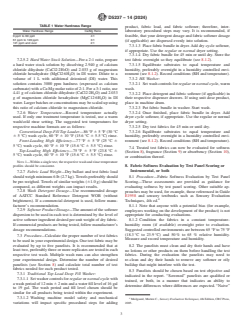
TABLE 1 Water Hardness Range
product, fabric load, and fabric softener; therefore, inter-
Water Hardness Range Ca/Mg Ratio laboratory procedural steps may vary. It is recommended, if
0 ppm to 60 ppm 4:1 feasible, that your detergent dosage and fabric softener dosage
61 ppm to 120 ppm 3:1
(if applicable) are dispersed evenly into solution.
121 ppm and over 2:1
7.3.1.3 Place fabric bundle in dryer. Add dry cycle softener,
if appropriate. Use the regular or normal dryer setting.
7.3.1.4 Dry fabric bundle for 45 min or until dry. Store the
7.2.5.2 Hard Water Stock Solution—For a 2:1 ratio, prepare
test fabric overnight so they equilibrate (see 8.1.2).
a hard water stock solution by dissolving 2.940 g of calcium 7.3.1.5 Equilibrate substrates to equal temperature and
chloride dihydrate (CaCl2·2H O) and 2.033 g of magnesium
humidity, preferably overnight in a humidity controlled envi-
chloride hexahydrate (MgCl2·6H O) in DI water. Dilute to a ronment (see 8.1.2). Record conditions (RH and temperature).
volume of 1 L with additional deionized (DI) water. This
7.3.2 HE Washer:
solution contains 3000 ppm hardness (expressed as calcium 7.3.2.1 Set wash controls for regular or normal cycle, warm
carbonate) with a Ca:Mg molar ratio of 2:1. For a 3:1 ratio, use
wash.
4.41 g of calcium chloride dihydrate (CaCl2·2H O) and 2.033 7.3.2.2 Place detergent and fabric softener (if applicable) in
g of magnesium chloride hexahydrate (MgC12·6H O) in DI their respective dispenser drawers. If using unit dose product,
water. Larger batches or concentrations may be scaled up using place in machine drum.
this ratio of calcium chloride to magnesium chloride. 7.3.2.3 Put fabric bundle in washer. Start wash.
7.2.6 Water Temperature—Record temperature actually 7.3.2.4 Once finished, place fabric bundle in dryer. Add
used. If only one treatment temperature is tested, use a warm dryer cycle softener, if appropriate. Use the regular or normal
wash/cold rinse setting. The suggested test temperatures for dryer setting.
respective machine formats are as follows: 7.3.2.5 Dry test fabrics for 45 min or until dry.
Conventional Deep-Fill Top Loader—86 °F 6 5 °F (30 °C
7.3.2.6 Equilibrate substrates to equal temperature and
6 5 °C) wash cycle, 60 °F 6 10 °F (15.6 °C 6 5.5 °C) rinse. humidity, preferably overnight in a humidity controlled envi-
Front-Loading High Effıciency—77 °F 6 5 °F (25 °C 6
ronment (see 8.1.2). Record conditions (RH and temperature).
5 °C) wash cycle, 60 °F 6 10 °F (15.6 °C 6 5.5 °C) rinse.
7.4 Treated test fabrics can now be evaluated for softness
Top-Loading High Effıciency—75 °F 6 5 °F (23.8 °C 6
(Section 8), fragrance (Section 9) or absorbency (Section 10),
5 °C) wash cycle, 60 °F 6 10 °F (15.6 °C 6 5.5 °C) rinse.
or combination thereof.
NOTE 1—Within a single test, the respective wash and rinse temperature
8. Fabric Softness Evaluation by Test Panel Scoring or
profiles should be consistent.
Instrumental, or both
7.2.7 Fabric Load Weight—Dry ballast and test fabric load
should weigh minimum 6 lb (2.7 kg). Towels preferably should 8.1 Procedure—Fabric Softness Evaluation by Test Panel
be pre-weighed. Towels of similar weights (61.0 g) should be
Scoring—These assessments are provided as guidance for
compared, as different weights can impact results. evaluating softness by test panel scoring. Other suitable ap-
7.2.8 Wash Detergent Dosage—Use recommended dosage
proaches may be used, for example, those referenced in Guide
of AATCC Standard Reference Detergent WOB (without E1958 and sensory textbooks such as Sensory Evaluation
brighteners). If a commercial detergent is used, follow manu-
Techniques, 4th ed.
facturer’s recommendation. 8.1.1 Note that anyone with a potential bias (for example,
7.2.9 Softener Product Dosage—The amount of the softener
employees working on the development of the product) is not
dispersion to be used in each test is determined by the level of appropriate for conducting evaluations.
active softener ingredient desired per unit weight of dry fabric.
8.1.2 Condition the fabrics in a constant temperature-
If commercial products are being tested, follow manufacturer’s
humidity room (if available) overnight prior to evaluation.
dosage recommendations.
Suggested controlled environments are between 65 °F to 75 °F
(18.3 °C to 23.9 °C) and 50 % to 65 % relative humidity.
7.3 Procedure—Calculate the proper number of test fabrics
Measure and record temperature and humidity.
to be used in your experimental design. One test fabric may be
evaluated by up to five panelists. It is recommended that at
8.2 The panelists must clean and dry their hands and have
least two, preferably three or more replicates are tested in each no lotions or other products on them before handling the test
respective test wash. Multiple wash runs can also strengthen
fabrics. During the evaluation the panelists may need to
your experimental design. Determine the number of desired re-clean and dry their hands to remove any softener or oily
panelists (see Section 8) and calculate total number of test
buildup that might interfere with the test.
fabrics needed for each product tested.
8.3 Panelists should be chosen based on test objective and
7.3.1 Traditional Top Load Deep Fill Washer:
indicated in the report. “Screened” panelists are qualified or
7.3.1.1 Set washer controls for regular or normal cycle with
trained, or both, in a manner that indicates an ability to
a wash period of 12 min 6 2 min and a water fill level of 16 gal
determine differences where differences are expected. “Naive”
to 19 gal. The wash period and fill level chosen should be
similar for all products being tested within the experiment.
7.3.1.2 Washing machine model safety and mechanical
Meilgaard, Morten C., Sensory Evaluation Techniques, 4th Edition, CRC Press,
variations will impact specific procedural steps for adding 2005.
D5237 − 14 (2024)
panelists typically have no prior training or qualification and 8.7 Directional Difference Test (Paired Comparison)—This
are typically used for consumer testing. Descriptive panelists evaluation compares two treatments, (for example, A versus
are highly trained and can also be used. B).
8.7.1 For effective evaluation, use Test Method E2164 as a
8.4 Individual panelists should use the same handling tech-
reference tool.
nique when evaluating each fabric in the test set.
8.7.2 Arrange the treated fabrics in pairs. The panelist
8.5 Ranking Comparison—This evaluation uses thr
...