

ASTM C935-19
(Specification)Standard Specification for General Requirements for Prestressed Concrete Poles Statically Cast
General Information
- Abstract
SCOPE
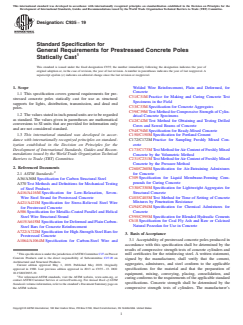
1.1 This specification covers general requirements for prestressed concrete poles statically cast for use as structural supports for lights, distribution, transmission, and dead end poles.
1.2 The values stated in inch-pound units are to be regarded as standard. The values given in parentheses are mathematical conversions to SI units that are provided for information only and are not considered standard.
1.3 This international standard was developed in accordance with internationally recognized principles on standardization established in the Decision on Principles for the Development of International Standards, Guides and Recommendations issued by the World Trade Organization Technical Barriers to Trade (TBT) Committee.
- Status
- Published
- Publication Date
- 30-Apr-2019
- Technical Committee
- C27 - Precast Concrete Products
- Drafting Committee
- C27.20 - Architectural and Structural Products
Buy Documents

ASTM C935-19 - Standard Specification for General Requirements for Prestressed Concrete Poles Statically Cast
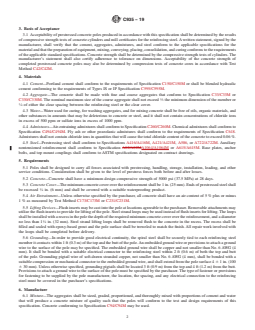
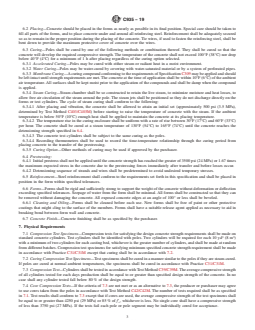

REDLINE ASTM C935-19 - Standard Specification for General Requirements for Prestressed Concrete Poles Statically Cast
Overview
ASTM C935-19 is the internationally recognized standard specification for the general requirements of prestressed concrete poles that are statically cast. Developed by ASTM International, this standard sets forth the criteria for manufacturing, materials, design, inspection, marking, and acceptance of prestressed concrete poles used as structural supports. Typical applications include lighting infrastructure, distribution lines, transmission poles, and dead-end poles in utility and roadway environments. The standard is designed in accordance with global principles established by the World Trade Organization's Technical Barriers to Trade (TBT) Committee, supporting consistency and interoperability worldwide.
Key Topics
ASTM C935-19 details essential requirements for prestressed concrete poles, focusing on:
- Materials: Specifies requirements for cement, aggregates, water, admixtures, and reinforcement to ensure concrete durability and performance.
- Design: Outlines strength, dimensions, and service condition considerations for poles to withstand prestressing, handling, installation, and load stresses.
- Manufacturing: Details processes for mixing, placing, curing, presressing, and finishing the poles, emphasizing compliance with referenced ASTM specifications.
- Testing and Quality Control: Requires compressive strength testing (e.g., using concrete cylinders), along with mill certifications for reinforcing steel and dimensional tolerance checks.
- Inspection and Acceptance: Covers protocols for inspection by purchasers or independent labs, permissible variations, and rejection criteria for nonconformance.
- Repair and Marking: Allows repair under purchaser approval and mandates clear marking for traceability, including manufacturer’s name and date of production.
Applications
Prestressed concrete poles manufactured according to ASTM C935-19 are widely utilized for:
- Utility Distribution and Transmission: Reliable structural supports for electrical grids and telecommunication lines, ensuring long-term stability and load-bearing capacity.
- Lighting Structures: Used for roadway, parking, and area lighting, these poles offer uniform specifications for safety and performance in public infrastructure projects.
- Dead-End and Custom Applications: Provides requirements for specialty poles at line terminations or locations subject to increased stresses.
By adhering to this standard, manufacturers, engineers, and utility companies benefit from enhanced safety, durability, and uniformity in infrastructure installations. This ultimately aids in project planning, regulatory compliance, and cross-regional compatibility.
Related Standards
ASTM C935-19 references several other important ASTM standards to support its requirements, including:
- ASTM C150/C150M - Specification for Portland Cement
- ASTM C595/C595M - Specification for Blended Hydraulic Cements
- ASTM C33/C33M & C330/C330M - Specifications for Aggregates
- ASTM A416/A416M, A421/A421M - Specifications for Prestressing Steel
- ASTM A615/A615M - Specification for Carbon-Steel Bars for Concrete Reinforcement
- ASTM C39/C39M - Test Method for Compressive Strength of Cylindrical Concrete Specimens
- ASTM C42/C42M - Test Method for Cores and Sawed Beams of Concrete
- ASTM C260/C260M - Air-Entraining Admixtures for Concrete
- ASTM C494/C494M - Chemical Admixtures for Concrete
- ASTM C94/C94M - Ready-Mixed Concrete
For comprehensive compliance and reliable performance, it is essential to consult these referenced documents alongside ASTM C935-19.
By following the guidelines of ASTM C935-19, stakeholders in infrastructure and utility projects can achieve project goals related to quality, safety, and regulatory compliance in the deployment of prestressed concrete poles.
Relations
- Effective Date
- 01-May-2019
- Effective Date
- 15-Apr-2024
- Refers
ASTM C31/C31M-24a - Standard Practice for Making and Curing Concrete Test Specimens in the Field - Effective Date
- 01-Apr-2024
- Effective Date
- 01-Apr-2024
- Effective Date
- 01-Mar-2024
- Effective Date
- 01-Mar-2024
- Effective Date
- 01-Jan-2024
- Effective Date
- 01-Jan-2024
- Effective Date
- 01-Jan-2024
- Refers
ASTM C31/C31M-24 - Standard Practice for Making and Curing Concrete Test Specimens in the Field - Effective Date
- 01-Jan-2024
- Refers
ASTM C39/C39M-23 - Standard Test Method for Compressive Strength of Cylindrical Concrete Specimens - Effective Date
- 01-Dec-2023
- Effective Date
- 01-Sep-2023
- Effective Date
- 01-Jul-2019
- Effective Date
- 01-Jul-2019
- Refers
ASTM C309-19 - Standard Specification for Liquid Membrane-Forming Compounds for Curing Concrete - Effective Date
- 15-Jun-2019
Buy Documents
ASTM C935-19 - Standard Specification for General Requirements for Prestressed Concrete Poles Statically Cast
REDLINE ASTM C935-19 - Standard Specification for General Requirements for Prestressed Concrete Poles Statically Cast
Get Certified
Connect with accredited certification bodies for this standard

DIBt (Deutsches Institut für Bautechnik)
German Institute for Building Technology.
DIN CERTCO
DIN Group product certification.

Aboma Certification B.V.
Specialized in construction, metal, and transport sectors.
Sponsored listings
Frequently Asked Questions
ASTM C935-19 is a technical specification published by ASTM International. Its full title is "Standard Specification for General Requirements for Prestressed Concrete Poles Statically Cast". This standard covers: SCOPE 1.1 This specification covers general requirements for prestressed concrete poles statically cast for use as structural supports for lights, distribution, transmission, and dead end poles. 1.2 The values stated in inch-pound units are to be regarded as standard. The values given in parentheses are mathematical conversions to SI units that are provided for information only and are not considered standard. 1.3 This international standard was developed in accordance with internationally recognized principles on standardization established in the Decision on Principles for the Development of International Standards, Guides and Recommendations issued by the World Trade Organization Technical Barriers to Trade (TBT) Committee.
SCOPE 1.1 This specification covers general requirements for prestressed concrete poles statically cast for use as structural supports for lights, distribution, transmission, and dead end poles. 1.2 The values stated in inch-pound units are to be regarded as standard. The values given in parentheses are mathematical conversions to SI units that are provided for information only and are not considered standard. 1.3 This international standard was developed in accordance with internationally recognized principles on standardization established in the Decision on Principles for the Development of International Standards, Guides and Recommendations issued by the World Trade Organization Technical Barriers to Trade (TBT) Committee.
ASTM C935-19 is classified under the following ICS (International Classification for Standards) categories: 91.100.30 - Concrete and concrete products. The ICS classification helps identify the subject area and facilitates finding related standards.
ASTM C935-19 has the following relationships with other standards: It is inter standard links to ASTM C935-13, ASTM A1064/A1064M-24, ASTM C31/C31M-24a, ASTM C94/C94M-24a, ASTM A370-24, ASTM A416/A416M-24, ASTM C231/C231M-24, ASTM C173/C173M-24, ASTM C94/C94M-24, ASTM C31/C31M-24, ASTM C39/C39M-23, ASTM C173/C173M-23, ASTM A370-19, ASTM C94/C94M-19, ASTM C309-19. Understanding these relationships helps ensure you are using the most current and applicable version of the standard.
ASTM C935-19 is available in PDF format for immediate download after purchase. The document can be added to your cart and obtained through the secure checkout process. Digital delivery ensures instant access to the complete standard document.
Standards Content (Sample)
This international standard was developed in accordance with internationally recognized principles on standardization established in the Decision on Principles for the
Development of International Standards, Guides and Recommendations issued by the World Trade Organization Technical Barriers to Trade (TBT) Committee.
Designation:C935 −19
Standard Specification for
General Requirements for Prestressed Concrete Poles
Statically Cast
This standard is issued under the fixed designation C935; the number immediately following the designation indicates the year of
original adoption or, in the case of revision, the year of last revision. A number in parentheses indicates the year of last reapproval. A
superscript epsilon (´) indicates an editorial change since the last revision or reapproval.
1. Scope Welded Wire Reinforcement, Plain and Deformed, for
Concrete
1.1 This specification covers general requirements for pre-
C31/C31M Practice for Making and Curing Concrete Test
stressed concrete poles statically cast for use as structural
Specimens in the Field
supports for lights, distribution, transmission, and dead end
C33/C33M Specification for Concrete Aggregates
poles.
C39/C39M Test Method for Compressive Strength of Cylin-
1.2 The values stated in inch-pound units are to be regarded
drical Concrete Specimens
as standard. The values given in parentheses are mathematical
C42/C42M Test Method for Obtaining and Testing Drilled
conversions to SI units that are provided for information only
Cores and Sawed Beams of Concrete
and are not considered standard.
C94/C94M Specification for Ready-Mixed Concrete
1.3 This international standard was developed in accor-
C150/C150M Specification for Portland Cement
dance with internationally recognized principles on standard- C172/C172M Practice for Sampling Freshly Mixed Con-
ization established in the Decision on Principles for the
crete
Development of International Standards, Guides and Recom- C173/C173M Test Method forAir Content of Freshly Mixed
mendations issued by the World Trade Organization Technical
Concrete by the Volumetric Method
Barriers to Trade (TBT) Committee. C231/C231M Test Method forAir Content of Freshly Mixed
Concrete by the Pressure Method
2. Referenced Documents
C260/C260M Specification for Air-Entraining Admixtures
for Concrete
2.1 ASTM Standards:
C309 Specification for Liquid Membrane-Forming Com-
A36/A36M Specification for Carbon Structural Steel
pounds for Curing Concrete
A370 Test Methods and Definitions for Mechanical Testing
C330/C330M Specification for Lightweight Aggregates for
of Steel Products
Structural Concrete
A416/A416M Specification for Low-Relaxation, Seven-
C403/C403M Test Method for Time of Setting of Concrete
Wire Steel Strand for Prestressed Concrete
Mixtures by Penetration Resistance
A421/A421M Specification for Stress-Relieved Steel Wire
C494/C494M Specification for Chemical Admixtures for
for Prestressed Concrete
Concrete
A586 Specification for Metallic-Coated Parallel and Helical
C595/C595M Specification for Blended Hydraulic Cements
Steel Wire Structural Strand
C618 Specification for Coal Fly Ash and Raw or Calcined
A615/A615M Specification for Deformed and Plain Carbon-
Natural Pozzolan for Use in Concrete
Steel Bars for Concrete Reinforcement
A722/A722M Specification for High-Strength Steel Bars for
3. Basis of Acceptance
Prestressed Concrete
3.1 Acceptability of prestressed concrete poles produced in
A1064/A1064M Specification for Carbon-Steel Wire and
accordance with this specification shall be determined by the
results of compressive strength tests of concrete cylinders and
This specification is under the jurisdiction ofASTM Committee C27 on Precast
mill certificates for the reinforcing steel. A written statement,
Concrete Products and is the direct responsibility of Subcommittee C27.20 on
signed by the manufacturer, shall verify that the cement,
Architectural and Structural Products.
aggregates, admixtures, and steel conform to the applicable
Current edition approved May 1, 2019. Published May 2019. Originally
specifications for the material and that the preparation of
approved in 1980. Last previous edition approved in 2013 as C935 – 13. DOI:
10.1520/C0935-19.
equipment, mixing, conveying, placing, consolidation, and
For referenced ASTM standards, visit the ASTM website, www.astm.org, or
curing conforms to the requirements of the applicable standard
contact ASTM Customer Service at service@astm.org. For Annual Book of ASTM
specifications. Concrete strength shall be determined by the
Standards volume information, refer to the standard’s Document Summary page on
the ASTM website. compressive strength tests of cylinders. The manufacturer’s
Copyright © ASTM International, 100 Barr Harbor Drive, PO Box C700, West Conshohocken, PA 19428-2959. United States
C935−19
statement shall also certify adherence to tolerance on dimen- lifting.The loops shall be installed with a recess in the pole the
sions. Acceptability of the concrete strength of completed depth of the required minimum concrete cover over the
prestressed concrete poles may also be determined by com- reinforcement, and a diameter no less than 1 ⁄4 in. (32 mm).
pression tests of concrete cores in accordance with Test Steel strand lifting loops shall be removed flush to the concrete
Method C42/C42M. in the recess. The recess shall be filled and sealed with
epoxy-based grout and the pole surface shall be troweled to
4. Materials
match the finish. All repair work involved with the loops shall
4.1 Cement—Portland cement shall conform to the require- be completed before delivery.
ments of Specification C150/C150M or shall be blended
5.6 Grounding—In order to provide good electrical
hydraulic cement conforming to the requirements of Types IS
continuity, the spiral steel shall be securely tied to each
or IP Specification C595/C595M.
reinforcing steel member it contacts within 1 ft (0.3 m) of the
top and the butt of the pole. An embedded ground wire or
4.2 Aggregate—The concrete shall be made with fine and
coarse aggregates that conform to Specification C33/C33M or provisions to attach a ground wire to the surface of the pole
may be specified. The embedded ground wire shall be copper
C330/C330M. The nominal maximum size of the coarse
aggregate shall not exceed ⁄5 the minimum dimension of the and not smaller than No. 6 AWG (4 mm). It shall be bonded
with a suitable electrical connector to the reinforcing steel
member or ⁄4 of either the clear spacing between the reinforc-
ing steel or the clear cover. within 2 ft (0.6 m) of both the top and butt of the pole.
Grounding pigtail wire of soft-drawn stranded copper, not
4.3 Water—Water used for curing, for washing aggregates,
smaller than No. 6 AWG (4 mm), shall be bonded with a
and for mixing concrete shall be free of oils, organic materials,
suitablecompressionormechanicalconnectortotheembedded
and other substances in amounts that may be deleterious to
ground wire, and shall extend from the pole surface 4 6 1 in.
concrete or steel, and it shall not contain concentrations of
(100 6 30 mm). Unless otherwise specified, grounding pigtails
chloride ions in excess of 500 ppm or sulfate ions in excess of
shall be located 3 ft (0.9 m) from the top and 4 ft (1.2 m) from
1000 ppm.
the butt. Provisions to attach a ground wire to the surface of the
4.4 Admixtures—Air-entrainingadmixturesshallconformto
pole must be specified by the purchaser.The type of fastener or
Specification C260/C260M. Chemical admixtures shall con-
provisions for fastening to be supplied by the pole
form to Specification C494/C494M. Fly ash or other pozzo-
manufacturer, the location, the spacing, and any electrical
lanic admixtures shall conform to the requirements of Speci-
connection to the reinforcing steel must be covered in the
fication C618. Admixtures shall not contain chloride ions in
purchaser’s specifications.
quantities that will cause the total chloride content of the
6. Manufacture
concrete to exceed 0.06 %.
6.1 Mixture—The aggregates shall be sized, graded,
4.5 Steel—Prestressing steel shall conform to Specifications
proportioned, and thoroughly mixed with proportions of ce-
A416/A416M, A421/A421M, A586,or A722/A722M. Auxil-
ment and water that will produce a concrete mixture of quality
iary nontensioned reinforcement shall conform to Specification
such that the poles will conform to the test and design
A1064/A1064M or A615/A615M. Base plates, anchor bolts,
requirements of this specification. Concrete conforming to
andtopmountcouplingsshallconformtoASTMspecifications
Specification C94/C94M may be used.
designated on contract drawings.
6.2 Placing—Concrete should be placed in the forms as
5. Requirements
nearly as possible in its final position. Special care should be
5.1 Poles shall be designed to carry all forces associated
taken to fill all parts of the forms, and to place concrete under
with prestressing, handling, storage, installation, loading, and and around all reinforcing steel. Reinforcement shall be ad-
other service conditions. Consideration shall be given to the
equately secured so as to remain in the proper position during
level of prestress forces both before and after losses. the placing of the concrete. Tie wires, if used to fasten the
reinforcing steel, shall be bent down to provide the maximum
5.2 Concrete—Concrete shall have a minimum design com-
protective cover of concrete over the wires.
pressive strength of 5000 psi (37.5 MPa) at 28 days.
6.3 Curing—Poles shall be cured by one of the following
5.3 ConcreteCover—The minimum concrete cover over the
methodsorcombinationthereof.Theyshallbecuredsothatthe
reinforcement shall be 1 in. (25 mm). Ends of prestressed steel
concrete will develop the required compressive strength. The
shall be recessed ⁄4 in. (6 mm) and shall be covered with a
temperature of the concrete shall not exceed 100°F (38°C) nor
suitable waterproofing product.
drop below 40°F (4°C) for a minimum of 1 h after placing
5.4 Air Entrainment—Unless otherwise specified by the
regardless of the curing option selected.
purchaser, all concrete shall
...
This document is not an ASTM standard and is intended only to provide the user of an ASTM standard an indication of what changes have been made to the previous version. Because
it may not be technically possible to adequately depict all changes accurately, ASTM recommends that users consult prior editions as appropriate. In all cases only the current version
of the standard as published by ASTM is to be considered the official document.
Designation: C935 − 13 C935 − 19
Standard Specification for
General Requirements for Prestressed Concrete Poles
Statically Cast
This standard is issued under the fixed designation C935; the number immediately following the designation indicates the year of
original adoption or, in the case of revision, the year of last revision. A number in parentheses indicates the year of last reapproval. A
superscript epsilon (´) indicates an editorial change since the last revision or reapproval.
1. Scope
1.1 This specification covers general requirements for prestressed concrete poles statically cast for use as structural supports for
lights, distribution, transmission, and dead end poles.
1.2 The values stated in inch-pound units are to be regarded as standard. The values given in parentheses are mathematical
conversions to SI units that are provided for information only and are not considered standard.
1.3 This international standard was developed in accordance with internationally recognized principles on standardization
established in the Decision on Principles for the Development of International Standards, Guides and Recommendations issued
by the World Trade Organization Technical Barriers to Trade (TBT) Committee.
2. Referenced Documents
2.1 ASTM Standards:
A36/A36M Specification for Carbon Structural Steel
A82/A82M Specification for Steel Wire, Plain, for Concrete Reinforcement (Withdrawn 2013)
A370 Test Methods and Definitions for Mechanical Testing of Steel Products
A416/A416M Specification for Low-Relaxation, Seven-Wire Steel Strand for Prestressed Concrete
A421/A421M Specification for Stress-Relieved Steel Wire for Prestressed Concrete
A586 Specification for Metallic-Coated Parallel and Helical Steel Wire Structural Strand
A615/A615M Specification for Deformed and Plain Carbon-Steel Bars for Concrete Reinforcement
A722/A722M Specification for High-Strength Steel Bars for Prestressed Concrete
A1064/A1064M Specification for Carbon-Steel Wire and Welded Wire Reinforcement, Plain and Deformed, for Concrete
C31/C31M Practice for Making and Curing Concrete Test Specimens in the Field
C33/C33M Specification for Concrete Aggregates
C39/C39M Test Method for Compressive Strength of Cylindrical Concrete Specimens
C42/C42M Test Method for Obtaining and Testing Drilled Cores and Sawed Beams of Concrete
C94/C94M Specification for Ready-Mixed Concrete
C150/C150M Specification for Portland Cement
C172/C172M Practice for Sampling Freshly Mixed Concrete
C173/C173M Test Method for Air Content of Freshly Mixed Concrete by the Volumetric Method
C231/C231M Test Method for Air Content of Freshly Mixed Concrete by the Pressure Method
C260/C260M Specification for Air-Entraining Admixtures for Concrete
C309 Specification for Liquid Membrane-Forming Compounds for Curing Concrete
C330/C330M Specification for Lightweight Aggregates for Structural Concrete
C403/C403M Test Method for Time of Setting of Concrete Mixtures by Penetration Resistance
C494/C494M Specification for Chemical Admixtures for Concrete
C595/C595M Specification for Blended Hydraulic Cements
C618 Specification for Coal Fly Ash and Raw or Calcined Natural Pozzolan for Use in Concrete
This specification is under the jurisdiction of ASTM Committee C27 on Precast Concrete Products and is the direct responsibility of Subcommittee C27.20 on
Architectural and Structural Products.
Current edition approved April 1, 2013May 1, 2019. Published April 2013May 2019. Originally approved in 1980. Last previous edition approved in 20022013 as
C935 – 80 (2002)C935 – 13. which was withdrawn January 2011 and reinstated in April 2013. DOI: 10.1520/C0935-13.DOI: 10.1520/C0935-19.
For referenced ASTM standards, visit the ASTM website, www.astm.org, or contact ASTM Customer Service at service@astm.org. For Annual Book of ASTM Standards
volume information, refer to the standard’s Document Summary page on the ASTM website.
Copyright © ASTM International, 100 Barr Harbor Drive, PO Box C700, West Conshohocken, PA 19428-2959. United States
C935 − 19
3. Basis of Acceptance
3.1 Acceptability of prestressed concrete poles produced in accordance with this specification shall be determined by the results
of compressive strength tests of concrete cylinders and mill certificates for the reinforcing steel. A written statement, signed by the
manufacturer, shall verify that the cement, aggregates, admixtures, and steel conform to the applicable specifications for the
material and that the preparation of equipment, mixing, conveying, placing, consolidation, and curing conforms to the requirements
of the applicable standard specifications. Concrete strength shall be determined by the compressive strength tests of cylinders. The
manufacturer’s statement shall also certify adherence to tolerance on dimensions. Acceptability of the concrete strength of
completed prestressed concrete poles may also be determined by compression tests of concrete cores in accordance with Test
Method C42/C42M.
4. Materials
4.1 Cement—Portland cement shall conform to the requirements of Specification C150/C150M or shall be blended hydraulic
cement conforming to the requirements of Types IS or IP Specification C595/C595M.
4.2 Aggregate—The concrete shall be made with fine and coarse aggregates that conform to Specification C33/C33M or
C330/C330M. The nominal maximum size of the coarse aggregate shall not exceed ⁄5 the minimum dimension of the member or
⁄4 of either the clear spacing between the reinforcing steel or the clear cover.
4.3 Water—Water used for curing, for washing aggregates, and for mixing concrete shall be free of oils, organic materials, and
other substances in amounts that may be deleterious to concrete or steel, and it shall not contain concentrations of chloride ions
in excess of 500 ppm or sulfate ions in excess of 1000 ppm.
4.4 Admixtures—Air-entraining admixtures shall conform to Specification C260/C260M. Chemical admixtures shall conform to
Specification C494/C494M. Fly ash or other pozzolanic admixtures shall conform to the requirements of Specification C618.
Admixtures shall not contain chloride ions in quantities that will cause the total chloride content of the concrete to exceed 0.06 %.
4.5 Steel—Prestressing steel shall conform to Specifications A416/A416M, A421/A421M, A586, or A722/A722M. Auxiliary
nontensioned reinforcement shall conform to Specification A82/A82MA1064/A1064M or A615/A615M. Base plates, anchor
bolts, and top mount couplings shall conform to ASTM specifications designated on contract drawings.
5. Requirements
5.1 Poles shall be designed to carry all forces associated with prestressing, handling, storage, installation, loading, and other
service conditions. Consideration shall be given to the level of prestress forces both before and after losses.
5.2 Concrete—Concrete shall have a minimum design compressive strength of 5000 psi (37.5 MPa) at 28 days.
5.3 Concrete Cover—The minimum concrete cover over the reinforcement shall be 1 in. (25 mm). Ends of prestressed steel shall
be recessed ⁄4 in. (6 mm) and shall be covered with a suitable waterproofing product.
5.4 Air Entrainment—Unless otherwise specified by the purchaser, all concrete shall have an air content of 5 % plus or minus
1 % as measured by Test Method C173/C173M or C231/C231M.
5.5 Lifting Devices—Flush inserts may be cast into the pole at locations agreeable to the purchaser. Removable attachments may
utilize the flush inserts to provide for lifting of the pole. Steel strand loops may be used instead of flush inserts for lifting. The loops
shall be installed with a recess in the pole the depth of the required minimum concrete cover over the reinforcement, and a diameter
no less than 1 ⁄4 in. (32 mm). Steel strand lifting loops shall be removed flush to the concrete in the recess. The recess shall be
filled and sealed with epoxy-based grout and the pole surface shall be troweled to match the finish. All repair work involved with
the loops shall be completed before delivery.
5.6 Grounding—In order to provide good electrical continuity, the spiral steel shall be securely tied to each reinforcing steel
member it contacts within 1 ft (0.3 m) of the top and the butt of the pole. An embedded ground wire or provisions to attach a ground
wire to the surface of the pole may be specified. The embedded ground wire shall be copper and not smaller than No. 6 AWG (4
mm). It shall be bonded with a suitable electrical connector to the reinforcing steel within 2 ft (0.6 m) of both the top and butt
of the pole. Grounding pigtail wire of soft-drawn stranded copper, not smaller than No. 6 AWG (4 mm), shall be bonded with a
suitable compression or mechanical connector to the embedded ground wire, and shall extend from the pole surface 4 6 1 in. (100
6 30 mm). Unless otherwise specified, grounding pigtails shall be located 3 ft (0.9 m) from the top and 4 ft (1.2 m) from the butt.
Provisions to attach a ground wire to the surface of the pole must be specified by the purchaser. The type of fastener or provisions
for fastening to be supplied by the pole manufacturer, the location, the spacing, and any electrical connection to the reinforcing
steel must be covered in the purchaser’s specifications.
6. Manufacture
6.1 Mixture—The aggregates shall be sized, graded, proportioned, and thoroughly mixed with proportions of cement and water
that will produce a concrete mixture of quality such that the poles will conform to the test and design requirements of this
specification. Concrete conforming to Specification C94/C94M may be used.
C935 − 19
6.2 Placing—Concrete should be placed in the forms as nearly as possible in its final position. Special care should be taken to
fill all parts of the forms, and to place concrete under and around all reinforcing steel. Reinforcement shall be adequately secured
so as to remain in the proper positio
...