

ASTM C173/C173M-24
(Test Method)Standard Test Method for Air Content of Freshly Mixed Concrete by the Volumetric Method
General Information
- Abstract
SIGNIFICANCE AND USE
4.1 This test method covers the determination of the air content of freshly mixed concrete. It measures the air contained in the mortar fraction of the concrete, but is not affected by air that may be present inside porous aggregate particles.
4.1.1 Therefore, this is the appropriate test to determine the air content of concretes containing lightweight aggregates, air-cooled slag, and highly porous or vesicular natural aggregates.
4.2 This test method requires the addition of sufficient isopropyl alcohol, when the meter is initially being filled with water, so that after the first or subsequent rollings little or no foam collects in the neck of the top section of the meter. If more foam is present than that equivalent to 2 % air above the water level, the test is declared invalid and must be repeated using a larger quantity of alcohol. Addition of alcohol to dispel foam any time after the initial filling of the meter to the zero mark is not permitted.
4.3 The air content of hardened concrete may be either higher or lower than that determined by this test method. This depends upon the methods and amounts of consolidation effort applied to the concrete from which the hardened concrete specimen is taken; uniformity and stability of the air bubbles in the fresh and hardened concrete; accuracy of the microscopic examination, if used; time of comparison; environmental exposure; stage in the delivery, placement and consolidation processes at which the air content of the unhardened concrete is determined, that is, before or after the concrete goes through a pump; and other factors.
SCOPE
1.1 This test method covers determination of the air content of freshly mixed concrete containing any type of aggregate, whether it be dense, cellular, or lightweight.
1.2 The values stated in either SI units or inch-pound units are to be regarded separately as standard. The inch-pound units are shown in brackets. The values stated in each system may not be exact equivalents; therefore, each system shall be used independently of the other. Combining values from the two systems may result in non-conformance with the standard.
1.3 The text of this standard references notes and footnotes that provide explanatory information. These notes and footnotes (excluding those in tables and figures) shall not be considered as requirements of this standard.
1.4 This standard does not purport to address all of the safety concerns, if any, associated with its use. It is the responsibility of the user of this standard to establish appropriate safety, health, and environmental practices and determine the applicability of regulatory limitations prior to use. (Warning—Fresh hydraulic cementitious mixtures are caustic and may cause chemical burns to skin and tissue upon prolonged exposure.2)
1.5 This international standard was developed in accordance with internationally recognized principles on standardization established in the Decision on Principles for the Development of International Standards, Guides and Recommendations issued by the World Trade Organization Technical Barriers to Trade (TBT) Committee.
- Status
- Published
- Publication Date
- 31-Dec-2023
- Technical Committee
- C09 - Concrete and Concrete Aggregates
- Drafting Committee
- C09.60 - Testing Fresh Concrete
Buy Documents
ASTM C173/C173M-24 - Standard Test Method for Air Content of Freshly Mixed Concrete by the Volumetric Method
REDLINE ASTM C173/C173M-24 - Standard Test Method for Air Content of Freshly Mixed Concrete by the Volumetric Method
Overview
ASTM C173/C173M-24: Standard Test Method for Air Content of Freshly Mixed Concrete by the Volumetric Method is a globally recognized standard developed by ASTM International. This method specifies procedures for determining the air content of freshly mixed concrete, regardless of aggregate type-dense, cellular, or lightweight. The ASTM volumetric method is especially useful for concretes containing lightweight aggregates, air-cooled slag, and highly porous natural aggregates, as it accurately measures the air contained in the mortar portion without being affected by air trapped within the aggregate particles.
Knowing the air content of concrete is vital for both quality assurance and durability, as it directly impacts concrete workability, freeze-thaw resistance, and overall performance in construction projects.
Key Topics
- Comprehensive Applicability: Suitable for all freshly mixed concretes, including those with lightweight or highly porous aggregates.
- Volumetric Measurement: Utilizes a calibrated air meter, water, and isopropyl alcohol to determine air content based on volume displacement.
- Isopropyl Alcohol Use: The method calls for isopropyl alcohol to minimize foam during testing, ensuring accurate measurements. The quantity used may require correction factors.
- Separate Measurement Systems: The standard supports both SI and inch-pound units but prohibits intermixing of units within a test to avoid non-conformance.
- Quality and Consistency: Offers procedures for sampling, apparatus calibration, and operator precision, which underpin reliable, repeatable results.
- Safety Considerations: Users must observe safety, health, and environmental practices due to hazards associated with fresh cementitious mixtures and isopropyl alcohol.
Applications
This standard test method finds broad application across various aspects of the concrete industry:
- Quality Control at Concrete Plants and Job Sites: Ensures that the concrete delivered and placed meets project specifications for air content, essential for structural integrity and freeze-thaw resistance.
- Assessment of Air-Entraining Admixtures: Verifies the effectiveness of additives used to intentionally introduce air voids into the concrete mix.
- Testing of Specialty and Lightweight Concretes: Offers a reliable solution for evaluating concretes with non-standard aggregate types, such as lightweight aggregate or slag that may influence air measurements made by other methods.
- Compliance and Acceptance Testing: Widely used by contractors, state DOTs, and agencies to certify construction materials meet project standards.
- Field and Laboratory Settings: Method is suitable for use both onsite and under laboratory conditions, ensuring flexibility in testing environments.
Related Standards
Several ASTM standards are referenced and often used in conjunction with ASTM C173/C173M-24:
- ASTM C231 – Test Method for Air Content of Freshly Mixed Concrete by the Pressure Method
- ASTM C138/C138M – Test Method for Density (Unit Weight), Yield, and Air Content (Gravimetric) of Concrete
- ASTM C143/C143M – Test Method for Slump of Hydraulic-Cement Concrete
- ASTM C172 – Practice for Sampling Freshly Mixed Concrete
- ASTM C1758/C1758M – Practice for Fabricating Test Specimens with Self-Consolidating Concrete
- ASTM C125 – Terminology Relating to Concrete and Concrete Aggregates
Practical Value
Implementing ASTM C173/C173M-24 helps construction professionals reliably control the quality and durability of concrete. Accurate air content determination is crucial for weather-resistant structures and long-lasting performance. This volumetric method is a foundational test for ensuring compliance with modern concrete construction standards, especially for projects utilizing innovative aggregate materials or requiring exceptional durability. The standard’s clear, robust procedures and its acceptance by regulatory authorities make it an essential reference for engineers, technicians, and quality control personnel worldwide.
Relations
- Effective Date
- 01-Jan-2024
- Refers
ASTM C31/C31M-24a - Standard Practice for Making and Curing Concrete Test Specimens in the Field - Effective Date
- 01-Apr-2024
- Effective Date
- 01-Feb-2024
- Effective Date
- 01-Jan-2024
- Effective Date
- 01-Jan-2024
- Effective Date
- 01-Dec-2023
- Refers
ASTM C31/C31M-23 - Standard Practice for Making and Curing Concrete Test Specimens in the Field - Effective Date
- 01-Jun-2023
- Effective Date
- 01-Oct-2017
- Effective Date
- 01-Feb-2016
- Effective Date
- 15-Jun-2015
- Effective Date
- 01-Jan-2024
- Referred By
ASTM C913-23 - Standard Specification for Precast Concrete Water and Wastewater Structures - Effective Date
- 01-Jan-2024
- Effective Date
- 01-Jan-2024
- Effective Date
- 01-Jan-2024
- Effective Date
- 01-Jan-2024
Buy Documents
ASTM C173/C173M-24 - Standard Test Method for Air Content of Freshly Mixed Concrete by the Volumetric Method
REDLINE ASTM C173/C173M-24 - Standard Test Method for Air Content of Freshly Mixed Concrete by the Volumetric Method
Get Certified
Connect with accredited certification bodies for this standard

DIBt (Deutsches Institut für Bautechnik)
German Institute for Building Technology.
DIN CERTCO
DIN Group product certification.

Aboma Certification B.V.
Specialized in construction, metal, and transport sectors.
Sponsored listings
Frequently Asked Questions
ASTM C173/C173M-24 is a standard published by ASTM International. Its full title is "Standard Test Method for Air Content of Freshly Mixed Concrete by the Volumetric Method". This standard covers: SIGNIFICANCE AND USE 4.1 This test method covers the determination of the air content of freshly mixed concrete. It measures the air contained in the mortar fraction of the concrete, but is not affected by air that may be present inside porous aggregate particles. 4.1.1 Therefore, this is the appropriate test to determine the air content of concretes containing lightweight aggregates, air-cooled slag, and highly porous or vesicular natural aggregates. 4.2 This test method requires the addition of sufficient isopropyl alcohol, when the meter is initially being filled with water, so that after the first or subsequent rollings little or no foam collects in the neck of the top section of the meter. If more foam is present than that equivalent to 2 % air above the water level, the test is declared invalid and must be repeated using a larger quantity of alcohol. Addition of alcohol to dispel foam any time after the initial filling of the meter to the zero mark is not permitted. 4.3 The air content of hardened concrete may be either higher or lower than that determined by this test method. This depends upon the methods and amounts of consolidation effort applied to the concrete from which the hardened concrete specimen is taken; uniformity and stability of the air bubbles in the fresh and hardened concrete; accuracy of the microscopic examination, if used; time of comparison; environmental exposure; stage in the delivery, placement and consolidation processes at which the air content of the unhardened concrete is determined, that is, before or after the concrete goes through a pump; and other factors. SCOPE 1.1 This test method covers determination of the air content of freshly mixed concrete containing any type of aggregate, whether it be dense, cellular, or lightweight. 1.2 The values stated in either SI units or inch-pound units are to be regarded separately as standard. The inch-pound units are shown in brackets. The values stated in each system may not be exact equivalents; therefore, each system shall be used independently of the other. Combining values from the two systems may result in non-conformance with the standard. 1.3 The text of this standard references notes and footnotes that provide explanatory information. These notes and footnotes (excluding those in tables and figures) shall not be considered as requirements of this standard. 1.4 This standard does not purport to address all of the safety concerns, if any, associated with its use. It is the responsibility of the user of this standard to establish appropriate safety, health, and environmental practices and determine the applicability of regulatory limitations prior to use. (Warning—Fresh hydraulic cementitious mixtures are caustic and may cause chemical burns to skin and tissue upon prolonged exposure.2) 1.5 This international standard was developed in accordance with internationally recognized principles on standardization established in the Decision on Principles for the Development of International Standards, Guides and Recommendations issued by the World Trade Organization Technical Barriers to Trade (TBT) Committee.
SIGNIFICANCE AND USE 4.1 This test method covers the determination of the air content of freshly mixed concrete. It measures the air contained in the mortar fraction of the concrete, but is not affected by air that may be present inside porous aggregate particles. 4.1.1 Therefore, this is the appropriate test to determine the air content of concretes containing lightweight aggregates, air-cooled slag, and highly porous or vesicular natural aggregates. 4.2 This test method requires the addition of sufficient isopropyl alcohol, when the meter is initially being filled with water, so that after the first or subsequent rollings little or no foam collects in the neck of the top section of the meter. If more foam is present than that equivalent to 2 % air above the water level, the test is declared invalid and must be repeated using a larger quantity of alcohol. Addition of alcohol to dispel foam any time after the initial filling of the meter to the zero mark is not permitted. 4.3 The air content of hardened concrete may be either higher or lower than that determined by this test method. This depends upon the methods and amounts of consolidation effort applied to the concrete from which the hardened concrete specimen is taken; uniformity and stability of the air bubbles in the fresh and hardened concrete; accuracy of the microscopic examination, if used; time of comparison; environmental exposure; stage in the delivery, placement and consolidation processes at which the air content of the unhardened concrete is determined, that is, before or after the concrete goes through a pump; and other factors. SCOPE 1.1 This test method covers determination of the air content of freshly mixed concrete containing any type of aggregate, whether it be dense, cellular, or lightweight. 1.2 The values stated in either SI units or inch-pound units are to be regarded separately as standard. The inch-pound units are shown in brackets. The values stated in each system may not be exact equivalents; therefore, each system shall be used independently of the other. Combining values from the two systems may result in non-conformance with the standard. 1.3 The text of this standard references notes and footnotes that provide explanatory information. These notes and footnotes (excluding those in tables and figures) shall not be considered as requirements of this standard. 1.4 This standard does not purport to address all of the safety concerns, if any, associated with its use. It is the responsibility of the user of this standard to establish appropriate safety, health, and environmental practices and determine the applicability of regulatory limitations prior to use. (Warning—Fresh hydraulic cementitious mixtures are caustic and may cause chemical burns to skin and tissue upon prolonged exposure.2) 1.5 This international standard was developed in accordance with internationally recognized principles on standardization established in the Decision on Principles for the Development of International Standards, Guides and Recommendations issued by the World Trade Organization Technical Barriers to Trade (TBT) Committee.
ASTM C173/C173M-24 is classified under the following ICS (International Classification for Standards) categories: 91.100.30 - Concrete and concrete products. The ICS classification helps identify the subject area and facilitates finding related standards.
ASTM C173/C173M-24 has the following relationships with other standards: It is inter standard links to ASTM C173/C173M-23, ASTM C31/C31M-24a, ASTM C670-24a, ASTM C173/C173M-24, ASTM C670-24, ASTM C1064/C1064M-23, ASTM C31/C31M-23, ASTM C1064/C1064M-17, ASTM C173/C173M-16, ASTM C670-15, ASTM C192/C192M-19, ASTM C913-23, ASTM C1364-23, ASTM C457/C457M-23a, ASTM C465-23. Understanding these relationships helps ensure you are using the most current and applicable version of the standard.
ASTM C173/C173M-24 is available in PDF format for immediate download after purchase. The document can be added to your cart and obtained through the secure checkout process. Digital delivery ensures instant access to the complete standard document.
Standards Content (Sample)
This international standard was developed in accordance with internationally recognized principles on standardization established in the Decision on Principles for the
Development of International Standards, Guides and Recommendations issued by the World Trade Organization Technical Barriers to Trade (TBT) Committee.
Designation: C173/C173M − 24
Standard Test Method for
Air Content of Freshly Mixed Concrete by the Volumetric
Method
This standard is issued under the fixed designation C173/C173M; the number immediately following the designation indicates the year
of original adoption or, in the case of revision, the year of last revision. A number in parentheses indicates the year of last reapproval.
A superscript epsilon (´) indicates an editorial change since the last revision or reapproval.
This standard has been approved for use by agencies of the U.S. Department of Defense.
1. Scope* 2. Referenced Documents
1.1 This test method covers determination of the air content 2.1 ASTM Standards:
of freshly mixed concrete containing any type of aggregate, C29/C29M Test Method for Bulk Density (“Unit Weight”)
whether it be dense, cellular, or lightweight. and Voids in Aggregate
C31/C31M Practice for Making and Curing Concrete Test
1.2 The values stated in either SI units or inch-pound units
Specimens in the Field
are to be regarded separately as standard. The inch-pound units
C125 Terminology Relating to Concrete and Concrete Ag-
are shown in brackets. The values stated in each system may
gregates
not be exact equivalents; therefore, each system shall be used
C138/C138M Test Method for Density (Unit Weight), Yield,
independently of the other. Combining values from the two
and Air Content (Gravimetric) of Concrete
systems may result in non-conformance with the standard.
C143/C143M Test Method for Slump of Hydraulic-Cement
1.3 The text of this standard references notes and footnotes
Concrete
that provide explanatory information. These notes and foot-
C172 Practice for Sampling Freshly Mixed Concrete
notes (excluding those in tables and figures) shall not be
C173/C173M Test Method for Air Content of Freshly Mixed
considered as requirements of this standard.
Concrete by the Volumetric Method
1.4 This standard does not purport to address all of the C231 Test Method for Air Content of Freshly Mixed Con-
safety concerns, if any, associated with its use. It is the
crete by the Pressure Method
responsibility of the user of this standard to establish appro-
C670 Practice for Preparing Precision and Bias Statements
priate safety, health, and environmental practices and deter- for Test Methods for Construction Materials
mine the applicability of regulatory limitations prior to use.
C1064/C1064M Test Method for Temperature of Freshly
(Warning—Fresh hydraulic cementitious mixtures are caustic Mixed Hydraulic-Cement Concrete
and may cause chemical burns to skin and tissue upon
C1758/C1758M Practice for Fabricating Test Specimens
prolonged exposure. ) with Self-Consolidating Concrete
1.5 This international standard was developed in accor-
3. Terminology
dance with internationally recognized principles on standard-
ization established in the Decision on Principles for the
3.1 For definitions of the terms used in this test method,
Development of International Standards, Guides and Recom-
refer to Terminology C125.
mendations issued by the World Trade Organization Technical
4. Significance and Use
Barriers to Trade (TBT) Committee.
4.1 This test method covers the determination of the air
content of freshly mixed concrete. It measures the air contained
in the mortar fraction of the concrete, but is not affected by air
This test method is under the jurisdiction of ASTM Committee C09 on
Concrete and Concrete Aggregates and is the direct responsibility of Subcommittee that may be present inside porous aggregate particles.
C09.60 on Testing Fresh Concrete.
Current edition approved Jan. 1, 2024. Published Ferbruary 2024. Originally
approved in 1942. Last previous edition approved in 2023 as C173/C173M – 23. For referenced ASTM standards, visit the ASTM website, www.astm.org, or
DOI: 10.1520/C0173_C0173M-24. contact ASTM Customer Service at service@astm.org. For Annual Book of ASTM
Section on Safety Precautions, Manual of Aggregate and Concrete Testing, Standards volume information, refer to the standard’s Document Summary page on
Annual Book of ASTM Standards, Vol 04.02. the ASTM website.
*A Summary of Changes section appears at the end of this standard
Copyright © ASTM International, 100 Barr Harbor Drive, PO Box C700, West Conshohocken, PA 19428-2959. United States
C173/C173M − 24
4.1.1 Therefore, this is the appropriate test to determine the
air content of concretes containing lightweight aggregates,
air-cooled slag, and highly porous or vesicular natural aggre-
gates.
4.2 This test method requires the addition of sufficient
isopropyl alcohol, when the meter is initially being filled with
water, so that after the first or subsequent rollings little or no
foam collects in the neck of the top section of the meter. If
more foam is present than that equivalent to 2 % air above the
water level, the test is declared invalid and must be repeated
using a larger quantity of alcohol. Addition of alcohol to dispel
foam any time after the initial filling of the meter to the zero
mark is not permitted.
4.3 The air content of hardened concrete may be either
higher or lower than that determined by this test method. This
depends upon the methods and amounts of consolidation effort
applied to the concrete from which the hardened concrete
specimen is taken; uniformity and stability of the air bubbles in
the fresh and hardened concrete; accuracy of the microscopic
examination, if used; time of comparison; environmental
exposure; stage in the delivery, placement and consolidation
processes at which the air content of the unhardened concrete
is determined, that is, before or after the concrete goes through
a pump; and other factors.
5. Apparatus
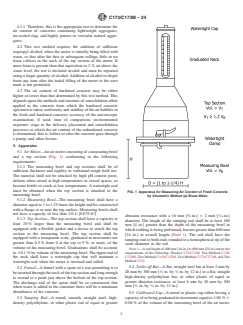
5.1 Air Meter—An air meter consisting of a measuring bowl
and a top section (Fig. 1) conforming to the following
requirements:
5.1.1 The measuring bowl and top sections shall be of
sufficient thickness and rigidity to withstand rough field use.
The material shall not be attacked by high pH cement paste,
deform when stored at high temperatures in closed spaces, or
become brittle or crack at low temperatures. A watertight seal
must be obtained when the top section is attached to the
FIG. 1 Apparatus for Measuring Air Content of Fresh Concrete
measuring bowl. by Volumetric Method (a) Brass Meter
5.1.2 Measuring Bowl—The measuring bowl shall have a
diameter equal to 1 to 1.25 times the height and be constructed
with a flange at or near the top surface. Measuring bowls shall
not have a capacity of less than 2.0 L [0.075 ft ]. 5 1
abrasion resistance with a 16 mm [ ⁄8 in.] 6 2 mm [ ⁄16 in.]
5.1.3 Top Section—The top section shall have a capacity at
diameter. The length of the tamping rod shall be at least 100
least 20 % larger than the measuring bowl and shall be
mm [4 in.] greater than the depth of the measuring bowl in
equipped with a flexible gasket and a device to attach the top
which rodding is being performed, but not greater than 600 mm
section to the measuring bowl. The top section shall be
[24 in.] in overall length (Note 1). The rod shall have the
equipped with a transparent scale, graduated in increments not
tamping end or both ends rounded to a hemispherical tip of the
greater than 0.5 % from 0 at the top to 9 %, or more, of the
same diameter as the rod.
volume of the measuring bowl. Graduations shall be accurate
NOTE 1—A rod length of 400 mm [16 in.] to 600 mm [24 in.] meets the
to 60.1 % by volume of the measuring bowl. The upper end of
requirements of the following: Practice C31/C31M, Test Method C138/
C138M, Test Method C143/C143M, Test Method C173/C173M, and Test
the neck shall have a watertight cap that will maintain a
Method C231.
watertight seal when the meter is inverted and rolled.
5.4 Strike-off Bar—A flat, straight steel bar at least 3 mm by
5.2 Funnel—A funnel with a spout of a size permitting it to
1 3
20 mm by 300 mm [ ⁄8 in. by ⁄4 in. by 12 in.] or a flat, straight
be inserted through the neck of the top section and long enough
high-density polyethylene bar, or other plastic of equal or
to extend to a point just above the bottom of the top section.
greater abrasion resistance, at least 6 mm by 20 mm by 300
The discharge end of the spout shall be so constructed that
1 3
mm [ ⁄4 in. by ⁄4 in. by 12 in.].
when water is added to the container there will be a minimum
disturbance of the concrete.
5.5 Calibrated Cup—A metal or plastic cup either having a
5.3 Tamping Rod—A round, smooth, straight steel, high- capacity of or being graduated in increments equal to 1.00 % 6
density polyethylene, or other plastic rod of equal or greater 0.04 % of the volume of the measuring bowl of the air meter.
C173/C173M − 24
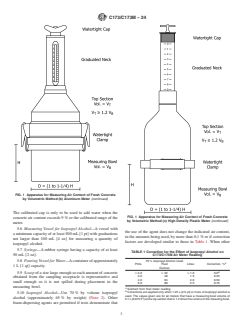
FIG. 1 Apparatus for Measuring Air Content of Fresh Concrete
by Volumetric Method (b) Aluminum Meter (continued)
The calibrated cup is only to be used to add water when the
FIG. 1 Apparatus for Measuring Air Content of Fresh Concrete
concrete air content exceeds 9 % or the calibrated range of the
by Volumetric Method (c) High Density Plastic Meter (continued)
meter.
5.6 Measuring Vessel for Isopropyl Alcohol—A vessel with
the use of the agent does not change the indicated air content,
a minimum capacity of at least 500 mL [1 pt] with graduations
in the amounts being used, by more than 0.1 % or if correction
not larger than 100 mL [4 oz] for measuring a quantity of
factors are developed similar to those in Table 1. When other
isopropyl alcohol.
5.7 Syringe—A rubber syringe having a capacity of at least
TABLE 1 Correction for the Effect of Isopropyl Alcohol on
50 mL [2 oz].
C173/C173M Air Meter Reading
70 % Isopropyl Alcohol Used
5.8 Pouring Vessel for Water—A container of approximately
A
Pints Fluid Litres Correction, %
1 L [1 qt] capacity.
Ounces
B
5.9 Scoop of a size large enough so each amount of concrete
# 2.0 # 32 # 1.0 0.0
3.0 48 1.5 0.25
obtained from the sampling receptacle is representative and
4.0 64 2.0 0.50
small enough so it is not spilled during placement in the
5.0 80 2.5 0.75
measuring bowl.
A
Subtract from final meter reading.
B
Corrections are applied only when 1.25 L [2.5 pt] or more of isopropyl alcohol is
5.10 Isopropyl Alcohol—Use 70 % by volume isopropyl
used. The values given are for air meters that have a measuring bowl volume of
alcohol (approximately 65 % by weight) (Note 2). Other 3
2.1 L [0.075 ft ] and a top section that is 1.2 times the volume of the meauring bowl.
foam-dispersing agents are permitted if tests demonstrate that
C173/C173M − 24
dispersing agents are used, a copy of the records documenting 8.1.3 Filling, Rodding, and Tapping—Using the scoop de-
the testing or calculations shall be available in the laboratory. scribed in 5.9, fill the measuring bowl with freshly mixed
concrete in two layers of approximately equal volume. While
NOTE 2—Seventy percent isopropyl alcohol is commonly available as
placing the concrete in the measuring bowl, move the scoop
rubbing alcohol. More concentrated grades can be diluted with water to
around the perimeter of the measuring bowl opening to ensure
the required concentration.
an even distribution of the concrete with minimal segregation.
5.11 Mallet—A mallet (with a rubber or rawhide head) with
Rod each layer 25 times uniformly over the cross section with
a mass of approximately 600 g 6 200 g [1.25 lb 6 0.5 lb].
the rounded end of the rod. Rod the bottom layer throughout its
6. Calibration depth. In rodding this layer, use care not to damage the bottom
of the measuring bowl. For the upper layer, allow the rod to
6.1 Calibrate the meter and calibrated cup initially and
penetrate through the layer being rodded and into the layer
annually or whenever there is reason to suspect damage or
below approximately 25 mm [1 in.]. After each layer is rodded,
deformation of the meter or calibrated cup.
tap the sides of the measuring bowl 10 to 15 times with the
6.2 Determine the volume of the measuring bowl with an
mallet to close any voids left by the tamping rod and to release
accuracy of at least 0.1 % by determining the mass of water
any large bubbles of air that may have been trapped. After
required to fill it at room temperature and dividing it by the
tapping the final layer, a slight excess of concrete, 3 mm [ ⁄8
density of the water at the same temperature. Follow the
in.] or less, above the rim is acceptable. Add or remove a
calibration procedure outlined in Test Method C29/C29M.
representative sample of concrete if necessary to obtain the
6.3 Determine the accuracy of the graduations on the neck required amount of concrete.
of the top section of the air meter by filling the assembled
8.2 Striking Off—After rodding and tapping of the second
measuring bowl and top section with water to the level of the
layer, strike off the excess concrete with the strike-off bar until
mark for highest air content graduation.
the surface is flush with the top of the measuring bowl. Wipe
6.3.1 Add water in increments of 1.0 % of the volume of the
the flange of the measuring bowl clean.
measuring bow
...
This document is not an ASTM standard and is intended only to provide the user of an ASTM standard an indication of what changes have been made to the previous version. Because
it may not be technically possible to adequately depict all changes accurately, ASTM recommends that users consult prior editions as appropriate. In all cases only the current version
of the standard as published by ASTM is to be considered the official document.
Designation: C173/C173M − 23 C173/C173M − 24
Standard Test Method for
Air Content of Freshly Mixed Concrete by the Volumetric
Method
This standard is issued under the fixed designation C173/C173M; the number immediately following the designation indicates the year
of original adoption or, in the case of revision, the year of last revision. A number in parentheses indicates the year of last reapproval.
A superscript epsilon (´) indicates an editorial change since the last revision or reapproval.
This standard has been approved for use by agencies of the U.S. Department of Defense.
1. Scope*
1.1 This test method covers determination of the air content of freshly mixed concrete containing any type of aggregate, whether
it be dense, cellular, or lightweight.
1.2 The values stated in either SI units or inch-pound units are to be regarded separately as standard. The inch-pound units are
shown in brackets. The values stated in each system may not be exact equivalents; therefore, each system shall be used
independently of the other. Combining values from the two systems may result in non-conformance with the standard.
1.3 The text of this standard references notes and footnotes that provide explanatory information. These notes and footnotes
(excluding those in tables and figures) shall not be considered as requirements of this standard.
1.4 This standard does not purport to address all of the safety concerns, if any, associated with its use. It is the responsibility
of the user of this standard to establish appropriate safety, health, and environmental practices and determine the applicability of
regulatory limitations prior to use. (Warning—Fresh hydraulic cementitious mixtures are caustic and may cause chemical burns
to skin and tissue upon prolonged exposure. )
1.5 This international standard was developed in accordance with internationally recognized principles on standardization
established in the Decision on Principles for the Development of International Standards, Guides and Recommendations issued
by the World Trade Organization Technical Barriers to Trade (TBT) Committee.
2. Referenced Documents
2.1 ASTM Standards:
C29/C29M Test Method for Bulk Density (“Unit Weight”) and Voids in Aggregate
C31/C31M Practice for Making and Curing Concrete Test Specimens in the Field
C125 Terminology Relating to Concrete and Concrete Aggregates
C138/C138M Test Method for Density (Unit Weight), Yield, and Air Content (Gravimetric) of Concrete
C143/C143M Test Method for Slump of Hydraulic-Cement Concrete
C172 Practice for Sampling Freshly Mixed Concrete
C173/C173M Test Method for Air Content of Freshly Mixed Concrete by the Volumetric Method
This test method is under the jurisdiction of ASTM Committee C09 on Concrete and Concrete Aggregates and is the direct responsibility of Subcommittee C09.60 on
Testing Fresh Concrete.
Current edition approved Sept. 1, 2023Jan. 1, 2024. Published October 2023Ferbruary 2024. Originally approved in 1942. Last previous edition approved in 20162023
as C173/C173M – 16. DOI: 10.1520/C0173_C0173M-23.23. DOI: 10.1520/C0173_C0173M-24.
Section on Safety Precautions, Manual of Aggregate and Concrete Testing, Annual Book of ASTM Standards, Vol 04.02.
For referenced ASTM standards, visit the ASTM website, www.astm.org, or contact ASTM Customer Service at service@astm.org. For Annual Book of ASTM Standards
volume information, refer to the standard’s Document Summary page on the ASTM website.
*A Summary of Changes section appears at the end of this standard
Copyright © ASTM International, 100 Barr Harbor Drive, PO Box C700, West Conshohocken, PA 19428-2959. United States
C173/C173M − 24
C231 Test Method for Air Content of Freshly Mixed Concrete by the Pressure Method
C670 Practice for Preparing Precision and Bias Statements for Test Methods for Construction Materials
C1064/C1064M Test Method for Temperature of Freshly Mixed Hydraulic-Cement Concrete
C1758/C1758M Practice for Fabricating Test Specimens with Self-Consolidating Concrete
3. Terminology
3.1 For definitions of the terms used in this test method, refer to Terminology C125.
4. Significance and Use
4.1 This test method covers the determination of the air content of freshly mixed concrete. It measures the air contained in the
mortar fraction of the concrete, but is not affected by air that may be present inside porous aggregate particles.
4.1.1 Therefore, this is the appropriate test to determine the air content of concretes containing lightweight aggregates, air-cooled
slag, and highly porous or vesicular natural aggregates.
4.2 This test method requires the addition of sufficient isopropyl alcohol, when the meter is initially being filled with water, so
that after the first or subsequent rollings little or no foam collects in the neck of the top section of the meter. If more foam is present
than that equivalent to 2 % air above the water level, the test is declared invalid and must be repeated using a larger quantity of
alcohol. Addition of alcohol to dispel foam any time after the initial filling of the meter to the zero mark is not permitted.
4.3 The air content of hardened concrete may be either higher or lower than that determined by this test method. This depends
upon the methods and amounts of consolidation effort applied to the concrete from which the hardened concrete specimen is taken;
uniformity and stability of the air bubbles in the fresh and hardened concrete; accuracy of the microscopic examination, if used;
time of comparison; environmental exposure; stage in the delivery, placement and consolidation processes at which the air content
of the unhardened concrete is determined, that is, before or after the concrete goes through a pump; and other factors.
5. Apparatus
5.1 Air Meter—An air meter consisting of a measuring bowl and a top section (Fig. 1) conforming to the following requirements:
5.1.1 The measuring bowl and top sections shall be of sufficient thickness and rigidity to withstand rough field use. The material
shall not be attacked by high pH cement paste, deform when stored at high temperatures in closed spaces, or become brittle or crack
at low temperatures. A watertight seal must be obtained when the top section is attached to the measuring bowl.
5.1.2 Measuring Bowl—The measuring bowl shall have a diameter equal to 1 to 1.25 times the height and be constructed with a
flange at or near the top surface. Measuring bowls shall not have a capacity of less than 2.0 L [0.075 ft ].
5.1.3 Top Section—The top section shall have a capacity at least 20 % larger than the measuring bowl and shall be equipped with
a flexible gasket and a device to attach the top section to the measuring bowl. The top section shall be equipped with a transparent
scale, graduated in increments not greater than 0.5 % from 0 at the top to 9 %, or more, of the volume of the measuring bowl.
Graduations shall be accurate to 60.1 % by volume of the measuring bowl. The upper end of the neck shall have a watertight cap
that will maintain a watertight seal when the meter is inverted and rolled.
5.2 Funnel—A funnel with a spout of a size permitting it to be inserted through the neck of the top section and long enough to
extend to a point just above the bottom of the top section. The discharge end of the spout shall be so constructed that when water
is added to the container there will be a minimum disturbance of the concrete.
5.3 Tamping Rod—A round, smooth, straight steel, high-density polyethylene, or other plastic rod of equal or greater abrasion
5 1
resistance with a 16 mm [ ⁄8 in.] 6 2 mm [ ⁄16 in.] diameter. The length of the tamping rod shall be at least 100 mm [4 in.] greater
than the depth of the measuring bowl in which rodding is being performed, but not greater than 600 mm [24 in.] in overall length
(Note 1). The rod shall have the tamping end or both ends rounded to a hemispherical tip of the same diameter as the rod.
NOTE 1—A rod length of 400 mm [16 in.] to 600 mm [24 in.] meets the requirements of the following: Practice C31/C31M, Test Method C138/C138M,
Test Method C143/C143M, Test Method C173/C173M, and Test Method C231.
C173/C173M − 24
FIG. 1 Apparatus for Measuring Air Content of Fresh Concrete by Volumetric Method (a) Brass Meter
1 3
5.4 Strike-off Bar—A flat, straight steel bar at least 3 mm by 20 mm by 300 mm [ ⁄8 in. by ⁄4 in. by 12 in.] or a flat, straight
high-density polyethylene bar, or other plastic of equal or greater abrasion resistance, at least 6 mm by 20 mm by 300 mm [ ⁄4 in. by
⁄4 in. by 12 in.].
5.5 Calibrated Cup—A metal or plastic cup either having a capacity of or being graduated in increments equal to 1.00 % 6 0.04 %
of the volume of the measuring bowl of the air meter. The calibrated cup is only to be used to add water when the concrete air
content exceeds 9 % or the calibrated range of the meter.
5.6 Measuring Vessel for Isopropyl Alcohol—A vessel with a minimum capacity of at least 500 mL [1 pt] with graduations not
larger than 100 mL [4 oz] for measuring a quantity of isopropyl alcohol.
5.7 Syringe—A rubber syringe having a capacity of at least 50 mL [2 oz].
5.8 Pouring Vessel for Water—A container of approximately 1 L [1 qt] capacity.
5.9 Scoop of a size large enough so each amount of concrete obtained from the sampling receptacle is representative and small
enough so it is not spilled during placement in the measuring bowl.
C173/C173M − 24
FIG. 1 Apparatus for Measuring Air Content of Fresh Concrete by Volumetric Method (b) Aluminum Meter (continued)
5.10 Isopropyl Alcohol—Use 70 % by volume isopropyl alcohol (approximately 65 % by weight) (Note 2). Other foam-dispersing
agents are permitted if tests demonstrate that the use of the agent does not change the indicated air content, in the amounts being
used, by more than 0.1 % or if correction factors are developed similar to those in Table 1. When other dispersing agents are used,
a copy of the records documenting the testing or calculations shall be available in the laboratory.
NOTE 2—Seventy percent isopropyl alcohol is commonly available as rubbing alcohol. More concentrated grades can be diluted with water to the required
concentration.
5.11 Mallet—A mallet (with a rubber or rawhide head) with a mass of approximately 600 g 6 200 g [1.25 lb 6 0.5 lb].
6. Calibration
6.1 Calibrate the meter and calibrated cup initially and annually or whenever there is reason to suspect damage or deformation
of the meter or calibrated cup.
6.2 Determine the volume of the measuring bowl with an accuracy of at least 0.1 % by determining the mass of water required
to fill it at room temperature and dividing it by the density of the water at the same temperature. Follow the calibration procedure
outlined in Test Method C29/C29M.
C173/C173M − 24
FIG. 1 Apparatus for Measuring Air Content of Fresh Concrete by Volumetric Method (c) High Density Plastic Meter (continued)
TABLE 1 Correction for the Effect of Isopropyl Alcohol on
C173/C173M Air Meter Reading
70 % Isopropyl Alcohol Used
A
Pints Fluid Litres Correction, %
Ounces
B
# 2.0 # 32 # 1.0 0.0
3.0 48 1.5 0.25
4.0 64 2.0 0.50
5.0 80 2.5 0.75
A
Subtract from final meter reading.
B
Corrections are applied only when 1.25 L [2.5 pt] or more of isopropyl alcohol is
used. The values given are for air meters that have a measuring bowl volume of
2.1 L [0.075 ft ] and a top section that is 1.2 times the volume of the meauring bowl.
6.3 Determine the accuracy of the graduations on the neck of the top section of the air meter by filling the assembled measuring
bowl and top section with water to the level of the mark for highest air content graduation.
C173/C173M − 24
6.3.1 Add water in increments of 1.0 % of the volume of the measuring bowl to check accuracy throughout the graduated range
of air content. The error at any point throughout the graduated range shall not exceed 0.1 % of air.
6.4 Determine the volume of the calibrated cup using water at 21.1°C [70°F] by the method outlined in 6.2. A quick check can
be made by adding one or more calibrated cups of water to the assembled apparatus and observing the increase in the height of
the water column after filling to a given level.
7. Sampling
7.1 Obtain the sample of freshly mixed concrete in accordance with Practice C172. If the concrete contains coarse aggregate
particles that would be retained on a 37.5 mm [1 ⁄2 in.] sieve, wet sieve a representative sample over a 25 mm [1 in.] sieve to yield
somewhat more than enough material to fill the measuring bowl. The wet sieving procedure is described in Practice C172.
7.2 The concrete used to fill the measuring bowl shall not have been previously used in the performance of any other test or
practice, other than wet sieving in accordance with Practice C172 or the temperature test in accordance with Test Method
C1064/C1064M.
8. Procedure
8.1 Rodding and Tapping—Preparation and Filling of Measuring Bowl and Consolidation of Concrete: Dampen the interior of
the measuring bowl and remove any standing water from the bottom. Using the scoop described in 5.9, fill the measuring bowl
with freshly mixed concrete in two layers of approximately equal volume. While placing the concrete in the measuring bowl, move
the scoop around the perimeter of the measuring bowl opening to ensure an even distribution of the concrete with minimal
segregation. Rod each layer 25 times uniformly over the cross section with the rounded end of the rod. Rod the bottom layer
throughout its depth. In rodding this layer, use care not to damage the bottom of the measuring bowl. For
...