

ASTM D5638-18
(Test Method)Standard Test Method for Chemical Resistance of Electrical Insulating Varnishes
General Information
- Abstract
SIGNIFICANCE AND USE
5.1 This test method is useful for the evaluation of insulating varnish performance in chemical exposure.
SCOPE
1.1 This test method covers the mechanical performance of insulating varnishes after exposure to various chemicals.
1.2 The values stated in SI units are to be regarded as standard. No other units of measurement are included in this standard.
1.3 This standard does not purport to address all of the safety concerns, if any, associated with its use. It is the responsibility of the user of this standard to establish appropriate safety, health, and environmental practices and determine the applicability of regulatory limitations prior to use. See 7.1.
Note 1: There is no IEC/ISO equivalent.
1.4 This international standard was developed in accordance with internationally recognized principles on standardization established in the Decision on Principles for the Development of International Standards, Guides and Recommendations issued by the World Trade Organization Technical Barriers to Trade (TBT) Committee.
- Status
- Published
- Publication Date
- 31-Oct-2018
- Technical Committee
- D09 - Electrical and Electronic Insulating Materials
- Drafting Committee
- D09.01 - Electrical Insulating Products
Buy Documents
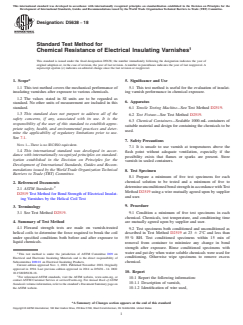


ASTM D5638-18 - Standard Test Method for Chemical Resistance of Electrical Insulating Varnishes
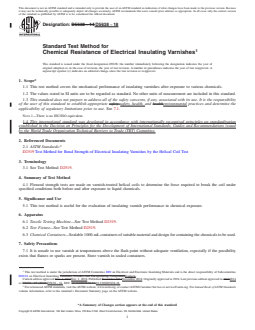


REDLINE ASTM D5638-18 - Standard Test Method for Chemical Resistance of Electrical Insulating Varnishes
Overview
ASTM D5638-18: Standard Test Method for Chemical Resistance of Electrical Insulating Varnishes establishes a widely recognized approach for evaluating the mechanical performance of electrical insulating varnishes after exposure to various chemicals. Published by ASTM International, this standard is a crucial reference for manufacturers, laboratories, and industry professionals seeking to ensure the durability and reliability of insulating varnishes used in electrical equipment. The primary outcome of this test method is the determination of retained bond strength on varnish-treated helical coils before and after chemical exposure.
Key Topics
- Chemical Resistance Testing: Outlines procedures to measure how insulating varnishes withstand exposure to a range of chemicals, helping users assess product suitability in challenging environments.
- Bond Strength Evaluation: Specifies using varnish-treated helical wire coils to determine the mechanical bond integrity, providing direct insight into material performance.
- Test Conditions: Uses agreed-upon chemicals, temperatures, and durations between suppliers and users, reflecting real-world applications.
- Specimen Preparation: Requires a minimum number of test samples for accurate comparison, and references ASTM D2519 for specimen handling and testing details.
- Result Reporting: Instructs reporting comprehensive details, including varnish and wire descriptions, exposure parameters, and calculations for retained bond strength expressed as a percentage.
Applications
ASTM D5638-18 is widely applied wherever electrical insulating varnishes are used, particularly in environments where chemical exposure is possible. Key applications include:
- Electrical Equipment Manufacturing: Ensures varnishes used for motors, generators, transformers, and coils meet chemical resistance standards, reducing the risk of equipment failure.
- Quality Control and Material Selection: Provides manufacturers and end-users with a consistent method for evaluating and comparing varnish products, enabling informed material choice in product design.
- Research and Product Development: Facilitates the development of new insulating varnishes by setting a reliable test method for chemical resistance performance.
- Regulatory Compliance: Helps organizations meet industry demands for product durability and safety by adhering to recognized ASTM methods.
Related Standards
ASTM D5638-18 references and aligns closely with the following standards:
- ASTM D2519: Test Method for Bond Strength of Electrical Insulating Varnishes by the Helical Coil Test - fundamental for specimen preparation and bond strength assessment.
- No IEC/ISO Equivalent: As noted, there is currently no directly equivalent international standard, highlighting ASTM D5638-18’s importance to international users.
Practical Value
Using ASTM D5638-18 assures stakeholders that insulating varnish products can reliably perform even after exposure to potentially degrading chemicals. This standard:
- Supports rigorous quality assurance protocols in industries dependent on electrical insulation
- Enhances product safety and longevity, minimizing the risk of electrical failures due to chemical degradation
- Provides an objective, repeatable method for testing and reporting chemical resistance
ASTM D5638-18 stands as the industry benchmark for evaluating the chemical resistance of electrical insulating varnishes, supporting durable and reliable electrical systems worldwide. For optimal results, always follow the standard’s safety, health, and environmental practices during testing.
Relations
- Replaces
ASTM D5638-14 - Standard Test Method for Chemical Resistance of Electrical Insulating Varnishes - Effective Date
- 01-Nov-2018
- Effective Date
- 01-Nov-2019
- Effective Date
- 01-Mar-2019
- Effective Date
- 01-Nov-2018
- Effective Date
- 01-Apr-2012
- Effective Date
- 01-May-2007
- Effective Date
- 10-Sep-2002
- Effective Date
- 10-Sep-2001
- Effective Date
- 10-Sep-2001
- Effective Date
- 01-Nov-2018
Buy Documents
ASTM D5638-18 - Standard Test Method for Chemical Resistance of Electrical Insulating Varnishes
REDLINE ASTM D5638-18 - Standard Test Method for Chemical Resistance of Electrical Insulating Varnishes
Get Certified
Connect with accredited certification bodies for this standard

IMQ S.p.A. (Certification)
Italian electrical product certification.

SLG Prüf- und Zertifizierungs GmbH
German testing and certification body.

UL Solutions
Global safety science company with testing, inspection and certification.
Sponsored listings
Frequently Asked Questions
ASTM D5638-18 is a standard published by ASTM International. Its full title is "Standard Test Method for Chemical Resistance of Electrical Insulating Varnishes". This standard covers: SIGNIFICANCE AND USE 5.1 This test method is useful for the evaluation of insulating varnish performance in chemical exposure. SCOPE 1.1 This test method covers the mechanical performance of insulating varnishes after exposure to various chemicals. 1.2 The values stated in SI units are to be regarded as standard. No other units of measurement are included in this standard. 1.3 This standard does not purport to address all of the safety concerns, if any, associated with its use. It is the responsibility of the user of this standard to establish appropriate safety, health, and environmental practices and determine the applicability of regulatory limitations prior to use. See 7.1. Note 1: There is no IEC/ISO equivalent. 1.4 This international standard was developed in accordance with internationally recognized principles on standardization established in the Decision on Principles for the Development of International Standards, Guides and Recommendations issued by the World Trade Organization Technical Barriers to Trade (TBT) Committee.
SIGNIFICANCE AND USE 5.1 This test method is useful for the evaluation of insulating varnish performance in chemical exposure. SCOPE 1.1 This test method covers the mechanical performance of insulating varnishes after exposure to various chemicals. 1.2 The values stated in SI units are to be regarded as standard. No other units of measurement are included in this standard. 1.3 This standard does not purport to address all of the safety concerns, if any, associated with its use. It is the responsibility of the user of this standard to establish appropriate safety, health, and environmental practices and determine the applicability of regulatory limitations prior to use. See 7.1. Note 1: There is no IEC/ISO equivalent. 1.4 This international standard was developed in accordance with internationally recognized principles on standardization established in the Decision on Principles for the Development of International Standards, Guides and Recommendations issued by the World Trade Organization Technical Barriers to Trade (TBT) Committee.
ASTM D5638-18 is classified under the following ICS (International Classification for Standards) categories: 29.035.60 - Varnished fabrics. The ICS classification helps identify the subject area and facilitates finding related standards.
ASTM D5638-18 has the following relationships with other standards: It is inter standard links to ASTM D5638-14, ASTM D2519-19a, ASTM D2519-19, ASTM D2519-18, ASTM D2519-07(2012), ASTM D2519-07, ASTM D2519-02, ASTM D2519-96, ASTM D2519-01, ASTM D3955-20. Understanding these relationships helps ensure you are using the most current and applicable version of the standard.
ASTM D5638-18 is available in PDF format for immediate download after purchase. The document can be added to your cart and obtained through the secure checkout process. Digital delivery ensures instant access to the complete standard document.
Standards Content (Sample)
This international standard was developed in accordance with internationally recognized principles on standardization established in the Decision on Principles for the
Development of International Standards, Guides and Recommendations issued by the World Trade Organization Technical Barriers to Trade (TBT) Committee.
Designation: D5638 − 18
Standard Test Method for
Chemical Resistance of Electrical Insulating Varnishes
This standard is issued under the fixed designation D5638; the number immediately following the designation indicates the year of
original adoption or, in the case of revision, the year of last revision. A number in parentheses indicates the year of last reapproval. A
superscript epsilon (´) indicates an editorial change since the last revision or reapproval.
1. Scope* 5. Significance and Use
1.1 This test method covers the mechanical performance of 5.1 This test method is useful for the evaluation of insulat-
insulating varnishes after exposure to various chemicals. ing varnish performance in chemical exposure.
1.2 The values stated in SI units are to be regarded as
6. Apparatus
standard. No other units of measurement are included in this
standard.
6.1 Tensile Testing Machine—See Test Method D2519.
1.3 This standard does not purport to address all of the
6.2 Test Fixture—See Test Method D2519.
safety concerns, if any, associated with its use. It is the
6.3 Chemical Containers—Sealable 1000-mL containers of
responsibility of the user of this standard to establish appro-
suitable material and design for containing the chemicals to be
priate safety, health, and environmental practices and deter-
used.
mine the applicability of regulatory limitations prior to use.
See 7.1.
7. Safety Precautions
NOTE 1—There is no IEC/ISO equivalent.
7.1 It is unsafe to use varnish at temperatures above the
1.4 This international standard was developed in accor-
flash point without adequate ventilation, especially if the
dance with internationally recognized principles on standard-
possibility exists that flames or sparks are present. Store
ization established in the Decision on Principles for the
varnish in sealed containers.
Development of International Standards, Guides and Recom-
mendations issued by the World Trade Organization Technical
8. Test Specimen
Barriers to Trade (TBT) Committee.
8.1 Prepare a minimum of five test specimens for each
chemical solution to be tested and a minimum of five to
2. Referenced Documents
determineunconditionedbondstrengthinaccordancewithTest
2.1 ASTM Standards:
Method D2519 using a wire mutually agreed upon by supplier
D2519 Test Method for Bond Strength of Electrical Insulat-
and user.
ing Varnishes by the Helical Coil Test
9. Procedure
3. Terminology
9.1 Condition a minimum of five test specimens in each
3.1 See Test Method D2519.
chemical. Chemicals, test temperature, and conditioning time
4. Summary of Test Method
are mutually agreed upon by supplier and user.
4.1 Flexural strength tests are made on varnish-treated
9.2 Test specimens both conditioned and unconditioned as
helical coils to determine the force required to break the coil
described in Test Method D2519 at 23 6 2°C and less than
under specified conditions both before and after exposure to
55 % RH. Test conditioned specimens within 15 min of
liquid chemicals.
removal from container to minimize any change in bond
strength after exposure. Rinse conditioned specimens with
water and pat dry when water soluble chemicals were used for
This test method is under the jurisdiction of ASTM Committee D09 on
conditioning. Otherwise wipe specimens to remove excess
Electric
...
This document is not an ASTM standard and is intended only to provide the user of an ASTM standard an indication of what changes have been made to the previous version. Because
it may not be technically possible to adequately depict all changes accurately, ASTM recommends that users consult prior editions as appropriate. In all cases only the current version
of the standard as published by ASTM is to be considered the official document.
Designation: D5638 − 14 D5638 − 18
Standard Test Method for
Chemical Resistance of Electrical Insulating Varnishes
This standard is issued under the fixed designation D5638; the number immediately following the designation indicates the year of
original adoption or, in the case of revision, the year of last revision. A number in parentheses indicates the year of last reapproval. A
superscript epsilon (´) indicates an editorial change since the last revision or reapproval.
1. Scope*
1.1 This test method covers the mechanical performance of insulating varnishes after exposure to various chemicals.
1.2 The values stated in SI units are to be regarded as standard. No other units of measurement are included in this standard.
1.3 This standard does not purport to address all of the safety concerns, if any, associated with its use. It is the responsibility
of the user of this standard to establish appropriate safety safety, health, and healthenvironmental practices and determine the
applicability of regulatory limitations prior to use. See 7.1.
NOTE 1—There is no IEC/ISO equivalent.
1.4 This international standard was developed in accordance with internationally recognized principles on standardization
established in the Decision on Principles for the Development of International Standards, Guides and Recommendations issued
by the World Trade Organization Technical Barriers to Trade (TBT) Committee.
2. Referenced Documents
2.1 ASTM Standards:
D2519 Test Method for Bond Strength of Electrical Insulating Varnishes by the Helical Coil Test
3. Terminology
3.1 See Test Method D2519.
4. Summary of Test Method
4.1 Flexural strength tests are made on varnish-treated helical coils to determine the force required to break the coil under
specified conditions both before and after exposure to liquid chemicals.
5. Significance and Use
5.1 This test method is useful for the evaluation of insulating varnish performance in chemical exposure.
6. Apparatus
6.1 Tensile Testing Machine—See Test Method D2519.
6.2 Test Fixture—See Test Method D2519.
6.3 Chemical Containers—Sealable 1000-mL containers of suitable material and design for containing the chemicals to be used.
7. Safety Precautions
7.1 It is unsafe to use varnish at temperatures above the flash point without adequate ventilation, especially if the possibility
exists that flames or sparks are present. Store varnish in sealed containers.
This test method is under the jurisdiction of ASTM Committee D09 on Electrical and Electronic Insulating Materials and is the direct responsibility of Subcommittee
D09.01 on Electrical Insulating Varnishes, Powders and Encapsulating CompoundsProducts.
Current edition approved Nov. 1, 2014Nov. 1, 2018. Published November 2014November 2018. Originally approved in 1994. Last previous edition approved in 20102014
as D5638 – 05 (2010).D5638 – 14. DOI: 10.1520/D5638-14.10.1520/D5638-18.
For referenced ASTM standards, visit the ASTM website, www.astm.org, or contact ASTM Customer Service at service@astm.org. For Annual Book of ASTM Standards
volume information, refer to the standard’s Document Summary page on the ASTM website.
*A Summary of Changes section appears at the end of this standard
Copyright © ASTM International, 100 Barr Harbor Drive, PO Box C700, West Conshohocken, PA 19428-2959. United States
----------------------
...