

ASTM E3187/E3187M-19
(Specification)Standard Specification for Less Lethal Aerosol Devices Used by Law Enforcement, Corrections, and Other Public Safety Officers
General Information
- Abstract
SCOPE
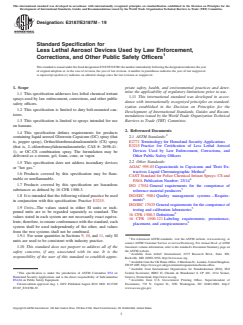
1.1 This specification addresses less lethal chemical irritant sprays used by law enforcement, corrections, and other public safety officers.
1.2 This specification is limited to duty belt-mounted canisters.
1.3 This specification is limited to sprays intended for use on humans.
1.4 This specification defines requirements for products containing liquid aerosol Oleoresin Capsicum (OC) spray (that is, pepper spray), Orthochlorobenzalmalononitrile (CS) spray (that is, 2–chlorobenzylidenemalononitrile; CAS #: 2698-41-1), or OC-CS combination spray. The formulation may be delivered as a stream, gel, foam, cone, or vapor.
1.5 This specification does not address incendiary devices or “hot gas.”
1.6 Products covered by this specification may be flammable or nonflammable.
1.7 Products covered by this specification are hazardous substances as defined by 16 CFR 1500.3.
1.8 It is intended that the following related practice be used in conjunction with this specification: Practice E3215.
1.9 Units—The values stated in either SI units or inch-pound units are to be regarded separately as standard. The values stated in each system are not necessarily exact equivalents; therefore, to ensure conformance with the standard, each system shall be used independently of the other, and values from the two systems shall not be combined.
1.9.1 For some quantities in Sections 9, 10, and 11, only SI units are used to be consistent with industry practice.
1.10 This standard does not purport to address all of the safety concerns, if any, associated with its use. It is the responsibility of the user of this standard to establish appropriate safety, health, and environmental practices and determine the applicability of regulatory limitations prior to use.
1.11 This international standard was developed in accordance with internationally recognized principles on standardization established in the Decision on Principles for the Development of International Standards, Guides and Recommendations issued by the World Trade Organization Technical Barriers to Trade (TBT) Committee.
- Status
- Published
- Publication Date
- 31-Jul-2019
- Technical Committee
- E54 - Homeland Security Applications
- Drafting Committee
- E54.04 - Public Safety Equipment
Overview
ASTM E3187/E3187M-19 is the Standard Specification for Less Lethal Aerosol Devices Used by Law Enforcement, Corrections, and Other Public Safety Officers. Published by ASTM International, this standard establishes the requirements and test methods for chemical irritant sprays-such as pepper (OC), CS, or OC-CS combination sprays-deployed in public safety operations. The specification is focused on duty belt-mounted canisters designed for use on humans, ensuring performance, safety, and quality of less lethal aerosol products for law enforcement, corrections, and other public safety professionals.
Key Topics
ASTM E3187/E3187M-19 covers several important areas that are essential for the procurement, deployment, and assessment of less lethal aerosol devices:
- Product Scope: Applies only to chemical irritant aerosol sprays (OC, CS, OC-CS) intended for use on humans, specifically in duty belt-mounted canisters.
- Formulation Types: Encompasses devices delivering chemical irritants as a stream, gel, foam, cone, or vapor.
- Performance Requirements: Includes stringent criteria for discharge reliability, resistance to crushing and dropping, leakage, operation at temperature extremes, and spray flammability (especially in the presence of electroshock weapons).
- Chemical and Toxicological Standards: Defines allowed and prohibited ingredient categories according to established toxicological classifications and requires full disclosure of active and inactive ingredients for certification.
- Testing and Certification: Outlines in-house and third-party laboratory requirements, including batch testing, documentation, and sample retention protocols.
- Labeling and Documentation: Specifies detailed labeling for individual products and packaging-including safety warnings, batch identification, usage instructions, and compliance with jurisdictional labeling laws.
Applications
This specification is widely used in several practical contexts where less lethal aerosol devices are deployed by:
- Law Enforcement Agencies: To ensure that pepper sprays and similar agents comply with recognized performance and safety benchmarks before field use.
- Correctional Institutions: For selecting and certifying chemical irritant sprays used in population management and crisis intervention.
- Public Safety Organizations: Including special response teams and campus security, to standardize their equipment and procurement processes.
- Testing Laboratories: For conducting required product validation, batch testing, and compliance reporting.
- Procurement Officers: Who are tasked with evaluating prospective products for certification to ASTM E3187/E3187M-19 requirements.
By adhering to this standard, organizations can enhance accountability, mitigate risk, and ensure the consistent performance and safety of less lethal aerosol devices. Additionally, ASTM E3187/E3187M-19 aids in meeting national and international regulatory obligations, facilitating transparency and quality assurance in procurement and deployment.
Related Standards
ASTM E3187/E3187M-19 references and complements several notable standards and regulations in the field of chemical irritant and public safety equipment:
- ASTM E3215 – Practice for Certification of Less Lethal Aerosol Devices Used by Law Enforcement, Corrections, and Other Public Safety Officers
- AOAC 995.03 – Capsaicinoids in Capsicums and Their Extractives Liquid Chromatographic Method
- CAST Standard for Police Chemical Irritant Sprays
- ISO 17025 – General requirements for the competence of testing and calibration laboratories
- ISO 17034 – Competence of reference material producers
- ISO/IEC 9001 – Quality management systems
- ANSI Z400.1 – Hazard Evaluation and Safety Data Sheet Preparation
- 16 CFR 1500.3 and 1500.121 – US Federal regulations on hazardous substances and labeling
Adopting ASTM E3187/E3187M-19 ensures compatibility with these and other international guidelines, reinforcing best practices in the manufacture, testing, and use of less lethal aerosol devices.
Keywords: ASTM E3187, less lethal aerosol devices, law enforcement, public safety, pepper spray, CS spray, chemical irritant, duty belt canister, OC spray, safety standard, testing and certification, product labeling, batch testing, flammability, compliance, ASTM International.
Relations
- Effective Date
- 15-Aug-2019
- Effective Date
- 15-Dec-2011
- Effective Date
- 15-Dec-2011
- Effective Date
- 15-Dec-2011
- Effective Date
- 15-Dec-2011
Get Certified
Connect with accredited certification bodies for this standard

CIS Institut d.o.o.
Personal Protective Equipment (PPE) certification body. Notified Body NB-2890 for EU Regulation 2016/425 PPE.

Kiwa BDA Testing
Building and construction product certification.
Kmetijski inštitut Slovenije
Agricultural Institute of Slovenia. Soil testing, plant health, agricultural product analysis.
Sponsored listings
Frequently Asked Questions
ASTM E3187/E3187M-19 is a technical specification published by ASTM International. Its full title is "Standard Specification for Less Lethal Aerosol Devices Used by Law Enforcement, Corrections, and Other Public Safety Officers". This standard covers: SCOPE 1.1 This specification addresses less lethal chemical irritant sprays used by law enforcement, corrections, and other public safety officers. 1.2 This specification is limited to duty belt-mounted canisters. 1.3 This specification is limited to sprays intended for use on humans. 1.4 This specification defines requirements for products containing liquid aerosol Oleoresin Capsicum (OC) spray (that is, pepper spray), Orthochlorobenzalmalononitrile (CS) spray (that is, 2–chlorobenzylidenemalononitrile; CAS #: 2698-41-1), or OC-CS combination spray. The formulation may be delivered as a stream, gel, foam, cone, or vapor. 1.5 This specification does not address incendiary devices or “hot gas.” 1.6 Products covered by this specification may be flammable or nonflammable. 1.7 Products covered by this specification are hazardous substances as defined by 16 CFR 1500.3. 1.8 It is intended that the following related practice be used in conjunction with this specification: Practice E3215. 1.9 Units—The values stated in either SI units or inch-pound units are to be regarded separately as standard. The values stated in each system are not necessarily exact equivalents; therefore, to ensure conformance with the standard, each system shall be used independently of the other, and values from the two systems shall not be combined. 1.9.1 For some quantities in Sections 9, 10, and 11, only SI units are used to be consistent with industry practice. 1.10 This standard does not purport to address all of the safety concerns, if any, associated with its use. It is the responsibility of the user of this standard to establish appropriate safety, health, and environmental practices and determine the applicability of regulatory limitations prior to use. 1.11 This international standard was developed in accordance with internationally recognized principles on standardization established in the Decision on Principles for the Development of International Standards, Guides and Recommendations issued by the World Trade Organization Technical Barriers to Trade (TBT) Committee.
SCOPE 1.1 This specification addresses less lethal chemical irritant sprays used by law enforcement, corrections, and other public safety officers. 1.2 This specification is limited to duty belt-mounted canisters. 1.3 This specification is limited to sprays intended for use on humans. 1.4 This specification defines requirements for products containing liquid aerosol Oleoresin Capsicum (OC) spray (that is, pepper spray), Orthochlorobenzalmalononitrile (CS) spray (that is, 2–chlorobenzylidenemalononitrile; CAS #: 2698-41-1), or OC-CS combination spray. The formulation may be delivered as a stream, gel, foam, cone, or vapor. 1.5 This specification does not address incendiary devices or “hot gas.” 1.6 Products covered by this specification may be flammable or nonflammable. 1.7 Products covered by this specification are hazardous substances as defined by 16 CFR 1500.3. 1.8 It is intended that the following related practice be used in conjunction with this specification: Practice E3215. 1.9 Units—The values stated in either SI units or inch-pound units are to be regarded separately as standard. The values stated in each system are not necessarily exact equivalents; therefore, to ensure conformance with the standard, each system shall be used independently of the other, and values from the two systems shall not be combined. 1.9.1 For some quantities in Sections 9, 10, and 11, only SI units are used to be consistent with industry practice. 1.10 This standard does not purport to address all of the safety concerns, if any, associated with its use. It is the responsibility of the user of this standard to establish appropriate safety, health, and environmental practices and determine the applicability of regulatory limitations prior to use. 1.11 This international standard was developed in accordance with internationally recognized principles on standardization established in the Decision on Principles for the Development of International Standards, Guides and Recommendations issued by the World Trade Organization Technical Barriers to Trade (TBT) Committee.
ASTM E3187/E3187M-19 is classified under the following ICS (International Classification for Standards) categories: 13.310 - Protection against crime. The ICS classification helps identify the subject area and facilitates finding related standards.
ASTM E3187/E3187M-19 has the following relationships with other standards: It is inter standard links to ASTM E3215-19, ASTM E2771-11e3, ASTM E2771-11, ASTM E2771-11e1, ASTM E2771-11e2. Understanding these relationships helps ensure you are using the most current and applicable version of the standard.
ASTM E3187/E3187M-19 is available in PDF format for immediate download after purchase. The document can be added to your cart and obtained through the secure checkout process. Digital delivery ensures instant access to the complete standard document.
Standards Content (Sample)
This international standard was developed in accordance with internationally recognized principles on standardization established in the Decision on Principles for the
Development of International Standards, Guides and Recommendations issued by the World Trade Organization Technical Barriers to Trade (TBT) Committee.
Designation:E3187/E3187M −19
Standard Specification for
Less Lethal Aerosol Devices Used by Law Enforcement,
Corrections, and Other Public Safety Officers
ThisstandardisissuedunderthefixeddesignationE3187/E3187M;thenumberimmediatelyfollowingthedesignationindicatestheyear
of original adoption or, in the case of revision, the year of last revision. A number in parentheses indicates the year of last reapproval.
A superscript epsilon (´) indicates an editorial change since the last revision or reapproval.
1. Scope priate safety, health, and environmental practices and deter-
mine the applicability of regulatory limitations prior to use.
1.1 This specification addresses less lethal chemical irritant
1.11 This international standard was developed in accor-
sprays used by law enforcement, corrections, and other public
dance with internationally recognized principles on standard-
safety officers.
ization established in the Decision on Principles for the
1.2 This specification is limited to duty belt-mounted can-
Development of International Standards, Guides and Recom-
isters.
mendations issued by the World Trade Organization Technical
Barriers to Trade (TBT) Committee.
1.3 This specification is limited to sprays intended for use
on humans.
2. Referenced Documents
1.4 This specification defines requirements for products
2.1 ASTM Standards:
containing liquid aerosol Oleoresin Capsicum (OC) spray (that
E2771 Terminology for Homeland Security Applications
is, pepper spray), Orthochlorobenzalmalononitrile (CS) spray
E3215 Practice for Certification of Less Lethal Aerosol
(that is, 2–chlorobenzylidenemalononitrile; CAS #: 2698-41-
Devices Used by Law Enforcement, Corrections, and
1), or OC-CS combination spray. The formulation may be
Other Public Safety Officers
delivered as a stream, gel, foam, cone, or vapor.
2.2 Other Standards:
1.5 This specification does not address incendiary devices
AOAC 995.03 Capsaicinoids in Capsicums and Their Ex-
or “hot gas.”
tractives Liquid Chromatographic Method
1.6 Products covered by this specification may be flam-
CAST Standard for Police Chemical Irritant Sprays: CS and
mable or nonflammable.
PAVA Publication Number: 23/14
1.7 Products covered by this specification are hazardous
ISO 17034 General requirements for the competence of
substances as defined by 16 CFR 1500.3.
reference material producers
ISO/IEC 9001 Quality management systems – Require-
1.8 It is intended that the following related practice be used
ments
in conjunction with this specification: Practice E3215.
ISO/IEC 17025 General requirements for the competence of
1.9 Units—The values stated in either SI units or inch-
testing and calibration laboratories
pound units are to be regarded separately as standard. The
16 CFR 1500.3 Definitions
values stated in each system are not necessarily exact equiva-
16 CFR 1500.121 Labeling requirements; prominence,
lents; therefore, to ensure conformance with the standard, each
placement, and conspicuousness
system shall be used independently of the other, and values
from the two systems shall not be combined.
1.9.1 For some quantities in Sections 9, 10, and 11, only SI
For referenced ASTM standards, visit the ASTM website, www.astm.org, or
units are used to be consistent with industry practice.
contact ASTM Customer Service at service@astm.org. For Annual Book of ASTM
Standards volume information, refer to the standard’s Document Summary page on
1.10 This standard does not purport to address all of the
the ASTM website.
safety concerns, if any, associated with its use. It is the
Available from AOAC International, 2275 Research Blvd., Suite 300,
responsibility of the user of this standard to establish appro-
Rockville, MD 20850-3250, http://www.aoac.org.
AvailablefromtheUKHomeOffice,2MarshamSt.,London,UnitedKingdom,
SW1P 4DF, https://www.gov.uk/government/organisations/home-office.
Available from International Organization for Standardization (ISO), ISO
This specification is under the jurisdiction of ASTM Committee E54 on Central Secretariat, BIBC II, Chemin de Blandonnet 8, CP 401, 1214 Vernier,
Homeland Security Applications and is the direct responsibility of Subcommittee Geneva, Switzerland, http://www.iso.org.
E54.04 on Public Safety Equipment. Available from U.S. Government Printing Office, Superintendent of
Current edition approved Aug. 1, 2019. Published August 2019. DOI: 10.1520/ Documents, 732 N. Capitol St., NW, Washington, DC 20401-0001, http://
E3187_E3187M-19. www.access.gpo.gov.
Copyright © ASTM International, 100 Barr Harbor Drive, PO Box C700, West Conshohocken, PA 19428-2959. United States
E3187/E3187M−19
29 CFR 1910.1200 Occupational Safety and Health Stan- organizations, and others assessing the performance of less
dards – Toxic and Hazardous Substances lethal aerosol devices.
ANSI Z400.1 American National Standard for Hazardous
4.3 The specification may be used by purchasers in their
Workplace Chemicals – Hazard Evaluation and Safety
evaluation of products to meet their needs and requirements.
Data Sheet and Precautionary Labeling Preparation
4.3.1 It is recommended that agencies or end users purchase
lesslethalaerosoldevicescertifiedtothisspecificationandthat
3. Terminology
the following requirements be included in purchase specifica-
3.1 Definitions of Terms Specific to This Standard:
tions:
3.1.1 batch, n—the formulation for a specific active ingre-
“The product shall be certified to meet the requirements of
dient percentage and delivery system.
ASTM Specification E3187/E3187M.”
3.1.1.1 Discussion—An example of a batch is 1.33 % cap-
5. Design Requirements
saicinoid stream.
5.1 The supplier shall declare whether the product is non-
3.1.2 controlled ambient, n—conditions with temperature of
flammable or flammable in its aerosol form.
20 °C 6 5.5 °C [68 °F 6 10 °F] and 50 % 6 20 % relative
humidity (RH). E2771
5.2 The carcinogenicity and toxicity of the product shall be
3.1.3 hazardous substance, n—any substance or mixture of verified as follows: in accordance with the Global Harmonized
substances which is toxic, corrosive, an irritant, a strong System of Classification and Labelling of Chemicals (GHS),
sensitizer, flammable or combustible, or generates pressure Part 3, Health Hazards, ingredients are “allowed” or “not
through decomposition, heat, or other means, if such substance allowed” in the product as shown in Table 1. Ingredients
or mixture of substances may cause substantial personal injury categorized as “not allowed” shall not be present in the
or substantial illness during or as a proximate result of any product.
customaryorreasonablyforeseeablehandlingoruse,including 5.2.1 The supplier of less lethal aerosol devices containing
reasonably foreseeable ingestion by children. 16 CFR 1500.3 irritants or inflammatory agents, such as OC, CS, or OC-CS,
shall disclose to the certification body all ingredients contained
3.1.4 model, n—the supplier’s design, with unique specifi-
within the formulation, including the propellant.
cations and characteristics, of a particular item. E2771
5.2.1.1 These disclosures shall be for any ingredient
3.1.4.1 Discussion—An example of a model is MK2 of a
formulation, regardless of the percentage, specifically if it is
particular formula and spray pattern.
intentionally added by the product supplier or raw material
3.1.5 supplier, n—the entity that directs and controls the
supplier. This includes additives and marking agents, such as
following: conformant product design, conformant product
UV dyes, colorants, fluorescents, emulsifiers, stabilizers, or
manufacturing, conformant product quality assurance; or the
carriers.
entity that assumes the liability for the conformant product or
5.2.1.2 Suppliers are not required to report de minimis
provides the warranty for the conformant product. E2771
ingredients, remnants, or chemical analogs that are present in
3.1.6 test item, n—a single article intended for testing.
the form of impurities related to the primary ingredients
E2771
contained within the formulations.
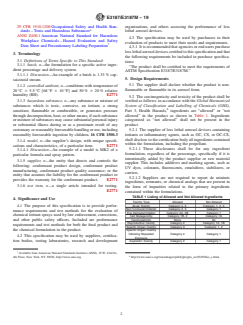
TABLE 1 Listing of Allowed and Not Allowed Ingredients
4. Significance and Use
Toxicity Type Allowed Not Allowed
Acute Toxicity Category 4, 5 Category 1, 2, 3
4.1 The purpose of this specification is to provide perfor-
Skin Corrosion/Irritation Category 2, 3 Category 1
mance requirements and test methods for the evaluation of
Eye Damage/Irritation Category 2A, 2B Category 1
chemical irritant sprays used by law enforcement, corrections,
Cell Mutagenicity Category 1B, 2 Category 1A
Carcinogenicity None All
and other public safety officers. Included are performance
Reproductive Toxicity Category 2 Category 1A, 1B
requirements and test methods for both the final product and
Specific Organ Toxicity Category 3 Category 1, 2
the chemical formulation in the product.
Specific Organ Toxicity
following Repeated Category 2 Category 1
4.2 This specification may be used by suppliers, certifica-
Exposure
tion bodies, testing laboratories, research and development
Aspiration Toxicity Category 2 Category 1
Available fromAmerican National Standards Institute (ANSI), 25 W. 43rd St.,
4th Floor, New York, NY 10036, http://www.ansi.org. http://www.unece.org/trans/danger/publi/ghs/ghs_rev03/03files_e.html.
E3187/E3187M−19
6. Performance Requirements The supplier shall specify the temperature. The test item shall
be removed from the conditioning chamber and assessed as
6.1 This section identifies product performance require-
specifiedinSection7ofthisspecification.Thetemperatureand
ments to be assessed during testing.
spray pattern shall be reported.
6.1.1 Some requirements are for test items, and some
(1) The test item shall subsequently be assessed as speci-
requirements are for batches, as indicated below.
fied in 6.2.2 of this specification to determine whether generic
6.2 Requirements for Test Items:
requirements are met, and the results shall be reported.
6.2.1 A different set of three test items for a model is
6.2.6.3 Thesuppliershallstatethehighandlowtemperature
required for each test listed in this section.
extremes as the operating range in the product documentation.
6.2.2 The generic requirements below shall be met by all
6.2.7 For products declared to be nonflammable, each of
test items following relevant test procedures within this sec-
three test items shall be tested for spray flammability in
tion. The test item shall:
accordance with Section 5.9 of CAST Standard for Police
6.2.2.1 Discharge when the actuator is activated (for
Chemical Irritant Sprays: CS and PAVA, and there shall be no
example, button depressed).
flame extension towards the test item, and the flame shall not
6.2.2.2 Stop discharging when the actuator is de-activated
be self-sustaining.
(for example, button released).
6.2.7.1 The test item shall subsequently be assessed as
6.2.2.3 Not discharge as a result of any action other than
specified in 6.2.2 of this specification to determine whether
intended discharge.
generic requirements are met, and the results shall be reported.
6.2.2.4 Not be damaged so that the device cannot physically
6.2.8 For products declared to be nonflammable, each of
be discharged without remedial action (for example, actuator
three test items shall be tested for flammability related to
falls off or significant damage to the cap).
electroshock weapons (ESWs) in accordance with Section 8 of
6.2.2.5 Not leak.
thisspecification,andthetestitemsshallbedemonstratedtobe
6.2.3 Prior to beginning each test below, the test items shall
nonflammable.
be conditioned at controlled ambient for at least 60 minutes.
6.2.4 To assess the container’s resistance to crushing, each
6.2.8.1 The test item shall subsequently be assessed as
of three test items shall be tested in accordance with Section specified in 6.2.2 of this specification to determine whether
5.3 of Cast Standard for Police Chemical Irritant Sprays: CS
generic requirements are met, and the results shall be reported.
and PAVA.
6.3 Requirements for Batches of OC Spray:
6.2.4.1 The spray pattern shall subsequently be assessed as
6.3.1 The chemical concentration of the active ingredients
specified in Section 7 of this specification, and the spray
in OC spray shall be assessed as specified in Section 9 of this
pattern shall be reported.
specification.
6.2.4.2 The test item shall subsequently be assessed as
6.3.1.1 Each batch of OC spray shall be tested by the
specified in 6.2.2 of this specification to determine whether
supplier, either in-house or by an independent test laboratory.
generic requirements are met, and the results shall be reported.
The supplier shall maintain test reports for every batch at least
6.2.5 To assess the container’s resistance to damage from
12 months beyond the expiration date of the batch.
dropping, each of three test items shall be tested in accordance
(1) The test laboratory shall either (1) be accredited to
with Section 5.5 of CAST Standard for Police Chemical
ISO/IEC 17025, or (2) have a documented program in place
Irritant Sprays: CS and PAVA,withthefollowingmodification:
that meets the requirements outlined in Practice E3215 (see
the surface upon which the canister is dropped may be a steel
Appendix X1: Audit Checklist in E3215).
plate or a concrete floor.
(2) At a minimum of four times per year (quarterly), a split
6.2.5.1 The spray pattern shall subsequently be assessed as
OC spray batch sample collected for testing by the supplier’s
specified in Section 7 of this specification, and the spray
designated laboratory (either in-house or third-party) shall be
pattern shall be reported.
sent to an ISO/IEC 17025 accredited laboratory to verify
6.2.5.2 The test item shall subsequently be assessed as
intralaboratory data quality and accuracy. This testing shall be
specified in 6.2.2 of this specification to determine whether
conductedinadditiontoanytestingspecifiedinPracticeE3215
generic requirements are met, and the results shall be reported.
for certification or surveillance testing. This requirement is
6.2.6 To assess operation in extreme temperatures, the
only applicable if the supplier is not using a laboratory
following steps shall be taken on two of three test items.
accredited to ISO/IEC 17025 to comply with 6.3.1.1(1).
6.2.6.1 The first test item shall be placed into a conditioning
chamber held at high temperature for 24 h 6 15 min. The 6.3.1.2 Theresultsforeachbatchshallberecordedandshall
supplier shall specify the temperature. The test item shall be meet the requirements below.
removed from the conditioning chamber and assessed as (1) The percentage of capsaicin in raw materials shall be at
specifiedinSection7ofthisspecification.Thetemperatureand least 55 % by weight.
spray pattern shall be reported. (2) The percentage of major capsaicinoids, by weight, in
(1) The test item shall subsequently be assessed as speci- the final formulation shall be declared by the supplier and shall
fied in 6.2.2 of this specification to determine whether generic be no more than 1.45 %. The measured percentage of major
requirements are met, and the results shall be reported. capsaicinoids shall be within 65 % of that declared value.
6.2.6.2 The second test item shall be placed into a condi- (3) The major capsaicinoids, by weight, in the final formu-
tioning chamber held at low temperature for 24 h 6 15 min. lation shall be no more than 1.50 %.
E3187/E3187M−19
6.3.1.3 The supplier shall make available test reports for that meets the requirements outlined in Practice E3215 (see
skin and eye testing, plus inhalation testing when applicable, at Appendix X1: Audit Checklist in E3215).
the supplier’s declared value for percentage of major capsaici- (2) At a minimum of four times per year (quarterly), a split
noids in the final formulation (1) to the certification body in OC-CS blended spray batch sample collected for testing by the
order to be certified and (2) to purchasers upon request. supplier’sdesignatedlaboratory(eitherin-houseorthird-party)
shall be sent to an ISO/IEC 17025 accredited laboratory to
NOTE 1—For a specific formulation tested at the upper limit of major
verify intralaboratory data quality and accuracy. This testing
capsaicinoids, that test report (skin and eye testing, plus inhalation testing
shall be conducted in addition to any testing specified in
when applicable) is allowed for the same formulation with a reduced level
of major capsaicinoids. Practice E3215 for certification or surveillance testing. This
requirement is only applicable if the supplier is not using a
6.4 Requirements for Batches of CS Spray:
laboratory accredited to ISO/IEC 17025 to comply with
6.4.1 The chemical concentration of the active ingredients
6.5.1.1(1).
in CS spray shall be assessed as specified in Section 10 of this
6.5.1.2 Theresultsforeachbatchshallbereportedandshall
specification.
meet the requirements below.
6.4.1.1 Each batch of CS spray shall be tested by the
(1) The percentage of capsaicin in raw materials shall be at
supplier, either in-house or by an independent test laboratory.
least 55 % by weight.
The supplier shall maintain test reports for every batch at least
(2) The percentage of major capsaicinoids, by weight, in
12 months beyond the expiration date of the batch.
the final formulation shall be declared by the supplier and
(1) The test laboratory shall either (1) be accredited to
should be no more than 0.33 %. The measured percentage of
ISO/IEC 17025, or (2) have a documented program in place
major capsaicinoids shall be within 65 % of that declared
that meets the requirements outlined in Practice E3215 (see
value.
Appendix X1: Audit Checklist in E3215).
(3) The mass fraction of CS by weight in the final formu-
(2) At a minimum of four times per year (quarterly), a split
lation should not be greater than 2 %.
CS spray batch sample collected for testing by the supplier’s
6.5.1.3 The supplier shall make available test reports for
designated laboratory (either in-house or third-party) shall be
skin and eye testing, plus inhalation testing when applicable, at
sent to an ISO/IEC 17025 accredited laboratory to verify
the supplier’s declared value for percentage of major capsaici-
intralaboratory data quality and accuracy. This testing shall be
noids and percent CS in the final formulation (1)tothe
conductedinadditiontoanytestingspecifiedinPracticeE3215
certification body in order to be certified and (2) to purchasers
for certification or surveillance testing. This requirement is
upon request.
only applicable if the supplier is not using a laboratory
accredited to ISO/IEC 17025 to comply with 6.4.1.1(1).
NOTE 4—For a specific formulation tested at the supper limit of major
capsaicinoids and higher level of CS, that test report (skin and eye testing,
6.4.1.2 Theresultsforeachbatchshallberecordedandshall
plus inhalation testing when applicable) is allowed for the same formu-
meet the requirements below.
lation with a reduced level of major capsaicinoids, CS, or both.
(1) TherecommendedmassfractionofCSbyweightinthe
6.6 Requirements for Chemical Formulations:
final formulation should be in the range of 1 % to 5 %.
6.6.1 Theproductchemicalformulationshallbeassessedon
NOTE2—Thisrecommendationisbasedonproductsknowntobeinuse
each of three test items according to 6.3, 6.4,or 6.5 of this
by public safety.
specification (as appropriate), except that the testing shall be
6.4.1.3 The supplier shall make available test reports for
performed on test items (not batche
...