

ASTM D8259/D8259M-21
(Test Method)Standard Test Method for Rotary Wheel Testing (RWT) of Compacted Asphalt Mixtures
General Information
- Abstract
SIGNIFICANCE AND USE
4.1 The test method is developed for determining the rutting and moisture susceptibility of asphalt mixtures. The rutting and moisture damage resistance can help differentiate mixtures whose service life might be compromised by permanent deformation or by moisture damage. The test method is valid for specimens that are tested at temperatures of 60 ± 0.5 °C [140 ± 0.9 °F]. Test specimen geometry is a diameter of 150 mm [5.9 in.] and a height of 115 ± 5 mm [4.5 ± 0.2 in.]. Specimens are prepared using a Superpave gyratory compactor.
Note 9: The quality of the results produced by this standard are dependent on the competence of the personnel performing the procedure and the capability, calibration, and maintenance of the equipment used. Agencies that meet the criteria of Specification D3666 are generally considered capable of competent and objective testing, sampling, inspection, etc. Users of this standard are cautioned that compliance with Specification D3666 alone does not completely ensure reliable results. Reliable results depend on many factors; following the suggestions of Specification D3666 or some similar acceptable guideline provides a means of evaluating and controlling some of those factors.
SCOPE
1.1 This test method describes a procedure for testing the rutting and moisture susceptibility of asphalt specimens using the Rotary Wheel Tester (RWT). Superpave Gyratory Compactor (SGC) specimens (Test Method D6925) are wrapped, conditioned, submerged in water, and confined between three metal wheels in continuous synchronized rotation with each wheel applying a fixed load around the periphery of the specimen. The system records the number of load cycles applied to the specimen, the deformation of the specimen (rut depth), the loading rate, the temperature of the water, and Sigma, which is an indication of specimen roundness.
1.2 The test method is used to determine the premature rutting susceptibility of asphalt mixtures by measuring rut depth as a function of number of load cycles throughout the test.
1.3 This test method also measures the potential for moisture damage effects because the specimens are submerged in temperature-controlled water during preconditioning and for the duration of the test.
1.4 The parameters of the test are shown in Table 1. See an example of the test parameters used in Appendix X1.
Note 1: This test uses a typical specimen produced by a Superpave gyratory compactor.
Note 2: The ruggedness study identified air void content as the most influential factor evaluated and recommended a tolerance of ±0.25 % to minimize the effect of air void content on the test results. The precision study evaluated three asphalt mixtures with specimen air void contents ranging from 2.87 % to 3.23 %, from 4.28 % to 4.64 %, and from 5.77 % to 6.19 %. Precision statements covering the air void content ranges of 2.75 % to 4.75 % and 5.75 % to 6.25 % can be found in Section 10. Lemke and Bahia (2019) found that an asphalt mixture with 7 % air void content was more susceptible to rutting than a mixture with 3 % air void content and that the test results for the 7 % AV mixture did not differentiate between control factors such as test temperature and mixture source like the mixture with 3 % air void content did.
Note 3: The University of Wisconsin at Madison Modified Asphalt Research Center (2017) reported that the City of LA selected the test temperature of 60 °C [140 °F] because “(1) it approximates the observed high average temperature of most pavements, (2) it is close to the high temperature performance grade classification of the asphalt binder used in most local applications, (3) it allows a test to be performed in an accelerated time frame (about 2 h excluding preconditioning time), and (4) research on rut testing has shown [that] the asphalt binder seems to have the most control over the test results at lower test temperatures.” The ruggedness study was comple...
- Status
- Published
- Publication Date
- 31-Jul-2021
- Technical Committee
- D04 - Road and Paving Materials
- Drafting Committee
- D04.20 - Mechanical Tests of Asphalt Mixtures
Overview
ASTM D8259/D8259M-21, "Standard Test Method for Rotary Wheel Testing (RWT) of Compacted Asphalt Mixtures," defines a widely recognized laboratory method to evaluate the rutting and moisture susceptibility of asphalt mixtures. Issued by ASTM International, this standard is critical for pavement engineers and road material laboratories seeking to predict the field performance of asphalt pavements under loaded and moisture-exposed conditions.
The procedure uses the Rotary Wheel Tester (RWT) to simulate mechanical loading and water exposure on cylindrical asphalt specimens created with a Superpave gyratory compactor. Key measurements include rut depth development and changes in specimen roundness, which are essential for assessing the potential for permanent deformation (rutting) and moisture-induced damage.
Key Topics
- Rutting Susceptibility: Quantifies the potential of asphalt mixtures to permanently deform under repeated loading at elevated temperatures.
- Moisture Damage Resistance: Evaluates mixtures for vulnerability to performance loss when saturated and subjected to load, simulating water damage scenarios.
- Testing Conditions:
- Temperature: 60 ± 0.5 °C (140 ± 0.9 °F)
- Specimen size: 150 mm diameter x 115 ± 5 mm height
- Air void content: Targeted within ±0.25%, typically between 3% and 6%
- Preparation in accordance with Superpave Gyratory Compactor (SGC) method
- Performance Metrics:
- Rut Depth: Tracked as rutting develops over up to 6900 load cycles or until a rut depth of 6 mm is reached
- Creep Slope (CS) and Stripping Slope (SS): Segments of the rut curve indicating mixture resistance before and after moisture effects dominate
- Sigma: A measure of sample roundness, ensuring test validity
Applications
- Asphalt Mixture Design: Allows engineers to compare different aggregate blends, binder types, and additives for optimal rut resistance and moisture tolerance.
- Quality Control & Assurance: Used by materials laboratories and transportation agencies to ensure supplied asphalt mixtures meet performance requirements before field application.
- Performance Prediction: Provides crucial data for modeling pavement life and for selecting materials suitable to local climate and traffic load conditions.
- Research and Development: Supports studies involving recycled asphalt, new binder technologies, or performance-grade innovations in paving materials.
The method is particularly relevant for agencies and contractors working in regions with high pavement temperatures or frequent moisture exposure, where rutting and stripping can cause severe pavement distress.
Related Standards
To ensure accuracy and reliability in testing and reporting, ASTM D8259/D8259M-21 references several key standards, including:
- ASTM D6925: Preparation and determination of Superpave Gyratory Compacted specimens
- ASTM D2041/D2041M: Theoretical maximum specific gravity and density of asphalt mixtures
- ASTM D3203/D3203M: Percent air voids determination in compacted mixtures
- ASTM D3666: Minimum requirements for agencies testing road and paving materials
- ASTM D6752/D6752M and D6857/D6857M: Bulk specific gravity and density using automatic sealing methods
- ASTM D8: Asphalt mixture-related terminology
Using these supporting standards in tandem helps ensure precision, repeatability, and comparability of results across labs and projects.
Keywords: Rotary Wheel Testing, ASTM D8259, rutting susceptibility, moisture damage, asphalt mixtures, Superpave, laboratory testing, pavement performance, road material standards, quality control.
Relations
- Effective Date
- 01-Jan-2024
- Effective Date
- 01-Dec-2023
- Effective Date
- 01-Nov-2023
- Effective Date
- 01-Nov-2023
- Effective Date
- 01-Aug-2019
- Effective Date
- 01-Jun-2019
- Effective Date
- 15-Dec-2018
- Effective Date
- 15-Aug-2018
- Effective Date
- 15-Aug-2018
- Effective Date
- 15-Aug-2018
- Effective Date
- 01-Jul-2018
- Effective Date
- 01-Feb-2018
- Effective Date
- 15-Jul-2017
- Effective Date
- 15-Jun-2017
- Effective Date
- 01-Jun-2017
Get Certified
Connect with accredited certification bodies for this standard

Zavod za gradbeništvo Slovenije (ZAG) - Inšpekcija
ZAG inspection body for construction products, structures, and materials.
Sponsored listings
Frequently Asked Questions
ASTM D8259/D8259M-21 is a standard published by ASTM International. Its full title is "Standard Test Method for Rotary Wheel Testing (RWT) of Compacted Asphalt Mixtures". This standard covers: SIGNIFICANCE AND USE 4.1 The test method is developed for determining the rutting and moisture susceptibility of asphalt mixtures. The rutting and moisture damage resistance can help differentiate mixtures whose service life might be compromised by permanent deformation or by moisture damage. The test method is valid for specimens that are tested at temperatures of 60 ± 0.5 °C [140 ± 0.9 °F]. Test specimen geometry is a diameter of 150 mm [5.9 in.] and a height of 115 ± 5 mm [4.5 ± 0.2 in.]. Specimens are prepared using a Superpave gyratory compactor. Note 9: The quality of the results produced by this standard are dependent on the competence of the personnel performing the procedure and the capability, calibration, and maintenance of the equipment used. Agencies that meet the criteria of Specification D3666 are generally considered capable of competent and objective testing, sampling, inspection, etc. Users of this standard are cautioned that compliance with Specification D3666 alone does not completely ensure reliable results. Reliable results depend on many factors; following the suggestions of Specification D3666 or some similar acceptable guideline provides a means of evaluating and controlling some of those factors. SCOPE 1.1 This test method describes a procedure for testing the rutting and moisture susceptibility of asphalt specimens using the Rotary Wheel Tester (RWT). Superpave Gyratory Compactor (SGC) specimens (Test Method D6925) are wrapped, conditioned, submerged in water, and confined between three metal wheels in continuous synchronized rotation with each wheel applying a fixed load around the periphery of the specimen. The system records the number of load cycles applied to the specimen, the deformation of the specimen (rut depth), the loading rate, the temperature of the water, and Sigma, which is an indication of specimen roundness. 1.2 The test method is used to determine the premature rutting susceptibility of asphalt mixtures by measuring rut depth as a function of number of load cycles throughout the test. 1.3 This test method also measures the potential for moisture damage effects because the specimens are submerged in temperature-controlled water during preconditioning and for the duration of the test. 1.4 The parameters of the test are shown in Table 1. See an example of the test parameters used in Appendix X1. Note 1: This test uses a typical specimen produced by a Superpave gyratory compactor. Note 2: The ruggedness study identified air void content as the most influential factor evaluated and recommended a tolerance of ±0.25 % to minimize the effect of air void content on the test results. The precision study evaluated three asphalt mixtures with specimen air void contents ranging from 2.87 % to 3.23 %, from 4.28 % to 4.64 %, and from 5.77 % to 6.19 %. Precision statements covering the air void content ranges of 2.75 % to 4.75 % and 5.75 % to 6.25 % can be found in Section 10. Lemke and Bahia (2019) found that an asphalt mixture with 7 % air void content was more susceptible to rutting than a mixture with 3 % air void content and that the test results for the 7 % AV mixture did not differentiate between control factors such as test temperature and mixture source like the mixture with 3 % air void content did. Note 3: The University of Wisconsin at Madison Modified Asphalt Research Center (2017) reported that the City of LA selected the test temperature of 60 °C [140 °F] because “(1) it approximates the observed high average temperature of most pavements, (2) it is close to the high temperature performance grade classification of the asphalt binder used in most local applications, (3) it allows a test to be performed in an accelerated time frame (about 2 h excluding preconditioning time), and (4) research on rut testing has shown [that] the asphalt binder seems to have the most control over the test results at lower test temperatures.” The ruggedness study was comple...
SIGNIFICANCE AND USE 4.1 The test method is developed for determining the rutting and moisture susceptibility of asphalt mixtures. The rutting and moisture damage resistance can help differentiate mixtures whose service life might be compromised by permanent deformation or by moisture damage. The test method is valid for specimens that are tested at temperatures of 60 ± 0.5 °C [140 ± 0.9 °F]. Test specimen geometry is a diameter of 150 mm [5.9 in.] and a height of 115 ± 5 mm [4.5 ± 0.2 in.]. Specimens are prepared using a Superpave gyratory compactor. Note 9: The quality of the results produced by this standard are dependent on the competence of the personnel performing the procedure and the capability, calibration, and maintenance of the equipment used. Agencies that meet the criteria of Specification D3666 are generally considered capable of competent and objective testing, sampling, inspection, etc. Users of this standard are cautioned that compliance with Specification D3666 alone does not completely ensure reliable results. Reliable results depend on many factors; following the suggestions of Specification D3666 or some similar acceptable guideline provides a means of evaluating and controlling some of those factors. SCOPE 1.1 This test method describes a procedure for testing the rutting and moisture susceptibility of asphalt specimens using the Rotary Wheel Tester (RWT). Superpave Gyratory Compactor (SGC) specimens (Test Method D6925) are wrapped, conditioned, submerged in water, and confined between three metal wheels in continuous synchronized rotation with each wheel applying a fixed load around the periphery of the specimen. The system records the number of load cycles applied to the specimen, the deformation of the specimen (rut depth), the loading rate, the temperature of the water, and Sigma, which is an indication of specimen roundness. 1.2 The test method is used to determine the premature rutting susceptibility of asphalt mixtures by measuring rut depth as a function of number of load cycles throughout the test. 1.3 This test method also measures the potential for moisture damage effects because the specimens are submerged in temperature-controlled water during preconditioning and for the duration of the test. 1.4 The parameters of the test are shown in Table 1. See an example of the test parameters used in Appendix X1. Note 1: This test uses a typical specimen produced by a Superpave gyratory compactor. Note 2: The ruggedness study identified air void content as the most influential factor evaluated and recommended a tolerance of ±0.25 % to minimize the effect of air void content on the test results. The precision study evaluated three asphalt mixtures with specimen air void contents ranging from 2.87 % to 3.23 %, from 4.28 % to 4.64 %, and from 5.77 % to 6.19 %. Precision statements covering the air void content ranges of 2.75 % to 4.75 % and 5.75 % to 6.25 % can be found in Section 10. Lemke and Bahia (2019) found that an asphalt mixture with 7 % air void content was more susceptible to rutting than a mixture with 3 % air void content and that the test results for the 7 % AV mixture did not differentiate between control factors such as test temperature and mixture source like the mixture with 3 % air void content did. Note 3: The University of Wisconsin at Madison Modified Asphalt Research Center (2017) reported that the City of LA selected the test temperature of 60 °C [140 °F] because “(1) it approximates the observed high average temperature of most pavements, (2) it is close to the high temperature performance grade classification of the asphalt binder used in most local applications, (3) it allows a test to be performed in an accelerated time frame (about 2 h excluding preconditioning time), and (4) research on rut testing has shown [that] the asphalt binder seems to have the most control over the test results at lower test temperatures.” The ruggedness study was comple...
ASTM D8259/D8259M-21 is classified under the following ICS (International Classification for Standards) categories: 93.080.20 - Road construction materials. The ICS classification helps identify the subject area and facilitates finding related standards.
ASTM D8259/D8259M-21 has the following relationships with other standards: It is inter standard links to ASTM D6027/D6027M-24, ASTM D6925-23, ASTM D6752/D6752M-23, ASTM D6857/D6857M-23, ASTM D8-19, ASTM D2041/D2041M-19, ASTM D8-18c, ASTM D6752/D6752M-18, ASTM D8-18b, ASTM D6857/D6857M-18, ASTM D8-18a, ASTM D8-18, ASTM D8-17c, ASTM D8-17b, ASTM D6752/D6752M-17. Understanding these relationships helps ensure you are using the most current and applicable version of the standard.
ASTM D8259/D8259M-21 is available in PDF format for immediate download after purchase. The document can be added to your cart and obtained through the secure checkout process. Digital delivery ensures instant access to the complete standard document.
Standards Content (Sample)
This international standard was developed in accordance with internationally recognized principles on standardization established in the Decision on Principles for the
Development of International Standards, Guides and Recommendations issued by the World Trade Organization Technical Barriers to Trade (TBT) Committee.
Designation: D8259/D8259M − 21
Standard Test Method for
Rotary Wheel Testing (RWT) of Compacted Asphalt
Mixtures
This standard is issued under the fixed designation D8259/D8259M; the number immediately following the designation indicates the
year of original adoption or, in the case of revision, the year of last revision. A number in parentheses indicates the year of last
reapproval. A superscript epsilon (´) indicates an editorial change since the last revision or reapproval.
temperature of 60 °C [140 °F] because “(1) it approximates the observed
1. Scope
high average temperature of most pavements, (2) it is close to the high
1.1 This test method describes a procedure for testing the
temperature performance grade classification of the asphalt binder used in
rutting and moisture susceptibility of asphalt specimens using most local applications, (3) it allows a test to be performed in an
acceleratedtimeframe(about2 hexcludingpreconditioningtime),and(4)
the RotaryWheelTester (RWT). Superpave Gyratory Compac-
research on rut testing has shown [that] the asphalt binder seems to have
tor (SGC) specimens (Test Method D6925) are wrapped,
the most control over the test results at lower test temperatures.” The
conditioned, submerged in water, and confined between three
ruggedness study was completed at 60 °C [140 °F] using PG 64-10 with
metal wheels in continuous synchronized rotation with each
50 % RAC asphalt mixture. The precision study was completed at 60 °C
wheel applying a fixed load around the periphery of the [140 °F] using PG 64-10 with 50 % RAC asphalt mixture for two of the
mixtures evaluated and using PG 76-22 for the third mixture considered.
specimen. The system records the number of load cycles
One may wish to consider lower test temperatures because Lemke and
applied to the specimen, the deformation of the specimen (rut
Bahia (2019) reported reducing the test temperature from 60 °C [140 °F]
depth), the loading rate, the temperature of the water, and
to 52 °C [125.6 °F] when testing PG 58S-28 and PG 58H-28 asphalt
Sigma, which is an indication of specimen roundness.
becauseofprematurefailure.Note8includesasuggestionforselectingan
alternative test temperature based on the binder if one chooses to do so.
1.2 The test method is used to determine the premature
NOTE 4—The University of Wisconsin at Madison Modified Asphalt
rutting susceptibility of asphalt mixtures by measuring rut
Research Center (2017) reported that the City of LA selected 6900 load
depth as a function of number of load cycles throughout the
cycles as the maximum load cycles because “initial observations from
tests showed that most samples tested showed their performance well
test.
beforethesevalues(6900loadcyclesand6.0mm[0.24in.])wereattained
1.3 This test method also measures the potential for mois-
... while those that exhibited low rut depth in the field and no moisture
ture damage effects because the specimens are submerged in
susceptibilityshowedtestresultcurvesthatbehavedasasymptotestotheir
initial creep slope until the maximum number of cycles (30 000 cycles) of
temperature-controlled water during preconditioning and for
the machine was attained.” 6900 load cycles was used in both the
the duration of the test.
ruggedness and precision work as well. The machine has an allowable
1.4 The parameters of the test are shown in Table 1. See an
range of 300 to 30 000 load cycles.
NOTE 5—The University of Wisconsin at Madison Modified Asphalt
example of the test parameters used in Appendix X1.
Research Center (2017) reported that the City of LA selected 6.0 mm
NOTE 1—This test uses a typical specimen produced by a Superpave
[0.24 in.] as the maximum rut depth because “initial observations from
gyratory compactor.
tests showed that most samples tested showed their performance well
NOTE 2—The ruggedness study identified air void content as the most
beforethesevalues(6900loadcyclesand6.0mm[0.24in.])wereattained
influential factor evaluated and recommended a tolerance of 60.25 % to
... while those that exhibited low rut depth in the field and no moisture
minimize the effect of air void content on the test results. The precision
susceptibilityshowedtestresultcurvesthatbehavedasasymptotestotheir
study evaluated three asphalt mixtures with specimen air void contents
initial creep slope until the maximum number of cycles (30 000 cycles) of
ranging from 2.87 % to 3.23 %, from 4.28 % to 4.64 %, and from 5.77 %
the machine was attained.” 6.0 mm [0.24 in.] was used in both the
to 6.19 %. Precision statements covering the air void content ranges of
ruggedness and precision work as well.
2.75 % to 4.75 % and 5.75 % to 6.25 % can be found in Section 10.
NOTE 6—The University of Wisconsin at Madison Modified Asphalt
Lemke and Bahia (2019) found that an asphalt mixture with 7 % air void
Research Center (2017) reported that the City of LA selected 70 CPM as
content was more susceptible to rutting than a mixture with 3 % air void
the loading rate because that is what its RWT was set at by the factory.
content and that the test results for the 7 % AV mixture did not
70 CPM was used in both the ruggedness and precision work as well. The
differentiate between control factors such as test temperature and mixture
machine has an allowable range of 60 to 90 CPM.
source like the mixture with 3 % air void content did.
NOTE 7—The University of Wisconsin at Madison Modified Asphalt
NOTE 3—The University of Wisconsin at Madison Modified Asphalt
Research Center (2017) reported that the City of LA selected an applied
Research Center (2017) reported that the City of LA selected the test
load of 334 N [75 lb] because that is what its RWT was set at by the
factory. 334 N [75 lb] was used in both the ruggedness and precision work
as well. The machine has an allowable range of 334 to 489 N [75 to
This test method is under the jurisdiction of ASTM Committee D04 on Road 110 lb] in 22-N [5-lb] increments. Applied loads of greater than 334 N
and Paving Materials and is the direct responsibility of Subcommittee D04.20 on
[75 lb] are not recommended based on experience.
Mechanical Tests of Asphalt Mixtures.
1.5 Criteria for the evaluation and interpretation of test
Current edition approved Aug. 1, 2021. Published August 2021. DOI: 10.1520/
D8259_D8259M-21. results shall be developed for local conditions and material
Copyright © ASTM International, 100 Barr Harbor Drive, PO Box C700, West Conshohocken, PA 19428-2959. United States
D8259/D8259M − 21
TABLE 1 Test Parameters
D6752/D6752M Test Method for Bulk Specific Gravity and
Test Parameter Specification Density of CompactedAsphalt Mixtures UsingAutomatic
Specimen height 115±5mm[4.5±0.2in.](Note 1)
Vacuum Sealing Method
Specimen diameter 150 mm [5.9 in.] (Note 1)
D6857/D6857M Test Method for Maximum Specific Grav-
Specimen air void content Target ± 0.25 % (3 %# Target#6%)(Note 2)
Test temperature 60 ± 0.5 °C [140 ± 0.9 °F] (Note 3) ity and Density of Asphalt Mixtures Using Automatic
Preconditioning time 120 ± 10 min
Vacuum Sealing Method
Maximum load cycles 6900 load cycles (Note 4)
D6925 Test Method for Preparation and Determination of
Maximum rut depth 6.0 mm [0.24 in.] (Note 5)
Loading rate 70±2load cycles per min (CPM) (Note 6)
the Relative Density ofAsphalt Mix Specimens by Means
Appliedload 334±5N[75±1lb](Note 7)
of the Superpave Gyratory Compactor
E4 Practices for Force Calibration and Verification of Test-
ing Machines
3. Terminology
characteristics. Appendix X1 shows an example of how test
results are used and interpreted.
3.1 Definitions—For definitions of terms used in this test
method, refer to Terminology D8.
1.6 The text of this test method references notes and
footnotes which provide explanatory material. These notes and
3.2 Definitions of Terms Specific to This Standard:
footnotes (excluding those in tables and figures) shall not be
3.2.1 applied load [N], n—the force applied by the top
considered as requirements of the test method.
wheel to the specimen.
1.7 Units—The values stated in either SI units or inch-
3.2.1.1 Discussion—This force is the combined effect of the
pound units are to be regarded separately as standard. The weight of the wheel, the load frame, and the dead weight.
values stated in each system may not be exact equivalents;
3.2.2 creep slope, CS, n—the straight line portion of the
therefore,eachsystemshallbeusedindependentlyoftheother.
curve before the SIP.
Combining values from the two systems may result in noncon-
3.2.2.1 Discussion—This portion of the curve is a measure
formance with the standard.
of rutting susceptibility not due to moisture.
1.8 This standard does not purport to address all of the
3.2.3 load cycle, n—theapplicationofloadtoaspecimenby
safety concerns, if any, associated with its use. It is the
one wheel for one rotation of the specimen.
responsibility of the user of this standard to establish appro-
3.2.3.1 Discussion—There are three wheels; therefore, each
priate safety, health, and environmental practices and deter-
rotation of a specimen generates three (3) load cycles.
mine the applicability of regulatory limitations prior to use.
3.2.4 loading rate [CPM]—the number of load cycles
1.9 This international standard was developed in accor-
applied to a specimen per minute.
dance with internationally recognized principles on standard-
3.2.4.1 Discussion—Because three (3) load cycles are ap-
ization established in the Decision on Principles for the
pliedperspecimenrevolution,aloadingrateof70CPMmeans
Development of International Standards, Guides and Recom-
the specimen is rotating 23.3 times per minute (70 CPM ÷ 3
mendations issued by the World Trade Organization Technical
load cycles per revolution).
Barriers to Trade (TBT) Committee.
3.2.5 post-compaction consolidation [mm], n—the rut depth
2. Referenced Documents
at the y-intercept of the creep slope.
3.2.5.1 Discussion—This represents densification of the
2.1 ASTM Standards:
specimen during the beginning load cycles of the test.
D8 Terminology Relating to Materials for Roads and Pave-
ments
3.2.6 rut curve, n—the plot of rut depth versus load cycle.
D1188 TestMethodforBulkSpecificGravityandDensityof
3.2.7 rut depth [mm], n—a depression into the asphalt
Compacted Bituminous Mixtures Using Coated Samples
mixture sample due to loading.
D2041/D2041M Test Method for Theoretical Maximum
3.2.7.1 Discussion—The reported rut depth is the average of
Specific Gravity and Density of Asphalt Mixtures
the rut depth measurements taken during one (1) revolution of
D2726/D2726M Test Method for Bulk Specific Gravity and
a specimen.
Density of Non-Absorptive Compacted Asphalt Mixtures
3.2.8 sigma, n—the roundness parameter of a specimen
D3203/D3203M Test Method for PercentAir Voids in Com-
calculated for each rotation of the specimen using the standard
pacted Asphalt Mixtures
deviation of the rut measurements for that rotation.
D3666 Specification for Minimum Requirements for Agen-
3.2.8.1 Discussion—A value of 0.0 represents a perfect
cies Testing and Inspecting Road and Paving Materials
cylinder. A value of 0.8 is considered to indicate a specimen
D6027/D6027M Practice for Calibrating Linear Displace-
that is severely out of round and is used as the default value for
ment Transducers for Geotechnical Purposes
stopping a test.
3.2.9 stripping inflection point, SIP, n—the intersection of
For referenced ASTM standards, visit the ASTM website, www.astm.org, or
the creep slope and the stripping slope.
contact ASTM Customer Service at service@astm.org. For Annual Book of ASTM
3.2.10 stripping slope, SS, n—the straight line portion of the
Standards volume information, refer to the standard’s Document Summary page on
the ASTM website. curve after the SIP.
D8259/D8259M − 21
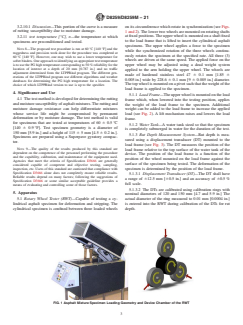
3.2.10.1 Discussion—This portion of the curve is a measure on its circumference which rotate in synchronization (see Figs.
of rutting susceptibility due to moisture damage. 1 and 2). The lower two wheels are mounted on rotating shafts
at fixed positions. The upper wheel is mounted on a shaft fixed
3.2.11 test temperature [°C], n—the temperature at which
to the load frame that is lifted to insert the cylindrical asphalt
specimens are preconditioned and tested.
specimens. The upper wheel applies a force to the specimen
NOTE 8—The proposed test procedure is run at 60 °C [140 °F] and the
while the synchronized rotation of the three wheels continu-
ruggedness and precision work done for the procedure was completed at
ously rotates the specimen at the specified rate. All three (3)
60 °C [140 °F]. However, one may wish to use a lower temperature for
wheels are driven at the same speed. The applied force on the
softerbinders.Oneapproachtoidentifyinganappropriatetesttemperature
is to use the PG high temperature corresponding to 50 % reliability for the
upper wheel may be adjusted using a dead weight system
location of interest at a depth of 20 mm [0.787 in.] and no traffic
applied to the arm holding the upper wheel. The wheels are
adjustment determined from the LTPPBind program. The different gen-
made of hardened stainless steel 47 6 0.1 mm [1.85 6
erations of the LTPPBind program use different algorithms and weather
0.005 in.] wide by 228.6 6 0.1 mm [9 6 0.005 in.] diameter.
databases for determining the PG high temperature for a location. The
Thetopwheelismountedonapivotsuchthattheweightofthe
choice of which LTPPBind version to use is up to the specifier.
load frame is applied to the specimen.
4. Significance and Use
5.1.1 Load Frame—Theupperwheelismountedontheload
4.1 Thetestmethodisdevelopedfordeterminingtherutting
frame which, when lowered into the testing position, applies
andmoisturesusceptibilityofasphaltmixtures.Theruttingand
the weight of the load frame to the specimen. Additional
moisture damage resistance can help differentiate mixtures
weight can be added to the load frame to increase the applied
whose service life might be compromised by permanent
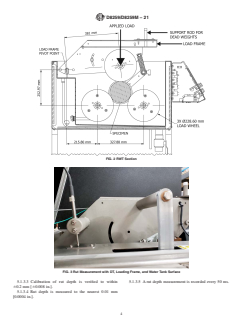
load (see Fig. 2). A lift mechanism raises and lowers the load
deformation or by moisture damage. The test method is valid
frame.
for specimens that are tested at temperatures of 60 6 0.5 °C
5.1.2 Water Tank—A water tank sized so that the specimen
[140 6 0.9 °F]. Test specimen geometry is a diameter of
is completely submerged in water for the duration of the test.
150 mm [5.9 in.] and a height of 115 6 5 mm [4.5 6 0.2 in.].
5.1.3 Rut Depth Measurement System—Rut depth is mea-
Specimens are prepared using a Superpave gyratory compac-
sured using a displacement transducer (DT) mounted to the
tor.
load frame (see Fig. 3). The DT measures the position of the
NOTE 9—The quality of the results produced by this standard are
load frame relative to the top surface of the water tank of the
dependent on the competence of the personnel performing the procedure
device. The position of the load frame is a function of the
and the capability, calibration, and maintenance of the equipment used.
position of the wheel mounted on the load frame against the
Agencies that meet the criteria of Specification D3666 are generally
surface of the specimen being tested. The deformation of the
considered capable of competent and objective testing, sampling,
inspection, etc. Users of this standard are cautioned that compliance with specimen is determined by the position of the load frame.
Specification D3666 alone does not completely ensure reliable results.
5.1.3.1 Displacement Transducer (DT)—The DT shall have
Reliable results depend on many factors; following the suggestions of
a range of 612.5 mm [60.5 in.] and an accuracy of 60.5 %
Specification D3666 or some similar acceptable guideline provides a
full scale.
means of evaluating and controlling some of those factors.
5.1.3.2 The DTs are calibrated using calibration rings with
5. Apparatus
nominal diameters of 120 and 150 mm [4.7 and 5.9 in.] The
5.1 Rotary Wheel Tester (RWT)—Capable of testing a cy- actual diameter of the ring measured to 0.01 mm [0.0004 in.]
lindrical asphalt specimen for deformation and stripping. The
is entered into the RWT during calibration of the DTs for rut
cylindrical specimen is confined between three loaded wheels depth.
FIG. 1 Asphalt Mixture Specimen Loading Geometry and Device Chamber of the RWT
D8259/D8259M − 21
FIG. 2 RWT Section
FIG. 3 Rut Measurement with DT, Loading Frame, and Water Tank Surface
5.1.3.3 Calibration of rut depth is verified to within 5.1.3.5 A rut depth measurement is recorded every 50 ms.
60.2 mm [60.008 in.].
5.1.3.4 Rut depth is measured to the nearest 0.01 mm
[0.0004 in.].
D8259/D8259M − 21
5.1.3.6 Rut depth is calculated using the average of the rut where:
depth measurements recorded during one revolution of the
Sigma = Sigma for specimen revolution i,
i
specimen, reported to 0.01 mm [0.0004 in.] for each revolution
CF = calibration factor (mm/count) (see Note 10),
(see Eq 1). n = the number of DT readings recorded in specimen
revolution i,
Rut Depth 5 Specimen Radius 2 Specimen Radius (1)
i Initial i
n
A = Σ DT (counts),
h=1 h
n 2 2
where:
B = Σ (DT ) (counts ), and
h=1 h
DT = DT readings taken every 50 ms in specimen
Rut Depth = rut depth on revolution i,
h
i
revolution i (counts).
Specimen Radius = specimen radius on revolution #4,
Initial
NOTE 11—Example for Sigma Calculation: Assume the asphalt speci-
and
men is rotating 20 times per minute.This means that one revolution of the
Specimen Radius = specimen radius on revolution i
i
specimen takes 3 s. The machine is recording a rut depth measurement
(see Eq 2).
every 50 ms, therefore the machine records 60 rut depth measurements in
n 3s.In Eq 3, n is 60, A is the sum of the 60 rut depth measurements, and
B is the sum of the square of each of the 60 rut depth measurements.
DT
( h
h51
Specimen Radius 5 CF 3 (2)
5.1.3.8 If Sigma reaches the programmed limit, the test is
i
2n
stopped.
where:
5.1.4 Specimen Rotation Counter—The actual rotation of
i = the specimen revolution number,
the specimen is measured so the system can maintain the
CF = calibration factor (mm/count) (see Note 10),
programmed loading rate in load cycles per minute to within
DT = DT readings taken every 50 ms in specimen revolu-
h 62 CPM.
tion i (counts), and
5.1.5 End Caps—Two end caps are required for each test
n = the number of DT readings recorded in specimen
(Fig. 4), one on each end of the specimen being tested.The end
revolution i.
caps fit snuggly on each end of a specimen.
NOTE 10—The manufacturer calibrates the DT on the rotary wheel
5.1.6 Temperature Control System—The specimen and
tester using rings of 120 and 150 mm [4.7 and 5.9 in.] nominal diameter.
wheels are submerged in a water tank that is of sufficient size
The DT readings are recorded in counts. The calibration process leads to
and depth to allow total immersion of the specimen and
a calibration factor in units of millimeters per count.
capable of maintaining constant bath temperature accurate to
5.1.3.7 The roundness of the specimen is monitored
within 60.5 °C [60.9 °F] of the specified test temperature for
throughout the test using the rut depth variation durin
...