

ASTM F2441-20
(Practice)Standard Practice for Labeling of Recreational Camping Tents and Bivouac Sacks
General Information
- Abstract
SIGNIFICANCE AND USE
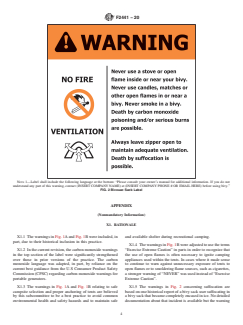
4.1 These warnings are intended as preventive measures against the most commonly reported hazards of which the subcommittee is aware.
4.2 A permanent warning label shall be affixed to all tents and to all bivouac sacks. The label shall be designed to be legible, clearly visible and unobstructed throughout the life of the tent.
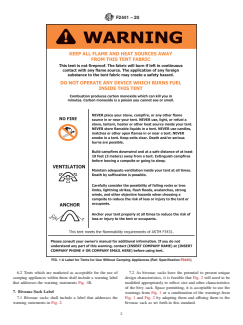
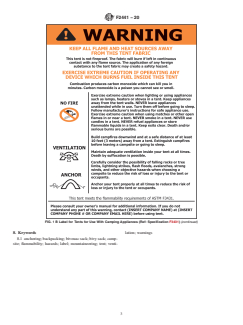
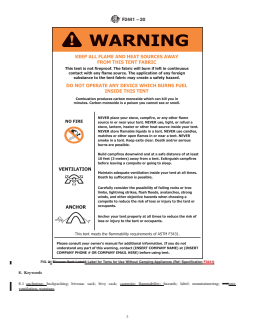
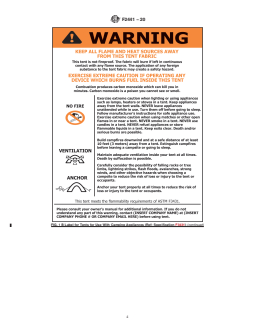
4.3 Whether the warning statements in Fig. 1A or those in Fig. 1B are to be used for a tent will depend on whether the tent is marketed as acceptable for the use of camping appliances within them and shall be determined by a review of publicly available marketing materials, images and the manufacturer’s written instructions and user manual.
FIG. 1 A Label for Tents for Use Without Camping Appliances (Ref: Specification F3431)
FIG. 1 B Label for Tents for Use With Camping Appliances (Ref: Specification F3431) (continued)
SCOPE
1.1 This practice establishes requirements for warnings and other information that shall be permanently affixed to recreational camping tents and bivouac sacks.
1.2 This international standard was developed in accordance with internationally recognized principles on standardization established in the Decision on Principles for the Development of International Standards, Guides and Recommendations issued by the World Trade Organization Technical Barriers to Trade (TBT) Committee.
- Status
- Published
- Publication Date
- 30-Nov-2020
- Technical Committee
- F08 - Sports Equipment, Playing Surfaces, and Facilities
- Drafting Committee
- F08.22 - Camping Softgoods
Buy Documents
ASTM F2441-20 - Standard Practice for Labeling of Recreational Camping Tents and Bivouac Sacks
REDLINE ASTM F2441-20 - Standard Practice for Labeling of Recreational Camping Tents and Bivouac Sacks
Overview
ASTM F2441-20: Standard Practice for Labeling of Recreational Camping Tents and Bivouac Sacks establishes clear requirements for the labeling of camping tents and bivouac sacks. Published by ASTM International, this standard is developed in alignment with globally recognized principles of standardization. The practice is focused on ensuring that essential hazard warnings and safety information are permanently and visibly affixed to portable shelters commonly used for recreational camping, backpacking, and mountaineering. By standardizing label content and placement, ASTM F2441-20 helps manufacturers and consumers promote safe use of tents and bivy sacks in outdoor environments.
Key Topics
Permanently Affixed Warning Labels
All recreational tents and bivouac sacks must have a warning label that remains legible, visible, and unobstructed for the lifespan of the product.Label Design and Placement
- Labels should adhere to the ANSI Z535.4 guidelines for safety signs and labels.
- Placement should be near an entrance or on/near a zipper in the case of bivouac sacks, ensuring optimal visibility for users.
Differentiated Warnings
- Labels differ based on whether tents are marketed for use with or without camping appliances.
- The decision is informed by manufacturer instructions and marketing materials.
Hazard Warnings Covered
- Fire hazards and flammability
- Safe use and operation of camping appliances, if applicable
- Ventilation and carbon monoxide risks
- Suffocation hazards, especially for bivy sacks
- Safe campsite selection and anchoring to prevent environmental hazards
Label Content
- Mandatory warning statements and universally recognizable graphics
- Strong language regarding not exposing tents to open flames, proper ventilation, and consulting the owner's manual for safety information
Applications
ASTM F2441-20 is essential for manufacturers of recreational camping tents and bivouac sacks aiming to comply with international best practices for product safety labeling. This standard is particularly relevant in the following areas:
Outdoor Equipment Manufacturing
Ensures products carry consistent, safety-focused warnings, reducing liability and increasing user trust.Retail and Distribution
Retailers and distributors benefit by offering compliant products that meet international safety standards.Consumer Safety
Users are better protected from risks such as fire, carbon monoxide, and suffocation due to the presence of clear, visible warnings and instructions for safe use.Regulatory Compliance
Adhering to ASTM F2441-20 helps meet regulatory requirements and supports global trade, as the standard aligns with WTO Technical Barriers to Trade principles.
Related Standards
ASTM F3431: Specification for Determining Flammability of Materials for Recreational Camping Tents and Warning Labels for Associated Hazards
- Sets flammability criteria and informs the content of hazard labels used in tents and bivy sacks.
ANSI Z535.4: Product Safety Signs and Labels
- Governs the design and formatting of product safety signage to ensure consistency and effectiveness.
CPIA-84: Specification for Flame-Resistant Materials Used in Camping Tentage
- Details flame resistance requirements for tent fabrics and complements the labeling requirements of ASTM F2441-20.
CGSB 182.1: Flammability and Labelling Requirements for Tents
- Provides additional context and harmonization for North American industry standards.
Practical Value
By implementing ASTM F2441-20, manufacturers and brands demonstrate commitment to product safety, regulatory compliance, and consumer well-being. Effective warning labels reduce the incidence of common camping hazards and ensure that customers receive vital safety information at the point of use. This practice ultimately supports safer outdoor experiences and enhances the global reputation of compliant outdoor equipment.
Keywords: camping tent labeling, bivouac sack safety, ASTM F2441-20, outdoor product standards, hazard warning labels, tent flammability, backpacking equipment compliance, tent safety standards
Buy Documents
ASTM F2441-20 - Standard Practice for Labeling of Recreational Camping Tents and Bivouac Sacks
REDLINE ASTM F2441-20 - Standard Practice for Labeling of Recreational Camping Tents and Bivouac Sacks
Frequently Asked Questions
ASTM F2441-20 is a standard published by ASTM International. Its full title is "Standard Practice for Labeling of Recreational Camping Tents and Bivouac Sacks". This standard covers: SIGNIFICANCE AND USE 4.1 These warnings are intended as preventive measures against the most commonly reported hazards of which the subcommittee is aware. 4.2 A permanent warning label shall be affixed to all tents and to all bivouac sacks. The label shall be designed to be legible, clearly visible and unobstructed throughout the life of the tent. 4.3 Whether the warning statements in Fig. 1A or those in Fig. 1B are to be used for a tent will depend on whether the tent is marketed as acceptable for the use of camping appliances within them and shall be determined by a review of publicly available marketing materials, images and the manufacturer’s written instructions and user manual. FIG. 1 A Label for Tents for Use Without Camping Appliances (Ref: Specification F3431) FIG. 1 B Label for Tents for Use With Camping Appliances (Ref: Specification F3431) (continued) SCOPE 1.1 This practice establishes requirements for warnings and other information that shall be permanently affixed to recreational camping tents and bivouac sacks. 1.2 This international standard was developed in accordance with internationally recognized principles on standardization established in the Decision on Principles for the Development of International Standards, Guides and Recommendations issued by the World Trade Organization Technical Barriers to Trade (TBT) Committee.
SIGNIFICANCE AND USE 4.1 These warnings are intended as preventive measures against the most commonly reported hazards of which the subcommittee is aware. 4.2 A permanent warning label shall be affixed to all tents and to all bivouac sacks. The label shall be designed to be legible, clearly visible and unobstructed throughout the life of the tent. 4.3 Whether the warning statements in Fig. 1A or those in Fig. 1B are to be used for a tent will depend on whether the tent is marketed as acceptable for the use of camping appliances within them and shall be determined by a review of publicly available marketing materials, images and the manufacturer’s written instructions and user manual. FIG. 1 A Label for Tents for Use Without Camping Appliances (Ref: Specification F3431) FIG. 1 B Label for Tents for Use With Camping Appliances (Ref: Specification F3431) (continued) SCOPE 1.1 This practice establishes requirements for warnings and other information that shall be permanently affixed to recreational camping tents and bivouac sacks. 1.2 This international standard was developed in accordance with internationally recognized principles on standardization established in the Decision on Principles for the Development of International Standards, Guides and Recommendations issued by the World Trade Organization Technical Barriers to Trade (TBT) Committee.
ASTM F2441-20 is classified under the following ICS (International Classification for Standards) categories: 97.200.30 - Camping equipment and camp-sites. The ICS classification helps identify the subject area and facilitates finding related standards.
ASTM F2441-20 is available in PDF format for immediate download after purchase. The document can be added to your cart and obtained through the secure checkout process. Digital delivery ensures instant access to the complete standard document.
Standards Content (Sample)
This international standard was developed in accordance with internationally recognized principles on standardization established in the Decision on Principles for the
Development of International Standards, Guides and Recommendations issued by the World Trade Organization Technical Barriers to Trade (TBT) Committee.
Designation:F2441 −20 An American National Standard
Standard Practice for
Labeling of Recreational Camping Tents and Bivouac
Sacks
This standard is issued under the fixed designation F2441; the number immediately following the designation indicates the year of
original adoption or, in the case of revision, the year of last revision. A number in parentheses indicates the year of last reapproval. A
superscript epsilon (´) indicates an editorial change since the last revision or reapproval.
1. Scope 3.1.4 tent, n—portable temporary shelter made primarily of
fabric and other pliable materials designed to protect people
1.1 This practice establishes requirements for warnings and
from outdoor environmental elements.
other information that shall be permanently affixed to recre-
ational camping tents and bivouac sacks.
4. Significance and Use
1.2 This international standard was developed in accor-
4.1 These warnings are intended as preventive measures
dance with internationally recognized principles on standard-
against the most commonly reported hazards of which the
ization established in the Decision on Principles for the
subcommittee is aware.
Development of International Standards, Guides and Recom-
mendations issued by the World Trade Organization Technical
4.2 A permanent warning label shall be affixed to all tents
Barriers to Trade (TBT) Committee.
and to all bivouac sacks. The label shall be designed to be
legible, clearly visible and unobstructed throughout the life of
2. Referenced Documents
the tent.
2.1 ASTM Standards:
4.3 Whether the warning statements in Fig. 1A or those in
F3431 Specification for Determining Flammability of Mate-
Fig.1Baretobeusedforatentwilldependonwhetherthetent
rials for Recreational Camping Tents and Warning Labels
is marketed as acceptable for the use of camping appliances
for Associated Hazards
within them and shall be determined by a review of publicly
2.2 ANSI Standard:
available marketing materials, images and the manufacturer’s
ANSI Z535.4 Product Safety Signs and Labels
written instructions and user manual.
2.3 CPIA Standard:
CPIA–84 Specification for Flame-Resistant Materials Used
5. Procedure
in Camping Tentage
5.1 The size and format of the warning label shall be large
3. Terminology enough so that the font and images are drafted in accordance
with ANSI Z535.4.
3.1 Definitions:
3.1.1 bivouac sack, n—lightweight waterproof bag that
5.2 The warning label shall be sewn into the tent or bivy
covers one or more sleeping bags. sack close to an entrance where the user will easily see it.
3.1.2 bivy sack, n—also known as bivouac sack.
5.3 Example labels including the warning statements that
shall be addressed are shown in the figures below.
3.1.3 camping appliance, n—device typically used to cook
or heat and powered by a combustible gas, liquid, or solid fuel.
5.4 Warning statements and graphics that convey the same
meaning as the warning statements and graphics in Fig. 1A,
1 Fig. 1B, and Fig. 2 are acceptable for use. It is also acceptable
This practice is under the jurisdiction of ASTM Committee F08 on Sports
Equipment, Playing Surfaces, and Facilities and is the direct responsibility of for individual manufacturers to use additional warning state-
Subcommittee F08.22 on Camping Softgoods.
ments and graphics, provided that the warning statements and
Current edition approved Dec. 1, 2020. Published February 2021. Originally
graphics in Fig. 1A, Fig. 1B and Fig. 2 are not minimized in
approved in 2005. Last previous edition approved in 2018 as F2441 – 12 (2018).
size or prominence to accommodate such additional warning
DOI: 10.1520/F2441-20.
For referenced ASTM standards, visit the ASTM website, www.astm.org, or
statements and graphics.
contact ASTM Customer Service at service@astm.org. For Annual Book of ASTM
Standards volume information, refer to the standard’s Document Summary page on
6. Tent Label
the ASTM website.
Available fromAmerican National Standards Institute (ANSI), 25 W. 43rd St.,
6.1 Tents which are not marketed as acceptable for the use
4th Floor, New York, NY 10036.
of camping appliances within them shall include a warning
Available from Industrial Fabrics Association International (IFAI), 345 Cedar
St., Suite 800, St. Paul, MN 55101-1088. label that addresses the warning statements in Fig. 1A.
Copyright © ASTM International, 100 Barr Harbor Drive, PO Box C700, West Conshohocken, PA 19428-2959. United States
F2441−20
FIG. 1A Label for Tents for Use Without Camping Appliances (Ref: Specification F3431)
6.2 Tents which are marketed as acceptable for the use of 7.2 As bivouac sacks have the potential to present unique
camping appliances within them shall include a warning label design characteristics, it is feasible that Fig. 2 will need to be
that addresses the warning statements Fig. 1B.
modified appropriately to reflect size and other characteristics
of the bivy sack. Space permitting, it is acceptable to use the
7. Bivouac S
...
This document is not an ASTM standard and is intended only to provide the user of an ASTM standard an indication of what changes have been made to the previous version. Because
it may not be technically possible to adequately depict all changes accurately, ASTM recommends that users consult prior editions as appropriate. In all cases only the current version
of the standard as published by ASTM is to be considered the official document.
Designation: F2441 − 12 (Reapproved 2018) F2441 − 20 An American National Standard
Standard Practice for
Labeling of Backpacking and Mountaineering Recreational
Camping Tents and Bivouac Sacks
This standard is issued under the fixed designation F2441; the number immediately following the designation indicates the year of
original adoption or, in the case of revision, the year of last revision. A number in parentheses indicates the year of last reapproval. A
superscript epsilon (´) indicates an editorial change since the last revision or reapproval.
1. Scope
1.1 This practice establishes requirements for the warnings and other information that shall be permanently affixed to backpacking
and mountaineering recreational camping tents and bivouac sacks.
1.2 This international standard was developed in accordance with internationally recognized principles on standardization
established in the Decision on Principles for the Development of International Standards, Guides and Recommendations issued
by the World Trade Organization Technical Barriers to Trade (TBT) Committee.
2. Referenced Documents
2.1 ASTM Standards:
F3431 Specification for Determining Flammability of Materials for Recreational Camping Tents and Warning Labels for
Associated Hazards
2.2 ANSI Standard:
ANSI Z535.4 Product Safety Signs and Labels
2.3 CPIA Standard:
CPIA–84 Specification for Flame-Resistant Materials Used in Camping Tentage
3. Terminology
3.1 Definitions:
3.1.1 backpacking and mountaineering tent, n—portable shelter made primarily of fabric weighing less than 3 oz/yd , designed
to be carried by the occupants while backpacking or mountaineering.
3.1.1 bivouac sack, n—lightweight waterproof bag that covers one or more sleeping bags.
3.1.2 bivy sack, n—also known as bivouac sack.
3.1.3 camping appliance, n—device typically used to cook or heat and powered by a combustible gas, liquid, or solid fuel.
This practice is under the jurisdiction of ASTM Committee F08 on Sports Equipment, Playing Surfaces, and Facilities and is the direct responsibility of Subcommittee
F08.22 on Camping Softgoods.
Current edition approved April 1, 2018Dec. 1, 2020. Published May 2018February 2021. Originally approved in 2005. Last previous edition approved in 20122018 as
F2441 – 12.F2441 – 12 (2018). DOI: 10.1520/F2441-12R18.10.1520/F2441-20.
For referenced ASTM standards, visit the ASTM website, www.astm.org, or contact ASTM Customer Service at service@astm.org. For Annual Book of ASTM Standards
volume information, refer to the standard’s Document Summary page on the ASTM website.
Available from American National Standards Institute (ANSI), 25 W. 43rd St., 4th Floor, New York, NY 10036.
Available from Industrial Fabrics Association International (IFAI), 345 Cedar St., Suite 800, St. Paul, MN 55101-1088.
Copyright © ASTM International, 100 Barr Harbor Drive, PO Box C700, West Conshohocken, PA 19428-2959. United States
F2441 − 20
3.1.4 tent, n—portable temporary shelter made primarily of fabric and other pliable materials designed to protect people from
outdoor environmental elements.
4. Significance and Use
4.1 These warnings are intended as preventive measures against the most reported hazards. This practice may not apply to all tents
or bivouac sacks, and should be modified appropriately.commonly reported hazards of which the subcommittee is aware.
4.2 A permanent warning label shall be affixed to all tents and to all bivouac sacks. The label shall be designed to be legible, clearly
visible and unobstructed throughout the life of the tent.
4.3 Whether the warning statements in Fig. 1A or those in Fig. 1B are to be used for a tent will depend on whether the tent is
marketed as acceptable for the use of camping appliances within them and shall be determined by a review of publicly available
marketing materials, images and the manufacturer’s written instructions and user manual.
5. Procedure
5.1 The size and format of the warning label shall be large enough so that the font and images are drafted in accordance with ANSI
Z535.4.
5.2 The warning label shall be sewn into the tent or bivy sack close to an entrance where the user will easily see it.
5.3 The recommended labels are shown in the figures below. The size of the tent label is not defined, but should be readable in
accordance with ANSI Z535.4 and based on the size of the tent.Example labels including the warning statements that shall be
addressed are shown in the figures below.
5.4 The tent label Warning statements and graphics that convey the same meaning as the warning statements and graphics in Fig.
1A, Fig. 1B, and Fig. 2is are acceptable for use. It is also acceptable for individual manufacturers to use additional warning
statements and graphics, provided that the warning statements and graphics in Fig. 1A, Fig. 1B and Fig. 2not intended to replace
the label required by CPIA-84. are not minimized in size or prominence to accommodate such additional warning statements and
graphics.
6. Tent Label
6.1 Tents which are not marketed as acceptable for the use of camping appliances within them shall include a warning label that
addresses the warning statements in Fig. 1A.
6.2 The caution sign and warning label are printed on an orange background 6 in. wide by 1 in. high, with the rest of the wording
on a white background. It is recommended that the label be sewn into the tent close to an entrance where the user will easily see
it. See Tents which are marketed as acceptable for the use of camping appliances within them shall include a warning label that
addresses the warning statements Fig. 1.B.
7. Bivouac Sack Label
7.1 Bivouac
...