

ASTM D1822-21
(Test Method)Standard Test Method for Determining the Tensile-Impact Resistance of Plastics
General Information
- Abstract
SIGNIFICANCE AND USE
5.1 Tensile-impact energy is the energy required to break a standard tension-impact specimen in tension by a single swing of a standard calibrated pendulum under a set of standard conditions (see Note 2). To compensate for the minor differences in cross-sectional area of the specimens, the energy to break is normalized to units of kilojoules per square metre (or foot-pounds-force per square inch) of minimum cross-sectional area. An alternative approach to normalizing the impact energy that compensates for these minor differences and still retains the test unit as joules (foot-pounds) is shown in Section 10. For a perfectly elastic material, the impact energy is usually reported per unit volume of material undergoing deformation. However, since much of the energy to break the plastic materials for which this test method is written is dissipated in drawing of only a portion of the test region, such normalization on a volume basis is not feasible. In order to observe the effect of elongation or rate of extension, or both, upon the result, the test method permits two specimen geometries. Results obtained with different capacity machines generally are not comparable.
5.1.1 With the Type S (short) specimen the extension is comparatively low, while with the Type L (long) specimen the extension is comparatively high. In general, the Type S specimen (with its greater occurrence of brittle fracture) gives greater reproducibility, but less differentiation among materials.
Note 2: Friction losses are largely eliminated by careful design and proper operation of the testing machine.
5.2 Scatter of data is sometimes attributed to different failure mechanisms within a group of specimens. Some materials exhibit a transition between different failure mechanisms. If so, the elongation will be critically dependent on the rate of extension encountered in the test. The impact energy values for a group of such specimens will have an abnormally large dispersion.
5.2.1 Some mater...
SCOPE
1.1 This test method covers the determination of the energy required to rupture standard tension-impact specimens of plastic materials. Rigid materials are suitable for testing by this method as well as specimens that are too flexible or thin to be tested in accordance with other impact test methods.
1.2 The values stated in SI units are to be regarded as standard. The values given in parentheses are for information only.
Note 1: This test method and ISO 8256 address the same subject matter, but differ in technical content.
1.3 This standard does not purport to address all of the safety concerns, if any, associated with its use. It is the responsibility of the user of this standard to establish appropriate safety, health, and environmental practices and determine the applicability of regulatory limitations prior to use.
1.4 This international standard was developed in accordance with internationally recognized principles on standardization established in the Decision on Principles for the Development of International Standards, Guides and Recommendations issued by the World Trade Organization Technical Barriers to Trade (TBT) Committee.
- Status
- Published
- Publication Date
- 30-Sep-2021
- Technical Committee
- D20 - Plastics
- Drafting Committee
- D20.10 - Mechanical Properties
Buy Documents
ASTM D1822-21 - Standard Test Method for Determining the Tensile-Impact Resistance of Plastics
REDLINE ASTM D1822-21 - Standard Test Method for Determining the Tensile-Impact Resistance of Plastics
Overview
ASTM D1822-21 is the internationally recognized standard test method for determining the tensile-impact resistance of plastics. Developed by ASTM International, this standard specifies a reliable procedure to evaluate the energy required to rupture plastic specimens using a single swing of a calibrated pendulum under controlled conditions. This method is suitable for a wide range of rigid plastics, as well as flexible or thin specimens that may not be testable using other impact test procedures.
The standard normalizes the measured energy values to account for minor differences in specimen cross-sectional area, expressing results in kilojoules per square meter, foot-pounds-force per square inch, or, as an alternate, simply joules. The method employs two types of specimen geometries-Type S (short) and Type L (long)-allowing users to assess the influence of extension rates on tensile-impact performance.
Key Topics
- Test Principle: Measures the tensile-impact resistance by breaking a standardized specimen in tension with a pendulum impact device.
- Specimen Types:
- Type S (short): Lower extension, higher reproducibility, but less differentiation between materials.
- Type L (long): Higher extension, greater differentiation, suitable for observing material elongation effects.
- Normalization of Results: Results are corrected and normalized by cross-sectional area to enable accurate comparisons between samples.
- Apparatus & Procedure:
- Use of standardized, pendulum-type impact machines.
- Specimen preparation, conditioning, and measurement protocols to ensure consistency.
- Correction for energy losses due to friction, windage, and apparatus bounce.
- Data Analysis: Reporting includes average, standard deviation, and potential observation of necking or brittle/ductile fracture, aiding in evaluating material properties such as toughness and failure mode.
- Significance: Assesses how plastics respond to dynamic tensile loading-key for materials used in applications where sudden mechanical stresses are expected.
Applications
ASTM D1822-21 is widely relevant for:
- Quality Control in Manufacturing: Ensures plastic components meet minimum impact resistance requirements.
- Material Comparison and Selection: Facilitates comparison of different formulations or sources of plastics based on standardized impact resistance data.
- Research and Development: Supports development of new plastics by providing a benchmark for dynamic mechanical performance.
- Product Safety and Reliability Verification: Critical for consumer products, automotive components, and electrical insulating materials where unexpected impacts may occur.
- Regulatory Compliance: Meets customers’, regulatory, or specification-driven requirements for documented impact resistance data.
Industries utilizing this standard include automotive, electronics, consumer goods, construction, and packaging, among others.
Related Standards
To ensure comprehensive material characterization, ASTM D1822-21 is often used in conjunction with or as an alternative to the following standards:
- ASTM D256: Test Methods for Determining the Izod Pendulum Impact Resistance of Plastics.
- ASTM D618: Practice for Conditioning Plastics for Testing.
- ASTM D638: Test Method for Tensile Properties of Plastics.
- ASTM D883: Terminology Relating to Plastics.
- ASTM D4000: Classification System for Specifying Plastic Materials.
- ASTM D5947: Test Methods for Physical Dimensions of Solid Plastics Specimens.
- ASTM D6988: Guide for Determination of Thickness of Plastic Film Test Specimens.
- ISO 8256: Plastics-Determination of Tensile-Impact Strength (covers similar subject matter with differing technical details).
Practical Value
Using ASTM D1822-21 ensures consistent evaluation of the tensile-impact resistance of plastics, supporting quality assurance, performance benchmarking, and compliance throughout the plastics supply chain. Its thorough, repeatable methodology helps manufacturers, material scientists, and engineers make informed decisions about materials for demanding, safety-critical, or innovative applications.
Keywords: ASTM D1822, tensile-impact resistance, plastics testing, impact energy, quality control, material comparison, standardized test method, pendulum test, plastic specimens, dynamic loading, material toughness.
Relations
- Effective Date
- 01-Feb-2024
- Effective Date
- 01-Nov-2023
- Effective Date
- 01-Apr-2022
- Effective Date
- 01-Jan-2020
- Effective Date
- 01-Aug-2019
- Effective Date
- 15-Apr-2019
- Effective Date
- 01-Feb-2019
- Effective Date
- 01-Dec-2018
- Effective Date
- 01-Nov-2018
- Effective Date
- 01-Oct-2017
- Effective Date
- 01-Oct-2017
- Effective Date
- 15-Aug-2017
- Effective Date
- 01-May-2014
- Effective Date
- 15-Nov-2013
- Effective Date
- 15-Nov-2013
Buy Documents
ASTM D1822-21 - Standard Test Method for Determining the Tensile-Impact Resistance of Plastics
REDLINE ASTM D1822-21 - Standard Test Method for Determining the Tensile-Impact Resistance of Plastics
Get Certified
Connect with accredited certification bodies for this standard

IMQ S.p.A. (Certification)
Italian electrical product certification.

SLG Prüf- und Zertifizierungs GmbH
German testing and certification body.

UL Solutions
Global safety science company with testing, inspection and certification.
Sponsored listings
Frequently Asked Questions
ASTM D1822-21 is a standard published by ASTM International. Its full title is "Standard Test Method for Determining the Tensile-Impact Resistance of Plastics". This standard covers: SIGNIFICANCE AND USE 5.1 Tensile-impact energy is the energy required to break a standard tension-impact specimen in tension by a single swing of a standard calibrated pendulum under a set of standard conditions (see Note 2). To compensate for the minor differences in cross-sectional area of the specimens, the energy to break is normalized to units of kilojoules per square metre (or foot-pounds-force per square inch) of minimum cross-sectional area. An alternative approach to normalizing the impact energy that compensates for these minor differences and still retains the test unit as joules (foot-pounds) is shown in Section 10. For a perfectly elastic material, the impact energy is usually reported per unit volume of material undergoing deformation. However, since much of the energy to break the plastic materials for which this test method is written is dissipated in drawing of only a portion of the test region, such normalization on a volume basis is not feasible. In order to observe the effect of elongation or rate of extension, or both, upon the result, the test method permits two specimen geometries. Results obtained with different capacity machines generally are not comparable. 5.1.1 With the Type S (short) specimen the extension is comparatively low, while with the Type L (long) specimen the extension is comparatively high. In general, the Type S specimen (with its greater occurrence of brittle fracture) gives greater reproducibility, but less differentiation among materials. Note 2: Friction losses are largely eliminated by careful design and proper operation of the testing machine. 5.2 Scatter of data is sometimes attributed to different failure mechanisms within a group of specimens. Some materials exhibit a transition between different failure mechanisms. If so, the elongation will be critically dependent on the rate of extension encountered in the test. The impact energy values for a group of such specimens will have an abnormally large dispersion. 5.2.1 Some mater... SCOPE 1.1 This test method covers the determination of the energy required to rupture standard tension-impact specimens of plastic materials. Rigid materials are suitable for testing by this method as well as specimens that are too flexible or thin to be tested in accordance with other impact test methods. 1.2 The values stated in SI units are to be regarded as standard. The values given in parentheses are for information only. Note 1: This test method and ISO 8256 address the same subject matter, but differ in technical content. 1.3 This standard does not purport to address all of the safety concerns, if any, associated with its use. It is the responsibility of the user of this standard to establish appropriate safety, health, and environmental practices and determine the applicability of regulatory limitations prior to use. 1.4 This international standard was developed in accordance with internationally recognized principles on standardization established in the Decision on Principles for the Development of International Standards, Guides and Recommendations issued by the World Trade Organization Technical Barriers to Trade (TBT) Committee.
SIGNIFICANCE AND USE 5.1 Tensile-impact energy is the energy required to break a standard tension-impact specimen in tension by a single swing of a standard calibrated pendulum under a set of standard conditions (see Note 2). To compensate for the minor differences in cross-sectional area of the specimens, the energy to break is normalized to units of kilojoules per square metre (or foot-pounds-force per square inch) of minimum cross-sectional area. An alternative approach to normalizing the impact energy that compensates for these minor differences and still retains the test unit as joules (foot-pounds) is shown in Section 10. For a perfectly elastic material, the impact energy is usually reported per unit volume of material undergoing deformation. However, since much of the energy to break the plastic materials for which this test method is written is dissipated in drawing of only a portion of the test region, such normalization on a volume basis is not feasible. In order to observe the effect of elongation or rate of extension, or both, upon the result, the test method permits two specimen geometries. Results obtained with different capacity machines generally are not comparable. 5.1.1 With the Type S (short) specimen the extension is comparatively low, while with the Type L (long) specimen the extension is comparatively high. In general, the Type S specimen (with its greater occurrence of brittle fracture) gives greater reproducibility, but less differentiation among materials. Note 2: Friction losses are largely eliminated by careful design and proper operation of the testing machine. 5.2 Scatter of data is sometimes attributed to different failure mechanisms within a group of specimens. Some materials exhibit a transition between different failure mechanisms. If so, the elongation will be critically dependent on the rate of extension encountered in the test. The impact energy values for a group of such specimens will have an abnormally large dispersion. 5.2.1 Some mater... SCOPE 1.1 This test method covers the determination of the energy required to rupture standard tension-impact specimens of plastic materials. Rigid materials are suitable for testing by this method as well as specimens that are too flexible or thin to be tested in accordance with other impact test methods. 1.2 The values stated in SI units are to be regarded as standard. The values given in parentheses are for information only. Note 1: This test method and ISO 8256 address the same subject matter, but differ in technical content. 1.3 This standard does not purport to address all of the safety concerns, if any, associated with its use. It is the responsibility of the user of this standard to establish appropriate safety, health, and environmental practices and determine the applicability of regulatory limitations prior to use. 1.4 This international standard was developed in accordance with internationally recognized principles on standardization established in the Decision on Principles for the Development of International Standards, Guides and Recommendations issued by the World Trade Organization Technical Barriers to Trade (TBT) Committee.
ASTM D1822-21 is classified under the following ICS (International Classification for Standards) categories: 29.035.20 - Plastics and rubber insulating materials. The ICS classification helps identify the subject area and facilitates finding related standards.
ASTM D1822-21 has the following relationships with other standards: It is inter standard links to ASTM D883-24, ASTM D883-23, ASTM E456-13a(2022)e1, ASTM D883-20, ASTM D883-19c, ASTM D883-19a, ASTM D883-19, ASTM D883-18a, ASTM D883-18, ASTM E456-13A(2017)e1, ASTM E456-13A(2017)e3, ASTM D883-17, ASTM E177-14, ASTM E456-13a, ASTM E456-13ae2. Understanding these relationships helps ensure you are using the most current and applicable version of the standard.
ASTM D1822-21 is available in PDF format for immediate download after purchase. The document can be added to your cart and obtained through the secure checkout process. Digital delivery ensures instant access to the complete standard document.
Standards Content (Sample)
This international standard was developed in accordance with internationally recognized principles on standardization established in the Decision on Principles for the
Development of International Standards, Guides and Recommendations issued by the World Trade Organization Technical Barriers to Trade (TBT) Committee.
Designation: D1822 − 21
Standard Test Method for
Determining the Tensile-Impact Resistance of Plastics
This standard is issued under the fixed designation D1822; the number immediately following the designation indicates the year of
original adoption or, in the case of revision, the year of last revision.Anumber in parentheses indicates the year of last reapproval.A
superscript epsilon (´) indicates an editorial change since the last revision or reapproval.
1. Scope* D6988GuideforDeterminationofThicknessofPlasticFilm
Test Specimens
1.1 This test method covers the determination of the energy
E177Practice for Use of the Terms Precision and Bias in
required to rupture standard tension-impact specimens of
ASTM Test Methods
plasticmaterials.Rigidmaterialsaresuitablefortestingbythis
E456Terminology Relating to Quality and Statistics
method as well as specimens that are too flexible or thin to be
E691Practice for Conducting an Interlaboratory Study to
tested in accordance with other impact test methods.
Determine the Precision of a Test Method
1.2 The values stated in SI units are to be regarded as
2.2 ISO Standards:
standard. The values given in parentheses are for information
ISO 8256 Plastics—Determination of Tensile-Impact
only.
Strength
NOTE 1—This test method and ISO 8256 address the same subject
3. Terminology
matter, but differ in technical content.
1.3 This standard does not purport to address all of the 3.1 Definitions—Terms used in this standard are defined in
safety concerns, if any, associated with its use. It is the accordance with Terminology D883, unless otherwise speci-
responsibility of the user of this standard to establish appro- fied. For terms relating to precision and bias and associated
priate safety, health, and environmental practices and deter- issues,thetermsusedinthisstandardaredefinedinaccordance
mine the applicability of regulatory limitations prior to use. with Terminology E456.
1.4 This international standard was developed in accor-
4. Summary of Test Method
dance with internationally recognized principles on standard-
ization established in the Decision on Principles for the
4.1 The energy utilized in this test method is delivered by a
Development of International Standards, Guides and Recom-
single swing of a calibrated pendulum of a standardized
mendations issued by the World Trade Organization Technical
tension-impactmachine.Theenergytofractureaspecimen,by
Barriers to Trade (TBT) Committee.
shock in tension, is determined by the kinetic energy extracted
from the pendulum of the impact machine in the process of
2. Referenced Documents
breakingthespecimen.Oneendofthespecimenismountedin
2.1 ASTM Standards: the pendulum. The other end of the specimen is gripped by a
crosshead which travels with the pendulum until the instant of
D256Test Methods for Determining the Izod Pendulum
impact (and instant of maximum pendulum kinetic energy),
Impact Resistance of Plastics
when the crosshead is arrested.
D618Practice for Conditioning Plastics for Testing
D638Test Method for Tensile Properties of Plastics
5. Significance and Use
D883Terminology Relating to Plastics
D4000Classification System for Specifying Plastic Materi- 5.1 Tensile-impact energy is the energy required to break a
als standard tension-impact specimen in tension by a single swing
D5947Test Methods for Physical Dimensions of Solid of a standard calibrated pendulum under a set of standard
Plastics Specimens conditions (see Note 2). To compensate for the minor differ-
ences in cross-sectional area of the specimens, the energy to
break is normalized to units of kilojoules per square metre (or
ThistestmethodisunderthejurisdictionofASTMCommitteeD20onPlastics
foot-pounds-forcepersquareinch)ofminimumcross-sectional
and is the direct responsibility of Subcommittee D20.10 on Mechanical Properties.
area.Analternativeapproachtonormalizingtheimpactenergy
Current edition approved Oct. 1, 2021. Published November 2021. Originally
that compensates for these minor differences and still retains
approved in 1961. Last previous edition approved in 2013 as D1822-13.
DOI:10.1520/D1822–21.
thetestunitasjoules(foot-pounds)isshowninSection10.For
For referenced ASTM standards, visit the ASTM website, www.astm.org, or
a perfectly elastic material, the impact energy is usually
contact ASTM Customer Service at service@astm.org. For Annual Book of ASTM
reported per unit volume of material undergoing deformation.
Standards volume information, refer to the standard’s Document Summary page on
the ASTM website. DOI: 10.1520/D1822-06. However, since much of the energy to break the plastic
*A Summary of Changes section appears at the end of this standard
Copyright © ASTM International, 100 Barr Harbor Drive, PO Box C700, West Conshohocken, PA 19428-2959. United States
D1822 − 21
materials for which this test method is written is dissipated in 5.7 For many materials, there are specifications that require
drawingofonlyaportionofthetestregion,suchnormalization the use of this test method, but with some procedural modifi-
on a volume basis is not feasible. In order to observe the effect
cations that take precedence when adhering to the specifica-
of elongation or rate of extension, or both, upon the result, the tion. Therefore, it is advisable to refer to that material speci-
test method permits two specimen geometries. Results ob-
fication before using this test method.Table 1 of Classification
tained with different capacity machines generally are not
System D4000 lists the ASTM materials standards that cur-
comparable.
rently exist.
5.1.1 With the Type S (short) specimen the extension is
comparatively low, while with the Type L(long) specimen the
6. Apparatus
extension is comparatively high. In general, the Type S
6.1 The machine shall be of the pendulum type shown
specimen (with its greater occurrence of brittle fracture) gives
schematically in Fig. 1 and Fig. 2. The base and suspending
greater reproducibility, but less differentiation among materi-
frame shall be of sufficiently rigid and massive construction to
als.
prevent or minimize energy losses to or through the base and
NOTE 2—Friction losses are largely eliminated by careful design and
frame. The position of the pendulum holding and releasing
proper operation of the testing machine.
mechanism shall be such that the vertical height of fall of the
strikershallbe610 62mm(24.0 60.1in.).Thiswillproduce
5.2 Scatter of data is sometimes attributed to different
a velocity of the striker at the moment of impact of approxi-
failure mechanisms within a group of specimens. Some mate-
mately 3.5 m (11.5 ft/second). The mechanism shall be so
rials exhibit a transition between different failure mechanisms.
constructed and operated that it will release the pendulum
If so, the elongation will be critically dependent on the rate of
without imparting additional acceleration or vibration.
extensionencounteredinthetest.Theimpactenergyvaluesfor
a group of such specimens will have an abnormally large
6.2 The pendulum shall be constructed of a single- or
dispersion.
multiple-memberedarmholdingthehead,inwhichthegreatest
5.2.1 Some materials retract at failure with insignificant
massisconcentrated.Arigidpendulumisessentialtomaintain
permanent set. With such materials, determining the type of
the proper clearances and geometric relationships between
failure, ductile or brittle, by examining the broken pieces is
related parts and to minimize energy losses, which always are
difficult, if not impossible. It is helpful to sort a set of
included in the measured impact energy value. It is imperative
specimens into two groups by observing the broken pieces to
that the center of percussion of the pendulum system and the
ascertain whether or not there was necking during the test.
point of impact are within 62.54 mm (60.100 in.) of each
Qualitatively,thestrainratesencounteredhereareintermediate
other and that the point of contact occurs in the neutral (free
between the high rate of the Izod test of Test Methods D256
hanging)positionofthependulumwithin2.54mm(0.100in.),
and the low rate of usual tension testing in accordance with
both with and without the crosshead in place.
Test Method D638.
NOTE 3—The distance from the axis of support to the center of
5.3 The energy for fracture is a function of the force times
percussion is determined experimentally from the period of small ampli-
thedistancethroughwhichtheforceoperates.Therefore,given
tude oscillations of the pendulum by means of the following equation:
the same specimen geometry, it is possible that one material
2 2
L 5 ~g/4π ! p (1)
will produce tensile-impact energies for fracture due to a large
force associated with a small elongation, and another material
where:
will produce the same energy for fracture result due to a small
L = distance from the axis of support to the center of percussion, mm
(ft),
forceassociatedwithalargeelongation.Itshallnotbeassumed
g = local gravitational acceleration (known to an accuracy of one part
that this test method will correlate with other tests or end uses
2 2
in one thousand), in mm/s (ft/s ),
unless such a correlation has been established by experiment.
π = 3.14159, and
p = period, s, of a single complete swing (to and fro) determined from
5.4 Comparisons among specimens from different sources
at least 50 consecutive and uninterrupted swings (known to one
aretobemadewithconfidenceonlytotheextentthatspecimen
part in two thousand). The angle of swing shall be less than 0.09
preparation, for example, molding history, has been precisely
radians (5°) each side of the center.
duplicated.Comparisonsbetweenmoldedandmachinedspeci-
6.3 The positions of the rigid pendulum and crosshead
mensmustnotbemadewithoutfirstestablishingquantitatively
clamps on the specimen are shown in Fig. 2. The crosshead is
the differences inherent between the two methods of prepara-
designedtoberigidandlightinweight.Thecrossheadshallbe
tion.
supported by the pendulum so that the test region of the
5.5 Only results from specimens of nominally equal thick-
specimen is not under stress until the moment of impact, when
ness and tab width shall be compared unless it has been shown
the specimen shall be subjected to a pure tensile force. The
that the tensile-impact energy normalized to kilojoules per
clamps shall have file-like serrated jaws to prevent the speci-
square metre (or foot-pounds-force per square inch) of cross-
men from slipping. The edge of the serrated jaws shall have a
sectionalareaisindependentofthethicknessovertherangeof
0.40-mm ( ⁄64-in.) radius to break the edge of the first serra-
thicknesses under consideration.
tions. The size of serrations will vary and shall be selected
according to experience with hard and tough materials, and
5.6 The bounce of the crosshead supplies part of the energy
to fracture test specimen (see Appendix X1). with the thickness of the specimen.
D1822 − 21
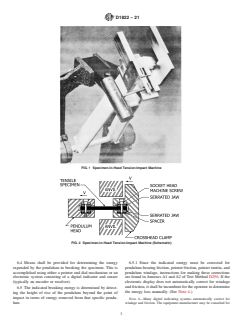
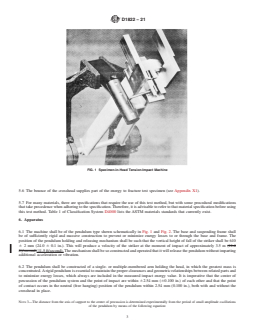
FIG. 1 Specimen-in-Head Tension-Impact Machine
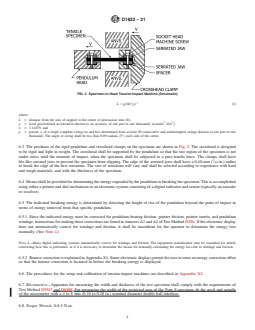
FIG. 2 Specimen-in-Head Tension-Impact Machine (Schematic)
6.4 Means shall be provided for determining the energy 6.5.1 Since the indicated energy must be corrected for
expended by the pendulum in breaking the specimen. This is pendulum-bearing friction, pointer friction, pointer inertia, and
accomplished using either a pointer and dial mechanism or an pendulum windage, instructions for making these corrections
electronic system consisting of a digital indicator and sensor are found inAnnexesA1 andA2 of Test Method D256.Ifthe
(typically an encoder or resolver). electronic display does not automatically correct for windage
andfriction,itshallbeincumbentfortheoperatortodetermine
6.5 The indicated breaking energy is determined by detect-
the energy loss manually. (See Note 4.)
ing the height of rise of the pendulum beyond the point of
impact in terms of energy removed from that specific pendu-
NOTE 4—Many digital indicating systems automatically correct for
lum. windage and friction. The equipment manufacturer may be consulted for
D1822 − 21
detailsconcerninghowthisisperformed,orifitisnecessarytodetermine
8.2 Test Conditions—Conductthetestsatthesametempera-
the means for manually calculating the energy loss due to windage and
ture and humidity used for conditioning with tolerances in
friction.
accordance with Section 7 of Practice D618, unless otherwise
6.5.2 BouncecorrectionisexplainedinAppendixX1.Some
specified by contract or the relevantASTM material specifica-
electronicdisplayspermittheusertoenteranenergycorrection
tion.
offset so that the bounce correction is factored in before the
breaking energy is displayed.
9. Procedure
6.6 The procedures for the setup and calibration of tension-
9.1 Measure the width and thickness of each specimen to
impact machines are described in Appendix X2.
the nearest 0.025 mm (0.001 in.) using the applicable test
6.7 Micrometers—Apparatus for measuring the width and
methods in Test Method D5947 or D6988. Record these
thickness of the test specimen shall comply with the require-
measurements along with the identifying markings of the
ments of Test Method D5947 and D6988. For measuring the
respective specimens.
widthoftherestrictedareaoftheTypeSspecimen,fittheanvil
9.2 Clamp the specimen to the crosshead while the cross-
and spindle of the micrometer witha4to8mm (0.16 to 0.28
head is out of the pendulum. A jig to position the specimen
in.) nominal diameter double ball interface.
properly with respect to the crosshead during the bolting
6.8 Torque Wrench, 0-8.5 N-m.
operation is useful for some machines. With the crosshead
properlypositionedintheelevatedpendulum,boltorclampthe
7. Test Specimen
specimen at its other end to the pendulum itself, as shown in
7.1 At least five and preferably ten specimens from each
Fig. 1, using a torque wrench. To avoid excessive deformation
sample shall be prepared for testing. For sheet materials that
of the specimens, use a torque suitable for the material being
are suspected of anisotropy, duplicate sets of test specimens
tested.
shall be prepared having their long axis respectively parallel
with, and normal to, the suspected directions of anisotropy.
9.3 Use the lowest capacity pendulum available, provided
thatthespecimensdonotextractmorethan85%oftheenergy
7.2 The test specimen shall be sanded, machined, or die cut
available. If this occurs, use a higher capacity pendulum.
to the dimensions of one of the specimen geometries shown in
Fig.3,ormoldedinamoldwhosecavityhasthesedimensions.
NOTE 6—In changing pendulums, the tensile-impact energy will de-
Fig. 4A shows bolt holes and bolt hole location and Fig. 4B
crease as the mass of the pendulum is increased.
shows a slot as an alternative method of bolting for easy
9.4 Slippage of specimens results in erroneously high val-
insertionofthespecimensintothegrips.TheNo.8-32boltsize
ues. Visually examine the tabs of the broken specimens for an
is recommended for the 9.53-mm (0.375-in.) wide tab and No.
undistorted image of the jaw faces , preferably under
8-32 or No. 10-32 bolt size is suggested for the 12.7-mm
magnification, and compared against a specimen which has
(0.500-in.)widetabs.Finalmachined,cut,ormoldedspecimen
been similarly clamped but not tested. If slippage of the
dimensions cannot be precisely maintained because of shrink-
specimens in the clamp occurs, reject the specimen and
age and other variables in sample preparation.
increase the torque the minimum amount necessary to elimi-
7.3 A nominal thickness of 3.2 mm ( ⁄8 in.) is optimum for
nate the slippage while avoiding breaking or cracking the
most materials being considered and for commercially avail-
specimen due to excessive force. The clamping force selected
able machines. Thicknesses other than 3.2 mm ( ⁄8 in.) are
for use on any one specimen is material dependent
nonstandardandtheyshallbereportedwiththetension-impact
value. 9.5 Measure the tension-impact energy of each specimen
and record its value, and comment on the appearance of the
NOTE 5—Cooperating laboratories should agree upon standard molds
specimen regarding permanent set or necking, and the location
and upon specimen preparation procedures and conditions.
of the fracture.
8. Conditioning
10. Calculation
8.1 Conditioning—Condition the test specimens in accor-
dance with Procedure A of Practice D618, unless otherwise
10.1 Calculate the corrected impact energy to break as
specified by contract or the relevantASTM material specifica-
follows:
tion. Conditioning time is specified as a minimum. Tempera-
X 5 E 2 Y1e (2)
ture and humidity tolerances shall be in accordance with
Section 7 of Practice D618 unless specified differently by
where:
contract or material specification.
X = corrected impact energy to break, in J (ft·lbf),
8.1.1 Note that for some hygroscopic materials, such as
E = scale reading of energy of break, in J (ft·lbf),
nylons, the material specifications call for testing “dry as-
Y = friction and windage correction in J (ft·lbf), and
molded specimens.” Such requirements take precedence over
e = bounce correction factor, in J (ft·lbf) (Fig. 5).
the above routine preconditioning to 50% relative humidity
NOTE 7—Fig. 5 is a sample curve. If desired, calculate a curve in
and require sealing the specimens in water vapor-impermeable
accordance with Appendix X1 for the crosshead and pendulum used
before applying any bounce correction factors.
containers as soon as molded and not removing them until
ready for testing. NOTE 8—Examples:
D1822 − 21
FIG. 3 Mold Dimensions of Types S and L Tension-Impact Specimens
FIG. 3A Mold Dimensions of Types S and L Tension-Impact Specimens (Dimensioned in Millimetres)
FIG. 3B Mold Dimensions of Types S and L Tension-Impact Specimens (Dimensioned in Inches)
D1822 − 21
11.1.2 Specimen type (S or L), and tab width.
11.1.3 Astatementofhowthespecimenswereprepared,the
testing conditions, including the size of the bolts and torque
used, thickness range, and direction of testing with respect to
anisotropy, if any.
11.1.4 The capacity of the pendulum in kilo-joules (or
foot-pounds-force or inch-pounds-force).
11.1.5 Theaverageandthestandarddeviationofthetensile-
impact energy of specimens in the sample. If the ratio of the
minimum value to maximum value is less than 0.75, report
average and maximum and minimum values. If there is an
apparent difference in the residual elongation observed due to
FIG. 4 Bolt Hole Location
some of the sample necking, report the number of specimens
displaying necking.
Case A— Low-Energy Specimen:
Scale reading of energy to break 0.58 J
11.1.6 Number of specimens tested per sample or lot of
(0.43 ft·lbf)
material (that is, five or ten or more).
Friction and windage correction
−0.03 J (−0.02 ft·lbf)
12. Precision and Bias
Bounce correction factor, e +0.22 J
(from Fig. 5 in Appendix X1) (0.16 ft·lbf)
12.1 The precision of this test method is based on two
+0.25 J ( +0.18 ft·lbf)
= +0.22 ( +0.16 ft·
...
This document is not an ASTM standard and is intended only to provide the user of an ASTM standard an indication of what changes have been made to the previous version. Because
it may not be technically possible to adequately depict all changes accurately, ASTM recommends that users consult prior editions as appropriate. In all cases only the current version
of the standard as published by ASTM is to be considered the official document.
Designation: D1822 − 13 D1822 − 21
Standard Test Method for
Tensile-Impact Energy to Break Plastics and Electrical
Insulating MaterialsDetermining the Tensile-Impact
Resistance of Plastics
This standard is issued under the fixed designation D1822; the number immediately following the designation indicates the year of
original adoption or, in the case of revision, the year of last revision. A number in parentheses indicates the year of last reapproval. A
superscript epsilon (´) indicates an editorial change since the last revision or reapproval.
1. Scope*
1.1 This test method covers the determination of the energy required to rupture standard tension-impact specimens of plastic or
electrical insulating materials. Rigid materials are suitable for testing by this method as well as specimens that are too flexible or
thin to be tested in accordance with other impact test methods.
1.2 The values stated in SI units are to be regarded as standard. The values given in parentheses are for information only.
NOTE 1—This test method and ISO 8256 address the same subject matter, but differ in technical content.
1.3 This standard does not purport to address all of the safety problems,concerns, if any, associated with its use. It is the
responsibility of the user of this standard to establish appropriate safety safety, health, and healthenvironmental practices and
determine the applicability of regulatory limitations prior to use.
1.4 This international standard was developed in accordance with internationally recognized principles on standardization
established in the Decision on Principles for the Development of International Standards, Guides and Recommendations issued
by the World Trade Organization Technical Barriers to Trade (TBT) Committee.
2. Referenced Documents
2.1 ASTM Standards:
D256 Test Methods for Determining the Izod Pendulum Impact Resistance of Plastics
D618 Practice for Conditioning Plastics for Testing
D638 Test Method for Tensile Properties of Plastics
D883 Terminology Relating to Plastics
D4000 Classification System for Specifying Plastic Materials
D5947 Test Methods for Physical Dimensions of Solid Plastics Specimens
D6988 Guide for Determination of Thickness of Plastic Film Test Specimens
E177 Practice for Use of the Terms Precision and Bias in ASTM Test Methods
E456 Terminology Relating to Quality and Statistics
E691 Practice for Conducting an Interlaboratory Study to Determine the Precision of a Test Method
2.2 ISO Standards:
ISO 8256 Plastics—Determination of Tensile-Impact Strength
This test method is under the jurisdiction of ASTM Committee D20 on Plastics and is the direct responsibility of Subcommittee D20.10 on Mechanical Properties.
Current edition approved Sept. 1, 2013Oct. 1, 2021. Published November 2013November 2021. Originally approved in 1961. Last previous edition approved in 20062013
as D1822 - 06.D1822 - 13. DOI:10.1520/D1822–13.DOI:10.1520/D1822–21.
For referenced ASTM standards, visit the ASTM website, www.astm.org, or contact ASTM Customer Service at service@astm.org. For Annual Book of ASTM Standards
volume information, refer to the standard’s Document Summary page on the ASTM website. DOI: 10.1520/D1822-06.
*A Summary of Changes section appears at the end of this standard
Copyright © ASTM International, 100 Barr Harbor Drive, PO Box C700, West Conshohocken, PA 19428-2959. United States
D1822 − 21
3. Terminology
3.1 Definitions—Definitions of terms applying to this test method appear in Terms used in this standard are defined in accordance
with Terminology D883, unless otherwise specified. For terms relating to precision and bias and associated issues, the terms used
in this standard are defined in accordance with Terminology E456.
4. Summary of Test Method
4.1 The energy utilized in this test method is delivered by a single swing of a calibrated pendulum of a standardized tension-impact
machine. The energy to fracture a specimen, by shock in tension, is determined by the kinetic energy extracted from the pendulum
of the impact machine in the process of breaking the specimen. One end of the specimen is mounted in the pendulum. The other
end of the specimen is gripped by a crosshead which travels with the pendulum until the instant of impact (and instant of maximum
pendulum kinetic energy), when the crosshead is arrested.
5. Significance and Use
5.1 Tensile-impact energy is the energy required to break a standard tension-impact specimen in tension by a single swing of a
standard calibrated pendulum under a set of standard conditions (see Note 2). To compensate for the minor differences in
cross-sectional area of the specimens, the energy to break is normalized to units of kilojoules per square metre (or
foot-pounds-force per square inch) of minimum cross-sectional area. An alternative approach to normalizing the impact energy that
compensates for these minor differences and still retains the test unit as joules (foot-pounds) is shown in Section 10. For a perfectly
elastic material, the impact energy is usually reported per unit volume of material undergoing deformation. However, since much
of the energy to break the plastic materials for which this test method is written is dissipated in drawing of only a portion of the
test region, such normalization on a volume basis is not feasible. In order to observe the effect of elongation or rate of extension,
or both, upon the result, the test method permits two specimen geometries. Results obtained with different capacity machines
generally are not comparable.
5.1.1 With the Type S (short) specimen the extension is comparatively low, while with the Type L (long) specimen the extension
is comparatively high. In general, the Type S specimen (with its greater occurrence of brittle fracture) gives greater reproducibility,
but less differentiation among materials.
NOTE 2—Friction losses are largely eliminated by careful design and proper operation of the testing machine.
5.2 Scatter of data is sometimes attributed to different failure mechanisms within a group of specimens. Some materials exhibit
a transition between different failure mechanisms. If so, the elongation will be critically dependent on the rate of extension
encountered in the test. The impact energy values for a group of such specimens will have an abnormally large dispersion.
5.2.1 Some materials retract at failure with insignificant permanent set. With such materials, determining the type of failure,
ductile or brittle, by examining the broken pieces is difficult, if not impossible. It is helpful to sort a set of specimens into two
groups by observing the broken pieces to ascertain whether or not there was necking during the test. Qualitatively, the strain rates
encountered here are intermediate between the high rate of the Izod test of Test Methods D256 and the low rate of usual tension
testing in accordance with Test Method D638.
5.3 The energy for fracture is a function of the force times the distance through which the force operates. Therefore, given the same
specimen geometry, it is possible that one material will produce tensile-impact energies for fracture due to a large force associated
with a small elongation, and another material will produce the same energy for fracture result due to a small force associated with
a large elongation. It shall not be assumed that this test method will correlate with other tests or end uses unless such a correlation
has been established by experiment.
5.4 Comparisons among specimens from different sources are to be made with confidence only to the extent that specimen
preparation, for example, molding history, has been precisely duplicated. Comparisons between molded and machined specimens
must not be made without first establishing quantitatively the differences inherent between the two methods of preparation.
5.5 Only results from specimens of nominally equal thickness and tab width shall be compared unless it has been shown that the
tensile-impact energy normalized to kilojoules per square metre (or foot-pounds-force per square inch) of cross-sectional area is
independent of the thickness over the range of thicknesses under consideration.
D1822 − 21
FIG. 1 Specimen-in-Head Tension-Impact Machine
5.6 The bounce of the crosshead supplies part of the energy to fracture test specimen (see Appendix X1).
5.7 For many materials, there are specifications that require the use of this test method, but with some procedural modifications
that take precedence when adhering to the specification. Therefore, it is advisable to refer to that material specification before using
this test method. Table 1 of Classification System D4000 lists the ASTM materials standards that currently exist.
6. Apparatus
6.1 The machine shall be of the pendulum type shown schematically in Fig. 1 and Fig. 2. The base and suspending frame shall
be of sufficiently rigid and massive construction to prevent or minimize energy losses to or through the base and frame. The
position of the pendulum holding and releasing mechanism shall be such that the vertical height of fall of the striker shall be 610
6 2 mm (24.0 6 0.1 in.). This will produce a velocity of the striker at the moment of impact of approximately 3.5 m (11.4
ft)/second.(11.5 ft/second). The mechanism shall be so constructed and operated that it will release the pendulum without imparting
additional acceleration or vibration.
6.2 The pendulum shall be constructed of a single- or multiple-membered arm holding the head, in which the greatest mass is
concentrated. A rigid pendulum is essential to maintain the proper clearances and geometric relationships between related parts and
to minimize energy losses, which always are included in the measured impact energy value. It is imperative that the center of
percussion of the pendulum system and the point of impact are within 62.54 mm (60.100 in.) of each other and that the point
of contact occurs in the neutral (free hanging) position of the pendulum within 2.54 mm (0.100 in.), both with and without the
crosshead in place.
NOTE 3—The distance from the axis of support to the center of percussion is determined experimentally from the period of small amplitude oscillations
of the pendulum by means of the following equation:
D1822 − 21
FIG. 2 Specimen-in-Head Tension-Impact Machine (Schematic)
2 2
L 5 g/4π p (1)
~ !
where:
L = distance from the axis of support to the center of percussion, mm (ft),
2 2
g = local gravitational acceleration (known to an accuracy of one part in one thousand), in mm/s (ft/s ),
π = 3.14159, and
p = period, s, of a single complete swing (to and fro) determined from at least 50 consecutive and uninterrupted swings (known to one part in two
thousand). The angle of swing shall be less than 0.09 radians (5°) each side of the center.
6.3 The positions of the rigid pendulum and crosshead clamps on the specimen are shown in Fig. 2. The crosshead is designed
to be rigid and light in weight. The crosshead shall be supported by the pendulum so that the test region of the specimen is not
under stress until the moment of impact, when the specimen shall be subjected to a pure tensile force. The clamps shall have
file-like serrated jaws to prevent the specimen from slipping. The edge of the serrated jaws shall have a 0.40-mm ( ⁄64-in.) radius
to break the edge of the first serrations. The size of serrations will vary and shall be selected according to experience with hard
and tough materials, and with the thickness of the specimen.
6.4 Means shall be provided for determining the energy expended by the pendulum in breaking the specimen. This is accomplished
using either a pointer and dial mechanism or an electronic system consisting of a digital indicator and sensor (typically an encoder
or resolver).
6.5 The indicated breaking energy is determined by detecting the height of rise of the pendulum beyond the point of impact in
terms of energy removed from that specific pendulum.
6.5.1 Since the indicated energy must be corrected for pendulum-bearing friction, pointer friction, pointer inertia, and pendulum
windage, instructions for making these corrections are found in Annexes A1 and A2 of Test Method D256. If the electronic display
does not automatically correct for windage and friction, it shall be incumbent for the operator to determine the energy loss
manually. (See Note 4.)
NOTE 4—Many digital indicating systems automatically correct for windage and friction. The equipment manufacturer may be consulted for details
concerning how this is performed, or if it is necessary to determine the means for manually calculating the energy loss due to windage and friction.
6.5.2 Bounce correction is explained in Appendix X1. Some electronic displays permit the user to enter an energy correction offset
so that the bounce correction is factored in before the breaking energy is displayed.
6.6 The procedures for the setup and calibration of tension-impact machines are described in Appendix X2.
6.7 Micrometers—Apparatus for measuring the width and thickness of the test specimen shall comply with the requirements of
Test Method D5947 and D6988. For measuring the width of the restricted area of the Type S specimen, fit the anvil and spindle
of the micrometer with a 4 to 8 mm (0.16 to 0.28 in.) nominal diameter double ball interface.
6.8 Torque Wrench, 0-8.5 N-m.
D1822 − 21
FIG. 3 Mold Dimensions of Types S and L Tension-Impact Specimens
FIG. 3A Mold Dimensions of Types S and L Tension-Impact Specimens (Dimensioned in Millimetres)
FIG. 3B Mold Dimensions of Types S and L Tension-Impact Specimens (Dimensioned in Inches)
7. Test Specimen
7.1 At least five and preferably ten specimens from each sample shall be prepared for testing. For sheet materials that are suspected
of anisotropy, duplicate sets of test specimens shall be prepared having their long axis respectively parallel with, and normal to,
the suspected directions of anisotropy.
7.2 The test specimen shall be sanded, machined, or die cut to the dimensions of one of the specimen geometries shown in Fig.
3, or molded in a mold whose cavity has these dimensions. Fig. 4A shows bolt holes and bolt hole location and Fig. 4B shows
D1822 − 21
FIG. 4 Bolt Hole Location
a slot as an alternative method of bolting for easy insertion of the specimens into the grips. The No. 8-32 bolt size is recommended
for the 9.53-mm (0.375-in.) wide tab and No. 8-32 or No. 10-32 bolt size is suggested for the 12.70-mm12.7-mm (0.500-in.) wide
tabs. Final machined, cut, or molded specimen dimensions cannot be precisely maintained because of shrinkage and other variables
in sample preparation.
7.3 A nominal thickness of 3.2 mm ( ⁄8 in.) is optimum for most materials being considered and for commercially available
machines. Thicknesses other than 3.2 mm ( ⁄8 in.) are nonstandard and they shall be reported with the tension-impact value.
NOTE 5—Cooperating laboratories should agree upon standard molds and upon specimen preparation procedures and conditions.
8. Conditioning
8.1 Conditioning—Condition the test specimens in accordance with Procedure A of Practice D618, unless otherwise specified by
contract or the relevant ASTM material specification. Conditioning time is specified as a minimum. Temperature and humidity
tolerances shall be in accordance with Section 7 of Practice D618 unless specified differently by contract or material specification.
8.1.1 Note that for some hygroscopic materials, such as nylons, the material specifications call for testing “dry as-molded
specimens.” Such requirements take precedence over the above routine preconditioning to 50 % relative humidity and require
sealing the specimens in water vapor-impermeable containers as soon as molded and not removing them until ready for testing.
8.2 Test Conditions—Conduct the tests at the same temperature and humidity used for conditioning with tolerances in accordance
with Section 7 of Practice D618, unless otherwise specified by contract or the relevant ASTM material specification.
9. Procedure
9.1 Measure the width and thickness of each specimen to the nearest 0.025 mm (0.001 in.) using the applicable test methods in
Test Method D5947 or D6988. Record these measurements along with the identifying markings of the respective specimens.
9.2 Clamp the specimen to the crosshead while the crosshead is out of the pendulum. A jig to position the specimen properly with
respect to the crosshead during the bolting operation is useful for some machines. With the crosshead properly positioned in the
elevated pendulum, bolt or clamp the specimen at its other end to the pendulum itself, as shown in Fig. 1, using a torque wrench.
To avoid excessive deformation of the specimens, use a torque suitable for the material being tested.
9.3 Use the lowest capacity pendulum available, provided that the specimens do not extract more than 85 % of the energy
available. If this occurs, use a higher capacity pendulum.
NOTE 6—In changing pendulums, the tensile-impact energy will decrease as the mass of the pendulum is increased.
9.4 Slippage of specimens results in erroneously high values. Visually examine the tabs of the broken specimens for an undistorted
image of the jaw faces , preferably under magnification, and compared against a specimen which has been similarly clamped but
not tested. Because slippage has been shown to be present in many cases and suspected in others, the use of bolted specimens is
mandatory. The function of the bolt is to assure good alignment and to improve the tightening of the jaw face plates. The bolt shall
be tightened using a torque wrench. If slippage of the specimens in the clamp occurs, reject the specimen and increase the torque
D1822 − 21
FIG. 5 Typical Correction Factor Curve for Single Bounce of Crosshead for Specimen-in-Head Tension-Impact Machine, 6.8-J Hammer,
0.428-lb Steel Crosshead (see Appendix X1)
the minimum amount necessary to eliminate the slippage while avoiding breaking or cracking the specimen due to excessive force.
The clamping force selected for use on any one specimen is material dependent
9.5 Measure the tension-impact energy of each specimen and record its value, and comment on the appearance of the specimen
regarding permanent set or necking, and the location of the fracture.
10. Calculation
10.1 Calculate the corrected impact energy to break as follows:
X 5 E 2 Y1e (2)
where:
X = corrected impact energy to break, in J (ft·lbf),
E = scale reading of energy of break, in J (ft·lbf),
Y = friction and windage correction in J (ft·lbf), and
e = bounce correction factor, in J (ft·lbf) (Fig. 5).
NOTE 7—Fig. 5 is a sample curve. If desired, calculate a curve in accordance with Appendix X1 for the crosshead and pendulum used before applying
any bounce correction factors.
NOTE 8—Examples:
D1822 − 21
Case A— Low-Energy Specimen:
Scale reading of energy to break 0.58 J
(0.43 ft·lbf)
Friction and windage correction
−0.03 J (−0.02 ft·lbf)
Bounce correction factor, e +0.22 J
(from Fig. 5 in Appendix X1) (0.16 ft·lbf)
+0.25 J ( +0.18 ft·lbf)
= +0.22 ( +0.16 ft·lbf)
Corrected impact energy to break 0.80 J
(0.59 ft·lbf)
Case B—High-Energy Specimen:
Scale reading of energy to break 2.33 J
(1.72 ft·lbf)
Friction and windage correction
−0.01 J (−0.01 ft·lbf) +0.33 J
Bounce correction factor. e (0.24 ft·lbf)
(from Fig. 5 in Appendix X1)
Corrected impact energy to break 2.66 J
(1.96 ft·lbf)
NOTE 9—Corrections for a slight variation in specimen dimensions due to specimen preparation or mold shrinkage are made, if desired, by using the
following equation:
E 2 Y1e
X 5 (3)
w t
S DS D
a a
where:
X, E, Y,and e are as described in 9.1,
a = 3.2 mm (0.125 in.),
a = 3.20 mm (0.126 in.),
w = specimen width, mm (in.), and
t = specimen thickness, mm (in.).
This would normalize the value of tensile impact energy to a standard specimen whose cross section is 3.2 mm (0.125 in.) by 3.2 mm (0.125 in.).
10.2 Calculate the standard deviation (estimated) as follows and report to two significant figures:
2 ¯ 2
=
s 5 X 2 nX /n 2 1 (4)
(
where:
s = estimated standard deviation,
X = value of single observation,
n = number of observations, and
X¯ = arithmetic mean of the set of observations.
11. Report
11.1 Report the following information:
11.1.1 Complete identification of the material tested, including type, source, manufacturer’s code number, form, principal
dimensions, and previous history.
11.1.2 Specimen type (S or L), and tab width.
11.1.3 A statement of how the specimens were prepared, the testing conditions, including the size of the bolts and torque used,
thickness range, and direction of testing with respect to anisotropy, if any.
11.1.4 The capacity of the pendulum in kilo-joules (or foot-pounds-force or inch-pounds-force).
11.1.5 The average and the standard deviation of the tensile-impact energy of specimens in the sample. If the ratio of the minimum
D1822 − 21
TABLE 2 Impact Energy (ft · lbf)
A
Average Reproducibility Standard Deviation Reproducibility Limit
x s R
R
Nylon 6/6 w/ 33 % glas
...