

ASTM E128-99(2019)
(Test Method)Standard Test Method for Maximum Pore Diameter and Permeability of Rigid Porous Filters for Laboratory Use
General Information
- Abstract
ABSTRACT
This test method covers the determination of maximum pore diameter and permeability of rigid porous filters used in the laboratory for filtration or diffusion. They are applicable to filters made of sintered glass, ceramic, metal, or plastic. This test method establishes a uniform designation for maximum pore diameter and also provides a means of detecting and measuring changes which occur through continued use. Maximum pore diameter is determined by immersing the filter in a suitable test liquid and applying air pressure until the first bubble of air passes through the filter. The maximum pore diameter is calculated from the surface tension of the test liquid and the applied pressure. Permeability is determined by measuring the flow of air through the filter when subjected to a pressure differential.
SCOPE
1.1 This test method covers the determination of maximum pore diameter and permeability of rigid porous filters used in the laboratory for filtration or diffusion. They are applicable to filters made of sintered glass, ceramic, metal, or plastic. This test method establishes a uniform designation for maximum pore diameter and also provides a means of detecting and measuring changes which occur through continued use.
1.2 The values stated in SI units are to be regarded as standard. No other units of measurement are included in this standard.
1.3 This standard does not purport to address all of the safety concerns, if any, associated with its use. It is the responsibility of the user of this standard to establish appropriate safety, health, and environmental practices and determine the applicability of regulatory limitations prior to use.
1.4 This international standard was developed in accordance with internationally recognized principles on standardization established in the Decision on Principles for the Development of International Standards, Guides and Recommendations issued by the World Trade Organization Technical Barriers to Trade (TBT) Committee.
- Status
- Published
- Publication Date
- 31-Oct-2019
- Technical Committee
- E41 - Laboratory Apparatus
- Drafting Committee
- E41.01 - Laboratory Ware and Supplies

Overview
ASTM E128-99(2019) is the internationally recognized standard test method for determining the maximum pore diameter and permeability of rigid porous filters used for laboratory applications. Developed by ASTM International, this standard is widely used to ensure consistent, reliable performance of filtration and diffusion equipment composed of sintered glass, ceramic, metal, or plastic materials. Through standardized testing procedures, ASTM E128-99(2019) facilitates quality assurance, comparability, and traceability in laboratory filtration, supporting both manufacturing and end-user needs.
Key Topics
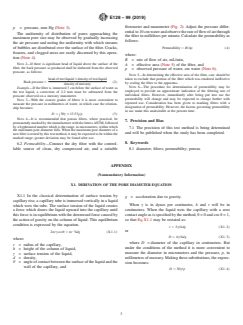
Maximum pore diameter determination: The standard provides a test method to measure the maximum pore diameter of rigid porous filters, defined as the equivalent diameter (in micrometres) of a capillary with similar surface-tension characteristics as the largest pore in a filter.
Permeability measurement: It sets out procedures to determine the permeability of a filter, specifying the flow of air (in millilitres per minute per square centimetre of filter area) when subjected to a defined pressure differential.
Applicability: Testing applies to filters composed of sintered glass, ceramic, metal, or plastic, making the standard versatile for various laboratory filtration technologies.
Repeatability and monitoring: The method also serves to detect and measure changes in pore structure and permeability that may occur due to repeated filter use, thus supporting maintenance and lifecycle management.
Applications
The ASTM E128-99(2019) standard is essential for a range of practical laboratory and manufacturing activities:
Quality control of laboratory filters: Laboratories and filter manufacturers use the standard to ensure that filter pore sizes and permeability conform to specifications, guaranteeing consistent performance in experiments and industrial processes.
Performance benchmarking: The uniform designation of maximum pore diameter enables easy comparison between filter batches and types, supporting informed selection and procurement.
Equipment validation and certification: Compliance with ASTM E128-99(2019) can form part of validation protocols for equipment used in critical laboratory and process environments, such as pharmaceutical, environmental, and analytical testing labs.
Maintenance and lifespan monitoring: By regularly measuring filters, users can detect blockages, cracks, or structural changes that impact performance, facilitating proactive replacement and minimizing downtime.
Material selection: The standard provides guidance on suitable test liquids for different filter materials (e.g., water for glass, alcohol for plastic), supporting the accurate characterization of diverse filter types.
Related Standards
When implementing ASTM E128-99(2019), it may be beneficial to reference the following related standards:
- ASTM D845: Specification for Five-Degree Xylene, referenced for permeability testing of certain filters.
- Other ASTM filtration standards: Additional ASTM test methods and specifications may complement the requirements for particulate retention, filter integrity, and chemical compatibility.
- ISO standards on filtration: Depending on your region or industry, relevant ISO standards concerning laboratory filtration or porous materials may offer further guidance and harmonize practices internationally.
Summary of Practical Value
Utilizing ASTM E128-99(2019) ensures that laboratories and manufacturers maintain high standards for filter performance and data integrity. By standardizing the test method for maximum pore diameter and permeability, it improves quality control, regulatory compliance, and repeatability across a broad spectrum of scientific and industrial activities. Adhering to this widely adopted test method helps establish reliable filtration systems, reducing the risk of contamination, experimental error, or unplanned failure in laboratory operations.
Relations
- Effective Date
- 01-Nov-2019
- Effective Date
- 01-Nov-2019
- Effective Date
- 01-Nov-2019
- Effective Date
- 01-Nov-2019
- Effective Date
- 01-Nov-2019
- Effective Date
- 01-Nov-2019
- Effective Date
- 01-Nov-2019
- Referred By
ASTM D6908-06(2017) - Standard Practice for Integrity Testing of Water Filtration Membrane Systems - Effective Date
- 01-Nov-2019
- Effective Date
- 01-Nov-2019
- Effective Date
- 01-Nov-2019
- Referred By
ASTM D1881-17 - Standard Test Method for Foaming Tendencies of Engine Coolants in Glassware - Effective Date
- 01-Nov-2019
- Effective Date
- 01-Nov-2019
- Effective Date
- 01-Nov-2019
- Effective Date
- 01-Nov-2019
- Effective Date
- 01-Nov-2019
Get Certified
Connect with accredited certification bodies for this standard

ECOCERT
Organic and sustainability certification.

Eurofins Food Testing Global
Global leader in food, environment, and pharmaceutical product testing.

Intertek Bangladesh
Intertek certification and testing services in Bangladesh.
Sponsored listings
Frequently Asked Questions
ASTM E128-99(2019) is a standard published by ASTM International. Its full title is "Standard Test Method for Maximum Pore Diameter and Permeability of Rigid Porous Filters for Laboratory Use". This standard covers: ABSTRACT This test method covers the determination of maximum pore diameter and permeability of rigid porous filters used in the laboratory for filtration or diffusion. They are applicable to filters made of sintered glass, ceramic, metal, or plastic. This test method establishes a uniform designation for maximum pore diameter and also provides a means of detecting and measuring changes which occur through continued use. Maximum pore diameter is determined by immersing the filter in a suitable test liquid and applying air pressure until the first bubble of air passes through the filter. The maximum pore diameter is calculated from the surface tension of the test liquid and the applied pressure. Permeability is determined by measuring the flow of air through the filter when subjected to a pressure differential. SCOPE 1.1 This test method covers the determination of maximum pore diameter and permeability of rigid porous filters used in the laboratory for filtration or diffusion. They are applicable to filters made of sintered glass, ceramic, metal, or plastic. This test method establishes a uniform designation for maximum pore diameter and also provides a means of detecting and measuring changes which occur through continued use. 1.2 The values stated in SI units are to be regarded as standard. No other units of measurement are included in this standard. 1.3 This standard does not purport to address all of the safety concerns, if any, associated with its use. It is the responsibility of the user of this standard to establish appropriate safety, health, and environmental practices and determine the applicability of regulatory limitations prior to use. 1.4 This international standard was developed in accordance with internationally recognized principles on standardization established in the Decision on Principles for the Development of International Standards, Guides and Recommendations issued by the World Trade Organization Technical Barriers to Trade (TBT) Committee.
ABSTRACT This test method covers the determination of maximum pore diameter and permeability of rigid porous filters used in the laboratory for filtration or diffusion. They are applicable to filters made of sintered glass, ceramic, metal, or plastic. This test method establishes a uniform designation for maximum pore diameter and also provides a means of detecting and measuring changes which occur through continued use. Maximum pore diameter is determined by immersing the filter in a suitable test liquid and applying air pressure until the first bubble of air passes through the filter. The maximum pore diameter is calculated from the surface tension of the test liquid and the applied pressure. Permeability is determined by measuring the flow of air through the filter when subjected to a pressure differential. SCOPE 1.1 This test method covers the determination of maximum pore diameter and permeability of rigid porous filters used in the laboratory for filtration or diffusion. They are applicable to filters made of sintered glass, ceramic, metal, or plastic. This test method establishes a uniform designation for maximum pore diameter and also provides a means of detecting and measuring changes which occur through continued use. 1.2 The values stated in SI units are to be regarded as standard. No other units of measurement are included in this standard. 1.3 This standard does not purport to address all of the safety concerns, if any, associated with its use. It is the responsibility of the user of this standard to establish appropriate safety, health, and environmental practices and determine the applicability of regulatory limitations prior to use. 1.4 This international standard was developed in accordance with internationally recognized principles on standardization established in the Decision on Principles for the Development of International Standards, Guides and Recommendations issued by the World Trade Organization Technical Barriers to Trade (TBT) Committee.
ASTM E128-99(2019) is classified under the following ICS (International Classification for Standards) categories: 71.040.20 - Laboratory ware and related apparatus. The ICS classification helps identify the subject area and facilitates finding related standards.
ASTM E128-99(2019) has the following relationships with other standards: It is inter standard links to ASTM E128-99(2011), ASTM D892-18e1, ASTM D7840-12(2017), ASTM D721-17, ASTM D3235-16e1, ASTM F2902-16e1, ASTM D3608-19, ASTM D6908-06(2017), ASTM F316-03(2019), ASTM F3510-21, ASTM D1881-17, ASTM F2150-19, ASTM D1607-91(2018)e1, ASTM D6082-23, ASTM F2450-18. Understanding these relationships helps ensure you are using the most current and applicable version of the standard.
ASTM E128-99(2019) is available in PDF format for immediate download after purchase. The document can be added to your cart and obtained through the secure checkout process. Digital delivery ensures instant access to the complete standard document.
Standards Content (Sample)
This international standard was developed in accordance with internationally recognized principles on standardization established in the Decision on Principles for the
Development of International Standards, Guides and Recommendations issued by the World Trade Organization Technical Barriers to Trade (TBT) Committee.
Designation: E128 − 99 (Reapproved 2019)
Standard Test Method for
Maximum Pore Diameter and Permeability of Rigid Porous
Filters for Laboratory Use
This standard is issued under the fixed designation E128; the number immediately following the designation indicates the year of
original adoption or, in the case of revision, the year of last revision. A number in parentheses indicates the year of last reapproval. A
superscript epsilon (´) indicates an editorial change since the last revision or reapproval.
1. Scope 3.1.1 maximum pore diameter—thediameterinmicrometres
of a capillary of circular cross section that is equivalent (with
1.1 This test method covers the determination of maximum
respect to characteristics related to surface-tension effects) to
pore diameter and permeability of rigid porous filters used in
the largest pore in the filter under consideration.
the laboratory for filtration or diffusion. They are applicable to
filters made of sintered glass, ceramic, metal, or plastic. This
NOTE 1—It is recognized that the maximum pore diameter as defined
herein does not necessarily indicate the physical dimensions of the largest
test method establishes a uniform designation for maximum
pore in the filter, and furthermore, that the pores are highly irregular in
pore diameter and also provides a means of detecting and
shape. Because of this irregularity in shape and other phenomena
measuring changes which occur through continued use.
characteristic of filtration, a filter may be expected to retain all particles
larger than the maximum pore diameter as defined and determined by this
1.2 The values stated in SI units are to be regarded as
test method, and will generally retain particles which are much smaller
standard. No other units of measurement are included in this
than the determined diameter.
standard.
3.1.2 permeability—the flow of air, in millimetres per min-
1.3 This standard does not purport to address all of the
ute per square centimetre of filter area per 1 cm of water
safety concerns, if any, associated with its use. It is the
pressure differential.
responsibility of the user of this standard to establish appro-
priate safety, health, and environmental practices and deter-
4. Summary of Test Method
mine the applicability of regulatory limitations prior to use.
4.1 Maximum Pore Diameter, is determined by immersing
1.4 This international standard was developed in accor-
the filter in a suitable test liquid and applying air pressure until
dance with internationally recognized principles on standard-
the first bubble of air passes through the filter. The maximum
ization established in the Decision on Principles for the
pore diameter is calculated from the surface tension of the test
Development of International Standards, Guides and Recom-
liquid and the applied pressure.
mendations issued by the World Trade Organization Technical
4.2 Permeability is determined by measuring the flow of air
Barriers to Trade (TBT) Committee.
through the filter when subjected to a pressure differential.
2. Referenced Documents
5. Apparatus
2.1 ASTM Standards:
5.1 Because of the variety of shapes of apparatus in which
D845 Specification for Five-Degree Xylene (Withdrawn
3 porous filters are incorporated, the apparatus for this test
1980)
method is not specified in detail.Apparatus that has been found
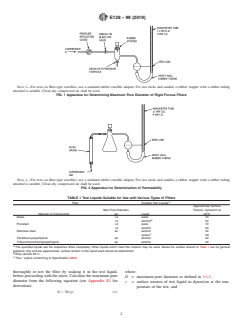
satisfactory is illustrated in Fig. 1 and Fig. 2.
3. Terminology
3.1 Definitions:
6. Procedure
6.1 Maximum Pore Diameter—Thoroughly wet the clean
filter to be tested by soaking it in the prescribed test liquid (see
This test method is under the jurisdiction of ASTM Committee E41 on
Table 1). Connect the filter to a controllable source of clean,
Laboratory Apparatus and is the direct responsibility of Subcommittee E41.01 on
Laboratory Ware and Supplies.
dry compressed air, and a manometer (Fig. 1). Immerse the
Current edition approved Nov. 1, 2019. Published November 2019. Originally
filter just below the surface of the test liquid (Note 2) and
approvedin1957.Lastpreviouseditionapprovedin2011asE128 – 99(2011).DOI:
gradually increase the air pressure at a rate of about 5 mm/min
10.1520/E0128-99R19.
in the area of the test until the first dynamic bubble passes
For referenced ASTM standards, visit the ASTM website, www.astm.org, or
contact ASTM Customer Service at service@astm.org. For Annual Book of ASTM
through the filter and rises through the liquid. The appearance
Standards volume information, refer to the standard’s Document Summary page on
of the first true dynamic bubble is readily recognized since it is
the ASTM website.
followed by a succession of additional bubbles. Read the
The last approved version of this historical standard is referenced on
www.astm.org. pressure from the manometer. If the test is to be repeated,
Copyright © ASTM International, 100 Barr Harbor Drive, PO Box C700, West Conshohocken, PA 19428-2959. United States
E128 − 99 (2019)
NOTE 1—For tests on filter-type crucibles, use a standard rubber crucible adapter. For test sticks and candles a rubber stopper with a rubber tubing
attached is suitable. Clean dry compressed air shall be used.
FIG. 1 Apparatus for Determining Maximum Pore Diameter of Rigid Porous Filters
NOTE 1—For tests on filter-type crucibles, use a standard rubber crucible adapter. For test sticks and candles a rubber stopper with a rubber tubing
attached is suitable. Clean dry compressed air shall be used.
FIG. 2 Apparatus for Determination of Permeability
TABLE 1 Test Liquids Suitable for Use with Various Types of Filters
A
Filter Suitable Test Liquids
Approximate Surface
Max Pore Diameter, Tension, dynes/cm at
Material of Construction µm Liquid 20°C
Glass >4 water 72
B
<4 alcohol 22
Porcelain >3 water 72
<3 alcohol 22
Stainless steel all alcohol 22
C
xylene 29
Tetrafluoro-polyethylene all alcohol 22
Trifluoromonochloropolyethylene all alcohol 22
A
The specified liquids wet the respective
...