

ASTM F3493-23
(Practice)Standard Practice for Measuring Dynamic Characteristics of Water Slide Systems Using Instrumented Humans
General Information
- Abstract
SIGNIFICANCE AND USE
4.1 This standard practice is intended for use whenever the dynamic characteristics of a water slide are to be determined using instrumented humans.
4.2 The use of this standard practice does not preclude the substitution of other published Amusement Industry accepted standard practices developed for use on water slides.
4.3 The existence of this practice is not intended to imply that there is a requirement to perform specific accelerometer testing on water slides.
SCOPE
1.1 This practice covers the acquisition of quantitative data related to the dynamic characteristics of water slides when taken with instrumented humans.
1.2 Prior to the use of this practice, the designer/engineer shall have completed and approved the testing of a new slide such that it is reasonably expected to meet the performance requirements, including accelerations, of Practice F2376-21 and ensure the slide is safe for human testing.
1.3 This practice shall not apply to:
1.3.1 Any other amusement rides or devices, other than water slides and water slide systems as classified by Practice F2376-21.
1.3.2 Non-human accelerometer testing on water slides or water slide systems as defined by Practice F2376-21.
1.4 Units—The values stated in SI units are to be regarded as the standard. Other units of measurement are included in this standard for information only and are not considered standard.
1.5 This standard does not purport to address all of the safety concerns, if any, associated with its use. It is the responsibility of the user of this standard to establish appropriate safety, health, and environmental practices and determine the applicability of regulatory limitations prior to use.
1.6 This international standard was developed in accordance with internationally recognized principles on standardization established in the Decision on Principles for the Development of International Standards, Guides and Recommendations issued by the World Trade Organization Technical Barriers to Trade (TBT) Committee.
- Status
- Published
- Publication Date
- 31-Dec-2022
- Technical Committee
- F24 - Amusement Rides and Devices
- Drafting Committee
- F24.70 - Water Related Amusement Rides and Devices
Overview
ASTM F3493-23, titled Standard Practice for Measuring Dynamic Characteristics of Water Slide Systems Using Instrumented Humans, provides industry guidelines for the collection and documentation of quantitative data related to the dynamic characteristics of water slides. This standard establishes practices for measuring the accelerations and forces experienced by humans on water slides using instrumented riders. The procedure supports designers, engineers, and operators in evaluating ride performance and user experience, assisting with compliance, quality assurance, and safety analysis for water slide systems.
Key Topics
- Use of Instrumented Humans: ASTM F3493-23 focuses exclusively on water slides and water slide systems, specifying the use of humans equipped with accelerometers and related transducers to capture dynamic ride data.
- Test Preparation and Safety: Before using this standard, slides must be pretested to confirm expected performance and compliance with relevant requirements, especially those referenced in ASTM F2376.
- Test Procedure: The standard outlines detailed steps for mounting and calibrating transducers, recording acceleration measurements, and operating the water slide through multiple test cycles for reliable data acquisition.
- Data Documentation: It mandates comprehensive documentation of test parameters, including test subject identification, anthropometric data, transducer specifications, environmental conditions, and detailed records of data capture.
- Transducer Placement: Specific guidance is provided for placement and orientation of acceleration sensors on the human subject, with consideration given to various slide types and configurations.
- Calibration and Validation: The document emphasizes the importance of calibration procedures and compliance with referenced standards (ASTM F2137) for data channel, transducer, and recorder performance.
Applications
ASTM F3493-23 is a practical resource for the amusement ride industry, particularly water park operators, ride manufacturers, and safety engineers responsible for water slide systems. Key applications include:
- Safety Verification: Assessing ride accelerations to ensure that water slides perform within recommended safety limits and comply with industry standards.
- Performance Evaluation: Gathering dynamic ride data to optimize design or monitor the performance of new and existing water slide installations.
- Regulatory Compliance: Supporting documentation for adherence to national and international regulations regarding amusement ride safety and operation.
- Incident Analysis: Providing objective ride data to assist in root-cause analysis or review in case of accidents or rider complaints.
- Quality Assurance: Implementing standardized testing and data collection procedures as part of a comprehensive quality control process.
Related Standards
ASTM F3493-23 references and operates in conjunction with several related ASTM and industry standards, including:
- ASTM F2137: Practice for Measuring the Dynamic Characteristics of Amusement Rides and Devices
- ASTM F2376: Practice for Classification, Design, Manufacture, Construction, and Operation of Water Slide Systems
These standards establish complementary requirements for test methods, instrumentation, hazard assessment, and overall slide system safety within the broader amusement ride industry.
Keywords: ASTM F3493-23, water slide dynamic characteristics, instrumented humans, ride safety, water park standards, accelerometer testing, amusement ride compliance, water slide system testing
Relations
- Effective Date
- 15-Oct-2019
- Effective Date
- 15-Oct-2016
- Effective Date
- 01-Nov-2015
- Effective Date
- 01-Feb-2015
- Effective Date
- 01-Aug-2013
- Effective Date
- 01-Jun-2011
- Effective Date
- 15-Sep-2009
- Effective Date
- 01-Feb-2009
- Effective Date
- 01-Jan-2006
- Effective Date
- 01-May-2004
- Effective Date
- 10-Nov-2001
Frequently Asked Questions
ASTM F3493-23 is a standard published by ASTM International. Its full title is "Standard Practice for Measuring Dynamic Characteristics of Water Slide Systems Using Instrumented Humans". This standard covers: SIGNIFICANCE AND USE 4.1 This standard practice is intended for use whenever the dynamic characteristics of a water slide are to be determined using instrumented humans. 4.2 The use of this standard practice does not preclude the substitution of other published Amusement Industry accepted standard practices developed for use on water slides. 4.3 The existence of this practice is not intended to imply that there is a requirement to perform specific accelerometer testing on water slides. SCOPE 1.1 This practice covers the acquisition of quantitative data related to the dynamic characteristics of water slides when taken with instrumented humans. 1.2 Prior to the use of this practice, the designer/engineer shall have completed and approved the testing of a new slide such that it is reasonably expected to meet the performance requirements, including accelerations, of Practice F2376-21 and ensure the slide is safe for human testing. 1.3 This practice shall not apply to: 1.3.1 Any other amusement rides or devices, other than water slides and water slide systems as classified by Practice F2376-21. 1.3.2 Non-human accelerometer testing on water slides or water slide systems as defined by Practice F2376-21. 1.4 Units—The values stated in SI units are to be regarded as the standard. Other units of measurement are included in this standard for information only and are not considered standard. 1.5 This standard does not purport to address all of the safety concerns, if any, associated with its use. It is the responsibility of the user of this standard to establish appropriate safety, health, and environmental practices and determine the applicability of regulatory limitations prior to use. 1.6 This international standard was developed in accordance with internationally recognized principles on standardization established in the Decision on Principles for the Development of International Standards, Guides and Recommendations issued by the World Trade Organization Technical Barriers to Trade (TBT) Committee.
SIGNIFICANCE AND USE 4.1 This standard practice is intended for use whenever the dynamic characteristics of a water slide are to be determined using instrumented humans. 4.2 The use of this standard practice does not preclude the substitution of other published Amusement Industry accepted standard practices developed for use on water slides. 4.3 The existence of this practice is not intended to imply that there is a requirement to perform specific accelerometer testing on water slides. SCOPE 1.1 This practice covers the acquisition of quantitative data related to the dynamic characteristics of water slides when taken with instrumented humans. 1.2 Prior to the use of this practice, the designer/engineer shall have completed and approved the testing of a new slide such that it is reasonably expected to meet the performance requirements, including accelerations, of Practice F2376-21 and ensure the slide is safe for human testing. 1.3 This practice shall not apply to: 1.3.1 Any other amusement rides or devices, other than water slides and water slide systems as classified by Practice F2376-21. 1.3.2 Non-human accelerometer testing on water slides or water slide systems as defined by Practice F2376-21. 1.4 Units—The values stated in SI units are to be regarded as the standard. Other units of measurement are included in this standard for information only and are not considered standard. 1.5 This standard does not purport to address all of the safety concerns, if any, associated with its use. It is the responsibility of the user of this standard to establish appropriate safety, health, and environmental practices and determine the applicability of regulatory limitations prior to use. 1.6 This international standard was developed in accordance with internationally recognized principles on standardization established in the Decision on Principles for the Development of International Standards, Guides and Recommendations issued by the World Trade Organization Technical Barriers to Trade (TBT) Committee.
ASTM F3493-23 is classified under the following ICS (International Classification for Standards) categories: 97.220.40 - Outdoor and water sports equipment. The ICS classification helps identify the subject area and facilitates finding related standards.
ASTM F3493-23 has the following relationships with other standards: It is inter standard links to ASTM F2137-19, ASTM F2137-16, ASTM F2137-15a, ASTM F2137-15, ASTM F2137-13, ASTM F2137-11, ASTM F2137-09, ASTM F2137-04(2009), ASTM F2376-06, ASTM F2137-04, ASTM F2137-01. Understanding these relationships helps ensure you are using the most current and applicable version of the standard.
ASTM F3493-23 is available in PDF format for immediate download after purchase. The document can be added to your cart and obtained through the secure checkout process. Digital delivery ensures instant access to the complete standard document.
Standards Content (Sample)
This international standard was developed in accordance with internationally recognized principles on standardization established in the Decision on Principles for the
Development of International Standards, Guides and Recommendations issued by the World Trade Organization Technical Barriers to Trade (TBT) Committee.
Designation: F3493 − 23
Standard Practice for
Measuring Dynamic Characteristics of Water Slide Systems
Using Instrumented Humans
This standard is issued under the fixed designation F3493; the number immediately following the designation indicates the year of
original adoption or, in the case of revision, the year of last revision. A number in parentheses indicates the year of last reapproval. A
superscript epsilon (´) indicates an editorial change since the last revision or reapproval.
1. Scope F2137 Practice for Measuring the Dynamic Characteristics
of Amusement Rides and Devices
1.1 This practice covers the acquisition of quantitative data
F2376 Practice for Classification, Design, Manufacture,
related to the dynamic characteristics of water slides when
Construction, and Operation of Water Slide Systems
taken with instrumented humans.
1.2 Prior to the use of this practice, the designer/engineer 3. Summary of Practice
shall have completed and approved the testing of a new slide
3.1 This practice provides a procedure for the collection of
such that it is reasonably expected to meet the performance
acceleration data on water slides utilizing instrumented hu-
requirements, including accelerations, of Practice F2376-21
mans.
and ensure the slide is safe for human testing.
3.2 One or more accelerometers are mounted on an instru-
1.3 This practice shall not apply to:
mented human.
1.3.1 Any other amusement rides or devices, other than
3.3 Acceleration values are recorded for the entire length of
water slides and water slide systems as classified by Practice
the water slide.
F2376-21.
1.3.2 Non-human accelerometer testing on water slides or
4. Significance and Use
water slide systems as defined by Practice F2376-21.
4.1 This standard practice is intended for use whenever the
1.4 Units—The values stated in SI units are to be regarded
dynamic characteristics of a water slide are to be determined
as the standard. Other units of measurement are included in this
using instrumented humans.
standard for information only and are not considered standard.
4.2 The use of this standard practice does not preclude the
1.5 This standard does not purport to address all of the
substitution of other published Amusement Industry accepted
safety concerns, if any, associated with its use. It is the
standard practices developed for use on water slides.
responsibility of the user of this standard to establish appro-
4.3 The existence of this practice is not intended to imply
priate safety, health, and environmental practices and deter-
that there is a requirement to perform specific accelerometer
mine the applicability of regulatory limitations prior to use.
testing on water slides.
1.6 This international standard was developed in accor-
dance with internationally recognized principles on standard-
5. Gravity
ization established in the Decision on Principles for the
Development of International Standards, Guides and Recom- 5.1 The handling of gravity effects shall follow the specifi-
mendations issued by the World Trade Organization Technical cation in Practice F2137-19, Section 12.1.8.
Barriers to Trade (TBT) Committee.
6. Data Channel Performance Specifications
2. Referenced Documents
6.1 The data channel performance specifications shall fol-
low the specifications in Practice F2137-19, Section 5 and
2.1 ASTM Standards:
Section 12.1.3.
1 7. Transducer Performance Specifications
This practice is under the jurisdiction of ASTM Committee F24 on Amusement
Rides and Devices and is the direct responsibility of Subcommittee F24.70 on Water
7.1 The transducer performance specifications shall follow
Related Amusement Rides and Devices.
the specifications in Practice F2137-19, Section 6.
Current edition approved Jan. 1, 2023. Published February 2023. DOI: 10.1520/
F3493-23.
For referenced ASTM standards, visit the ASTM website, www.astm.org, or 8. Recorder Performance Specifications
contact ASTM Customer Service at service@astm.org. For Annual Book of ASTM
8.1 The recorder performance specifications shall follow the
Standards volume information, refer to the standard’s Document Summary page on
the ASTM website. specifications in Practice F2137-19, Section 7.2.
Copyright © ASTM International, 100 Barr Harbor Drive, PO Box C700, West Conshohocken, PA 19428-2959. United States
F3493 − 23
9. Calibration Specifications contact with the slide surface. See Annex A1 for illustrations of
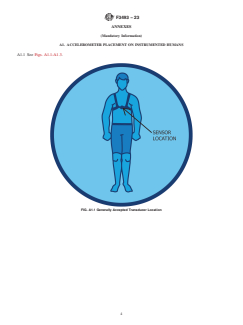
accelerometer placement on an instrumented human.
9.1 The calibration performance specifications shall follow
the specifications in Practice F2137-19, Section 8.
11. Procedure
11.1 When testing the nominal dynamic characteristics of
10. Transducer Location and Mounting for Instrumented
amusement rides and devices that have characteristics that may
Humans
change, the water slide shall be operated for a minimum of
10.1 Transducer location, orientation, and mounting method
three full cycles prior to data collection.
shall be consistent with the intended test objectives and
11.2 It is possible that the unique characteristics of a
generally accepted instrumentation and engineering practice.
particular water slide or other circumstances are such that it is
(See Annex A1.)
not reasonable to test in strict conformance with one or more
10.2 To avoid distortion in the data channel values, accel-
provisions of this practice. It is acceptable to alter one or more
erometers shall be mounted to minimize relative motion
provisions of this practice when unique characteristics of a
between the transducer and the instrumented surface. It is
particular water slide or other circumstances do not allow strict
acceptable to perform an analytical or experimental evaluation
conformance with this practice. Any deviation(s) from the
of transducer mounting effects on the data channel (See
provisions of this practice shall be recorded to clearly provide
Practice F2137-19, Section 12.1.6).
a description of the specific deviation(s) and a summary of why
a deviation was necessary. Pictures and documentation shall be
10.3 Refer to Practice F2137-19 section 9.2.2 when multi-
recorded to adequately explain a specific testing arrangement
axis accelerations at a point are to be measured.
or protocol deviation. In the absence of the designer/engineer
10.4 Transducers shall be oriented and mounted such that
the justification shall include a review by a biodynamic expert.
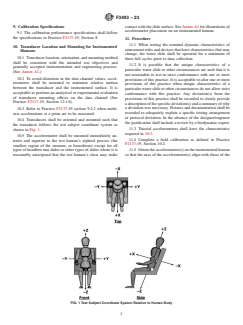
the transducer follows the test subject coordinate system as
11.3 Triaxial accelerometers shall have the characteristics
shown in Fig. 1.
required in 10.3.
10.5 The accelerometer shall be mounted immediately an-
11.4 Complete a field calibration as defined in Practice
terior and superior to the test human’s xiphoid process (the
F2137-19, Section 10.2.
smallest region of the sternum, or breastbone) except for all
types of headfirst mat slides or other types of slides where it is 11.5 Orient the accelerometer(s) on the instrumented human
reasonably anticipated that the test human’s chest may make so that the axes of the accelerometer(s) align with those of the
FIG. 1 Test Subject Coordinate System Relative to Human Body
...