

ASTM D4383-21
(Specification)Standard Specification for Plowable, Raised Retroreflective Pavement Markers
General Information
- Abstract
ABSTRACT
This specification covers a type of plowable, retroreflective, raised pavement marker for lane marking and delineation. Retroreflective markers are intended for nighttime visibility. Markers shall be classified as to type, color, and intended application. The types of markers are: type A, type B, and type E. The colors of markers are: white, yellow, red, blue, and green. The intended applications of markers are: marker to be mounted in a holder, and marker to be mounted in a recess. The construction requirements for retroreflective markers are presented in details. The coefficient of luminous intensity, abrasion resistance, compressive strength, and impact strength shall be tested to meet the requirements specified. The holder ramp hardness shall be tested to meet the requirements prescribed.
SCOPE
1.1 This specification covers several types of plowable, retroreflective pavement markers for lane marking and delineation.
1.2 Retroreflective markers are intended for nighttime visibility under both wet and dry conditions.
1.3 The values stated in inch-pound units are to be regarded as the standard, except where noted in the document. The values given in parentheses are mathematical conversions to SI units that are provided for information only and are not considered standard.
1.4 The text of this standard references notes and footnotes which provide explanatory material. These notes and footnotes (excluding those in tables and figures) shall not be considered as requirements of the standard.
1.5 The following precautionary caveat pertains only to the test methods portion, Section 10, of this specification: This standard does not purport to address all of the safety concerns, if any, associated with its use. It is the responsibility of the user of this standard to establish appropriate safety, health, and environmental practices and determine the applicability of regulatory limitations prior to use.
1.6 This international standard was developed in accordance with internationally recognized principles on standardization established in the Decision on Principles for the Development of International Standards, Guides and Recommendations issued by the World Trade Organization Technical Barriers to Trade (TBT) Committee.
- Status
- Published
- Publication Date
- 14-Dec-2021
- Technical Committee
- D04 - Road and Paving Materials
- Drafting Committee
- D04.38 - Highway Traffic Control Materials
Buy Documents
ASTM D4383-21 - Standard Specification for Plowable, Raised Retroreflective Pavement Markers
REDLINE ASTM D4383-21 - Standard Specification for Plowable, Raised Retroreflective Pavement Markers
Overview
ASTM D4383-21 is the internationally recognized standard specification for plowable, raised retroreflective pavement markers. Developed by ASTM International, this standard outlines the requirements, classifications, and test methods for retroreflective pavement markers designed for lane marking and roadway delineation. These markers are specifically engineered for enhanced nighttime visibility in both wet and dry conditions, improving road safety by helping drivers identify lanes and road features in low-light environments.
Key Topics
Marker Classification:
- Types:
- Type A: Two-way retroreflective marker (one color)
- Type B: One-way retroreflective marker (one color)
- Type E: Two-way retroreflective marker (two colors)
- Colors: White, yellow, red, blue, and green
- Categories (Intended Applications):
- Category 1: Marker mounted in a metallic holder, protruding above pavement
- Category 2: Marker in a nonmetallic holder with protective rails, protruding above pavement
- Category 3: Marker recessed below pavement in a nonmetallic holder
- Category 4: Conventional, nonplowable marker recessed below pavement
- Types:
Performance Requirements:
- Retroreflectivity: Markers must meet minimum coefficients of luminous intensity to ensure visibility
- Color: Retroreflected light must fall within defined chromaticity coordinates for each color
- Abrasion and Impact Resistance: Markers undergo rigorous abrasion and impact tests to verify durability
- Compressive Strength: Must support significant loads without permanent deformation
- Temperature Cycling: Resistance to cracking or delamination after exposure to temperature extremes
- Holder Ramp Hardness: Holders for protruding markers must meet specific hardness levels to withstand plow impacts
Ordering and Marking:
Clear guidelines are provided for specifying marker quantity, type, color, and holder design during procurementAdhesives:
Specifications for bituminous adhesives suitable for installing markers on concrete, asphalt, and chip-sealed surfaces
Applications
Roadway Lane Marking and Delineation:
Plowable, raised retroreflective pavement markers are essential for marking traffic lanes, delineating road features, and providing guidance in tunnels, curves, intersections, and hazardous locations.Snow-Prone and High-Traffic Areas:
The design of these markers ensures resistance to damage from snowplows, making them ideal for regions with frequent snow removal operations. Their durability under vehicle loads and abrasive conditions ensures long-lasting performance in demanding environments.Nighttime and Low-Visibility Conditions:
Retroreflective properties significantly increase driver visibility at night or during adverse weather, contributing to highway safety.Multicolor Applications:
Use of white, yellow, red, blue, or green markers allows for differentiation of lane designations, emergency routes, and special zones.
Related Standards
- ASTM D4280: Specification for extended life type, nonplowable, raised retroreflective pavement markers
- ASTM A536: Specification for ductile iron castings (used in marker holders)
- ASTM D4402: Test methods for determination of asphalt viscosity
- AASHTO M237: Epoxy resin adhesives for bonding markers to pavements
- ASTM E809: Practice for measuring photometric characteristics of retroreflectors
Practical Value
- Increased Road Safety:
Compliant markers ensure reliable guidance for motorists, particularly at night and in inclement weather. - Long-Term Cost Savings:
Enhanced durability reduces maintenance frequency and replacement costs on high-traffic and plow-prone roads. - Regulatory Compliance:
Following ASTM D4383-21 helps agencies meet requirements for retroreflective pavement marker use on highways and urban road networks.
Adhering to the ASTM D4383-21 standard is essential for transportation agencies, contractors, and manufacturers involved in road marking and highway safety infrastructure, ensuring that plowable, raised retroreflective pavement markers deliver consistent performance and contribute to safer roadways.
Relations
- Effective Date
- 01-Dec-2023
- Effective Date
- 01-Dec-2023
- Effective Date
- 15-Jun-2020
- Effective Date
- 01-May-2020
- Effective Date
- 15-Dec-2019
- Effective Date
- 01-Dec-2019
- Effective Date
- 01-May-2019
- Effective Date
- 01-Apr-2019
- Effective Date
- 15-Dec-2018
- Effective Date
- 01-Jul-2018
- Effective Date
- 01-Jul-2018
- Effective Date
- 01-Jul-2017
- Effective Date
- 01-May-2017
- Effective Date
- 01-Jan-2016
- Effective Date
- 15-Sep-2015
Buy Documents
ASTM D4383-21 - Standard Specification for Plowable, Raised Retroreflective Pavement Markers
REDLINE ASTM D4383-21 - Standard Specification for Plowable, Raised Retroreflective Pavement Markers
Get Certified
Connect with accredited certification bodies for this standard

Zavod za gradbeništvo Slovenije (ZAG) - Inšpekcija
ZAG inspection body for construction products, structures, and materials.
Sponsored listings
Frequently Asked Questions
ASTM D4383-21 is a technical specification published by ASTM International. Its full title is "Standard Specification for Plowable, Raised Retroreflective Pavement Markers". This standard covers: ABSTRACT This specification covers a type of plowable, retroreflective, raised pavement marker for lane marking and delineation. Retroreflective markers are intended for nighttime visibility. Markers shall be classified as to type, color, and intended application. The types of markers are: type A, type B, and type E. The colors of markers are: white, yellow, red, blue, and green. The intended applications of markers are: marker to be mounted in a holder, and marker to be mounted in a recess. The construction requirements for retroreflective markers are presented in details. The coefficient of luminous intensity, abrasion resistance, compressive strength, and impact strength shall be tested to meet the requirements specified. The holder ramp hardness shall be tested to meet the requirements prescribed. SCOPE 1.1 This specification covers several types of plowable, retroreflective pavement markers for lane marking and delineation. 1.2 Retroreflective markers are intended for nighttime visibility under both wet and dry conditions. 1.3 The values stated in inch-pound units are to be regarded as the standard, except where noted in the document. The values given in parentheses are mathematical conversions to SI units that are provided for information only and are not considered standard. 1.4 The text of this standard references notes and footnotes which provide explanatory material. These notes and footnotes (excluding those in tables and figures) shall not be considered as requirements of the standard. 1.5 The following precautionary caveat pertains only to the test methods portion, Section 10, of this specification: This standard does not purport to address all of the safety concerns, if any, associated with its use. It is the responsibility of the user of this standard to establish appropriate safety, health, and environmental practices and determine the applicability of regulatory limitations prior to use. 1.6 This international standard was developed in accordance with internationally recognized principles on standardization established in the Decision on Principles for the Development of International Standards, Guides and Recommendations issued by the World Trade Organization Technical Barriers to Trade (TBT) Committee.
ABSTRACT This specification covers a type of plowable, retroreflective, raised pavement marker for lane marking and delineation. Retroreflective markers are intended for nighttime visibility. Markers shall be classified as to type, color, and intended application. The types of markers are: type A, type B, and type E. The colors of markers are: white, yellow, red, blue, and green. The intended applications of markers are: marker to be mounted in a holder, and marker to be mounted in a recess. The construction requirements for retroreflective markers are presented in details. The coefficient of luminous intensity, abrasion resistance, compressive strength, and impact strength shall be tested to meet the requirements specified. The holder ramp hardness shall be tested to meet the requirements prescribed. SCOPE 1.1 This specification covers several types of plowable, retroreflective pavement markers for lane marking and delineation. 1.2 Retroreflective markers are intended for nighttime visibility under both wet and dry conditions. 1.3 The values stated in inch-pound units are to be regarded as the standard, except where noted in the document. The values given in parentheses are mathematical conversions to SI units that are provided for information only and are not considered standard. 1.4 The text of this standard references notes and footnotes which provide explanatory material. These notes and footnotes (excluding those in tables and figures) shall not be considered as requirements of the standard. 1.5 The following precautionary caveat pertains only to the test methods portion, Section 10, of this specification: This standard does not purport to address all of the safety concerns, if any, associated with its use. It is the responsibility of the user of this standard to establish appropriate safety, health, and environmental practices and determine the applicability of regulatory limitations prior to use. 1.6 This international standard was developed in accordance with internationally recognized principles on standardization established in the Decision on Principles for the Development of International Standards, Guides and Recommendations issued by the World Trade Organization Technical Barriers to Trade (TBT) Committee.
ASTM D4383-21 is classified under the following ICS (International Classification for Standards) categories: 93.080.20 - Road construction materials. The ICS classification helps identify the subject area and facilitates finding related standards.
ASTM D4383-21 has the following relationships with other standards: It is inter standard links to ASTM D4280-23, ASTM E808-23, ASTM E811-09(2020)e1, ASTM D36/D36M-14(2020), ASTM D5/D5M-19a, ASTM D71-94(2019), ASTM A536-84(2019)e1, ASTM D3111-19, ASTM D3111-10(2018), ASTM E18-18, ASTM D4280-18, ASTM E18-17, ASTM E308-17, ASTM E808-01(2016), ASTM D4280-15. Understanding these relationships helps ensure you are using the most current and applicable version of the standard.
ASTM D4383-21 is available in PDF format for immediate download after purchase. The document can be added to your cart and obtained through the secure checkout process. Digital delivery ensures instant access to the complete standard document.
Standards Content (Sample)
This international standard was developed in accordance with internationally recognized principles on standardization established in the Decision on Principles for the
Development of International Standards, Guides and Recommendations issued by the World Trade Organization Technical Barriers to Trade (TBT) Committee.
Designation:D4383 −21
Standard Specification for
Plowable, Raised Retroreflective Pavement Markers
This standard is issued under the fixed designation D4383; the number immediately following the designation indicates the year of
original adoption or, in the case of revision, the year of last revision.Anumber in parentheses indicates the year of last reapproval.A
superscript epsilon (´) indicates an editorial change since the last revision or reapproval.
1. Scope D5/D5MTest Method for Penetration of Bituminous Mate-
rials
1.1 This specification covers several types of plowable,
D36/D36MTest Method for Softening Point of Bitumen
retroreflective pavement markers for lane marking and delin-
(Ring-and-Ball Apparatus)
eation.
D71Test Method for Relative Density of Solid Pitch and
1.2 Retroreflective markers are intended for nighttime vis-
Asphalt (Displacement Method)
ibility under both wet and dry conditions.
D92Test Method for Flash and Fire Points by Cleveland
1.3 Thevaluesstatedininch-poundunitsaretoberegarded Open Cup Tester
as the standard, except where noted in the document. The
D113Test Method for Ductility of Asphalt Materials
valuesgiveninparenthesesaremathematicalconversionstoSI
D1785Specification for Poly(Vinyl Chloride) (PVC) Plastic
units that are provided for information only and are not
Pipe, Schedules 40, 80, and 120
considered standard.
D3111Practice for Flexibility Determination of Hot-Melt
Adhesives by Mandrel Bend Test
1.4 The text of this standard references notes and footnotes
D4280Specification for Extended Life Type, Nonplowable,
whichprovideexplanatorymaterial.Thesenotesandfootnotes
Raised Retroreflective Pavement Markers
(excluding those in tables and figures) shall not be considered
D4402/D4402MTestMethodforViscosityDeterminationof
as requirements of the standard.
Asphalt at Elevated Temperatures Using a Rotational
1.5 The following precautionary caveat pertains only to the
Viscometer
test methods portion, Section 10, of this specification: This
E18Test Methods for Rockwell Hardness of Metallic Ma-
standard does not purport to address all of the safety concerns,
terials
if any, associated with its use. It is the responsibility of the user
E284Terminology of Appearance
of this standard to establish appropriate safety, health, and
E308PracticeforComputingtheColorsofObjectsbyUsing
environmental practices and determine the applicability of
the CIE System
regulatory limitations prior to use.
E691Practice for Conducting an Interlaboratory Study to
1.6 This international standard was developed in accor-
Determine the Precision of a Test Method
dance with internationally recognized principles on standard-
E808Practice for Describing Retroreflection
ization established in the Decision on Principles for the
E809Practice for Measuring Photometric Characteristics of
Development of International Standards, Guides and Recom-
Retroreflectors
mendations issued by the World Trade Organization Technical
E811Practice for Measuring Colorimetric Characteristics of
Barriers to Trade (TBT) Committee.
Retroreflectors Under Nighttime Conditions
2. Referenced Documents
2.2 Federal Specification:
TT-T-291Thinner,Paint,MineralSpirits,RegularandOdor-
2.1 ASTM Standards:
less
A536Specification for Ductile Iron Castings
C778Specification for Standard Sand
2.3 AASHTO Standard:
AASHTOM237EpoxyResinAdhesiveforBondingTraffic
Markers to Hardened Concrete
This specification is under the jurisdiction ofASTM Committee D04 on Road
and Paving Materials and is the direct responsibility of Subcommittee D04.38 on
Highway Traffic Control Materials.
Current edition approved Dec. 15, 2021. Published January 2022. Originally
approved in 1984. Last previous edition approved in 2018 as D4383–18. DOI: AvailablefromU.S.GovernmentPrintingOfficeSuperintendentofDocuments,
10.1520/D4383-21. 732 N. Capitol St., NW, Mail Stop: SDE, Washington, DC 20401, http://
For referenced ASTM standards, visit the ASTM website, www.astm.org, or www.access.gpo.gov.
contact ASTM Customer Service at service@astm.org. For Annual Book of ASTM Available from American Association of State Highway and Transportation
Standards volume information, refer to the standard’s Document Summary page on Officials (AASHTO), 444 N. Capitol St., NW, Suite 249, Washington, DC 20001,
the ASTM website. http://www.transportation.org.
Copyright © ASTM International, 100 Barr Harbor Drive, PO Box C700, West Conshohocken, PA 19428-2959. United States
D4383−21
3. Terminology 4.1.2.3 R—Red,
4.1.2.4 B—Blue, and
3.1 Definitions:
4.1.2.5 G—Green.
3.1.1 cleanability—the ability of a retroreflective marker to
4.1.3 Intended Application of Markers:
keep its optical surfaces clean under traffic and environmental
4.1.3.1 Category 1: Marker mounted in a metallic holder
conditions.
and installed in a plunge cut in the pavement in such a manner
3.1.2 coeffıcient of luminous intensity, R —the ratio of the
I
that the marker protrudes above the pavement surface.
luminous intensity (I) of the retroreflector in the direction of
4.1.3.2 Category 2: Marker mounted in a holder consisting
observation to the illuminance (E) at the retroreflector on a
of a nonmetallic body with metallic rails that provide the
plane perpendicular to the direction of the incident light,
marker protection from the plows and installed in a plunge cut
expressed in candelas per lux (cd/lx) (see Practice E808 and
in the pavement in such a manner that the marker protrudes
Terminology E284).
above the pavement surface.
3.1.2.1 Discussion—Thevaluespresentedforthecoefficient
4.1.3.3 Category3:Markermountedinanonmetallicholder
of luminous intensity are presented in SI units, which are the
and installed in a plunge cut groove in the pavement in such a
acceptedworldwidenormforexpressingthisvalue,ratherthan
manner that the marker is recessed below the pavement
in inch-pounds units. When values are low, the coefficient of
surface.
(retroreflected) luminous intensity may be given in millican-
4.1.3.4 Category 4: Conventional, nonplowable marker in-
delas per lux. In inch-pound units, R is given in candelas per
I
stalled in a recess below the pavement surface.
foot-candle (cd/fc). Historically, the term “specific intensity”
4.1.4 Show classification in the order detailed in 4.1.1 –
and symbol “SI” have been used to designate this term, but
4.1.3: type, color, and category.
“R” is preferred.
I
4.2 Category 1 and 2 holders shall be classified as to the
3.1.3 color—expressed by chromaticity coordinates accord-
design installed height of the holder above the pavement
ing to the CIE (Commission Internationale de l’Eclairage
surface.
1931) standard colorimetric system.
4.3 Category 3 holders shall be classified as to the designed
3.1.4 horizontal entrance angle—the angle in the horizontal
depth of both the groove and the plunge cut for marker
plane between the direction of incident light and the normal to
placementthatwouldallowthemarkerresidingintheholderto
the leading edge of the marker.
bepositionedbelowthesurfaceofthepavementataminimum
3.1.4.1 Discussion—This angle corresponds to the entrance
of 0.12 in. (3.0 mm).
angle component β2 when the marker is positioned for pho-
4.4 Category4markersshallbeclassifiedastothedesigned
tometry. (See Practice E808.) The direction given in Practice
depth of the cut for placement that would allow the marker to
E808 should be used when designating this angle.
bepositionedbelowthesurfaceofthepavementataminimum
3.1.5 observation angle—the angle at the reflector between
of 0.06 in. (1.5 mm).
the illumination axis and the observation axis. (See Practice
E808.)
5. Ordering Information
3.2 Definitions of Terms Specific to This Standard:
5.1 Orders for markers under this specification should
3.2.1 retroreflective pavement markers, retroreflective
include the following information:
marker, and marker—usedinterchangeablyinthisspecification
5.1.1 Quantity,
to refer to a molded plastic prismatic retroreflector, the reflect-
5.1.2 Type of marker—retroreflective one-way or retrore-
ing area of which is covered with an abrasion-resistant lens
flective two-way, and
surface.Thetermsdonotincludetheholdersometimesusedto
5.1.3 Color of marker.
protect markers from plow blades where the lens is positioned
5.2 Orders for holders under this specification should in-
above the pavement surface or used to hold the lens when
clude the following information:
positioned below the pavement surface (inlaid). The holder
5.2.1 Design installed maximum height of the holder for
maybemetallic,nonmetallic,oracombinationofbothmetallic
Category 1 and 2 markers.
and nonmetallic components.
5.2.2 Design installed length and minimum depth of the
groove and placement and minimum depth of the plunge cut
4. Classification
for Category 3 markers.
4.1 Markers shall be classified as to type, color, and
6. Performance Requirements
category (intended application).
4.1.1 Types of Markers: 6.1 Retroreflectivity:
4.1.1.1 TypeA—Two-wayretroreflectivemarkers,onecolor. 6.1.1 For new markers, coefficient of luminous intensity
4.1.1.2 Type B—One-wayretroreflectivemarkers,onecolor.
(RI) measured in accordance with 10.1 shall be not less than
4.1.1.3 Type E—Two-way retroreflective marker, two col- the values in Table 1.
ors. 6.1.2 After abrading the marker per 10.2, coefficient of
4.1.2 Color of Markers: luminous intensity at 0° entrance angle measured in accor-
4.1.2.1 W—White, dance with 10.1 shall be not less than the values in Table 1
4.1.2.2 Y—Yellow, multiplied by 0.5.
D4383−21
TABLE 1 Coefficient of Luminous Intensity R
I Point No. xy
1 0.310 0.348
NOTE 1—The retroreflector axis and datum axis of the marker are as
2 0.453 0.440
shown in Figs. 2 and 3.
3 0.500 0.440
4 0.500 0.380
NOTE 2—Entrance angle component β1 and rotation angle ε are 0°.
5 0.440 0.380
6 0.310 0.283
NOTE 3—The values presented for the coefficient of luminous intensity
in the table are given in SI units, which are the accepted worldwide norm
6.2.2 Yellow:
for expressing this value, rather than in inch-pound units. The values in
Point No. xy
cd/fc are provided for information.
1 0.545 0.424
Observation
Minimum Value R, mcd/lx 2 0.559 0.439
Entrance Angle I
Angle
3 0.609 0.390
β2
White Yellow Red Green Blue
α
4 0.597 0.390
0° 0.2° 279 167 70 93 26
6.2.3 Red:
+20° ⁄−20° 0.2° 112 67 28 37 10
Observation
Minimum Value R, cd/fc
I
Entrance Angle Point No. xy
Angle
β2 1 0.650 0.330
White Yellow Red Green Blue
α
2 0.668 0.330
0° 0.2° 3.0 1.8 0.75 1.0 0.28
3 0.734 0.265
+20° ⁄−20° 0.2° 1.2 0.72 0.30 0.40 0.11
4 0.721 0.259
6.2.4 Blue:
Point No. xy
1 0.039 0.320
NOTE 1—No laboratory abrasion test has been established for markers
2 0.160 0.320
having biconvex optical elements.
3 0.160 0.240
NOTE 2—Some two-color markers may intentionally have only one of
4 0.183 0.218
the retroreflective faces abrasion resistant, in which case the second face
5 0.088 0.142
should not be abraded.
6.2.5 Green:
NOTE 3—No laboratory abrasion test can be expected to model the full
range of surface wear of pavement markers in use.
Point No. xy
1 0.009 0.733
6.2 Color—When the retroreflector is illuminated by a CIE
2 0.288 0.520
Standard Source A and when measured in accordance with
3 0.209 0.395
10.3, the color of the retroreflected light shall fall within the 4 0.012 0.494
color gamuts given by the following corner points and shown
6.3 Lens Impact Strength—When impacted in accordance
in Fig. 1:
with 10.4.2, the face of the lens shall show no more than two
radial cracks longer than 0.25 in. (6.4 mm). There shall be no
radial cracks extending to the edge of the abrasion-resistant
area. There shall be no delamination.
6.4 Temperature Cycling—When subjected to temperature
cyclinginaccordancewith10.4.3,thereshallbenocrackingor
delamination.
6.5 Adhesive Bond Strength—Because no practical labora-
tory procedures have been determined to provide complete,
reliable,andpredictiveinformationonadhesivebondstrength,
the user is encouraged to seek information from alternative
sources such as field tests. A field test of duration twelve
months is recommended. A control marker is chosen with
knownsatisfactoryadhesion.Thetestmarkersmayberequired
to experience no more than 1.5× as great an adhesion failure
rate as the controls. The test severity should be such that
between 3 % and 20 % of the controls fail during the field test.
There must be adequate numbers of test markers and controls
for statistical validity.
6.6 Compressive Strength—Tested in accordance with 10.5,
a marker shall support a load of 6000 lbf (26700 N, 2720 kgf)
without breakage or significant deformation of the marker.
Significant permanent deformation shall be understood to be
0.13 in. (3.2 mm). For markers laminated to an elastomeric
pad, remove the pad before testing.
FIG. 1Color Gamut per 6.2
6.7 Ramp Hardness of Category 1 and 2 Holders—
Measured in accordance with 10.6, the hardness of the ramps
6.2.1 White: shall be 51-55 HRC.
D4383−21
7. Construction Requirements for Retroreflective 7.4.1 The holder shall be constructed of a nonmetallic
Markers material of sufficient strength to withstand the environmental
conditions to which it is exposed during in-service life.
7.1 To withstand plowing, snow-plowable retroreflective
7.4.2 The installed depth of the holder shall not exceed
markers are protected either by recessing within a groove
1.0in. (25.4 mm) below the road surface.
below the pavement surface (see Appendix X1), mounting
7.4.3 The holder shall be designed to be recessed below the
within a holder having metal ramps to deflect plow blades,
pavement surface to withstand plow impact. It shall have
mounting in a nonmetallic holder and recessing within a
means for indexing the pavement surface, such as tabs.
groove below the pavement surface, or by other methods
7.4.4 Other holder constructions may be acceptable at the
approved by the purchaser.
option of the purchaser following a six-month road test during
7.2 Retroreflective Markers:
the time of the year when weather conditions are most critical
7.2.1 The marker shall be comprised of materials with
to determine durability.
adequate chemical, water, and UV resistance for the intended
use.
8. Sampling
7.2.2 The marker width shall be approximately 4 in.
8.1 For markers supplied not mounted in holders, 26 mark-
(102mm).
ers selected at random will constitute a representative sample
7.2.3 Theanglebetweenthefaceofthemarkerandthebase
foreachlotconsistingof10000markersorless.Fortymarkers
shall be no greater than 45°.
will constitute a representative sample for lots consisting of
7.2.4 Markers to be mounted in a holder may preferably be
morethan10000markers.Thelotsizeshallnotexceed25000
laminated to an elastomeric pad.
markers.
7.2.5 The base of the marker shall be flat within 0.05 in.
8.2 For markers supplied mounted in holders, the purchaser
(1.3mm). If the bottom of the marker is configurated, the
may require the sample quantities specified in 8.1 or, alterna-
outermost faces of the configurations shall not deviate more
tivelyforpracticalityoftesting,mayrequiretensamplesofthe
than 0.05 in. (1.3 mm) from a flat surface.
markers installed in holders and, in addition, require that the
7.2.6 Other construction meeting the performance require-
manufacturersubmit26or40loosemarkers,asin8.1,certified
ments will be acceptable following a six-month road test
to be representative of the markers shipped in holders.
duringthetimeoftheyearwhenweatherandtrafficconditions
are most critical to determine cleanability and durability.
9. Number of Tests and Retests
7.3 Category 1 and 2 Holders(designedtopositionthelens
9.1 For coefficient of luminous intensity before abrasion
above the pavement surface):
(6.1), the entire sample of retroreflective pavement markers
7.3.1 The installed height of the holder shall not exceed
shall be photometered in accordance with 10.1. The failure of
0.43in. (10.9 mm) above the road surface.
more than 10% of the retroreflective faces shall be cause for
7.3.2 The Category 1 holders and the ramps of Category 2
rejection of the entire lot represented by the sample.
holders shall be nodular iron, conforming to Specification
9.2 Forabrasionresistance(6.1.2),fourretroreflectivefaces
A536, Grade 80-55-06, hardened to 51-55 HRC, when tested
passing the photometric requirements of 6.1 shall be subjected
according to Test Methods E18.
to abrasion in accordance with 10.2 and rephotometered in
7.3.3 To minimize plow blade impact and damage to the
accordance with 10.1; the failure of more than one retroreflec-
casting, the plow blade deflecting ramps of the holder shall be
tive face shall be cause for rejection of the entire lot.
angled not more than 6° to the surface of the road.
9.3 For compressive strength (6.6) and color (6.2), three
7.3.4 The ramps shall be so designed that there shall be no
vertical surfaces above the road level that can be contacted by specimens shall be tested for each requirement. Specimens
previouslysubjectedtomeasurementofcoefficientofluminous
the plow blade moving in the normal travel direction of the
road. intensity before abrasion (10.1), measurement of abrasion
resistance (10.2), and to color tests may be used for tests of
7.3.5 Surfaces of the holder shall be free of scale, dirt, rust,
compressive strength. Failure of more than one specimen shall
oil, grease, or any other contaminant which may reduce its
be cause for rejection of the lot.
bond to the adhesive with which the holder is installed or with
which the marker is mounted.
9.4 For lens impact strength (6.3), resistance to temperature
7.3.6 The holder shall be designed to be partially recessed
cycling (6.4), and ramp hardness of holders (6.7), ten speci-
below the pavement surface to withstand plow impact. It shall
mensshallbetestedforeachrequirement.Failureofmorethan
have means for indexing the pavement surface, such as tabs.
oneofthespecimensinanyonetestshallbecauseforrejection
7.3.7 Other holder constructions may be acceptable at the of the entire lot.
option of the purchaser following a six-month road test during
9.5 In the event of failure that would result in rejection of a
the time of the year when weather conditions are most critical
lot, and at the direction of the purchaser, a resample may be
to determine durability.
taken consisting of double the number of samples originally
7.4 Category 3 Holders(designedtopositionthelensbelow taken. Tolerances for resamples shall be in the same ratio as
the pavement surface): specified in 9.1 – 9.4.
D4383−21
10. Test Methods 10.1.4.1 The calculations, results, and terminology used to
prepare this statement follow Practice E691.
10.1 Coeffıcient of Luminous Intensity:
10.1.4.2 A set of markers conforming to this specification
10.1.1 Procedure—Measure coefficient of luminous inten-
was photometered at six laboratories. The set comprised 150
sity in accordance with Practice E809.Angular aperture of the
lenses, equally divided among the five colors of 6.2 and also
source and angular aperture of the receiver shall each be no
equallydividedamongthreeopticaltypes:thosehavingprisms
larger than 0.1°. Angular aperture of the retroreflective ele-
approximately 0.1 in. (2.5 mm) in diameter; those having
ments shall be no larger than 0.02°. If the retroreflective
prisms approximately 0.012 in. (0.3 mm) in diameter; and
elements are no larger than 0.21 in. (5.3 mm) diameter,
those having discrete biconvex elements.
suggested test dimensions are 50 ft (15.2 m) distance, 1.0 in.
(25.4 mm) diameter receptor and 1.0 in. (25.4 mm) diameter
NOTE 4—The sample markers met the dimensional requirements of
source. Other test distances are acceptable, provided that the Specification D4280. The results of the interlaboratory study are appli-
cablealsotomarkersmeetingthedimensionalrequirementsofthepresent
stated angular aperture requirements are met and that the
specification.
marker subtends no more than 1° at the source. Measure the
10.1.4.3 Each laboratory photometered each lens at 0.2°
distance from the light source exit pupil to the center of the
observationangleateachof0°,+20°,and–20°entranceangles
retroreflective face of the marker.The base of the marker shall
lie on a plane parallel to the illumination axis and perpendicu- in accordance with 10.1.1, and the measurements were re-
peated on a second day.
lar to the observation half-plane. Refer to Figs. 2 and 3 and
Practice E809. Any vertical surfaces on the marker, for 10.1.4.4 The precision statistics are given in Table 2. For
eachlens,precisionstatisticswerecalculatedaspercentagesof
example, on its leading edge, that could specularly reflect the
source into the receiver shall be covered. The tolerance on the interlaboratory mean R value for that lens. The precision
I
statistics were averaged over the ten specimens of like color
entrance angle shall be 60.5°. Maintain laboratory and condi-
tion markers to 73.4 6 3.6°F (23 6 2°C), 50 6 25 % RH. and optical type. The precision statistics for +20° entrance
angle and for –20° entrance angle were averaged for the
10.1.2 If the markers are mounted in a holder, photometer
the markers in the holder, and if the holder shadows the reported 620° entrance angle. The differences in precision
statistics among the five colors were small enough to allow
retroreflective area, divide the measured coefficient of lumi-
nous intensity by the ratio of the unshadowed retroreflective average values to be reported. The differences in precision
statistics among the three optical types were small enough to
area to the total retroreflective area for comparison with Table
1. allow average values to be reported.
10.1.3 Before photometry, gently wipe the face of the 10.1.4.5 There is no estimate of bias. There is no reference
marker with a soft damp towel, then dry with a soft towel. laboratory in NorthAmerica by which to establish bias for this
10.1.4 Interlaboratory Study of Precision: measurement.
FIG. 2Position of Marker for Photometry, 0° Entrance Angle
D4383−21
FIG. 3Position of Marker for Photometry, +20° Entrance Angle
TABLE 2 Precision for Coefficient of Luminous Intensity
10.2.7 The abrasion resistance test shall be performed at 25
S S r R 6 5°C and 50 6 25 % RH, with the markers pre-conditioned
r R
Entrance Repeatability Reproducibility 95 % 95 %
to those ranges.
Angle Standard Standard Repeatability Reproducibility
10.2.8 Abrasion Apparatus:
Deviation Deviation Limit Limit
0° 1.5 % 6.7 % 4.1 % 18.5 %
10.2.8.1 Theapparatusshallconsistofaverticalpipewitha
±20° 4.0 % 9.0 % 11.1 % 25.0 %
sieve at the top, a calibration aperture with deflectors at the
bottom, a marker support, and a means for collecting the sand
that passes through the calibration aperture.
10.2.8.2 Sand shall fall within the full unobstructed pipe
10.2 Abrasion Resistance:
from the sieve to the plane of the calibration aperture.
10.2.1 The abrasion resistance test method is only appli-
10.2.8.3 The pipe shall have inner diameter at least 5.9 in.
cable to markers having a smooth, continuous lens surface.
(15 cm). Smooth plastic pipe conforming to Specification
10.2.2 Sand shall fall 9.8 6 0.1 ft (3.00 6 0.03 m)
D1785 may be used. The pipe shall be within 0.2° of vertical.
uniformly onto the front of a marker having its retroreflector
10.2.8.4 The sieve shall be used to establish the beginning
axis vertical. Distance shall be measured to the marker’s
point of the sand drop and also to limit sand flow. Sand may
leading edge.
fall no more than 1.2 in. (3 cm) onto the sieve.
10.2.3 Sand shall be natural silica sand from the St. Peters
10.2.8.5 The calibration aperture shall be formed from four
or Jordan sandstone deposits (located in the central United
sharp horizontal edges which are the upper edges of angled
States) and shall meet the requirements of Specification C778
deflectors. See Fig. 4. Sand falling within the calibration
20-30 sand, and under no circumstances shall sand labeled
aperture is not deflected; sand falling outside the calibration
“ASTM C778 Graded Sand” be substituted.
aperture is deflected away from the aperture and cannot strike
10.2.3.1 This sand is characterized by its roundness of
the marker.
grains and its exceptionally high silicon dioxide content.
10.2.4 Sand shall not be reused. 10.2.8.6 The marker shall be mounted with its leading edge
nofartherthan5.9in.(15cm)fromtheplaneofthecalibration
10.2.5 Sandshallfallatleast9.4ft(2.85m)beforereaching
aperture.Themarkershallbemountedwithnofixturingwithin
a calibration aperture, a horizontal rectangular opening 1.57 6
1cmofitsfrontface.Fixturingmustbesuchtoallowfreeflow
0.04 in. (4.0 6 0.1 cm) by 4.72 6 0.04 in. (12.0 6 0.1 cm),
ofsandaroundthemarker.Planeofmarkerbaseshallbewithin
under which the marker is centered with the marker width in
1° of vertical. Marker leading edge shall be within 2° of
the 4.72 in. (12 cm) direction.
horizontal.
10.2.6 Atotal of 2.5 6 0.05 kg of sand shall fall through a
calibration aperture at a rate maintained in the range from 0.4 10.2.8.7 All sand passing through the calibration aperture,
to 1.0 kg/min. including any that bounces off the marker, must be collected
D4383−21
FIG. 4Abrasion Resistance Test Apparatus
and weighed. Sand that does not pass through the calibration ducibility of the measurement depends primarily on the repro-
aperture must not be included in this weight. ducibility of the abrasion.
10.2.8.8 Sand must flow equally through all parts of the 10.2.9.3 The sample markers were of three types: LPG,
calibration aperture. This shall be verified by placing at least LPC, SPC, depending on their optics and front surface. LP
ten vials having approximately 0.4-in. (1-cm) mouths at the denotes having prisms approximately 0.1 in. (2.5 mm) in
heightofthemarkerundertheaperture.Whenenoughsandhas diameter and SP denotes having prisms approximately 0.01 in.
dropped through the apparatus that at least one of the vials has (0.3mm)indiameter. Gdenotesglassedand Cdenotescoated.
received at least 0.2 oz (5 g), the least filled vial shall have The markers of each type were as identical as practical
receivedatleast75%asmuchweightofsandasthemostfilled manufacturing allowed. All reflectors were white.
vial. After determining the flow stability of the apparatus,
NOTE 5—The sample markers met the dimensional requirements of
...
This document is not an ASTM standard and is intended only to provide the user of an ASTM standard an indication of what changes have been made to the previous version. Because
it may not be technically possible to adequately depict all changes accurately, ASTM recommends that users consult prior editions as appropriate. In all cases only the current version
of the standard as published by ASTM is to be considered the official document.
Designation: D4383 − 18 D4383 − 21
Standard Specification for
Plowable, Raised Retroreflective Pavement Markers
This standard is issued under the fixed designation D4383; the number immediately following the designation indicates the year of
original adoption or, in the case of revision, the year of last revision. A number in parentheses indicates the year of last reapproval. A
superscript epsilon (´) indicates an editorial change since the last revision or reapproval.
1. Scope
1.1 This specification covers a typeseveral types of plowable, retroreflective, raised retroreflective pavement markermarkers for
lane marking and delineation.
1.2 Retroreflective markers are intended for nighttime visibility.visibility under both wet and dry conditions.
1.3 The values stated in inch-pound units are to be regarded as the standard, except where noted in the document. The values given
in parentheses are mathematical conversions to SI units that are provided for information only and are not considered standard.
1.4 The text of this standard references notes and footnotes which provide explanatory material. These notes and footnotes
(excluding those in tables and figures) shall not be considered as requirements of the standard.
1.5 The following precautionary caveat pertains only to the test methods portion, Section 10, of this specification: This standard
does not purport to address all of the safety concerns, if any, associated with its use. It is the responsibility of the user of this
standard to establish appropriate safety, health, and environmental practices and determine the applicability of regulatory
limitations prior to use.
1.6 This international standard was developed in accordance with internationally recognized principles on standardization
established in the Decision on Principles for the Development of International Standards, Guides and Recommendations issued
by the World Trade Organization Technical Barriers to Trade (TBT) Committee.
2. Referenced Documents
2.1 ASTM Standards:
A536 Specification for Ductile Iron Castings
C184 Test Method for Fineness of Hydraulic Cement by the 150-μm (No. 100) and 75-μm (No. 200) Sieves (Withdrawn 2002)
C430 Test Method for Fineness of Hydraulic Cement by the 45-μm (No. 325) Sieve
C778 Specification for Standard Sand
D5D5/D5M Test Method for Penetration of Bituminous Materials
D36D36/D36M Test Method for Softening Point of Bitumen (Ring-and-Ball Apparatus)
D70 Test Method for Specific Gravity and Density of Semi-Solid Asphalt Binder (Pycnometer Method)
D71 Test Method for Relative Density of Solid Pitch and Asphalt (Displacement Method)
D92 Test Method for Flash and Fire Points by Cleveland Open Cup Tester
This specification is under the jurisdiction of ASTM Committee D04 on Road and Paving Materials and is the direct responsibility of Subcommittee D04.38 on Highway
Traffic Control Materials.
Current edition approved April 1, 2018Dec. 15, 2021. Published April 2018January 2022. Originally approved in 1984. Last previous edition approved in 20122018 as
D4383 – 12.D4383 – 18. DOI: 10.1520/D4383-18.10.1520/D4383-21.
For referenced ASTM standards, visit the ASTM website, www.astm.org, or contact ASTM Customer Service at service@astm.org. For Annual Book of ASTM Standards
volume information, refer to the standard’s Document Summary page on the ASTM website.
Copyright © ASTM International, 100 Barr Harbor Drive, PO Box C700, West Conshohocken, PA 19428-2959. United States
D4383 − 21
D113 Test Method for Ductility of Asphalt Materials
D1754 Test Method for Effects of Heat and Air on Asphaltic Materials (Thin-Film Oven Test)
D1785 Specification for Poly(Vinyl Chloride) (PVC) Plastic Pipe, Schedules 40, 80, and 120
D1856 Test Method for Recovery of Asphalt from Solution by Abson Method
D2171 Test Method for Viscosity of Asphalts by Vacuum Capillary Viscometer
D2172 Test Methods for Quantitative Extraction of Asphalt Binder from Asphalt Mixtures
D2669 Test Method for Apparent Viscosity of Petroleum Waxes Compounded with Additives (Hot Melts)
D3111 Practice for Flexibility Determination of Hot-Melt Adhesives by Mandrel Bend Test
D4280 Specification for Extended Life Type, Nonplowable, Raised Retroreflective Pavement Markers
D4402D4402/D4402M Test Method for Viscosity Determination of Asphalt at Elevated Temperatures Using a Rotational
Viscometer
D5329 Test Methods for Sealants and Fillers, Hot-Applied, for Joints and Cracks in Asphalt Pavements and Portland Cement
Concrete Pavements
E18 Test Methods for Rockwell Hardness of Metallic Materials
E284 Terminology of Appearance
E308 Practice for Computing the Colors of Objects by Using the CIE System
E691 Practice for Conducting an Interlaboratory Study to Determine the Precision of a Test Method
E808 Practice for Describing Retroreflection
E809 Practice for Measuring Photometric Characteristics of Retroreflectors
E811 Practice for Measuring Colorimetric Characteristics of Retroreflectors Under Nighttime Conditions
2.2 Federal Specification:
TT-T-291 Thinner, Paint, Mineral Spirits, Regular and Odorless
2.3 AASHTO Standard:
AASHTO M237M 237 Epoxy Resin Adhesive for Bonding Traffic Markers to Hardened Concrete
3. Terminology
3.1 Definitions:
3.1.1 cleanability—the ability of a raised retroreflective marker to keep its optical surfaces clean under traffic and environmental
conditions.
3.1.2 coeffıcient of luminous intensity, R —the ratio of the luminous intensity (I) of the retroreflector in the direction of observation
I
to the illuminance (E) at the retroreflector on a plane perpendicular to the direction of the incident light, expressed in candelas per
lux (cd/lx) (see Practice E808 and Terminology E284).
3.1.2.1 Discussion—
The values presented for the coefficient of luminous intensity are presented in SI units, which are the accepted worldwide norm
for expressing this value, rather than in inch-pounds units. When values are low, the coefficient of (retroreflected) luminous
intensity may be given in millicandelas per lux. In inch-pound units, R is given in candelas per footcandlefoot-candle (cd/fc).
I
Historically, the term “specific intensity” and symbol “SI” have been used to designate this term, but “R ” is preferred.
I
3.1.3 color—expressed by chromaticity coordinates according to the CIE (Commission Internationale de l’Eclairage 1931)
standard colorimetric system.
3.1.4 horizontal entrance angle—the angle in the horizontal plane between the direction of incident light and the normal to the
leading edge of the marker.
3.1.4.1 Discussion—
This angle corresponds to the entrance angle component β2 when the marker is positioned for photometry. (See Practice E808.)
The direction given in Practice E808 should be used when designating this angle.
3.1.5 observation angle—the angle at the reflector between the illumination axis and the observation axis. (See Practice E808.)
3.2 Definitions of Terms Specific to This Standard:
Available from U.S. Government Printing Office Superintendent of Documents, 732 N. Capitol St., NW, Mail Stop: SDE, Washington, DC 20401, http://
www.access.gpo.gov.
Available from American Association of State Highway and Transportation Officials (AASHTO), 444 N. Capitol St., NW, Suite 249, Washington, DC 20001,
http://www.transportation.org.
D4383 − 21
3.2.1 raised retroreflective pavement markers, raised retroreflective marker, retroreflective marker, and markermarker——used
interchangeably in this specification to refer to a molded plastic prismatic retroreflector, the reflecting area of which is covered with
an abrasion-resistant lens surface. The terms do not include the metal holder sometimes used to protect markers from plow
blades.blades where the lens is positioned above the pavement surface or used to hold the lens when positioned below the pavement
surface (inlaid). The holder may be metallic, nonmetallic, or a combination of both metallic and nonmetallic components.
4. Classification
4.1 Markers shall be classified as to type, color, and intended application.category (intended application).
4.1.1 Types of Markers:
4.1.1.1 Type A—Two-way retroreflective markers, one color.
4.1.1.2 Type B—One-way retroreflective markers, one color.
4.1.1.3 Type E—Two-way retroreflective marker, two colors.
4.1.2 Color of Markers:
4.1.2.1 W—White,
4.1.2.2 Y—Yellow,
4.1.2.3 R—Red,
4.1.2.4 B—Blue, and
4.1.2.5 G—Green.
4.1.3 Intended Application of Markers:
4.1.3.1 Marker to beCategory 1: Marker mounted in a holder.metallic holder and installed in a plunge cut in the pavement in such
a manner that the marker protrudes above the pavement surface.
4.1.3.2 Marker to beCategory 2: Marker mounted in a recess.holder consisting of a nonmetallic body with metallic rails that
provide the marker protection from the plows and installed in a plunge cut in the pavement in such a manner that the marker
protrudes above the pavement surface.
4.1.3.3 Category 3: Marker mounted in a nonmetallic holder and installed in a plunge cut groove in the pavement in such a manner
that the marker is recessed below the pavement surface.
4.1.3.4 Category 4: Conventional, nonplowable marker installed in a recess below the pavement surface.
4.1.4 Show classification in the order detailed in 4.1.1 – 4.1.34.1.3.2: type, color, and application.category.
4.2 Holders Category 1 and 2 holders shall be classified as to the design installed height of the holder above the
pavement.pavement surface.
4.3 Category 3 holders shall be classified as to the designed depth of both the groove and the plunge cut for marker placement
that would allow the marker residing in the holder to be positioned below the surface of the pavement at a minimum of 0.12 in.
(3.0 mm).
4.4 Category 4 markers shall be classified as to the designed depth of the cut for placement that would allow the marker to be
positioned below the surface of the pavement at a minimum of 0.06 in. (1.5 mm).
D4383 − 21
5. Ordering Information
5.1 Orders for markers under this specification should include the following information:
5.1.1 Quantity,
5.1.2 Type of marker—Retroreflectivemarker—retroreflective one-way or retroreflective two-way, and
5.1.3 Color of marker.
5.2 Orders for holders under this specification should include the following information:
5.2.1 Design installed maximum height of the holder.holder for Category 1 and 2 markers.
5.2.2 Design installed length and minimum depth of the groove and placement and minimum depth of the plunge cut for Category
3 markers.
6. Performance Requirements
6.1 Retroreflectivity:
6.1.1 For new markers, coefficient of luminous intensity (RI) measured in accordance with 10.1 shall be not less than the values
in Table 1.
6.1.2 After abrading the marker per 10.2, coefficient of luminous intensity at 0° entrance angle measured in accordance with 10.1
shall be not less than the values in Table 1 multiplied by 0.5.
TABLE 1 Coefficient of Luminous Intensity R
I
NOTE 1—The retroreflector axis and datum axis of the marker are as
shown in Figs. 2 and 3.
NOTE 2—Entrance angle component β1 and rotation angle ε are 0°.
NOTE 3—The values presented for the coefficient of luminous intensity
in the table are given in SI units, which are the accepted worldwide norm
for expressing this value, rather than in inch-pound units. The values in
cd/fc are provided for information.
Observation
Minimum Value R , mcd/lx
I
Entrance Angle
Angle
β2
White Yellow Red Green Blue
α
0° 0.2° 279 167 70 93 26
+ 20° ⁄−20° 0.2° 112 67 28 37 10
0° 0.2° 279 167 70 93 26
+20° ⁄−20° 0.2° 112 67 28 37 10
Observation
Minimum Value R , cd/fc
I
Entrance Angle
Angle
β2
White Yellow Red Green Blue
α
0° 0.2° 3.0 1.8 0.75 1.0 0.28
+ 20° ⁄−20° 0.2° 1.2 0.72 0.30 0.40 0.11
0° 0.2° 3.0 1.8 0.75 1.0 0.28
+20° ⁄−20° 0.2° 1.2 0.72 0.30 0.40 0.11
D4383 − 21
NOTE 1—No laboratory abrasion test has been established for markers having biconvex optical elements.
NOTE 2—Some two-color markers may intentionally have only one of the retroreflective faces abrasion resistant, in which case the second face should
not be abraded.
NOTE 3—No laboratory abrasion test can be expected to model the full range of surface wear of pavement markers in use.
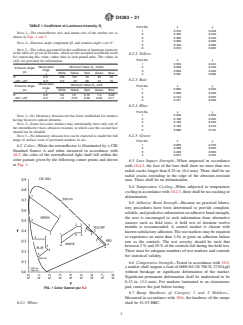
6.2 Color—When the retroreflector is illuminated by a CIE Standard Source A and when measured in accordance with 10.3, the
color of the retroreflected light shall fall within the color gamuts given by the following corner points and shown in Fig. 1:
FIG. 1 Color Gamut per 6.2
6.2.1 White:
Point No. x y
1 0.310 0.348
2 0.453 0.440
3 0.500 0.440
4 0.500 0.380
5 0.440 0.380
6 0.310 0.283
6.2.2 Yellow:
Point No. x y
1 0.545 0.424
2 0.559 0.439
3 0.609 0.390
4 0.597 0.390
6.2.3 Red:
D4383 − 21
Point No. x y
1 0.650 0.330
2 0.668 0.330
3 0.734 0.265
4 0.721 0.259
6.2.4 Blue:
Point No. x y
1 0.039 0.320
2 0.160 0.320
3 0.160 0.240
4 0.183 0.218
5 0.088 0.142
6.2.5 Green:
Point No. x y
1 0.009 0.733
2 0.288 0.520
3 0.209 0.395
4 0.012 0.494
6.3 Lens Impact Strength—When impacted in accordance with 10.4.2, the face of the lens shall show no more than two radial
cracks longer than 0.25 in. (6.4 mm). There shall be no radial cracks extending to the edge of the abrasion-resistant area. There
shall be no delamination.
6.4 Temperature Cycling—When subjected to temperature cycling in accordance with 10.4.3, there shall be no cracking or
delamination.
6.5 Adhesive Bond Strength—Because no practical laboratory procedures have been determined to provide complete, reliable, and
predictive information on adhesive bond strength, the user is encouraged to seek information from alternative sources such as field
tests. A field test of duration twelve months is recommended. A control marker is chosen with known satisfactory adhesion. The
test markers may be required to experience no more than 1.5 times 1.5× as great an adhesion failure rate as the controls. The test
severity should be such that between 3 % and 20 % of the controls fail during the field test. There must be adequate numbers of
test markers and controls for statistical validity.
6.6 Compressive Strength—Tested in accordance with 10.5, a marker shall support a load of 6000 lbf (26 700 N, 2720 kgf) without
breakage or significant deformation of the marker. Significant permanent deformation shall be understood to be 0.13 in. (3.2 mm).
For markers laminated to an elastomeric pad, remove the pad before testing.
6.7 Ramp Hardness of Category 1 and 2 Holders—Measured in accordance with 10.6, the hardness of the ramps shall be 51-55
HRC.
7. Construction Requirements for Retroreflective Markers
7.1 To withstand plowing, raisedsnow-plowable retroreflective markers are protected either by recessing within a groove below
the pavement surface (see Appendix X1), mounting within a holder having metal ramps to deflect plowblades, plow blades,
mounting in a nonmetallic holder and recessing within a groove below the pavement surface, or by other methods approved by
the purchaser.
7.2 Retroreflective Markers:
7.2.1 The marker shall be comprised of materials with adequate chemical, water, and UV resistance for the intended use.
7.2.2 The marker width shall be approximately 4 in. (102 mm).
D4383 − 21
7.2.3 The angle between the face of the marker and the base shall be no greater than 45°.
7.2.4 Markers to be mounted in a holder may preferably be laminated to an elastomeric pad.
7.2.5 The base of the marker shall be flat within 0.05 in. (1.3 mm). If the bottom of the marker is configurated, the outermost faces
of the configurations shall not deviate more than 0.05 in. (1.3 mm) from a flat surface.
7.2.6 Other construction meeting the performance requirements will be acceptable following a six-month road test during the time
of the year when weather and traffic conditions are most critical to determine cleanability and durability.
7.3 Holder: Category 1 and 2 Holders (designed to position the lens above the pavement surface):
7.3.1 The installed height of the holder shall not exceed 0.43 in. (10.9 mm) above the road surface.
7.3.2 The holder Category 1 holders and the ramps of Category 2 holders shall be nodular iron, conforming to Specification A536,
Grade 80-55-06, hardened to 51-55 HRC, when tested according to Test Methods E18.
7.3.3 To minimize plow blade impact and damage to the casting, the plow blade deflecting ramps of the holder shall be angled
not more than 6° to the surface of the road.
7.3.4 The ramps shall be so designed that there shall be no vertical surfaces above the road level that can be contacted by the plow
blade moving in the normal travel direction of the road.
7.3.5 Surfaces of the holder shall be free of scale, dirt, rust, oil, grease, or any other contaminant which may reduce its bond to
the adhesive with which the holder is installed or with which the marker is mounted.
7.3.6 The holder shall be designed to be partially recessed below the pavement surface to withstand plow impact. It shall have
means for indexing the pavement surface, such as tabs.
7.3.7 Other holder constructions may be acceptable at the option of the purchaser following a six-month road test during the time
of the year when weather conditions are most critical to determine durability.
7.4 Category 3 Holders (designed to position the lens below the pavement surface):
7.4.1 The holder shall be constructed of a nonmetallic material of sufficient strength to withstand the environmental conditions to
which it is exposed during in-service life.
7.4.2 The installed depth of the holder shall not exceed 1.0 in. (25.4 mm) below the road surface.
7.4.3 The holder shall be designed to be recessed below the pavement surface to withstand plow impact. It shall have means for
indexing the pavement surface, such as tabs.
7.4.4 Other holder constructions may be acceptable at the option of the purchaser following a six-month road test during the time
of the year when weather conditions are most critical to determine durability.
8. Sampling
8.1 For markers supplied not mounted in holders, 26 markers selected at random will constitute a representative sample for each
lot consisting of 10 000 markers or less. Forty markers will constitute a representative sample for lots consisting of more than
10 000 markers. The lot size shall not exceed 25 000 markers.
8.2 For markers supplied mounted in holders, the purchaser may require the sample quantities specified in 8.1 or, alternatively for
practicality of testing, may require ten samples of the markers installed in holders and, in addition, require that the manufacturer
submit 26 or 40 loose markers, as in 8.1, certified to be representative of the markers shipped in holders.
D4383 − 21
9. Number of Tests and Retests
9.1 For coefficient of luminous intensity before abrasion (6.1), the entire sample of retroreflective pavement markers shall be
photometered in accordance with 10.1. The failure of more than 10 % of the retroreflective faces shall be cause for rejection of
the entire lot represented by the sample.
9.2 For abrasion resistance (6.1.2), four retroreflective faces passing the photometric requirements of 6.1 shall be subjected to
abrasion in accordance with 10.2 and rephotometered in accordance with 10.1; the failure of more than one retroreflective face
shall be cause for rejection of the entire lot.
9.3 For compressive strength (6.6) and color (6.2), three specimens shall be tested for each requirement. Specimens previously
subjected to measurement of coefficient of luminous intensity before abrasion (10.1), measurement of abrasion resistance (10.2),
and to color tests may be used for tests of compressive strength. Failure of more than one specimen shall be cause for rejection
of the lot.
9.4 For lens impact strength (6.3), resistance to temperature cycling (6.4), and ramp hardness of holders (6.7), ten specimens shall
be tested for each requirement. Failure of more than one of the specimens in any one test shall be cause for rejection of the entire
lot.
9.5 In the event of failure that would result in rejection of a lot, and at the direction of the purchaser, a resample may be taken
consisting of double the number of samples originally taken. Tolerances for resamples shall be in the same ratio as specified in
9.1 – 9.4.
10. Test Methods
10.1 Coeffıcient of Luminous Intensity:
10.1.1 Procedure—Measure coefficient of luminous intensity in accordance with Practice E809. Angular aperture of the source and
angular aperture of the receiver shall each be no larger than 0.1°. Angular aperture of the retroreflective elements shall be no larger
than 0.02°. If the retroreflective elements are no larger than 0.21 in. (5.3 mm) diameter, suggested test dimensions are 50 ft (15.2
m) distance, 1.0 in. (25.4 mm) diameter receptor and 1.0 in. (25.4 mm) diameter source. Other test distances are acceptable,
provided that the stated angular aperture requirements are met and that the marker subtends no more than 1° at the source. Measure
the distance from the light source exit pupil to the center of the retroreflective face of the marker. The base of the marker shall
lie on a plane parallel to the illumination axis and perpendicular to the observation half-plane. Refer to Figs. 2 and 3 and Practice
E809. Any vertical surfaces on the marker, for example, on its leading edge, that could specularly reflect the source into the receiver
shall be covered. The tolerance on entrance angle shall be 60.5°. Maintain laboratory and condition markers to 73.4 6 3.6 °F (23
6 2 °C), 50 6 25 % RH.
10.1.2 If the markers are mounted in a holder, photometer the markers in the holder, and if the holder shadows the retroreflective
area, divide the measured coefficient of luminous intensity by the ratio of the unshadowed retroreflective area to the total
retroreflective area for comparison with Table 1.
10.1.3 Before photometry, gently wipe the face of the marker with a soft damp towel, then dry with a soft towel.
10.1.4 Interlaboratory Study of Precision:
10.1.4.1 The calculations, results, and terminology used to prepare this statement follow Practice E691.
10.1.4.2 A set of markers conforming to this specification was photometered at six laboratories. The set comprised 150 lenses,
equally divided among the five colors of 6.2 and also equally divided among three optical types: those having prisms approximately
0.1 in. (2.5 mm) in diameter; those having prisms approximately 0.012 in. (0.3 mm) in diameter; and those having discrete
biconvex elements.
NOTE 4—The sample markers met the dimensional requirements of Specification D4280. The results of the interlaboratory study are applicable also to
markers meeting the dimensional requirements of the present specification.
D4383 − 21
FIG. 2 Position of Marker for Photometry, 0° Entrance Angle
FIG. 3 Position of Marker for Photometry, +20° Entrance Angle
10.1.4.3 Each laboratory photometered each lens at 0.2° observation angle at each of 0°, +20°, and –20° entrance angles in
accordance with 10.1.1, and the measurements were repeated on a second day.
D4383 − 21
10.1.4.4 The precision statistics are given in Table 2. For each lens, precision statistics were calculated as percentages of the
interlaboratory mean R value for that lens. The precision statistics were averaged over the ten specimens of like color and optical
I
type. The precision statistics for +20° entrance angle and for –20° entrance angle were averaged for the reported 620° entrance
angle. The differences in precision statistics among the five colors were small enough to allow average values to be reported. The
differences in precision statistics among the three optical types were small enough to allow average values to be reported.
10.1.4.5 There is no estimate of bias. There is no reference laboratory in North America by which to establish bias for this
measurement.
10.2 Abrasion Resistance:
10.2.1 The abrasion resistance test method is only applicable to markers having a smooth, continuous lens surface.
10.2.2 Sand shall fall 9.8 6 0.1 ft (3.00 6 0.03 m) uniformly onto the front of a marker having its retroreflector axis vertical.
Distance shall be measured to the marker’s leading edge.
10.2.3 Sand shall be natural silica sand from the St. Peters or Jordan sandstone deposits (located in the central United States) and
shall meet the requirements of Specification C778 20-30 sand, and under no circumstances shall sand labeled “ASTM C778 Graded
Sand” be substituted.
10.2.3.1 This sand is characterized by its roundness of grains and its exceptionally high silicon dioxide content.
10.2.4 Sand shall not be reused.
10.2.5 Sand shall fall at least 9.4 ft (2.85 m) before reaching a calibration aperture, a horizontal rectangular opening 1.57 6 0.04
in. (4.0 6 0.1 cm) by 4.72 6 0.04 in. (12.0 6 0.1 cm), under which the marker is centered with the marker width in the 4.72 in.
(12 cm) direction.
10.2.6 A total of 2.5 6 0.05 kg of sand shall fall through a calibration aperture at a rate maintained in the range from 0.4 to 1.0
kg/min.
10.2.7 The abrasion resistance test shall be performed at 25 6 5 °C and 50 6 25 % RH, with the markers pre-conditioned to those
ranges.
10.2.8 Abrasion Apparatus:
10.2.8.1 The apparatus shall consist of a vertical pipe with a sieve at the top, a calibration aperture with deflectors at the bottom,
a marker support, and a means for collecting the sand that passes through the calibration aperture.
10.2.8.2 Sand shall fall within the full unobstructed pipe from the sieve to the plane of the calibration aperture.
10.2.8.3 The pipe shall have inner diameter at least 5.9 in. (15 cm). Smooth plastic pipe conforming to Specification D1785 may
be used. The pipe shall be within 0.2° of vertical.
10.2.8.4 The sieve shall be used to establish the beginning point of the sand drop and also to limit sand flow. Sand may fall no
more than 1.2 in. (3 cm) onto the sieve.
10.2.8.5 The calibration aperture shall be formed from four sharp horizontal edges which are the upper edges of angled deflectors.
TABLE 2 Precision for Coefficient of Luminous Intensity
S S r R
r R
Entrance Repeatability Reproducibility 95 % 95 %
Angle Standard Standard Repeatability Reproducibility
Deviation Deviation Limit Limit
0° 1.5 % 6.7 % 4.1 % 18.5 %
±20° 4.0 % 9.0 % 11.1 % 25.0 %
D4383 − 21
See Fig. 4. Sand falling within the calibration aperture is not deflected; sand falling outside the calibration aperture is deflected
away from the aperture and cannot strike the marker.
10.2.8.6 The marker shall be mounted with its leading edge no farther than 5.9 in. (15 cm) from the plane of the calibration
aperture. The marker shall be mounted with no fixturing within 1 cm of its front face. Fixturing must be such to allow free flow
of sand around the marker. Plane of marker base shall be within 1° of vertical. Marker leading edge shall be within 2° of horizontal.
10.2.8.7 All sand passing through the calibration aperture, including any that bounces off the marker, must be collected and
weighed. Sand that does not pass through the calibration aperture must not be included in this weight.
10.2.8.8 Sand must flow equally through all parts of the calibration aperture. This shall be verified by placing at least ten vials
having approximately 0.4-in. (1-cm) mouths at the height of the marker under the aperture. When enough sand has dropped through
the apparatus that at least one of the vials has received at least 0.2 oz (5 g), the least filled vial shall have received at least 75 %
as much weight of sand as the most filled vial. After determining the flow stability of the apparatus, verify uniformity as often as
necessary.
10.2.9 Interlaboratory Study of Precision:
10.2.9.1 The calculations, results, and terminology used to prepare this statement follow Practice E691, except for minor
modifications to accommodate the unequal numbers of samples tested at the participating laboratories.
10.2.9.2 The measured quantity is the unitless ratio of the coefficient of luminous intensity (R ) at 0° entrance angle after abrasion
I
FIG. 4 Abrasion Resistance Test Apparatus
D4383 − 21
to the coefficient of luminous intensity (R ) at 0° entrance angle before abrasion. The repeatability of the measurement therefore
I
depends on both the repeatability of the R measurement and the repeatability of the abrasion. The reproducibility of the
I
measurement depends primarily on the reproducibility of the abrasion.
10.2.9.3 The sample markers were of three types: LPG, LPC, SPC, depending on their optics and front surface. LP denotes having
prisms approximately 0.1 in. (2.5 mm) in diameter and SP denotes having prisms approximately 0.01 in. (0.3 mm) in diameter.
G denotes glassed and C denotes coated. The markers of each type were as identical as practical manufacturing allowed. All
reflectors were white.
NOTE 5—The sample markers met the dimensional requirements of Specification D4280. The results of the interlaboratory study are applicable also to
markers meeting the dimensional requirements of the present specification.
10.2.9.4 The study included four laboratories. Each laboratory photometered, abraded, and re-photometered between ten and 20
markers of each type. Markers were conditioned to within 3.6 °F (2 °C) for the pre-abrasion and post-abrasion photometry.
10.2.9.5 The precision statistics are given in Table 3.
10.2.9.6 The data given in Table 4 suggest upper limits to the contribution of manufacturing variation within the three types to
the precision statistics.
10.2.9.7 There is no estimate of bias. No reference abrasion apparatus exists by which to establish bias in the abrasion. Any
photometric bias is expected to nearly cancel in the ratioing.
10.3 Color—Measure color in accordance with Practice E811 at 0.2° observation angle and 0° entrance angle. The source and
receptor angular aperture shall each be 6 min of arc. Calculate chromaticity coordinates in accordance with Practice E308.
10.4 Resistance to Lens Cracking:
10.4.1 Separate markers laminated to an elastomeric pad from the pad before testing.
10.4.2 Lens Impact Strength—Condition the markers in a convection oven at 130 °F (55 °C) for 1 h.
10.4.2.1 While at the elevated temperature, impact the reflective face of the marker by allowing a 0.42-lb (190-g) dart fitted with
a 0.25-in. (6.4-mm) radius semispherical head to drop 18 in. (457 mm) perpendicularly onto the approximate center of the
reflective surface. For impact testing, set the marker on a steel fixture designed to hold the reflecting face horizontal, and place
the fixture on a solid surface such as a concrete floor.
10.4.2.2 Inspect for cracking and delaminati
...