

ASTM D197-19
(Test Method)Standard Test Method for Sampling and Fineness Test of Pulverized Coal
General Information
- Abstract
SIGNIFICANCE AND USE
3.1 This test method provides a means for assisting in the evaluation of pulverizers and pulverizer systems in terms of fineness specifications. It may also be used to confirm the influence of coal fineness on combustion performance and to evaluate carbon loss. By consent among interested parties, it may be used for evaluation of coal fineness in preparation, pneumatic transfer systems, etc.
SCOPE
1.1 This test method covers the determination of the fineness by sieve analysis of coal sampled from a dry pulverizing operation. It is not applicable to products of wet milling or to fines that have clustered into an agglomerated mass.
1.2 The values stated in SI units are to be regarded as standard. The values given in parentheses after SI units are provided for information only and are not considered standard.
1.3 This standard does not purport to address all of the safety concerns, if any, associated with its use. It is the responsibility of the user of this standard to establish appropriate safety, health, and environmental practices and determine the applicability of regulatory limitations prior to use.
1.4 This international standard was developed in accordance with internationally recognized principles on standardization established in the Decision on Principles for the Development of International Standards, Guides and Recommendations issued by the World Trade Organization Technical Barriers to Trade (TBT) Committee.
- Status
- Published
- Publication Date
- 31-Oct-2019
- Technical Committee
- D05 - Coal and Coke
- Drafting Committee
- D05.07 - Physical Characteristics of Coal
Overview
ASTM D197-19, Standard Test Method for Sampling and Fineness Test of Pulverized Coal, provides an internationally recognized procedure for determining the fineness of pulverized coal through sieve analysis. Developed by ASTM International, this standard supports the evaluation of pulverizer performance, coal preparation processes, and combustion efficiency. The method is specifically designed for coal sampled from dry pulverizing operations and is highly essential in power generation, industrial fuel analysis, and material quality control. It is not applicable for wet-milled products or agglomerated fines.
Adherence to ASTM D197-19 helps ensure consistent analysis, optimized combustion, and effective performance monitoring of coal pulverization systems.
Key Topics
Sampling Methods: The standard outlines procedures for obtaining representative samples from storage systems and direct-fired systems. In storage systems, increments are collected during discharge, while direct-fired systems require in-pipe sampling of the coal-air mixture.
Fineness Determination: Pulverized coal is analyzed using a series of woven-wire cloth sieves conforming to ASTM E11 standards. The fineness is quantified by calculating the percentage of material retained on, and passing through, various specified sieve sizes.
Apparatus Requirements:
- Sealed, vapor-impervious sample containers
- Drying oven to prepare samples at controlled temperatures
- Selection of sieves ranging from 2.36 mm to 45 μm openings
- Accurate laboratory balance (minimum sensitivity of 0.1 g)
- Sampling devices and riffles for proper sample division
- Mechanical or manual sieving equipment
Validation and Reporting: The method provides guidance on acceptable sample recovery rates, repeatability, and reproducibility to ensure valid and reliable results. The report summarizes the percentage retained on, and passing through, each sieve size.
Applications
ASTM D197-19 is critical in the assessment and optimization of systems that burn pulverized coal, especially in:
- Power Plants: Monitoring coal fineness to enhance combustion efficiency, reduce carbon loss, and improve boiler performance.
- Industrial Fuel Systems: Evaluating and controlling fuel preparation for industrial furnaces and kilns.
- Coal Preparation Facilities: Assessing product consistency, meeting customer specifications, and regulatory compliance.
- Quality Control: Ensuring uniformity in coal size distribution for end users and facilitating reliable fuel supply contracts.
Through its systematic approach, the standard helps identify operational issues, optimize equipment, and maintain consistent product quality in the handling and use of pulverized coal.
Related Standards
Several other ASTM standards and international documents complement ASTM D197-19 and are often referenced in conjunction:
- ASTM E11: Specification for Woven Wire Test Sieve Cloth and Test Sieves - crucial for the correct selection and use of sieves in the fineness test.
- General Sampling Standards: Broader ASTM and ISO standards regarding sampling and sample preparation in bulk materials.
- Combustion and Ash Analysis Standards: Standards that address additional testing for combustion performance, fly ash content, and trace contaminants.
Systematic implementation of ASTM D197-19 and related standards promotes safety, efficiency, and regulatory compliance in coal utilization and energy production sectors.
Keywords: ASTM D197-19, pulverized coal sampling, coal fineness test, sieve analysis, coal quality control, power plant fuel analysis, ASTM coal standard
Relations
- Effective Date
- 01-Nov-2019
- Effective Date
- 01-Oct-2013
- Effective Date
- 01-May-2009
- Effective Date
- 01-May-2004
- Effective Date
- 10-May-2001
- Effective Date
- 10-May-2001
- Effective Date
- 01-Nov-2019
Get Certified
Connect with accredited certification bodies for this standard

Bureau Veritas Chile
Bureau Veritas certification services in Chile.
Bureau Veritas Peru
Bureau Veritas certification services in Peru.
BVQI Peru
Bureau Veritas certification in Peru.
Sponsored listings
Frequently Asked Questions
ASTM D197-19 is a standard published by ASTM International. Its full title is "Standard Test Method for Sampling and Fineness Test of Pulverized Coal". This standard covers: SIGNIFICANCE AND USE 3.1 This test method provides a means for assisting in the evaluation of pulverizers and pulverizer systems in terms of fineness specifications. It may also be used to confirm the influence of coal fineness on combustion performance and to evaluate carbon loss. By consent among interested parties, it may be used for evaluation of coal fineness in preparation, pneumatic transfer systems, etc. SCOPE 1.1 This test method covers the determination of the fineness by sieve analysis of coal sampled from a dry pulverizing operation. It is not applicable to products of wet milling or to fines that have clustered into an agglomerated mass. 1.2 The values stated in SI units are to be regarded as standard. The values given in parentheses after SI units are provided for information only and are not considered standard. 1.3 This standard does not purport to address all of the safety concerns, if any, associated with its use. It is the responsibility of the user of this standard to establish appropriate safety, health, and environmental practices and determine the applicability of regulatory limitations prior to use. 1.4 This international standard was developed in accordance with internationally recognized principles on standardization established in the Decision on Principles for the Development of International Standards, Guides and Recommendations issued by the World Trade Organization Technical Barriers to Trade (TBT) Committee.
SIGNIFICANCE AND USE 3.1 This test method provides a means for assisting in the evaluation of pulverizers and pulverizer systems in terms of fineness specifications. It may also be used to confirm the influence of coal fineness on combustion performance and to evaluate carbon loss. By consent among interested parties, it may be used for evaluation of coal fineness in preparation, pneumatic transfer systems, etc. SCOPE 1.1 This test method covers the determination of the fineness by sieve analysis of coal sampled from a dry pulverizing operation. It is not applicable to products of wet milling or to fines that have clustered into an agglomerated mass. 1.2 The values stated in SI units are to be regarded as standard. The values given in parentheses after SI units are provided for information only and are not considered standard. 1.3 This standard does not purport to address all of the safety concerns, if any, associated with its use. It is the responsibility of the user of this standard to establish appropriate safety, health, and environmental practices and determine the applicability of regulatory limitations prior to use. 1.4 This international standard was developed in accordance with internationally recognized principles on standardization established in the Decision on Principles for the Development of International Standards, Guides and Recommendations issued by the World Trade Organization Technical Barriers to Trade (TBT) Committee.
ASTM D197-19 is classified under the following ICS (International Classification for Standards) categories: 73.040 - Coals. The ICS classification helps identify the subject area and facilitates finding related standards.
ASTM D197-19 has the following relationships with other standards: It is inter standard links to ASTM D197-87(2012), ASTM E11-13, ASTM E11-09e1, ASTM E11-04, ASTM E11-01, ASTM E11-95, ASTM D4749/D4749M-87(2019)e1. Understanding these relationships helps ensure you are using the most current and applicable version of the standard.
ASTM D197-19 is available in PDF format for immediate download after purchase. The document can be added to your cart and obtained through the secure checkout process. Digital delivery ensures instant access to the complete standard document.
Standards Content (Sample)
This international standard was developed in accordance with internationally recognized principles on standardization established in the Decision on Principles for the
Development of International Standards, Guides and Recommendations issued by the World Trade Organization Technical Barriers to Trade (TBT) Committee.
Designation: D197 − 19
Standard Test Method for
Sampling and Fineness Test of Pulverized Coal
This standard is issued under the fixed designation D197; the number immediately following the designation indicates the year of
original adoption or, in the case of revision, the year of last revision.Anumber in parentheses indicates the year of last reapproval.A
superscript epsilon (´) indicates an editorial change since the last revision or reapproval.
1. Scope 4. Apparatus
1.1 This test method covers the determination of the fine-
4.1 Sample Containers—Heavy vapor impervious bags,
ness by sieve analysis of coal sampled from a dry pulverizing
properly sealed, or noncorroding cans such as those with an
operation. It is not applicable to products of wet milling or to
airtight, friction top or screw top sealed with a rubber gasket
fines that have clustered into an agglomerated mass.
and pressure sensitive tape for use in storage and transport of
the laboratory sample. Glass containers sealed with rubber
1.2 The values stated in SI units are to be regarded as
gaskets may be used, but care must be taken to avoid breakage
standard. The values given in parentheses after SI units are
in transport.
provided for information only and are not considered standard.
1.3 This standard does not purport to address all of the
4.2 Drying Oven—A device for passing slightly heated air
safety concerns, if any, associated with its use. It is the
over the sample. The oven should be capable of maintaining a
responsibility of the user of this standard to establish appro-
temperature of 10°C to 15°C (18°F to 27°F) above room
priate safety, health, and environmental practices and deter-
temperature with a maximum oven temperature of 40°C
mine the applicability of regulatory limitations prior to use.
(104°F). Air changes should be at the rate of 1L⁄min to
1.4 This international standard was developed in accor-
4L⁄min.
dance with internationally recognized principles on standard-
4.3 Sieves, square-hole, woven-wire cloth conforming to
ization established in the Decision on Principles for the
Specification E11:
Development of International Standards, Guides and Recom-
2.36 mm (No. 8 USA Standard)
mendations issued by the World Trade Organization Technical
1.18 mm (No. 16 USA Standard)
Barriers to Trade (TBT) Committee.
600 µm (No. 30 USA Standard)
300 µm (No. 50 USA Standard)
2. Referenced Documents 150 µm (No. 100 USA Standard)
75 µm (No. 200 USA Standard)
2.1 ASTM Standards:
45 µm (No. 325 USA Standard)
E11Specification forWovenWireTest Sieve Cloth andTest
The sieve frames shall be 203mm (8in.) in diameter, and
Sieves
the height of the sieve from the top of the frame to the cloth
shall be either 50.8mm (2 in.) or 25.4mm (1in.). Selection of
3. Significance and Use
specificsizesisoptional,dependingontheobjectiveofthetest.
3.1 This test method provides a means for assisting in the
4.3.1 Since the finer mesh sieves in particular are suscep-
evaluation of pulverizers and pulverizer systems in terms of
tible to damage by distortion resulting from undue pressure,
fineness specifications. It may also be used to confirm the
accidental scraping with hard brushes, etc., each sieve should
influence of coal fineness on combustion performance and to
be closely inspected and discarded if it shows evidence of
evaluate carbon loss. By consent among interested parties, it
damage.
may be used for evaluation of coal fineness in preparation,
4.4 Mechanical Sieving Machine—The mechanical sieving
pneumatic transfer systems, etc.
machine shall be designed to provide both a circular motion
andatappingaction.Itshallbedesignedtoacceptanassembly
This test method is under the jurisdiction of ASTM Committee D05 on Coal
of vertically nested circular sieves as described in 4.3. The
and Coke and is the direct responsibility of Subcommittee D05.07 on Physical
machine action shall be such that results as described in
Characteristics of Coal.
Section 7 are obtained within the allotted time frame. Action
Current edition approved Nov. 1, 2019. Published December 2019. Originally
should not be sufficiently severe to generate new fines by
approved in 1924. Last previous edition approved in 2012 as D197–87(2012).
DOI: 10.1520/D0197-19.
particle degradation. To facilitate the sieving operation, a
For referenced ASTM standards, visit the ASTM website, www.astm.org, or
control switch device with timer is recommended. Other
contact ASTM Customer Service at service@astm.org. For Annual Book of ASTM
equipment designs may be used provided the results are
Standards volume information, refer to the standard’s Document Summary page on
the ASTM website. comparable.
Copyright © ASTM International, 100 Barr Harbor Drive, PO Box C700, West Conshohocken, PA 19428-2959. United States
D197 − 19
4.5 Balance, Laboratory—Approximately 1000g capacity, Continue the operations of mixing and dividing until the
sensitivity 0.1 g. sample is divided sufficiently so that all of one of the divisions
mass is approximately 500 g. This should constitute the
4.6 Sampling Device (Storage System)—An instrument
laboratory sample.
(scoop, dipper, or other suitable device) for collecting incre-
ments that will constitute the total sample.
6. Sampling, Direct-Fired System
4.7 Sampling Device (Direct-Fired System)—Apparatus as
6.1 In the direct-fired system, the coal is pulverized and
described in 6.2.1 and 6.2.2.
delivered directly to the furnace in an air stream. It is difficult
4.8 Sample Riffle with Pans—Amanual sample divider that
to obtain representative samples, as it is necessary to sample
splits the coal stream into a number of alternate elements.
the coal from a moving stream of coal-air mixture inside the
Riffle divisions should be in the size range from 6.4mm to
pipe between the pulverizer and furnace. It is best to collect
1 1
12.7mm ( ⁄4in. to ⁄2in.).
such samples from a vertical pipe, where as in a horizontal
pipe, a greater amount of segregation may take place.
5. Sampling, Storage System
6.2 Apparatus for Sample Collection—Becauseitisdifficult
5.1 In the pulverized coal storage system, the coal after
to collect a representative sample of solids from a moving
pulverization is conveyed into bins.
coal-air stream, it is essential that the equipment and sampling
5.1.1 Collection of Gross Sample—Collect not less than ten
procedures are uniformly consistent to assure valid and repro-
increments of representative pulverized coal, preferably as it is
ducible results. Recommended equipment and sampling ar-
being discharged from the collector. This is best accomplished
rangements are shown in Fig. 2 and Fig. 3. Except in
by collecting increments of not less than 50g at regular
circumstanceswherestationaryinterferencesintheareaaround
intervals by means of a scoop, dipper, or a device capable of
the sampling location prohibits the use of the sampling
removing an increment from a specific location within the
equipmentasshowninFig.3,changestotheequipmentshould
stream of pulverized coal. Place the increments in the sample
not be allowed. Any changes to the equipment may produce
container and seal.
inconsistent results.
5.1.2 Preparation of the Laboratory Sample—Asmall riffle
6.2.1 Fig. 2 shows the recommended arrangement for sam-
(Fig. 1) can be used for mixing and dividing the sample by
pling pulverized coal in a direct-fired system using a dustless
splitting.An enclosed riffle is preferred. Mix the gross sample
sampling connection with an aspirator and a cyclone collector.
by splitting and recombining the halves a minimum of two
In collecting the sample, turn on the compressed air to the
times. Divide the sample amount by successive riffle splitting
dustless connection and adjust to give a balanced pressure at
operationsononehalfofthesampleuntilthesampleisdivided
the connection. Insert the sampling tip into the dustless
to approximately 500 g for the laboratory sample. To correctly
connection with the tip facing directly into the coal-air stream.
use the riffle, the sample should be poured over the side of a
Readjust the compressed air to give a balanced pressure with
pan (a third pan is necessary) and not from an end or corner,
the nozzle inserted. Traverse the fuel transport line across the
nor from a container such as a pail or jar. Transfer the sample
entirediameterofthepipebymovingatauniformratewiththe
to a sample container and seal.
tip facing directly into the coal-air stream. The rate should be
5.1.3 As an alternative to riffle mixing and splitting, the
60 seconds per sample port. The aspirating air on the cyclone
sample can be prepared as follows: Place the gross sample on
collector may or may not be used, depending on the static
asheetofrubber,plastic,orpaperandmixitbyraisingfirstone
pressure in the fuel transport line, as discussed in 6.3.7.
corneroftheclothandthentheothersoastorollthecoalover
6.2.2 Fig. 3 shows detailed dimensions of a recommended
and over at least 20 times. After mixing, divide the sample.
samplingtip.Theareaofthetipshownis12.7mmby24.1mm
2 2
or 306 mm (0.5in. by 0.95 in. or 0.475 in. ), which is the
projected area of the tip facing the coal-air stream. Other tip
configurations and dimensions can be employed provided they
permit the collection of an unbiased sample from the coal
stream. See Appendix X1.
6.3 Collection of Gross Sample:
6.3.1 In sampling, it is essential that the velocity into the
sampling tip be nearly the same as the velocity in the pipe. If
the velocity in the sampling tube is insufficient, the full quota
of the coarse particles will be entrained, but some of the fine
particles that should be caught will follow the air in passing
around the tip. If the velocity in the sampling tube is greater,
more than the proper number of fine particles will be drawn
into the sampling tip.
6.3.2 A procedure for confirming sample validity is in-
cluded in Appendix X4.
6.3.3 A sample obtained in a given time (1 min per pipe)
FIG. 1 Sample Divider (Riffle) shouldbeweighedandcomparedwiththemassofcoalpassing
D197 − 19
FIG. 2 Recommended Arrangement for Sampling Pulverized Coal in a Direct-Fired System
through the fuel transport line. The mass of the coal passing
Sample rate, lb/min = 28 576.3 kg (63 000 lb)/h-pulverizer × 1 h/60 min × 1
2 2 2 2)
pulverizer/6 lines × 306 mm (0.475 in. )/sampler/1170 cm (182.65 in. /line × 1
through the pipe may be determined from the total coal to the
sampler/1 line = 206 g/min-line (0.455 lb/min-line)
pulverizer divided by number of pipes. The mass of coal
Sampling for a 3min period should then be 618 g (1.37 lb)
passing through the fuel transport line, multiplied by the ratio
for 100% recovery.
of the cross-sectional area of the sampling tip to that of the
6.3.4 Iftherecoveryisbetween90%and110%,thesample
pipe, should be approximately equal to the sample mass (see
shallbeconsideredsatisfactoryastocollectionrateforthepipe
6.3.9). For example, if a pulverizer has an output of
and flow velocities. See Appendix X2.
28576.319kg (63000lb) of coal per hour passing through six
6.3.5 After taking one or two samples and weighing them
lines, and if each line is 387 mm (15.25 in.) in inside diameter,
2 2
for confirmation, the collector vent control can be adjusted to
with a cross-sectional area of 1170cm (182.65in. ) and if the
give a re
...
This document is not an ASTM standard and is intended only to provide the user of an ASTM standard an indication of what changes have been made to the previous version. Because
it may not be technically possible to adequately depict all changes accurately, ASTM recommends that users consult prior editions as appropriate. In all cases only the current version
of the standard as published by ASTM is to be considered the official document.
Designation: D197 − 87 (Reapproved 2012) D197 − 19
Standard Test Method for
Sampling and Fineness Test of Pulverized Coal
This standard is issued under the fixed designation D197; the number immediately following the designation indicates the year of
original adoption or, in the case of revision, the year of last revision. A number in parentheses indicates the year of last reapproval. A
superscript epsilon (´) indicates an editorial change since the last revision or reapproval.
1. Scope
1.1 This test method covers the determination of the fineness by sieve analysis of coal sampled from a dry pulverizing operation.
It is not applicable to products of wet milling or to fines that have clustered into an agglomerated mass.
1.2 The values stated in inch-poundSI units shall are to be regarded as the standard. Sample weights of 1000 g or less shall be
expressed in metric units.standard. The values given in parentheses after SI units are provided for information only and are not
considered standard.
1.3 This standard does not purport to address all of the safety concerns, if any, associated with its use. It is the responsibility
of the user of this standard to establish appropriate safety safety, health, and healthenvironmental practices and determine the
applicability of regulatory limitations prior to use.
1.4 This international standard was developed in accordance with internationally recognized principles on standardization
established in the Decision on Principles for the Development of International Standards, Guides and Recommendations issued
by the World Trade Organization Technical Barriers to Trade (TBT) Committee.
2. Referenced Documents
2.1 ASTM Standards:
E11 Specification for Woven Wire Test Sieve Cloth and Test Sieves
3. Significance and Use
3.1 This test method provides a means for assisting in the evaluation of pulverizers and pulverizer systems in terms of fineness
specifications. It may also be used to confirm the influence of coal fineness on combustion performance and to evaluate carbon
loss. By consent among interested parties, it may be used for evaluation of coal fineness in preparation, pneumatic transfer systems,
etc.
4. Apparatus
4.1 Sample Containers—Heavy vapor impervious bags, properly sealed, or noncorroding cans such as those with an airtight,
friction top or screw top sealed with a rubber gasket and pressure sensitive tape for use in storage and transport of the laboratory
sample. Glass containers sealed with rubber gaskets may be used, but care must be taken to avoid breakage in transport.
4.2 Drying Oven—A device for passing slightly heated air over the sample. The oven should be capable of maintaining a
temperature of 1810 °C to 27°F (1015 °C (18 °F to 15°C)27 °F) above room temperature with a maximum oven temperature of
104°F (40°C).40 °C (104 °F). Air changes should be at the rate of 11 L ⁄min to 4/min.4 L ⁄min.
4.3 Sieves, square-hole, woven-wire cloth conforming to Specification E11:
No. 8 USA Standard (2.36 mm)
No. 16 USA Standard (1.18 mm)
No. 30 USA Standard (600 μm)
No. 50 USA Standard (300 μm)
No. 100 USA Standard (150 μm)
No. 200 USA Standard (75 μm)
No. 325 USA Standard (45 μm)
This test method is under the jurisdiction of ASTM Committee D05 on Coal and Coke and is the direct responsibility of Subcommittee D05.07 on Physical Characteristics
of Coal.
Current edition approved Sept. 1, 2012Nov. 1, 2019. Published November 2012December 2019. Originally publishedapproved in 1924. Last previous edition approved
in 20072012 as D197 – 87 (2007).(2012). DOI: 10.1520/D0197-87R12.10.1520/D0197-19.
For referenced ASTM standards, visit the ASTM website, www.astm.org, or contact ASTM Customer Service at service@astm.org. For Annual Book of ASTM Standards
volume information, refer to the standard’s Document Summary page on the ASTM website.
Copyright © ASTM International, 100 Barr Harbor Drive, PO Box C700, West Conshohocken, PA 19428-2959. United States
D197 − 19
2.36 mm (No. 8 USA Standard)
1.18 mm (No. 16 USA Standard)
600 μm (No. 30 USA Standard)
300 μm (No. 50 USA Standard)
150 μm (No. 100 USA Standard)
75 μm (No. 200 USA Standard)
45 μm (No. 325 USA Standard)
The sieve frames shall be 8 in. (203 mm) 203 mm (8 in.) in diameter, and the height of the sieve from the top of the frame to
the cloth shall be either 2 in. (50.8 mm) or 1 in. (25.4 mm). 50.8 mm (2 in.) or 25.4 mm (1 in.). Selection of specific sizes is
optional, depending on the objective of the test.
4.3.1 Since the finer mesh sieves in particular are susceptible to damage by distortion resulting from undue pressure, accidental
scraping with hard brushes, etc., each sieve should be closely inspected and discarded if it shows evidence of damage.
4.4 Mechanical Sieving Machine—The mechanical sieving machine shall be designed to provide both a circular motion and a
tapping action. It shall be designed to accept an assembly of vertically nested circular sieves as described in 4.3. The machine
action shall be such that results as described in Section 7 are obtained within the allotted time frame. Action shallshould not be
sufficiently severe to generate new fines by particle degradation. To facilitate the sieving operation, a control switch device with
timer is recommended. Other equipment designs may be used provided the results are comparable.
4.5 Balance, Laboratory—Approximately 1000-g1000 g capacity, sensitivity 0.1 g.
4.6 Sampling Device (Storage System)—An instrument (scoop, dipper, or other suitable device) for collecting increments that
will constitute the total sample.
4.7 Sampling Device (Direct-Fired System)—Apparatus as described in 6.2.1 and 6.2.26.2.1 and 6.2.2.
4.8 Sample Riffle with Pans—A manual sample divider that splits the coal stream into a number of alternate elements. Riffle
1 1
divisions should be in the size range from 6.4 mm to 12.7 mm ( ⁄4 in. to ⁄2 in. (6.4 to 12.7 mm). in.).
5. Sampling, Storage System
5.1 In the pulverized coal storage system, the coal after pulverization is conveyed into bins.
5.1.1 Collection of Gross Sample—Collect not less than ten increments of representative pulverized coal, preferably as it is
being discharged from the collector. This is best accomplished by collecting increments of not less than 50 g 50 g at regular
intervals by means of a scoop, dipper, or a device capable of removing an increment from a specific location within the stream
of pulverized coal. Place the increments in the sample container and seal.
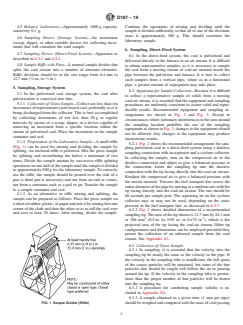
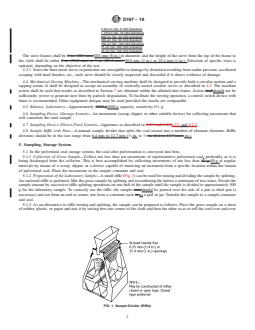
5.1.2 Preparation of the Laboratory Sample—A small riffle (Fig. 1) can be used for mixing and dividing the sample by splitting.
An enclosed riffle is preferred. Mix the gross sample by splitting and recombining the halves a minimum of two times. Divide the
sample amount by successive riffle splitting operations on one half of the sample until the sample is divided to approximately 500
g for the laboratory sample. To correctly use the riffle, the sample mustshould be poured over the side of a pan (a third pan is
necessary) and not from an end or corner, nor from a container such as,as a pail or jar. Transfer the sample to a sample container
and seal.
5.1.3 As an alternative to riffle mixing and splitting, the sample can be prepared as follows: Place the gross sample on a sheet
of rubber, plastic, or paper and mix it by raising first one corner of the cloth and then the other so as to roll the coal over and over
FIG. 1 Sample Divider (Riffle)
D197 − 19
at least 20 times. After mixing, divide the sample. Continue the operations of mixing and dividing until the sample is divided
sufficiently so that all of one of the divisions weighs mass is approximately 500 g. This shallshould constitute the laboratory
sample.
6. Sampling, Direct-Fired System
6.1 In the direct-fired system, the coal is pulverized and delivered directly to the furnace in an air stream. It is difficult to obtain
representative samples, as it is necessary to sample the coal from a moving stream of coal-air mixture inside the pipe between the
pulverizer and furnace. It is preferablebest to collect such samples from a vertical pipes, pipe, where as in a horizontal pipespipe,
a greater amount of segregation may take place.
6.2 Apparatus for Sample Collection—Because it is difficult to collect a representative sample of solids from a moving coal-air
stream, it is essential that the equipment and sampling procedures are uniformly consistent to assure valid and reproducible results.
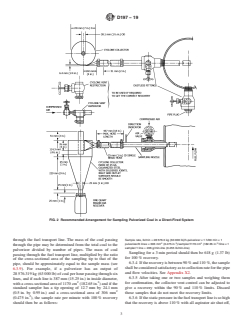
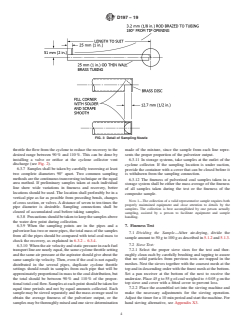
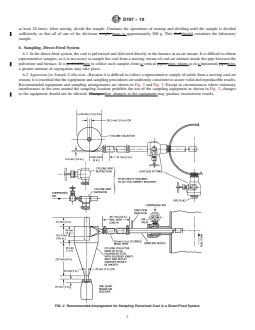
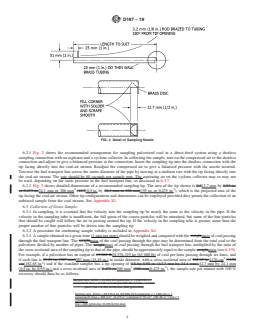
Recommended equipment and sampling arrangements are shown in Fig. 2 and Fig. 3. Except in circumstances where stationary
interferences in the area around the sampling location prohibits the use of the sampling equipment as shown in Fig. 3, changes
to the equipment should not be allowed. Changes Any changes to the equipment may produce inconsistent results.
FIG. 2 Recommended Arrangement for Sampling Pulverized Coal in a Direct-Fired System
D197 − 19
FIG. 3 Detail of Sampling Nozzle
6.2.1 Fig. 2 shows the recommended arrangement for sampling pulverized coal in a direct-fired system using a dustless
sampling connection with an aspirator and a cyclone collector. In collecting the sample, turn on the compressed air to the dustless
connection and adjust to give a balanced pressure at the connection. Insert the sampling tip into the dustless connection with the
tip facing directly into the coal-air stream. Readjust the compressed air to give a balanced pressure with the nozzle inserted.
Traverse the fuel transport line across the entire diameter of the pipe by moving at a uniform rate with the tip facing directly into
the coal-air stream. The rate should be 60 seconds per sample port. The aspirating air on the cyclone collector may or may not
be used, depending on the static pressure in the fuel transport line, as discussed in 6.3.7.
6.2.2 Fig. 3 shows detailed dimensions of a recommended sampling tip. The area of the tip shown is 0.512.7 mm by 0.95 in.
2 2
or 0.475 in.24.1 mm or 306 mm (12.7(0.5 in. by 24.1 mm or 306 mm0.95 in. or 0.475 in. ), which is the projected area of the
tip facing the coal-air stream. Other tip configurations and dimensions can be employed provided they permit the collection of an
unbiased sample from the coal stream. See Appendix X1.
6.3 Collection of Gross Sample:
6.3.1 In sampling, it is essential that the velocity into the sampling tip be nearly the same as the velocity in the pipe. If the
velocity in the sampling tube is insufficient, the full quota of the coarse particles will be entrained, but some of the fine particles
that should be caught will follow the air in passing around the tip. If the velocity in the sampling tube is greater, more than the
proper number of fine particles will be drawn into the sampling tip.
6.3.2 A procedure for confirming sample validity is included in Appendix X4.
6.3.3 A sample obtained in a given time (1 min per pipe) should be weighed and compared with the weightmass of coal passing
through the fuel transport line. The weightmass of the coal passing through the pipe may be determined from the total coal to the
pulverizer divided by number of pipes. The weightmass of coal passing through the fuel transport line, multiplied by the ratio of
the cross-sectional area of the sampling tip to that of the pipe, should be approximately equal to the sample weightmass (see 6.3.9).
For example, if a pulverizer has an output of 63 000 lb28 576.319 kg (63 000 lb) of coal per hour passing through six lines, and
if each line is 15.25 in. (387 mm)387 mm (15.25 in.) in inside diameter, with a cross-sectional area of 182.65 in.1170 cm (1170
cm(182.65 in. ) and if the standard sampler has a tip opening of 0.5 by 0.95 in. (12.7 mm by 24.1 mm) 12.7 mm by 24.1 mm
2 2
(0.5 in. by 0.95 in.) and a cross-sectional area of 0.475 in.306 mm (306 mm(0.475 in. ), the sample rate per minute with 100 %
recovery should then be as follows:
Sample rate, lb/min = 63 000 lb/h-pulverizer × 1 h⁄60 min × 1
2 2
pulverizer/6 lines × 0.475 in. /sampler/182.65 in. /line × 1 sam-
pler/1 line = 0.455 lb/min-line (206 g/min-line)
Sample rate, lb/min = 28 576.3 kg (63 000 lb)/h-pulverizer × 1 h/60 min × 1
2 2 2 2)
pulverizer/6 lines × 306 mm (0.475 in. )/sampler/1170 cm (182.65 in. /line × 1
sampler/1
line = 206 g/min-line (0.455 lb/min-line)
----------------
...