

ASTM D720/D720M-23
(Test Method)Standard Test Method for Free-Swelling Index of Coal
General Information
- Abstract
SIGNIFICANCE AND USE
3.1 This test method, in addition to indicating the caking properties of a coal when burned as a fuel, can be used to give a broad indication of the degree of oxidation of a coal.
SCOPE
1.1 This test method2 is a small-scale, empirical test for obtaining information regarding the free-swelling properties of a coal. The results may be used as an indication of the caking characteristic of the coal when burned as a fuel. This test is not recommended as a method for the determination of expansion of coals in coke ovens.
1.2 Units—The values stated in either SI units or non-SI units are to be regarded separately as standard. The values stated in each system are not necessarily exact equivalents; therefore, to ensure conformance with the standard, each system shall be used independently of the other, and values from the two systems shall not be combined.
1.3 This standard does not purport to address all of the safety concerns, if any, associated with its use. It is the responsibility of the user of this standard to establish appropriate safety, health, and environmental practices and determine the applicability of regulatory limitations prior to use.
1.4 This international standard was developed in accordance with internationally recognized principles on standardization established in the Decision on Principles for the Development of International Standards, Guides and Recommendations issued by the World Trade Organization Technical Barriers to Trade (TBT) Committee.
- Status
- Published
- Publication Date
- 31-Oct-2023
- Technical Committee
- D05 - Coal and Coke
- Drafting Committee
- D05.15 - Metallurgical Properties of Coal and Coke
Overview
ASTM D720/D720M-23, Standard Test Method for Free-Swelling Index of Coal, is a widely recognized standard developed by ASTM International. This test method provides a small-scale, empirical procedure for evaluating the free-swelling properties of coal, offering valuable insight into both the caking characteristics and the degree of oxidation of coal samples. The method is a practical approach for those seeking to understand how specific coal will behave when used as a fuel, especially in furnace and boiler applications. It is approved for use by agencies of the U.S. Department of Defense and is internationally recognized under WTO standardization principles.
Key Topics
- Free-Swelling Index (FSI): The core focus of ASTM D720/D720M-23 is the measurement of the free-swelling index, a parameter that indicates the tendency of coal to swell when heated in the absence of air. The FSI is determined by visual comparison of the coke button shape produced during testing.
- Caking Properties: The standard is useful in assessing the coal’s ability to form a coherent, porous mass (cake) when burned, which is a key fuel property.
- Degree of Oxidation: Changes in FSI can suggest the extent to which coal has oxidized, which impacts its caking behavior and fuel value.
- Test Procedure: Specifies preparation and particle size of the coal sample, describes heating equipment (electric or gas methods), and details procedures for preparing and assessing coke buttons.
- Units: The method allows for results in both SI and non-SI units but strictly requires using one system without intermixing values.
- Repeatability and Reproducibility: Includes precision guidelines to ensure consistency between repeated and interlaboratory results, enhancing confidence in reported FSI values.
- Safety Responsibilities: Users must establish and follow proper safety, health, and environmental practices specific to their regulatory context.
Applications
- Coal Quality Assessment: Energy producers, suppliers, and researchers use the free-swelling index to evaluate the suitability of coal for particular combustion applications, including in power generation and industrial boilers.
- Blending and Sourcing Decisions: Knowledge of coal’s caking and swelling behaviors enables better blending strategies to meet performance requirements or emission standards.
- Process Optimization: Operators in the coal industry rely on the FSI to optimize furnace or boiler operation, minimizing problems related to clinker formation or inefficient combustion.
- Research and Development: The method supports coal technology research, including studies on coal oxidation and the development of new fuel blends.
- Regulatory Compliance: Meets the requirements needed by regulatory agencies and buyers involved in international trade and quality assurance.
Related Standards
For comprehensive coal analysis and quality control, consider the following related ASTM standards:
- ASTM D2013/D2013M: Practice for Preparing Coal Samples for Analysis. Specifies standard procedures for sample preparation that underpin the accuracy of the FSI measurement.
- ASTM E691: Practice for Conducting an Interlaboratory Study to Determine the Precision of a Test Method. Essential for laboratories engaged in collaborative testing or quality assurance processes.
Keywords: Free-Swelling Index, coal, caking characteristic, ASTM D720, coal testing, oxidation of coal, coal quality, fuel properties.
By following ASTM D720/D720M-23, stakeholders in the coal and fuel industries can reliably determine the free-swelling properties of coal, thus optimizing fuel selection, processing, and combustion performance while ensuring compliance with recognized international standards.
Relations
- Effective Date
- 01-Nov-2023
- Effective Date
- 01-Nov-2023
Get Certified
Connect with accredited certification bodies for this standard

Bureau Veritas Chile
Bureau Veritas certification services in Chile.
Bureau Veritas Peru
Bureau Veritas certification services in Peru.
BVQI Peru
Bureau Veritas certification in Peru.
Sponsored listings
Frequently Asked Questions
ASTM D720/D720M-23 is a standard published by ASTM International. Its full title is "Standard Test Method for Free-Swelling Index of Coal". This standard covers: SIGNIFICANCE AND USE 3.1 This test method, in addition to indicating the caking properties of a coal when burned as a fuel, can be used to give a broad indication of the degree of oxidation of a coal. SCOPE 1.1 This test method2 is a small-scale, empirical test for obtaining information regarding the free-swelling properties of a coal. The results may be used as an indication of the caking characteristic of the coal when burned as a fuel. This test is not recommended as a method for the determination of expansion of coals in coke ovens. 1.2 Units—The values stated in either SI units or non-SI units are to be regarded separately as standard. The values stated in each system are not necessarily exact equivalents; therefore, to ensure conformance with the standard, each system shall be used independently of the other, and values from the two systems shall not be combined. 1.3 This standard does not purport to address all of the safety concerns, if any, associated with its use. It is the responsibility of the user of this standard to establish appropriate safety, health, and environmental practices and determine the applicability of regulatory limitations prior to use. 1.4 This international standard was developed in accordance with internationally recognized principles on standardization established in the Decision on Principles for the Development of International Standards, Guides and Recommendations issued by the World Trade Organization Technical Barriers to Trade (TBT) Committee.
SIGNIFICANCE AND USE 3.1 This test method, in addition to indicating the caking properties of a coal when burned as a fuel, can be used to give a broad indication of the degree of oxidation of a coal. SCOPE 1.1 This test method2 is a small-scale, empirical test for obtaining information regarding the free-swelling properties of a coal. The results may be used as an indication of the caking characteristic of the coal when burned as a fuel. This test is not recommended as a method for the determination of expansion of coals in coke ovens. 1.2 Units—The values stated in either SI units or non-SI units are to be regarded separately as standard. The values stated in each system are not necessarily exact equivalents; therefore, to ensure conformance with the standard, each system shall be used independently of the other, and values from the two systems shall not be combined. 1.3 This standard does not purport to address all of the safety concerns, if any, associated with its use. It is the responsibility of the user of this standard to establish appropriate safety, health, and environmental practices and determine the applicability of regulatory limitations prior to use. 1.4 This international standard was developed in accordance with internationally recognized principles on standardization established in the Decision on Principles for the Development of International Standards, Guides and Recommendations issued by the World Trade Organization Technical Barriers to Trade (TBT) Committee.
ASTM D720/D720M-23 is classified under the following ICS (International Classification for Standards) categories: 73.040 - Coals. The ICS classification helps identify the subject area and facilitates finding related standards.
ASTM D720/D720M-23 has the following relationships with other standards: It is inter standard links to ASTM D720/D720M-22, ASTM D388-23. Understanding these relationships helps ensure you are using the most current and applicable version of the standard.
ASTM D720/D720M-23 is available in PDF format for immediate download after purchase. The document can be added to your cart and obtained through the secure checkout process. Digital delivery ensures instant access to the complete standard document.
Standards Content (Sample)
This international standard was developed in accordance with internationally recognized principles on standardization established in the Decision on Principles for the
Development of International Standards, Guides and Recommendations issued by the World Trade Organization Technical Barriers to Trade (TBT) Committee.
Designation: D720/D720M − 23
Standard Test Method for
Free-Swelling Index of Coal
This standard is issued under the fixed designation D720/D720M; the number immediately following the designation indicates the year
of original adoption or, in the case of revision, the year of last revision. A number in parentheses indicates the year of last reapproval.
A superscript epsilon (´) indicates an editorial change since the last revision or reapproval.
This standard has been approved for use by agencies of the U.S. Department of Defense.
1. Scope 2. Referenced Documents
2.1 ASTM Standards:
1.1 This test method is a small-scale, empirical test for
D2013/D2013M Practice for Preparing Coal Samples for
obtaining information regarding the free-swelling properties of
Analysis
a coal. The results may be used as an indication of the caking
E691 Practice for Conducting an Interlaboratory Study to
characteristic of the coal when burned as a fuel. This test is not
Determine the Precision of a Test Method
recommended as a method for the determination of expansion
of coals in coke ovens.
3. Significance and Use
1.2 Units—The values stated in either SI units or non-SI
3.1 This test method, in addition to indicating the caking
units are to be regarded separately as standard. The values
properties of a coal when burned as a fuel, can be used to give
stated in each system are not necessarily exact equivalents;
a broad indication of the degree of oxidation of a coal.
therefore, to ensure conformance with the standard, each
system shall be used independently of the other, and values
4. Apparatus
from the two systems shall not be combined.
4.1 This test method can be performed using either electric
1.3 This standard does not purport to address all of the
or gas heating. When using electric heating, the results ob-
safety concerns, if any, associated with its use. It is the
tained must be the same as those obtained when using the gas
responsibility of the user of this standard to establish appro-
heating method. The apparatus common to both electric and
priate safety, health, and environmental practices and deter-
gas methods shall consist of the following:
mine the applicability of regulatory limitations prior to use.
4.1.1 Crucible, translucent silica, low-form, with a flat,
1.4 This international standard was developed in accor- close-fitting silica ring-handle lid and an extra pierced lid for
use in determining the crucible temperature, conforming to the
dance with internationally recognized principles on standard-
following requirements:
ization established in the Decision on Principles for the
Development of International Standards, Guides and Recom-
Mass, g 11.0 to 12.75
External height, mm 26 ± 0.5
mendations issued by the World Trade Organization Technical
External diameter at top, mm 41 ± 0.75
Barriers to Trade (TBT) Committee.
Internal diameter at base, min, mm 11
Capacity (approximate), cm 17
4.1.2 Sight Tube, as shown in Fig. 1, for viewing the coke
buttons so that the effect of parallax will be eliminated. Make
This test method is under the jurisdiction of ASTM Committee D05 on Coal
and Coke and is the direct responsibility of Subcommittee D05.15 on Metallurgical
the tube of any rigid and preferably opaque material and
Properties of Coal and Coke.
support vertically on a ring stand. The sight tube shall be
Current edition approved Nov. 1, 2023. Published December 2023. Originally
38 mm [1.5 in.] in diameter and 250 mm [10 in.] in length and
approved in 1943. Last previous edition approved in 2022 as D720/D720M – 22.
supported on the ring stand at a height of 76 mm [3.0 in.] above
DOI: 10.1520/D0720_D0720M-23.
This test method is an adaptation of the Crucible Swelling Test for Coal of the
the base of the stand.
British Standards Institution. For information concerning the experimental work on
which this adaptation is based, see paper by Ostborg, H. N., Limbacker, H. R., and
Sherman, R. A., “An Experimental Investigation of the British Standard Method for
the Crucible Swelling Test for Coal,” Proceedings, Am. Soc. Testing Mats., Vol 42, For referenced ASTM standards, visit the ASTM website, www.astm.org, or
1042, p. 851. See also a paper by Selvig, W. A., and Ode, W. H., “An Investigation contact ASTM Customer Service at service@astm.org. For Annual Book of ASTM
of a Laboratory Test for Determination of the Free-Swelling Index of Coal,” U.S. Standards volume information, refer to the standard’s Document Summary page on
Bureau of Mines Report of Investigation 4238, Revision of R. I. 3989, 1948. the ASTM website.
Copyright © ASTM International, 100 Barr Harbor Drive, PO Box C700, West Conshohocken, PA 19428-2959. United States
D720/D720M − 23
6 10 °C [1472 °F 6 18 °F] and 820 °C 6 5 °C [1508 °F 6
9 °F] as measured by a thermocouple positioned in the cru-
cible. An example design is shown in Fig. 2.
4.2.2 Crucible Support—A convenient crucible support con-
sists of a cradle support made from nickel-chromium wire
suspended from a metal ring. The height of the support inside
the furnace shall be adjustable.
4.2.3 Thermocouple—(Optional) Suitable sheathed thermo-
couple with its exposed thermojunction positioned in the zone
of uniform temperature of the furnace, as is shown in Fig. 2,
employed to monitor the temperature of the furnace.
4.2.4 Electric Controls—Suitable manual or automatic
transformer capable of maintaining the furnace temperature at
800 °C 6 10 °C [1472 °F 6 18 °F] after 1.5 min and 820 °C 6
5 °C [1508 °F 6 9 °F] after 2.5 min.
4.3 The gas apparatus shall consist of the following:
4.3.1 Burner—Gas burner capable of obtaining the required
FIG. 1 Sight Tube
temperature of 820 °C 6 5 °C [1508 °F 6 9 °F]. A Meker-
Type Bunsen burner or Teclu-Type burner has been found to be
4.1.3 Thermocouple and Potentiometer—External, em-
sufficient. The burner shall have a grid of external diameter,
ployed for calibration of the electric furnace and gas burner
30.0 mm to 42.0 mm [1.18 in. to 1.65 in.]. The burner may use
assembly.
any combination natural gas or liquid petroleum gas and
4.1.4 Mass, 500 g 6 10 g, having a flat bottom surface.
oxidant in order to obtain the required temperature. See Fig. 3.
Employed to assign the index of a non-swollen button.
4.3.2 Draft Shield, constructed from 5 mm [0.2 in.] thick
4.2 The electric apparatus shall consist of the following: refractory pipe, having an internal diameter of 100 mm [4 in.]
4.2.1 Furnace, consisting of a refractory base, a heating and a length of 150 mm [6.0 in.]. The top shall have three slots,
element, crucible shelf, and a refractory chimney. The furnace 25 mm [1.0 in.] in depth, in which the wires of the crucible
shall be capable of having the temperature regulated at 800 °C support rest. Support the draft shield on a ring stand, so that the
FIG. 2 Example Furnace Base and Chimney
D720/D720M − 23
FIG. 3 Example of Burner Assembly
distance between the base of the crucible and the top of the 5. Calibration
burner grid may be adjusted by raising or lowering the draft
5.1 Electric Furnace:
shield. See Fig. 3.
5.1.1 Turn the main power switch on and adjust the variable
4.3.3 Triangular Crucible Support, constructed from three
transformer so that the furnace will obtain a temperature of
pieces of translucent silica tubing each approximately 63 mm
820 °C 6 5 °C [1508 °F 6 9 °F]. Allow the furnace tempera-
[2.5 in.] in length, approximately 6 mm to 7 mm [0.2 in. to
ture to reach equilibrium.
0.3 in.] in external diameter, and mounted on chromium-nickel
wire so that the diameter of the inscribed circle is approxi-
5.1.2 Lower an empty crucible with pierced lid into the
mately 32 mm [1.3 in.] as shown in Fig. 4. The twisted ends of
furnace using the crucible support. Measure the temperature at
the triangle may be joined together by a loop of wire to
the inside base of the crucible with a thermocouple and a
facilitate removal of the hot crucible.
potentiometer. The unprotected junction of the thermocouple
4.3.4 Flowmeter—Suitable gauge for measuring the gas
must be in contact with the inside base of the crucible. At the
flow, such as a variable area flowmeter or a capillary flowmeter
end of 1.5 min, the furnace shall obtain a temperature of
with water manometer placed in the gas line before the burner
800 °C 6 10 °C [1472 °F 6 18 °F], and at the end of 2.5 min,
as a guide to the control of the rate of gas flow (Fig. 3).
FIG. 4 Triangular Crucible Support
D720/D720M − 23
820 °C 6 5 °C [1508 °F 6 9 °F]. Adjust the variable trans- 7. Procedure
former as necessary to achieve the required temperatures.
7.1 Preparation of Coke Buttons:
5.2 Gas Burner:
7.1.1 Electric Method—Transfer approximately 1 g of the
5.2.1 With the burner assembly arranged as shown in Fig. 3,
prepared sample into a clean crucible and level by lightly
and with an empty crucible in position, light the burner
tapping the crucible twelve times on a solid surface, rotating it
approximately 15 min before making a determination to allow
between taps. Cover the crucible with a solid lid. Lower the
the draft shield to rise to an equilibrium temperature.
crucible and cover into the furn
...
This document is not an ASTM standard and is intended only to provide the user of an ASTM standard an indication of what changes have been made to the previous version. Because
it may not be technically possible to adequately depict all changes accurately, ASTM recommends that users consult prior editions as appropriate. In all cases only the current version
of the standard as published by ASTM is to be considered the official document.
Designation: D720/D720M − 22 D720/D720M − 23
Standard Test Method for
Free-Swelling Index of Coal
This standard is issued under the fixed designation D720/D720M; the number immediately following the designation indicates the year
of original adoption or, in the case of revision, the year of last revision. A number in parentheses indicates the year of last reapproval.
A superscript epsilon (´) indicates an editorial change since the last revision or reapproval.
This standard has been approved for use by agencies of the U.S. Department of Defense.
1. Scope
1.1 This test method is a small-scale, empirical test for obtaining information regarding the free-swelling properties of a coal. The
results may be used as an indication of the caking characteristic of the coal when burned as a fuel. This test is not recommended
as a method for the determination of expansion of coals in coke ovens.
1.2 Units—The values stated in either SI units or non-SI units are to be regarded separately as standard. The values stated in each
system are not necessarily exact equivalents; therefore, to ensure conformance with the standard, each system shall be used
independently of the other, and values from the two systems shall not be combined.
1.3 This standard does not purport to address all of the safety concerns, if any, associated with its use. It is the responsibility
of the user of this standard to establish appropriate safety, health, and environmental practices and determine the applicability of
regulatory limitations prior to use.
1.4 This international standard was developed in accordance with internationally recognized principles on standardization
established in the Decision on Principles for the Development of International Standards, Guides and Recommendations issued
by the World Trade Organization Technical Barriers to Trade (TBT) Committee.
2. Referenced Documents
2.1 ASTM Standards:
D2013/D2013M Practice for Preparing Coal Samples for Analysis
E691 Practice for Conducting an Interlaboratory Study to Determine the Precision of a Test Method
3. Significance and Use
3.1 This test method, in addition to indicating the caking properties of a coal when burned as a fuel, can be used to give a broad
indication of the degree of oxidation of a coal.
This test method is under the jurisdiction of ASTM Committee D05 on Coal and Coke and is the direct responsibility of Subcommittee D05.15 on Metallurgical Properties
of Coal and Coke.
Current edition approved Sept. 1, 2022Nov. 1, 2023. Published October 2022December 2023. Originally approved in 1943. Last previous edition approved in 20152022
ε1
as D720/D720M – 15D720/D720M – 22. . DOI: 10.1520/D0720_D0720M-22.10.1520/D0720_D0720M-23.
This test method is an adaptation of the Crucible Swelling Test for Coal of the British Standards Institution. For information concerning the experimental work on which
this adaptation is based, see paper by Ostborg, H. N., Limbacker, H. R., and Sherman, R. A., “An Experimental Investigation of the British Standard Method for the Crucible
Swelling Test for Coal,” Proceedings, Am. Soc. Testing Mats., Vol 42, 1042, p. 851. See also a paper by Selvig, W. A., and Ode, W. H., “An Investigation of a Laboratory
Test for Determination of the Free-Swelling Index of Coal,” U.S. Bureau of Mines Report of Investigation 4238, Revision of R. I. 3989, 1948.
For referenced ASTM standards, visit the ASTM website, www.astm.org, or contact ASTM Customer Service at service@astm.org. For Annual Book of ASTM Standards
volume information, refer to the standard’s Document Summary page on the ASTM website.
Copyright © ASTM International, 100 Barr Harbor Drive, PO Box C700, West Conshohocken, PA 19428-2959. United States
D720/D720M − 23
4. Apparatus
4.1 This test method can be performed using either electric or gas heating. When using electric heating, the results obtained must
be the same as those obtained when using the gas heating method. The apparatus common to both electric and gas methods shall
consist of the following:
4.1.1 Crucible, translucent silica, low-form, with a flat, close-fitting silica ring-handle lid and an extra pierced lid for use in
determining the crucible temperature, conforming to the following requirements:
Mass, g 11.0 to 12.75
External height, mm 26 ± 0.5
External diameter at top, mm 41 ± 0.75
Internal diameter at base, min, mm 11
Capacity (approximate), cm 17
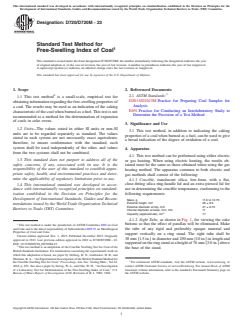
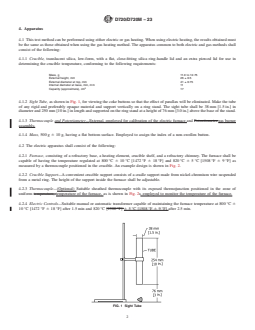
4.1.2 Sight Tube, as shown in Fig. 1, for viewing the coke buttons so that the effect of parallax will be eliminated. Make the tube
of any rigid and preferably opaque material and support vertically on a ring stand. The sight tube shall be 38 mm [1.5 in.] in
diameter and 250 mm [10 in.] in length and supported on the ring stand at a height of 76 mm [3.0 in.] above the base of the stand.
4.1.3 Thermocouple and Potentiometer—External, employed for calibration of the electric furnace and Potentiometer.gas burner
assembly.
4.1.4 Mass, 500 g 6 10 g, having a flat bottom surface. Employed to assign the index of a non-swollen button.
4.2 The electric apparatus shall consist of the following:
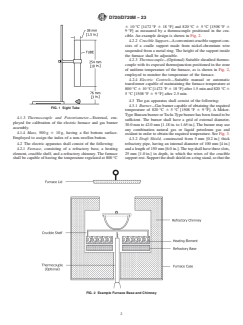
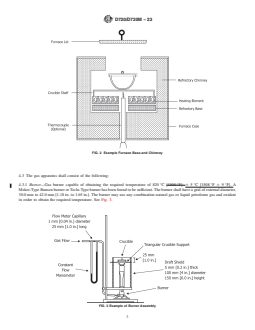
4.2.1 Furnace, consisting of a refractory base, a heating element, crucible shelf, and a refractory chimney. The furnace shall be
capable of having the temperature regulated at 800 °C 6 10 °C [1472 °F 6 18 °F] and 820 °C 6 5 °C [1508 °F 6 9 °F] as
measured by a thermocouple positioned in the crucible. An example design is shown in Fig. 2.
4.2.2 Crucible Support—A convenient crucible support consists of a cradle support made from nickel-chromium wire suspended
from a metal ring. The height of the support inside the furnace shall be adjustable.
4.2.3 Thermocouple—(Optional) Suitable sheathed thermocouple with its exposed thermojunction positioned in the zone of
uniform temperature, temperature of the furnace, as is shown in Fig. 2., employed to monitor the temperature of the furnace.
4.2.4 Electric Controls—Suitable manual or automatic transformer capable of maintaining the furnace temperature at 800 °C 6
10 °C [1472 °F 6 18 °F] after 1.5 min and 820 °C [1500 °F] 6 5 °C [1508 °F 6 9 °F] after 2.5 min.
FIG. 1 Sight Tube
D720/D720M − 23
FIG. 2 Example Furnace Base and Chimney
4.3 The gas apparatus shall consist of the following:
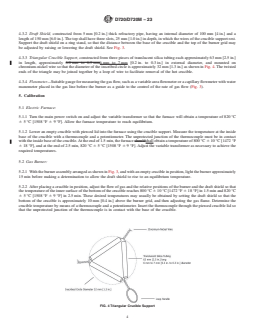
4.3.1 Burner—Gas burner capable of obtaining the required temperature of 820 °C [1500 °F]. 6 5 °C [1508 °F 6 9 °F]. A
Meker-Type Bunsen burner or Teclu-Type burner has been found to be sufficient. The burner shall have a grid of external diameter,
30.0 mm to 42.0 mm [1.18 in. to 1.65 in.]. The burner may use any combination natural gas or liquid petroleum gas and oxidant
in order to obtain the required temperature. See Fig. 3.
FIG. 3 Example of Burner Assembly
D720/D720M − 23
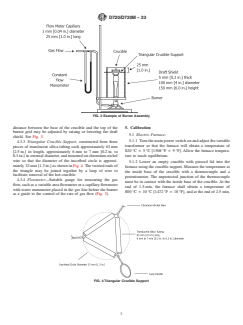
4.3.2 Draft Shield, constructed from 5 mm [0.2 in.] thick refractory pipe, having an internal diameter of 100 mm [4 in.] and a
length of 150 mm [6.0 in.]. The top shall have three slots, 25 mm [1.0 in.] in depth, in which the wires of the crucible support rest.
Support the draft shield on a ring stand, so that the distance between the base of the crucible and the top of the burner grid may
be adjusted by raising or lowering the draft shield. See Fig. 3.
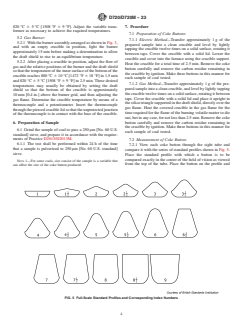
4.3.3 Triangular Crucible Support, constructed from three pieces of translucent silica tubing each approximately 63 mm [2.5 in.]
in length, approximately 6.0 mm to 6.5 mm6 mm to 7 mm [0.2 in. to 0.3 in.] in external diameter, and mounted on
chromium-nickel wire so that the diameter of the inscribed circle is approximately 32 mm [1.3 in.] as shown in Fig. 4. The twisted
ends of the triangle may be joined together by a loop of wire to facilitate removal of the hot crucible.
4.3.4 Flowmeter—Suitable gauge for measuring the gas flow, such as a variable area flowmeter or a capillary flowmeter with water
manometer placed in the gas line before the burner as a guide to the control of the rate of gas flow (Fig. 3).
5. Calibration
5.1 Electric Furnace:
5.1.1 Turn the main power switch on and adjust the variable transformer so that the furnace will obtain a temperature of 820 °C
6 5 °C [1508 °F 6 9 °F]. Allow the furnace temperature to reach equilibrium.
5.1.2 Lower an empty crucible with pierced lid into the furnace using the crucible support. Measure the temperature at the inside
base of the crucible with a thermocouple and a potentiometer. The unprotected junction of the thermocouple must be in contact
with the inside base of the crucible. At the end of 1.5 min, the furnace shouldshall obtain a temperature of 800 °C 6 10 °C [1472 °F
6 18 °F], and at the end of 2.5 min, 820 °C 6 5 °C [1508 °F 6 9 °F]. Adjust the variable transformer as necessary to achieve the
required temperatures.
5.2 Gas Burner:
5.2.1 With the burner assembly arranged as shown in Fig. 3, and with an empty crucible in position, light the burner approximately
15 min before making a determination to allow the draft shield to rise to an equilibrium temperature.
5.2.2 After placing a crucible in position, adjust the flow of gas and the relative positions of the burner and the draft shield so that
the temperature of the inner surface of the bottom of the crucible reaches 800 °C 6 10 °C [1472 °F 6 18 °F] in 1.5 min and 820 °C
6 5 °C [1508 °F 6 9 °F] in 2.5 min. Thes
...