

ASTM D5256-14(2022)
(Test Method)Standard Test Method for Relative Efficacy of Dynamic Solvent Systems for Dissolving Water-Formed Deposits
General Information
- Abstract
SIGNIFICANCE AND USE
5.1 This test method is useful because the choice of a solvent system for removing water-formed deposits depends upon the ability of the dynamic solvent system to dissolve both unattached and attached deposits.
SCOPE
1.1 This test method covers the determination of the relative efficacy of dynamic solvent systems for dissolving water-formed deposits that have been removed from the underlying material or deposits attached to the underlying material.
1.2 The nature of this test method is such that statements of precision and bias as determined by round robin tests could mislead users of this test method (see Sections 11 and 12). Therefore, no precision and bias statements are made.
1.3 The values stated in SI units are to be regarded as standard. The values given in parentheses are mathematical conversions to inch-pound units that are provided for information only and are not considered standard.
1.4 This standard does not purport to address all of the safety concerns, if any, associated with its use. It is the responsibility of the user of this standard to establish appropriate safety, health, and environmental practices and determine the applicability of regulatory limitations prior to use.
1.5 This international standard was developed in accordance with internationally recognized principles on standardization established in the Decision on Principles for the Development of International Standards, Guides and Recommendations issued by the World Trade Organization Technical Barriers to Trade (TBT) Committee.
- Status
- Published
- Publication Date
- 31-Oct-2022
- Technical Committee
- D19 - Water
Overview
ASTM D5256-14(2022): Standard Test Method for Relative Efficacy of Dynamic Solvent Systems for Dissolving Water-Formed Deposits provides a reliable procedure to determine how effectively different dynamic solvent systems dissolve both unattached and attached water-formed deposits. This method is particularly valuable for industries where scale, sludge, or other water-related deposits can reduce equipment efficiency or cause maintenance issues. Developed by ASTM International, this test method guides users in evaluating appropriate solvent systems for deposit removal, supporting better decision-making in maintenance and operational protocols.
Key Topics
- Dynamic Solvent Systems: Defined as closed-loop systems where the solvent circulates across the surface of water-formed deposits. The method distinguishes between single and multiple solvent systems.
- Deposit Types: Covers both unattached deposits (those removed from their original surfaces) and attached deposits (remaining on the underlying material).
- Testing Procedure:
- For unattached deposits: Expose a known weight of the deposit to the solvent system, monitor dissolution, and measure weight loss to assess efficacy.
- For attached deposits: Assess the removal of deposits remaining on test specimens after exposure to dynamic solvent flow.
- Sample Preparation and Analysis: Involves careful collection, drying, filtration, and weighing of samples before and after solvent exposure to determine removal efficiency.
- Calculating Solvent Efficacy: Provides formulas to quantify the percentage of deposit dissolved or removed through direct measurement and calculation.
Applications
This ASTM standard is widely applicable in sectors where water-formed scale, sludge, corrosion products, or biological deposits are a concern, including:
- Power Generation: Steam generator tubes and cooling systems often suffer from reduced efficiency due to water-formed deposits. This method helps identify effective solvent cleaning protocols.
- Industrial Processes: Manufacturing plants dealing with boilers, pipelines, or heat exchangers rely on efficient deposit removal to maintain optimal operation.
- Water Treatment Facilities: Assists in selecting chemical cleaning agents for removing buildup in filtration, storage, and distribution infrastructure.
- Maintenance Services: Facility managers and cleaning service providers use this method to compare commercial chemical cleaning solutions, ensuring effective maintenance and minimizing downtime.
Using this standard ensures that solvent-based cleaning operations are tested, compared, and documented in a consistent and defensible manner, improving equipment reliability and longevity.
Related Standards
Several ASTM standards are referenced or complement ASTM D5256:
- ASTM D887: Practices for Sampling Water-Formed Deposits
- ASTM D1129: Terminology Relating to Water
- ASTM D1193: Specification for Reagent Water
- ASTM D2331: Practices for Preparation and Preliminary Testing of Water-Formed Deposits
- ASTM D2777: Practice for Determination of Precision and Bias of Applicable Test Methods of Committee D19 on Water
- ASTM D3483: Test Methods for Accumulated Deposition in a Steam Generator Tube
Together, these standards provide a comprehensive toolkit for sampling, analyzing, and managing water-formed deposits and the solvents used to remove them.
Optimized for industries seeking reliable methods for evaluating dynamic solvent systems, ASTM D5256-14(2022) delivers standardized guidance for maintaining system performance and reducing the risks associated with water-formed deposit accumulation.
Relations
- Effective Date
- 01-May-2020
- Effective Date
- 15-Jun-2012
- Effective Date
- 01-Mar-2010
- Refers
ASTM D3483-05(2009) - Standard Test Methods for Accumulated Deposition in a Steam Generator Tube - Effective Date
- 01-May-2009
- Refers
ASTM D2331-08 - Standard Practices for Preparation and Preliminary Testing of Water-Formed Deposits - Effective Date
- 01-Oct-2008
- Effective Date
- 01-May-2008
- Effective Date
- 15-Jan-2008
- Effective Date
- 01-Sep-2006
- Effective Date
- 01-Sep-2006
- Effective Date
- 15-Aug-2006
- Effective Date
- 01-Mar-2006
- Effective Date
- 15-Feb-2006
- Effective Date
- 01-Jun-2005
- Refers
ASTM D3483-83(2005) - Standard Test Methods for Accumulated Deposition in a Steam Generator Tube - Effective Date
- 01-Jan-2005
- Effective Date
- 01-Mar-2004
Get Certified
Connect with accredited certification bodies for this standard

CIS Institut d.o.o.
Personal Protective Equipment (PPE) certification body. Notified Body NB-2890 for EU Regulation 2016/425 PPE.

Kiwa BDA Testing
Building and construction product certification.
Kmetijski inštitut Slovenije
Agricultural Institute of Slovenia. Soil testing, plant health, agricultural product analysis.
Sponsored listings
Frequently Asked Questions
ASTM D5256-14(2022) is a standard published by ASTM International. Its full title is "Standard Test Method for Relative Efficacy of Dynamic Solvent Systems for Dissolving Water-Formed Deposits". This standard covers: SIGNIFICANCE AND USE 5.1 This test method is useful because the choice of a solvent system for removing water-formed deposits depends upon the ability of the dynamic solvent system to dissolve both unattached and attached deposits. SCOPE 1.1 This test method covers the determination of the relative efficacy of dynamic solvent systems for dissolving water-formed deposits that have been removed from the underlying material or deposits attached to the underlying material. 1.2 The nature of this test method is such that statements of precision and bias as determined by round robin tests could mislead users of this test method (see Sections 11 and 12). Therefore, no precision and bias statements are made. 1.3 The values stated in SI units are to be regarded as standard. The values given in parentheses are mathematical conversions to inch-pound units that are provided for information only and are not considered standard. 1.4 This standard does not purport to address all of the safety concerns, if any, associated with its use. It is the responsibility of the user of this standard to establish appropriate safety, health, and environmental practices and determine the applicability of regulatory limitations prior to use. 1.5 This international standard was developed in accordance with internationally recognized principles on standardization established in the Decision on Principles for the Development of International Standards, Guides and Recommendations issued by the World Trade Organization Technical Barriers to Trade (TBT) Committee.
SIGNIFICANCE AND USE 5.1 This test method is useful because the choice of a solvent system for removing water-formed deposits depends upon the ability of the dynamic solvent system to dissolve both unattached and attached deposits. SCOPE 1.1 This test method covers the determination of the relative efficacy of dynamic solvent systems for dissolving water-formed deposits that have been removed from the underlying material or deposits attached to the underlying material. 1.2 The nature of this test method is such that statements of precision and bias as determined by round robin tests could mislead users of this test method (see Sections 11 and 12). Therefore, no precision and bias statements are made. 1.3 The values stated in SI units are to be regarded as standard. The values given in parentheses are mathematical conversions to inch-pound units that are provided for information only and are not considered standard. 1.4 This standard does not purport to address all of the safety concerns, if any, associated with its use. It is the responsibility of the user of this standard to establish appropriate safety, health, and environmental practices and determine the applicability of regulatory limitations prior to use. 1.5 This international standard was developed in accordance with internationally recognized principles on standardization established in the Decision on Principles for the Development of International Standards, Guides and Recommendations issued by the World Trade Organization Technical Barriers to Trade (TBT) Committee.
ASTM D5256-14(2022) is classified under the following ICS (International Classification for Standards) categories: 13.060.50 - Examination of water for chemical substances. The ICS classification helps identify the subject area and facilitates finding related standards.
ASTM D5256-14(2022) has the following relationships with other standards: It is inter standard links to ASTM D1129-13(2020)e2, ASTM D2777-12, ASTM D1129-10, ASTM D3483-05(2009), ASTM D2331-08, ASTM D887-08, ASTM D2777-08, ASTM D1129-06a, ASTM D1129-06ae1, ASTM D2777-06, ASTM D1193-06, ASTM D1129-06, ASTM D3483-05, ASTM D3483-83(2005), ASTM D1129-04. Understanding these relationships helps ensure you are using the most current and applicable version of the standard.
ASTM D5256-14(2022) is available in PDF format for immediate download after purchase. The document can be added to your cart and obtained through the secure checkout process. Digital delivery ensures instant access to the complete standard document.
Standards Content (Sample)
This international standard was developed in accordance with internationally recognized principles on standardization established in the Decision on Principles for the
Development of International Standards, Guides and Recommendations issued by the World Trade Organization Technical Barriers to Trade (TBT) Committee.
Designation: D5256 − 14 (Reapproved 2022)
Standard Test Method for
Relative Efficacy of Dynamic Solvent Systems for
Dissolving Water-Formed Deposits
This standard is issued under the fixed designation D5256; the number immediately following the designation indicates the year of
original adoption or, in the case of revision, the year of last revision. A number in parentheses indicates the year of last reapproval. A
superscript epsilon (´) indicates an editorial change since the last revision or reapproval.
1. Scope Water-Formed Deposits
D2777 Practice for Determination of Precision and Bias of
1.1 Thistestmethodcoversthedeterminationoftherelative
Applicable Test Methods of Committee D19 on Water
efficacy of dynamic solvent systems for dissolving water-
D3263 Test Methods for Corrosivity of Solvent Systems for
formed deposits that have been removed from the underlying
Removing Water-Formed Deposits (Withdrawn 2008)
material or deposits attached to the underlying material.
D3483 TestMethodsforAccumulatedDepositioninaSteam
1.2 The nature of this test method is such that statements of
Generator Tube
precision and bias as determined by round robin tests could
mislead users of this test method (see Sections 11 and 12).
3. Terminology
Therefore, no precision and bias statements are made.
3.1 Definitions:
1.3 The values stated in SI units are to be regarded as
3.1.1 For definitions of other terms used in this test method,
standard. The values given in parentheses are mathematical
refer to Terminology D1129.
conversions to inch-pound units that are provided for informa-
3.2 Definitions of Terms Specific to This Standard:
tion only and are not considered standard.
3.2.1 dynamic solvent system, n—any closed loop system in
which the solvent is in motion across the deposit surface.
1.4 This standard does not purport to address all of the
safety concerns, if any, associated with its use. It is the
3.2.2 single and multiple solvent systems, n—a single sol-
responsibility of the user of this standard to establish appro-
vent system is a one-solution treatment. A multiple solvent
priate safety, health, and environmental practices and deter-
system is a treatment using two or more solutions in sequence.
mine the applicability of regulatory limitations prior to use.
3.2.3 solvent system, n—specified chemicals or combination
1.5 This international standard was developed in accor-
of chemicals, that may include corrosion inhibitors, formulated
dance with internationally recognized principles on standard-
to react with and remove deposits.
ization established in the Decision on Principles for the
3.2.4 water-formed deposits, n—any accumulation of in-
Development of International Standards, Guides and Recom-
soluble material derived from water or formed by the reaction
mendations issued by the World Trade Organization Technical
of water upon the surface in contact with the water.
Barriers to Trade (TBT) Committee.
3.2.4.1 Discussion—Depositsformedfromorbywaterinall
its phases may be further classified as scale, sludge, corrosion
2. Referenced Documents
products, or biological deposits. The overall composition of a
2.1 ASTM Standards:
deposit or some part of a deposit may be determined by
D887 Practices for Sampling Water-Formed Deposits
chemical or spectrographic analysis; the constituents actually
D1129 Terminology Relating to Water
present as chemical substances may be identified by micro-
D1193 Specification for Reagent Water
scope or x-ray diffraction studies. Organisms may be identified
D2331 Practices for Preparation and Preliminary Testing of
by microscopical or biological methods.
4. Summary of Test Method
This test method is under the jurisdiction of ASTM Committee D19 on Water
and is the direct responsibility of Subcommittee D19.03 on Sampling Water and
4.1 This test method consists of determining the ability of a
Water-Formed Deposits, Analysis of Water for Power Generation and Process Use,
dynamic solvent system to dissolve deposits.
On-Line Water Analysis, and Surveillance of Water.
Current edition approved Nov. 1, 2022. Published December 2022. Originally
4.2 For the unattached deposits, this test method consists of
approved 1992. Last previous edition approved in 2014 as D5256 – 14. DOI:
exposing weighed amounts of deposit to the dynamic solvent
10.1520/D5256-14R22.
For referenced ASTM standards, visit the ASTM website, www.astm.org, or
contact ASTM Customer Service at service@astm.org. For Annual Book of ASTM
Standards volume information, refer to the standard’s Document Summary page on The last approved version of this historical standard is referenced on
the ASTM website. www.astm.org.
Copyright © ASTM International, 100 Barr Harbor Drive, PO Box C700, West Conshohocken, PA 19428-2959. United States
D5256 − 14 (2022)
systems and determining the weight loss of the exposed
deposit, thereby determining the efficacy of the solvent system.
4.3 For the attached deposits, the amount and time required
to yield a constant amount of certain loss of interest and the
amount of deposit not removed determines the relative efficacy
of the dynamic solvent system.
5. Significance and Use
5.1 This test method is useful because the choice of a
solvent system for removing water-formed deposits depends
upon the ability of the dynamic solvent system to dissolve both
unattached and attached deposits.
6. Apparatus
6.1 Common Equipment:
NOTE 1—The equipment listed in this section is basic and serves the
function of this test method. This basic test procedure could be modified
to meet the specific needs of a particular investigation. The test apparatus,
however,mustbeidentifiedandreportedwiththeresults.Forcomparative
A: Stirrer, B: Pressure Control (Gauge, Vent and Relief), C: Temperature
typetests, as describedintheprocedure,itisimportantthatalltestsberun
Measurement, D: Temperature Control, E: Heated Autoclave
in an identical manner.
FIG. 2 High Temperature Test Equipment
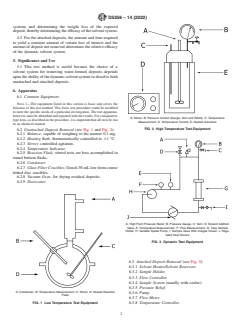
6.2 Unattached Deposit Removal (see Fig. 1 and Fig. 2):
6.2.1 Balance, capable of weighing to the nearest 0.1 mg.
6.2.2 Heating Bath, thermostatically controlled to 61 °C.
6.2.3 Stirrer, controlled agitation.
6.2.4 Temperature Indicator.
6.2.5 Reaction Flask, stirred tests are best accomplished in
round bottom flasks.
6.2.6 Condenser.
6.2.7 Glass Filter Crucibles,Gooch30-mLlowformcourse
fritted disc crucibles.
6.2.8 Vacuum Oven, for drying residual deposits.
6.2.9 Desiccator.
A: High Point Pressure Relief, B: Pressure Gauge, C: Vent, D: Solvent Addition
Valve, E: Temperature Measurement, F: Flow Measurement, G: Tube Sample
Holder, H: Variable Speed Pump, I: Sample Valve With Integral Cooler, J: Regu-
lated Heat Source
FIG. 3 Dynamic Test Equipment
6.3 Attached Deposit Removal (see Fig. 3):
6.3.1 Solvent Heater/Solvent Reservoir.
6.3.2 Sample Holder.
6.3.3 Flow Controller.
6.3.4 Sample System (usually with cooler).
6.3.5 Pressure Relief.
A: Condenser, B: Temperature Measurement, C: Stirrer, D: Heated Reaction
6.3.6 Pump.
Flask
6.3.7 Flow Meter.
FIG. 1 Low Temperature Test Equipment 6.3.8 Temperature Controller.
D5256 − 14 (2022)
7. Reagents filter paper. Spread the entire quantity of sample in a thin layer
on a nonreactive, impervious surface.
7.1 Purity of Reagents—All solvent materials such as acids,
(1) Oven Drying—Dry the sample using a vacuum oven at
inhibitors, and other additives shall be of the grade normally
a temperature that will not degrade the deposit. A common
employed in chemical cleaning practices for the removal of
choice is 52 °C (125 °F) and 34 kPa (absolute) (20 in. of
water-formed deposits. Unless otherwise indicated, it is in-
mercury). Place the sample in a desiccator and allow it to cool
tended that all chemicals shall conform to the specifications of
to room temperature. Weigh the sample to the nearest 0.01 g.
theCommitteeonAnalyticalReagentsoftheAmericanChemi-
Repeatuntilconstantweightisobtained.Arecordoftheweight
cal Society, where such specifications are available.
loss during drying is often used.
7.2 Purity of Water—Unless otherwise indicated references
(2) Air Drying—Air dry the entire quantity of solid, spread
to water shall be understood to mean reagent water conforming
it in a thin layer on a nonreactive impervious surface.Arecord
to Type IV of Specification D1193.
of the loss of weight during air drying is often used.
9.2.1.4 Choose a representative portion of the dried sample
8. Sampling
for testing.
8.1 Collect and preserve the sample in accordance with
9.2.2 Pour a measured volume of the test solvent (see 9.1)
Practices D887 (see Note 2).
into the chosen test apparatus (see Section 6).
9.2.2.1 The weighed deposit can be added to the solvent
NOTE2—IfMethodAofTestMethodsD3483isbeingused,thedeposit
prior to heating the solvent; however, a controlled and reported
removed in that test can be used in this test method.
temperature must be maintained so that the results between
8.2 Collect and preserve the sample(s) obtained during the
tests can be readily compared.
cleaning of attached deposit sample.
9.2.3 Heat the solvent to the test temperature while stirring
at the specified RPM (see Note 3).
9. Procedure
NOTE 3—A stir rate of 60 to 90 RPM is commonly used.
9.1 Prepare a water solution of the solvent systems to be
tested using a weight percentage basis for the acid or other
9.2.4 Take a portion of the deposit (see 9.2.1), weigh to the
active material including any additives. Add only inhibitors
nearest 0.01 g and record an original deposit weight. The
supplied in liquid form on a volume basis as prescribed by the
deposit weight should meet a so
...