

ASTM D1051-23
(Specification)Standard Specification for Rubber Insulating Sleeves
General Information
- Abstract
SCOPE
1.1 This specification covers manufacturing and testing of rubber insulating sleeves for protection of workers from electrical shock.
1.2 Two types of sleeves are provided and are designated as Type I, nonresistant to ozone, and Type II, resistant to ozone.
1.3 Five classes of sleeves, differing in electrical characteristics, are provided and are designated as Class 0, Class 1, Class 2, Class 3, and Class 4.
1.4 Two styles of sleeves, differing in configuration, are provided and are designated as Style A, straight taper, and Style B, curved elbow.
1.5 The values stated in SI units are to be regarded as the standard. See IEEE/ASTM SI 10.
1.6 The following safety hazards caveat pertains only to the test methods portion, Sections 16 – 19, of this specification: This standard does not purport to address all of the safety concerns, if any, associated with its use. It is the responsibility of the user of this standard to establish appropriate safety, health, and environmental practices and determine the applicability of regulatory limitations prior to use. Specific safety hazards statements are given in 18.2.
1.7 This international standard was developed in accordance with internationally recognized principles on standardization established in the Decision on Principles for the Development of International Standards, Guides and Recommendations issued by the World Trade Organization Technical Barriers to Trade (TBT) Committee.
- Status
- Published
- Publication Date
- 30-Nov-2023
- Technical Committee
- F18 - Electrical Protective Equipment for Workers
- Drafting Committee
- F18.15 - Worker Personal Equipment
Overview
ASTM D1051-23 is the internationally recognized standard specification for rubber insulating sleeves, developed by ASTM International. This standard outlines the manufacturing and testing requirements for rubber sleeves designed to protect workers from electrical shock. Notably, this document establishes criteria for two types of sleeves, multiple electrical classes, and various styles, ensuring comprehensive coverage for worker safety in electrical environments. Adherence to ASTM D1051 is essential for electrical safety programs and regulatory compliance in industries where electrical hazards are present.
Key Topics
Sleeve Types:
- Type I: Nonresistant to ozone
- Type II: Resistant to ozone
Electrical Classes:
Rubber insulating sleeves are available in five classes, each defined by electrical characteristics:- Class 0
- Class 1
- Class 2
- Class 3
- Class 4
Styles of Sleeves:
- Style A: Straight taper configuration
- Style B: Curved elbow configuration
Material and Markings:
- Manufactured by a seamless process with a smooth finish and self-reinforced edges
- Markings include manufacturer, ASTM D1051 designation, type, class, size, and orientation (right/left)
- Voltage class color coding:
- Class 0-red, Class 1-white, Class 2-yellow, Class 3-green, Class 4-orange
Physical, Chemical, and Electrical Requirements:
- Minimum standards for tensile strength, elongation, tear and puncture resistance, and moisture absorption
- Electrical proof-testing at specific voltage levels for each class
Testing and Inspection:
- Procedures for sampling, inspection, and various electrical/physical tests are specified
- Annual calibration and maintenance of test equipment is required
Safety and Compliance:
- Usage and safe practices are the responsibility of the end user
- Provides guidance in alignment with WTO principles for international standardization
Applications
Rubber insulating sleeves specified under ASTM D1051 are fundamental components of personal protective equipment (PPE) in environments with risk of electrical shock, such as:
- Utility and Electrical Maintenance: For linemen, electricians, and power company workers exposed to live voltages.
- Industrial Settings: Protection during equipment installation, maintenance, or troubleshooting in factories and manufacturing plants.
- Construction Industry: Workers handling electrical systems or conducting repairs near energized components.
- Infrastructure Operations: Ensuring safety in transportation, telecommunications, and energy sectors.
By adhering to ASTM D1051, organizations can:
- Enhance worker safety against electrical hazards
- Comply with occupational health regulations
- Improve operational reliability by reducing downtime due to electrical incidents
Related Standards
Other key standards referenced in or related to ASTM D1051 include:
- ASTM D149: Test Method for Dielectric Breakdown Voltage and Dielectric Strength of Solid Electrical Insulating Materials
- ASTM D297: Test Methods for Rubber Products-Chemical Analysis
- ASTM D412: Test Methods for Vulcanized Rubber and Thermoplastic Elastomers-Tension
- ASTM D570: Test Method for Water Absorption of Plastics
- ASTM D573: Test Method for Deterioration in an Air Oven (Rubber)
- ASTM D624: Test Method for Tear Strength of Rubber and Thermoplastic Elastomers
- ASTM D1415 / D2240: Test Methods for Hardness of Rubber
- ASTM D2865: Practice for Calibration of Standards for Electrical Insulating Materials
- IEEE/ASTM SI 10: American National Standard for Metric Practice
- ASTM F819: Terminology Relating to Electrical Protective Equipment
Compliance with ASTM D1051-23 ensures harmonization with international safety and testing requirements, supporting the safe implementation and maintenance of electrical protective equipment globally. Organizations seeking to meet or exceed electrical safety standards for workers should ensure their PPE aligns with this standard.
Relations
- Effective Date
- 01-Dec-2023
- Referred By
ASTM F496-23 - Standard Specification for In-Service Care of Insulating Gloves and Sleeves - Effective Date
- 01-Dec-2023
Get Certified
Connect with accredited certification bodies for this standard

IMQ S.p.A. (Certification)
Italian electrical product certification.

SLG Prüf- und Zertifizierungs GmbH
German testing and certification body.

UL Solutions
Global safety science company with testing, inspection and certification.
Sponsored listings
Frequently Asked Questions
ASTM D1051-23 is a technical specification published by ASTM International. Its full title is "Standard Specification for Rubber Insulating Sleeves". This standard covers: SCOPE 1.1 This specification covers manufacturing and testing of rubber insulating sleeves for protection of workers from electrical shock. 1.2 Two types of sleeves are provided and are designated as Type I, nonresistant to ozone, and Type II, resistant to ozone. 1.3 Five classes of sleeves, differing in electrical characteristics, are provided and are designated as Class 0, Class 1, Class 2, Class 3, and Class 4. 1.4 Two styles of sleeves, differing in configuration, are provided and are designated as Style A, straight taper, and Style B, curved elbow. 1.5 The values stated in SI units are to be regarded as the standard. See IEEE/ASTM SI 10. 1.6 The following safety hazards caveat pertains only to the test methods portion, Sections 16 – 19, of this specification: This standard does not purport to address all of the safety concerns, if any, associated with its use. It is the responsibility of the user of this standard to establish appropriate safety, health, and environmental practices and determine the applicability of regulatory limitations prior to use. Specific safety hazards statements are given in 18.2. 1.7 This international standard was developed in accordance with internationally recognized principles on standardization established in the Decision on Principles for the Development of International Standards, Guides and Recommendations issued by the World Trade Organization Technical Barriers to Trade (TBT) Committee.
SCOPE 1.1 This specification covers manufacturing and testing of rubber insulating sleeves for protection of workers from electrical shock. 1.2 Two types of sleeves are provided and are designated as Type I, nonresistant to ozone, and Type II, resistant to ozone. 1.3 Five classes of sleeves, differing in electrical characteristics, are provided and are designated as Class 0, Class 1, Class 2, Class 3, and Class 4. 1.4 Two styles of sleeves, differing in configuration, are provided and are designated as Style A, straight taper, and Style B, curved elbow. 1.5 The values stated in SI units are to be regarded as the standard. See IEEE/ASTM SI 10. 1.6 The following safety hazards caveat pertains only to the test methods portion, Sections 16 – 19, of this specification: This standard does not purport to address all of the safety concerns, if any, associated with its use. It is the responsibility of the user of this standard to establish appropriate safety, health, and environmental practices and determine the applicability of regulatory limitations prior to use. Specific safety hazards statements are given in 18.2. 1.7 This international standard was developed in accordance with internationally recognized principles on standardization established in the Decision on Principles for the Development of International Standards, Guides and Recommendations issued by the World Trade Organization Technical Barriers to Trade (TBT) Committee.
ASTM D1051-23 is classified under the following ICS (International Classification for Standards) categories: 29.035.20 - Plastics and rubber insulating materials. The ICS classification helps identify the subject area and facilitates finding related standards.
ASTM D1051-23 has the following relationships with other standards: It is inter standard links to ASTM D1051-19, ASTM F496-23. Understanding these relationships helps ensure you are using the most current and applicable version of the standard.
ASTM D1051-23 is available in PDF format for immediate download after purchase. The document can be added to your cart and obtained through the secure checkout process. Digital delivery ensures instant access to the complete standard document.
Standards Content (Sample)
This international standard was developed in accordance with internationally recognized principles on standardization established in the Decision on Principles for the
Development of International Standards, Guides and Recommendations issued by the World Trade Organization Technical Barriers to Trade (TBT) Committee.
Designation: D1051 − 23
Standard Specification for
Rubber Insulating Sleeves
This standard is issued under the fixed designation D1051; the number immediately following the designation indicates the year of
original adoption or, in the case of revision, the year of last revision. A number in parentheses indicates the year of last reapproval. A
superscript epsilon (´) indicates an editorial change since the last revision or reapproval.
1. Scope D149 Test Method for Dielectric Breakdown Voltage and
Dielectric Strength of Solid Electrical Insulating Materials
1.1 This specification covers manufacturing and testing of
at Commercial Power Frequencies
rubber insulating sleeves for protection of workers from
D297 Test Methods for Rubber Products—Chemical Analy-
electrical shock.
sis
1.2 Two types of sleeves are provided and are designated as
D412 Test Methods for Vulcanized Rubber and Thermoplas-
Type I, nonresistant to ozone, and Type II, resistant to ozone.
tic Elastomers—Tension
D570 Test Method for Water Absorption of Plastics
1.3 Five classes of sleeves, differing in electrical
characteristics, are provided and are designated as Class 0, D573 Test Method for Rubber—Deterioration in an Air
Oven
Class 1, Class 2, Class 3, and Class 4.
D624 Test Method for Tear Strength of Conventional Vul-
1.4 Two styles of sleeves, differing in configuration, are
canized Rubber and Thermoplastic Elastomers
provided and are designated as Style A, straight taper, and
D1415 Test Method for Rubber Property—International
Style B, curved elbow.
Hardness
1.5 The values stated in SI units are to be regarded as the
D2240 Test Method for Rubber Property—Durometer Hard-
standard. See IEEE/ASTM SI 10.
ness
1.6 The following safety hazards caveat pertains only to the F819 Terminology Relating to Electrical Protective Equip-
test methods portion, Sections 16 – 19, of this specification: ment for Workers
This standard does not purport to address all of the safety IEEE/ASTM SI 10 American National Standard for Metric
concerns, if any, associated with its use. It is the responsibility Practice
of the user of this standard to establish appropriate safety,
3. Terminology
health, and environmental practices and determine the appli-
cability of regulatory limitations prior to use. Specific safety
3.1 Definitions:
hazards statements are given in 18.2.
3.1.1 color splash, n—a splash, smear, or streak of contrast-
1.7 This international standard was developed in accor-
ing color evident on the inside or outside of the sleeves that
dance with internationally recognized principles on standard-
was deposited during the dripping operation and is vulcanized
ization established in the Decision on Principles for the
into the sleeve as part of the homogeneous compound.
Development of International Standards, Guides and Recom-
3.1.2 halogenation treatment, n—exposure of the entire
mendations issued by the World Trade Organization Technical
sleeve surface area to a halogen for the purpose of reducing
Barriers to Trade (TBT) Committee.
surface friction.
3.1.3 user, n—the employer or entity purchasing the equip-
2. Referenced Documents
ment to be utilized by workers for their protection; in the
2.1 ASTM Standards:
absence of such an employer or entity, the individual purchas-
ing and utilizing the protective equipment.
3.1.4 For definitions of other terms, refer to Terminology
This specification is under the jurisdiction of ASTM Committee F18 on
F819.
Electrical Protective Equipment for Workers and is the direct responsibility of
Subcommittee F18.15 on Worker Personal Equipment. This standard replaces ANSI
Standard J6.5, which is no longer available.
4. Significance and Use
Current edition approved Dec. 1, 2023. Published December 2023. Originally
4.1 This specification covers the minimum electrical,
approved in 1949. Last previous edition approved in 2019 as D1051 – 19. DOI:
10.1520/D1051-23.
chemical, and physical properties guaranteed by the manufac-
For referenced ASTM standards, visit the ASTM website, www.astm.org, or
turer and the detailed procedures by which such properties are
contact ASTM Customer Service at service@astm.org. For Annual Book of ASTM
to be determined. The purchaser at his option may perform or
Standards volume information, refer to the standard’s Document Summary page on
the ASTM website. have performed any of these tests in order to verify the
Copyright © ASTM International, 100 Barr Harbor Drive, PO Box C700, West Conshohocken, PA 19428-2959. United States
D1051 − 23
guarantee. Claims for failure to meet the specification are 7. Manufacture and Marking
subject to verification by the manufacturer.
7.1 The sleeves shall be produced by a seamless process.
4.2 Sleeves are used for personal protection; therefore,
7.2 Sleeves shall have a smooth finish and self-reinforced
when authorizing their use, a margin of safety shall be allowed
edges.
between the maximum voltage on which they are used and the
7.3 The holes provided in sleeves for the purposes of strap
proof-test voltage at which they are tested. The relationship
or harness attachments shall have non-metallic reinforced
between proof-test voltage and the maximum voltage at which
edges and shall be nominally 8 mm ( ⁄16 in.) in diameter.
the sleeves shall be used is shown in Table 1.
4.3 Work practices vary from user to user, dependent upon 7.4 Each sleeve shall be marked clearly and permanently
many factors. These may include but are not limited to, with the name of the manufacturer or supplier, ASTM D1051,
operating system voltages, construction design, work proce- type, class, size, and right or left. All such marking shall be
dure techniques, weather conditions, and so forth. Therefore, confined to the shoulder flap area and shall be nonconducting
except for the restrictions set forth in this specification because and applied in such a manner as to not impair the required
of design limitations, the use and maintenance of this equip-
properties of the sleeves.
ment is beyond the scope of this specification.
7.4.1 A label shall be used to identify the voltage class:
Class 0—red, Class 1—white, Class 2—yellow, Class
4.4 It is common practice and the responsibility of the user
3—green, and Class 4—orange. The other required informa-
of this type of protective equipment to prepare complete
tion in 7.4 may be placed on the label or molded directly into
instructions and regulations to govern the correct and safe use
the sleeve.
of such equipment.
7.4.2 To minimize problems of marking and identification,
5. Classification the following standard abbreviations may be used: Small (Sm),
Regular (Rg), Large (Lg), Extra Large (XLg), and Class 1 (1),
5.1 Sleeves covered under this specification shall be desig-
Class 2 (2), and so forth. Right or left shall not be abbreviated.
nated as Type I or Type II; Class 0, Class 1, Class 2, Class 3,
7.4.3 At the request of the user, the sleeves may be given a
and Class 4; and Style A or Style B.
halogenation treatment to reduce surface friction. This treat-
5.1.1 Type I, nonresistant to ozone, made from a high-grade
ment shall have no detrimental effect upon the electrical,
cis-1,4-polyisoprene rubber compound of natural or synthetic
chemical or physical properties of the sleeves.
origin, properly vulcanized.
5.1.2 Type II, resistant to ozone, made of any elastomer or
8. Chemical and Physical Requirements
combination of elastomeric compounds.
5.1.3 The class designation shall be based on the electrical
8.1 Sleeve test material taken from sample sleeves selected
properties as shown in Table 1.
in accordance with 13.2 shall conform to the physical require-
5.1.4 Style A, straight taper design.
ments in Table 2 and the accelerated aging in 19.2.5.
5.1.5 Style B, curved elbow design.
8.2 In the event of a dispute, the identification of the rubber
polymer in Type I sleeves shall be performed in accordance
6. Ordering Information
with 19.1.1.
6.1 Orders for sleeves under this specification should in-
8.3 The Type II sleeve material shall show no visible effects
clude the following information:
from ozone when tested in accordance with 18.7. Any visible
6.1.1 Type,
signs of ozone deterioration of the sleeve material such as
6.1.2 Class,
checking, cracking, breaks, pitting, and so forth, shall be
6.1.3 Style,
considered as evidence of failure to meet the requirements of
6.1.4 Size,
Type II sleeves.
6.1.5 Color, and
6.1.6 With or without halogenation treatment.
9. Electrical Requirements
6.2 The listing of types, classes, styles, sizes, and colors is
not intended to mean that all shall necessarily be available from 9.1 Each sleeve shall be given a proof test and shall
manufacturers; it signifies only that, if made, they shall withstand the 60 Hz ac proof-test voltage (rms value) or the dc
conform to the details of this specification. proof-test voltage (average value) specified in Table 1. The
TABLE 1 Proof Test/Use Voltage Relationship
Maximum Use Maximum
Class of AC Proof-Test DC Proof-Test
Voltage ac Use Voltage,
Sleeve Voltage rms V Voltage avg, V
(rms), V DC, avg , V
0 5 000 20 000 1 000 1 500
1 10 000 40 000 7 500 11 250
2 20 000 50 000 17 000 25 500
3 30 000 60 000 26 500 39 750
4 40 000 70 000 36 000 54 000
D1051 − 23
TABLE 2 Physical Requirements
11.2.1 The indentations, protuberance or mold marks tend to
Property Type I Type II blend into a smooth slope upon stretching of the material.
Tensile strength, min, Die C, MPa (psi) 17.2 (2500) 10.3 (1500)
11.2.2 The rubber thickness at any irregularity conforms to
Tensile stress at 200 %, max, MPa (psi) 2.1 (300) 2.1 (300)
the thickness requirements.
Ultimate elongation, min, % 600 500
Tension set, max at 400 %, % 25 25
11.2.3 Foreign material remains in place when the sleeve is
Tear resistance, min, kN/m (lbf/in.) 21 (120) 14 (80)
folded and stretched with the material surrounding it.
Puncture resistance, min, kN/m (lbf/in.) 18 (100) 18 (100)
Hardness, Shore A, max 47 47 11.2.4 Color splashes are no longer than 3 mm in any
Moisture absorption, max, % 1.5 1.5
direction on a surface of the sleeve.
12. Guarantee
proof test shall be performed in accordance with Section 18.
12.1 The manufacturer or supplier shall replace, without
The voltage shall be applied continuously for 3 min.
charge to the purchaser, unused sleeves which, at any time
9.2 Sample sleeve material selected in accordance with
within a period of 9 months from date of initial delivery of
13.2, when tested between 50 mm (2 in.) disk electrodes with
shipment to the purchaser or designee, fail to pass the tests in
edges rounded to a radius of 6 mm (0.25 in.), shall show a
this specification. This guarantee will be binding on the
60 Hz dielectric strength of not less than 14.8 MV/m (375 V
manufacturer or supplier only if the sleeves have been properly
rms/mil) of specimen thickness for each individual test.
stored and have not been subjected to more than an original
acceptance test and one retest.
10. Dimensions and Permissible Variations
12.2 Any acceptance test made by the purchaser or the
10.1 Sample sleeves selected in accordance with 13.2 shall
purchaser’s designee, shall be performed within the first two
fall within the thickness limits specified in Table 3 when
months of the guarantee period unless otherwise specified.
measured in accordance with 17.1.
NOTE 1—Proper storage means that sleeves are stored right side out, not
10.2 Sample sleeves selected in accordance with 13.2 shall
distorted and not stored directly above or in proximity to steam pipes,
fall within the dimension limits specified in Table 4 for each
radiators, or other sources of artificial heat, or exposed to direct sunlight
size and style when measured in accordance with 17.2 in
or other sources of ozone. It is desirable that the ambient storage
conjunction with Fig. 1 and Fig. 2. Variations in sleeve length
temperature shall not exceed 35 °C (95 °F).
and wrist dimensions are acceptable when required to meet
special physical requirements.
13. Sampling
10.2.1 The taper of sleeves should be uniform as this is
13.1 Each sleeve in a lot or shipment shall be subject to
significant because of the advent of dry-form electrical testing.
inspection and test to meet the requirements of Sections 7, 11,
and 15, and 9.1.
11. Workmanship and Finish
13.2 An original sample of 1 % of the lot or shipment or not
11.1 Sleeves shall be free on both inner and outer surfaces
of harmful physical irregularities that can be detected by less than two sleeves, whichever is greater, shall be selected at
random from the lot or shipment for the test requirements of
thorough test and inspection.
11.1.1 Harmful physical irregularities may be defined as any Sections 10 and 9.2. Where a failure occurs in the first sample,
a second sample of the same quantity shall be selected and
feature that disrupts the uniform, smooth surface contour and
represents a potential hazard to the user, such as pinholes, tested.
cracks, blisters, cuts, conductive embedded foreign matter,
13.3 An original sample of 0.1 % of the lot or shipment or
creases, pinch marks, voids (entrapped air), prominent ripples,
not less than two sleeves, whichever is greater, shall be
and prominent mold marks.
selected at random from the lot or shipment for the test
11.2 Nonharmful physical irregularities may be defined as
requirements of Section 8.
surface irregularities present on the inner and outer surfaces of
the rubber sleeve due to imperfections on forms or molds and
14. Rejection
inherent difficulties in the manufacturing process. These irregu-
14.1 Individual sleeves shall be rejected if they fail to meet
larities may appear as mold marks that look like cuts even
requirements of Sections 7 and 11, 9.1 and the minimum
though they are actually a raised ridge of rubber, indentations,
thickness requirement of 10.1.
protuberances, embedded foreign material, or color splashes
14.2 Individual sleeves may be rejected at the option of the
that are acceptable provided that:
purchaser if they fail to meet the requirements of Sections 15
and 10.2.
TABLE 3 Thickness
Class of Minimum Maximum
14.3 The entire lot or shipment of sleeves shall be rejected
Sleeve mm in. mm in.
under any of the following conditions:
0 0.51 0.020 1.02 0.040
14.3.1 If 5 % or more, but not less than two sleeves, in a lot
1 0.76 0.030 1.52 0.060
2 1.27 0.050 2.54 0.100
or shipment fail to meet the requirements of 9.1.
3 1.90 0.075 2.92 0.115
14.3.2 If two dielectric breakdowns that do not meet the
4 2.54 0.100 3.56 0.140
requirements of 9.2 occur in the sample.
D1051 − 23
TABLE 4 Dimensions and Tolerances
A
Dimensions
Style Size A B C D
mm in. mm in. mm in. mm in.
1 1 1 3
Straight taper (Fig. 1) small 616 24 ⁄4 384 15 ⁄8 317 12 ⁄2 146 5 ⁄4
1 1 1 3
regular 667 26 ⁄4 394 15 ⁄2 286 11 ⁄4 146 5 ⁄4
1 7 7
large 724 28 ⁄2 432 17 327 12 ⁄8 175 6 ⁄8
1 7
extra large 762 30 483 19 337 13 ⁄4 175 6 ⁄8
1 1 1 3
Curved elbow (Fig. 2) small 616 24 ⁄4 384 15 ⁄8 317 12 ⁄2 146 5 ⁄4
1 1 1 3
regular 673 26 ⁄2 394 15 ⁄2 311 12 ⁄4 146 5 ⁄4
3 7 7
large 705 27 ⁄4 406 16 327 12 ⁄8 175 6 ⁄8
1 1 7
extra large 749 29 ⁄2 445 17 ⁄2 327 12 ⁄8 178 7
A
Tolerances shall be as follows:
A—±13 mm (± ⁄2 in.)
B—Minimum allowable length
C—±13 mm (± ⁄2 in.)
D—±6 mm (± ⁄4 in.)
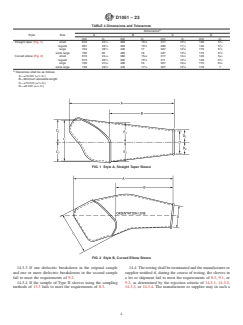
FIG. 1 Style A, Straight Taper Sleeve
FIG. 2 Style B, Curved Elbow Sleeve
14.3.3 If one dielectric breakdown in the original sample 14.4 The testing shall be terminated and the manufacturer or
and one or more dielectric breakdowns in the second sample supplier notified if, during the course of testing, the sleeves in
fail to meet the requirements of 9.2. a lot or shipment fail to meet the requirements of 8.3, 9.1, or
14.3.4 If the sample of Type II sleeves using the sampling 9.2, as determined by the rejection criteria of 14.3.1, 14.3.2,
methods of 13.3 fails to meet the requirements of 8.3. 14.3.3, or 14.3.4. The manufacturer or supplier may in such a
D1051 − 23
case require the purchaser to submit proof that the test 16.1.5 Ozone resistance tests in accordance with 18.7.
procedure and equipment conform to the appropriate para- 16.1.6 Chemical and physical property tests in accordance
graphs of Section 18. When such proof has been furnished, the with Section 19.
manufacturer or supplier may request that his representative
17. Dimension Measurements
witness the testing of additional sleeves from the shipment.
17.1 Thickness:
14.5 The entire lot or shipment may be rejected at the option
17.1.1 Thickness measurements shall be made at eight or
of the purchaser, if two specimens of the first sample and one
more points uniformly distributed over the total area of the
of the second sample, selected in accordance with 13.3, fail any
sleeve.
of the separate requirements outlined in Section 8.
17.1.2 Thickness measurements shall be made on complete
14.6 The entire lot or shipment of sleeves may be rejected at
sleeves with a micrometer graduated to within 0.025 mm
the option of the purchaser if 25 % of the sleeves in the lot or
(0.001 in.), having an anvil about 6 mm (0.25 in.) in diameter
shipment fail to meet the requirements of Section 10 or 11.
and a presser foot 3.17 mm 6 0.25 mm (0.125 in. 6 0.001 in.)
in diameter. The presser foot shall exert a total force of 0.83 N
14.7 All rejected material shall be returned as directed by
6 0.03 N (3.0 ozf 6 0.1 ozf). Sufficient support shall be given
the manufacturer, at his or the supplier’s request, without being
to the sleeve so that it will present an unstressed, flat surface
defaced by rubber stamp or other permanent marking.
between the anvil faces of the micrometer.
However, those sleeves punctured when tested under 9.1 and
9.2 shall be stamped, punched, or cut prior to being returned to
NOTE 2—A dial-type micrometer graduated in millimetres or inches and
mounted in a manner similar to that shown in Fig. 3 is particularly
the supplier to indicate that they are unfit for electrical use.
convenient for making these measurements.
15. Packaging and Package Marking
17.2 Other Dimensions:
17.2.1 Straight Taper Sleeves—Dimensions of straight taper
15.1 Each pair of sleeves shall be packed in an individual
sleeves, as illustrated in Fig. 1 and specified in Table 4, shall be
container of sufficient strength to properly protect the sleeves
determined with the sleeve in a flattened condition (that is, with
from damage in transit. The end of the container shall be
one side firmly and uniformly pressed against the other). A
marked with the name of the manufacturer or supplier, type,
convenient device for measuring is a board with a center line
class, style, size, and color.
upon which the sleeve is placed so that D equals D and E
1 2 1
TEST METHODS
equals E , in which case C will be greater than C .
2 1 2
17.2.1.1 Dimension A—The overall length shall be mea-
16. Sequence of Testing
sured from the outside edge of the wrist opening to the outside
16.1 The following order of procedure is suggested for edge of the shoulder opening, parallel to the center line.
testing rubber insulating sleeves: 17.2.1.2 Dimension B—The underarm length shall be mea-
16.1.1 Inspection of the surfaces in accordance with Section sured from the outside edge of the cuff opening to the lowest
11. point of the underarm opening along the center line.
16.1.2 The dimensions in accordance with Section 17. 17.2.1.3 Dimension C—The shoulder opening width shall
16.1.3 Electrical proof tests in accordance with 18.5.2 or be the sum of C and C minus twice the thickness of the
1 2
18.6.2. sleeve, measured perpendicular to the center line as shown in
16.1.4 Breakdown voltage tests in accordance with 18.5.3. Fig. 1.
FIG. 3 Dial-Micrometer for Measuring Sleeve Thickness
D1051 − 23
17.2.1.4 Dimension D—The wrist opening width shall be conductance of 100 μS ⁄cm. Other electrodes shall fit sleeves as
the sum of D and D minus twice the thickness of the sleeve, snugly as possible and without distortion. Areas not in contact
...
This document is not an ASTM standard and is intended only to provide the user of an ASTM standard an indication of what changes have been made to the previous version. Because
it may not be technically possible to adequately depict all changes accurately, ASTM recommends that users consult prior editions as appropriate. In all cases only the current version
of the standard as published by ASTM is to be considered the official document.
Designation: D1051 − 19 D1051 − 23
Standard Specification for
Rubber Insulating Sleeves
This standard is issued under the fixed designation D1051; the number immediately following the designation indicates the year of
original adoption or, in the case of revision, the year of last revision. A number in parentheses indicates the year of last reapproval. A
superscript epsilon (´) indicates an editorial change since the last revision or reapproval.
1. Scope
1.1 This specification covers manufacturing and testing of rubber insulating sleeves for protection of workers from electrical
shock.
1.2 Two types of sleeves are provided and are designated as Type I, nonresistant to ozone, and Type II, resistant to ozone.
1.3 Five classes of sleeves, differing in electrical characteristics, are provided and are designated as Class 0, Class 1, Class 2, Class
3, and Class 4.
1.4 Two styles of sleeves, differing in configuration, are provided and are designated as Style A, straight taper, and Style B, curved
elbow.
1.5 The values stated in SI units are to be regarded as the standard. See IEEE/ASTM SI 10.
1.6 The following safety hazards caveat pertains only to the test methods portion, Sections 16 – 19, of this specification: This
standard does not purport to address all of the safety concerns, if any, associated with its use. It is the responsibility of the user
of this standard to establish appropriate safety, health, and environmental practices and determine the applicability of regulatory
limitations prior to use.Specific safety hazards statements are given in 18.2.
1.7 This international standard was developed in accordance with internationally recognized principles on standardization
established in the Decision on Principles for the Development of International Standards, Guides and Recommendations issued
by the World Trade Organization Technical Barriers to Trade (TBT) Committee.
2. Referenced Documents
2.1 ASTM Standards:
D149 Test Method for Dielectric Breakdown Voltage and Dielectric Strength of Solid Electrical Insulating Materials at
Commercial Power Frequencies
D297 Test Methods for Rubber Products—Chemical Analysis
D412 Test Methods for Vulcanized Rubber and Thermoplastic Elastomers—Tension
D570 Test Method for Water Absorption of Plastics
D573 Test Method for Rubber—Deterioration in an Air Oven
D624 Test Method for Tear Strength of Conventional Vulcanized Rubber and Thermoplastic Elastomers
This specification is under the jurisdiction of ASTM Committee F18 on Electrical Protective Equipment for Workers and is the direct responsibility of Subcommittee
F18.15 on Worker Personal Equipment. This standard replaces ANSI Standard J6.5, which is no longer available.
Current edition approved Aug. 1, 2019Dec. 1, 2023. Published August 2019December 2023. Originally approved in 1949. Last previous edition approved in 20142019
as D1051 – 14D1051 – 19.A. DOI: 10.1520/D1051-19.10.1520/D1051-23.
For referenced ASTM standards, visit the ASTM website, www.astm.org, or contact ASTM Customer Service at service@astm.org. For Annual Book of ASTM Standards
volume information, refer to the standard’s Document Summary page on the ASTM website.
Copyright © ASTM International, 100 Barr Harbor Drive, PO Box C700, West Conshohocken, PA 19428-2959. United States
D1051 − 23
D1415 Test Method for Rubber Property—International Hardness
D2240 Test Method for Rubber Property—Durometer Hardness
D2865 Practice for Calibration of Standards and Equipment for Electrical Insulating Materials Testing
F819 Terminology Relating to Electrical Protective Equipment for Workers
IEEE/ASTM SI 10 American National Standard for Metric Practice
3. Terminology
3.1 Definitions:
3.1.1 color splash—splash, n—a splash, smear, or streak of contrasting color evident on the inside or outside of the sleeves that
was deposited during the dripping operation and is vulcanized into the sleeve as part of the homogeneous compound.
3.1.2 halogenation treatment—treatment, n—exposure of the entire sleeve surface area to a halogen for the purpose of reducing
surface friction.
3.1.3 user—user, n—the employer or entity purchasing the equipment to be utilized by workers for their protection; in the absence
of such an employer or entity, the individual purchasing and utilizing the protective equipment.
3.1.4 For definitions of other terms, refer to Terminology F819.
4. Significance and Use
4.1 This specification covers the minimum electrical, chemical, and physical properties guaranteed by the manufacturer and the
detailed procedures by which such properties are to be determined. The purchaser at his option may perform or have performed
any of these tests in order to verify the guarantee. Claims for failure to meet the specification are subject to verification by the
manufacturer.
4.2 Sleeves are used for personal protection; therefore, when authorizing their use, a margin of safety shall be allowed between
the maximum voltage on which they are used and the proof-test voltage at which they are tested. The relationship between
proof-test voltage and the maximum voltage at which the sleeves shall be used is shown in Table 1.
4.3 Work practices vary from user to user, dependent upon many factors. These may include but are not limited to, operating
system voltages, construction design, work procedure techniques, weather conditions, and so forth. Therefore, except for the
restrictions set forth in this specification because of design limitations, the use and maintenance of this equipment is beyond the
scope of this specification.
4.4 It is common practice and the responsibility of the user of this type of protective equipment to prepare complete instructions
and regulations to govern the correct and safe use of such equipment.
5. Classification
5.1 Sleeves covered under this specification shall be designated as Type I or Type II; Class 0, Class 1, Class 2, Class 3, and Class
4; and Style A or Style B.
5.1.1 Type I, nonresistant to ozone, made from a high-grade cis-1,4-polyisoprene rubber compound of natural or synthetic origin,
properly vulcanized.
TABLE 1 Proof Test/Use Voltage Relationship
Maximum Use Maximum
Class of AC Proof-Test DC Proof-Test
Voltage ac Use Voltage,
Sleeve Voltage rms V Voltage avg, V
(rms), V DC, avg , V
0 5 000 20 000 1 000 1 500
1 10 000 40 000 7 500 11 250
2 20 000 50 000 17 000 25 500
3 30 000 60 000 26 500 39 750
4 40 000 70 000 36 000 54 000
D1051 − 23
5.1.2 Type II, resistant to ozone, made of any elastomer or combination of elastomeric compounds.
5.1.3 The class designation shall be based on the electrical properties as shown in Table 1.
5.1.4 Style A, straight taper design.
5.1.5 Style B, curved elbow design.
6. Ordering Information
6.1 Orders for sleeves under this specification should include the following information:
6.1.1 Type,
6.1.2 Class,
6.1.3 Style,
6.1.4 Size,
6.1.5 Color, and
6.1.6 With or without halogenation treatment.
6.2 The listing of types, classes, styles, sizes, and colors is not intended to mean that all shall necessarily be available from
manufacturers; it signifies only that, if made, they shall conform to the details of this specification.
7. Manufacture and Marking
7.1 The sleeves shall be produced by a seamless process.
7.2 Sleeves shall have a smooth finish and self-reinforced edges.
7.3 The holes provided in sleeves for the purposes of strap or harness attachments shall have non-metallic reinforced edges and
shall be nominally 8 mm ( ⁄16 in.) in diameter.
7.4 Each sleeve shall be marked clearly and permanently with the name of the manufacturer or supplier, ASTM D1051, type, class,
size, and right or left. All such marking shall be confined to the shoulder flap area and shall be nonconducting and applied in such
a manner as to not impair the required properties of the sleeves.
7.4.1 A label shall be used to identify the voltage class: Class 0—red, Class 1—white, Class 2—yellow, Class 3—green, and Class
4—orange. The other required information in 7.4 may be placed on the label or molded directly into the sleeve.
7.4.2 To minimize problems of marking and identification, the following standard abbreviations may be used: Small (Sm), Regular
(Rg), Large (Lg), Extra Large (XLg), and Class 1 (1), Class 2 (2), and so forth. Right or left shall not be abbreviated.
7.4.3 At the request of the user, the sleeves may be given a halogenation treatment to reduce surface friction. This treatment shall
have no detrimental effect upon the electrical, chemical or physical properties of the sleeves.
8. Chemical and Physical Requirements
8.1 Sleeve test material taken from sample sleeves selected in accordance with 13.2 shall conform to the physical requirements
in Table 2 and the accelerated aging in 19.2.5.
8.2 In the event of a dispute, the identification of the rubber polymer in Type I sleeves shall be performed in accordance with
19.1.1.
D1051 − 23
TABLE 2 Physical Requirements
Property Type I Type II
Tensile strength, min, Die C, MPa (psi) 17.2 (2500) 10.3 (1500)
Tensile stress at 200 %, max, MPa (psi) 2.1 (300) 2.1 (300)
Ultimate elongation, min, % 600 500
Tension set, max at 400 %, % 25 25
Tear resistance, min, kN/m (lbf/in.) 21 (120) 14 (80)
Puncture resistance, min, kN/m (lbf/in.) 18 (100) 18 (100)
Hardness, Shore A, max 47 47
Moisture absorption, max, % 1.5 1.5
8.3 The Type II sleeve material shall show no visible effects from ozone when tested in accordance with 18.7. Any visible signs
of ozone deterioration of the sleeve material such as checking, cracking, breaks, pitting, and so forth, shall be considered as
evidence of failure to meet the requirements of Type II sleeves.
9. Electrical Requirements
9.1 Each sleeve shall be given a proof test and shall withstand the 60-Hz60 Hz ac proof-test voltage (rms value) or the dc
proof-test voltage (average value) specified in Table 1. The proof test shall be performed in accordance with Section 18. The
voltage shall be applied continuously for 3 min.
9.2 Sample sleeve material selected in accordance with 13.2, when tested between 50 mm (2 in.) disk electrodes with edges
rounded to a radius of 6 mm (0.25 in.), shall show a 60 Hz dielectric strength of not less than 14.8 MV/m (375 V (375 V rms/mil)
of specimen thickness for each individual test.
10. Dimensions and Permissible Variations
10.1 Sample sleeves selected in accordance with 13.2 shall fall within the thickness limits specified in Table 3 when measured in
accordance with 17.1.
10.2 Sample sleeves selected in accordance with 13.2 shall fall within the dimension limits specified in Table 4 for each size and
style when measured in accordance with 17.2 in conjunction with Fig. 1 and Fig. 2. Variations in sleeve length and wrist
dimensions are acceptable when required to meet special physical requirements.
10.2.1 The taper of sleeves should be uniform as this is significant because of the advent of dry-form electrical testing.
11. Workmanship and Finish
11.1 Sleeves shall be free on both inner and outer surfaces of harmful physical irregularities that can be detected by thorough test
and inspection.
11.1.1 Harmful physical irregularities may be defined as any feature that disrupts the uniform, smooth surface contour and
represents a potential hazard to the user, such as pinholes, cracks, blisters, cuts, conductive embedded foreign matter, creases, pinch
marks, voids (entrapped air), prominent ripples, and prominent mold marks.
11.2 Nonharmful physical irregularities may be defined as surface irregularities present on the inner and outer surfaces of the
rubber sleeve due to imperfections on forms or molds and inherent difficulties in the manufacturing process. These irregularities
may appear as mold marks that look like cuts even though they are actually a raised ridge of rubber, indentations, protuberances,
embedded foreign material, or color splashes that are acceptable provided that:
TABLE 3 Thickness
Class of Minimum Maximum
Sleeve mm in. mm in.
0 0.51 0.020 1.02 0.040
1 0.76 0.030 1.52 0.060
2 1.27 0.050 2.54 0.100
3 1.90 0.075 2.92 0.115
4 2.54 0.100 3.56 0.140
D1051 − 23
TABLE 4 Dimensions and Tolerances
A
Dimensions
Style Size A B C D
mm in. mm in. mm in. mm in.
1 1 1 3
Straight taper (Fig. 1) small 616 24 ⁄4 384 15 ⁄8 317 12 ⁄2 146 5 ⁄4
1 1 1 3
regular 667 26 ⁄4 394 15 ⁄2 286 11 ⁄4 146 5 ⁄4
1 7 7
large 724 28 ⁄2 432 17 327 12 ⁄8 175 6 ⁄8
1 7
extra large 762 30 483 19 337 13 ⁄4 175 6 ⁄8
1 1 1 3
Curved elbow (Fig. 2) small 616 24 ⁄4 384 15 ⁄8 317 12 ⁄2 146 5 ⁄4
1 1 1 3
regular 673 26 ⁄2 394 15 ⁄2 311 12 ⁄4 146 5 ⁄4
3 7 7
large 705 27 ⁄4 406 16 327 12 ⁄8 175 6 ⁄8
1 1 7
extra large 749 29 ⁄2 445 17 ⁄2 327 12 ⁄8 178 7
A
Tolerances shall be as follows:
A—±13 mm A—±13 mm (± ⁄2 in.)
B—Minimum allowable length
C—±13 mm C—±13 mm (± ⁄2 in.)
D—±6 mm D—±6 mm (± ⁄4 in.)
FIG. 1 Style A, Straight Taper Sleeve
FIG. 2 Style B, Curved Elbow Sleeve
11.2.1 The indentations, protuberance or mold marks tend to blend into a smooth slope upon stretching of the material.
11.2.2 The rubber thickness at any irregularity conforms to the thickness requirements.
11.2.3 Foreign material remains in place when the sleeve is folded and stretched with the material surrounding it.
11.2.4 Color splashes are no longer than 3 mm in any direction on a surface of the sleeve.
D1051 − 23
12. Guarantee
12.1 The manufacturer or supplier shall replace, without charge to the purchaser, unused sleeves which, at any time within a period
of 9 months from date of initial delivery of shipment to the purchaser or designee, fail to pass the tests in this specification. This
guarantee will be binding on the manufacturer or supplier only if the sleeves have been properly stored and have not been subjected
to more than an original acceptance test and one retest.
12.2 Any acceptance test made by the purchaser or the purchaser’s designee, shall be performed within the first two months of
the guarantee period unless otherwise specified.
NOTE 1—Proper storage means that sleeves are stored right side out, not distorted and not stored directly above or in proximity to steam pipes, radiators,
or other sources of artificial heat, or exposed to direct sunlight or other sources of ozone. It is desirable that the ambient storage temperature shall not
exceed 35 °C (95 °F).
13. Sampling
13.1 Each sleeve in a lot or shipment shall be subject to inspection and test to meet the requirements of Sections 7, 11, and 15,
and 9.1.
13.2 An original sample of 1 % of the lot or shipment or not less than two sleeves, whichever is greater, shall be selected at random
from the lot or shipment for the test requirements of Sections 10 and 9.2. Where a failure occurs in the first sample, a second sample
of the same quantity shall be selected and tested.
13.3 An original sample of 0.1 % of the lot or shipment or not less than two sleeves, whichever is greater, shall be selected at
random from the lot or shipment for the test requirements of Section 8.
14. Rejection
14.1 Individual sleeves shall be rejected if they fail to meet requirements of Sections 7 and 11, 9.1 and the minimum thickness
requirement of 10.1.
14.2 Individual sleeves may be rejected at the option of the purchaser if they fail to meet the requirements of Sections 15 and 10.2.
14.3 The entire lot or shipment of sleeves shall be rejected under any of the following conditions:
14.3.1 If 5 % or more, but not less than two sleeves, in a lot or shipment fail to meet the requirements of 9.1.
14.3.2 If two dielectric breakdowns that do not meet the requirements of 9.2 occur in the sample.
14.3.3 If one dielectric breakdown in the original sample and one or more dielectric breakdowns in the second sample fail to meet
the requirements of 9.2.
14.3.4 If the sample of Type II sleeves using the sampling methods of 13.3 fails to meet the requirements of 8.3.
14.4 The testing shall be terminated and the manufacturer or supplier notified if, during the course of testing, the sleeves in a lot
or shipment fail to meet the requirements of 8.3, 9.1, or 9.2, as determined by the rejection criteria of 14.3.1, 14.3.2, 14.3.3, or
14.3.4. The manufacturer or supplier may in such a case require the purchaser to submit proof that the test procedure and equipment
conform to the appropriate paragraphs of Section 18. When such proof has been furnished, the manufacturer or supplier may
request that his representative witness the testing of additional sleeves from the shipment.
14.5 The entire lot or shipment may be rejected at the option of the purchaser, if two specimens of the first sample and one of
the second sample, selected in accordance with 13.3, fail any of the separate requirements outlined in Section 8.
14.6 The entire lot or shipment of sleeves may be rejected at the option of the purchaser if 25 % of the sleeves in the lot or
shipment fail to meet the requirements of Section 10 or 11.
D1051 − 23
14.7 All rejected material shall be returned as directed by the manufacturer, at his or the supplier’s request, without being defaced
by rubber stamp or other permanent marking. However, those sleeves punctured when tested under 9.1 and 9.2 shall be stamped,
punched, or cut prior to being returned to the supplier to indicate that they are unfit for electrical use.
15. Packaging and Package Marking
15.1 Each pair of sleeves shall be packed in an individual container of sufficient strength to properly protect the sleeves from
damage in transit. The end of the container shall be marked with the name of the manufacturer or supplier, type, class, style, size,
and color.
TEST METHODS
16. Sequence of Testing
16.1 The following order of procedure is suggested for testing rubber insulating sleeves:
16.1.1 Inspection of the surfaces in accordance with Section 11.
16.1.2 The dimensions in accordance with Section 17.
16.1.3 Electrical proof tests in accordance with 18.5.2 or 18.6.2.
16.1.4 Breakdown voltage tests in accordance with 18.5.3.
16.1.5 Ozone resistance tests in accordance with 18.7.
16.1.6 Chemical and physical property tests in accordance with Section 19.
17. Dimension Measurements
17.1 Thickness:
17.1.1 Thickness measurements shall be made at eight or more points uniformly distributed over the total area of the sleeve.
17.1.2 Thickness measurements shall be made on complete sleeves with a micrometer graduated to within 0.025 mm (0.001 in.),
having an anvil about 6 mm (0.25 in.) in diameter and a presser foot 3.173.17 mm 6 0.25 mm (0.125(0.125 in. 6 0.001 in.) in
diameter. The presser foot shall exert a total force of 0.830.83 N 6 0.03 N (3.0(3.0 ozf 6 0.1 ozf). Sufficient support shall be given
to the sleeve so that it will present an unstressed, flat surface between the anvil faces of the micrometer.
NOTE 2—A dial-type micrometer graduated in millimetres or inches and mounted in a manner similar to that shown in Fig. 3 is particularly convenient
for making these measurements.
17.2 Other Dimensions:
17.2.1 Straight Taper Sleeves—Dimensions of straight taper sleeves, as illustrated in Fig. 1 and specified in Table 4, shall be
determined with the sleeve in a flattened condition (that is, with one side firmly and uniformly pressed against the other). A
convenient device for measuring is a board with a center line upon which the sleeve is placed so that D equals D and E equals
1 2 1
E , in which case C will be greater than C .
2 1 2
17.2.1.1 Dimension A—The overall length shall be measured from the outside edge of the wrist opening to the outside edge of
the shoulder opening, parallel to the center line.
17.2.1.2 Dimension B—The underarm length shall be measured from the outside edge of the cuff opening to the lowest point of
the underarm opening along the center line.
D1051 − 23
FIG. 3 Dial-Micrometer for Measuring Sleeve Thickness
17.2.1.3 Dimension C—The shoulder opening width shall be the sum of C and C minus twice the thickness of the sleeve,
1 2
measured perpendicular to the center line as shown in Fig. 1.
17.2.1.4 Dimension D—The wrist opening width shall be the sum of D and D minus twice the thickness of the sleeve, measured
1 2
perpendicular to the cente
...