

ASTM D2655-23
(Specification)Standard Specification for Crosslinked Polyethylene Insulation for Wire and Cable Rated 0 to 2000 V, 90 °C Operation
General Information
- Abstract
ABSTRACT
This specification covers crosslinked polymer insulation material consisting substantially of polyethylene or a polyethylene copolymer for electrical wires and cables in conductor, suitable for continuous use on power cables in wet and dry locations, having specified sizes and operating at specified voltage ratings and conductor temperatures. Materials covered by this specification are not sunlight and weather resistant unless they are carbon black pigmented or contain an additive system designed for this protection. Since the insulation cannot be tested unless it has been formed around a conductor, tests shall then be done on insulated wire solely to determine the relevant property of the insulation and not to test the conductor or completed cable. Materials shall meet the physical properties as follows: unaged tensile strength and elongation at rupture; tensile strength and elongation at rupture after air oven aging; heat distortion; filled and unfilled percent hot creep; and filled and unfilled percent hot set. Insulations shall also perform satisfactorily during tests for AC and DC voltage, insulation resistance, and accelerated water absorption.
SCOPE
1.1 This specification covers a crosslinked polyethylene insulation for electrical wires and cables in conductor sizes 14 AWG [2.08 mm2] and larger. The base polymer of this insulation consists substantially of polyethylene or a polyethylene copolymer.
1.2 This type of insulation is suitable for continuous use on power cables in wet and dry locations, for voltage ratings not exceeding 2000 V and at conductor temperatures not exceeding 90 °C for normal operation. For copper conductors, the insulation can be applied over the uncoated metal.
1.3 Materials covered by this specification are not sunlight and weather resistant unless they are carbon black pigmented or contain an additive system designed for this protection.
1.4 In many instances the insulation cannot be tested unless it has been formed around a conductor. Therefore, tests are done on insulated wire in this standard solely to determine the relevant property of the insulation and not to test the conductor or completed cable.
1.5 Whenever two sets of values are presented, in different units, the values in the first set are the standard, while those in parentheses are for information only.
1.6 This international standard was developed in accordance with internationally recognized principles on standardization established in the Decision on Principles for the Development of International Standards, Guides and Recommendations issued by the World Trade Organization Technical Barriers to Trade (TBT) Committee.
- Status
- Published
- Publication Date
- 31-Jul-2023
- Technical Committee
- D09 - Electrical and Electronic Insulating Materials
- Drafting Committee
- D09.07 - Electrical Insulating Materials
Buy Documents
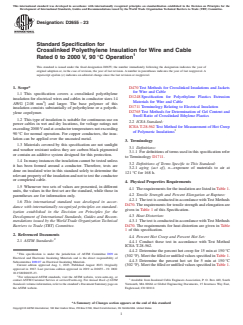
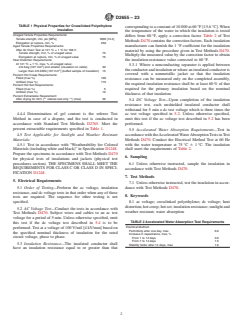


ASTM D2655-23 - Standard Specification for Crosslinked Polyethylene Insulation for Wire and Cable Rated 0 to 2000 V, 90 °C Operation
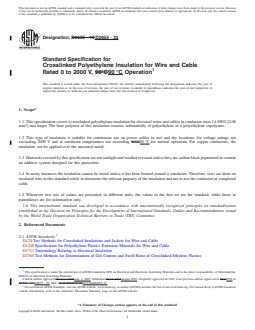
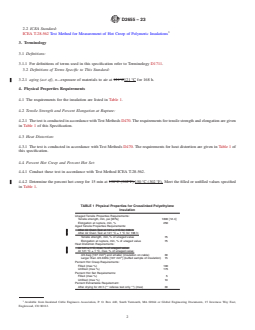

REDLINE ASTM D2655-23 - Standard Specification for Crosslinked Polyethylene Insulation for Wire and Cable Rated 0 to 2000 V, 90 °C Operation
Overview
ASTM D2655-23 is the Standard Specification for Crosslinked Polyethylene Insulation for Wire and Cable Rated 0 to 2000 V, 90 °C Operation. Developed by ASTM International, this standard establishes requirements for crosslinked polyethylene (XLPE) insulation, applicable to electrical wires and cables used in a range of conductor sizes (14 AWG and larger). XLPE insulation specified by ASTM D2655-23 is designed for reliable performance in both wet and dry conditions, at voltage ratings up to 2000 V, and at conductor operating temperatures up to 90°C.
ASTM D2655-23 plays a crucial role in ensuring the safety, durability, and physical and electrical performance of insulated wires and cables used in diverse power distribution and industrial applications.
Key Topics
- Material Composition: Specifies insulation made primarily from crosslinked polyethylene or polyethylene copolymer, providing the base for robust dielectric properties.
- Operating Conditions: Suitable for continuous operation at temperatures up to 90°C and for use with voltage ratings not exceeding 2000 V in both wet and dry environments.
- Environmental Resistance: Materials are not inherently resistant to sunlight and weather unless specifically formulated with carbon black pigment or additives for UV protection.
- Physical Property Requirements: Includes minimum standards for unaged and aged tensile strength, elongation at rupture, heat distortion, and both hot creep and hot set performance for filled and unfilled insulation types.
- Electrical Property Requirements: Defines necessary performance for AC and DC voltage withstand, insulation resistance, and accelerated water absorption.
- Testing Protocols: All performance tests are conducted on the formed insulated conductor using referenced ASTM and ICEA methods, ensuring the requirements pertain to the insulation, not the conductor or overall cable assembly.
Applications
Crosslinked polyethylene insulation conforming to ASTM D2655-23 is widely used in the following areas:
- Power Distribution Cables: For low- and medium-voltage cables in commercial, industrial, and residential installations.
- Control and Instrumentation Cables: Ensures signal integrity and electrical safety for control systems in manufacturing and processing facilities.
- Underground and Wet-Location Wiring: Suitable for environments where exposure to moisture, chemicals, or buried installation is a concern.
- General Purpose Wiring: Ideal for applications requiring enhanced mechanical strength, electrical insulation, and heat resistance up to 90°C.
This standard benefits manufacturers, installers, and specifiers by:
- Providing consistent quality for crosslinked polyethylene-insulated wire and cable products.
- Supporting compliance with strict safety and reliability requirements in electrical installations.
- Assisting in project specification and regulatory approvals for power and control cable implementations.
Related Standards
ASTM D2655-23 references and aligns with several other crucial industry standards, including:
- ASTM D470: Test Methods for Crosslinked Insulations and Jackets for Wire and Cable - used for various mechanical and electrical property measurements.
- ASTM D1248: Specification for Polyethylene Plastics Extrusion Materials for Wire and Cable - details material classifications and physical requirements.
- ASTM D1711: Terminology Relating to Electrical Insulation - provides relevant definitions and standard language.
- ASTM D2765: Test Methods for Determination of Gel Content and Swell Ratio of Crosslinked Ethylene Plastics - specified for gel content and extractables testing.
- ICEA T-28-562: Test Methods for Measurement of Hot Creep of Polymeric Insulations - referenced for hot creep and hot set performance.
By adhering to ASTM D2655-23, manufacturers and engineers ensure insulated wire and cable products deliver reliable performance, safety, and longevity in demanding electrical applications. This standard remains a key reference for quality assurance and regulatory compliance in the electrical wire and cable industry.
Relations
- Effective Date
- 01-Mar-2024
- Effective Date
- 01-Feb-2024
- Effective Date
- 15-Nov-2016
- Effective Date
- 01-Sep-2016
- Effective Date
- 01-Nov-2015
- Effective Date
- 01-Nov-2014
- Effective Date
- 01-May-2014
- Effective Date
- 01-Nov-2013
- Effective Date
- 01-Apr-2012
- Effective Date
- 01-Aug-2011
- Effective Date
- 01-May-2008
- Effective Date
- 01-Apr-2006
- Effective Date
- 01-Apr-2006
- Refers
ASTM D470-05 - Standard Test Methods for Crosslinked Insulations and Jackets for Wire and Cable - Effective Date
- 01-Sep-2005
- Effective Date
- 01-Mar-2005
Buy Documents
ASTM D2655-23 - Standard Specification for Crosslinked Polyethylene Insulation for Wire and Cable Rated 0 to 2000 V, 90 °C Operation
REDLINE ASTM D2655-23 - Standard Specification for Crosslinked Polyethylene Insulation for Wire and Cable Rated 0 to 2000 V, 90 °C Operation
Get Certified
Connect with accredited certification bodies for this standard

IMQ S.p.A. (Certification)
Italian electrical product certification.

SLG Prüf- und Zertifizierungs GmbH
German testing and certification body.

UL Solutions
Global safety science company with testing, inspection and certification.
Sponsored listings
Frequently Asked Questions
ASTM D2655-23 is a technical specification published by ASTM International. Its full title is "Standard Specification for Crosslinked Polyethylene Insulation for Wire and Cable Rated 0 to 2000 V, 90 °C Operation". This standard covers: ABSTRACT This specification covers crosslinked polymer insulation material consisting substantially of polyethylene or a polyethylene copolymer for electrical wires and cables in conductor, suitable for continuous use on power cables in wet and dry locations, having specified sizes and operating at specified voltage ratings and conductor temperatures. Materials covered by this specification are not sunlight and weather resistant unless they are carbon black pigmented or contain an additive system designed for this protection. Since the insulation cannot be tested unless it has been formed around a conductor, tests shall then be done on insulated wire solely to determine the relevant property of the insulation and not to test the conductor or completed cable. Materials shall meet the physical properties as follows: unaged tensile strength and elongation at rupture; tensile strength and elongation at rupture after air oven aging; heat distortion; filled and unfilled percent hot creep; and filled and unfilled percent hot set. Insulations shall also perform satisfactorily during tests for AC and DC voltage, insulation resistance, and accelerated water absorption. SCOPE 1.1 This specification covers a crosslinked polyethylene insulation for electrical wires and cables in conductor sizes 14 AWG [2.08 mm2] and larger. The base polymer of this insulation consists substantially of polyethylene or a polyethylene copolymer. 1.2 This type of insulation is suitable for continuous use on power cables in wet and dry locations, for voltage ratings not exceeding 2000 V and at conductor temperatures not exceeding 90 °C for normal operation. For copper conductors, the insulation can be applied over the uncoated metal. 1.3 Materials covered by this specification are not sunlight and weather resistant unless they are carbon black pigmented or contain an additive system designed for this protection. 1.4 In many instances the insulation cannot be tested unless it has been formed around a conductor. Therefore, tests are done on insulated wire in this standard solely to determine the relevant property of the insulation and not to test the conductor or completed cable. 1.5 Whenever two sets of values are presented, in different units, the values in the first set are the standard, while those in parentheses are for information only. 1.6 This international standard was developed in accordance with internationally recognized principles on standardization established in the Decision on Principles for the Development of International Standards, Guides and Recommendations issued by the World Trade Organization Technical Barriers to Trade (TBT) Committee.
ABSTRACT This specification covers crosslinked polymer insulation material consisting substantially of polyethylene or a polyethylene copolymer for electrical wires and cables in conductor, suitable for continuous use on power cables in wet and dry locations, having specified sizes and operating at specified voltage ratings and conductor temperatures. Materials covered by this specification are not sunlight and weather resistant unless they are carbon black pigmented or contain an additive system designed for this protection. Since the insulation cannot be tested unless it has been formed around a conductor, tests shall then be done on insulated wire solely to determine the relevant property of the insulation and not to test the conductor or completed cable. Materials shall meet the physical properties as follows: unaged tensile strength and elongation at rupture; tensile strength and elongation at rupture after air oven aging; heat distortion; filled and unfilled percent hot creep; and filled and unfilled percent hot set. Insulations shall also perform satisfactorily during tests for AC and DC voltage, insulation resistance, and accelerated water absorption. SCOPE 1.1 This specification covers a crosslinked polyethylene insulation for electrical wires and cables in conductor sizes 14 AWG [2.08 mm2] and larger. The base polymer of this insulation consists substantially of polyethylene or a polyethylene copolymer. 1.2 This type of insulation is suitable for continuous use on power cables in wet and dry locations, for voltage ratings not exceeding 2000 V and at conductor temperatures not exceeding 90 °C for normal operation. For copper conductors, the insulation can be applied over the uncoated metal. 1.3 Materials covered by this specification are not sunlight and weather resistant unless they are carbon black pigmented or contain an additive system designed for this protection. 1.4 In many instances the insulation cannot be tested unless it has been formed around a conductor. Therefore, tests are done on insulated wire in this standard solely to determine the relevant property of the insulation and not to test the conductor or completed cable. 1.5 Whenever two sets of values are presented, in different units, the values in the first set are the standard, while those in parentheses are for information only. 1.6 This international standard was developed in accordance with internationally recognized principles on standardization established in the Decision on Principles for the Development of International Standards, Guides and Recommendations issued by the World Trade Organization Technical Barriers to Trade (TBT) Committee.
ASTM D2655-23 is classified under the following ICS (International Classification for Standards) categories: 29.035.20 - Plastics and rubber insulating materials. The ICS classification helps identify the subject area and facilitates finding related standards.
ASTM D2655-23 has the following relationships with other standards: It is inter standard links to ASTM D1711-24, ASTM D2765-16(2024), ASTM D1248-16, ASTM D2765-16, ASTM D1711-15, ASTM D1711-14a, ASTM D1711-14, ASTM D1711-13, ASTM D1248-12, ASTM D1711-11a, ASTM D1711-08, ASTM D2765-11, ASTM D2765-01(2006), ASTM D470-05, ASTM D1248-05. Understanding these relationships helps ensure you are using the most current and applicable version of the standard.
ASTM D2655-23 is available in PDF format for immediate download after purchase. The document can be added to your cart and obtained through the secure checkout process. Digital delivery ensures instant access to the complete standard document.
Standards Content (Sample)
This international standard was developed in accordance with internationally recognized principles on standardization established in the Decision on Principles for the
Development of International Standards, Guides and Recommendations issued by the World Trade Organization Technical Barriers to Trade (TBT) Committee.
Designation: D2655 − 23
Standard Specification for
Crosslinked Polyethylene Insulation for Wire and Cable
Rated 0 to 2000 V, 90 °C Operation
This standard is issued under the fixed designation D2655; the number immediately following the designation indicates the year of
original adoption or, in the case of revision, the year of last revision. A number in parentheses indicates the year of last reapproval. A
superscript epsilon (´) indicates an editorial change since the last revision or reapproval.
1. Scope* D470 Test Methods for Crosslinked Insulations and Jackets
for Wire and Cable
1.1 This specification covers a crosslinked polyethylene
D1248 Specification for Polyethylene Plastics Extrusion
insulation for electrical wires and cables in conductor sizes 14
2 Materials for Wire and Cable
AWG [2.08 mm ] and larger. The base polymer of this
D1711 Terminology Relating to Electrical Insulation
insulation consists substantially of polyethylene or a polyeth-
D2765 Test Methods for Determination of Gel Content and
ylene copolymer.
Swell Ratio of Crosslinked Ethylene Plastics
1.2 This type of insulation is suitable for continuous use on
2.2 ICEA Standard:
power cables in wet and dry locations, for voltage ratings not
ICEA T-28-562 Test Method for Measurement of Hot Creep
exceeding 2000 V and at conductor temperatures not exceeding
of Polymeric Insulations
90 °C for normal operation. For copper conductors, the insu-
lation can be applied over the uncoated metal.
3. Terminology
1.3 Materials covered by this specification are not sunlight
3.1 Definitions:
and weather resistant unless they are carbon black pigmented
3.1.1 For definitions of terms used in this specification refer
or contain an additive system designed for this protection.
to Terminology D1711.
1.4 In many instances the insulation cannot be tested unless
3.2 Definitions of Terms Specific to This Standard:
it has been formed around a conductor. Therefore, tests are
3.2.1 aging (act of), n—exposure of materials to air at
done on insulated wire in this standard solely to determine the
121 °C for 168 h.
relevant property of the insulation and not to test the conductor
or completed cable.
4. Physical Properties Requirements
1.5 Whenever two sets of values are presented, in different
4.1 The requirements for the insulation are listed in Table 1.
units, the values in the first set are the standard, while those in
4.2 Tensile Strength and Percent Elongation at Rupture:
parentheses are for information only.
4.2.1 The test is conducted in accordance with Test Methods
1.6 This international standard was developed in accor-
D470. The requirements for tensile strength and elongation are
dance with internationally recognized principles on standard-
given in Table 1 of this Specification.
ization established in the Decision on Principles for the
4.3 Heat Distortion:
Development of International Standards, Guides and Recom-
4.3.1 The test is conducted in accordance with Test Methods
mendations issued by the World Trade Organization Technical
D470. The requirements for heat distortion are given in Table
Barriers to Trade (TBT) Committee.
1 of this specification.
2. Referenced Documents
4.4 Percent Hot Creep and Percent Hot Set:
2.1 ASTM Standards:
4.4.1 Conduct these test in accordance with Test Method
ICEA T-28-562.
4.4.2 Determine the percent hot creep for 15 min at 150 °C
This specification is under the jurisdiction of ASTM Committee D09 on
(302 °F). Meet the filled or unfilled values specified in Table 1.
Electrical and Electronic Insulating Materials and is the direct responsibility of
4.4.3 Determine the percent hot set for 5 min at 150 °C
Subcommittee D09.07 on Electrical Insulating Materials.
Current edition approved Aug. 1, 2023. Published August 2023. Originally (302 °F). Meet the filled or unfilled values specified in Table 1.
approved in 1967. Last previous edition approved in 2019 as D2655 – 19. DOI:
10.1520/D2655-23.
For referenced ASTM standards, visit the ASTM website, www.astm.org, or
contact ASTM Customer Service at service@astm.org. For Annual Book of ASTM Available from Insulated Cable Engineers Association, P. O. Box 440, South
Standards volume information, refer to the standard’s Document Summary page on Yarmouth, MA 02664 or Global Engineering Documents, 15 Inverness Way East,
the ASTM website. Englewood, CO 80112.
*A Summary of Changes section appears at the end of this standard
Copyright © ASTM International, 100 Barr Harbor Drive, PO Box C700, West Conshohocken, PA 19428-2959. United States
D2655 − 23
TABLE 1 Physical Properties for Crosslinked Polyethylene
corresponding to a constant of 10 000 at 60 °F [15.6 °C]. When
Insulation
the temperature of the water in which the insulation is tested
Unaged Tensile Properties Requirements:
differs from 60 °F, apply a correction factor. Table 2 of Test
Tensile strength, min, psi [MPa] 1800 [12.4]
Methods D470 contains the correction factors. Each insulation
Elongation at rupture, min, % 250
manufacturer can furnish the 1 °F coefficient for the insulation
Aged Tensile Properties Requirements:
After Air Oven Test at 121 °C ± 1 °C for 168 h:
material by using the proce
...
This document is not an ASTM standard and is intended only to provide the user of an ASTM standard an indication of what changes have been made to the previous version. Because
it may not be technically possible to adequately depict all changes accurately, ASTM recommends that users consult prior editions as appropriate. In all cases only the current version
of the standard as published by ASTM is to be considered the official document.
Designation: D2655 − 19 D2655 − 23
Standard Specification for
Crosslinked Polyethylene Insulation for Wire and Cable
Rated 0 to 2000 V, 90°C90 °C Operation
This standard is issued under the fixed designation D2655; the number immediately following the designation indicates the year of
original adoption or, in the case of revision, the year of last revision. A number in parentheses indicates the year of last reapproval. A
superscript epsilon (´) indicates an editorial change since the last revision or reapproval.
1. Scope*
1.1 This specification covers a crosslinked polyethylene insulation for electrical wires and cables in conductor sizes 14 AWG [2.08
mm ] and larger. The base polymer of this insulation consists substantially of polyethylene or a polyethylene copolymer.
1.2 This type of insulation is suitable for continuous use on power cables in wet and dry locations, for voltage ratings not
exceeding 2000 V and at conductor temperatures not exceeding 90°C90 °C for normal operation. For copper conductors, the
insulation can be applied over the uncoated metal.
1.3 Materials covered by this specification are not sunlight and weather resistant unless they are carbon black pigmented or contain
an additive system designed for this protection.
1.4 In many instances the insulation cannot be tested unless it has been formed around a conductor. Therefore, tests are done on
insulated wire in this standard solely to determine the relevant property of the insulation and not to test the conductor or completed
cable.
1.5 Whenever two sets of values are presented, in different units, the values in the first set are the standard, while those in
parentheses are for information only.
1.6 This international standard was developed in accordance with internationally recognized principles on standardization
established in the Decision on Principles for the Development of International Standards, Guides and Recommendations issued
by the World Trade Organization Technical Barriers to Trade (TBT) Committee.
2. Referenced Documents
2.1 ASTM Standards:
D470 Test Methods for Crosslinked Insulations and Jackets for Wire and Cable
D1248 Specification for Polyethylene Plastics Extrusion Materials for Wire and Cable
D1711 Terminology Relating to Electrical Insulation
D2765 Test Methods for Determination of Gel Content and Swell Ratio of Crosslinked Ethylene Plastics
This specification is under the jurisdiction of ASTM Committee D09 on Electrical and Electronic Insulating Materials and is the direct responsibility of Subcommittee
D09.07 on Electrical Insulating Materials.
Current edition approved March 1, 2019Aug. 1, 2023. Published March 2019August 2023. Originally approved in 1967. Last previous edition approved in 20172019 as
D2655 – 17.D2655 – 19. DOI: 10.1520/D2655-19.10.1520/D2655-23.
For referenced ASTM standards, visit the ASTM website, www.astm.org, or contact ASTM Customer Service at service@astm.org. For Annual Book of ASTM Standards
volume information, refer to the standard’s Document Summary page on the ASTM website.
*A Summary of Changes section appears at the end of this standard
Copyright © ASTM International, 100 Barr Harbor Drive, PO Box C700, West Conshohocken, PA 19428-2959. United States
D2655 − 23
2.2 ICEA Standard:
ICEA T-28-562 Test Method for Measurement of Hot Creep of Polymeric Insulations
3. Terminology
3.1 Definitions:
3.1.1 For definitions of terms used in this specification refer to Terminology D1711.
3.2 Definitions of Terms Specific to This Standard:
3.2.1 aging (act of), n—exposure of materials to air at 121°C121 °C for 168 h.
4. Physical Properties Requirements
4.1 The requirements for the insulation are listed in Table 1.
4.2 Tensile Strength and Percent Elongation at Rupture:
4.2.1 The test is conducted in accordance with Test Methods D470. The requirements for tensile strength and elongation are given
in Table 1 of this Specification.
4.3 Heat Distortion:
4.3.1 The test is conducted in accordance with Test Methods D470. The requirements for heat distortion are given in Table 1 of
this specification.
4.4 Percent Hot Creep and Percent Hot Set:
4.4.1 Conduct these test in accordance with Test Method ICEA T-28-562.
4.4.2 Determine the percent hot creep for 15 min at 150°C (302°F).150 °C (302 °F). Meet the filled or unfilled values specified
in Table 1.
TABLE 1 Physical Properties for Crosslinked Polyethylene
Insulation
Unaged Tensile Properties Requirements:
Tensile strength, min, psi [MPa] 1800 [12.4]
Elongation at rupture, min, % 250
Aged Tensile Properties Requirements:
After Air Oven Test at 121 ± 1°C for 168 h:
After Air Oven Test at 121 °C ± 1 °C for 168 h:
Tensile strength, min, % of unaged value 75
Elongation at rupture, min, % of unaged value 75
Heat Distortion Requirements:
At 121 ± 1°C, max, % of unaged value:
At 121 °C ± 1 °C, max, % of unaged value:
4/0 Awg [107 mm ] and smaller (insulation on cable) 30
Larger than 4/0 AWG [107 mm ] (buffed sample of insulation) 15
Percent Hot Creep Requirements:
Filled (max %) 100
Unfilled (max %) 175
Percent Hot Set Requirements:
Filled (max %) 5
Unfilled (max %) 10
Percent Extractable Requirement:
After drying for 20 h (** referee test only **) (max) 30
Available from Insulated Cable Engineers Association, P. O. Box 440, South Yarmouth, MA 02664 or Global Engineering Documents, 15 Inverness Way East,
Englewood, CO 80112.
D2655 − 23
4.4.3 Determine the percent hot set for 5 min at 15
...