

ASTM F552-14(2023)
(Terminology)Standard Terminology Relating to Chain Link Fencing
General Information
- Abstract
- Status
- Published
- Publication Date
- 31-Aug-2023
- Technical Committee
- F14 - Fences
- Drafting Committee
- F14.40 - Chain Link Fence and Wire Accessories
Overview
ASTM F552-14(2023), titled Standard Terminology Relating to Chain Link Fencing, is an internationally recognized terminology standard developed and maintained by ASTM International. The document provides clear, consistent definitions for terms commonly used in the manufacture, specification, installation, and maintenance of chain link fences and their components. By establishing uniform language, this standard supports effective communication throughout the fencing industry, assisting manufacturers, suppliers, contractors, architects, designers, and regulatory agencies in interpreting and applying chain link fencing standards and practices.
Adhering to standardized terminology is critical for ensuring product compatibility, system integrity, and safety across various applications. This standard is utilized across industries and has also been approved for use by agencies of the U.S. Department of Defense, highlighting its widespread relevance.
Key Topics
The standard covers a comprehensive range of terms specific to chain link fencing, including but not limited to:
- Fabric Types: Definitions related to chain link fence fabric, such as knuckled or twisted selvages, mesh sizes, and pickets.
- Coatings and Materials: Terms for various coatings like galvanized, aluminized, Zn-5Al-MM, PVC, and polymer applications on wire and framework.
- Framework and Components: Terminology for posts (terminal, corner, line, pull, end), rails (top, intermediate/middle, bottom), clamps, and caps.
- Barriers and Security Add-ons: Definitions for barbed wire, barbed tape, barbed wire arms, corner barbed wire arms, and tension wire installations.
- Gates and Hardware: Detailed terms related to gate structures, including gate frames, posts, hinges, latches, double drive gates, pedestrian gates, overhead and cantilever slide gates, and associated fittings.
- Installation Elements: Explanations of devices and processes such as truss rods, tension bands, ties, sleeves, stretching, panel clamps, and scrolls.
By defining these and other elements, ASTM F552-14(2023) ensures clarity in technical discussions, documentation, and contractual obligations.
Applications
The terminology standardized in ASTM F552-14(2023) is essential in several practical scenarios, including:
- Product Specification: Ensures manufacturers and procurement specialists are aligned when selecting or specifying fencing materials and accessories.
- Project Contracts and Bidding: Facilitates unambiguous bid documents, contracts, and project specifications, reducing risk of misinterpretation.
- Installation Procedures: Guides contractors and installers in correctly identifying components and methods, improving quality and safety.
- Regulatory Compliance: Assists governmental and safety bodies in enforcing standards for chain link fencing.
- Training and Education: Enables effective training of industry professionals and personnel by using standardized definitions.
- International Trade: Supports the export and import of fencing products by harmonizing language and expectations across borders.
Using this terminology promotes efficiency, safety, and reliability in projects ranging from security fencing to sports facilities, public infrastructure, commercial, military, and residential applications.
Related Standards
ASTM F552-14(2023) frequently references other key ASTM standards relevant to chain link fencing systems and components. Some related standards include:
- ASTM A491, A121, A392, A824 - Material specifications for zinc-coated and other metallic wire products used in fencing.
- ASTM F626, F654, F668, F900, F934, F969, F1184, F1234, F1345, F1379, F1665 - Covering aspects from accessories, coatings, gates, fittings, and installation practices.
- ASTM F1184, F900 - Standards for cantilever and overhead slide gates, and vehicular access gates.
- ASTM F1379 - Terminology for barbed tape products.
- ASTM F668 and F1234 - Specifications for polymer-coated chain link fencing and hardware.
For further detail and to ensure compliance, users should consult the referenced ASTM standards and visit the ASTM International website.
By applying the terminology in ASTM F552-14(2023), professionals can confidently navigate the chain link fencing industry’s technical landscape, ensuring quality, safety, and interoperability.
Get Certified
Connect with accredited certification bodies for this standard

Element Materials Technology
Materials testing and product certification.

Inštitut za kovinske materiale in tehnologije
Institute of Metals and Technology. Materials testing, metallurgical analysis, NDT.
Sponsored listings
Frequently Asked Questions
ASTM F552-14(2023) is a standard published by ASTM International. Its full title is "Standard Terminology Relating to Chain Link Fencing". This standard covers: Standard Terminology Relating to Chain Link Fencing
Standard Terminology Relating to Chain Link Fencing
ASTM F552-14(2023) is classified under the following ICS (International Classification for Standards) categories: 77.140.65 - Steel wire, wire ropes and link chains. The ICS classification helps identify the subject area and facilitates finding related standards.
ASTM F552-14(2023) is available in PDF format for immediate download after purchase. The document can be added to your cart and obtained through the secure checkout process. Digital delivery ensures instant access to the complete standard document.
Standards Content (Sample)
This international standard was developed in accordance with internationally recognized principles on standardization established in the Decision on Principles for the
Development of International Standards, Guides and Recommendations issued by the World Trade Organization Technical Barriers to Trade (TBT) Committee.
Designation: F552 − 14 (Reapproved 2023)
Standard Terminology Relating to
Chain Link Fencing
This standard is issued under the fixed designation F552; the number immediately following the designation indicates the year of original
adoption or, in the case of revision, the year of last revision. A number in parentheses indicates the year of last reapproval. A superscript
epsilon (´) indicates an editorial change since the last revision or reapproval.
This standard has been approved for use by agencies of the U.S. Department of Defense.
aluminized—in chain link fabric, describes fabric woven from of contact with the roller mechanism by a person. See
steel wire that is coated with aluminum before weaving (see Specification F1184.
Specification A491 ).
bottom rail—horizontal member of the framework running
barb—as related to barbed wire- a short length of wire, with continuously along the bottom edge of the fence.
exposed ends cut on a bias to produce sharp points. See
boulevard clamp—a two piece clamp with carriage bolts and
Specifications F1665 and A121.
nuts designed for 180° horizontal rail connections to a line
post (also called line rail clamp).
barbed tape—strip of metal, machined to produce clusters of
sharp points (see Terminology F1379 for further informa-
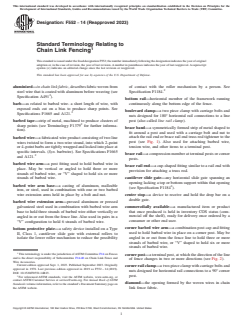
brace band—a symmetrically formed strip of metal shaped to
tion).
fit around a post and used with a carriage bolt and nut to
barbed wire—a fabricated wire product consisting of two line attach the rail end or brace rail end truss rod tightener to the
post (see Fig. 1). Also used for attaching barbed wire,
wires twisted to form a two-wire strand, into which 2–point
or 4–point barbs are tightly wrapped and locked into place at tension wire, and other items to a terminal post.
specific intervals. (Syn. barbwire). See Specifications F1665
brace rail—a compression member at terminal posts or corner
and A121.
posts.
barbed wire arm—a post fitting used to hold barbed wire in
brace rail end—a cup-shaped fitting similar to a rail end with
place. May be vertical or angled to hold three or more
provision for attaching a truss rod.
strands of barbed wire, or “V” shaped to hold six or more
cantilever slide gate—any horizontal slide gate spanning an
strands of barbed wire.
opening lacking a top or bottom support within that opening
barbed wire arm base—a casting of aluminum, malleable
(see Specification F1184 ).
iron, or steel, used in combination with one or two barbed
wire extension arms held in place by a bolt and nut. center stop—a device to receive and hold the drop bar on a
double gate.
barbed wire extension arm—pressed aluminum or pressed
commercdially available—a manufactured item or product
galvanized steel used in combination with barbed wire arm
that once produced is held in inventory COS status (com-
base to hold three strands of barbed wire either vertically or
mercial off the shelf), ready for delivery once ordered by a
angled in or out from the fence line. Also used in pairs in a
consumer or other end user.
“V” configuration to hold 6 strands of barbed wire.
corner barbed wire arm—a combination post cap and fitting
bottom protective plate—a safety device installed on a Type
used to hold barbed wire in place on a corner post. May be
II, Class 1, cantilever slide gate with external rollers to
angled in or out from the fence line to hold three or more
isolate the lower roller mechanism to reduce the possibility
strands of barbed wire, or “V” shaped to hold six or more
strands of barbed wire.
This terminology is under the jurisdiction of ASTM Committee F14 on Fences
corner post—a terminal post, at which the direction of the line
and is the direct responsibility of Subcommittee F14.40 on Chain Link Fence and
of fence changes in two or more directions (see Fig. 2).
Wire Accessories.
Current edition approved Sept. 1, 2023. Published September 2023. Originally
corner rail clamp—a two-piece clamp with carriage bolts and
approved in 1978. Last previous edition approved in 2019 as F552 – 14 (2019).
nuts designed for horizontal rail connections to a 90° corner
DOI: 10.1520/F0552-14R23.
post.
For referenced ASTM standards, visit the ASTM website, www.astm.org, or
contact ASTM Customer Service at service@astm.org. For Annual Book of ASTM
diamond—the opening formed by the woven wires in chain
Standards volume information, refer to the standard’s Document Summary page on
the ASTM website. link fence fabric.
Copyright © ASTM International, 100 Barr Harbor Drive, PO Box C700, West Conshohocken, PA 19428-2959. United States
F552 − 14 (2023)
FIG. 1 Brace Band
FIG. 4 End Post
end rail clamp—a two-piece clamp with carriage bolt and nut
designed for horizontal rail connections to an end post.
fabric (chain link fence)—a fencing material made from wire
helically wound and interwoven in such a manner as to
provide a continuous mesh without knots or ties except in the
form of knuckling or of twisting the ends of the wires to
form the selvages of the fabric (see Fig. 5).
flange—in chain link fencing, a plate or casting for securing a
post to a floor or a horizontal rail to a wall.
frame hinge—a fitting that attaches to the gate frame and
FIG. 2 Corner Post
functions with the post hinge.
framework—the basic structure supporting installed fabric,
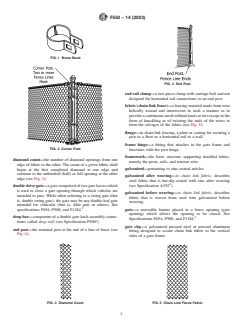
diamond count—the number of diamond openings from one
namely the posts, rails, and tension wire.
edge of fabric to the other. The count of a given fabric shall
galvanized—pertaining to zinc-coated articles.
begin at the first completed diamond at one edge and
continue to the unfinished (half) or full opening at the other
galvanized after weaving—in chain link fabric, describes
edge (see Fig. 3).
steel fabric that is hot-dip coated with zinc after weaving
(see Specification A392 ).
double drive gate—a gate comprised of two gate leaves which
is used to close a gate opening through which vehicles are
galvanized before weaving—in chain link fabric, describes
intended to pass. While often referring to a swing gate (that
fabric that is woven from steel wire galvanized before
is, double swing gate), the gate may be any double leaf gate
weaving.
intended for vehicular (that is, slide gate or others). See
gate—a moveable barrier placed in a fence opening (gate
specifications F654, F900, and F1184.
opening) which allows the opening to be closed. See
drop bar—component of a double gate latch assembly (some- 2
Specifications F654, F900, and F1184.
times called drop rod) (see Specification F900 ).
gate clip—a galvanized pressed steel or pressed aluminum
end post—the terminal post at the end of a line of fence (see
fitting designed to secure chain link fabric to the vertical
Fig. 4).
sides of a gate frame.
FIG. 3 Diamond Count FIG. 5 Chain Link Fence Fabric
F552 − 14 (2023)
gate frame—the structural member(s) of the gate.
gate holdback or keeper—a device to receive and hold the
gate leaf in an open position.
gate latch—a fitting to hold the gate in place when closed.
gate leaf—a component of a swing gate which consists of a
gate frame covered with chain link fabric and/or other
material. See Specifications F654 and F900.
gate opening—the clear distance between the gate posts.
gate post—the post to which a gate is attached via hinges. It
may also be used as a terminal post.
gate transom—a panel of chain link fabric over the top of a
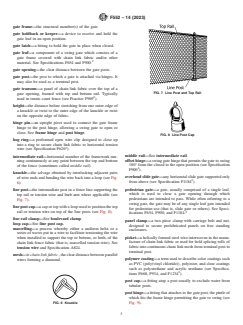
FIG. 7 Line Post and Top Rail
gate opening, framed with top and bottom rail. Typically
used in tennis court fence (see Practice F969 ).
height—the distance before stretching from one outer edge of
a knuckle or twist to the outer edge of the knuckle or twist
on the opposite edge of fabric.
hinge pin—an upright pivot used to connect
...