

ASTM C1601-22a
(Test Method)Standard Test Method for Field Determination of Water Penetration of Masonry Wall Surfaces
General Information
- Abstract
SIGNIFICANCE AND USE
4.1 This non-destructive test method contains procedures and equipment requirements to quantitatively determine the surface penetration of water at a single location on a masonry wall. The test method is not designed to determine the overall water penetration and leakage of a masonry system.
4.2 Excessive water penetration of masonry may degrade masonry wall performance with respect to thermal conductivity, durability, efflorescence, staining, corrosion of embedded metal items, and water leakage.
4.3 This test may be used to measure the rate of surface water penetration for in-situ masonry and field mockups. Common applications of this method have been comparison of water penetration rates of walls before and after repairs, and testing the efficacy of coatings. Alternative procedures are also provided to simulate the effect of local climatology on water penetration of masonry wall surfaces.
4.4 The outer surface of all masonry walls will experience water penetration when subjected to wind-driven rain. The resistance to water penetration is dependent on materials, workmanship, design, and maintenance. Some wall types accommodate large volumes of water penetration, without deleterious effects, through the presence of properly designed and installed drainage systems including flashing and weep holes. Use of this standard without consideration of the overall wall system may lead to incorrect conclusions regarding performance.
4.5 It is the intent of this standard that a sheet of water be developed and maintained on the wall surface during testing. In some cases, due to the surface texture of the masonry, the application of a coating, or other factors, a sheet of water will not consistently form. In those cases, results of this test method will likely be inaccurate.
4.6 This test method is similar to but distinct from the laboratory Test Method E514/E514M. This standard is a field test method designed to test in-situ walls and measures water penetration of...
SCOPE
1.1 This test method covers the field determination of water penetration of a masonry wall surface under specific water flow rate and air pressure conditions. This test is intended for use on any masonry wall surface that can be properly instrumented and tested within the requirements of this standard. This test method is not identical to and the results are not the same as laboratory standard Test Method E514/E514M. Test Method E514/E514M measures through-wall water penetration, whereas this test method only measures surface water penetration.
1.2 The values stated in inch-pound units are to be regarded as standard. The values given in parentheses are mathematical conversions to SI units that are provided for information only and are not considered standard.
1.3 This standard does not purport to address all of the safety concerns, if any, associated with its use. It is the responsibility of the user of this standard to establish appropriate safety, health, and environmental practices and determine the applicability of regulatory limitations prior to use.
1.4 This international standard was developed in accordance with internationally recognized principles on standardization established in the Decision on Principles for the Development of International Standards, Guides and Recommendations issued by the World Trade Organization Technical Barriers to Trade (TBT) Committee.
- Status
- Published
- Publication Date
- 31-May-2022
- Technical Committee
- C15 - Masonry – Manufactured Masonry Units, Mortars and Grouts
- Drafting Committee
- C15.04 - Research for Masonry Units and Assemblies
Buy Documents
ASTM C1601-22a - Standard Test Method for Field Determination of Water Penetration of Masonry Wall Surfaces
REDLINE ASTM C1601-22a - Standard Test Method for Field Determination of Water Penetration of Masonry Wall Surfaces
Overview
ASTM C1601-22a, Standard Test Method for Field Determination of Water Penetration of Masonry Wall Surfaces, establishes procedures and equipment requirements to quantitatively assess surface water penetration at a specific location on a masonry wall. Developed by ASTM International, this non-destructive test method is designed for field use to evaluate the water resistance of in-situ masonry walls and field mockups. It is not intended to measure total water penetration or leakage through an entire masonry system. The standard provides guidance for testing under specified water flow rates and air pressure conditions, as well as methods to simulate local climatological factors.
Proper water penetration testing is vital for evaluating the durability, thermal performance, and overall integrity of masonry wall systems, especially when exposed to wind-driven rain. Excessive surface water penetration can lead to issues such as efflorescence, staining, corrosion of embedded metals, and water leakage.
Key Topics
- Surface Water Penetration: Focuses on the passage of water through the exterior face of masonry, not through-wall leakage.
- Test Apparatus: Requirements for the test chamber and related equipment to ensure accurate, repeatable measurements.
- Standard and Alternative Test Conditions: Procedures for testing under default laboratory-like conditions or site-specific weather simulation.
- Non-Destructive Field Testing: Guidelines for mounting, sealing, and monitoring during testing to avoid damage to the masonry wall.
- Observation and Reporting: Comprehensive instructions for recording water flow patterns, penetration rates, and environmental factors.
- Limitations:
- For single locations only - does not represent overall system performance.
- Test outcomes can be affected by masonry texture, coatings, or the ability to maintain a sheet of water on the surface.
Applications
This standard is widely used by building envelope consultants, masonry contractors, and quality assurance professionals for:
- Assessing Water Resistance: Measuring the rate of surface water penetration for both existing masonry walls and new construction mockups.
- Evaluating Repairs and Coatings: Comparing water penetration rates before and after masonry repair work or application of protective coatings.
- Simulating Climate Effects: Adjusting test conditions to mirror local wind-driven rain and rainfall intensities, improving the relevance of field results.
- Supporting Maintenance Decisions: Identifying water ingress problems early to inform targeted repairs and maintenance.
- Documentation and Compliance: Creating consistent records that support code compliance, warranty claims, and performance verification.
Related Standards
- ASTM E514/E514M – Standard Test Method for Water Penetration and Leakage Through Masonry: Laboratory method for measuring through-wall water leakage, distinct from the field method in ASTM C1601.
- ASTM C1232 – Terminology for Masonry: Provides definitions for terms used in masonry standards, including those referenced in ASTM C1601.
Practical Value
Adopting ASTM C1601-22a ensures a consistent, reliable approach to field testing for water penetration in masonry wall surfaces, enhancing:
- Quality Control: Early identification of water penetration can prevent long-term structural and aesthetic damage.
- Design Verification: Validates effectiveness of masonry design, materials, and installation quality under simulated real-world conditions.
- Risk Management: Minimizes liability by documenting compliance with internationally recognized standard practices for water testing.
- Extend Building Lifespan: Proactive surface water penetration testing contributes to the longevity and performance of masonry construction, especially in regions subject to frequent wind-driven rain.
By following ASTM C1601-22a, industry professionals can make informed decisions about masonry maintenance, repairs, and protective strategies, ensuring robust building envelope performance.
Relations
- Effective Date
- 15-Dec-2023
- Effective Date
- 01-Jun-2017
- Effective Date
- 01-Sep-2015
- Effective Date
- 01-Jun-2015
- Effective Date
- 01-Feb-2014
- Effective Date
- 01-Jun-2012
- Effective Date
- 15-Dec-2011
- Effective Date
- 15-Dec-2010
- Effective Date
- 15-Jun-2010
- Effective Date
- 01-May-2010
- Effective Date
- 01-Jan-2010
- Effective Date
- 15-Dec-2009
- Effective Date
- 01-Aug-2009
- Effective Date
- 01-Jul-2009
- Effective Date
- 01-Feb-2009
Buy Documents
ASTM C1601-22a - Standard Test Method for Field Determination of Water Penetration of Masonry Wall Surfaces
REDLINE ASTM C1601-22a - Standard Test Method for Field Determination of Water Penetration of Masonry Wall Surfaces
Get Certified
Connect with accredited certification bodies for this standard

DIBt (Deutsches Institut für Bautechnik)
German Institute for Building Technology.
DIN CERTCO
DIN Group product certification.

Aboma Certification B.V.
Specialized in construction, metal, and transport sectors.
Sponsored listings
Frequently Asked Questions
ASTM C1601-22a is a standard published by ASTM International. Its full title is "Standard Test Method for Field Determination of Water Penetration of Masonry Wall Surfaces". This standard covers: SIGNIFICANCE AND USE 4.1 This non-destructive test method contains procedures and equipment requirements to quantitatively determine the surface penetration of water at a single location on a masonry wall. The test method is not designed to determine the overall water penetration and leakage of a masonry system. 4.2 Excessive water penetration of masonry may degrade masonry wall performance with respect to thermal conductivity, durability, efflorescence, staining, corrosion of embedded metal items, and water leakage. 4.3 This test may be used to measure the rate of surface water penetration for in-situ masonry and field mockups. Common applications of this method have been comparison of water penetration rates of walls before and after repairs, and testing the efficacy of coatings. Alternative procedures are also provided to simulate the effect of local climatology on water penetration of masonry wall surfaces. 4.4 The outer surface of all masonry walls will experience water penetration when subjected to wind-driven rain. The resistance to water penetration is dependent on materials, workmanship, design, and maintenance. Some wall types accommodate large volumes of water penetration, without deleterious effects, through the presence of properly designed and installed drainage systems including flashing and weep holes. Use of this standard without consideration of the overall wall system may lead to incorrect conclusions regarding performance. 4.5 It is the intent of this standard that a sheet of water be developed and maintained on the wall surface during testing. In some cases, due to the surface texture of the masonry, the application of a coating, or other factors, a sheet of water will not consistently form. In those cases, results of this test method will likely be inaccurate. 4.6 This test method is similar to but distinct from the laboratory Test Method E514/E514M. This standard is a field test method designed to test in-situ walls and measures water penetration of... SCOPE 1.1 This test method covers the field determination of water penetration of a masonry wall surface under specific water flow rate and air pressure conditions. This test is intended for use on any masonry wall surface that can be properly instrumented and tested within the requirements of this standard. This test method is not identical to and the results are not the same as laboratory standard Test Method E514/E514M. Test Method E514/E514M measures through-wall water penetration, whereas this test method only measures surface water penetration. 1.2 The values stated in inch-pound units are to be regarded as standard. The values given in parentheses are mathematical conversions to SI units that are provided for information only and are not considered standard. 1.3 This standard does not purport to address all of the safety concerns, if any, associated with its use. It is the responsibility of the user of this standard to establish appropriate safety, health, and environmental practices and determine the applicability of regulatory limitations prior to use. 1.4 This international standard was developed in accordance with internationally recognized principles on standardization established in the Decision on Principles for the Development of International Standards, Guides and Recommendations issued by the World Trade Organization Technical Barriers to Trade (TBT) Committee.
SIGNIFICANCE AND USE 4.1 This non-destructive test method contains procedures and equipment requirements to quantitatively determine the surface penetration of water at a single location on a masonry wall. The test method is not designed to determine the overall water penetration and leakage of a masonry system. 4.2 Excessive water penetration of masonry may degrade masonry wall performance with respect to thermal conductivity, durability, efflorescence, staining, corrosion of embedded metal items, and water leakage. 4.3 This test may be used to measure the rate of surface water penetration for in-situ masonry and field mockups. Common applications of this method have been comparison of water penetration rates of walls before and after repairs, and testing the efficacy of coatings. Alternative procedures are also provided to simulate the effect of local climatology on water penetration of masonry wall surfaces. 4.4 The outer surface of all masonry walls will experience water penetration when subjected to wind-driven rain. The resistance to water penetration is dependent on materials, workmanship, design, and maintenance. Some wall types accommodate large volumes of water penetration, without deleterious effects, through the presence of properly designed and installed drainage systems including flashing and weep holes. Use of this standard without consideration of the overall wall system may lead to incorrect conclusions regarding performance. 4.5 It is the intent of this standard that a sheet of water be developed and maintained on the wall surface during testing. In some cases, due to the surface texture of the masonry, the application of a coating, or other factors, a sheet of water will not consistently form. In those cases, results of this test method will likely be inaccurate. 4.6 This test method is similar to but distinct from the laboratory Test Method E514/E514M. This standard is a field test method designed to test in-situ walls and measures water penetration of... SCOPE 1.1 This test method covers the field determination of water penetration of a masonry wall surface under specific water flow rate and air pressure conditions. This test is intended for use on any masonry wall surface that can be properly instrumented and tested within the requirements of this standard. This test method is not identical to and the results are not the same as laboratory standard Test Method E514/E514M. Test Method E514/E514M measures through-wall water penetration, whereas this test method only measures surface water penetration. 1.2 The values stated in inch-pound units are to be regarded as standard. The values given in parentheses are mathematical conversions to SI units that are provided for information only and are not considered standard. 1.3 This standard does not purport to address all of the safety concerns, if any, associated with its use. It is the responsibility of the user of this standard to establish appropriate safety, health, and environmental practices and determine the applicability of regulatory limitations prior to use. 1.4 This international standard was developed in accordance with internationally recognized principles on standardization established in the Decision on Principles for the Development of International Standards, Guides and Recommendations issued by the World Trade Organization Technical Barriers to Trade (TBT) Committee.
ASTM C1601-22a is classified under the following ICS (International Classification for Standards) categories: 91.080.30 - Masonry. The ICS classification helps identify the subject area and facilitates finding related standards.
ASTM C1601-22a has the following relationships with other standards: It is inter standard links to ASTM C1232-23, ASTM C1232-17, ASTM C1232-15a, ASTM C1232-15, ASTM E514/E514M-14, ASTM C1232-12, ASTM E514/E514M-11, ASTM C1232-10c, ASTM C1232-10b, ASTM C1232-10a, ASTM C1232-10, ASTM C1232-09b, ASTM E514/E514M-09, ASTM C1232-09a, ASTM C1232-09. Understanding these relationships helps ensure you are using the most current and applicable version of the standard.
ASTM C1601-22a is available in PDF format for immediate download after purchase. The document can be added to your cart and obtained through the secure checkout process. Digital delivery ensures instant access to the complete standard document.
Standards Content (Sample)
This international standard was developed in accordance with internationally recognized principles on standardization established in the Decision on Principles for the
Development of International Standards, Guides and Recommendations issued by the World Trade Organization Technical Barriers to Trade (TBT) Committee.
Designation: C1601 − 22a
Standard Test Method for
Field Determination of Water Penetration of Masonry Wall
Surfaces
This standard is issued under the fixed designation C1601; the number immediately following the designation indicates the year of
original adoption or, in the case of revision, the year of last revision. A number in parentheses indicates the year of last reapproval. A
superscript epsilon (´) indicates an editorial change since the last revision or reapproval.
1. Scope* 3. Terminology
1.1 This test method covers the field determination of water 3.1 Definitions of Terms Specific to This Standard:
penetrationofamasonrywallsurfaceunderspecificwaterflow 3.1.1 dampness, n—visual change in the appearance of a
rate and air pressure conditions.This test is intended for use on material due to the presence of water.
any masonry wall surface that can be properly instrumented
3.1.2 surface water penetration, n—passage of water
and tested within the requirements of this standard. This test
through the exterior face of the masonry.
method is not identical to and the results are not the same as
3.1.3 through-wall water penetration, n—passage of water
laboratory standard Test Method E514/E514M. Test Method
through a wall and appearance of water on the interior face of
E514/E514M measures through-wall water penetration,
the masonry.
whereas this test method only measures surface water penetra-
3.1.4 water penetration, n—water that passes into or
tion.
through the masonry.
1.2 The values stated in inch-pound units are to be regarded
3.1.5 wind-driven rain, n—rain water that is directed against
as standard. The values given in parentheses are mathematical
the surface of the wall by wind.
conversions to SI units that are provided for information only
and are not considered standard. 3.2 For definitions of terms used in this test method, refer to
Terminology C1232.
1.3 This standard does not purport to address all of the
safety concerns, if any, associated with its use. It is the
4. Significance and Use
responsibility of the user of this standard to establish appro-
4.1 This non-destructive test method contains procedures
priate safety, health, and environmental practices and deter-
and equipment requirements to quantitatively determine the
mine the applicability of regulatory limitations prior to use.
1.4 This international standard was developed in accor- surface penetration of water at a single location on a masonry
wall. The test method is not designed to determine the overall
dance with internationally recognized principles on standard-
ization established in the Decision on Principles for the water penetration and leakage of a masonry system.
Development of International Standards, Guides and Recom-
4.2 Excessive water penetration of masonry may degrade
mendations issued by the World Trade Organization Technical
masonry wall performance with respect to thermal
Barriers to Trade (TBT) Committee.
conductivity, durability, efflorescence, staining, corrosion of
embedded metal items, and water leakage.
2. Referenced Documents
4.3 This test may be used to measure the rate of surface
2.1 ASTM Standards:
water penetration for in-situ masonry and field mockups.
C1232 Terminology for Masonry
Common applications of this method have been comparison of
E514/E514M Test Method for Water Penetration and Leak-
water penetration rates of walls before and after repairs, and
age Through Masonry
testing the efficacy of coatings.Alternative procedures are also
provided to simulate the effect of local climatology on water
penetration of masonry wall surfaces.
This test method is under the jurisdiction of ASTM Committee C15 on
Manufactured Masonry Units and is the direct responsibility of Subcommittee
4.4 The outer surface of all masonry walls will experience
C15.04 on Research.
water penetration when subjected to wind-driven rain. The
Current edition approved June 1, 2022. Published June 2022. Originally
resistance to water penetration is dependent on materials,
approved in 2014. Last previous edition approved in 2022 as C1601 – 22. DOI:
10.1520/C1601-22A.
workmanship, design, and maintenance. Some wall types
For referenced ASTM standards, visit the ASTM website, www.astm.org, or
accommodate large volumes of water penetration, without
contact ASTM Customer Service at service@astm.org. For Annual Book of ASTM
deleterious effects, through the presence of properly designed
Standards volume information, refer to the standard’s Document Summary page on
the ASTM website. and installed drainage systems including flashing and weep
*A Summary of Changes section appears at the end of this standard
Copyright © ASTM International, 100 Barr Harbor Drive, PO Box C700, West Conshohocken, PA 19428-2959. United States
C1601 − 22a
holes. Use of this standard without consideration of the overall line of 0.04-in. (1.0-mm) diameter holes spaced 1 in. (25 mm)
wall system may lead to incorrect conclusions regarding apart, starting within 1 in. (25 mm) of each end (Note 3).
performance. Position the water spray pipe within the chamber so that the
water impinges the wall perpendicular to the wall not more
4.5 It is the intent of this standard that a sheet of water be
than 1.5 in. (40 mm) below the interior top of the test chamber.
developedandmaintainedonthewallsurfaceduringtesting.In
some cases, due to the surface texture of the masonry, the
NOTE 1—A size of 36 in. (0.9 m) wide and 48 in. (1.2 m) high is
application of a coating, or other factors, a sheet of water will
common.
3 1
NOTE 2—Transparent plastic sheets ⁄16 to ⁄4 in. (5 to 6 mm) thick have
not consistently form. In those cases, results of this test method
been shown to perform well. Plexiglas® and Lexan® are two products
will likely be inaccurate.
that have been used.
4.6 This test method is similar to but distinct from the
NOTE 3—Clean-outs at the end of the spray bar to facilitate cleaning the
laboratory Test Method E514/E514M. This standard is a field
spray bar are common.
test method designed to test in-situ walls and measures water
5.2 Fixtures and Appurtenances to Chamber—Fixtures and
penetration of masonry at its surface. Test Method E514/
appurtenances to the chamber include an air line with manom-
E514M is a laboratory test method designed to test laboratory
eter or pressure gauge able to read air pressure to within 0.50
fabricated wall specimens and measures the water that has
lb/ft (24 Pa), a water line with valves, a flow meter in the
penetrated into and through the masonry specimen and is
water supply line able to read flow within 0.02 gpm (4.5 L/h),
collected. Results from this standard and Test Method E514/
and a water drain pipe at the bottom of the chamber. The water
E514M are not the same.
is stored in a calibrated reservoir with a minimum volume of 3
gal (13 L), with graduations to allow readings within 0.015 gal
5. Apparatus
(0.055 L) (Note 4). Pump water from the reservoir to the spray
5.1 Test Chamber—Useatestchambersimilartothatshown
bar. Return water which drains from the bottom of the chamber
in Fig. 1. Provide a rectangular opening with a minimum area
directly to the reservoir.
2 2
of12ft (1.08m )withaminimumdimensionof24in.(0.6m)
NOTE 4—Use of a cylindrical reservoir having dimensions of approxi-
for each side of the opening (Note 1). Seal the contact surface
mately 4 to 8 in. (100 to 200 mm) in diameter by 5 ft (1.5 m) or taller is
between the frame of the chamber and the test area to prevent
common.
loss of water and maintain air pressure. Cover the face of the
chamber with a tough, transparent material capable of with- 5.3 Other equipment includes devices for handling and
standing the test pressure (Note 2). Provide a ⁄4-in. (19-mm) mounting the chamber and measuring time, water quantities,
diameter, corrosion-resistant, water spray pipe with a single and ambient temperature.
FIG. 1 Water Surface Penetration Test System
C1601 − 22a
6. Hazards with 9.4 produces a coefficient of correlation (R ) of 0.94 or
greater over a minimum of a one-hour period (see Note 7).
6.1 The use of this test method requires careful design of
both air chamber and support of the wall system to avoid
NOTE 7—In many tests there may be an initial conditioning period of
time, typically 5 to 60 minutes, at the beginning of the test where the
possible injury due to equipment or masonry failure. Assure
penetration rate is not linear. This is due to a number of factors including
that the chamber and its attachment to the wall are adequate for
the moisture content of the masonry at the time of the test and the
the applied pressures during testing.
absorption rate of the mortar and masonry units. While it is important to
record and report all of the data from the start of the test, the data points
6.2 Water penetration resulting from this test can cause
from this initial conditioning period can be removed from the data set
saturation of adjacent materials and leakage into occupied
when determining the steady state penetration rate using the linear fit of
spaces of the buildings. Take into consideration the effects of
the water penetration versus time calculation as long as the test is
potential water infiltration and leakage.
continuedforaminimumofone-hourafterthisinitialconditioningperiod.
7.4 Alternate Test Conditions—Special condition testing
7. Procedure
specified to model different water flow rates or chamber air
7.1 Mounting Chamber—Attach the test chamber with me-
pressures are acceptable. Procedures for specifying the testing
chanical fasteners using sufficient pressure to form an air- and
parametersusinglocalclimatologicaldataareprovidedin7.4.1
water-resistant seal (Note 5).
and 7.4.2.
7.4.1 Testing Parameter Determination Using Local
NOTE 5—Use of a gasket or sealant at the contact surface is common.
(See Note 6.)
Weather Data—This procedure utilizes local weather data
(wind speeds and rainfall intensity) to produce testing param-
7.2 Sealing—If needed, apply a perimeter sealant between
eters (water flow rate, air pressure, and duration of test) for
the chamber and wall surface to ensure that leakage does not
water chamber testing of vertical surfaces. The conversion is
occur at the interface. Allow the sealant to cure sufficiently to
accomplished using a numerical approach. The weather data
ensure adequate bond and water resistance (Note 6).
can be obtained from various sources, including the National
NOTE 6—Applying sealant directly to the face of the masonry should be
Climatological Data Center. This procedure does not address
avoidedsinceitmaypermanentlydamagethewallsurface.Othermethods
the methods used to select weather data nor does it address the
such as applying non-marking flexible tape that will conform to the
significance of using those data in chamber testing
...
This document is not an ASTM standard and is intended only to provide the user of an ASTM standard an indication of what changes have been made to the previous version. Because
it may not be technically possible to adequately depict all changes accurately, ASTM recommends that users consult prior editions as appropriate. In all cases only the current version
of the standard as published by ASTM is to be considered the official document.
Designation: C1601 − 22 C1601 − 22a
Standard Test Method for
Field Determination of Water Penetration of Masonry Wall
Surfaces
This standard is issued under the fixed designation C1601; the number immediately following the designation indicates the year of
original adoption or, in the case of revision, the year of last revision. A number in parentheses indicates the year of last reapproval. A
superscript epsilon (´) indicates an editorial change since the last revision or reapproval.
1. Scope*
1.1 This test method covers the field determination of water penetration of a masonry wall surface under specific water flow rate
and air pressure conditions. This test is intended for use on any masonry wall surface that can be properly instrumented and tested
within the requirements of this standard. This test method is not identical to and the results are not the same as laboratory standard
Test Method E514/E514M. Test Method E514/E514M measures through-wall water penetration, whereas this test method only
measures surface water penetration.
1.2 The values stated in inch-pound units are to be regarded as standard. The values given in parentheses are mathematical
conversions to SI units that are provided for information only and are not considered standard.
1.3 This standard does not purport to address all of the safety concerns, if any, associated with its use. It is the responsibility
of the user of this standard to establish appropriate safety, health, and environmental practices and determine the applicability of
regulatory limitations prior to use.
1.4 This international standard was developed in accordance with internationally recognized principles on standardization
established in the Decision on Principles for the Development of International Standards, Guides and Recommendations issued
by the World Trade Organization Technical Barriers to Trade (TBT) Committee.
2. Referenced Documents
2.1 ASTM Standards:
C1232 Terminology for Masonry
E514/E514M Test Method for Water Penetration and Leakage Through Masonry
3. Terminology
3.1 Definitions of Terms Specific to This Standard:
3.1.1 dampness, n—visual change in the appearance of a material due to the presence of water.
3.1.2 surface water penetration, n—passage of water through the exterior face of the masonry.
3.1.3 through-wall water penetration, n—passage of water through a wall and appearance of water on the interior face of the
masonry.
This test method is under the jurisdiction of ASTM Committee C15 on Manufactured Masonry Units and is the direct responsibility of Subcommittee C15.04 on Research.
Current edition approved Feb. 15, 2022June 1, 2022. Published February 2022June 2022. Originally approved in 2014. Last previous edition approved in 20202022 as
C1601 – 20.C1601 – 22. DOI: 10.1520/C1601-22.10.1520/C1601-22A.
For referenced ASTM standards, visit the ASTM website, www.astm.org, or contact ASTM Customer Service at service@astm.org. For Annual Book of ASTM Standards
volume information, refer to the standard’s Document Summary page on the ASTM website.
*A Summary of Changes section appears at the end of this standard
Copyright © ASTM International, 100 Barr Harbor Drive, PO Box C700, West Conshohocken, PA 19428-2959. United States
C1601 − 22a
3.1.4 water penetration, n—water that passes into or through the masonry.
3.1.5 wind-driven rain, n—rain water that is directed against the surface of the wall by wind.
3.2 For definitions of terms used in this test method, refer to Terminology C1232.
4. Significance and Use
4.1 This non-destructive test method contains procedures and equipment requirements to quantitatively determine the surface
penetration of water at a single location on a masonry wall. The test method is not designed to determine the overall water
penetration and leakage of a masonry system.
4.2 Excessive water penetration of masonry may degrade masonry wall performance with respect to thermal conductivity,
durability, efflorescence, staining, corrosion of embedded metal items, and water leakage.
4.3 This test may be used to measure the rate of surface water penetration for in-situ masonry and field mockups. Common
applications of this method have been comparison of water penetration rates of walls before and after repairs, and testing the
efficacy of coatings. Alternative procedures are also provided to simulate the effect of local climatology on water penetration of
masonry wall surfaces.
4.4 The outer surface of all masonry walls will experience water penetration when subjected to wind-driven rain. The resistance
to water penetration is dependent on materials, workmanship, design, and maintenance. Some wall types accommodate large
volumes of water penetration, without deleterious effects, through the presence of properly designed and installed drainage systems
including flashing and weep holes. Use of this standard without consideration of the overall wall system may lead to incorrect
conclusions regarding performance.
4.5 It is the intent of this standard that a sheet of water be developed and maintained on the wall surface during testing. In some
cases, due to the surface texture of the masonry, the application of a coating, or other factors, a sheet of water will not consistently
form. In those cases, results of this test method will likely be inaccurate.
4.6 This test method is similar to but distinct from the laboratory Test Method E514/E514M. This standard is a field test method
designed to test in-situ walls and measures water penetration of masonry at its surface. Test Method E514/E514M is a laboratory
test method designed to test laboratory fabricated wall specimens and measures the water that has penetrated into and through the
masonry specimen and is collected. Results from this standard and Test Method E514/E514M are not the same.
5. Apparatus
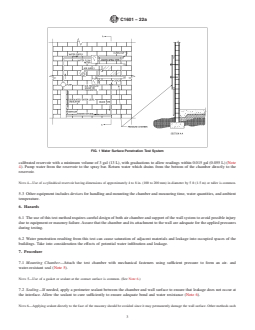
5.1 Test Chamber—Use a test chamber similar to that shown in Fig. 1. Provide a rectangular opening with a minimum area of 12
2 2
ft (1.08 m ) with a minimum dimension of 24 in. (0.6 m) for each side of the opening (Note 1). Seal the contact surface between
the frame of the chamber and the test area to prevent loss of water and maintain air pressure. Cover the face of the chamber with
a tough, transparent material capable of withstanding the test pressure (Note 2). Provide a ⁄4-in. (19-mm) diameter,
corrosion-resistant, water spray pipe with a single line of 0.04-in. (1.0-mm) diameter holes spaced 1 in. (25 mm) apart, starting
within 1 in. (25 mm) of each end (Note 3). Position the water spray pipe within the chamber so that the water impinges the wall
perpendicular to the wall not more than 1.5 in. (40 mm) below the interior top of the test chamber.
NOTE 1—A size of 36 in. (0.9 m) wide and 48 in. (1.2 m) high is common.
3 1
NOTE 2—Transparent plastic sheets ⁄16 to ⁄4 in. (5 to 6 mm) thick have been shown to perform well. Plexiglas® and Lexan® are two products that have
been used.
NOTE 3—Clean-outs at the end of the spray bar to facilitate cleaning the spray bar are common.
5.2 Fixtures and Appurtenances to Chamber—Fixtures and appurtenances to the chamber include an air line with manometer or
pressure gauge able to read air pressure to within 0.50 lb/ft (24 Pa), a water line with valves, a flow meter in the water supply
line able to read flow within 0.02 gpm (4.5 L/h), and a water drain pipe at the bottom of the chamber. The water is stored in a
C1601 − 22a
FIG. 1 Water Surface Penetration Test System
calibrated reservoir with a minimum volume of 3 gal (13 L), with graduations to allow readings within 0.015 gal (0.055 L) (Note
4). Pump water from the reservoir to the spray bar. Return water which drains from the bottom of the chamber directly to the
reservoir.
NOTE 4—Use of a cylindrical reservoir having dimensions of approximately 4 to 8 in. (100 to 200 mm) in diameter by 5 ft (1.5 m) or taller is common.
5.3 Other equipment includes devices for handling and mounting the chamber and measuring time, water quantities, and ambient
temperature.
6. Hazards
6.1 The use of this test method requires careful design of both air chamber and support of the wall system to avoid possible injury
due to equipment or masonry failure. Assure that the chamber and its attachment to the wall are adequate for the applied pressures
during testing.
6.2 Water penetration resulting from this test can cause saturation of adjacent materials and leakage into occupied spaces of the
buildings. Take into consideration the effects of potential water infiltration and leakage.
7. Procedure
7.1 Mounting Chamber—Attach the test chamber with mechanical fasteners using sufficient pressure to form an air- and
water-resistant seal (Note 5).
NOTE 5—Use of a gasket or sealant at the contact surface is common. (See Note 6.)
7.2 Sealing—If needed, apply a perimeter sealant between the chamber and wall surface to ensure that leakage does not occur at
the interface. Allow the sealant to cure sufficiently to ensure adequate bond and water resistance (Note 6).
NOTE 6—Applying sealant directly to the face of the masonry should be avoided since it may permanently damage the wall surface. Other methods such
C1601 − 22a
as applying non-marking flexible tape that will conform to the masonry’s surface texture prior to applying sealant should be considered to avoid defacing
the masonry.
2 2 2
7.3 Standard Test Conditions—Perform this test using a water flow rate of 3.4 gal ⁄ft /h (138 L/m /h) and an air pressure of 10 lb/ft
(500 Pa).
2 2
7.3.1 Application of Air Pressure and Water Flow—Adjust the water flow rate to 3.4 gal/ft /h (138 L/m /h) times the area of the
chamber opening. Simultaneously, increase the air pressure within the chamber to 10 lb/ft (500 Pa). Check for leakage from the
perimeter of the chamber. If leakage occurs, stop the test, reseal, and re-start the procedure.
7.3.2 During the test, record the test observations in accordance with Section 8. This includes the test parameters at the beginning
of the test and at intervals throughout the test as well as the water flow pattern.
7.3.3 Duration—The test shall be performed until a steady state penetration rate occurs. occurs or for 4 hours. A steady state
penetration rate is deemed to be achieved when the linear fit of the water penetration versus time as calculated in accordance with
9.4 produces a coefficient of correlation (R ) of 0.94 or greater over a minimum of a one-hour period (see Note 7). If real time
monitoring of penetration rate is not feasible onsite, then run the test for 4 h.
NOTE 7—In many tests there may be an initial conditioning period of time, typically 5 to 60 minutes, at the beginning of the test where the penetration
rate is not linear. This is due to a number of factors including the moisture content of the masonry at the time of the test and the absorption rate of the
mortar and masonry units. While it is important to record and report all of the data from the start of the test, the data points from this initial conditioning
period ca
...