

ASTM E514/E514M-20
(Test Method)Standard Test Method for Water Penetration and Leakage Through Masonry
General Information
- Abstract
SIGNIFICANCE AND USE
4.1 This test method provides information that aids in evaluating the effect of four principal variables: materials, coatings, wall design, and workmanship.
4.2 Water penetration and leakage through masonry is significantly affected by air pressure in the test chamber. Data from tests made at different pressures are not comparable.
4.3 The performance of a masonry wall is a function of materials, construction, wall design, and maintenance. In service the performance will also depend on the rigidity of supporting structure and on the resistance of components to deterioration by various causes, such as corrosion, vibration, thermal expansion and contraction, curing, and others. It is impossible to simulate the complex conditions encountered in service, such as variations in wind velocity, negative pressure, and lateral or upward moving air and water. Factors such as location, exposure, and wall openings should be considered.
4.4 Given the complexity of variables noted above, this test method establishes comparative behavior between various masonry wall constructions in a given laboratory.
4.5 Even when a single laboratory tests the same wall design utilizing the same wall materials and the same construction practices, variables such as the level of skill of the mason building the specimen, the temperature and humidity in the laboratory at the time of construction, curing of the specimen, the moisture contents of the materials used to build the specimen, and even the use or lack of use of a lime and water wash on the back of the specimen can affect the results of the test making reliable comparisons dubious. For these reasons and the multi-variables listed in 4.1, 4.2, and 4.3, a meaningful, useful, absolute wall leakage rating standard is impractical and discouraged.
4.6 This test method is similar to but distinct from field Test Method C1601. This standard is a laboratory test method designed to test laboratory fabricated wall specimens and measures th...
SCOPE
1.1 This laboratory test method2 provides a procedure for determining the resistance to water penetration and leakage through unit masonry subjected to wind-driven rain. This test method is not identical to and the results are not the same as field standard Test Method C1601. This test method measures through-wall water penetration, whereas Test Method C1601 only measures surface water penetration.
1.2 The values stated in either SI units or inch-pound units are to be regarded separately as standard. The values stated in each system may not be exact equivalents; therefore, each system shall be used independently of the other. Combining values from the two systems may result in non-conformance with the standard.
1.3 This standard does not purport to address all of the safety concerns, if any, associated with its use. It is the responsibility of the user of this standard to establish appropriate safety, health, and environmental practices and determine the applicability of regulatory limitations prior to use. For a specific hazard statement, see Section 6.
1.4 This international standard was developed in accordance with internationally recognized principles on standardization established in the Decision on Principles for the Development of International Standards, Guides and Recommendations issued by the World Trade Organization Technical Barriers to Trade (TBT) Committee.
- Status
- Published
- Publication Date
- 30-Nov-2020
- Technical Committee
- C15 - Masonry – Manufactured Masonry Units, Mortars and Grouts
- Drafting Committee
- C15.04 - Research for Masonry Units and Assemblies
Overview
ASTM E514/E514M-20: Standard Test Method for Water Penetration and Leakage Through Masonry is a laboratory-based standard designed by ASTM International. This test method provides a procedure to assess the resistance of masonry wall specimens to water penetration and leakage, particularly under simulated wind-driven rain conditions. The standard is widely referenced in construction and materials testing industries to evaluate the influence of materials, coatings, wall design, and workmanship on masonry wall performance.
ASTM E514/E514M-20 is instrumental for determining through-wall water penetration rather than just surface water ingress, distinguishing it from field tests such as ASTM C1601. Adhering to this standard helps ensure the integrity, durability, and weather resistance of unit masonry in various applications.
Key Topics
- Materials and Coatings: The test evaluates the influence of mortar types, masonry units, and various surface treatments or coatings.
- Wall Design: The standard examines the effects of wall configuration, openings, and structural design on resistance to water penetration.
- Workmanship: It assesses how construction practices and mason skill levels impact wall performance.
- Environmental and Construction Variability: Factors such as air pressure, temperature, humidity, and curing conditions can significantly affect results.
- Laboratory Procedures: The specification emphasizes controlled laboratory conditions and a comparative approach, rather than providing an absolute leakage rating.
- Distinct from Field Testing: Unlike ASTM C1601, this method gathers data on water moving completely through the wall, to provide insights into true barrier performance.
Applications
ASTM E514/E514M-20 is essential in several areas within the building materials and construction sector:
- Product Development: Manufacturers use the test to assess new masonry materials, coatings, or assemblies for improved water resistance.
- Quality Control: Construction teams apply this standard to ensure that masonry walls meet project specifications and function as intended against moisture ingress.
- Comparative Studies: Researchers and engineers use the method to benchmark different masonry systems or designs under consistent laboratory conditions.
- Specification Compliance: Architects and engineers specify ASTM E514/E514M-20 in project documents to guarantee that installed masonry meets essential durability and moisture control standards.
- Forensic Analysis: The procedure assists inspectors and consultants in diagnosing water leakage issues in constructed masonry and suggesting remediation.
Note: Due to inherent variable factors in materials, workmanship, and environment, results from different laboratories may not be directly comparable, and absolute wall leakage ratings are not recommended based on this test.
Related Standards
The following standards and references are commonly cited alongside or within ASTM E514/E514M-20:
- ASTM C270: Specification for Mortar for Unit Masonry
- ASTM C1232: Terminology for Masonry
- ASTM C1601: Field Test Method for Water Penetration of Masonry Wall Surfaces (measures surface, not through-wall, penetration)
- TMS 402/ACI 530/ASCE 5: Building Code Requirements for Masonry Structures
- TMS 602/ACI 530.1/ASCE 6: Specifications for Masonry Structures
Practical Value
By following ASTM E514/E514M-20, stakeholders in the construction industry gain a robust protocol to:
- Identify potential weaknesses in masonry assemblies regarding water penetration.
- Enhance building durability and occupant comfort by improving moisture control.
- Support compliance with specifications for public and private sector projects.
- Build confidence in the long-term performance of masonry structures, thereby reducing maintenance and repair costs.
Keywords: ASTM E514/E514M-20, masonry water penetration, leakage test, through-wall water resistance, wind-driven rain, masonry standards, laboratory test method, construction quality, building envelope.
Relations
- Effective Date
- 15-Dec-2023
- Effective Date
- 01-May-2019
- Effective Date
- 01-May-2019
- Effective Date
- 01-Feb-2019
- Effective Date
- 01-Jun-2017
- Effective Date
- 01-Sep-2015
- Effective Date
- 01-Jun-2015
- Effective Date
- 15-Dec-2014
- Effective Date
- 01-Jun-2014
- Effective Date
- 01-Feb-2014
- Effective Date
- 01-Jun-2012
- Effective Date
- 01-Jun-2012
- Effective Date
- 01-Jan-2012
- Effective Date
- 15-Dec-2011
- Effective Date
- 15-Dec-2010
Get Certified
Connect with accredited certification bodies for this standard

DIBt (Deutsches Institut für Bautechnik)
German Institute for Building Technology.
DIN CERTCO
DIN Group product certification.

Aboma Certification B.V.
Specialized in construction, metal, and transport sectors.
Sponsored listings
Frequently Asked Questions
ASTM E514/E514M-20 is a standard published by ASTM International. Its full title is "Standard Test Method for Water Penetration and Leakage Through Masonry". This standard covers: SIGNIFICANCE AND USE 4.1 This test method provides information that aids in evaluating the effect of four principal variables: materials, coatings, wall design, and workmanship. 4.2 Water penetration and leakage through masonry is significantly affected by air pressure in the test chamber. Data from tests made at different pressures are not comparable. 4.3 The performance of a masonry wall is a function of materials, construction, wall design, and maintenance. In service the performance will also depend on the rigidity of supporting structure and on the resistance of components to deterioration by various causes, such as corrosion, vibration, thermal expansion and contraction, curing, and others. It is impossible to simulate the complex conditions encountered in service, such as variations in wind velocity, negative pressure, and lateral or upward moving air and water. Factors such as location, exposure, and wall openings should be considered. 4.4 Given the complexity of variables noted above, this test method establishes comparative behavior between various masonry wall constructions in a given laboratory. 4.5 Even when a single laboratory tests the same wall design utilizing the same wall materials and the same construction practices, variables such as the level of skill of the mason building the specimen, the temperature and humidity in the laboratory at the time of construction, curing of the specimen, the moisture contents of the materials used to build the specimen, and even the use or lack of use of a lime and water wash on the back of the specimen can affect the results of the test making reliable comparisons dubious. For these reasons and the multi-variables listed in 4.1, 4.2, and 4.3, a meaningful, useful, absolute wall leakage rating standard is impractical and discouraged. 4.6 This test method is similar to but distinct from field Test Method C1601. This standard is a laboratory test method designed to test laboratory fabricated wall specimens and measures th... SCOPE 1.1 This laboratory test method2 provides a procedure for determining the resistance to water penetration and leakage through unit masonry subjected to wind-driven rain. This test method is not identical to and the results are not the same as field standard Test Method C1601. This test method measures through-wall water penetration, whereas Test Method C1601 only measures surface water penetration. 1.2 The values stated in either SI units or inch-pound units are to be regarded separately as standard. The values stated in each system may not be exact equivalents; therefore, each system shall be used independently of the other. Combining values from the two systems may result in non-conformance with the standard. 1.3 This standard does not purport to address all of the safety concerns, if any, associated with its use. It is the responsibility of the user of this standard to establish appropriate safety, health, and environmental practices and determine the applicability of regulatory limitations prior to use. For a specific hazard statement, see Section 6. 1.4 This international standard was developed in accordance with internationally recognized principles on standardization established in the Decision on Principles for the Development of International Standards, Guides and Recommendations issued by the World Trade Organization Technical Barriers to Trade (TBT) Committee.
SIGNIFICANCE AND USE 4.1 This test method provides information that aids in evaluating the effect of four principal variables: materials, coatings, wall design, and workmanship. 4.2 Water penetration and leakage through masonry is significantly affected by air pressure in the test chamber. Data from tests made at different pressures are not comparable. 4.3 The performance of a masonry wall is a function of materials, construction, wall design, and maintenance. In service the performance will also depend on the rigidity of supporting structure and on the resistance of components to deterioration by various causes, such as corrosion, vibration, thermal expansion and contraction, curing, and others. It is impossible to simulate the complex conditions encountered in service, such as variations in wind velocity, negative pressure, and lateral or upward moving air and water. Factors such as location, exposure, and wall openings should be considered. 4.4 Given the complexity of variables noted above, this test method establishes comparative behavior between various masonry wall constructions in a given laboratory. 4.5 Even when a single laboratory tests the same wall design utilizing the same wall materials and the same construction practices, variables such as the level of skill of the mason building the specimen, the temperature and humidity in the laboratory at the time of construction, curing of the specimen, the moisture contents of the materials used to build the specimen, and even the use or lack of use of a lime and water wash on the back of the specimen can affect the results of the test making reliable comparisons dubious. For these reasons and the multi-variables listed in 4.1, 4.2, and 4.3, a meaningful, useful, absolute wall leakage rating standard is impractical and discouraged. 4.6 This test method is similar to but distinct from field Test Method C1601. This standard is a laboratory test method designed to test laboratory fabricated wall specimens and measures th... SCOPE 1.1 This laboratory test method2 provides a procedure for determining the resistance to water penetration and leakage through unit masonry subjected to wind-driven rain. This test method is not identical to and the results are not the same as field standard Test Method C1601. This test method measures through-wall water penetration, whereas Test Method C1601 only measures surface water penetration. 1.2 The values stated in either SI units or inch-pound units are to be regarded separately as standard. The values stated in each system may not be exact equivalents; therefore, each system shall be used independently of the other. Combining values from the two systems may result in non-conformance with the standard. 1.3 This standard does not purport to address all of the safety concerns, if any, associated with its use. It is the responsibility of the user of this standard to establish appropriate safety, health, and environmental practices and determine the applicability of regulatory limitations prior to use. For a specific hazard statement, see Section 6. 1.4 This international standard was developed in accordance with internationally recognized principles on standardization established in the Decision on Principles for the Development of International Standards, Guides and Recommendations issued by the World Trade Organization Technical Barriers to Trade (TBT) Committee.
ASTM E514/E514M-20 is classified under the following ICS (International Classification for Standards) categories: 91.080.30 - Masonry. The ICS classification helps identify the subject area and facilitates finding related standards.
ASTM E514/E514M-20 has the following relationships with other standards: It is inter standard links to ASTM C1232-23, ASTM C270-19a, ASTM C270-19ae1, ASTM C270-19, ASTM C1232-17, ASTM C1232-15a, ASTM C1232-15, ASTM C270-14a, ASTM C270-14, ASTM C1601-14, ASTM C270-12a, ASTM C1232-12, ASTM C270-12, ASTM C1601-11, ASTM C1232-10c. Understanding these relationships helps ensure you are using the most current and applicable version of the standard.
ASTM E514/E514M-20 is available in PDF format for immediate download after purchase. The document can be added to your cart and obtained through the secure checkout process. Digital delivery ensures instant access to the complete standard document.
Standards Content (Sample)
This international standard was developed in accordance with internationally recognized principles on standardization established in the Decision on Principles for the
Development of International Standards, Guides and Recommendations issued by the World Trade Organization Technical Barriers to Trade (TBT) Committee.
Designation: E514/E514M − 20
Standard Test Method for
Water Penetration and Leakage Through Masonry
This standard is issued under the fixed designation E514/E514M; the number immediately following the designation indicates the year
of original adoption or, in the case of revision, the year of last revision.Anumber in parentheses indicates the year of last reapproval.
A superscript epsilon (´) indicates an editorial change since the last revision or reapproval.
This standard has been approved for use by agencies of the U.S. Department of Defense.
1. Scope* C1232Terminology for Masonry
2 C1601Test Method for Field Determination of Water Pen-
1.1 This laboratory test method provides a procedure for
etration of Masonry Wall Surfaces
determining the resistance to water penetration and leakage
2.2 The Masonry Society Standards:
through unit masonry subjected to wind-driven rain. This test
TMS 402Building Code Requirements for Masonry Struc-
method is not identical to and the results are not the same as
tures
field standard Test Method C1601. This test method measures
TMS 602Specifications for Masonry Structures
through-wall water penetration, whereas Test Method C1601
only measures surface water penetration.
3. Terminology
1.2 The values stated in either SI units or inch-pound units
3.1 Definitions of Terms Specific to This Standard:
are to be regarded separately as standard. The values stated in
3.1.1 dampness, n—visual change in the appearance of a
each system may not be exact equivalents; therefore, each
material due to the presence of water.
system shall be used independently of the other. Combining
3.1.2 surface water penetration, n—passage of water
values from the two systems may result in non-conformance
through the exterior face of the masonry.
with the standard.
3.1.3 through-wall water penetration, n—passage of water
1.3 This standard does not purport to address all of the
through a wall and appearance of the water on the interior face
safety concerns, if any, associated with its use. It is the
of the masonry.
responsibility of the user of this standard to establish appro-
priate safety, health, and environmental practices and deter- 3.1.4 water penetration, n—water that passes into or
mine the applicability of regulatory limitations prior to use. through the masonry.
For a specific hazard statement, see Section 6.
3.1.5 wind-driven rain, n—rainwaterthatisdirectedagainst
1.4 This international standard was developed in accor-
the surface of the wall by wind.
dance with internationally recognized principles on standard-
3.2 For definitions of other terms used in this test method,
ization established in the Decision on Principles for the
refer to Terminology C1232.
Development of International Standards, Guides and Recom-
mendations issued by the World Trade Organization Technical
4. Significance and Use
Barriers to Trade (TBT) Committee.
4.1 This test method provides information that aids in
2. Referenced Documents
evaluating the effect of four principal variables: materials,
coatings, wall design, and workmanship.
2.1 ASTM Standards:
C270Specification for Mortar for Unit Masonry
4.2 Water penetration and leakage through masonry is
significantly affected by air pressure in the test chamber. Data
This test method is under the jurisdiction of ASTM Committee C15 on
from tests made at different pressures are not comparable.
Manufactured Masonry Units and is the direct responsibility of Subcommittee
4.3 The performance of a masonry wall is a function of
C15.04 on Research.
Current edition approved Dec. 1, 2020. Published December 2020. Originally
materials, construction, wall design, and maintenance. In
approved in 1974. Last previous edition approved in 2014 as E514/E514M–14a.
service the performance will also depend on the rigidity of
DOI: 10.1520/E0514_E0514M-20.
supporting structure and on the resistance of components to
This test method is based upon those used by the National Bureau of Standards
and described in NBS Report BMS7, “Water Permeability of MasonryWalls,” 1933,
deterioration by various causes, such as corrosion, vibration,
and NBS Report BMS82, “Water Permeability of Walls Built of Masonry Units,”
thermal expansion and contraction, curing, and others. It is
1942.
impossible to simulate the complex conditions encountered in
For referenced ASTM standards, visit the ASTM website, www.astm.org, or
contact ASTM Customer Service at service@astm.org. For Annual Book of ASTM
Standards volume information, refer to the standard’s Document Summary page on
the ASTM website. Published by The Masonry Society, www.masonrysociety.org.
*A Summary of Changes section appears at the end of this standard
Copyright © ASTM International, 100 Barr Harbor Drive, PO Box C700, West Conshohocken, PA 19428-2959. United States
E514/E514M − 20
service, such as variations in wind velocity, negative pressure, 5. Apparatus
and lateral or upward moving air and water. Factors such as
5.1 Test Chamber—Useatestchambersimilartothatshown
location, exposure, and wall openings should be considered.
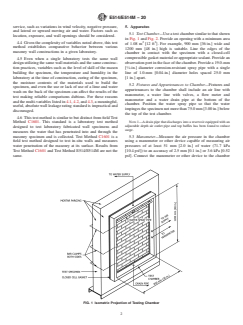
in Fig. 1 and Fig. 2. Provide an opening with a minimum area
2 2
4.4 Given the complexity of variables noted above, this test
of 1.08 m [12 ft ]. For example, 900 mm [36in.] wide and
method establishes comparative behavior between various
1200 mm [48 in.] high is suitable. Line the edges of the
masonry wall constructions in a given laboratory.
chamber in contact with the specimen with a closed-cell
compressiblegasketmaterialorappropriatesealant.Providean
4.5 Even when a single laboratory tests the same wall
observationportinthefaceofthechamber.Providea19.0-mm
designutilizingthesamewallmaterialsandthesameconstruc-
tion practices, variables such as the level of skill of the mason [ ⁄4-in.] diameter corrosion-resistant spray pipe with a single
line of 1.0-mm [0.04-in.] diameter holes spaced 25.0 mm
building the specimen, the temperature and humidity in the
laboratory at the time of construction, curing of the specimen, [1in.] apart.
the moisture contents of the materials used to build the
5.2 Fixtures and Appurtenances to Chamber—Fixtures and
specimen, and even the use or lack of use of a lime and water
appurtenances to the chamber shall include an air line with
wash on the back of the specimen can affect the results of the
manometer, a water line with valves, a flow meter and
test making reliable comparisons dubious. For these reasons
manometer and a water drain pipe at the bottom of the
andthemulti-variableslistedin4.1,4.2,and4.3,ameaningful,
chamber. Position the water spray pipe so that the water
useful, absolute wall leakage rating standard is impractical and
impingesthespecimennotmorethan75.0mm[3.00in.]below
discouraged.
the top of the test chamber.
4.6 This test method is similar to but distinct from fieldTest
NOTE 1—Adrain pipe that discharges into a reservoir equipped with an
Method C1601. This standard is a laboratory test method
adjustable depth air outlet pipe and top baffles has been found to reduce
designed to test laboratory fabricated wall specimens and
surge.
measures the water that has penetrated into and through the
5.3 Manometer—Measure the air pressure in the chamber
masonry specimen and is collected. Test Method C1601 is a
field test method designed to test in-situ walls and measures using a manometer or other device capable of measuring air
water penetration of the masonry at its surface. Results from pressures of at least 51 mm [2.0 in.] of water (71.7 kPa
Test Method C1601 and Test Method E514/E514M are not the [10.4psf]) to an accuracy of 2.5 mm [0.1 in.] or 3.6 kPa [0.52
same. psf]. Connect the manometer or other device to the chamber
FIG. 1 Isometric Projection of Testing Chamber
E514/E514M − 20
FIG. 2 General Arrangement of Water Penetration Testing Chamber System
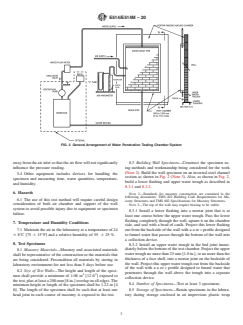
awayfromtheairinletsothattheairflowwillnotsignificantly 8.3 Building Wall Specimens—Construct the specimen us-
influence the pressure reading. ing methods and workmanship being considered for the work
(Note 2). Build the wall specimen on an inverted steel channel
5.4 Other equipment includes devices for handling the
section as shown in Fig. 2 (Note 3). Also, as shown in Fig. 2,
specimen and measuring time, water quantities, temperature,
build a lower flashing and upper water trough as described in
and humidity.
8.3.1 and 8.3.2.
6. Hazards NOTE 2—Standards for masonry construction are contained in the
following documents: TMS 402 Building Code Requirements for Ma-
6.1 The use of this test method will require careful design
sonry Structures and TMS 602 Specifications for Mason
...
This document is not an ASTM standard and is intended only to provide the user of an ASTM standard an indication of what changes have been made to the previous version. Because
it may not be technically possible to adequately depict all changes accurately, ASTM recommends that users consult prior editions as appropriate. In all cases only the current version
of the standard as published by ASTM is to be considered the official document.
Designation: E514/E514M − 14a E514/E514M − 20
Standard Test Method for
Water Penetration and Leakage Through Masonry
This standard is issued under the fixed designation E514/E514M; the number immediately following the designation indicates the year
of original adoption or, in the case of revision, the year of last revision. A number in parentheses indicates the year of last reapproval.
A superscript epsilon (´) indicates an editorial change since the last revision or reapproval.
This standard has been approved for use by agencies of the U.S. Department of Defense.
1. Scope*
1.1 This laboratory test method provides a procedure for determining the resistance to water penetration and leakage through unit
masonry subjected to wind-driven rain. This test method is not identical to and the results are not the same as field standard Test
Method C1601. This test method measures through-wall water penetration, whereas Test Method C1601 only measures surface
water penetration.
1.2 The values stated in either SI units or inch-pound units are to be regarded separately as standard. The values stated in each
system may not be exact equivalents; therefore, each system shall be used independently of the other. Combining values from the
two systems may result in non-conformance with the standard.
1.3 This standard does not purport to address all of the safety concerns, if any, associated with its use. It is the responsibility
of the user of this standard to establish appropriate safety safety, health, and healthenvironmental practices and determine the
applicability of regulatory limitations prior to use. For a specific hazard statement, see Section 6.
1.4 This international standard was developed in accordance with internationally recognized principles on standardization
established in the Decision on Principles for the Development of International Standards, Guides and Recommendations issued
by the World Trade Organization Technical Barriers to Trade (TBT) Committee.
2. Referenced Documents
2.1 ASTM Standards:
C270 Specification for Mortar for Unit Masonry
C1232 Terminology for Masonry
C1601 Test Method for Field Determination of Water Penetration of Masonry Wall Surfaces
2.2 The Masonry Society Standards:
TMS 402/ACI 530402⁄ASCE 5 Building Code Requirements for Masonry Structures
TMS 602/ACI 530.1602⁄ASCE 6 Specifications for Masonry Structures
3. Terminology
3.1 Definitions of Terms Specific to This Standard:
This test method is under the jurisdiction of ASTM Committee C15 on Manufactured Masonry Units and is the direct responsibility of Subcommittee C15.04 on Research.
Current edition approved July 1, 2014Dec. 1, 2020. Published July 2014December 2020. Originally approved in 1974. Last previous edition approved in 2014 as
E514/E514M – 14.E514/E514M – 14a. DOI: 10.1520/E0514_E0514M-14A.10.1520/E0514_E0514M-20.
This test method is based upon those used by the National Bureau of Standards and described in NBS Report BMS7, “Water Permeability of Masonry Walls,” 1933, and
NBS Report BMS82, “Water Permeability of Walls Built of Masonry Units,” 1942.
For referenced ASTM standards, visit the ASTM website, www.astm.org, or contact ASTM Customer Service at service@astm.org. For Annual Book of ASTM Standards
volume information, refer to the standard’s Document Summary page on the ASTM website.
Published by The Masonry Society, www.masonrysociety.org; American Concrete Institute, www.aci-int.org; and American Society of Civil Engineers,
www.masonrysociety.org.
www.asce.org.
*A Summary of Changes section appears at the end of this standard
Copyright © ASTM International, 100 Barr Harbor Drive, PO Box C700, West Conshohocken, PA 19428-2959. United States
E514/E514M − 20
3.1.1 dampness, n—visual change in the appearance of a material due to the presence of water.
3.1.2 surface water penetration, n—passage of water through the exterior face of the masonry.
3.1.3 through-wall water penetration, n—passage of water through a wall and appearance of the water on the interior face of the
masonry.
3.1.4 water penetration, n—water that passes into or through the masonry.
3.1.5 wind-driven rain, n—rain water that is directed against the surface of the wall by wind.
3.2 For definitions of other terms used in this test method, refer to Terminology C1232.
4. Significance and Use
4.1 This test method provides information that aids in evaluating the effect of four principal variables: materials, coatings, wall
design, and workmanship.
4.2 Water penetration and leakage through masonry is significantly affected by air pressure in the test chamber. Data from tests
made at different pressures are not comparable.
4.3 The performance of a masonry wall is a function of materials, construction, wall design, and maintenance. In service the
performance will also depend on the rigidity of supporting structure and on the resistance of components to deterioration by various
causes, such as corrosion, vibration, thermal expansion and contraction, curing, and others. It is impossible to simulate the complex
conditions encountered in service, such as variations in wind velocity, negative pressure, and lateral or upward moving air and
water. Factors such as location, exposure, and wall openings should be considered.
4.4 Given the complexity of variables noted above, this test method establishes comparative behavior between various masonry
wall constructions in a given laboratory.
4.5 Even when a single laboratory tests the same wall design utilizing the same wall materials and the same construction practices,
variables such as the level of skill of the mason building the specimen, the temperature and humidity in the laboratory at the time
of construction, curing of the specimen, the moisture contents of the materials used to build the specimen, and even the use or lack
of use of a lime and water wash on the back of the specimen can affect the results of the test making reliable comparisons dubious.
For these reasons and the multi-variables listed in 4.1, 4.2, and 4.3, a meaningful, useful, absolute wall leakage rating standard is
impractical and discouraged.
4.6 This test method is similar to but distinct from field Test Method C1601. This standard is a laboratory test method is designed
to test laboratory fabricated wall specimens. Field Test Method specimens and C1601 is designed to test in-situ walls. This test
method measures the water that has penetrated into and through the masonry specimen and is collected. Test Method C1601
determines is a field test method designed to test in-situ walls and measures water penetration of the masonry at its surface. Results
from Test Method C1601 and Test Method E514/E514M are not the same.
5. Apparatus
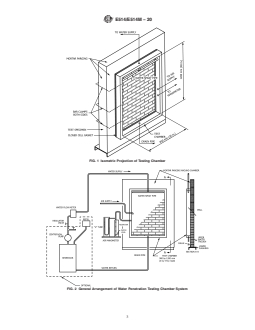
5.1 Test Chamber—Use a test chamber similar to that shown in Fig. 1 and Fig. 2. Provide an opening with a minimum area of
2 2
1.08 m [12 ft ]. For example, 900 mm [36 in.] wide and 1200 mm [48 in.] high is suitable. Line the edges of the chamber in
contact with the specimen with a closed-cell compressible gasket material or appropriate sealant. Provide an observation port in
the face of the chamber. Provide a 19.0-mm [ ⁄4-in.] diameter corrosion-resistant spray pipe with a single line of 1.0-mm [0.04-in.]
diameter holes spaced 25.0 mm [1 in.] apart.
5.2 Fixtures and Appurtenances to Chamber—Fixtures and appurtenances to the chamber shall include an air line with manometer,
a water line with valves, a flow meter and manometer and a water drain pipe at the bottom of the chamber. Position the water spray
pipe so that the water impinges the specimen not more than 75.0 mm [3.00 in.] below the top of the test chamber.
E514/E514M − 20
FIG. 1 Isometric Projection of Testing Chamber
FIG. 2 General Arrangement of Water Penetration Testing Chamber System
E514/E514M − 20
NOTE 1—A drain pipe that discharges into a reservoir equipped with an adjustable depth air outlet pipe and top baffles has been found to reduce surge.
5.3 Manometer—Measure the air pressure in the chamber using a manometer or other device capable of measuring air pressures
of at least 51 mm [2.0 in.] of water (71.7 kPa [10.4 psf]) to an accuracy of 2.5 mm [0.1 in.] or 3.6 kPa [0.52 psf]. Connect the
manometer or other device to the chamber away from the air inlet so that the air flow will not significantly influence the pressure
reading.
5.4 Other equipment includes devices for handling the specimen and measuring time, water quantities, temperature, and humidity.
6. Hazards
6.1 The use of this test method will require careful design consideration of both air chamber and support of the wall system to
avoid possible injury due to equipment or specimen failure.
7. Temperature and Humidity Conditions
7.1 Maintain the air in the laboratory at a temperature of 24 6 8°C [75 6 15°F] and a relative humidity of 55 6 25 %.
8. Test Specimens
8.1 Masonry Materials—Masonry and
...