

ASTM C1892/C1892M-22
(Test Method)Standard Test Methods for Strength of Anchors in Masonry
General Information
- Abstract
SIGNIFICANCE AND USE
4.1 These test methods are intended to provide reproducible data from which acceptance criteria, design data, and specifications can be developed for anchors intended to be installed in masonry assemblies.
SCOPE
1.1 These test methods address the tensile and shear strengths of post-installed and placed-during-construction anchors in masonry test specimens made of masonry assemblies. Environmental exposures include freezing and thawing, moisture, decreased and elevated temperatures and corrosion. These test methods provide basic testing procedures for use with product-specific evaluation and acceptance standards and are intended to be performed in a testing laboratory. Product-specific evaluation and acceptance standards may add specific details and appropriate parameters as needed to accomplish the testing. Only those tests required by the specifying authority need to be performed.
1.2 Loadings include quasi-static, dynamic, fatigue and shock. Environmental exposures include freezing and thawing, moisture, decreased and elevated temperatures and corrosion.
1.3 These test methods are intended for use with post-installed and placed-during-construction anchors designed for installation projecting from the surface of a masonry test specimen.
1.4 This standard prescribes separate procedures for static, dynamic, fatigue and shock testing. Nothing in this standard, however, shall preclude combined tests incorporating two or more of these types of loading (such as dynamic, fatigue and shock tests in series).
1.5 The text of this standard refers to notes and footnotes that provide explanatory material. These notes and footnotes (excluding those in tables and figures) shall not be considered as requirements of the standard.
1.6 Both inch-pound and SI units are provided in this standard. The testing may be performed in either system and reported in that system and the results converted to the other. However, anchor diameters, threads, and related testing equipment shall be in accordance with either inch-pound or SI provisions.
1.7 Units—The values stated in each system are not necessarily exact equivalents; therefore, to ensure conformance with the standard, each system shall be used independently of the other, and values from the two systems shall not be combined.
1.8 This standard does not purport to address all of the safety concerns, if any, associated with its use. It is the responsibility of the user of this standard to establish appropriate safety, health, and environmental practices and determine the applicability of regulatory limitations prior to use.
1.9 This international standard was developed in accordance with internationally recognized principles on standardization established in the Decision on Principles for the Development of International Standards, Guides and Recommendations issued by the World Trade Organization Technical Barriers to Trade (TBT) Committee.
- Status
- Published
- Publication Date
- 30-Nov-2022
- Technical Committee
- C15 - Masonry – Manufactured Masonry Units, Mortars and Grouts
- Drafting Committee
- C15.04 - Research for Masonry Units and Assemblies
Overview
ASTM C1892/C1892M-22: Standard Test Methods for Strength of Anchors in Masonry provides comprehensive procedures to evaluate the tensile and shear strengths of anchors installed in masonry assemblies. Developed by ASTM International, this standard supports consistent and reproducible testing of post-installed and placed-during-construction anchors under various conditions and loading scenarios. The document is essential for manufacturers, engineers, specifiers, and testing laboratories involved with masonry anchorage systems, ensuring the anchors meet acceptance criteria, design parameters, and relevant specifications.
Key Topics
ASTM C1892/C1892M-22 covers a broad range of topics critical for the standardization and evaluation of anchors in masonry structures, including:
- Scope of Testing: Addresses tensile and shear strengths for both post-installed and placed-during-construction anchors.
- Load Types: Includes static, dynamic (such as earthquake simulation), fatigue, quasi-static, and shock loading scenarios.
- Environmental Exposures: Evaluates anchor performance under conditions like freezing and thawing, moisture, high and low temperatures, and corrosion.
- Test Methods: Provides separate procedures for each type of loading, with allowance for combined testing.
- Measurement Units: Specifies the use of both inch-pound and SI units but requires reports and equipment to adhere strictly to one measurement system per test.
- Failure Criteria: Defines various anchor failure modes, including masonry breakout, pullout/pull-through, anchor rupture, bond, shear, and side-face blowout.
Applications
ASTM C1892/C1892M-22 test methods are applied in multiple practical contexts, including:
- Product Evaluation: Supporting the development and qualification of anchors for use in masonry, enabling manufacturers to provide verified performance data.
- Quality Control: Assisting specifiers and regulatory agencies in verifying that anchor systems meet minimum strength and durability requirements.
- Design and Engineering: Providing engineers and designers with standardized data for safe working loads, installation criteria, and environmental resistance when designing masonry assemblies.
- Field and Laboratory Testing: Used in accredited laboratories to replicate real-life exposure and loading conditions, ensuring reliable and standardized test results for anchor performance.
- Research and Development: Aiding in the innovation and improvement of new anchoring technologies and solutions for masonry applications.
These applications ensure that building constructions, retrofits, and infrastructure projects benefit from anchors with demonstrated and reliable performance in masonry settings.
Related Standards
ASTM C1892/C1892M-22 references several key standards to ensure the consistency and accuracy of anchor testing in masonry:
- ASTM C1180: Terminology of Mortar and Grout for Unit Masonry.
- ASTM C1232: Terminology for Masonry.
- ASTM E4: Practices for Force Calibration and Verification of Testing Machines.
- ASTM E468: Practice for Presentation of Constant Amplitude Fatigue Test Results for Metallic Materials.
- ASTM E575: Practice for Reporting Data from Structural Tests of Building Constructions, Elements, Connections, and Assemblies.
- ASTM E631: Terminology of Building Constructions.
- ANSI B212.15: Standard for Cutting Tools-Carbide-Tipped Masonry Drills.
- Various product-specific evaluation and acceptance standards for anchors.
These referenced standards help define consistent terminology, calibration procedures, reporting formats, and specific testing details required to implement ASTM C1892/C1892M-22 effectively.
Keywords: anchor strength in masonry, tensile strength, shear strength, post-installed anchors, placed-during-construction anchors, dynamic load testing, masonry assemblies, ASTM masonry standards, environmental exposure, anchor testing laboratory.
Relations
- Effective Date
- 15-Dec-2023
- Effective Date
- 01-Dec-2018
- Effective Date
- 01-Jul-2018
- Effective Date
- 01-Jun-2017
- Effective Date
- 01-Sep-2015
- Effective Date
- 01-Jun-2015
- Effective Date
- 01-Mar-2015
- Effective Date
- 01-Nov-2014
- Effective Date
- 01-Jun-2014
- Effective Date
- 01-Jun-2012
- Effective Date
- 01-Oct-2011
- Effective Date
- 01-Apr-2011
- Effective Date
- 15-Dec-2010
- Effective Date
- 01-Dec-2010
- Effective Date
- 15-Jun-2010
Get Certified
Connect with accredited certification bodies for this standard

DIBt (Deutsches Institut für Bautechnik)
German Institute for Building Technology.
DIN CERTCO
DIN Group product certification.

Aboma Certification B.V.
Specialized in construction, metal, and transport sectors.
Sponsored listings
Frequently Asked Questions
ASTM C1892/C1892M-22 is a standard published by ASTM International. Its full title is "Standard Test Methods for Strength of Anchors in Masonry". This standard covers: SIGNIFICANCE AND USE 4.1 These test methods are intended to provide reproducible data from which acceptance criteria, design data, and specifications can be developed for anchors intended to be installed in masonry assemblies. SCOPE 1.1 These test methods address the tensile and shear strengths of post-installed and placed-during-construction anchors in masonry test specimens made of masonry assemblies. Environmental exposures include freezing and thawing, moisture, decreased and elevated temperatures and corrosion. These test methods provide basic testing procedures for use with product-specific evaluation and acceptance standards and are intended to be performed in a testing laboratory. Product-specific evaluation and acceptance standards may add specific details and appropriate parameters as needed to accomplish the testing. Only those tests required by the specifying authority need to be performed. 1.2 Loadings include quasi-static, dynamic, fatigue and shock. Environmental exposures include freezing and thawing, moisture, decreased and elevated temperatures and corrosion. 1.3 These test methods are intended for use with post-installed and placed-during-construction anchors designed for installation projecting from the surface of a masonry test specimen. 1.4 This standard prescribes separate procedures for static, dynamic, fatigue and shock testing. Nothing in this standard, however, shall preclude combined tests incorporating two or more of these types of loading (such as dynamic, fatigue and shock tests in series). 1.5 The text of this standard refers to notes and footnotes that provide explanatory material. These notes and footnotes (excluding those in tables and figures) shall not be considered as requirements of the standard. 1.6 Both inch-pound and SI units are provided in this standard. The testing may be performed in either system and reported in that system and the results converted to the other. However, anchor diameters, threads, and related testing equipment shall be in accordance with either inch-pound or SI provisions. 1.7 Units—The values stated in each system are not necessarily exact equivalents; therefore, to ensure conformance with the standard, each system shall be used independently of the other, and values from the two systems shall not be combined. 1.8 This standard does not purport to address all of the safety concerns, if any, associated with its use. It is the responsibility of the user of this standard to establish appropriate safety, health, and environmental practices and determine the applicability of regulatory limitations prior to use. 1.9 This international standard was developed in accordance with internationally recognized principles on standardization established in the Decision on Principles for the Development of International Standards, Guides and Recommendations issued by the World Trade Organization Technical Barriers to Trade (TBT) Committee.
SIGNIFICANCE AND USE 4.1 These test methods are intended to provide reproducible data from which acceptance criteria, design data, and specifications can be developed for anchors intended to be installed in masonry assemblies. SCOPE 1.1 These test methods address the tensile and shear strengths of post-installed and placed-during-construction anchors in masonry test specimens made of masonry assemblies. Environmental exposures include freezing and thawing, moisture, decreased and elevated temperatures and corrosion. These test methods provide basic testing procedures for use with product-specific evaluation and acceptance standards and are intended to be performed in a testing laboratory. Product-specific evaluation and acceptance standards may add specific details and appropriate parameters as needed to accomplish the testing. Only those tests required by the specifying authority need to be performed. 1.2 Loadings include quasi-static, dynamic, fatigue and shock. Environmental exposures include freezing and thawing, moisture, decreased and elevated temperatures and corrosion. 1.3 These test methods are intended for use with post-installed and placed-during-construction anchors designed for installation projecting from the surface of a masonry test specimen. 1.4 This standard prescribes separate procedures for static, dynamic, fatigue and shock testing. Nothing in this standard, however, shall preclude combined tests incorporating two or more of these types of loading (such as dynamic, fatigue and shock tests in series). 1.5 The text of this standard refers to notes and footnotes that provide explanatory material. These notes and footnotes (excluding those in tables and figures) shall not be considered as requirements of the standard. 1.6 Both inch-pound and SI units are provided in this standard. The testing may be performed in either system and reported in that system and the results converted to the other. However, anchor diameters, threads, and related testing equipment shall be in accordance with either inch-pound or SI provisions. 1.7 Units—The values stated in each system are not necessarily exact equivalents; therefore, to ensure conformance with the standard, each system shall be used independently of the other, and values from the two systems shall not be combined. 1.8 This standard does not purport to address all of the safety concerns, if any, associated with its use. It is the responsibility of the user of this standard to establish appropriate safety, health, and environmental practices and determine the applicability of regulatory limitations prior to use. 1.9 This international standard was developed in accordance with internationally recognized principles on standardization established in the Decision on Principles for the Development of International Standards, Guides and Recommendations issued by the World Trade Organization Technical Barriers to Trade (TBT) Committee.
ASTM C1892/C1892M-22 is classified under the following ICS (International Classification for Standards) categories: 91.080.30 - Masonry. The ICS classification helps identify the subject area and facilitates finding related standards.
ASTM C1892/C1892M-22 has the following relationships with other standards: It is inter standard links to ASTM C1232-23, ASTM C1180-18, ASTM E575-05(2018), ASTM C1232-17, ASTM C1232-15a, ASTM C1232-15, ASTM E631-15, ASTM E631-14, ASTM E4-14, ASTM C1232-12, ASTM E468-11, ASTM E575-05(2011), ASTM C1232-10c, ASTM C1180-10, ASTM C1232-10b. Understanding these relationships helps ensure you are using the most current and applicable version of the standard.
ASTM C1892/C1892M-22 is available in PDF format for immediate download after purchase. The document can be added to your cart and obtained through the secure checkout process. Digital delivery ensures instant access to the complete standard document.
Standards Content (Sample)
This international standard was developed in accordance with internationally recognized principles on standardization established in the Decision on Principles for the
Development of International Standards, Guides and Recommendations issued by the World Trade Organization Technical Barriers to Trade (TBT) Committee.
Designation: C1892/C1892M − 22
Standard Test Methods for
Strength of Anchors in Masonry
This standard is issued under the fixed designation C1892/C1892M; the number immediately following the designation indicates the
year of original adoption or, in the case of revision, the year of last revision. A number in parentheses indicates the year of last
reapproval. A superscript epsilon (´) indicates an editorial change since the last revision or reapproval.
1. Scope* 1.7 Units—The values stated in each system are not neces-
sarily exact equivalents; therefore, to ensure conformance with
1.1 These test methods address the tensile and shear
the standard, each system shall be used independently of the
strengths of post-installed and placed-during-construction an-
other, and values from the two systems shall not be combined.
chors in masonry test specimens made of masonry assemblies.
Environmental exposures include freezing and thawing, 1.8 This standard does not purport to address all of the
moisture, decreased and elevated temperatures and corrosion.
safety concerns, if any, associated with its use. It is the
These test methods provide basic testing procedures for use responsibility of the user of this standard to establish appro-
with product-specific evaluation and acceptance standards and
priate safety, health, and environmental practices and deter-
are intended to be performed in a testing laboratory. Product- mine the applicability of regulatory limitations prior to use.
specific evaluation and acceptance standards may add specific
1.9 This international standard was developed in accor-
detailsandappropriateparametersasneededtoaccomplishthe
dance with internationally recognized principles on standard-
testing. Only those tests required by the specifying authority
ization established in the Decision on Principles for the
need to be performed.
Development of International Standards, Guides and Recom-
mendations issued by the World Trade Organization Technical
1.2 Loadings include quasi-static, dynamic, fatigue and
Barriers to Trade (TBT) Committee.
shock. Environmental exposures include freezing and thawing,
moisture, decreased and elevated temperatures and corrosion.
2. Referenced Documents
1.3 These test methods are intended for use with post-
installed and placed-during-construction anchors designed for 2.1 ASTM Standards:
C1180Terminology of Mortar and Grout for Unit Masonry
installation projecting from the surface of a masonry test
C1232Terminology for Masonry
specimen.
E4Practices for Force Calibration and Verification of Test-
1.4 This standard prescribes separate procedures for static,
ing Machines
dynamic, fatigue and shock testing. Nothing in this standard,
E468Practice for Presentation of Constant Amplitude Fa-
however, shall preclude combined tests incorporating two or
tigue Test Results for Metallic Materials
more of these types of loading (such as dynamic, fatigue and
E575Practice for Reporting Data from Structural Tests of
shock tests in series).
Building Constructions, Elements, Connections, and As-
1.5 The text of this standard refers to notes and footnotes
semblies
that provide explanatory material. These notes and footnotes
E631Terminology of Building Constructions
(excluding those in tables and figures) shall not be considered
2.2 Other Standards:
as requirements of the standard.
ANSI B212.15 American National Standard for Cutting
1.6 Both inch-pound and SI units are provided in this
Tools—Carbide-Tipped Masonry Drills and Blanks for
standard. The testing may be performed in either system and
Carbide-Tipped Masonry Drills
reported in that system and the results converted to the other.
However, anchor diameters, threads, and related testing equip-
3. Terminology
ment shall be in accordance with either inch-pound or SI
3.1 For definitions of general terms related to building
provisions.
construction used in this standard, refer to Terminology E631.
For definitions of terms related to masonry refer to Terminol-
ogy C1180 or C1232.
This test method is under the jurisdiction of ASTM Committee C15 on
Manufactured Masonry Units and is the direct responsibility of Subcommittee 3.2 Definitions of Terms Specific to This Standard:
C15.04 on Research.
3.2.1 adhesive anchor, n—an anchor that derives its holding
Current edition approved Dec. 1, 2022. Published December 2022. Originally
strength from the chemical compound between the wall of the
approvedin2019.Lastpreviouseditionapprovedin2020asC1892/C1892M–20a.
DOI: 10.1520/C1892_C1892M-22. hole and the anchor rod.
*A Summary of Changes section appears at the end of this standard
Copyright © ASTM International, 100 Barr Harbor Drive, PO Box C700, West Conshohocken, PA 19428-2959. United States
C1892/C1892M − 22
3.2.1.1 Discussion—The compounds used include epoxy, 3.2.17 shock test, n—a laboratory test that simulates shock
cementitious material, polyester resin, and other similar types. loads on an anchorage system by the application of a short
duration external load.
3.2.2 anchor spacing, n—the distance between anchors
measured centerline to centerline. 3.2.18 static test, n—a test in which a load is slowly applied
to an anchor according to a specified rate such that the anchor
3.2.3 displacement, n—movement of an anchor relative to
receives one loading cycle.
the masonry assembly.
3.2.19 tensile test, n—a test in which an anchor is loaded
3.2.3.1 Discussion—For tension tests, displacement is mea-
axially in tension.
sured along the axis of the anchor, and for shear tests,
displacement is measured perpendicular to the axis of the
3.2.20 undercut anchor, n—a post-installed anchor that
anchor.
derivesitsholdingstrengthfromanexpansionofanembedded
portion of the anchor into a portion of the hole that is larger in
3.2.4 dynamic test, n—a laboratory test that applies load
diameter than the portion of the hole between the enlarged
cycles of varying magnitude and frequency to an anchorage
section and the surface of the masonry test specimen.
system for the purpose of simulating dynamic loads such as a
3.2.20.1 Discussion—The enlarged diameter section of the
seismic event (earthquake).
hole is predrilled or enlarged by an expansion process during
3.2.5 edge distance, n—the distance from the centerline of
installation of the anchor.
an anchor to the nearest edge of a masonry test specimen.
3.3 Notation:
3.2.6 embedment depth, n—distance from the masonry test
specimen surface to the installed end of the anchor.
A = instrument readings at a given load, in. [mm].
N
3.2.6.1 Discussion—The embedment depth is measured
A = initial instrument readings, in. [mm].
I
prior to any movement that results from anchor setting.
C = minimum distance from the center of an anchor shaft
a
to the edge of masonry test specimen, determined
3.2.7 expansion anchor, n—an anchor that derives its hold-
from tests, in. [mm].
ing strength through a mechanically expanded system which
d = nominal diameter of anchor, in. [mm].
exerts forces against the sides of the drilled hole.
d = diameter of carbide-tipped drill bit with diameter on
m
3.2.8 fatigue test, n—a laboratory test that applies repeated
low end of tolerance range for new bit, representing
load cycles to an anchorage system for the purpose of
moderately used bit, in. [mm].
determining the fatigue life or fatigue strength of that system.
d = diameter of carbide-tipped drill bit with diameter on
max
high end of tolerance range for new bit, representing
3.2.9 linear variable differential transformer (LVDT), n—a
deviceusedformeasuringthedisplacementormovementofan bit as large as would be expected in use, in. [mm].
d = diameterofcarbide-tippeddrillbitwithdiameterless
anchor or anchor system.
min
than the low end of the tolerance range for new bit
3.2.10 masonry test specimen, n—the masonry assembly in
representing a well-used bit, in. [mm].
which an anchor is installed and which resists forces from the
d = outside diameter of anchor, in. [mm].
o
anchor.
f’ = specified masonry compressive strength, psi [MPa].
m
3.2.11 placed-during-construction anchor, n—an anchor
h = effective embedment depth, measured from the ma-
ef
that is installed prior to the placement of grout or mortar.
sonry test specimen surface to the deepest point at
3.2.11.1 Discussion—The anchor typically derives its hold- which the anchor tension load is transferred to the
ing strength from plates, lugs, or other protrusions that engage masonry, in. [mm].
F = safe working load, lb [N].
with the masonry assembly.
s
N = tensile load in tests of anchors located in cracks
w
3.2.12 post-installed anchor, n—an anchor that is installed
whose opening width is cycled, lb [N].
after the placement and hardening of masonry.
s = minimum anchor spacing, determined from test, in.
min
3.2.13 run-out, n—a condition in which a failure does not
[mm].
occur in the specified number of load cycles in a fatigue test.
S = anchor spacing, in. [mm], measured centerline to
centerline.
3.2.14 safe working loads, n—the allowable or design load
∆ = uncorrected displacement for tension tests, in. [mm].
T
obtained by applying factors of safety to the ultimate load of
∆ = uncorrected displacement for shear tests, in. [mm].
S
the anchorage device.
3.2.15 screw anchor, n—a post-installed anchor that is an 4. Significance and Use
externally threaded mechanical fastener installed in a pre-
4.1 These test methods are intended to provide reproducible
drilled hole.
data from which acceptance criteria, design data, and specifi-
3.2.15.1 Discussion—The anchor derives its capacity from
cationscanbedevelopedforanchorsintendedtobeinstalledin
the mechanical interlock of the fastener threads with the
masonry assemblies.
grooves cut into the base material during the anchor installa-
tion. 5. Apparatus
3.2.16 shear test, n—a test in which an anchor is loaded 5.1 Equipment:
perpendicular to the axis of the anchor and parallel to the 5.1.1 General Laboratory—Use calibrated electronic load
surface of the masonry test specimen. and displacement measuring devices meeting the specified
C1892/C1892M − 22
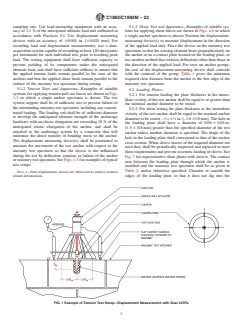
sampling rate. Use load-measuring equipment with an accu- 5.1.3 Shear Test and Apparatus—Examples of suitable sys-
racy of 61% of the anticipated ultimate load and calibrated in tems for applying shear forces are shown in Figs. 4-6 in which
accordance with Practices E4. Use displacement measuring a single anchor specimen is shown. Position the displacement-
devices with an accuracy of 60.001 in. [60.025 mm]. For measuring device(s) to measure displacement in the direction
recording load and displacement measurements, use a data- of the applied load only. Place the device on the masonry test
acquisitionsystemcapableofrecordingatleast120datapoints specimen so that the sensing element bears perpendicularly on
per instrument for each individual test, prior to reaching peak theanchororonacontactplatelocatedontheloadingplate,or
load. The testing equipment shall have sufficient capacity to useanothermethodthatrestrictsdeflectionsotherthanthosein
prevent yielding of its components under the anticipated the direction of the applied load. For tests on anchor groups,
ultimate load, and shall have sufficient stiffness to ensure that the axis of the displacement-measuring device shall coincide
the applied tension loads remain parallel to the axes of the with the centroid of the group. Table 1 gives the minimum
anchors and that the applied shear loads remain parallel to the required clear distance from the anchor to the free edge of the
surface of the masonry test specimen during testing. masonry test specimen.
5.1.2 Tension Tests and Apparatus—Examples of suitable
5.2 Loading Plates:
systems for applying tension pull-out forces are shown inFigs.
5.2.1 For tension loading the plate thickness in the imme-
1-3 in which a single anchor specimen is shown. The test
diatevicinityofthetestanchorshallbeequaltoorgreaterthan
system support shall be of sufficient size to prevent failure of
the nominal anchor diameter to be tested.
the surrounding masonry test specimen, including any concen-
5.2.2 For shear testing the plate thickness in the immediate
trated loading. The loading rod shall be of sufficient diameter
vicinity of the test anchor shall be equal to the nominal anchor
to develop the anticipated ultimate strength of the anchorage
1 1
diameter to be tested, – ⁄16 + ⁄8 in. [–1.6 +3.0 mm].The hole in
hardware with an elastic elongation not exceeding 10% of the
the loading plate shall have a diameter of 0.06 60.03in.
anticipated elastic elongation of the anchor, and shall be
[1.5 60.8mm] greater than the specified diameter of the test
attached to the anchorage system by a connector that will
anchor unless another diameter is specified. The shape of the
minimize the direct transfer of bending stress to the anchor.
hole in the loading plate shall correspond to that of the anchor
The displacement measuring device(s) shall be positioned to
cross section. When sleeve inserts of the required diameter are
measure the movement of the test anchor with respect to the
used they shall be periodically inspected and replaced to meet
masonry test specimen so that the device is not influenced
theserequirementsandpreventeccentricloadingofsleeve.See
during the test by deflection, rotation, or failure of the anchor
Fig. 7 for representative shear plates with sleeves. The contact
ormasonrytestspecimen.SeeFigs.1-3forexamplesoftypical
area between the loading plate through which the anchor is
test setups.
installed and the masonry test specimen shall be as given in
Table 2, unless otherwise specified. Chamfer or smooth the
NOTE 1—Dual displacement sensors are often used to remove rotation
related deformations. edges of the loading plate so that it does not dig into the
FIG. 1 Example of Tension Test Setup—Displacement Measurement with Dual LVDTs
C1892/C1892M − 22
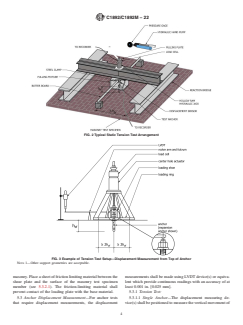
FIG. 2 Typical Static Tension Test Arrangement
FIG. 3 Example of Tension Test Setup—Displacement Measurement from Top of Anchor
NOTE 1—Other support geometries are acceptable.
masonry.Placeasheetoffrictionlimitingmaterialbetweenthe measurements shall be made using LVDT device(s) or equiva-
shear plate and the surface of the masonry test specimen lent which provide continuous readings with an accuracy of at
member (see 5.3.2.1). The friction-limiting material shall least 0.001 in. [0.025 mm].
prevent contact of the loading plate with the base material.
5.3.1 Tension Test:
5.3 Anchor Displacement Measurement—For anchor tests 5.3.1.1 Single Anchor—The displacement measuring de-
that require displacement measurements, the displacement vice(s)shallbepositionedtomeasuretheverticalmovementof
C1892/C1892M − 22
FIG. 4 Typical Method of Applying Shear Loads to Anchors Attached to Masonry Test Specimens—Direct Loading Method
FIG. 5 Example of a Shear Test Setup Vertical Orientation
the anchor with respect to points on the masonry test specimen shims, attachment hardware, and masonry test specimen.
in such a way that the device is not influenced during the test Deduct all of the elongations from these sources from the total
by deflection, rotation, flexure, or failure of the anchor or displacement measurements by using supplementary measur-
masonry test specimen. ing devices or calibration test data for the installed test set-up
5.3.1.2 Group of Anchors—Displacement measurements with a rigid specimen replacing the anchor to be tested. The
shall be made on all anchors or group of anchors tested displacementtobeusedfortheevaluationofthefindingsisthe
simultaneouslyexceptthatonlyonesetofinstrumentsneedsto average displacement indicated by both instruments mounted
be used for a group of anchors tested as a closely spaced symmetrically equidistant from the centroid of the cluster as
cluster. Displacement measurements will include components shown in Fig. 8.
ofdeformationnotdirectlyassociatedwithdisplacementofthe 5.3.2 Shear Test—The displacement measuring device(s)
anchor relative to the masonry test specimen. Include compo- shall be positioned to measure displacement in the direction of
nents of deformation such as elastic elongation of the loading theappliedload.Thedeviceshallbeplacedonthemasonrytest
rod anchor stem, deformation of the loading plate, sleeves, specimen to allow the sensing element to bear perpendicularly
C1892/C1892M − 22
FIG. 6 Typical Dynamic Shear Test Arrangement—Indirect Loading Method
TABLE 1 Minimum Clearance Requirements for Test Equipment Supports
All Anchors
Spacing Between Distance from Anchor
Test Supports to Edge of Test Support
Tension Loads
4.0h 2.0h
ef ef
Shear Loads
4.0C 2.0C
a a
FIG. 7 Examples of Shear Plates with Sleeves
on the anchor or on a contact plate located on the loading plate 5.3.2.1 For static shear tests, a sheet of tetrafluoroethylene
as shown in Figs. 4 and 5 or other methods which prevents (TFE), polytetrafluoroethylene (PTFE), fluorinated ethylene
extraneous deflections. For tests on clusters of anchors, the propylene (FEP), or perfluoroalkoxy (PFA) of
instrument shall lie on a plane through the axis of the shear 0.020 60.004in.[0.5 60.1mm] thickness and correspond-
loading rod or plate. An extension of the axis of the shear ing to the area required according to Table 2 shall be placed
loading rod or plate shall pass through the centric axis of the between the shear plate and the surface of the masonry test
cluster of anchors. specimen.
C1892/C1892M − 22
TABLE 2 Shear Loading Plate Bearing Area as a Function of
either the outside edges of the masonry test specimen or the
Anchor Diameter
bearing contact points of the test frame.The overall size of the
A, B
Anchor Diameter, d Shear Loading Plate Contact Area
o test specimen shall only be reduced when the minimum
2 2
in. [cm ]
in. [mm]
requirements in 6.4.1 are met.
Minimum Maximum
< ⁄8 [<10] 8 [50] 12 [80]
6.4.3 Surface Finish—The surface of the masonry test
3 5
⁄8 [10]# d < ⁄8 [16] 12 [80] 18 [115]
o
specimen where the loading fixture or loading plate bears on
5 7
⁄8 [16]# d < ⁄8 [22] 18 [115] 25 [160]
o
7 the member shall be typical of the anchor application
⁄8 [22]# d < 2 [50] 25 [160] 40 [260]
o
d $ 2 [50] 40 [260] 60 [385]
o conditions, unless otherwise specified.
A
Shear loading plate contact area with PTFE or other friction-limiting material.
B
7. Conditioning
Calculated uniform bearing stress on contact area due to self-weight of loading
plate and associated loading apparatus shall not exceed 5 psi [0.03 MPa].
7.1 Specimen Conditioning and Curing—When aging,
seasoning, or curing conditions affect the performance and
capacity of the installed anchor, take appropriate measures to
6. Anchor and Masonry Wall Specimens
age, season, or cure the installed anchoring system in accor-
dance with appropriate procedures prior to testing. Describe
6.1 Anchorage System—The anchorage system shall be
such conditions in detail. Placed-during-construction, grout-
representative of the type and lot to be used in field construc-
set, and epoxy-set anchors are some examples of anc
...
This document is not an ASTM standard and is intended only to provide the user of an ASTM standard an indication of what changes have been made to the previous version. Because
it may not be technically possible to adequately depict all changes accurately, ASTM recommends that users consult prior editions as appropriate. In all cases only the current version
of the standard as published by ASTM is to be considered the official document.
Designation: C1892/C1892M − 20a C1892/C1892M − 22
Standard Test Methods for
Strength of Anchors in Masonry
This standard is issued under the fixed designation C1892/C1892M; the number immediately following the designation indicates the
year of original adoption or, in the case of revision, the year of last revision. A number in parentheses indicates the year of last
reapproval. A superscript epsilon (´) indicates an editorial change since the last revision or reapproval.
1. Scope*
1.1 These test methods address the tensile and shear strengths of post-installed and placed-during-construction anchors in masonry
test specimens made of masonry assemblies. Environmental exposures include freezing and thawing, moisture, decreased and
elevated temperatures and corrosion. These test methods provide basic testing procedures for use with product-specific evaluation
and acceptance standards and are intended to be performed in a testing laboratory. Product-specific evaluation and acceptance
standards may add specific details and appropriate parameters as needed to accomplish the testing. Only those tests required by
the specifying authority need to be performed.
1.2 Loadings include quasi-static, dynamic, fatigue and shock. Environmental exposures include freezing and thawing, moisture,
decreased and elevated temperatures and corrosion.
1.3 These test methods are intended for use with post-installed and placed-during-construction anchors designed for installation
projecting from the surface of a masonry test specimen.
1.4 This standard prescribes separate procedures for static, dynamic, fatigue and shock testing. Nothing in this standard, however,
shall preclude combined tests incorporating two or more of these types of loading (such as dynamic, fatigue and shock tests in
series).
1.5 The text of this standard refers to notes and footnotes that provide explanatory material. These notes and footnotes (excluding
those in tables and figures) shall not be considered as requirements of the standard.
1.6 Both inch-pound and SI units are provided in this standard. The testing may be performed in either system and reported in
that system and the results converted to the other. However, anchor diameters, threads, and related testing equipment shall be in
accordance with either inch-pound or SI provisions.
1.7 Units—The values stated in each system are not necessarily exact equivalents; therefore, to ensure conformance with the
standard, each system shall be used independently of the other, and values from the two systems shall not be combined.
1.8 This standard does not purport to address all of the safety concerns, if any, associated with its use. It is the responsibility
of the user of this standard to establish appropriate safety, health, and environmental practices and determine the applicability of
regulatory limitations prior to use.
1.9 This international standard was developed in accordance with internationally recognized principles on standardization
established in the Decision on Principles for the Development of International Standards, Guides and Recommendations issued
by the World Trade Organization Technical Barriers to Trade (TBT) Committee.
This test method is under the jurisdiction of ASTM Committee C15 on Manufactured Masonry Units and is the direct responsibility of Subcommittee C15.04 on Research.
Current edition approved Dec. 1, 2020Dec. 1, 2022. Published December 2020December 2022. Originally approved in 2019. Last previous edition approved in 2020 as
C1892/C1892M – 20.C1892/C1892M – 20a. DOI: 10.1520/C1892_C1892M-20A.10.1520/C1892_C1892M-22.
*A Summary of Changes section appears at the end of this standard
Copyright © ASTM International, 100 Barr Harbor Drive, PO Box C700, West Conshohocken, PA 19428-2959. United States
C1892/C1892M − 22
2. Referenced Documents
2.1 ASTM Standards:
C1180 Terminology of Mortar and Grout for Unit Masonry
C1232 Terminology for Masonry
E4 Practices for Force Calibration and Verification of Testing Machines
E468 Practice for Presentation of Constant Amplitude Fatigue Test Results for Metallic Materials
E575 Practice for Reporting Data from Structural Tests of Building Constructions, Elements, Connections, and Assemblies
E631 Terminology of Building Constructions
2.2 Other Standards:
ANSI B212.15 American National Standard for Cutting Tools—Carbide-Tipped Masonry Drills and Blanks for Carbide-Tipped
Masonry Drills
3. Terminology
3.1 For definitions of general terms related to building construction used in this standard, refer to Terminology E631. For
definitions of terms related to masonry refer to Terminology C1180 or C1232.
3.2 Definitions of Terms Specific to This Standard:
3.2.1 adhesive anchor, n—an anchor that derives its holding strength from the chemical compound between the wall of the hole
and the anchor rod.
3.2.1.1 Discussion—
The compounds used include epoxy, cementitious material, polyester resin, and other similar types.
3.2.2 anchor spacing, n—the distance between anchors measured centerline to centerline.
3.2.3 displacement, n—movement of an anchor relative to the masonry assembly.
3.2.3.1 Discussion—
For tension tests, displacement is measured along the axis of the anchor, and for shear tests, displacement is measured
perpendicular to the axis of the anchor.
3.2.4 dynamic test, n—a laboratory test that applies load cycles of varying magnitude and frequency to an anchorage system for
the purpose of simulating dynamic loads such as a seismic event (earthquake).
3.2.5 edge distance, n—the distance from the centerline of an anchor to the nearest edge of a masonry test specimen.
3.2.6 embedment depth, n—distance from the masonry test specimen surface to the installed end of the anchor.
3.2.6.1 Discussion—
The embedment depth is measured prior to any movement that results from anchor setting.
3.2.7 expansion anchor, n—an anchor that derives its holding strength through a mechanically expanded system which exerts
forces against the sides of the drilled hole.
3.2.8 fatigue test, n—a laboratory test that applies repeated load cycles to an anchorage system for the purpose of determining the
fatigue life or fatigue strength of that system.
3.2.9 linear variable differential transformer (LVDT), n—a device used for measuring the displacement or movement of an anchor
or anchor system.
3.2.10 masonry test specimen, n—the masonry assembly in which an anchor is installed and which resists forces from the anchor.
3.2.11 placed-during-construction anchor, n—an anchor that is installed prior to the placement of grout or mortar.
3.2.11.1 Discussion—
The anchor typically derives its holding strength from plates, lugs, or other protrusions that engage with the masonry assembly.
C1892/C1892M − 22
3.2.12 post-installed anchor, n—an anchor that is installed after the placement and hardening of masonry.
3.2.13 run-out, n—a condition in which a failure does not occur in the specified number of load cycles in a fatigue test.
3.2.14 safe working loads, n—the allowable or design load obtained by applying factors of safety to the ultimate load of the
anchorage device.
3.2.15 screw anchor, n—a post-installed anchor that is an externally threaded mechanical fastener installed in a pre-drilled hole.
3.2.15.1 Discussion—
The anchor derives its capacity from the mechanical interlock of the fastener threads with the grooves cut into the base material
during the anchor installation.
3.2.16 shear test, n—a test in which an anchor is loaded perpendicular to the axis of the anchor and parallel to the surface of the
masonry test specimen.
3.2.17 shock test, n—a laboratory test that simulates shock loads on an anchorage system by the application of a short duration
external load.
3.2.18 static test, n—a test in which a load is slowly applied to an anchor according to a specified rate such that the anchor receives
one loading cycle.
3.2.19 tensile test, n—a test in which an anchor is loaded axially in tension.
3.2.20 undercut anchor, n—a post-installed anchor that derives its holding strength from an expansion of an embedded portion of
the anchor into a portion of the hole that is larger in diameter than the portion of the hole between the enlarged section and the
surface of the masonry test specimen.
3.2.20.1 Discussion—
The enlarged diameter section of the hole is predrilled or enlarged by an expansion process during installation of the anchor.
3.3 Notation:
A = instrument readings at a given load, in. [mm].
N
A = initial instrument readings, in. [mm].
I
C = minimum distance from the center of an anchor shaft to the edge of masonry test specimen, determined from tests, in.
a
[mm].
d = nominal diameter of anchor, in. [mm].
d = diameter of carbide-tipped drill bit with diameter on low end of tolerance range for new bit, representing moderately used
m
bit, in. [mm].
d = diameter of carbide-tipped drill bit with diameter on high end of tolerance range for new bit, representing bit as large as
max
would be expected in use, in. [mm].
d = diameter of carbide-tipped drill bit with diameter less than the low end of the tolerance range for new bit representing
min
a well-used bit, in. [mm].
d = outside diameter of anchor, in. [mm].
o
f’ = specified masonry compressive strength, psi [MPa].
m
h = effective embedment depth, measured from the masonry test specimen surface to the deepest point at which the anchor
ef
tension load is transferred to the masonry, in. [mm].
F = safe working load, lb [N].
s
N = tensile load in tests of anchors located in cracks whose opening width is cycled, lb [N].
w
s = minimum anchor spacing, determined from test, in. [mm].
min
S = anchor spacing, in. [mm], measured centerline to centerline.
Δ = uncorrected displacement for tension tests, in. [mm].
T
Δ = uncorrected displacement for shear tests, in. [mm].
S
C1892/C1892M − 22
4. Significance and Use
4.1 These test methods are intended to provide reproducible data from which acceptance criteria, design data, and specifications
can be developed for anchors intended to be installed in masonry assemblies.
5. Apparatus
5.1 Equipment:
5.1.1 General Laboratory—Use calibrated electronic load and displacement measuring devices meeting the specified sampling
rate. Use load-measuring equipment with an accuracy of 61 % of the anticipated ultimate load and calibrated in accordance with
Practices E4. Use displacement measuring devices with an accuracy of 60.001 in. [60.025 mm]. For recording load and
displacement measurements, use a data-acquisition system capable of recording at least 120 data points per instrument for each
individual test, prior to reaching peak load. The testing equipment shall have sufficient capacity to prevent yielding of its
components under the anticipated ultimate load, and shall have sufficient stiffness to ensure that the applied tension loads remain
parallel to the axes of the anchors and that the applied shear loads remain parallel to the surface of the masonry test specimen
during testing.
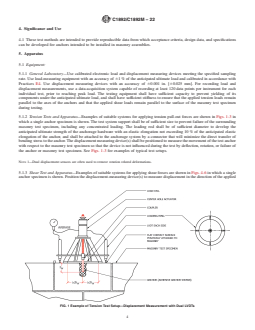
5.1.2 Tension Tests and Apparatus—Examples of suitable systems for applying tension pull-out forces are shown in Figs. 1-3 in
which a single anchor specimen is shown. The test system support shall be of sufficient size to prevent failure of the surrounding
masonry test specimen, including any concentrated loading. The loading rod shall be of sufficient diameter to develop the
anticipated ultimate strength of the anchorage hardware with an elastic elongation not exceeding 10 % of the anticipated elastic
elongation of the anchor, and shall be attached to the anchorage system by a connector that will minimize the direct transfer of
bending stress to the anchor. The displacement measuring device(s) shall be positioned to measure the movement of the test anchor
with respect to the masonry test specimen so that the device is not influenced during the test by deflection, rotation, or failure of
the anchor or masonry test specimen. See Figs. 1-3 for examples of typical test setups.
NOTE 1—Dual displacement sensors are often used to remove rotation related deformations.
5.1.3 Shear Test and Apparatus—Examples of suitable systems for applying shear forces are shown in Figs. 4-6 in which a single
anchor specimen is shown. Position the displacement-measuring device(s) to measure displacement in the direction of the applied
FIG. 1 Example of Tension Test Setup—Displacement Measurement with Dual LVDTs
C1892/C1892M − 22
FIG. 2 Typical Static Tension Test Arrangement
FIG. 3 Example of Tension Test Setup—Displacement Measurement from Top of Anchor
NOTE 1—Other support geometries are acceptable.
load only. Place the device on the masonry test specimen so that the sensing element bears perpendicularly on the anchor or on
a contact plate located on the loading plate, or use another method that restricts deflections other than those in the direction of the
applied load. For tests on anchor groups, the axis of the displacement-measuring device shall coincide with the centroid of the
group. Table 1 gives the minimum required clear distance from the anchor to the free edge of the masonry test specimen.
5.2 Loading Plates:
C1892/C1892M − 22
FIG. 4 Typical Method of Applying Shear Loads to Anchors Attached to Masonry Test Specimens—Direct Loading Method
FIG. 5 Example of a Shear Test Setup Vertical Orientation
5.2.1 For tension loading the plate thickness in the immediate vicinity of the test anchor shall be equal to or greater than the
nominal anchor diameter to be tested.
5.2.2 For shear testing the plate thickness in the immediate vicinity of the test anchor shall be equal to the nominal anchor diameter
1 1
to be tested, – ⁄16 + ⁄8 in. [–1.6 +3.0 mm]. The hole in the loading plate shall have a diameter of 0.06 6 0.03 in. [1.5 6 0.8 mm]
greater than the specified diameter of the test anchor unless another diameter is specified. The shape of the hole in the loading plate
shall correspond to that of the anchor cross section. When sleeve inserts of the required diameter are used they shall be periodically
inspected and replaced to meet these requirements and prevent eccentric loading of sleeve. See Fig. 7 for representative shear plates
with sleeves. The contact area between the loading plate through which the anchor is installed and the masonry test specimen shall
be as given in Table 2, unless otherwise specified. Chamfer or smooth the edges of the loading plate so that it does not dig into
the masonry. Place a sheet of friction limiting material between the shear plate and the surface of the masonry test specimen
member (see 5.3.2.1). The friction-limiting material shall prevent contact of the loading plate with the base material.
C1892/C1892M − 22
FIG. 6 Typical Dynamic Shear Test Arrangement—Indirect Loading Method
TABLE 1 Minimum Clearance Requirements for Test Equipment Supports
All Anchors
Spacing Between Distance from Anchor
Test Supports to Edge of Test Support
Tension Loads
4.0h 2.0h
ef ef
Shear Loads
4.0C 2.0C
a a
FIG. 7 Examples of Shear Plates with Sleeves
5.3 Anchor Displacement Measurement—For anchor tests that require displacement measurements, the displacement measure-
ments shall be made using LVDT device(s) or equivalent which provide continuous readings with an accuracy of at least 0.001
in. [0.025 mm].
5.3.1 Tension Test:
5.3.1.1 Single Anchor—The displacement measuring device(s) shall be positioned to measure the vertical movement of the anchor
C1892/C1892M − 22
TABLE 2 Shear Loading Plate Bearing Area as a Function of
Anchor Diameter
A, B
Anchor Diameter, d Shear Loading Plate Contact Area
o
2 2
in. [cm ]
in. [mm]
Minimum Maximum
< ⁄8 [<10] 8 [50] 12 [80]
3 5
⁄8 [10] # d < ⁄8 [16] 12 [80] 18 [115]
o
5 7
⁄8 [16] # d < ⁄8 [22] 18 [115] 25 [160]
o
⁄8 [22] # d < 2 [50] 25 [160] 40 [260]
o
d $ 2 [50] 40 [260] 60 [385]
o
A
Shear loading plate contact area with PTFE or other friction-limiting material.
B
Calculated uniform bearing stress on contact area due to self-weight of loading
plate and associated loading apparatus shall not exceed 5 psi [0.03 MPa].
with respect to points on the masonry test specimen in such a way that the device is not influenced during the test by deflection,
rotation, flexure, or failure of the anchor or masonry test specimen.
5.3.1.2 Group of Anchors—Displacement measurements shall be made on all anchors or group of anchors tested simultaneously
except that only one set of instruments needs to be used for a group of anchors tested as a closely spaced cluster. Displacement
measurements will include components of deformation not directly associated with displacement of the anchor relative to the
masonry test specimen. Include components of deformation such as elastic elongation of the loading rod anchor stem, deformation
of the loading plate, sleeves, shims, attachment hardware, and masonry test specimen. Deduct all of the elongations from these
sources from the total displacement measurements by using supplementary measuring devices or calibration test data for the
installed test set-up with a rigid specimen replacing the anchor to be tested. The displacement to be used for the evaluation of the
findings is the average displacement indicated by both instruments mounted symmetrically equidistant from the centroid of the
cluster as shown in Fig. 8.
5.3.2 Shear Test—The displacement measuring device(s) shall be positioned to measure displacement in the direction of the
applied load. The device shall be placed on the masonry test specimen to allow the sensing element to bear perpendicularly on the
anchor or on a contact plate located on the loading plate as shown in Figs. 4 and 5 or other methods which prevents extraneous
deflections. For tests on clusters of anchors, the instrument shall lie on a plane through the axis of the shear loading rod or plate.
An extension of the axis of the shear loading rod or plate shall pass through the centric axis of the cluster of anchors.
FIG. 8 Typical Method of Applying a Test Load to a Cluster of Anchors in the Test Area of a Masonry Test Specimens
C1892/C1892M − 22
5.3.2.1 For static shear tests, a sheet of tetrafluoroethylene (TFE), polytetrafluoroethylene (PTFE), fluorinated ethylene propylene
(FEP), or perfluoroalkoxy (PFA) of 0.020 6 0.004 in. [0.5 6 0.1 mm] thickness and corresponding to the area required according
to Table 2 shall be placed between the shear plate and the surface of the masonry test specimen.
6. Anchor and Masonry Wall Specimens
6.1 Anchorage System—The anchorage system shall be representative of the type and lot to be used in field construction and shall
include all accessory hardware normally required for its use, that is, all attachment hardware.
6.2 Anchor Installation—Install the anchors according to the manufacturer’s instructions. Report the installation details in
accordance with 14.1.7.
NOTE 2—Worn drill bits may produce hole diameters that are outside the manufacturer’s installation specifications. Refer to ANSI B212.15 for guidance
on drill bits and ranges of diameters.
6.3 Anchor Placement—Individually test all anchors as specified in the test program. Individual test anchors shall be spaced at
distances equal to or greater than those given in Table 1. Table 1 test support requirements are not prohibited from being reduced
for bonded an
...