


ASTM B737-10(2015)
(Specification)Standard Specification for Hot-Rolled and/or Cold-Finished Hafnium Rod and Wire
Standard Specification for Hot-Rolled and/or Cold-Finished Hafnium Rod and Wire
ABSTRACT
This specification covers hot-, cold-, or both hot- and cold-rolled hafnium rods and wires in either one of two grades. All grades should be in the recrystallization annealed condition unless specified otherwise. The materials should be made from ingots produced by vacuum melting in an electron beam or consumable arc furnaces, or both, of a type conventionally used for reactive metals. Samples for chemical composition tests should be taken from the top, middle, and bottom of the ingots. The requirements for mechanical properties do not apply to wires. Corrosion tests shall be done in water. All rods should be furnished in mechanically descaled and pickled, centerless ground and pickled, or centerless ground, pickled, and oxidized surface finish, while wires should be furnished in either conditioned and pickled or conditioned, pickled, and oxidized surface finish.
SIGNIFICANCE AND USE
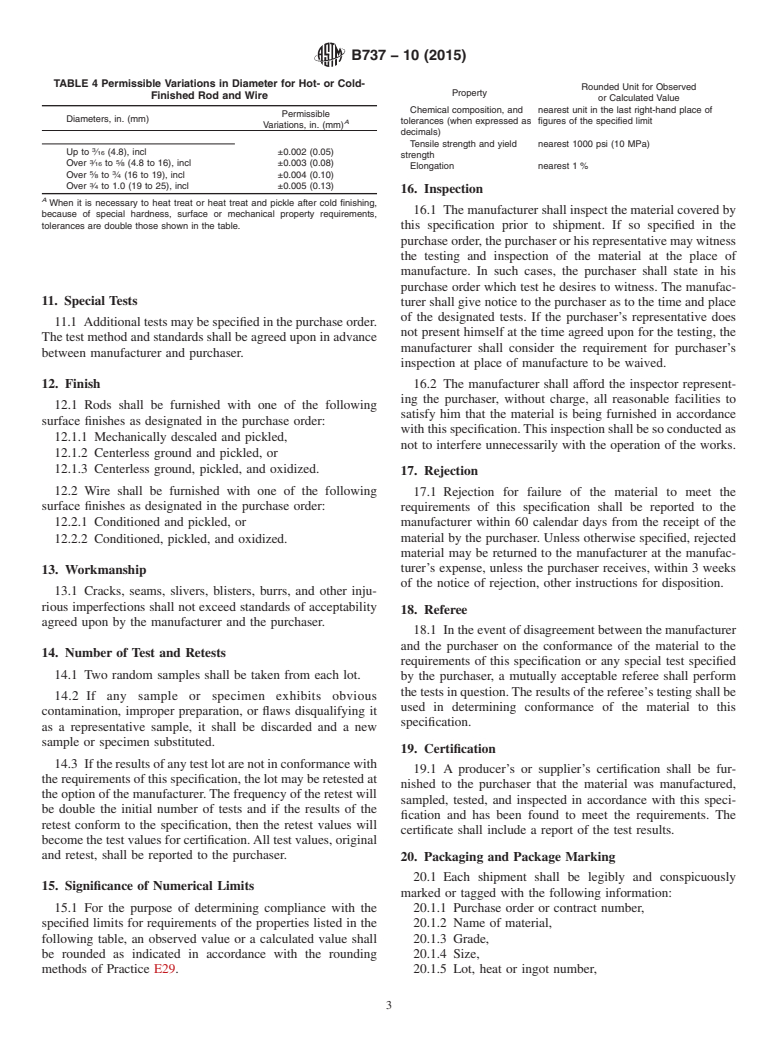
15.1 For the purpose of determining compliance with the specified limits for requirements of the properties listed in the following table, an observed value or a calculated value shall be rounded as indicated in accordance with the rounding methods of Practice E29.
Property
Rounded Unit for Observed
or Calculated Value
Chemical composition, and tolerances (when expressed as decimals)
nearest unit in the last right-hand place of figures of the specified limit
Tensile strength and yield strength
nearest 1000 psi (10 MPa)
Elongation
nearest 1 %
SCOPE
1.1 This specification covers hot- or cold-worked hafnium rod and wire.
1.2 This specification contains two material grades, one specifically for nuclear applications (Grade R1) and one for commercial alloying applications (Grade R3).
1.3 The products covered include the following:
1.3.1 Rod 3/8 to 1 in. (9.5 to 25 mm) in diameter.
1.3.2 Wire less than 3/8 in. (9.5 mm) in diameter.
1.4 Unless a single unit is used, for example, corrosion mass gain in mg/dm2, the values stated in either inch-pound or SI units are to be regarded separately as standard. The values stated in each system are not exact equivalents; therefore, each system must be used independently of the other. SI values cannot be mixed with inch-pound values.
1.5 This standard does not purport to address all of the safety concerns, if any, associated with its use. It is the responsibility of the user of this standard to establish appropriate safety and health practices and determine the applicability of regulatory limitations prior to use.
General Information
Buy Standard
Standards Content (Sample)
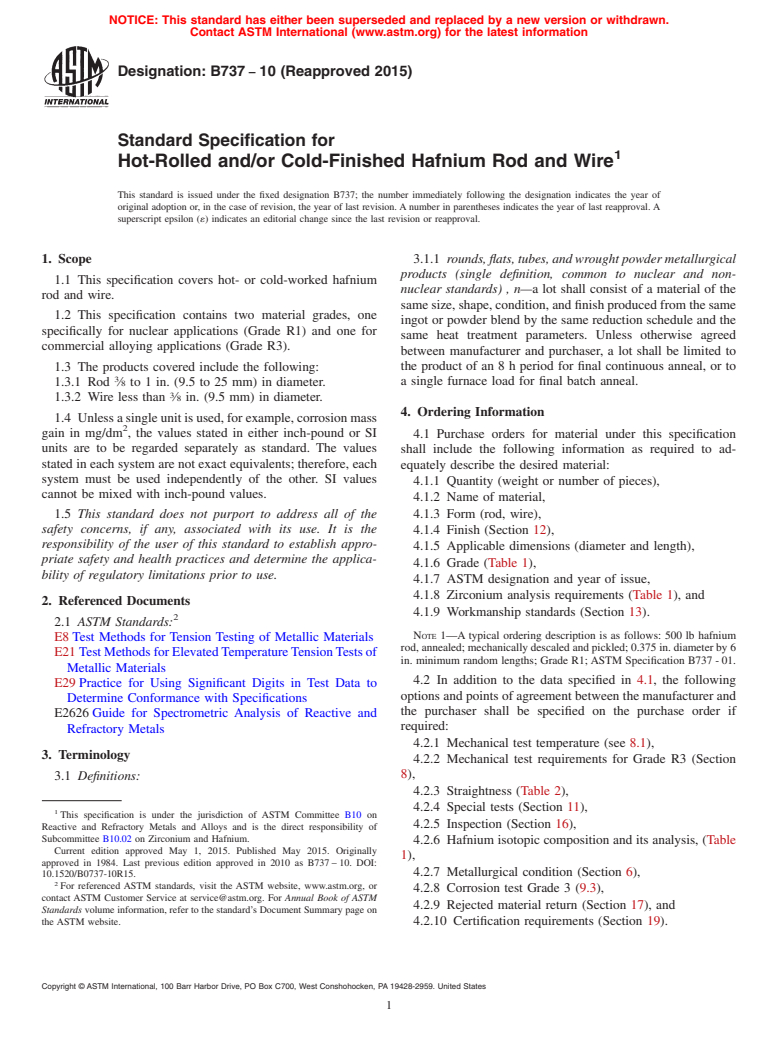
NOTICE: This standard has either been superseded and replaced by a new version or withdrawn.
Contact ASTM International (www.astm.org) for the latest information
Designation:B737 −10 (Reapproved 2015)
Standard Specification for
Hot-Rolled and/or Cold-Finished Hafnium Rod and Wire
This standard is issued under the fixed designation B737; the number immediately following the designation indicates the year of
original adoption or, in the case of revision, the year of last revision.Anumber in parentheses indicates the year of last reapproval.A
superscript epsilon (´) indicates an editorial change since the last revision or reapproval.
1. Scope 3.1.1 rounds, flats, tubes, and wrought powder metallurgical
products (single definition, common to nuclear and non-
1.1 This specification covers hot- or cold-worked hafnium
nuclear standards) , n—a lot shall consist of a material of the
rod and wire.
samesize,shape,condition,andfinishproducedfromthesame
1.2 This specification contains two material grades, one
ingot or powder blend by the same reduction schedule and the
specifically for nuclear applications (Grade R1) and one for
same heat treatment parameters. Unless otherwise agreed
commercial alloying applications (Grade R3).
between manufacturer and purchaser, a lot shall be limited to
the product of an 8 h period for final continuous anneal, or to
1.3 The products covered include the following:
1.3.1 Rod ⁄8 to 1 in. (9.5 to 25 mm) in diameter. a single furnace load for final batch anneal.
1.3.2 Wire less than ⁄8 in. (9.5 mm) in diameter.
4. Ordering Information
1.4 Unlessasingleunitisused,forexample,corrosionmass
gain in mg/dm , the values stated in either inch-pound or SI
4.1 Purchase orders for material under this specification
units are to be regarded separately as standard. The values
shall include the following information as required to ad-
stated in each system are not exact equivalents; therefore, each equately describe the desired material:
system must be used independently of the other. SI values
4.1.1 Quantity (weight or number of pieces),
cannot be mixed with inch-pound values.
4.1.2 Name of material,
1.5 This standard does not purport to address all of the 4.1.3 Form (rod, wire),
safety concerns, if any, associated with its use. It is the
4.1.4 Finish (Section 12),
responsibility of the user of this standard to establish appro-
4.1.5 Applicable dimensions (diameter and length),
priate safety and health practices and determine the applica-
4.1.6 Grade (Table 1),
bility of regulatory limitations prior to use.
4.1.7 ASTM designation and year of issue,
4.1.8 Zirconium analysis requirements (Table 1), and
2. Referenced Documents
4.1.9 Workmanship standards (Section 13).
2.1 ASTM Standards:
NOTE 1—A typical ordering description is as follows: 500 lb hafnium
E8Test Methods for Tension Testing of Metallic Materials
rod,annealed;mechanicallydescaledandpickled;0.375in.diameterby6
E21TestMethodsforElevatedTemperatureTensionTestsof
in. minimum random lengths; Grade R1;ASTM Specification B737-01.
Metallic Materials
4.2 In addition to the data specified in 4.1, the following
E29Practice for Using Significant Digits in Test Data to
optionsandpointsofagreementbetweenthemanufacturerand
Determine Conformance with Specifications
the purchaser shall be specified on the purchase order if
E2626Guide for Spectrometric Analysis of Reactive and
required:
Refractory Metals
4.2.1 Mechanical test temperature (see 8.1),
3. Terminology
4.2.2 Mechanical test requirements for Grade R3 (Section
8),
3.1 Definitions:
4.2.3 Straightness (Table 2),
4.2.4 Special tests (Section 11),
This specification is under the jurisdiction of ASTM Committee B10 on
4.2.5 Inspection (Section 16),
Reactive and Refractory Metals and Alloys and is the direct responsibility of
Subcommittee B10.02 on Zirconium and Hafnium.
4.2.6 Hafnium isotopic composition and its analysis, (Table
Current edition approved May 1, 2015. Published May 2015. Originally
1),
approved in 1984. Last previous edition approved in 2010 as B737–10. DOI:
4.2.7 Metallurgical condition (Section 6),
10.1520/B0737-10R15.
For referenced ASTM standards, visit the ASTM website, www.astm.org, or
4.2.8 Corrosion test Grade 3 (9.3),
contact ASTM Customer Service at service@astm.org. For Annual Book of ASTM
4.2.9 Rejected material return (Section 17), and
Standards volume information, refer to the standard’s Document Summary page on
the ASTM website. 4.2.10 Certification requirements (Section 19).
Copyright © ASTM International, 100 Barr Harbor Drive, PO Box C700, West Conshohocken, PA 19428-2959. United States
B737−10 (2015)
TABLE 1 Chemical Requirements — Maximum Impurity Level
7. Chemical Composition
Composition, Weight %
7.1 The material shall conform to the requirements for
Alloying
Nuclear Grade
chemical composition as prescribed in Table 1.
Grade
Element
Grade R1 Grade R3
7.2 The manufacturer’s ingot analysis shall be considered
Aluminum 0.010 0.050
the chemical analysis for material produced to this specifica-
Carbon 0.015 0.025
tion except for hydrogen and nitrogen content which shall be
Chromium 0.010 0.050
determined on the finished product.
Copper 0.010 .
Hydrogen 0.0025 0.0050
7.3 Analysis shall be made using the manufacturer’s stan-
Iron 0.050 0.0750
Molybdenum 0.0020 .
dard methods.
Nickel 0.0050 .
Niobium 0.010 .
7.4 Sampling for chemical composition shall consist of
Nitrogen 0.010 0.0150
samplestakenattop,middle,andbottomoftheingot.Samples
Oxygen 0.040 0.130
Silicon 0.010 0.050 for hydrogen and nitrogen shall be taken as two random
Tantalum 0.020 .
samples from each lot at final size.
Tin 0.0050 .
Titanium 0.010 0.050
Tungsten 0.0150 0.0150
8. Mechanical Properties
Uranium 0.0010 .
Vanadium 0.0050 .
8.1 Grade R1 in rod form shall conform to the requirements
AA
Zirconium
prescribed in Table 3 for room temperature mechanical prop-
B
Hafnium balance balance
erties. Elevated temperature properties shall be used to deter-
A
Zirconium shall be reported. Acceptable levels shall be established by mutual
mine compliance only when specified in the purchase order
agreement between purchaser and producer.
B
Hafnium isotopic composition and analytical methods, if required, shall be (see Test Methods E21).
mutually agreed upon by the purchaser and producer.
8.2 The yield strength shall be determined by the offset
(0.2%) method as prescribed in Test Methods E8.
TABLE 2 Permissible Variations in Straightness for Straight
8.3 The tensile properties shall be determined using a strain
A
Lengths Hot- or Cold-Finished Rod and Wire
rate of 0.003 to 0.007 in./in.[mm/mm]/min through the yield
Diameter, in. (mm) Permissible Variations
3 3 strength. After the yield strength has been exceeded, the
Up to ⁄8 (9.5), incl ⁄32 in. (2.4 mm) in any 5 ft (1.5 m) but may not
exceed ⁄32 in. (2.4 mm) × (number of feet in length /
cross-head speed shall be increased to approximately 0.05
5; number of meters in length / 1.52)
in./in.[mm/mm]/min to failure.
3 1
Over ⁄8 to 1.0 (9.5 to 25) ⁄16 in. (1.6 mm) in any 5 ft (1.5 m) but may not
exceed ⁄16 in. (1.6 mm) × (number of feet in length /
8.4 Requirements for mechanical properties do not apply to
5; number of meters in length / 1.52)
wire.
A
The measurement is taken on the concave side of the bar with a straight- edge.
Unless otherwise specified, hot- or cold-finished bars for machining purposes are
furnished machine straightened to the tolerances specified in the table.
9. Corrosion Properties
9.1 Two samples chosen at random from each lot shall be
corrosion tested in water at 680°F (360°C), 2690 psi (18.5
MPa) for 672+8 ⁄ −0 h using the manufacturer’s standard
5. Materials and Manufacture
procedure.
5.1 Material covered by this specification shall be made by
9.2 Grade R1—Coupons shall exhibit a weight gain of not
conventional hot and cold working procedures, from ingots
more than 10 mg/dm .
produced by vacuum melting in electron beam or consumable
9.3 Grade R3—Test for information only, if required by
...
This document is not an ASTM standard and is intended only to provide the user of an ASTM standard an indication of what changes have been made to the previous version. Because
it may not be technically possible to adequately depict all changes accurately, ASTM recommends that users consult prior editions as appropriate. In all cases only the current version
of the standard as published by ASTM is to be considered the official document.
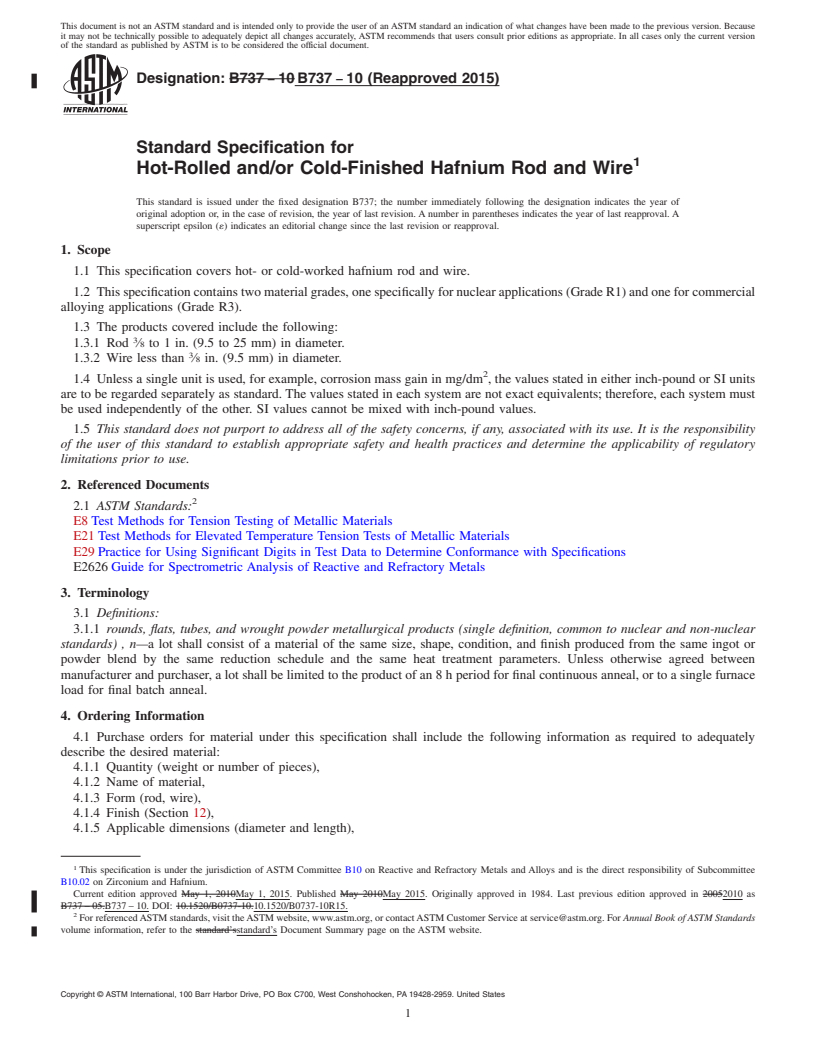
Designation: B737 − 10 B737 − 10 (Reapproved 2015)
Standard Specification for
Hot-Rolled and/or Cold-Finished Hafnium Rod and Wire
This standard is issued under the fixed designation B737; the number immediately following the designation indicates the year of
original adoption or, in the case of revision, the year of last revision. A number in parentheses indicates the year of last reapproval. A
superscript epsilon (´) indicates an editorial change since the last revision or reapproval.
1. Scope
1.1 This specification covers hot- or cold-worked hafnium rod and wire.
1.2 This specification contains two material grades, one specifically for nuclear applications (Grade R1) and one for commercial
alloying applications (Grade R3).
1.3 The products covered include the following:
1.3.1 Rod ⁄8 to 1 in. (9.5 to 25 mm) in diameter.
1.3.2 Wire less than ⁄8 in. (9.5 mm) in diameter.
1.4 Unless a single unit is used, for example, corrosion mass gain in mg/dm , the values stated in either inch-pound or SI units
are to be regarded separately as standard. The values stated in each system are not exact equivalents; therefore, each system must
be used independently of the other. SI values cannot be mixed with inch-pound values.
1.5 This standard does not purport to address all of the safety concerns, if any, associated with its use. It is the responsibility
of the user of this standard to establish appropriate safety and health practices and determine the applicability of regulatory
limitations prior to use.
2. Referenced Documents
2.1 ASTM Standards:
E8 Test Methods for Tension Testing of Metallic Materials
E21 Test Methods for Elevated Temperature Tension Tests of Metallic Materials
E29 Practice for Using Significant Digits in Test Data to Determine Conformance with Specifications
E2626 Guide for Spectrometric Analysis of Reactive and Refractory Metals
3. Terminology
3.1 Definitions:
3.1.1 rounds, flats, tubes, and wrought powder metallurgical products (single definition, common to nuclear and non-nuclear
standards) , n—a lot shall consist of a material of the same size, shape, condition, and finish produced from the same ingot or
powder blend by the same reduction schedule and the same heat treatment parameters. Unless otherwise agreed between
manufacturer and purchaser, a lot shall be limited to the product of an 8 h period for final continuous anneal, or to a single furnace
load for final batch anneal.
4. Ordering Information
4.1 Purchase orders for material under this specification shall include the following information as required to adequately
describe the desired material:
4.1.1 Quantity (weight or number of pieces),
4.1.2 Name of material,
4.1.3 Form (rod, wire),
4.1.4 Finish (Section 12),
4.1.5 Applicable dimensions (diameter and length),
This specification is under the jurisdiction of ASTM Committee B10 on Reactive and Refractory Metals and Alloys and is the direct responsibility of Subcommittee
B10.02 on Zirconium and Hafnium.
Current edition approved May 1, 2010May 1, 2015. Published May 2010May 2015. Originally approved in 1984. Last previous edition approved in 20052010 as
B737 – 05.B737 – 10. DOI: 10.1520/B0737-10.10.1520/B0737-10R15.
For referenced ASTM standards, visit the ASTM website, www.astm.org, or contact ASTM Customer Service at service@astm.org. For Annual Book of ASTM Standards
volume information, refer to the standard’sstandard’s Document Summary page on the ASTM website.
Copyright © ASTM International, 100 Barr Harbor Drive, PO Box C700, West Conshohocken, PA 19428-2959. United States
B737 − 10 (2015)
4.1.6 Grade (Table 1),
4.1.7 ASTM designation and year of issue,
4.1.8 Zirconium analysis requirements (Table 1), and
4.1.9 Workmanship standards (Section 13).
NOTE 1—A typical ordering description is as follows: 500 lb hafnium rod, annealed; mechanically descaled and pickled; 0.375 in. diameter by 6 in.
minimum random lengths; Grade R1; ASTM Specification B737 - 01.
4.2 In addition to the data specified in 4.1, the following options and points of agreement between the manufacturer and the
purchaser shall be specified on the purchase order if required:
4.2.1 Mechanical test temperature (see 8.1),
4.2.2 Mechanical test requirements for Grade R3 (Section 8),
4.2.3 Straightness (Table 2),
4.2.4 Special tests (Section 11),
4.2.5 Inspection (Section 16),
4.2.6 Hafnium isotopic composition and its analysis, (Table 1),
4.2.7 Metallurgical condition (Section 6),
4.2.8 Corrosion test Grade 3 (9.3),
4.2.9 Rejected material return (Section 17), and
4.2.10 Certification requirements (Section 19).
5. Materials and Manufacture
5.1 Material covered by this specification shall be made by conventional hot and cold working procedures, from ingots produced
by vacuum melting in electron beam or consumable arc furnaces, or both, of a type conventionally used for reactive metals.
6. Metallurgical Condition
6.1 All grades furnished under this specification shall be in the recrystallization annealed condition unless otherwise specified.
7. Chemical Composition
7.1 The material shall conform to the requirements for chemical composition as prescribed in Table 1.
7.2 The manufacturer’smanufacturer’s ingot analysis shall be considered the chemical analysis for material produced to this
specification except for hydrogen and nitrogen content which shall be determined on the finished product.
7.3 Analysis shall be made using the manufacturer’smanufacturer’s standard methods.
TABLE 1 Chemical Requirements — Maximum Impurity Level
Composition, Weight %
Alloying
Nuclear Grade
Grade
Element
Grade R1 Grade R3
Aluminum 0.010 0.050
Carbon 0.015 0.025
Chromium 0.010 0.050
Copper 0.010 .
Hydrogen 0.0025 0.0050
Iron 0.050 0.0750
Molybdenum 0.0020 .
Nickel 0.0050 .
Niobium 0.010 .
Nitrogen 0.010 0.0150
Oxygen 0.040 0.130
Silicon 0.010 0.050
Tantalum 0.020 .
Tin 0.0050 .
Titanium 0.010 0.050
Tungsten 0.0150 0.0150
Uranium 0.0010 .
Vanadium 0.0050 .
A A
Zirconium
B
Hafnium balance balance
A
Zirconium shall be reported. Acceptable levels shall be established by mutual
agreement between purchaser and producer.
B
Hafnium isotopic composition and analytical methods, if required, shall be
mutually agreed upon by the purchaser and producer.
B737 − 10 (2015)
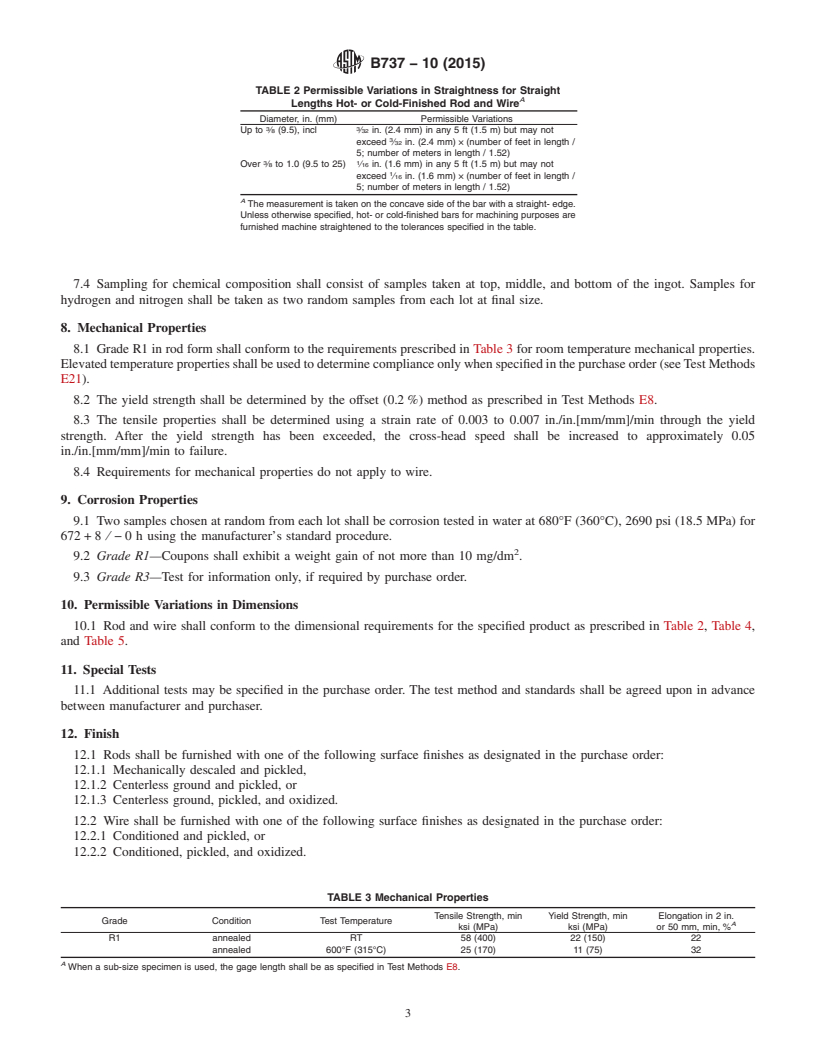
TABLE 2 Permissible Variations in Straightness for Straight
A
Lengths Hot- or Cold-Finished Rod and Wire
Diameter, in. (mm) Permissible Variations
3 3
Up to ⁄8 (9.5), incl ⁄32 in. (2.4 mm) in any 5 ft (1.5 m) but may not
exceed ⁄32 in. (2.4 mm) × (number of feet in length /
5; number of meters in length / 1.52)
3 1
Over ⁄8 to 1.0 (9.5 to 25) ⁄16 in. (1.6 mm) in any 5 ft (1.5 m) but may not
exceed ⁄16 in. (1.6 mm) × (number of feet in length /
5; number of meters in length / 1.52)
A
The measurement is taken on the concave side of the bar with a straight- edge.
Unless otherwise specified, hot- or cold-finished bars for machining purposes are
furnished machine straightened to the tolerances specified in the table.
7.4 Sampling for chemical composition shall consist of samples taken at top, middle, and bottom of the ingot. Samples for
hydrogen and nitrogen shall be taken as two random samples from each lot at final size.
8. Mechanical Properties
8.1 Grade R1 in rod form shall conform to the requirements prescribed in Table 3 for room temperature mechanical properties.
Elevated temperature properties shall be used to determine compliance only when specified in the purchase order (see Test Methods
E21).
8.2 The yield strength shall be determined by the offset (0.2 %) method as prescribed in Test Methods E8.
8.3 The tensile properties shall be determined using a strain rate of 0.003 to 0.007 in./in.[mm/mm]/min through the yield
strength. After the yield strength has been exceeded, the cross-head speed shall be increased to approximately 0.05
in./in.[mm/mm]/min to failure.
8.4 Requirements for mechani
...
Questions, Comments and Discussion
Ask us and Technical Secretary will try to provide an answer. You can facilitate discussion about the standard in here.