


ASTM D2207-00(2015)
(Test Method)Standard Test Method for Bursting Strength of Leather by the Ball Method
Standard Test Method for Bursting Strength of Leather by the Ball Method
SIGNIFICANCE AND USE
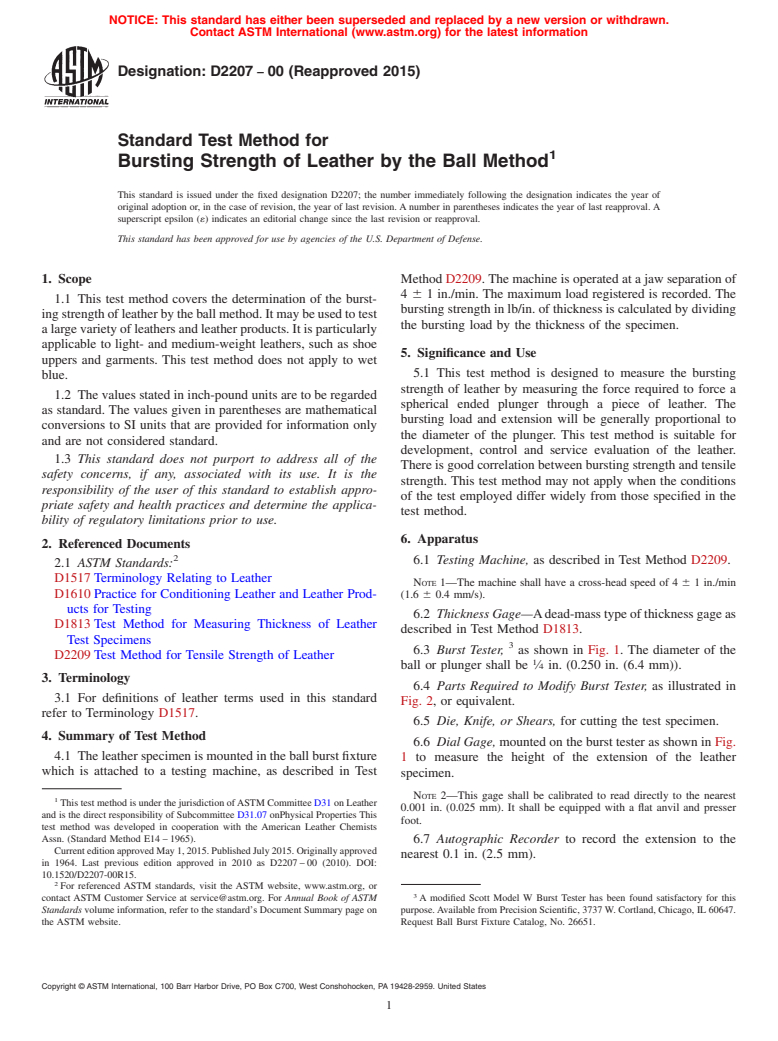
5.1 This test method is designed to measure the bursting strength of leather by measuring the force required to force a spherical ended plunger through a piece of leather. The bursting load and extension will be generally proportional to the diameter of the plunger. This test method is suitable for development, control and service evaluation of the leather. There is good correlation between bursting strength and tensile strength. This test method may not apply when the conditions of the test employed differ widely from those specified in the test method.
SCOPE
1.1 This test method covers the determination of the bursting strength of leather by the ball method. It may be used to test a large variety of leathers and leather products. It is particularly applicable to light- and medium-weight leathers, such as shoe uppers and garments. This test method does not apply to wet blue.
1.2 The values stated in inch-pound units are to be regarded as standard. The values given in parentheses are mathematical conversions to SI units that are provided for information only and are not considered standard.
1.3 This standard does not purport to address all of the safety concerns, if any, associated with its use. It is the responsibility of the user of this standard to establish appropriate safety and health practices and determine the applicability of regulatory limitations prior to use.
General Information
Buy Standard
Standards Content (Sample)
NOTICE: This standard has either been superseded and replaced by a new version or withdrawn.
Contact ASTM International (www.astm.org) for the latest information
Designation:D2207 −00 (Reapproved 2015)
Standard Test Method for
Bursting Strength of Leather by the Ball Method
This standard is issued under the fixed designation D2207; the number immediately following the designation indicates the year of
original adoption or, in the case of revision, the year of last revision. A number in parentheses indicates the year of last reapproval. A
superscript epsilon (´) indicates an editorial change since the last revision or reapproval.
This standard has been approved for use by agencies of the U.S. Department of Defense.
1. Scope Method D2209. The machine is operated at a jaw separation of
4 6 1 in./min. The maximum load registered is recorded. The
1.1 This test method covers the determination of the burst-
bursting strength in lb/in. of thickness is calculated by dividing
ingstrengthofleatherbytheballmethod.Itmaybeusedtotest
the bursting load by the thickness of the specimen.
a large variety of leathers and leather products. It is particularly
applicable to light- and medium-weight leathers, such as shoe
5. Significance and Use
uppers and garments. This test method does not apply to wet
5.1 This test method is designed to measure the bursting
blue.
strength of leather by measuring the force required to force a
1.2 The values stated in inch-pound units are to be regarded
spherical ended plunger through a piece of leather. The
as standard. The values given in parentheses are mathematical
bursting load and extension will be generally proportional to
conversions to SI units that are provided for information only
the diameter of the plunger. This test method is suitable for
and are not considered standard.
development, control and service evaluation of the leather.
1.3 This standard does not purport to address all of the
There is good correlation between bursting strength and tensile
safety concerns, if any, associated with its use. It is the
strength. This test method may not apply when the conditions
responsibility of the user of this standard to establish appro-
of the test employed differ widely from those specified in the
priate safety and health practices and determine the applica-
test method.
bility of regulatory limitations prior to use.
6. Apparatus
2. Referenced Documents
6.1 Testing Machine, as described in Test Method D2209.
2.1 ASTM Standards:
D1517 Terminology Relating to Leather
NOTE 1—The machine shall have a cross-head speed of 4 6 1 in./min
D1610 Practice for Conditioning Leather and Leather Prod-
(1.6 6 0.4 mm/s).
ucts for Testing
6.2 ThicknessGage—Adead-mass type of thickness gage as
D1813 Test Method for Measuring Thickness of Leather
described in Test Method D1813.
Test Specimens
6.3 Burst Tester, as shown in Fig. 1. The diameter of the
D2209 Test Method for Tensile Strength of Leather
ball or plunger shall be ⁄4 in. (0.250 in. (6.4 mm)).
3. Terminology
6.4 Parts Required to Modify Burst Tester, as illustrated in
3.1 For definitions of leather terms used in this standard
Fig. 2, or equivalent.
refer to Terminology D1517.
6.5 Die, Knife, or Shears, for cutting the test specimen.
4. Summary of Test Method
6.6 Dial Gage, mounted on the burst tester as shown in Fig.
4.1 The leather specimen is mounted in the ball burst fixture
1 to measure the height of the extension of the leather
which is attached to a testing machine, as described in Test
specimen.
NOTE 2—This gage shall be calibrated to read directly to the nearest
This test method is under the jurisdiction ofASTM Committee D31 on Leather
0.001 in. (0.025 mm). It shall be equipped with a flat anvil and presser
and is the direct responsibility of Subcommittee D31.07 onPhysical Properties This
foot.
test method was developed in cooperation with the American Leather Chemists
Assn. (Standard Method E14 – 1965).
6.7 Autographic Recorder to record the extension to the
CurrenteditionapprovedMay1,2015.PublishedJuly2015.Originallyapproved
nearest 0.1 in. (2.5 mm).
in 1964. Last previous edition approved in 2010 as D2207 – 00 (2010). DOI:
10.1520/D2207-00R15.
For referenced ASTM standards, visit the ASTM website, www.astm.org, or
contact ASTM Customer Service at service@astm.org. For Annual Book of ASTM A modified Scott Model W Burst Tester has been found satisfactory for this
Standards volume information, refer to the standard’s Document Summary page on purpose.Available from Precision Scientific, 3737 W. Cortland, Chicago, IL60647.
the ASTM website. Request Ball Burst Fixture Catalog, No. 26651.
Copyright © ASTM International, 100 Barr Harbor Drive, PO Box C700, West Conshohocken, PA 19428-2959. United States
D2207−00 (2015)
calculated by dividing the bursting load by the thickness of the specimen
measured in inches.
9.5 Observe on the gage the extension or stretch of the
leather at different loads up to total burst.
10. Report
10.1 Report the following information:
10.1.1 Thickness to the nearest 0.001 in. (0.025 mm),
reported for each specimen or averaged and reported as the
thickness of the sample,
10.1.2 Bursting load to the n
...
This document is not an ASTM standard and is intended only to provide the user of an ASTM standard an indication of what changes have been made to the previous version. Because
it may not be technically possible to adequately depict all changes accurately, ASTM recommends that users consult prior editions as appropriate. In all cases only the current version
of the standard as published by ASTM is to be considered the official document.
Designation: D2207 − 00 (Reapproved 2010) D2207 − 00 (Reapproved 2015)
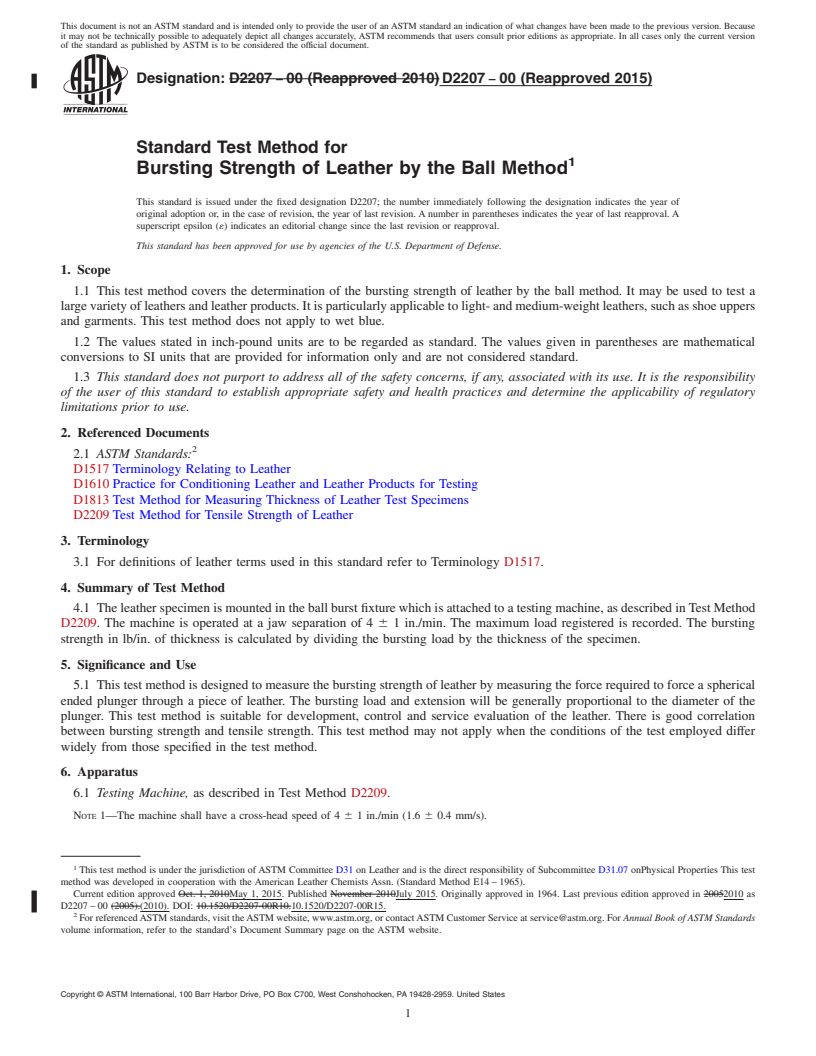
Standard Test Method for
Bursting Strength of Leather by the Ball Method
This standard is issued under the fixed designation D2207; the number immediately following the designation indicates the year of
original adoption or, in the case of revision, the year of last revision. A number in parentheses indicates the year of last reapproval. A
superscript epsilon (´) indicates an editorial change since the last revision or reapproval.
This standard has been approved for use by agencies of the U.S. Department of Defense.
1. Scope
1.1 This test method covers the determination of the bursting strength of leather by the ball method. It may be used to test a
large variety of leathers and leather products. It is particularly applicable to light- and medium-weight leathers, such as shoe uppers
and garments. This test method does not apply to wet blue.
1.2 The values stated in inch-pound units are to be regarded as standard. The values given in parentheses are mathematical
conversions to SI units that are provided for information only and are not considered standard.
1.3 This standard does not purport to address all of the safety concerns, if any, associated with its use. It is the responsibility
of the user of this standard to establish appropriate safety and health practices and determine the applicability of regulatory
limitations prior to use.
2. Referenced Documents
2.1 ASTM Standards:
D1517 Terminology Relating to Leather
D1610 Practice for Conditioning Leather and Leather Products for Testing
D1813 Test Method for Measuring Thickness of Leather Test Specimens
D2209 Test Method for Tensile Strength of Leather
3. Terminology
3.1 For definitions of leather terms used in this standard refer to Terminology D1517.
4. Summary of Test Method
4.1 The leather specimen is mounted in the ball burst fixture which is attached to a testing machine, as described in Test Method
D2209. The machine is operated at a jaw separation of 4 6 1 in./min. The maximum load registered is recorded. The bursting
strength in lb/in. of thickness is calculated by dividing the bursting load by the thickness of the specimen.
5. Significance and Use
5.1 This test method is designed to measure the bursting strength of leather by measuring the force required to force a spherical
ended plunger through a piece of leather. The bursting load and extension will be generally proportional to the diameter of the
plunger. This test method is suitable for development, control and service evaluation of the leather. There is good correlation
between bursting strength and tensile strength. This test method may not apply when the conditions of the test employed differ
widely from those specified in the test method.
6. Apparatus
6.1 Testing Machine, as described in Test Method D2209.
NOTE 1—The machine shall have a cross-head speed of 4 6 1 in./min (1.6 6 0.4 mm/s).
This test method is under the jurisdiction of ASTM Committee D31 on Leather and is the direct responsibility of Subcommittee D31.07 onPhysical Properties This test
method was developed in cooperation with the American Leather Chemists Assn. (Standard Method E14 – 1965).
Current edition approved Oct. 1, 2010May 1, 2015. Published November 2010July 2015. Originally approved in 1964. Last previous edition approved in 20052010 as
D2207 – 00 (2005).(2010). DOI: 10.1520/D2207-00R10.10.1520/D2207-00R15.
For referenced ASTM standards, visit the ASTM website, www.astm.org, or contact ASTM Customer Service at service@astm.org. For Annual Book of ASTM Standards
volume information, refer to the standard’s Document Summary page on the ASTM website.
Copyright © ASTM International, 100 Barr Harbor Drive, PO Box C700, West Conshohocken, PA 19428-2959. United States
D2207 − 00 (2015)
6.2 Thickness Gage—A dead-mass type of thickness gage as described in Test Method D1813.
6.3 Burst Tester, as shown in Fig. 1. The diameter of the ball or plunger shall be ⁄4 in. (0.250 in. (6.4 mm)).
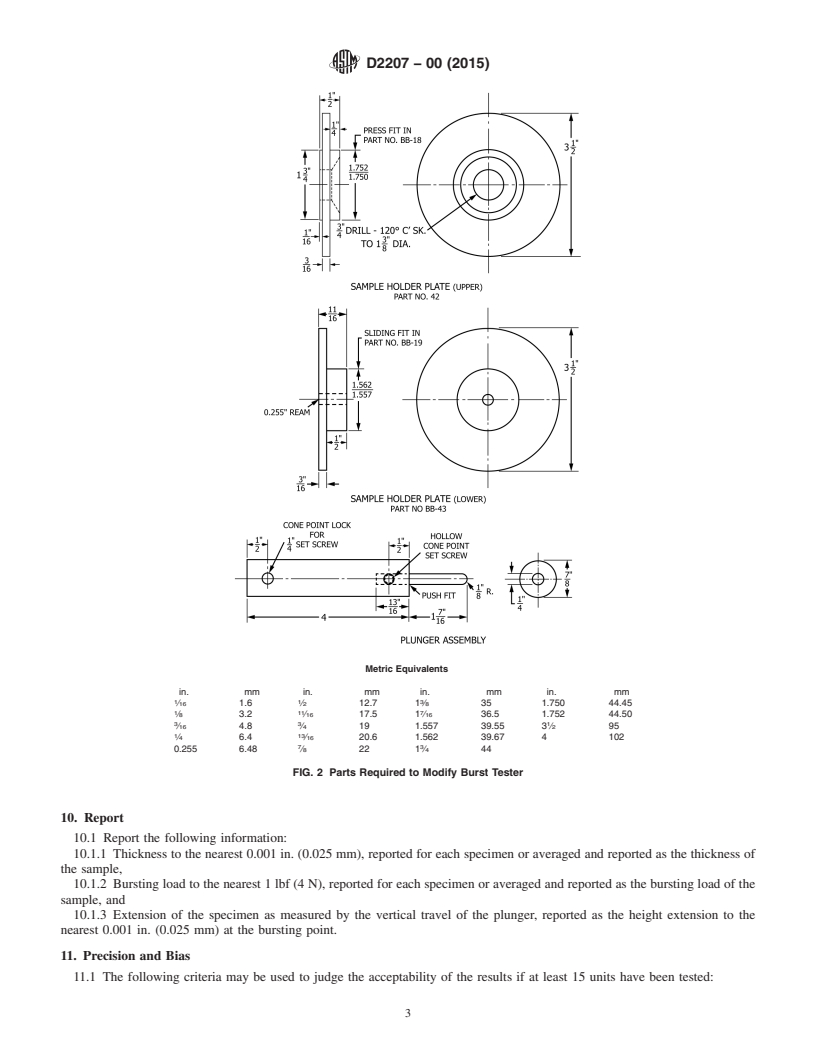
6.4 Parts Required to Modify Burst Tester, as illustrated in Fig. 2, or equivalent.
6.5 Die, Knife, or Shears, for cutting the test specimen.
6.6 Dial Gage, mounted on the burst tester as shown in Fig. 1 to measure the height of the extension of the leather specimen.
NOTE 2—This gage shall be calibrated to read directly to the nearest 0.001 in. (0.025 mm). It shall be equipped with a flat anvil and presser foot.
6.7 Autographic Recorder to record the extension to the nearest 0.1 in. (2.5 mm).
7. Test Specimen
7.1 The test specimen shall be a disk of leather at least 1.75 in. (44.5 mm) in diameter.
7.2 A strip of leather between 1.75 and 6 in. (44.5 and 152 mm) wide may be used for a test specimen. Two tests shall be run
on each strip.
NOTE 3—When tests are made on a strip of leather, the clamping areas can be overlapped so that tests can be made with a minimum distance of 1.25
in. (31.8 mm) between bursts.
8. Conditioning
8.1 All specimens shall be conditioned in accordan
...
Questions, Comments and Discussion
Ask us and Technical Secretary will try to provide an answer. You can facilitate discussion about the standard in here.