


ASTM D8368-22
(Test Method)Standard Test Method for Determination of Totals of Aromatic, Polyaromatic and Fatty Acid Methyl Esters (FAME) Content of Diesel Fuel Using Gas Chromatography with Vacuum Ultraviolet Absorption Spectroscopy Detection (GC-VUV)
Standard Test Method for Determination of Totals of Aromatic, Polyaromatic and Fatty Acid Methyl Esters (FAME) Content of Diesel Fuel Using Gas Chromatography with Vacuum Ultraviolet Absorption Spectroscopy Detection (GC-VUV)
SIGNIFICANCE AND USE
5.1 The determination of group type composition of diesel fuel is useful for evaluating quality and expected performance. Aromatics and polyaromatics, in particular, are related to combustion characteristics, cetane number, energy content, lubricity, water solubility and exhaust emissions.
5.1.1 Aromatic hydrocarbon type analysis may be useful for evaluating refinery processes.
5.1.2 The ability to determine aromatics content in the presence of FAME may be useful to users of diesel fuel.
SCOPE
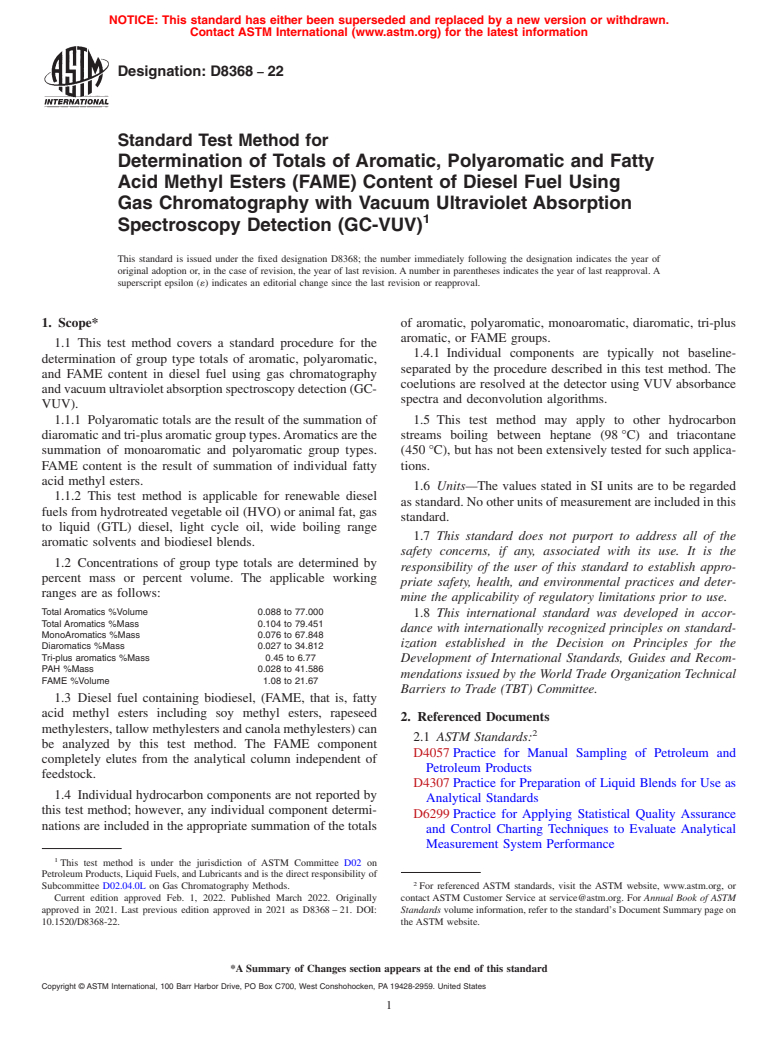
1.1 This test method covers a standard procedure for the determination of group type totals of aromatic, polyaromatic, and FAME content in diesel fuel using gas chromatography and vacuum ultraviolet absorption spectroscopy detection (GC-VUV).
1.1.1 Polyaromatic totals are the result of the summation of diaromatic and tri-plus aromatic group types. Aromatics are the summation of monoaromatic and polyaromatic group types. FAME content is the result of summation of individual fatty acid methyl esters.
1.1.2 This test method is applicable for renewable diesel fuels from hydrotreated vegetable oil (HVO) or animal fat, gas to liquid (GTL) diesel, light cycle oil, wide boiling range aromatic solvents and biodiesel blends.
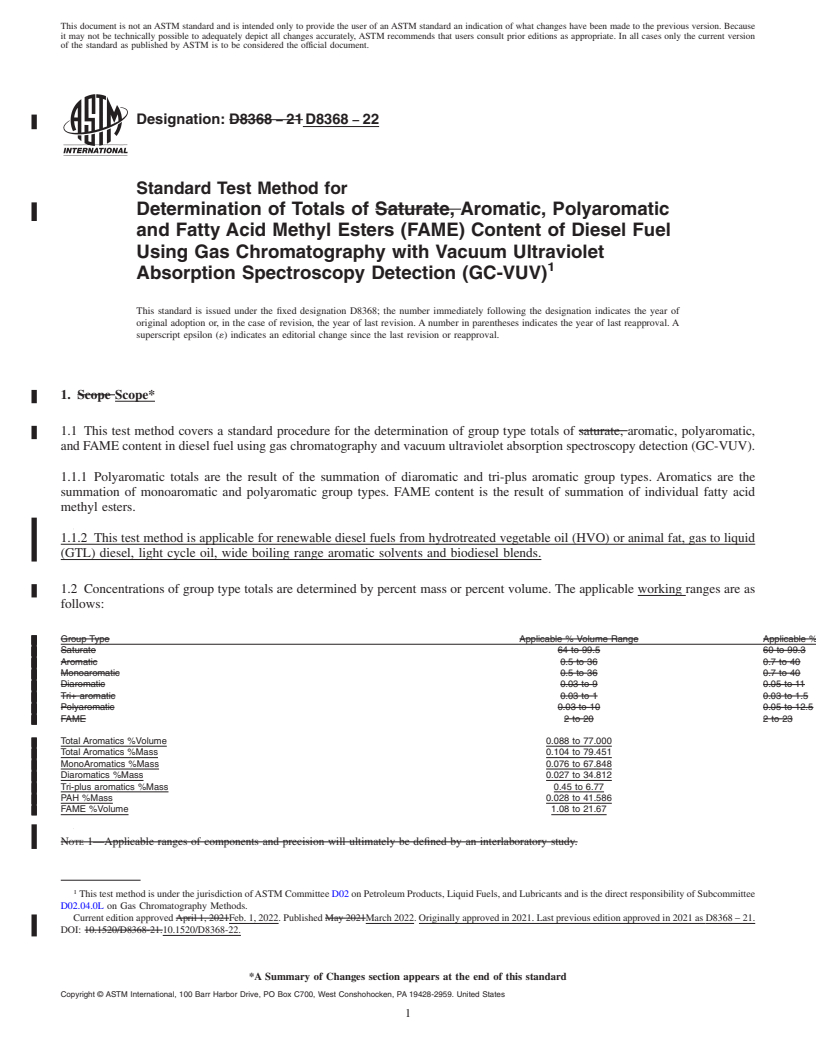
1.2 Concentrations of group type totals are determined by percent mass or percent volume. The applicable working ranges are as follows:
Total Aromatics %Volume
0.088 to 77.000
Total Aromatics %Mass
0.104 to 79.451
MonoAromatics %Mass
0.076 to 67.848
Diaromatics %Mass
0.027 to 34.812
Tri-plus aromatics %Mass
0.45 to 6.77
PAH %Mass
0.028 to 41.586
FAME %Volume
1.08 to 21.67
1.3 Diesel fuel containing biodiesel, (FAME, that is, fatty acid methyl esters including soy methyl esters, rapeseed methylesters, tallow methylesters and canola methylesters) can be analyzed by this test method. The FAME component completely elutes from the analytical column independent of feedstock.
1.4 Individual hydrocarbon components are not reported by this test method; however, any individual component determinations are included in the appropriate summation of the totals of aromatic, polyaromatic, monoaromatic, diaromatic, tri-plus aromatic, or FAME groups.
1.4.1 Individual components are typically not baseline-separated by the procedure described in this test method. The coelutions are resolved at the detector using VUV absorbance spectra and deconvolution algorithms.
1.5 This test method may apply to other hydrocarbon streams boiling between heptane (98 °C) and triacontane (450 °C), but has not been extensively tested for such applications.
1.6 Units—The values stated in SI units are to be regarded as standard. No other units of measurement are included in this standard.
1.7 This standard does not purport to address all of the safety concerns, if any, associated with its use. It is the responsibility of the user of this standard to establish appropriate safety, health, and environmental practices and determine the applicability of regulatory limitations prior to use.
1.8 This international standard was developed in accordance with internationally recognized principles on standardization established in the Decision on Principles for the Development of International Standards, Guides and Recommendations issued by the World Trade Organization Technical Barriers to Trade (TBT) Committee.
General Information
Buy Standard

Standards Content (Sample)
NOTICE: This standard has either been superseded and replaced by a new version or withdrawn.
Contact ASTM International (www.astm.org) for the latest information
Designation: D8368 − 22
Standard Test Method for
Determination of Totals of Aromatic, Polyaromatic and Fatty
Acid Methyl Esters (FAME) Content of Diesel Fuel Using
Gas Chromatography with Vacuum Ultraviolet Absorption
1
Spectroscopy Detection (GC-VUV)
This standard is issued under the fixed designation D8368; the number immediately following the designation indicates the year of
original adoption or, in the case of revision, the year of last revision. A number in parentheses indicates the year of last reapproval. A
superscript epsilon (´) indicates an editorial change since the last revision or reapproval.
1. Scope* of aromatic, polyaromatic, monoaromatic, diaromatic, tri-plus
aromatic, or FAME groups.
1.1 This test method covers a standard procedure for the
1.4.1 Individual components are typically not baseline-
determination of group type totals of aromatic, polyaromatic,
separated by the procedure described in this test method. The
and FAME content in diesel fuel using gas chromatography
coelutions are resolved at the detector using VUV absorbance
andvacuumultravioletabsorptionspectroscopydetection(GC-
spectra and deconvolution algorithms.
VUV).
1.1.1 Polyaromatic totals are the result of the summation of 1.5 This test method may apply to other hydrocarbon
diaromaticandtri-plusaromaticgrouptypes.Aromaticsarethe streams boiling between heptane (98 °C) and triacontane
summation of monoaromatic and polyaromatic group types. (450 °C), but has not been extensively tested for such applica-
FAME content is the result of summation of individual fatty tions.
acid methyl esters.
1.6 Units—The values stated in SI units are to be regarded
1.1.2 This test method is applicable for renewable diesel
as standard. No other units of measurement are included in this
fuels from hydrotreated vegetable oil (HVO) or animal fat, gas
standard.
to liquid (GTL) diesel, light cycle oil, wide boiling range
1.7 This standard does not purport to address all of the
aromatic solvents and biodiesel blends.
safety concerns, if any, associated with its use. It is the
1.2 Concentrations of group type totals are determined by
responsibility of the user of this standard to establish appro-
percent mass or percent volume. The applicable working
priate safety, health, and environmental practices and deter-
ranges are as follows:
mine the applicability of regulatory limitations prior to use.
Total Aromatics %Volume 0.088 to 77.000
1.8 This international standard was developed in accor-
Total Aromatics %Mass 0.104 to 79.451
dance with internationally recognized principles on standard-
MonoAromatics %Mass 0.076 to 67.848
ization established in the Decision on Principles for the
Diaromatics %Mass 0.027 to 34.812
Tri-plus aromatics %Mass 0.45 to 6.77
Development of International Standards, Guides and Recom-
PAH %Mass 0.028 to 41.586
mendations issued by the World Trade Organization Technical
FAME %Volume 1.08 to 21.67
Barriers to Trade (TBT) Committee.
1.3 Diesel fuel containing biodiesel, (FAME, that is, fatty
acid methyl esters including soy methyl esters, rapeseed
2. Referenced Documents
methylesters, tallow methylesters and canola methylesters) can
2
2.1 ASTM Standards:
be analyzed by this test method. The FAME component
D4057 Practice for Manual Sampling of Petroleum and
completely elutes from the analytical column independent of
Petroleum Products
feedstock.
D4307 Practice for Preparation of Liquid Blends for Use as
1.4 Individual hydrocarbon components are not reported by
Analytical Standards
this test method; however, any individual component determi-
D6299 Practice for Applying Statistical Quality Assurance
nations are included in the appropriate summation of the totals
and Control Charting Techniques to Evaluate Analytical
Measurement System Performance
1
This test method is under the jurisdiction of ASTM Committee D02 on
Petroleum Products, Liquid Fuels, and Lubricants and is the direct responsibility of
2
Subcommittee D02.04.0L on Gas Chromatography Methods. For referenced ASTM standards, visit the ASTM website, www.astm.org, or
Current edition approved Feb. 1, 2022. Published March 2022. Originally contact ASTM Customer Service at service@astm.org. For Annual Book of ASTM
approved in 2021. Last previous edition approved in 2021 as D8368 – 21. DOI: Standards volume information, refer to the standard’s Document Summary page on
10.1520/D8368-22. the ASTM website.
*A Summary of Changes section appears at the end of this standard
Copyright © ASTM International, 100 Barr Harbor Drive, PO Box C700, West Conshohocken, PA 19428-2959. United States
1
---------------------- Page: 1 ----------------------
D8368 − 22
D6300 Practice for Determination of Precision and Bias 3.3.7 RRF—relative response factor
Data for Use in Test Methods for Petroleum Products,
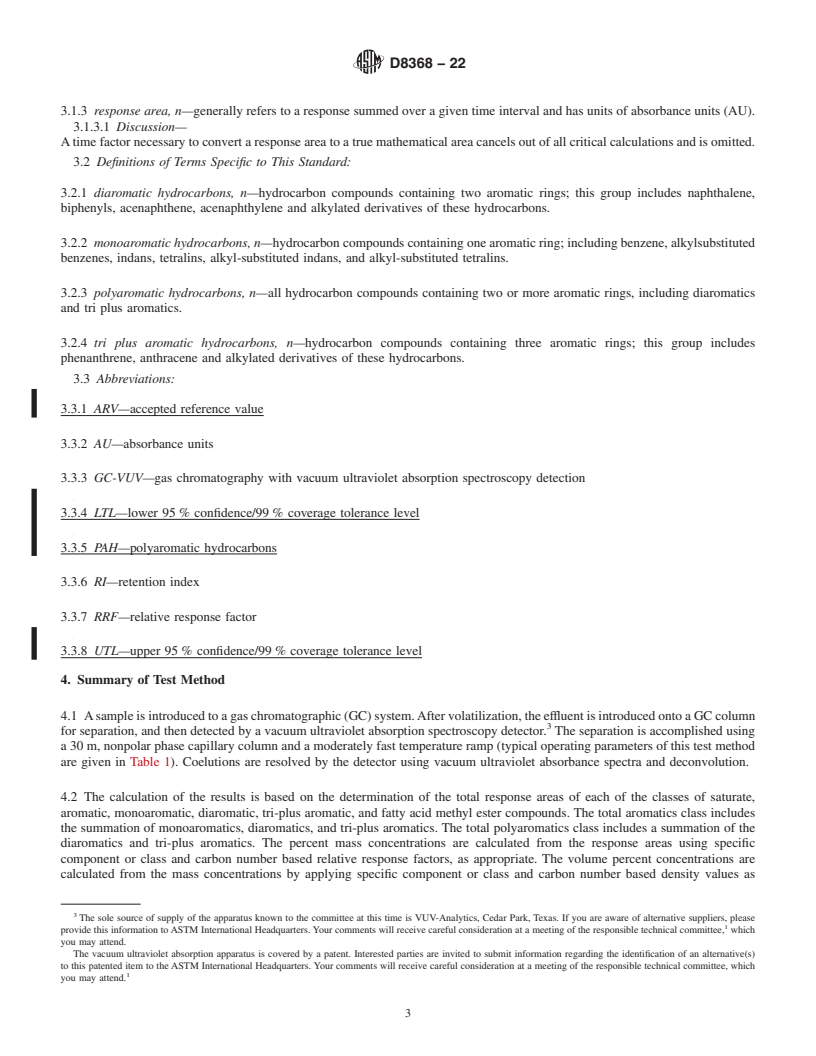
3.3.8 UTL—upper 95 % confidence
...
This document is not an ASTM standard and is intended only to provide the user of an ASTM standard an indication of what changes have been made to the previous version. Because
it may not be technically possible to adequately depict all changes accurately, ASTM recommends that users consult prior editions as appropriate. In all cases only the current version
of the standard as published by ASTM is to be considered the official document.
Designation: D8368 − 21 D8368 − 22
Standard Test Method for
Determination of Totals of Saturate, Aromatic, Polyaromatic
and Fatty Acid Methyl Esters (FAME) Content of Diesel Fuel
Using Gas Chromatography with Vacuum Ultraviolet
1
Absorption Spectroscopy Detection (GC-VUV)
This standard is issued under the fixed designation D8368; the number immediately following the designation indicates the year of
original adoption or, in the case of revision, the year of last revision. A number in parentheses indicates the year of last reapproval. A
superscript epsilon (´) indicates an editorial change since the last revision or reapproval.
1. Scope Scope*
1.1 This test method covers a standard procedure for the determination of group type totals of saturate, aromatic, polyaromatic,
and FAME content in diesel fuel using gas chromatography and vacuum ultraviolet absorption spectroscopy detection (GC-VUV).
1.1.1 Polyaromatic totals are the result of the summation of diaromatic and tri-plus aromatic group types. Aromatics are the
summation of monoaromatic and polyaromatic group types. FAME content is the result of summation of individual fatty acid
methyl esters.
1.1.2 This test method is applicable for renewable diesel fuels from hydrotreated vegetable oil (HVO) or animal fat, gas to liquid
(GTL) diesel, light cycle oil, wide boiling range aromatic solvents and biodiesel blends.
1.2 Concentrations of group type totals are determined by percent mass or percent volume. The applicable working ranges are as
follows:
Group Type Applicable % Volume Range Applicable %
Saturate 64 to 99.5 60 to 99.3
Aromatic 0.5 to 36 0.7 to 40
Monoaromatic 0.5 to 36 0.7 to 40
Diaromatic 0.03 to 9 0.05 to 11
Tri+ aromatic 0.03 to 1 0.03 to 1.5
Polyaromatic 0.03 to 10 0.05 to 12.5
FAME 2 to 20 2 to 23
Total Aromatics %Volume 0.088 to 77.000
Total Aromatics %Mass 0.104 to 79.451
MonoAromatics %Mass 0.076 to 67.848
Diaromatics %Mass 0.027 to 34.812
Tri-plus aromatics %Mass 0.45 to 6.77
PAH %Mass 0.028 to 41.586
FAME %Volume 1.08 to 21.67
NOTE 1—Applicable ranges of components and precision will ultimately be defined by an interlaboratory study.
1
This test method is under the jurisdiction of ASTM Committee D02 on Petroleum Products, Liquid Fuels, and Lubricants and is the direct responsibility of Subcommittee
D02.04.0L on Gas Chromatography Methods.
Current edition approved April 1, 2021Feb. 1, 2022. Published May 2021March 2022. Originally approved in 2021. Last previous edition approved in 2021 as D8368 – 21.
DOI: 10.1520/D8368-21.10.1520/D8368-22.
*A Summary of Changes section appears at the end of this standard
Copyright © ASTM International, 100 Barr Harbor Drive, PO Box C700, West Conshohocken, PA 19428-2959. United States
1
---------------------- Page: 1 ----------------------
D8368 − 22
1.3 Diesel fuel containing biodiesel, (FAME, that is, fatty acid methyl esters) esters including soy methyl esters, rapeseed
methylesters, tallow methylesters and canola methylesters) can be analyzed by this test method. The FAME component completely
elutes from the analytical column independent of feedstock; however, interim precision is determined only with soy methyl esters.
FAME content in diesel fuel can be determined by Test Methods feedstock.D7371 or D7861.
1.4 Individual hydrocarbon components are not reported by this test method; however, any individual component determinations
are included in the appropriate summation of the totals of saturate, aromatic, polyaromatic, monoaromatic, diaromatic, tri-plus
aromatic, or FAME groups.
1.4.1 Individual components are typically not baseline-separated by the procedure described in this test method, that is, some
components will coelute. method. The coelutions are resolved at the detector using VUV absorbance spectra and deconvolution
algorithms.
1.5 This test method has been tested for diesel fuel, including renewable diesel fuels from hydrotreated vegetable oil (HVO) and
gas to liquid (GTL) processes, and biodiesel blends; this test method may apply to other hydrocarbon streams boiling between
heptane (98 °C) and triacontane (450 °C), but has not been extensively tested for such applications.
1.6 Units—The values stated in SI units are to be regarded as standard. No other units of measurement are included in this
standard.
1.7 This standard does not purport to address all of the safety concerns, if any, associated with its use. It is the responsibility
of the user of this standard to establish appropriate safety, health, and environmental practices and determine the applica
...
Questions, Comments and Discussion
Ask us and Technical Secretary will try to provide an answer. You can facilitate discussion about the standard in here.